M&A Deals Are Exceptionally Active in the Crypto Market

marsbitPublished on 2026-06-16Last updated on 2026-06-16

Abstract

Mergers and acquisitions (M&A) activity in the cryptocurrency primary market has reached a historic high, accounting for approximately 42% of total deals in the current month, nearly matching the number of financing rounds. This shift does not signal a new boom cycle but rather reflects a severe contraction in the venture capital funding environment. As financing dwindles, established industry giants—including major exchanges, payment firms, and infrastructure providers—are seizing the opportunity to acquire strategic assets at lower valuations. Key drivers behind the surge in M&A include depressed project valuations, the need to quickly acquire talent and technology to capture short market windows, the pursuit of crucial regulatory licenses, and the strategic expansion into adjacent business verticals such as derivatives, payments, stablecoins, and real-world asset (RWA) issuance. Major acquisitions, like Coinbase's purchase of Deribit and Kraken's acquisition of NinjaTrader, exemplify the push to expand into high-margin areas like derivatives and multi-asset trading. This trend is reshaping the industry's exit landscape, offering an alternative to token-based exits and incentivizing startups to build tangible products and revenue streams with inherent strategic value for acquisition. However, it also points toward increasing centralization, as critical functions—trading, custody, payments, compliance—become concentrated within a few large, well-capitalized platforms, pote...

Author: Gu Yu, ChainCatcher

A rare signal is emerging in the crypto primary market: the proportion of M&A deals is approaching half that of financing rounds.

According to RootData statistics, this month alone, the number of M&A cases in the crypto industry has reached 10, while the number of financing rounds is only 14. Calculated as a proportion of total primary market deals, M&A now accounts for approximately 42%, the highest level in history.
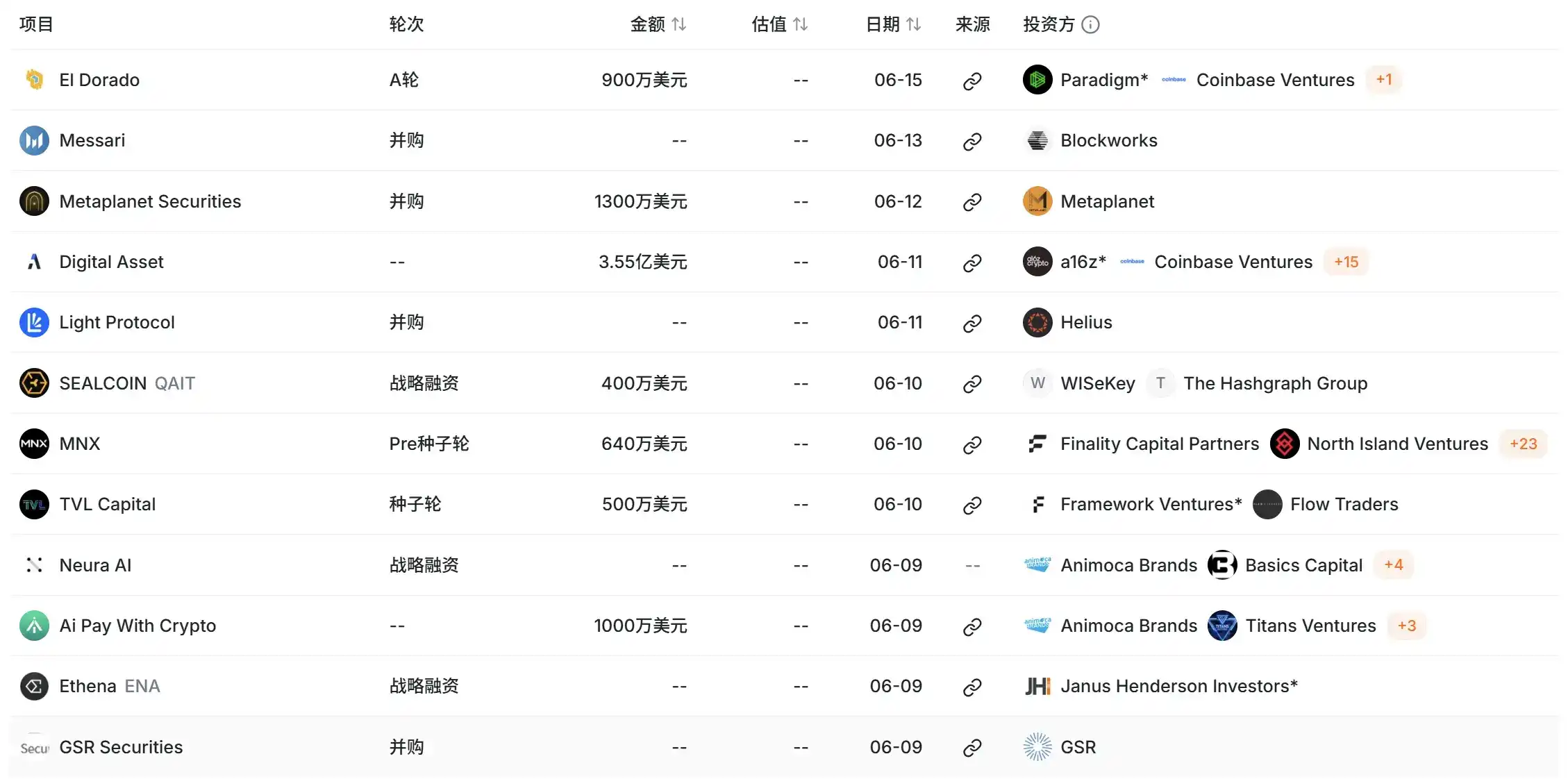
The meaning of this data is not complicated: in the past, the protagonist of the crypto primary market was fundraising; now, more and more deals are becoming acquisitions.

This does not mean the industry has suddenly entered a boom cycle. On the contrary, the rapid rise in the proportion of M&A primarily reflects the continued downturn in the financing market. Since November 2024, the monthly number of M&A transactions in the crypto industry has remained basically in the range of 10-20 deals, while the number of financing transactions has dropped significantly from around 100 to around 50, potentially setting a new low this month.

In other words, M&A transactions have not truly replaced the heat of the financing market; rather, they have become the most stable form of transaction in the primary market after the financing market contracted.

For project teams, this means the path of relying on narratives for fundraising, token expectations, and ecosystem subsidies to maintain valuations is narrowing. For leading companies, however, this means a rare window: to acquire teams, licenses, technology, liquidity, and market entry points at lower prices, with less competition, and stronger bargaining power.

After the ebb of fundraising, the crypto primary market has not stopped functioning; it's just that pricing power is shifting from VCs to buyer giants.

I. Why M&A Activity Remains High

Over the past year, frequent buyers have included Coinbase, Kraken, Ripple, MoonPay, Polymarket, Kaiko, Sol Strategies, GSR, Keyrock, Jupiter, Paxos, Ondo Finance, etc.

These companies operate in different sectors, including exchanges, payment companies, market makers, data service providers, prediction markets, RWA platforms, Solana treasury companies, as well as stablecoin and financial infrastructure firms. However, their M&A logic is highly consistent: to complement key capabilities at lower cost during the industry downturn.

First, valuations are cheap enough.

When the financing environment tightens, many projects cannot continue to raise funds at their previous round's valuation. For buyers, this means better acquisition prices, fewer competitors in bidding, and stronger bargaining power. For sellers, even if the price isn't ideal, being acquired by a leading company may offer more certainty than further dilution, layoffs, or pivots.

Take the recently acquired Messari as an example. The project's highest valuation once reached $300 million, with cumulative funding exceeding $70 million. However, as its core investment research business was severely impacted by AI and competitors, leading to repeated layoffs and business contraction, Blockworks' acquisition price was only a little over ten million dollars.

Second, saving time and trial-and-error costs.

Windows of opportunity in the crypto industry are often very short. When a regulatory gap opens, a new product model proves successful, or an asset class heats up, the market won't give companies two or three years to build a team from scratch. Acquiring a mature team is often faster than internal incubation and avoids unnecessary trial-and-error costs.

Coinbase's acquisition of Deribit for $2.9 billion is a typical case. Deribit is one of the world's major crypto options platforms, with trading volume reaching approximately $1.2 trillion in 2024. Through this transaction, Coinbase directly entered the core global crypto derivatives market, rather than building an options trading platform from scratch.

Third, acquiring licenses and compliance resources.

As regulatory frameworks in the US, EU, Hong Kong, Singapore, and other regions gradually become clearer, licenses are becoming core assets for crypto companies. Trading, custody, payment, stablecoins, brokerage, clearing, derivatives—every link requires a compliant entry point.

Kraken's acquisition of NinjaTrader follows this logic. NinjaTrader is a futures trading platform for retail users, with trading volume of $15 billion; this deal helps Kraken expand into multi-asset trading and regulated derivatives businesses.

Fourth, integrating industry chain upstream and downstream.

Crypto giants are moving from single-point products towards financial conglomerates. Exchanges are not just matching orders; they also want to offer derivatives, wallets, custody, payments, RWA, token issuance, data, and institutional services. Stablecoin companies don't just issue tokens; they want to build payment networks, AI agents, and financial infrastructure. RWA platforms don't just issue assets; they want to master compliance, distribution, liquidity, and data entry points.

The M&A path of crypto payment giant MoonPay is typical. In 2025, MoonPay acquired crypto payment startup Helio for approximately $175 million; later, it announced the acquisition of stablecoin infrastructure platform Iron to expand its enterprise payment and stablecoin capabilities.

II. Which Areas Are the Focus of M&A?

Judging from recent M&A directions, areas crypto giants are most willing to spend money on are mainly concentrated in four categories: trading infrastructure, payments & stablecoins, compliance licenses, and asset issuance & distribution.

Trading infrastructure remains the biggest battleground.

Coinbase's acquisition of Deribit and Kraken's acquisition of NinjaTrader are driven by the same judgment: spot trading growth is limited, while derivatives, options, futures, multi-asset trading, and institutional services are higher-value profit pools. Especially with the gradual rise of ETFs, RWA, tokenized stocks, and prediction markets, the boundaries of trading platforms are expanding from "crypto-to-crypto exchanges" to "global asset trading gateways."

Payments and stablecoins form the second main line.

MoonPay, Ripple, Paxos, Tether, and other companies are expanding around payment, stablecoin clearing, merchant acquiring, enterprise settlement, and cross-border transfers. Ripple's acquisition moves in recent years have been particularly aggressive, including the $250 million acquisition of custody company Metaco in 2023, followed by expansions focusing on stablecoin payments, prime brokerage, and enterprise treasury management.

This indicates that the stablecoin war is no longer just about issuance scale; it's about payment networks, compliance channels, institutional clients, and scenario access.

RWA and asset issuance are also becoming new M&A hotspots.

Companies like Ondo Finance, Jupiter, Polymarket, and Coinbase are expanding their asset issuance, liquidity distribution, and trading gateway capabilities through acquisitions or integrations. Coinbase's acquisitions of Liquifi and Echo are precisely focused on token issuance and on-chain financing capabilities. The Echo deal, valued at $375 million, helps Coinbase expand into an on-chain capital formation platform; Liquifi provides token distribution and management tools, aligning with Coinbase's bet on compliant token issuance pathways.

The strategic significance of such M&A lies in the fact that whoever controls asset issuance controls the source of trading. In the past, exchanges mainly profited from trading fees on existing assets; in the future, leading platforms prefer to profit from the entire chain encompassing asset creation, financing, listing, distribution, market making, custody, and trading. M&A is the fastest way to integrate this chain.

III. M&A Is Rewriting the Primary Market Exit Logic

The warming of M&A is not necessarily bad for entrepreneurs.

In the past, the exit path for crypto projects was overly reliant on tokens. A project's success often depended on whether it could issue a token, list it on exchanges, maintain market cap, and create liquidity. However, this mechanism created numerous problems over the past few years: founders exiting early, VC unlocking sell pressure, retail investors left holding the bag, high valuations with low circulation, and real business being held hostage by token prices.

M&A offers an alternative path. Even if a team cannot independently grow into a giant, as long as it can develop genuine capabilities in a certain area—such as licenses, technology, liquidity, compliance, users, data, risk control, market making, payment networks—it has the potential to be acquired by a larger platform.

This will change entrepreneurs' behavior. In the past, many projects issued tokens for the sake of issuing tokens and packaged narratives for fundraising; in the future, more teams might refocus on product, revenue, customers, and strategic value that can be integrated.

This is also why the M&A boom can, to some extent, give the primary market a shot in the arm. It shows that there are still asset buyers in the crypto industry, there is still value revaluation, and exit possibilities still exist.

It's just that the market is screening value in a more demanding way. What can be bought is no longer grand narratives on PowerPoint slides, but real capabilities that can be directly integrated into business blueprints.

IV. The Crypto Industry Is Becoming More Centralized

Behind the M&A boom lies the downturn in the financing market, declining project valuations, and increasing exit pressure on startup teams. But it also indicates that the crypto industry has not lost its capital vitality; it is simply completing resource reorganization in a different way.

Another issue that must be recognized is: the crypto industry is becoming more centralized.

As asset issuance, trading, market making, custody, payments, and data gradually concentrate in the hands of a few companies, the openness and anti-monopoly emphasis of the crypto industry's early days may be reshaped by realistic business logic.

Especially as compliance becomes a core barrier, the difficulty for new entrepreneurs to enter the market will increase further. The future crypto industry may develop a landscape similar to traditional finance: a few large platforms hold licenses, customers, and liquidity, while small and medium-sized teams can only become technology suppliers, ecosystem plugins, or potential acquisition targets.

Therefore, another implication of the rising proportion of M&A is: the crypto industry is bidding farewell to the era of low-barrier entrepreneurship.

Future entrepreneurs will not only face market competition but also the ecosystem boundaries and regulatory barriers of giants.


Related Questions

QWhat is the current proportion of M&A deals in the crypto primary market, and what is this trend a reflection of?

AAccording to the article, M&A deals now account for approximately 42% of all primary market transactions, a historically high level. This trend primarily reflects the continued downturn in the fundraising market, not a sudden industry boom. The number of M&A deals has remained relatively stable while fundraising deals have significantly declined, making M&A the most stable form of transaction in this market environment.

QWhat are the four main reasons driving the surge in M&A activity according to the article?

AThe four main reasons are: 1) Valuations have become sufficiently cheap for buyers. 2) Acquisition saves time and trial-and-error costs compared to building capabilities from scratch. 3) Acquiring licenses and compliance resources is crucial in a tightening regulatory landscape. 4) To integrate and control the industry's upstream and downstream value chain.

QWhich key areas are currently the focus of acquisitions by crypto giants?

AThe key acquisition areas are: 1) Trading infrastructure (especially derivatives and multi-asset trading). 2) Payments and stablecoins (focusing on payment networks and compliance). 3) Compliance and licenses. 4) Asset issuance and distribution (RWA, token issuance platforms).

QHow does the article suggest the rise in M&A is changing the exit logic for crypto startups?

AThe article suggests M&A provides an alternative exit path to the traditional reliance on token listings and price performance. It incentivizes startups to build genuine strategic value—like real products, revenue, compliance assets, or specific technological capabilities—that can be integrated into a larger platform's business, potentially leading to a more tangible acquisition exit.

QWhat potential long-term consequence of increasing M&A activity does the article highlight regarding industry structure?

AThe article highlights that the increase in M&A activity is leading to greater centralization within the crypto industry. Resources like asset issuance, trading, custody, payments, and data are becoming concentrated in the hands of a few large platforms. This, combined with rising compliance barriers, is making the industry less accessible for new entrepreneurs, potentially leading to a structure resembling traditional finance with dominant incumbents.

Related Reads

Dalio's Latest Warning: Don't Get Carried Away by AI, Real Returns on US Stocks in the Next 5-10 Years Could Be -5% to -10%

Ray Dalio, founder of Bridgewater Associates, warns investors against excessive concentration in AI stocks. He argues the current market, dominated by a few AI giants, mirrors historical patterns where revolutionary new technologies lead to high risk, volatility, and uncertainty. While acknowledging AI's transformative potential, Dalio emphasizes that most investors fail at this stage of the cycle by over-concentrating in a handful of leading companies. He cites inherent risks: companies cannot accurately forecast investment needs or external shocks (e.g., monetary policy, geopolitics, taxes), face potential disruption from future technologies and international competition (notably from China), and experience significant price swings. Dalio's core advice is diversification, calling it his "Holy Grail of Investing." He presents a mathematical case that a well-diversified portfolio of 15-20 uncorrelated, good bets offers a superior risk-adjusted return compared to a concentrated position. Dalio also offers a cautious outlook, suggesting U.S. stocks may deliver real returns of -5% to -10% over the next 5-10 years based on valuation and bubble indicators. He concludes that in the face of high uncertainty, the prudent strategy is not to avoid betting entirely, but to avoid large, concentrated bets where one lacks sufficient informational edge. Instead, investors should build a strategically balanced, diversified portfolio.

marsbit21m ago

Dalio's Latest Warning: Don't Get Carried Away by AI, Real Returns on US Stocks in the Next 5-10 Years Could Be -5% to -10%

marsbit21m ago

Rain Valuation Approaches $20 Billion: The Battle for U-Cards Extends to Rewards Systems

Rain, a stablecoin payments infrastructure company, is shifting the competitive focus for U Cards from simple issuance to user retention and repeated usage. On June 15, Rain launched "Rain Rewards," an embedded loyalty program capability within its card-issuing infrastructure. This allows partner businesses—like fintech platforms and neobanks—to configure branded loyalty points, earning rules, redemptions, and merchant promotions directly within their card products. The system, built from the 2025 acquisition of Uptop, ensures points are only issued upon final transaction settlement, preventing liabilities from refunds. Trials, such as with Avalanche Card, reportedly boosted spending by 25% among enrolled users. Founded by Farooq Malik and Charles Yoo-Naut, Rain evolved from a tool for managing Web3 company expenses into a full-stack enterprise platform. It is a Principal Member of Visa and Mastercard, enabling partners to issue stablecoin-backed cards and wallets while leveraging traditional payment networks. Notably, the popular U Card Plasma One is issued by Rain under Visa's authority. Rain also integrates with Visa's stablecoin settlement pilot, using USDC for network settlement. Rain's rapid funding reflects growing institutional interest in stablecoin payment infrastructure. It raised a $245 million Series A in March 2025, a $58 million Series B in August 2025, and a $250 million Series C in January of this year, reaching a $19.5 billion valuation. Annualized transaction volume exceeds $3 billion, serving over 200 partners including Western Union and Nuvei. Beyond cards, Rain is expanding into programmable payments. Its June 2026 "Agent Control Layer" allows businesses to set spending rules—like merchant categories, amounts, and frequency—for AI agents before transactions occur. This positions Rain not as a single product but as an operating system for stablecoin payments, handling everything from card issuance and wallet management to rewards, on/off-ramps, and automated compliance. The goal is to enable seamless, often invisible, real-world spending of on-chain assets.

Foresight News24m ago

Rain Valuation Approaches $20 Billion: The Battle for U-Cards Extends to Rewards Systems

Foresight News24m ago

Google TPU Shipments Revised Up by 50%

Recent industry research indicates a significant upward revision in the shipments of Google's TPU (Tensor Processing Unit) chips. Previous expectations for 2027 were set at around 10 million units, but new estimates now point to 15 million units, a 50% increase. This substantial boost directly translates to higher demand across the entire supporting supply chain. Google's TPU clusters utilize a standardized all-optical interconnect architecture. Consequently, key hardware components are deeply integrated and scaled in fixed ratios with the chips. The 15 million TPU target will drive corresponding demand increases for NPO optical engines (roughly a 1:1 match), 1.6T optical modules, OCS optical switches, high-end server power supplies, fiber optics & MPO connectors, and liquid cooling solutions. Among these, liquid cooling is highlighted as the sector experiencing the most significant transformation and offering the most stable potential for excess returns. As next-generation TPU chips reach power levels where traditional air cooling is insufficient, liquid cooling becomes essential. 2026 is forecasted as the first year of substantial adoption for Google's liquid cooling solutions. This shift, coupled with delivery and capacity bottlenecks faced by incumbent overseas manufacturers, is creating a prime window for domestic Chinese suppliers to enter and secure Google's core supply chain. The market size for Google-specific liquid cooling is projected to potentially triple from a baseline of hundreds of billions to around 300 billion units by 2028. The logic for the fiber optic sector is also being rewritten. Once considered a cyclical commodity tied to telecom operator procurement, fiber is now a strategic and scarce resource for AI Data Centers (AIDC). A severe supply-demand imbalance, driven by the long lead time for preform production (18-24 months) and surging demand from cloud giants, is supporting strong performance. Chinese fiber manufacturers are well-positioned to capture a significant share of global AIDC demand, with exports potentially reaching 200-300 million core kilometers in 2026. Overall, the investment focus within the AI computing industry is shifting from pure "chip performance speculation" towards the more certain incremental growth in computing infrastructure and its supporting ecosystem. The upward revision in Google TPU shipments, along with the potential for further doubling by 2028, is seen as solidifying performance visibility for the entire supporting supply chain over the next two years.

marsbit2h ago

Google TPU Shipments Revised Up by 50%

marsbit2h ago

What Wall Street Really Wants After the Crypto Story Recedes

The tide of speculative crypto narratives has receded, revealing Wall Street's true objective: building a controlled, yield-generating, and compliant financial pipeline on distributed ledgers. They are migrating core functions onto blockchains, not for decentralization, but for efficiency and new revenue streams. Key developments include BlackRock's BUIDL fund, a tokenized treasury fund acting as a foundational reserve asset, and the rise of Securitize, which is going public and partnering with the NYSE to build a 24/7 digital securities trading and settlement system. This signals a major shift of securities clearing to blockchain technology. To make volatile assets like Bitcoin palatable for institutional investors, firms like BlackRock and Goldman Sachs are creating "covered call" ETFs (e.g., BITA). These products systematically sell options on Bitcoin holdings, transforming price volatility into stable monthly income, effectively repackaging crypto as a yield-bearing asset. Stablecoins are being positioned not as speculative tools but as efficient payment rails. Companies like Stripe and Mastercard are integrating them for instant, low-cost merchant settlements and cross-border card payments, respectively. Critically, new legislation like the GENIUS Act shapes them as non-interest-bearing, heavily regulated extensions of the US dollar system. In summary, Wall Street is quietly constructing a parallel, blockchain-based financial infrastructure featuring tokenized traditional assets, structured crypto yields, and programmable dollar pipelines—all under its control and fully integrated with existing regulatory and credit frameworks.

marsbit2h ago

What Wall Street Really Wants After the Crypto Story Recedes

marsbit2h ago

Trading

Spot
Futures

Hot Articles

What is DOGE M

Doge Matrix ($doge m): The New Breed of Community-Driven Cryptocurrency Introduction In the ever-evolving landscape of cryptocurrency, new projects constantly emerge, each aiming to capture the interest of investors and enthusiasts alike. One of the latest entrants to this domain is Doge Matrix, represented by the ticker symbol $doge m. This project has attracted attention thanks to its roots in the popular meme culture surrounding Dogecoin, establishing its place within the web3 space. This article aims to provide a comprehensive analysis of Doge Matrix, covering its overview, creator, investors, functionality, timeline, and notable aspects. What is Doge Matrix ($doge m)? Doge Matrix is a community-driven cryptocurrency project that seemingly builds upon the widespread appeal of Dogecoin, a digital currency known for its Shiba Inu mascot and its meme origins. While the overarching objectives of Doge Matrix are not extensively defined, it is characterised by a commitment to harnessing community involvement and support. Unlike traditional cryptocurrencies that often emphasise utility or intrinsic value through underlying technologies, Doge Matrix positions itself within a space that embraces the cultural phenomenon of cryptocurrencies, particularly appealing to those who resonate with the ethos of meme-based assets. Drawing on the strengths of the Dogecoin community, Doge Matrix operates as part of a broader ecosystem, inviting participation and engagement from users who share an interest in cryptocurrency and the digital landscape. Who is the Creator of Doge Matrix ($doge m)? The identity of the creator of Doge Matrix remains unknown. This lack of transparency is not an uncommon occurrence in the cryptocurrency space, where some projects are launched without revealing the identities of their founders. The absence of information regarding the founding team can raise questions among potential investors about the project’s accountability and direction. Who are the Investors of Doge Matrix ($doge m)? As it stands, there is no publicly available information detailing the investors or investment foundations that back Doge Matrix. The project appears to rely primarily on community support rather than institutional investment. This model aligns with the community-driven nature of the initiative, fostering an environment where the direction of the project is shaped by its participants rather than being dictated by a select few financial backers. How Does Doge Matrix ($doge m) Work? The specifics regarding the operational mechanisms of Doge Matrix are somewhat vague, reflecting a broader trend of projects in the meme coin space where innovative functionalities are not always clearly articulated. Nonetheless, Doge Matrix seems designed to tap into the existing cryptocurrency ecosystem by encouraging user participation while tapping into the familiar cultural references associated with Dogecoin. Its potentially unique characteristics derive from community interactions rather than technological advancements, emphasising shared experiences and collaboration among token holders. While the exact innovations have not been explicitly outlined, the project appears to create a space where community members can engage, share ideas, and propel the project's potential forward. Timeline of Doge Matrix ($doge m) Reflecting on the project’s timeline reveals notable events that have defined its journey thus far: November 25, 2024: Doge Matrix reached its all-time high value, marking a significant milestone in its early history. January 1, 2025: Conversely, Doge Matrix hit its all-time low value, illustrating the volatility often associated with cryptocurrencies, especially in the early stages of a project's lifecycle. Ongoing: The project continues to be actively traded and supported by its community, although specific future milestones or objectives have yet to be disclosed. Key Points About Doge Matrix ($doge m) Community Focus At the heart of Doge Matrix is a commitment to community engagement. The project thrives on the premise of collaboration and shared objectives among its members, emphasising the importance of collective effort. Unlike centralised projects that often have a defined leadership structure, Doge Matrix at present showcases a more fluid approach to governance, where every community member's voice matters. Volatility The cryptocurrency market is notorious for its volatility, and Doge Matrix is no exception. Its price history reflects significant fluctuations between high and low values, which is typical of many new cryptocurrencies but underscores the risks associated with investment in emerging tokens. Lack of Detailed Information One of the most striking features about Doge Matrix is the scarcity of detailed information regarding its technological underpinnings and operational mechanisms. This ambiguity necessitates that potential investors conduct thorough due diligence before engaging with the project. Conclusion In summary, Doge Matrix ($doge m) illustrates a new wave of cryptocurrency projects that lean heavily on community engagement and cultural relevance. While lacking in certain specifics—such as clear leadership, defined objectives, and detailed functionality—the project has managed to generate interest within the crypto community, leveraging the established appeal of meme culture. As with any investment in the cryptocurrency space, understanding the inherent risks and conducting comprehensive research is essential for potential participants. Doge Matrix stands as a reminder of the dynamic, sometimes unpredictable nature of the crypto industry, marked by constant evolution and enthusiasm for community-driven initiatives.

521 Total ViewsPublished 2025.02.03Updated 2025.02.03

What is DOGE M

What is $M

Understanding Mantis ($M): A New Era in Cross-Chain Interoperability In the continually evolving landscape of Web3 and cryptocurrency, new projects strive to offer innovative solutions aimed at enhancing the user experience and expanding functional possibilities within the decentralised financial ecosystem. One such project garnering attention is Mantis ($M), a pioneering protocol founded on the principles of cross-chain interoperability and intent-based settlements. This article delves into the essential aspects of Mantis, including its core functionality, creators, investment backing, innovative features, and critical milestones. What is Mantis ($M)? Mantis is described as a multi-domain intent settlement protocol that simplifies cross-chain interactions, enabling users to execute complex financial transactions across various blockchain platforms seamlessly. The protocol operates through three primary layers: Intent Expression: Users can articulate their transaction goals using natural language facilitated by the DISE LLM, an advanced AI language model. For instance, a user might express a desire to swap Ethereum (ETH) for Solana (SOL) with a specific slippage tolerance of 1%. Execution: This layer employs a network of solvers that compete to fulfil user intents. Transactions are executed using mechanisms such as Coincidence of Wants (CoWs) and Order Flow Auctions (OFAs), which ensure that user demands are met optimally. Settlement: Leveraging the Inter-Blockchain Communication (IBC) protocol, Mantis enables atomic cross-chain transactions, allowing users to operate across various supported chains, including Ethereum, Solana, and Cosmos. Mantis is engineered to introduce native yield generation for idle assets, employing cryptographic proofs to maintain the integrity of transactions throughout the entire process. Creators & Development Team Mantis was conceived by the Composable Foundation, a research-driven organisation notable for its emphasis on blockchain interoperability solutions. This foundation collaborates with esteemed academic institutions, including Harvard University and the University of Lisbon, contributing to extensive research and development efforts that inform Mantis's architecture and functionality. The Composable Foundation’s commitment to fostering innovation in the blockchain space positions Mantis as a robust solution for the growing demand for interoperability among multiple blockchain networks. Investors & Backing While specific details about individual investors have not been publicly disclosed, Mantis enjoys substantial backing from various entities, including: Ecosystem grants from IBC-enabled chains, which support the protocol's growth and integration within decentralised finance ecosystems. Strategic partnerships with infrastructure providers that enhance Mantis's network capabilities and deployment strategies. Funding through the Composable Foundation's treasury, ensuring sustained financial support for ongoing development and operational costs. These collaborative efforts reflect a consensus among stakeholders about the importance of enhancing cross-chain functionality and the potential utility of Mantis's infrastructural innovations. Key Innovations Mantis sets itself apart through several pioneering innovations that enhance its functionality and utility: Chain-Agnostic Intents: Users can initiate transactions from any supported chain while settling on another. This flexibility empowers users, driving increased interaction among different platforms. AI-Powered Interface: The integration of DISE LLM allows users to conduct complex DeFi operations using natural language, thereby simplifying interactions and making blockchain technology accessible to a broader audience. Cross-Domain MEV Capture: Mantis creates an internal market for maximal extractable value (MEV) through competitions among solvers. This innovative approach allows for greater efficiency and value extraction in complex transactions. Modular Settlement Layer: The protocol supports various verification methods, including zero-knowledge proofs and optimistic rollups, providing a versatile framework that can adapt to emerging blockchain technologies. Historical Timeline Mantis's development is marked by several critical milestones that chart its trajectory and growth: | Year | Milestone | |————|————————————————————————-| | 2022 | Initial concept development within the Composable Foundation's research division. | | Q3 2024 | Launch of the testnet with bridging capabilities between Solana and Ethereum. | | Q1 2025 | Anticipated Token Generation Event (TGE) alongside the mainnet launch. | | Q2 2025 | Expected integration of DISE LLM and expansion of cross-chain capabilities. | | 2025 H2 | Planned support for over 15 chains through further IBC upgrades. | This timeline outlines Mantis's evolution, from conceptual discussions to active implementation and future growth phases. Ecosystem Growth Strategy Mantis's strategy for ecosystem growth includes several initiatives designed to encourage user participation and developer engagement: Credits System: Users can earn protocol credits by providing liquidity and engaging in referral programmes. These credits are redeemable for incentives in the future, fostering a robust user community. Modular Software Development Kit (SDK): This toolkit empowers developers to create applications based on intent-driven models utilising Mantis's infrastructure, thus promoting innovation within its ecosystem. Governance Model: As the protocol matures, $M token holders will have a voice in protocol governance, allowing them to vote on proposed upgrades and changes, thereby enhancing community engagement and decentralisation. Mantis represents a significant advancement in the realm of cross-chain architecture. By seamlessly integrating advanced AI algorithms with a robust settlement framework, Mantis seeks to tackle the problems of fragmentation within multi-chain ecosystems. Its innovative approach prioritises improved user experiences while adhering to the foundational principles of decentralisation and security, setting a new standard for the future interoperability of blockchain technologies. As Mantis continues its journey of growth and implementation, it promises to be a project to watch closely in the competitive landscape of Web3 and decentralised finance. With its focus on crossing boundaries and elevating user engagement, Mantis is poised to be an integral part of the future developments in the cryptocurrency space.

46 Total ViewsPublished 2025.03.18Updated 2025.03.18

What is $M

Discussions

Welcome to the HTX Community. Here, you can stay informed about the latest platform developments and gain access to professional market insights. Users' opinions on the price of M (M) are presented below.

活动图片