Single-Day Plunge of 30%, Arthur Hayes Suddenly Liquidates: Why Did ZEC Get Exploded by Security Issues?

foresightnews_apiPublished on 2026-06-05Last updated on 2026-06-05

Abstract

On June 5th, Zcash founder Zooko Wilcox disclosed a critical soundness vulnerability in the project's latest Orchard privacy pool. This flaw, found in the elliptic curve multiplication constraints, could allow an attacker to create unlimited counterfeit ZEC within the shielded pool, with transactions appearing valid. The vulnerability was discovered in late May by security researcher Taylor Hornby, who utilized Anthropic's new Opus 4.8 AI model for a targeted audit. The Zcash ecosystem had already performed an emergency network upgrade to patch the issue. However, the detailed disclosure triggered severe market panic, causing ZEC's price to plummet over 30% in a single day. Notably, prominent investor Arthur Hayes announced he had sold his entire ZEC position following the news. The incident starkly challenges the "technological trust" narrative central to privacy coins. Despite years of top-tier cryptographic audits, the bug persisted until uncovered with advanced AI-assisted research. This highlights the growing gap between theoretical perfection and practical implementation in privacy technology. The event serves as a industry-wide warning: in an AI-driven security landscape, the assumption that "undiscovered equals safe" is obsolete. It underscores the urgent need for continuous, proactive security practices combining AI audits, formal verification, and rapid response mechanisms.


Author: Ma He, Foresight News


On June 5th, Zcash founder Zooko Wilcox, along with Jason McGee and Taylor Hornby, published a detailed article disclosing a critical soundness vulnerability in the project's latest privacy layer, the Orchard pool, which could be exploited to create an unlimited amount of counterfeit ZEC in a covert environment.
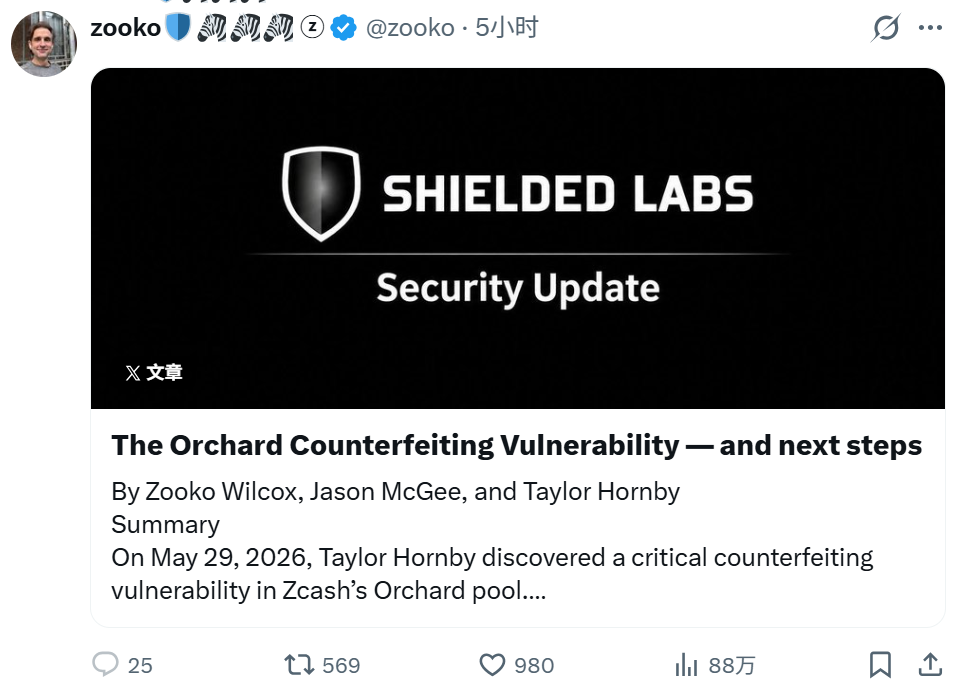


Although the Zcash ecosystem had already urgently completed a network upgrade to fix the issue, after the detailed impact was disclosed, ZEC's price experienced severe volatility, with a single-day drop exceeding 30% at one point, touching lows around $411.
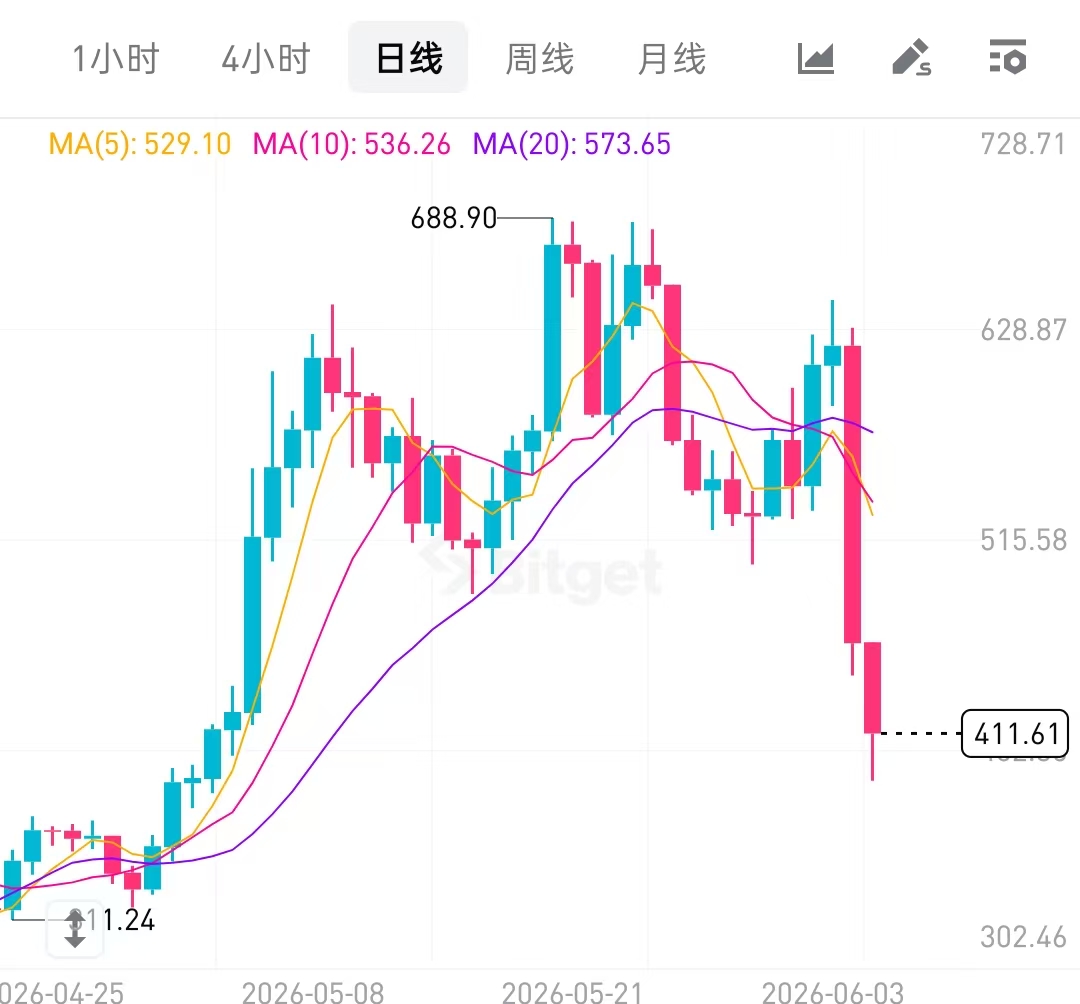


Zcash has been the absolute star in the privacy coin track over the past six months, surging from around $200 in March this year to a peak of $688. Figures including AllianceDAO co-founder Wang Qiao, Bankless founder David Hoffman, and the "shilling king" Arthur Hayes have all expressed high optimism about its performance.


However, after the vulnerability was discovered, Arthur Hayes tweeted that he had sold his entire ZEC holdings. He stated that after reading the vulnerability details and observing ZEC's 30% pullback, he decided to completely close his position for profit. He mentioned he would continuously re-evaluate and, if subsequent evidence proved his assumptions wrong, would consider buying back at lower prices.


So, what exactly happened with Zcash?


In simple terms, Orchard is a privacy vault within Zcash that is "completely opaque" to the outside; after people deposit funds, neither the outside world nor the blockchain itself knows how much money is inside or who owns it. The vulnerability this time lies in the vault's "verification lock"—this lock was supposed to be extremely rigorous, allowing only legitimate transactions to pass verification. However, due to a loosely written mathematical constraint (akin to a loose gear in the lock), an attacker could forge a key that appears completely legitimate, trick the system, and create new ZEC out of thin air within the vault.


This incident directly challenges the narrative of the privacy coin track that "technological trust is core value."


As the earliest public chain to scale the application of zk-SNARKs for private transactions, Zcash's Orchard pool, activated with the NU5 upgrade in May 2022, has been regarded as a more efficient evolution of the Sapling pool, hosting a large amount of private funds. Now, vulnerabilities discovered by security researchers using the latest AI models are forcing the entire industry to re-examine the gap between privacy technology theory and practice.


Vulnerability Discovery Originated from AI-Assisted Audit


The discovery process of the vulnerability was dramatic.


In April 2026, Shielded Labs hired senior security engineer Taylor Hornby to conduct ongoing security research targeting the Zcash protocol, aiming to discover issues before malicious actors.


On May 28th, Anthropic released the Opus 4.8 model. The next day, Taylor used this model combined with traditional methods to conduct a highly targeted review of the Orchard circuit, discovering the issue: an insufficient constraint in elliptic curve multiplication within the halo2_gadgets crate, allowing attackers to input arbitrary false values into the multiplication operation while verification would still pass. This meant it was possible to construct seemingly fully valid Orchard actions—that is, generate counterfeit ZEC within the Orchard pool, and due to privacy features, on-chain differentiation between real and fake was impossible.


Taylor immediately disclosed the issue to ZODL core engineers, who confirmed the severity of the vulnerability within hours and initiated an emergency response.


The foundation's initial security announcement tried to downplay the severity, describing it as a "double-spend risk," and assured that the "rotation mechanism protected the total supply from inflation," attempting to use "total supply security" to stabilize market sentiment and conceal the harsh reality that the Orchard pool might have already been flooded with counterfeit coins, diluting honest users' assets.


By June 4th, founder Zooko's statement supplemented the fatal details. He candidly admitted that "cryptographically, it is impossible to prove whether the vulnerability had been exploited before the fix," and publicly disclosed the "possibility of infinite ZEC forgery." It was this frank admission by the founder that directly punctured the "safety illusion" maintained by the foundation earlier, triggering the market's panic sell-off.


Zooko


Because if an attacker had, over the past few years, already used the vulnerability to mint 1 million fake ZEC inside the Orchard pool and cashed out by withdrawing to the transparent pool via the rotation mechanism before the fix, the total supply indeed didn't inflate, but the real assets of users within the Orchard pool had already been evaporated and harvested in a targeted manner. Once the rotation limits are announced next week, the Orchard pool will face the largest "bank run" in the history of privacy blockchains, with the assets of users who retreat later being permanently locked.


In the AI Era, "Unfound Vulnerability Equals Security" No Longer Holds True


Orchard, since its activation in 2022, underwent years of security audits by top cryptographers yet still contained bugs, only discovered through targeted research combined with the latest AI tools. This serves as a warning for many privacy solutions (including other ZK privacy projects): theoretically "perfect" mathematical constructs may still have omissions in engineering implementation.


Taylor Hornby's use of Anthropic Opus 4.8 to pinpoint the Orchard flaw in an extremely short time proves that AI can be a powerful aid for white-hat researchers, but also implies that attackers can similarly use similar tools to mine high-value targets faster.


If project teams fail to establish continuous, proactive security review mechanisms, the window from vulnerability discovery to malicious exploitation will shrink dramatically. While Zcash gained the upper hand this time by proactively investing in security research,


for the entire crypto industry, this is more like a collective warning: in the AI-driven security offense and defense race, any reliance on the侥幸心理 of "safe because undiscovered for years" is no longer valid. Only by internalizing AI auditing, formal verification, and rapid response capabilities as standard practices can privacy protocols truly withstand the pressure tests of the new era.
Related Reads

From Ethereum to AI's 'CROPS': What Exactly is This Set of 'Slow Variables' That Vitalik Repeatedly Emphasizes?

In recent discussions, Vitalik Buterin has frequently emphasized the concept of "CROPS," a framework defining core values for Ethereum's development. CROPS stands for Censorship Resistance, Capture Resistance, Open Source, Privacy, and Security. Initially outlined in the Ethereum Foundation's "EF Mandate," it represents a commitment to user sovereignty, ensuring that the network resists external control, remains open, protects privacy, and prioritizes security. The relevance of CROPS extends beyond Ethereum's foundational principles, becoming crucial in the context of AI integration. As AI agents begin handling wallet operations and automated transactions, the risk increases that users may cede control over their digital assets, privacy, and intentions to centralized AI service providers. A "CROPS AI" would therefore emphasize local execution where possible, privacy-preserving remote model calls (e.g., using zero-knowledge proofs), and transparent, verifiable processes to maintain user agency. Vitalik highlights a significant convergence between "CROPS Ethereum access layer" and "CROPS AI." Both address the same fundamental challenge: how users can access powerful services—be it blockchain data via RPCs or AI models—without exposing sensitive information or relinquishing ultimate control. This intersection points toward a future digital entry point that is more private, secure, and user-controlled. Ultimately, CROPS is not merely an abstract ideal but a practical guidepost. It steers development—from protocol resilience and wallet design to AI agent safety—towards a future where users retain self-sovereignty even as digital systems grow more complex and powerful. In an era of accelerating AI adoption, these "slow variables" of censorship resistance, openness, privacy, and security may define Ethereum's enduring value.

marsbit4m ago

From Ethereum to AI's 'CROPS': What Exactly is This Set of 'Slow Variables' That Vitalik Repeatedly Emphasizes?

marsbit4m ago

Silicon Valley 'Startup Guru' Steve Hoffman: Web3 + AI Could Be a Trap

Silicon Valley investor and "Godfather of Startups" Steve Hoffman warns that combining Web3 with AI is likely a trap, not a promising venture. In an interview, Hoffman argues that while AI is a foundational technology touching all industries, Web3 adds complexity, friction, and regulatory risk without solving mainstream consumer or business needs. He advises founders to focus on deep, specialized applications where startups can out-iterate giants, rather than on generic features easily replicated by large tech companies. Hoffman observes that Silicon Valley will lead foundational AI research, while China excels at rapid, large-scale application and commercialization, particularly in robotics. He stresses that AI-driven autonomous agents capable of collaborative, multi-step tasks are 2-4 years away, which will cause significant job displacement. The solution is not to slow AI but to redesign business models around human-AI collaboration and reform social systems like education and retraining. For startups, Hoffman recommends focusing on vertical, expertise-heavy domains to build defensibility. He sees major opportunities in AI fraud detection and cybersecurity. Key founder mindsets include systemic thinking over feature-focus, relentless customer centricity, building adaptive teams, and deeply understanding AI's capabilities and limits. Hoffman is also leading a non-profit initiative to establish university centers aimed at training future leaders in responsible, human-value-aligned AI innovation.

marsbit1h ago

Silicon Valley 'Startup Guru' Steve Hoffman: Web3 + AI Could Be a Trap

marsbit1h ago

Token Inefficient, Economy Tokenless

The article "Tokens Aren't Economical, Economics Aren't Tokenized" analyzes a pivotal shift in the AI industry from a technology-driven narrative to one dominated by capital efficiency. It highlights two concurrent trends: a severe capital shortage due to the exorbitant and recurring costs of compute (e.g., OpenAI's high burn rate) and a wave of corporate spin-offs where major tech companies are separating their AI units (like Kuaishou's Kling and Baidu's Kunlunxin). The core argument is that AI's "anti-internet" business model, where user growth increases costs rather than profits, has created a disconnect between high valuations and actual cash flow. Spin-offs address this by allowing AI assets to be valued independently. Within a parent company, they are seen as cost centers, but as standalone entities, they are priced based on their growth potential and scarcity in the primary market, leading to massive valuation premiums (e.g., Kling's estimated value tripling post-spin-off). The industry is at an inflection point, moving from "model worship" to "value realization." The competition is evolving from a pure compute (GPU) race to a broader focus on systemic efficiency and full-stack engineering (involving CPUs and orchestration) to achieve viable commercialization. The year 2026 is framed as a critical moment where the industry must definitively answer how to economically translate AI capability into tangible business value, reshaping the sector's future power structure.

marsbit1h ago

Token Inefficient, Economy Tokenless

marsbit1h ago

Crossing the 'Memory Wall': The Wafer-Level Revolution and Computing Power Routes in the AI Inference Era

In 2026, a historic shift occurred in AI as major cloud providers' inference spending surpassed training spending for the first time, signaling a move from "building large models" to "using large models." This shifts the core challenge from computing power to the "memory wall"—the bottleneck of data movement (model weights, activations, KV Cache) between external DRAM and processors, where energy and latency from data transfer far exceed computation itself. Companies like Nvidia face GPU idle time due to bandwidth limits. In contrast, Cerebras Systems adopts a radical "wafer-scale" approach with its Wafer-Scale Engine (WSE). Instead of cutting a silicon wafer into many chips, Cerebras uses almost the entire wafer as one massive chip (WSE-3). This design provides 44GB of on-chip SRAM, delivering memory bandwidth thousands of times higher than traditional HBM (e.g., 21 PB/s vs. Nvidia B200). For LLM inference, weights are streamed layer-by-layer from external MemoryX storage to the chip, avoiding HBM bottlenecks. This results in token generation speeds 1.5–5 times faster than Nvidia's B200 in some models and significant advantages in first-token latency and long-context tasks. Additionally, Cerebras's architecture offers much lower interconnect power consumption (0.15 pJ/bit vs. GPU's ~10 pJ/bit). However, Cerebras faces challenges: SRAM scaling has slowed with advanced nodes, limiting future capacity gains; the chip requires specialized liquid cooling and custom software stacks; and its external I/O bandwidth (150 GB/s) is low compared to NVLink, hindering multi-system scaling for very large models. Competition is intensifying. Major players are pursuing three paths: 1) Developing proprietary inference ASICs (e.g., Google TPU, Microsoft Maia), 2) Leveraging advanced packaging (e.g., TSMC's SoW) to democratize wafer-scale-like integration, potentially eroding Cerebras's process advantage within a few years, and 3) Exploring optical interconnects for ultimate bandwidth. Commercially, Cerebras is transitioning from a hardware vendor to a service provider, facing the immense challenge of building high-power, specialized data centers to meet large contracts (e.g., 250MW/year from 2026–2028). In conclusion, the AI inference era presents a fundamental architectural trade-off. Cerebras opts for extreme physical optimization for low-latency, single-task performance, while Nvidia prioritizes versatility and massive cluster throughput. The path forward remains uncertain, with technology and business models still evolving in the race toward advanced AI.

marsbit1h ago

Crossing the 'Memory Wall': The Wafer-Level Revolution and Computing Power Routes in the AI Inference Era

marsbit1h ago

Trading

Spot
Futures

Hot Articles

How to Buy ZEC

Welcome to HTX.com! We've made purchasing Zcash (ZEC) simple and convenient. Follow our step-by-step guide to embark on your crypto journey.Step 1: Create Your HTX AccountUse your email or phone number to sign up for a free account on HTX. Experience a hassle-free registration journey and unlock all features.Get My AccountStep 2: Go to Buy Crypto and Choose Your Payment MethodCredit/Debit Card: Use your Visa or Mastercard to buy Zcash (ZEC) instantly.Balance: Use funds from your HTX account balance to trade seamlessly.Third Parties: We've added popular payment methods such as Google Pay and Apple Pay to enhance convenience.P2P: Trade directly with other users on HTX.Over-the-Counter (OTC): We offer tailor-made services and competitive exchange rates for traders.Step 3: Store Your Zcash (ZEC)After purchasing your Zcash (ZEC), store it in your HTX account. Alternatively, you can send it elsewhere via blockchain transfer or use it to trade other cryptocurrencies.Step 4: Trade Zcash (ZEC)Easily trade Zcash (ZEC) on HTX's spot market. Simply access your account, select your trading pair, execute your trades, and monitor in real-time. We offer a user-friendly experience for both beginners and seasoned traders.

3.2k Total ViewsPublished 2024.03.29Updated 2026.06.02

How to Buy ZEC

Discussions

Welcome to the HTX Community. Here, you can stay informed about the latest platform developments and gain access to professional market insights. Users' opinions on the price of ZEC (ZEC) are presented below.

活动图片