Ethereum Repeats A Notable Market Trend As Momentum Wanes – Here’s How Investors Are Positioning

bitcoinistPublished on 2026-06-03Last updated on 2026-06-03

Abstract

Ethereum's price has dipped below $2,000, but analysts spot a potentially bullish short-term pattern. The cryptocurrency has closed below a key multi-year uptrend line for the second time recently, mirroring a setup from early 2026 that could precede a rebound, though momentum appears weak. Experts suggest this may create entry opportunities. They highlight the upcoming CLARITY Act vote as a pivotal event that could trigger a classic "sell the rumor, buy the news" scenario, advocating for positioning in DeFi and accumulating ETH. On-chain data supports this outlook, showing large investors (whales holding 100,000+ ETH) have been accumulating significantly since mid-April 2026, with their collective holdings reaching a 9-week high, indicating strong long-term conviction amidst current market uncertainty.

After a persistent bearish performance, Ethereum’s price is now hovering below the $2,000 mark, raising questions about its stability. ETH may be struggling with volatility, but its short-term outlook appears to be quite bullish as the altcoin mirrors a historical pattern that presents an impending rebound.

ETH’s Price And Investors’ Current Behavior

Ethereum is once again exhibiting a market pattern that emerged at a significant juncture in its price action over the past few months, sparking conjecture that a potential bounce may be imminent. Rekt Capital, a crypto analyst and investor, has found parallels between current price behavior and the past few months that preceded notable changes in momentum, making the trend a crucial area of attention.

As seen in the chart, this trend involves a monthly close below its multi-year upward trend. According to the expert, Ethereum has recently made this key monthly close for the second time in the last 5 months, increasing the likelihood of ETH mirroring its price action of early 2026. Rekt Capital highlighted that the last time the altcoin mostly closed below the trend line of its multi-year uptrend, the price experienced a limited move to the upside. However, it later got rejected, sparking a steady downward trend.
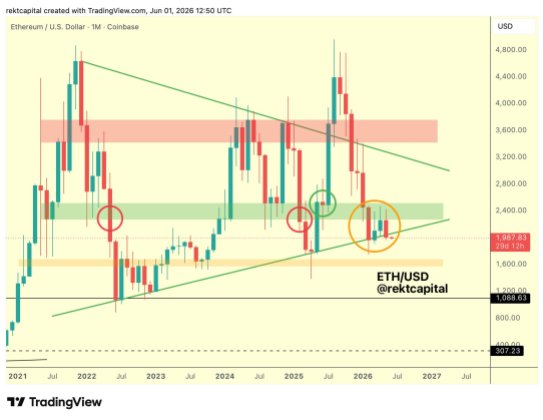
Source: Chart from Rekt Capital on X

Currently, the rallies originating from this trend line are clearly weakening, and the multi-year upward trend is likely faltering. In the meantime, the altcoin needs to at least keep the 2026 lows and/or reclaim the upward trend to avoid deeper downside.

Michael Van De Poppe, the Chief Information Officer (CIO) and founder of MNFund, revealed that ETH is in the area of interest for entry points after a period of sideways price action. This analysis suggests that the ETH market structure is shifting, creating ideal entry opportunities.

However, with the CLARITY Act vote, this month is a decisive one for the altcoin, which the expert believes is providing the ideal “Sell the rumor, Buy the News” type of scenario. Once the bill is passed, Van De Poppe urges immediate positioning in DeFi, as it is highly likely that ETH will experience a lot of upside. Thus, the expert expresses his intention to add more ETH to his portfolio.

Large Investors Are Accumulating More Ethereum

Data shows that investors are already positioning for an upcoming surge as they steadily add more Ethereum to their portfolios. Leon reported that this renewed accumulation is observed among big whales or large investors, particularly wallet addresses holding at least 100,000 ETH, despite ongoing heavy FUD.

Currently, these investors control a total of 17.41 million ETH, marking their highest level in the last 9 weeks. When compared to the ETH total supply, this purchase represents about 22.03%, marking a 10-week high. Since mid-April 2026, their holdings have grown considerably despite strong downward pressure on the price of ETH.

These investors, also considered as smart money, are quietly buying the dip instead of selling, but retail investors are panicking and spreading FUD. This is a classic whale behavior where they see long-term value in ETH way bigger than short-term noise.

ETH trading at $1,983 on the 1D chart | Source: ETHUSDT on Tradingview.com

Related Questions

QAccording to the article, what key market pattern is Ethereum currently repeating, and what historical period does it mirror?

AEthereum is repeating a pattern of a monthly close below its multi-year upward trend line. According to the analyst Rekt Capital, this mirrors the price action that occurred in early 2026, which was followed by a limited upside move and then a steady downward trend.

QWhat are the two potential actions the article states Ethereum needs to take to avoid a deeper downside?

ATo avoid a deeper downside, Ethereum needs to at least hold (keep) the 2026 lows and/or reclaim the upward trend line.

QWhat specific scenario does Michael Van De Poppe associate with the upcoming CLARITY Act vote for Ethereum?

AMichael Van De Poppe believes the upcoming CLARITY Act vote is providing the ideal 'Sell the rumor, Buy the News' type of scenario for Ethereum. He urges immediate positioning in DeFi once the bill is passed, expecting significant upside.

QWhat does the data show about the behavior of large investors (whales) holding at least 100,000 ETH?

AData shows that large investors (whales) holding at least 100,000 ETH are accumulating more Ethereum, increasing their holdings to 17.41 million ETH, which is their highest level in 9 weeks. This represents about 22.03% of the total supply, a 10-week high.

QHow does the article contrast the behavior of large 'smart money' investors with retail investors during the current market phase?

AThe article contrasts that large 'smart money' investors are quietly buying the dip and accumulating Ethereum, seeing long-term value, while retail investors are panicking and spreading FUD (Fear, Uncertainty, and Doubt).

Related Reads

HYPE Spot ETF Continuously Accumulates 1% in 14 Days: Is the $75 New High Just the Starting Point?

Hyperliquid (HYPE) has surged to a new all-time high of $75 amid strong institutional and ETF-driven buying pressure. The article highlights several key bullish factors. First, the HYPE spot ETFs from 21Shares and Bitwise have seen 14 consecutive days of net inflows, totaling over $136 million and absorbing nearly 1% of HYPE's market cap—a faster initial pace than BTC or ETH ETFs. This ETF demand provides a solid price floor. Second, the protocol's own Assistance Fund (AF) mechanism, which uses 99% of fees to buy back and burn HYPE, has already removed over $1.1 billion worth of tokens, creating a dual support system alongside ETF inflows. This combined buying power is expected to counter potential selling pressure from upcoming team token unlocks. Institutionally, venture firm a16z is now considered one of the largest external holders of HYPE, with multiple addresses accumulating millions of tokens. Galaxy Digital is also actively buying. Analysts and firms like Bitwise and Grayscale are framing HYPE not as a mere meme coin but as a "second-generation" crypto with real value capture and infrastructure potential. Furthermore, Hyperliquid Strategies (PURR), a publicly traded company holding a large HYPE treasury, is set to join the Russell 3000 Index, potentially unlocking further passive investment flows. The ongoing feud between prominent backers like Arthur Hayes (pro-HYPE) and Kyle Samani (pro-SOL) underscores the intense market debate, with Hayes famously betting HYPE will outperform all top-ten crypto assets this year.

Odaily星球日报7m ago

HYPE Spot ETF Continuously Accumulates 1% in 14 Days: Is the $75 New High Just the Starting Point?

Odaily星球日报7m ago

ETH Bull and Bear Views Compilation: Can Ethereum's Value Flow Back to ETH?

Titled "ETH Bull and Bear Views: Can Ethereum's Value Flow Back to ETH?", this article synthesizes the current heated debate around Ethereum's native token, ETH, following Bankless co-founder David Hoffman's decision to sell his entire ETH holdings. The **bullish case**, represented by figures like Tom Lee (BitMine CEO) and Raoul Pal, argues that ETH's core thesis remains intact. They contend Ethereum is the essential, secure, and neutral foundational layer for future finance—encompassing stablecoins, RWA, DeFi, L2s, and Agentic AI. Bulls bet on ETH's long-term revaluation as institutional adoption of on-chain finance grows, with significant buying activity from entities like BitMine and Consensys cited as evidence. Conversely, the **bearish perspective**, led by Hoffman and analysts like Markus Thielen, questions ETH's value capture mechanism. They acknowledge Ethereum's network success but argue that the value created by L2s, DeFi, and applications does not sufficiently accrue to the ETH token itself. Bears point to ETH's prolonged underperformance versus the broader crypto market, lack of traditional cash flows, weakening "ultrasound money" narrative, and apparent institutional retreat (e.g., Harvard Management Company exiting its ETH ETF position) as key concerns. The debate highlights a pivotal shift: ETH is no longer just a community belief asset. The central question is whether ETH can transition from being a "**used infrastructure**" to a "**continuously bought and held core asset**" as more value enters the Ethereum ecosystem. The market is now critically examining the direct link between network growth and ETH's value.

marsbit54m ago

ETH Bull and Bear Views Compilation: Can Ethereum's Value Flow Back to ETH?

marsbit54m ago

Crypto is dead, Perps are forever

The crypto industry is shifting from a focus on creating native assets (like altcoins and protocol tokens) to becoming a "global asset pipeline." Native cryptocurrencies, except for Bitcoin, are seen as failing in their value storage and utility promises, with demand driven largely by speculation. Attention and liquidity are now moving toward real-world assets (RWAs) like U.S. stocks, bonds, gold, and oil traded on-chain via perpetual contracts (Perps). Stablecoins like USDT and USDC set the precedent, proving blockchain's core strength is efficient global settlement and transfer, not inventing new monetary systems. Meanwhile, assets like Ethereum and many DeFi tokens struggle as their narratives weaken against tangible traditional assets and the rapid real-world progress of AI. Perpetual contracts have emerged as a pivotal innovation. They simplify trading by offering pure price exposure to any asset, bypassing complexities of ownership, custody, and traditional market hours. Projects like Hyperliquid gained traction by combining CEX-like efficiency with on-chain transparency, capitalizing on post-FTX distrust, macroeconomic volatility, and the surge in demand for 24/7 stock trading. In conclusion, while the era of speculative native "crypto assets" may be over, perpetual contracts persist as the industry's most potent financial instrument—transforming all assets into globally accessible, constantly tradable instruments centered on price speculation.

marsbit1h ago

Crypto is dead, Perps are forever

marsbit1h ago

Tencent, Alibaba, ByteDance in a Battle for the Skill Store

Skill is becoming a key concept in the AI field, essentially serving as a structured "instruction manual" for AI Agents that specifies tool calls, decision logic, and output standards. This allows Agents to execute predefined tasks. As the number of Skills grows, distribution platforms have emerged. Major tech companies are swiftly entering this space. In March, Tencent, Alibaba, and ByteDance launched Skill stores within their respective Agent platforms. Subsequently, players like Zhipu AI, Meituan, and Xiaohongshu joined the fray. This competition for the "Skill store" is fundamentally a battle for the AI-era user entry point; whoever controls distribution controls the users. While ByteDance's Coze has experimented with paid Skills, most platforms offer them for free. The real value lies not in the stores themselves but in using them to attract and retain users within an ecosystem, driving revenue from services like cloud computing, model calls, or advertising. The landscape features three main player types: 1) **Internet giants** (e.g., Alibaba, ByteDance, Tencent, Meituan), leveraging Skills to drive traffic and monetize through their broader ecosystems (cloud services, transactions, ads). 2) **Large model companies** (e.g., Zhipu AI, Moonshot AI), using Skill stores to increase user engagement and monetize model API calls. 3) **Content platforms** (e.g., Xiaohongshu), treating Skills as a new content format to generate traffic and ad revenue. However, transforming Skill stores into a sustainable business faces significant hurdles. Key challenges include: the **difficulty in pricing Skills** due to inconsistent outputs across different models and contexts; **lack of cost transparency** (varying token consumption); **security risks** like Skill poisoning; and the **absence of standardized protocols** for development and evaluation. Unlike standardized mobile apps, Skills are often personalized workflows resistant to uniformity, which hinders the establishment of a reliable review and monetization system akin to the App Store. While there is genuine user demand for paid Skills—particularly in enterprise (e.g., contract review) and certain personal productivity scenarios—current platforms offer developers limited and unpredictable distribution. The future of Skill stores depends on overcoming these standardization, evaluation, and safety challenges to make acquiring a Skill as straightforward as downloading an app. For now, the stores function more as display shelves than robust marketplaces.

marsbit1h ago

Tencent, Alibaba, ByteDance in a Battle for the Skill Store

marsbit1h ago

Trading

Spot
Futures

Hot Articles

Discussions

Welcome to the HTX Community. Here, you can stay informed about the latest platform developments and gain access to professional market insights. Users' opinions on the price of ETH (ETH) are presented below.

活动图片