The Warsh Storm Approaches

marsbitPublished on 2026-05-19Last updated on 2026-05-19

Abstract

The article "The Warsh Storm Approaches" analyzes the potential market impact of Kevin Warsh becoming the new Federal Reserve Chairman, succeeding Jerome Powell. It argues that the current AI-driven stock market rally, concentrated in high-valuation tech giants, relies on a crucial premise: that long-term interest rates will eventually fall. This premise is now under threat as the 30-year Treasury yield remains persistently high, exceeding 5%, due to sticky inflation, worsening U.S. fiscal deficits, and deteriorating Treasury supply-demand dynamics. The core vulnerability is that high long-term rates pressure valuations by increasing the discount rate for future earnings. The article warns that Warsh's policy stance could intensify this pressure. Unlike Powell, Warsh is seen as more tolerant of market stress, more committed to quantitative tightening (QT/shrinking the Fed's balance sheet), and less inclined to provide implicit market support. His tenure at the Fed during the 2008 crisis shaped his skepticism about prolonged quantitative easing, believing it fuels asset bubbles without sufficiently boosting the real economy. While strong AI-driven earnings growth could theoretically offset higher rates, the narrative is currently concentrated in a few firms and hasn't yet translated into broad-based productivity gains for the wider economy. Therefore, the AI boom may not be enough to counter the valuation pressures from sustained high yields. Warsh's leadership could force t...

Produced by | Miaotou APP

Author | Ding Ping, Huxiao APP

Cover Image | Visual China

Warsh is not the storm itself, but he might make the market realize that when the storm comes, the Fed is no longer standing in the same position as before.

Over the past two years, tech giants like Nvidia, Microsoft, and Meta have continuously set new market cap records. AI has almost redefined the entire market's risk appetite, lifting the S&P 500 and Nasdaq indices.

But if we dissect this market rally, AI is merely the story on stage. The real factor propping up U.S. stock valuations is a more crucial premise: that long-term interest rates will ultimately come down.

Only if this premise holds true does the market dare to continue paying high premiums for future earnings, to discount the growth narratives of a few tech giants all the way to the present, and to chase stocks at 30x, 40x, or even higher P/E ratios.

But now, this premise is becoming shaky.

The yield on the 30-year U.S. Treasury note continues to climb, recently breaking through the high level of 5%. For a highly concentrated, expensive, and forward-earnings-narrative-dependent U.S. stock market, the longer long-term rates stay elevated, the more fragile the valuation system becomes.

What's more troublesome is that this pressure is likely to intensify.

On May 15th, Jerome Powell, after serving eight years as Fed Chair, formally stepped down. Kevin Warsh became the next Chairman. Compared to Powell, Warsh may be more tolerant of market pressure, more committed to balance sheet reduction, and less inclined to provide implicit Fed support for financial markets.

Once long-term yields move persistently higher and the Fed no longer soothes the market as quickly as before, the prosperous logic that has supported high U.S. stock valuations may begin to lose its foundation.

The Current Fragility of U.S. Stocks

It's that long-term rates refuse to come down.

For some time now, the market has focused excessively on whether the Fed will cut rates, overlooking a problem: long-term rates are no longer moving in sync with monetary policy.

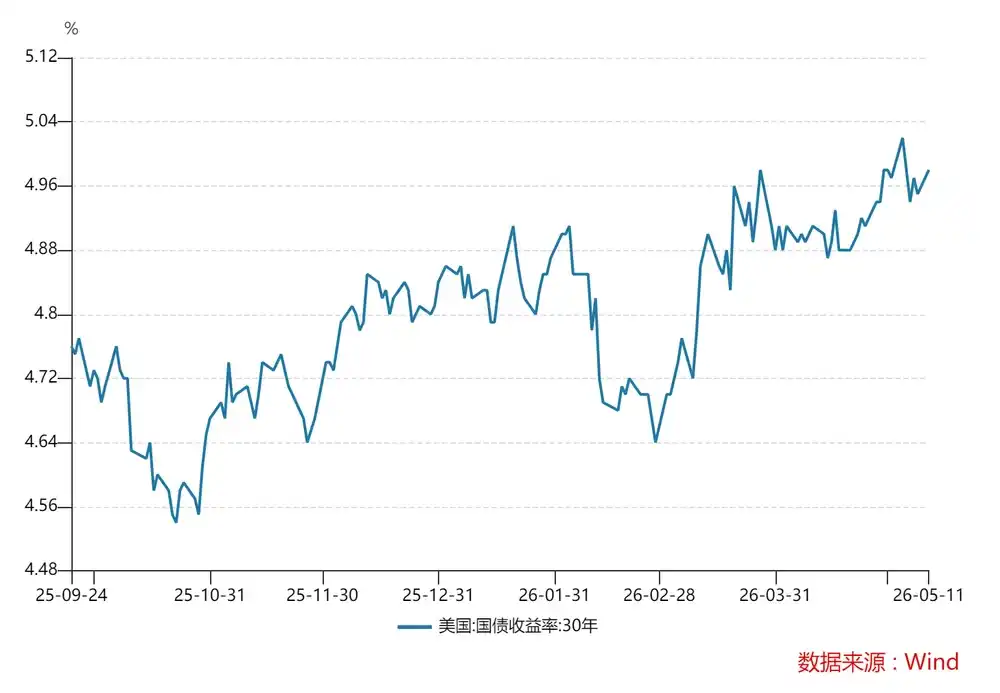
In theory, central bank rate cuts directly lower short-term rates; if the market believes future rates will stay low, long-term rates should follow suit. But an anomaly has occurred. Even without the Fed hiking, the 30-year Treasury yield continues to rise, hitting a high of 5.13% on May 15th. This indicates the market does not believe long-term U.S. risks will diminish and therefore demands higher risk compensation.
This is precisely where U.S. stocks are most vulnerable right now.

The reason long-term rates are stuck at high levels has at least three layers.

First, inflation has not eased as smoothly as the market hoped.

The latest data shows U.S. April CPI rose 3.8% year-on-year, hitting a nearly three-year high. Core CPI accelerated to 2.8%. More troublingly, U.S.-Iran conflict risks haven't been truly resolved, with persistently high oil prices constantly reinforcing market concerns about imported inflation. As long as inflation expectations can't be firmly suppressed, long-term rates will struggle to fall smoothly.

Second, U.S. fiscal issues are also eroding market confidence in its long-term fiscal discipline.

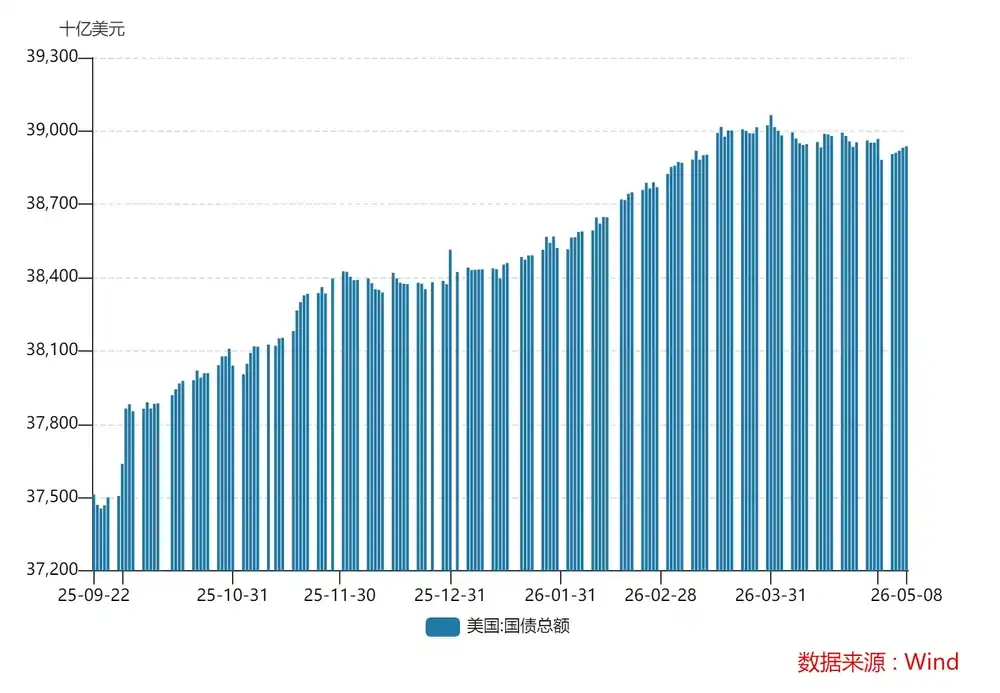
In October 2025, U.S. national debt stood at $38 trillion. Just five months later, that scale breached $39 trillion. Behind this is chronic fiscal deficits (high military and social welfare spending). The Treasury Department issues new bonds to repay maturing old debt, and these new bonds bring higher interest payments, pushing the U.S. into a "Ponzi-like" fiscal debt situation—needing ever-expanding debt to sustain the existing system's stability.
Third, the supply and demand structure for U.S. Treasuries is deteriorating.

On one side, the Treasury continues to increase issuance; on the other, overseas holdings are shrinking due to global de-dollarization. Foreign official sectors are reducing their accumulation, and the U.S. Treasury's share of global reserve assets is in decline, currently at 24%. Supply is increasing while the buying power is weakening, making it increasingly difficult to suppress long-term yields.

When these risks are not alleviated, U.S. Treasuries cease to be just safe assets, and investors naturally demand higher risk compensation.

This is especially dangerous for U.S. stocks.

Because the current U.S. stock market is not a broadly undervalued market relying on gradual earnings delivery. It is a highly concentrated market, supported by a handful of leaders, and extremely sensitive to discount rates.

Once long-term rates stay high, the discounting of future cash flows becomes significantly harsher, and the tolerance range for valuations narrows rapidly. At that point, the first to be hit may not be companies with the worst fundamentals, but precisely those with the best fundamentals but whose valuations are already stretched to the limit.

Bank of America's Hartnett also noted that once the 30-year Treasury yield stabilizes above 5%, rising financing costs and falling risk appetite would first impact high-valuation U.S. tech stocks.

October 2023 demonstrated this once.

At that time, the 30-year yield briefly rose above 5%, and the Nasdaq index corrected about 10% cumulatively over several months. Investors then still believed that once financial conditions worsened further, the Fed would ultimately send soothing signals. But if, after Warsh takes office, this expectation begins to waver, then the market's reaction to a similar long-term rate shock would be entirely different.

Many also like to compare today to 2007, but the truly relevant lesson isn't that rates were high then too. It's that the damage high rates inflict on a financial system never happens instantly. It's more like a chronic erosion: first pressuring financing, then valuations, then balance sheets, finally forcing out the weakest link in the system.

What truly burst in 2007 was real estate, subprime, and shadow banking. Today, what's more dangerous is high-deficit fiscal policy pushing long-term bond supply ever higher, making long-term yields hard to suppress. Banking unrealized losses, commercial real estate tail risks, and risk assets' dependence on liquidity would all be gradually exposed.

Therefore, once long-term rates fail to come down, the valuation foundation for this AI-driven bull market begins to loosen.

This problem will be more severe in the Warsh era.

Why Should Warsh Make the Market Wary?

Because Warsh's inclination towards balance sheet reduction would further push up 30-year Treasury yields, amplifying U.S. stock fragility.

How to understand this?

Fed balance sheet reduction (quantitative tightening, QT) means shrinking the size of the Fed's balance sheet. Previously, to stimulate the economy, the Fed bought many assets like Treasury bonds and mortgage-backed securities (MBS); buying these assets was equivalent to injecting a lot of money into the market. QT is about letting these assets decrease, gradually withdrawing liquidity from the market.

We can simply understand it as: the Fed stops buying newly issued or maturing Treasury bonds from the Treasury Department, and may even sell some of the bonds it holds.

As mentioned above, the U.S. Treasury is currently increasing issuance, and overseas buyers are reducing holdings. If the Fed also reduces its balance sheet, then new and maturing Treasuries can only flow to the market, with the market determining the interest rate level. The result is persistently rising Treasury yields. This also leads to an increasingly heavy interest burden for the government, which is very dangerous for a system relying on issuing new debt to replace old. Once interest costs become too high to support, a Treasury crisis emerges.

Former U.S. Treasury Secretary Paulson also warned that once U.S. Treasuries start losing market buyers, the entire financial system's "risk-free anchor" would be shaken.

If the consequences are so severe, why is Warsh inclined to reduce the balance sheet? This stems from his background.

Warsh served as a Federal Reserve Governor from 2006 to 2011, a period crucial for judging his policy leanings. He experienced the final credit expansion before the financial crisis, the 2008 global financial crisis, and the start of zero interest rates and QE (quantitative easing).

He is not someone who completely denies crisis intervention. On the contrary, during times of strongest systemic risk, he supported the Fed acting as lender of last resort and recognized the necessity of unconventional tools. But later he grew increasingly skeptical: should the prolonged QE post-crisis have persisted for so long?

From his perspective, the post-crisis U.S. economy did not recover in proportion to asset price gains. The real economy's recovery wasn't strong, productivity improvements were limited, but financial asset prices rebounded rapidly driven by liquidity, even surpassing pre-crisis levels.

This likely led Warsh to a very typical conclusion: QE might be good at boosting financial asset prices, but not necessarily equally good at repairing the real economy. Once markets begin to assume "the Fed will ultimately backstop asset prices," the financial system becomes increasingly dependent on liquidity, risk appetite is artificially suppressed long-term, and asset bubbles and misallocations worsen.

So in his logic, if the Fed maintains an oversized balance sheet and suppresses term premiums for too long, markets will ultimately become increasingly unable to function independently of central bank liquidity. In his view, QT is not just about withdrawing liquidity; it's also the Fed proactively withdrawing from its role as a "financial conditions stabilizer."

This is also why Warsh might be more inclined than Powell to advance QT.

Therefore, after Warsh takes office, the high-interest-rate environment will become even more severe, and the Fed may not soothe the market as quickly as before. Once such expectations form, the pressure on the already fragile high-valuation system of U.S. stocks will be further amplified.

The AI Narrative Can't Fully Offset High Rates

Of course, persistently high 30-year Treasury yields are not an absolute negative for U.S. stocks.

If the U.S. economy continues to outperform expectations, corporate earnings are revised upward, and especially if AI genuinely translates into broad productivity gains quickly, then even with elevated long-term rates, risk assets might still hold up. Ultimately, what determines whether the market can digest high rates is economic growth itself.

Over the past year, the reason U.S. stocks, especially tech stocks, continued to rise in a high-rate environment largely relied on this optimistic judgment: AI will significantly boost corporate profits, raise productivity, and open a new growth cycle for the U.S. economy.

But the problem is, the AI narrative currently concentrates more among a few leading companies and capital markets. It hasn't been sufficiently proven to quickly and broadly transform into fundamental improvements for the entire economy.

Take Nvidia as an example. It has indeed created astounding capital returns and market imagination. But such companies share these characteristics: high technological barriers, high profit concentration, limited employment absorption capacity (as of FY2026, Nvidia's global headcount was only about 42,000). Their spillover effects on the overall economy aren't as strong as market sentiment suggests.

In other words, AI can quickly lift valuations for companies like Nvidia and Microsoft in the short term, but it may not equally quickly support broader employment, investment, and expansion in the real economy.

More realistically, the U.S. itself faces problems of insufficient electricity, infrastructure, and industrial support. The faster the AI industry expands, the more it tends to suck capital, energy, and talent further into top tech sectors, making already uneven resource allocation even more concentrated towards leading tech.

This isn't to say AI won't succeed, just to emphasize it hasn't progressed fast enough to fully offset the valuation pressure from persistently high long-term rates.

In other words, the market thinks it's trading AI, but it's actually still trading another thing: low long-term rates and Fed backstops. As long as these two premises hold, high valuations can be justified. Once these premises begin to waver, no matter how strong AI is, it only delays, not cancels, the revaluation.

Warsh is not the source of the risk, but he might be the one who makes this trend harder to reverse.

In summary, while Warsh won't actively create a crisis, he might make the market truly accept for the first time that the high-valuation logic, supported by low long-term rates and Fed backstops, is no longer so stable.


Related Questions

QAccording to the article, what is the key premise that has been supporting high valuations in the US stock market, and why is it becoming unstable?

AThe key premise is that long-term interest rates will ultimately fall. This is becoming unstable because the 30-year U.S. Treasury yield remains persistently high (above 5%), which undermines the market's willingness to pay high premiums for future earnings and increases the fragility of the valuation system for stocks, especially highly valued tech stocks.

QWho is Kevin Warsh, and how might his approach as Fed Chair differ from Jerome Powell's, potentially impacting market expectations?

AKevin Warsh is the next Fed Chair following Jerome Powell. The article suggests he may be more tolerant of market stress, more persistent in quantitative tightening (QT / balance sheet reduction), and less likely to provide implicit support to financial markets compared to Powell. This could weaken the market's expectation of a 'Fed put' or rapid intervention to stabilize markets.

QWhat are the three main reasons cited in the article for the persistent high level of long-term U.S. Treasury yields?

A1. Inflation has not declined as smoothly as expected, with CPI data remaining high and oil price risks from conflicts like U.S.-Iran tensions reinforcing inflation concerns. 2. The U.S. fiscal situation undermines confidence in long-term fiscal discipline, with rapid debt growth leading to a 'Ponzi-like' structure requiring more borrowing to service existing debt. 3. Deteriorating supply-demand dynamics for U.S. Treasuries, as the Treasury increases issuance while foreign buyers (due to de-dollarization) are reducing their holdings.

QHow could a high 30-year Treasury yield and Kevin Warsh's potential policies combine to create specific risks for the U.S. stock market?

AA persistently high 30-year yield increases the discount rate for future corporate earnings, putting pressure on the high valuations of growth stocks, particularly in the tech sector. If Chairman Warsh is less inclined to intervene and supports continued quantitative tightening, it could remove a key market support (the 'Fed put'), leading to a re-rating of valuations as the old logic of low long-term rates and Fed support weakens.

QThe article argues that the AI narrative cannot fully offset the pressure from high interest rates. What is the primary limitation of the AI boom mentioned in this context?

AThe primary limitation is that the benefits of the AI boom are currently concentrated in a few leading companies and in capital markets, but it has not yet been proven to translate quickly and broadly into widespread improvements in economic fundamentals like productivity, employment, and investment across the broader economy. Therefore, it cannot sufficiently cover the valuation pressure caused by sustained high long-term interest rates.

Related Reads

IOSG: After the Number of Developers Halved, Crypto Did Not Die

The crypto development community has undergone a significant transformation, with monthly active developers on GitHub halving from 45K in 2022 to approximately 23K by 2026. This decline is largely attributed to the departure of newcomers, whose roles were often tied to market-driven hype cycles like NFTs and forked DeFi protocols, leading to a 52% churn rate among those with less than a year of experience. However, the core of the industry has strengthened. Established developers with over two years of experience have reached a record high, contributing about 70% of the code. They are consolidating around ecosystems with genuine users and revenue, such as Bitcoin and Solana, while moving away from narrative-driven projects. The talent shift represents a "deleveraging" and an increase in core density. This core group has developed a unique skillset by operating in an environment of "code is law," with zero tolerance for error and no external recourse. They have learned to build trust and functional systems from the ground up without central authorities, as demonstrated by protocols like Uniswap and MakerDAO. These capabilities are now being repriced and leveraged in the AI era. The structural challenges of AI scaling—such as trust, coordination, and verification—mirror those long addressed in crypto. Examples include CoreWeave pivoting from GPU mining to AI compute, OpenSea's founder applying NFT market logic to AI model routing with OpenRouter, and projects like NEAR and Catena Labs transitioning crypto-native architectural and financial insights into AI infrastructure and agent banking. Key areas where crypto-bred skills are directly applicable to AI include: 1. **Compute Aggregation & Optimization**: Using token incentives and cryptographic verification (e.g., Proof of Sampling & Privacy) to create trusted, decentralized GPU networks, as seen with Hyperbolic. 2. **AI Governance & Incentive Design**: Applying economic mechanism design from DAOs and tokenomics to align the goals of multiple, fast-acting AI agents, a direction explored by EigenLayer's EigenCloud. 3. **AI Agent Autonomous Payments**: Leveraging stablecoins and programmable, permissionless blockchains to enable the micro-transactions required for AI agent economies, exemplified by protocols like x402. The role of the crypto builder is evolving from writing smart contracts to designing trust mechanisms for autonomous AI systems. This convergence is reflected in hiring trends at major firms and significant capital allocation from funds like Paradigm and a16z crypto, which are investing at the intersection of crypto and AI. Regional differences exist, with the US favoring foundational protocol innovation and Asia focusing on compliant application-layer integration, but the underlying trend is clear. The industry's "deleveraging" has not signaled its demise but rather a maturation, positioning its core builders to solve critical trust and coordination problems in the age of AI.

marsbit9m ago

IOSG: After the Number of Developers Halved, Crypto Did Not Die

marsbit9m ago

Currency and Stock Market Barometer: Strategy Invested Over $2 Billion to Buy Over 24,800 BTC Last Week; Bitmine's ETH Holdings Increase to 4.37% of Total Supply (May 19)

Crypto & Stock Market Watch: Institutional BTC Buying Surges, ETH Holdings Grow Major listed companies aggressively accumulated Bitcoin last week, with net purchases skyrocketing over 44x to $2.03 billion. Strategy (formerly MicroStrategy) led the charge, spending approximately $2.01 billion to buy 24,869 BTC, bringing its total holdings to 843,738 BTC. Overall, listed firms (excluding miners) now hold 1,113,841 BTC, valued at ~$86.16 billion. On the Ethereum front, Bitmine purchased 71,672 ETH in the past week. It now holds 5,278,462 ETH, worth $11.56 billion and representing 4.37% of ETH's total supply. A significant portion (4,712,917 ETH) is staked, generating an annualized yield of $289 million. Industry leaders note a divergence from the MicroStrategy model, with ETH treasury firms increasingly focusing on staking yields and simpler balance sheets. In traditional markets, Morgan Stanley warns of a potential significant U.S. stock market correction if bond yields and volatility continue rising. Investment giants like Berkshire Hathaway and Bridgewater adjusted portfolios in Q1, with Bridgewater notably increasing its stakes in chipmakers like Nvidia, Broadcom, and Micron while shedding software stocks. Among other crypto-focused public companies, Solana treasury firm Upexi reported a widened net loss of $109 million for its fiscal Q3, driven by a decline in its crypto holdings' value. Meanwhile, Hyperion DeFi, a HYPE token treasury company, reported a Q1 net profit of $8.8 million and increased its HYPE holdings past 2 million tokens.

marsbit10m ago

Currency and Stock Market Barometer: Strategy Invested Over $2 Billion to Buy Over 24,800 BTC Last Week; Bitmine's ETH Holdings Increase to 4.37% of Total Supply (May 19)

marsbit10m ago

Global Long-Term Bonds Break Down: The Fiscal Illusion of the Low-Interest Era is Collapsing

Global long-term bonds are experiencing a widespread breakdown, as the fiscal illusion of the low-interest-rate era collapses. Sovereign yields are hitting multi-year highs in the US, UK, Japan, and France, signaling a market repricing driven by a common reality: unsustainable debt and deficits outpacing economic growth, compounded by renewed inflationary pressures from energy shocks. The direct trigger is the blockade of the Strait of Hormuz, which has pushed oil prices higher and reignited inflation fears. This squeezes central bank policy space, with expectations shifting from future rate cuts to potential hikes. The core "fiscal Ponzi scheme" is becoming evident—governments rely on new debt to service existing obligations, but as growth lags and borrowing costs rise, investors demand higher yields. Key developments include the US 30-year yield surpassing 5% for the first time since 2007, with tepid auction demand; Japan's 30-year yield reaching 4%, threatening its long-standing low-rate financial system; and political paralysis in the UK and France making meaningful fiscal consolidation unlikely. The marginal buyer for US debt is also shifting from foreign central banks to more price-sensitive private investors. While debt managers may adjust issuance, fundamental drivers—deteriorating fiscal paths, persistent inflation, and constrained central banks—remain. The market is conclusively repricing the end of the low-interest-rate financing model for highly indebted developed economies.

marsbit37m ago

Global Long-Term Bonds Break Down: The Fiscal Illusion of the Low-Interest Era is Collapsing

marsbit37m ago

Following the KelpDAO Hack: $40 Billion in Assets Flee LayerZero, Chainlink Emerges as the Primary 'Beneficiary'

Following a major security breach in April where KelpDAO's bridge using LayerZero was attacked for approximately $292 million, a significant shift is underway in the cross-chain infrastructure landscape. An estimated $40 billion in assets is in the process of migrating or has already migrated from LayerZero to Chainlink's Cross-Chain Interoperability Protocol (CCIP). The attack exploited a single-point-of-failure vulnerability due to KelpDAO's 1-of-1 validator configuration within the LayerZero network. Attackers corrupted RPC nodes and used DDoS attacks to force the system to rely on compromised nodes, allowing fraudulent messages. While LayerZero acknowledged a serious error in allowing its validator network to service high-value transactions with such a configuration, the incident highlighted critical security risks. This triggered a rapid migration wave. Starting with KelpDAO on May 6th, several major protocols—including Solv Protocol, Re, Tydro, Kraken, and Lombard—announced switching their cross-chain infrastructure exclusively to Chainlink CCIP. The combined value of these migrations is estimated to be around $40 billion. This movement followed earlier major adoptions by Coinbase (in late 2025) and Circle (in early 2024). Market sentiment reflected this shift, with LINK's price showing relative stability while ZRO (LayerZero's token) declined significantly. Data indicates a net outflow of approximately $20.1 billion from the LayerZero network over 30 days. The migration is largely driven by perceived security differences. Chainlink CCIP employs a decentralized oracle network as its default consensus layer, featuring multiple independent node operators, a separate Risk Management Network, and built-in safeguards like rate limits. In contrast, LayerZero's highly modular architecture offers flexibility but places more responsibility on application developers to configure security settings, a risk underscored by the KelpDAO incident. LayerZero has since apologized for its communication handling post-attack and stated the protocol itself was not compromised, but rather its Labs DVN's internal RPC was poisoned. An official post-mortem report with external security partners is forthcoming.

marsbit1h ago

Following the KelpDAO Hack: $40 Billion in Assets Flee LayerZero, Chainlink Emerges as the Primary 'Beneficiary'

marsbit1h ago

Trading

Spot
Futures

Hot Articles

What is LINON

Linde plc Tokenized Stock (Ondo): Revolutionizing Traditional Equity Access Through Blockchain Innovation The emergence of Linde plc Tokenized Stock (Ondo), represented by the ticker $LINON, signifies a monumental shift in the fusion of traditional financial structures and decentralized finance (DeFi). This innovative financial instrument showcases the tremendous potential of blockchain technology to democratize access to traditional equity markets while ensuring the security and regulatory compliance necessary for institutional-grade financial products. Through Ondo Finance's pioneering tokenization platform, $LINON provides a seamless pathway for global investors to engage with one of the world's leading industrial gas companies, Linde plc, creating a blockchain-native representation of the underlying equity. Introduction to Linde plc Tokenized Stock The landscape of financial markets is witnessing a groundbreaking transformation through the tokenization of real-world assets. Linde plc Tokenized Stock (Ondo) epitomizes this revolutionary approach by bridging the gap between conventional stock ownership and blockchain-enabled financial infrastructure. The $LINON token allows investors to gain exposure to one of the prominent industrial companies worldwide through decentralized technology. Operating within Ondo Finance's comprehensive ecosystem, $LINON symbolizes a practical application of tokenization technology that enhances accessibility, efficiency, and global connectivity in traditional financial markets. By leveraging blockchain infrastructure, this tokenized stock enables international investors to participate in U.S. equity markets, overcoming traditional barriers associated with cross-border investing. The significance of $LINON goes beyond technological innovation; it represents a fundamental shift in asset structuring, distribution, and trading in the digital age. This tokenized stock maintains all the economic benefits associated with traditional Linde plc shares while offering improved liquidity, programmable compliance features, and seamless integration with decentralized finance protocols. The development of $LINON indicates a growing acceptance of blockchain technology as a viable means for traditional finance, exemplifying how even well-established assets like Linde plc can integrate into blockchain systems. This approach preserves the core attributes that appeal to investors while introducing advanced capabilities that enhance the overall investment proposition. Project Overview and Objectives Linde plc Tokenized Stock (Ondo) encapsulates a strategic effort to democratize access to traditional equity markets through advanced blockchain technologies. The primary objective of $LINON is to provide approved global investors seamless access to the economic exposure associated with Linde plc shares, furthering an effort to create a more inclusive financial ecosystem. Beyond the digital representation of traditional assets, $LINON endeavors to eliminate barriers of geography and time zones that limit investor participation. Its design ensures that blockchain technology can elevate traditional investment vehicles without undermining the security or compliance requirements expected by investors. Key goals of the project include enhanced liquidity provision, programmable compliance mechanisms, and interoperability with other blockchain networks. Each $LINON token is fortified by actual Linde plc securities housed at U.S.-registered broker-dealers, allowing holders to reap economic advantages akin to traditional stockholders, such as dividend reinvestment. Furthermore, $LINON aims to establish new industry standards for institutional-grade tokenized securities, paving the way for traditional assets to embrace blockchain technology while remaining compliant with regulatory frameworks. By associating itself with a company as reputable as Linde plc, the project opens avenues for exploring tokenized equities catering to both conservative institutional players and daring retail investors. Project Creator and Development Team The vision for Linde plc Tokenized Stock (Ondo) comes from Nathan Allman, founder and CEO of Ondo Finance. His background in traditional finance coupled with expertise in blockchain technology positions him uniquely to navigate the complexities of asset tokenization. Allman's academic journey began at Brown University, focusing on Economics and Biology, equipping him with valuable analytical skills. His time at Goldman Sachs in the Digital Assets division strengthened his understanding of the interplay between financial institutions and emerging technologies, laying the groundwork for his later endeavors in alternative investment strategies. Under Allman's guidance, Ondo Finance has emerged as a leader in asset tokenization, launching $LINON as a flagship example of the company's larger mission towards revolutionizing traditional financial systems using blockchain technology. His commitment to leveraging blockchain for creating institutional-grade financial products has shaped the landscape of real-world asset tokenization. Investment and Funding Structure The growth of Ondo Finance, the platform powering Linde plc Tokenized Stock (Ondo), is bolstered by robust financial backing from prestigious venture capital firms and strategic investors. This strong investment foundation underpins the development of the key infrastructure essential for compliant tokenized securities like $LINON. In August 2021, Ondo Finance secured $4 million in seed funding led by a major venture capital firm, which enabled the company to commence platform development and establish the necessary regulatory processes for tokenizing real-world assets. This early investment cemented Ondo Finance's credibility within the industry. The Series A funding round followed, garnering $20 million with participation from renowned firms committed to transformative technology companies. This backing demonstrated substantial institutional confidence in Ondo Finance's vision, allowing it to hone its approach to asset tokenization through mechanisms that ensure compliance and accessibility. Noteworthy contributors, including institutional investors and experienced partners, have added significant value to Ondo Finance’s development efforts. Their involvement underscores the confidence across sectors in Ondo Finance's approach to bridging traditional finance with blockchain innovations. Technical Infrastructure and Innovation The technical architecture that underpins Linde plc Tokenized Stock (Ondo) represents a sophisticated melding of traditional finance systems and cutting-edge blockchain technology. The architecture's foundation is built on the Ethereum network, renowned for its security and programmability—both critical for intricate financial instruments. The $LINON tokenization process comprises creating a blockchain-native representation of Linde plc shares that preserves economic benefits while augmenting investor capabilities. Each token corresponds to actual shares held at U.S.-registered broker-dealers, creating a compliant custody structure that legitimizes the asset's existence and value. Automated compliance systems are integrated into the tokenization process, managing critical components such as know-your-customer (KYC) verification and anti-money laundering (AML) protocols. This incorporation of programmable compliance empowers $LINON to uphold regulatory standards essential for institutional proliferation. Cross-chain interoperability characterizes the advanced technical features of $LINON. While initially deployed on Ethereum, the framework is designed for expansion to other networks such as Solana and BNB Chain. This adaptability enhances liquidity and accessibility, allowing investors to select their preferred blockchain ecosystems. Historical Timeline and Development Crafting the history of Linde plc Tokenized Stock (Ondo) unfolds in parallel with the evolution of Ondo Finance's tokenization platform. The timeline's inception dates back to March 2021 when Nathan Allman laid the foundations for creating institutional-grade financial products on blockchain infrastructure. The initial funding round in August 2021 provided crucial resources for developing the platform and establishing partnerships necessary for effective tokenization. By January 2023, Ondo Finance launched its tokenized treasury products, establishing mechanisms that would facilitate future tokenized equities such as $LINON. A pivotal milestone arose in February 2025 when Ondo Chain—a Layer 1 blockchain designed specifically for asset tokenization—was introduced. This infrastructure enhances capabilities vital for institutional markets, demonstrating Ondo Finance's long-term commitment to tokenization. Subsequently, the launch of Ondo Global Markets in September 2025 marked the official debut of $LINON. This milestone showcased the successful transition from development to active trading, enabling investors around the world to access American financial markets seamlessly. Ongoing development plans include a targeted expansion of available tokenized assets to over 1,000 by the end of 2025, pointing to a bright future for Ondo Finance's ecosystem and its mission to broaden tokenized equity accessibility. Regulatory Compliance and Legal Framework The legal architecture governing Linde plc Tokenized Stock (Ondo) emphasizes a sophisticated approach to regulatory compliance, allowing tokenized securities to be implemented within a blockchain-based framework. The legal structure governing $LINON spans multiple jurisdictions while maintaining a robust legal footing. Compliance systems ensure that only eligible investors can access the token, enforced through automated verification that aligns with international regulations. This innovative regulatory technology promises real-time enforcement of complex requirements, considerably enhancing efficiency in operating within the regulatory landscape. The custody framework undergirding $LINON ensures that the underlying shares are securely held at U.S.-registered broker-dealers, complying with necessary regulations while delivering blockchain-driven access to investors. The token maintains its economic equivalency and security through this carefully structured custody arrangement. KYC and AML compliance systems are embedded within the smart contract architecture, ensuring integrity and adherence to regulatory practices while fostering transparency for investors. The jurisdictional restrictions mark a commitment to navigating the evolving landscape of international securities laws. Market Impact and Industry Significance The advent of Linde plc Tokenized Stock (Ondo) holds profound implications for the broader financial landscape, symbolizing a clear shift towards blockchain-enabled markets. $LINON serves as a proof-of-concept for integrating traditional companies into blockchain ecosystems, showcasing the potential benefits such as broader accessibility and improved efficiency. The market's response to $LINON indicates a growing acceptance of tokenization among institutional investors, contributing to the emergence of an expanding sector wherein traditional assets can be interconnected with blockchain innovations. The success of $LINON further solidifies market confidence, indicating an overarching shift towards recognizing asset tokenization as a transformative force in finance. Future Development and Expansion Plans The future trajectory for Linde plc Tokenized Stock (Ondo) centers around the expansion of the tokenization ecosystem and enhanced infrastructure supporting blockchain-enabled financial services. Plans for cross-chain integration usher in new opportunities for liquidity and flexibility within the investment framework, with existing capabilities poised for continuous enhancement. With the introduction of Ondo Chain, Ondo Finance aims to transition $LINON to an optimized blockchain environment specifically designed for asset tokenization. This new infrastructure heralds exciting prospects for the development of institutional-grade financial products, ensuring ongoing compatibility with contemporary investment strategies. Further integration with decentralized finance protocols signifies a commitment to empowering $LINON holders through advanced financial strategies. The anticipated expansion of available tokenized assets promises to broaden investor access, enhancing the utility and appeal of the platform. In alignment with ambitions for regulatory expansion, ongoing efforts to secure approvals for new jurisdictions will enhance investor access, further positioning $LINON at the forefront of the burgeoning tokenization market. Conclusion Linde plc Tokenized Stock (Ondo), as represented by the $LINON token, stands at the intersection of traditional finance and blockchain innovation. It embodies a transformative milestone in how financial assets are structured, distributed, and engaged within modern investment ecosystems. The technical sophistication behind $LINON, combined with its regulatory compliance framework, illustrates that asset tokenization can improve financial infrastructure rather than simply digitizing existing products. This pioneering effort not only enhances investor access to U.S. equity markets but also signifies an evolution of how traditional financial services can integrate blockchain technology. As the asset tokenization market grows exponentially, with prospects suggesting significant valuation increases, $LINON paves the way for a future where tokenized securities become standard fixtures in the financial landscape. The trajectory of $LINON will undoubtedly influence how traditional finance adapts to a transformed, blockchain-powered world.

2.8k Total ViewsPublished 2025.12.05Updated 2025.12.05

What is LINON

What is CRMON

Salesforce Tokenized Stock (Ondo): Revolutionising Traditional Equity Access Through Blockchain Innovation The emergence of Salesforce Tokenized Stock (CRMON) marks a pivotal advancement in integrating traditional financial markets with blockchain technology. This innovative approach offers investors unprecedented access to equity exposure through tokenisation. Developed by Ondo Finance, CRMON provides tokenholders with economic exposure equivalent to holding Salesforce stock (CRM) while automatically reinvesting dividends. This effectively bridges the gap between conventional equity markets and decentralised finance (DeFi). Introduction and Comprehensive Overview of Salesforce Tokenized Stock In recent years, the financial landscape has dramatically transformed due to blockchain technology, fundamentally altering how investors access and interact with traditional assets. The development of Salesforce Tokenized Stock (CRMON) is a prime example of this evolution, representing a sophisticated fusion of conventional equity markets with cutting-edge distributed ledger technology. CRMON is a tokenised version of Salesforce stock, emerging from the innovative work of Ondo Finance, a leading platform in the real-world asset tokenisation sector that positions itself as a bridge between traditional finance and decentralised systems. Designed to provide tokenholders with economic exposure that mirrors the performance of the underlying Salesforce stock, CRMON incorporates automatic dividend reinvestment mechanisms. This eliminates many traditional barriers associated with international equity investment, such as complex brokerage relationships, currency conversion challenges, and restricted trading hours. The tokenisation process reimagines stock ownership as a blockchain-native asset while maintaining its economic equivalence with the underlying security, offering enhanced portability and integration capabilities within decentralised finance ecosystems. CRMON transcends its individual utility as an investment instrument to represent a fundamental shift in how financial markets can operate in an increasingly digital world. By maintaining full backing through U.S.-registered broker-dealers and implementing robust compliance frameworks, CRMON demonstrates that tokenised securities can achieve the regulatory standards necessary for institutional adoption while delivering the technological advantages of blockchain infrastructure. Understanding Tokenized Real-World Assets and CRMON's Strategic Position Tokenised real-world assets signify one of the most significant innovations in modern finance, fundamentally reimagining how traditional securities are represented, traded, and utilised within digital ecosystems. CRMON operates as a tokenised equity instrument correlating directly with Salesforce stock while optimising accessibility and efficiency. This aligns with Ondo Finance's broader mission to democratise access to institutional-grade financial products through innovative tokenisation strategies. The tokenisation process guarantees complete economic equivalence with the underlying Salesforce equity. Each CRMON token represents a proportional claim on Salesforce stock held by qualified custodians, with dividend payments automatically reinvested to maintain continuous exposure to total return performance. This structure simplifies dividend management and ensures that tokenholders receive the full economic benefit of their equity exposure, encompassing both capital appreciation and income generation. Ondo Finance's strategy in tokenising Salesforce stock demonstrates its expertise in creating compliant, institutional-grade products that meet traditional financial markets' stringent requirements. The platform’s focus on merging regulatory compliance with blockchain benefits positions it at the forefront of decentralised finance, captivating both institutional and retail investors seeking blockchain-native solutions. The Technology and Innovation Framework Behind CRMON The technological infrastructure supporting CRMON integrates blockchain technology with traditional financial mechanisms, delivering institutional-grade security and compliance while maintaining the operational advantages of decentralised systems. Built on the Ethereum blockchain, CRMON utilises robust smart contract capabilities to ensure transparent, secure operations. The smart contract architecture incorporates layered security and compliance mechanisms, enabling automated compliance checks and real-time asset backing verification. Integration with oracle services maintains accurate pricing and dividend information, ensuring CRMON reflects the underlying Salesforce stock's accurate performance. This architecture delivers automated dividend reinvestments and other corporate actions, eliminating manual processing requirements and directly enhancing tokenholder benefits. Ondo Finance ensures CRMON's security structure includes daily third-party verification of holdings, independent collateral agents, and a multiple-layer custody system through partnerships with established financial institutions. This framework safeguards tokenholder interests against operational risks while providing robust asset backing. The user interface enhances integration capabilities, allowing seamless interaction between CRMON and various decentralised finance protocols, as well as cryptocurrency exchanges. This interoperability enables users to leverage their tokenised equity across multiple platforms, creating sophisticated investment strategies that marry traditional equity characteristics with blockchain-native innovation. Leadership and Corporate Structure of Ondo Finance The leadership team behind CRMON and Ondo Finance blends expertise from traditional finance and blockchain technology, presenting a robust combination of skills essential for successfully bridging conventional markets with decentralised finance. Nathan Allman, the founder and CEO, emerged from a distinguished financial background before establishing Ondo Finance in 2021. Allman's experience includes notable roles at major financial institutions, including significant contributions to developing cryptocurrency market services. His insights into regulatory compliance were paramount in developing products like CRMON that successfully unify traditional securities with blockchain technology. With a team of professionals boasting substantial experience in both conventional finance and blockchain sectors, Ondo Finance's leadership comprises diverse expertise that covers every aspect of tokenised asset development. Justin Schmidt serves as President and COO, contributing unique operational expertise, while Chris Tyrell brings essential compliance knowledge. Investment Landscape and Funding History The investment landscape surrounding Ondo Finance reflects significant institutional confidence in its mission to tokenise real-world assets. The company has raised substantial funds through various investment rounds, attracting leading venture capital firms and strategic investors that recognise the transformative potential of tokenised securities like CRMON. Notably, Ondo Finance completed a successful Series A funding round in 2022, led by well-known venture capital firms. This funding success validates Ondo Finance's innovative approach to creating compliant, institutional-grade tokenised products. In total, Ondo Finance has successfully secured substantial funding, raising significant capital for product development and market expansion, including a noteworthy token sale that reinforced its governance structure through the establishment of the ONDO token. The diverse composition of investors reflects broad market confidence in Ondo Finance's business model, demonstrating support from both traditional and blockchain-native organisations. Operational Mechanics and Technical Implementation The operational framework supporting CRMON exemplifies sophisticated integration of traditional financial mechanisms with blockchain technology. The technical implementation introduces multiple layers of security, compliance, and operational efficiency to meet institutional standards while enhancing accessibility. The tokenisation process begins by acquiring actual Salesforce stock through U.S.-registered broker-dealers, ensuring each CRMON token maintains direct correlation with the underlying equity performance. Smart contracts automate operational processes, including dividend reinvestment and corporate action processing, facilitating a streamlined user experience. The Minting and redemption processes allow authorised participants to manage CRMON tokens effectively. During U.S. trading hours, institutions can mint new tokens by depositing stablecoins that are used to purchase corresponding Salesforce equity. This structure maintains a tight correlation with underlying assets, enhancing liquidity and price discovery. Additionally, the infrastructure supports twenty-four-hour token transfer capabilities, providing CRMON holders with operations outside traditional market hours. This represents a significant advantage over conventional securities ownership, thus promoting integration with decentralised finance applications. Plans for cross-chain compatibility through partnerships signal further ambitions for CRMON's market reach. By expanding to other blockchain networks, Ondo Finance aims to enhance accessibility and user engagement with tokenised equity products. Timeline and Historical Development of Tokenized Equity Innovation The timeline of CRMON's development and Ondo Finance's broader tokenised capabilities demonstrates a systematic innovation process beginning with the company's founding in 2021. 2021: Ondo Finance is founded by Nathan Allman and co-founders, launching initial products focused on structured vault offerings on the Ethereum blockchain. 2022: The company completes substantial funding rounds—both equity and token sales—totaling significant capital and launching initial tokenised U.S. Treasury products. 2023-2024: Ondo Finance experiences substantial growth, establishing partnerships with major financial institutions while expanding its product offerings beyond fixed-income securities. February 2025: Ondo Global Markets is announced, marking the transition into equity tokenisation with plans for accessing over one hundred U.S. stocks and ETFs. September 2025: The official launch of Ondo Global Markets includes CRMON alongside other tokenised equity offerings, marking a significant evolution in Ondo Finance's product ecosystem. This timeline highlights the organisation's rapid growth and its capability to adapt its technological and compliance frameworks to accommodate different asset classes effectively while maintaining security and regulatory integrity. Regulatory Framework and Compliance Approach Ondo Finance's regulatory framework showcases a sophisticated compliance strategy, essential for achieving institutional adoption in the tokenised securities market. The company's strong partnerships with U.S.-registered broker-dealers promote adherence to Securities and Exchange Commission regulations and apply robust investor protections. Acquisitions, such as Oasis Pro—a registered broker-dealer—significantly enhance Ondo Finance's compliance capabilities, ensuring thorough alignment with existing regulatory structures. The company employs independent verification procedures that foster transparency, aiming for a solid performance standards reputation. Furthermore, Ondo Finance's commitment extends to international regulatory compliance, ensuring token access remains restricted to eligible investors while adhering to pertinent cross-border securities regulations. Comprehensive attention to tax implications and reporting requirements fortifies the security and compliance landscape of CRMON, ensuring that investor obligations remain manageable. Future Prospects and Market Positioning The forward-looking landscape for CRMON and Ondo Finance illustrates substantial growth opportunities driven by institutional adoption of blockchain technology and escalating demand for efficient alternatives to conventional securities ownership. Market projections indicate the tokenised asset sector could value multiple trillion dollars by 2030. With plans to scale CRMON offerings significantly and integrate it with a dedicated blockchain infrastructure—Ondo Chain—Ondo Finance aims to elevate its institutional-grade tokenised asset operations. Additionally, the development of strategic partnerships enhances distribution capabilities while establishing the company's credibility in the financial market. Furthermore, the integration of tokenised equity with decentralised finance protocols offers new potential for innovative financial products and strategies previously impossible with traditional securities. These factors underscore CRMON's positioning to effectively capture increased market share and deliver innovative solutions for international investment exposure. Conclusion Salesforce Tokenized Stock (CRMON) symbolises a transformative development within financial markets, successfully bridging traditional equity ownership with blockchain technology to create unprecedented accessibility for global investors. Through Ondo Finance's sophisticated tokenisation framework, CRMON provides complete economic exposure to Salesforce equity performance while enhancing operational advantages that exceed traditional ownership. The launch of CRMON reflects the broader evolution of financial markets towards blockchain infrastructures that maintain regulatory compliance while delivering increased efficiency. Ondo Finance's extensive approach to regulatory adherence, institutional-grade security, and technological innovation solidifies CRMON as a model for future tokenised securities, delivering access previously unattainable in conventional brokerage structures. As the tokenised asset sector continues to develop, CRMON is well-positioned to address historical inefficiencies in capital markets while providing investors with innovative solutions for accessing traditional securities. The outlook for CRMON looks exceptionally promising, supported by ambitious expansion plans, technological innovations, and strategic partnerships, thereby representing a pioneering model of modern financial infrastructure evolving through blockchain integration.

2.9k Total ViewsPublished 2025.12.05Updated 2025.12.05

What is CRMON

What is SHOPON

Shopify Tokenized Stock (Ondo): A Comprehensive Analysis of Real-World Asset Tokenization in Web3 This article delves into the Shopify Tokenized Stock (Ondo), recognised by its ticker symbol $SHOPON, exploring its implications at the intersection of traditional finance and blockchain technology. As a part of Ondo Finance's tokenized securities platform, Shopify’s tokenized stock exemplifies advancements in democratizing access to global capital markets through innovative digital assets. Introduction and Overview of Shopify Tokenized Stock (Ondo) Shopify Tokenized Stock (Ondo), or $SHOPON, portrays a pivotal innovation in the realm of tokenized securities, allowing investors to gain economic exposure akin to directly owning shares of Shopify Inc. This token, developed under the umbrella of Ondo Finance, not only provides investors with the ability to hold digital representations of the company’s stock but also integrates features such as automatic reinvestment of dividends. This advancement represents a substantial shift in the landscape of decentralized finance (DeFi), linking conventional equity markets with blockchain solutions designed to enhance accessibility, transparency, and liquidity. By eliminating geographical barriers and enabling 24/7 trading capabilities, $SHOPON is positioned as a bridge connecting traditional financial instruments and the emerging Web3 ecosystem. What is Shopify Tokenized Stock (Ondo), $SHOPON? The $SHOPON token serves as a digital manifestation of Shopify Inc.'s shares, engineered to provide a direct correlation to the underlying asset's performance. Through the utilization of blockchain technology, the token gives holders a mechanism to participate in the economic benefits associated with equity ownership, including capital appreciation and dividend distribution. The unique aspect of $SHOPON lies in its automatic dividend reinvestment mechanism, which allows returns to compound without necessitating active management by the investor. This feature inherently enhances its attractiveness as an investment vehicle, particularly for individuals seeking passive income growth alongside exposure to high-performing equities. The tokenization process is facilitated by the custody of actual Shopify shares through regulated intermediaries, ensuring that every $SHOPON token is verifiably backed by real equity. This structure empowers investors with the dual advantages of both traditional financial characteristics and the innovative benefits tied to blockchain technology. Who is the Creator of Shopify Tokenized Stock (Ondo)? The creator of Shopify Tokenized Stock (Ondo), Nathan Allman, is an experienced figure in the finance sector, formerly associated with Goldman Sachs. His rich background includes significant expertise in digital asset development, bridging the gap between traditional finance and cryptocurrencies. Allman’s educational journey, marked by studies at Brown University, provided him with a deep understanding of economics and biology, equipping him with analytical skills that inform his strategic vision. In 2021, he founded Ondo Finance, committing to developing tokenized securities that meet institutional-grade standards while leveraging blockchain's transformative capabilities. Under Allman's leadership, Ondo Finance has focused on creating compliant and innovative financial products that empower a diverse investor base. Who are the Investors of Shopify Tokenized Stock (Ondo)? The investment landscape surrounding Shopify Tokenized Stock (Ondo) is notably robust, underpinned by significant institutional support. Primarily, Pantera Capital stands out as a strategic partner through the Ondo Catalyst initiative, a $250 million commitment aimed at accelerating the development of on-chain capital markets. This partnership not only signifies institutional confidence in the potential of tokenized assets but also reinforces Ondo Finance's operational capabilities and market positioning. The funding pathways have included earlier rounds that amassed millions in seed funding and further structural investments, solidifying relationships with both venture capital firms and private investors. Moreover, the financial framework is complemented by strategic partnerships with established financial institutions and technology companies, enhancing Ondo’s infrastructure and operational expertise. How Does Shopify Tokenized Stock (Ondo), $SHOPON Work? At the core of $SHOPON's operational framework is a sophisticated system integrating traditional finance mechanisms with blockchain technology. The custody of actual Shopify shares ensures that token holders retain authentic economic exposure, safeguarding their investments in line with recognized legal structures. The smart contracts employed in managing $SHOPON handle various functions, including automatic dividend reinvestment and ownership transfer, offering instant settlement and increased liquidity, marking a significant departure from conventional trading systems plagued by multi-day settlement delays. By providing interoperability with other decentralized finance applications, $SHOPON empowers holders with potentially lucrative opportunities for advanced investment strategies, including lending and automated market making. This complex integration presents a unique value proposition, catering to both traditional and crypto-native investors. The innovative structure of $SHOPON also allows for real-time settlements and transactions documented on the blockchain, delivering unparalleled transparency and security—a major advancement over standard equity trading practices. Timeline of Shopify Tokenized Stock (Ondo) March 2021: Nathan Allman establishes Ondo Finance, initially focusing on decentralized finance yield optimization. August 2021: Completion of a $4 million seed funding round led by Pantera Capital. January 2023: Launch of initial tokenized treasury security products, laying the groundwork for future equity tokenization. July 2025: Announcement of the Ondo Catalyst initiative, a strategic investment program valued at $250 million, aimed at propelling the development of tokenization in capital markets. September 3, 2025: Launch of Ondo Global Markets featuring over 100 tokenized U.S. stocks and ETFs, including $SHOPON. Technical Implementation and Blockchain Infrastructure Shopify Tokenized Stock (Ondo) operates on a technical architectural framework that marries blockchain protocols with traditional financial custody arrangements. The ecosystem leverages Ethereum's smart contract capabilities, providing seamless transaction management while ensuring compliance with regulatory standards through established financial custodians. Central to this architecture are security measures and transparent transaction records that affirm the legitimacy of each tokenholder's economic stake. With automated features managed by intricate smart contracts, $SHOPON not only streamlines ownership transfers but also allows for the tactical reinvestment of dividends—a hallmark of modern investment strategies. Moreover, the incorporation of LayerZero technology facilitates cross-chain interoperability, making $SHOPON accessible across multiple blockchain environments while preserving its functional robustness. This forward-thinking technical design positions $SHOPON as an adaptable asset within the larger DeFi milieu. Regulatory Framework and Compliance Architecture $SHOPON's regulatory framework is built upon the meticulous navigation of existing financial regulations that govern securities. The custody arrangements for the underlying Shopify shares are managed by U.S.-regulated broker-dealers, ensuring compliance and protection for investors. By maintaining a separation between the blockchain tokenization process and traditional custody, $SHOPON adheres to legal requirements while offering innovative functionalities that challenge conventional constraints. This dual-layered compliance approach enhances investor confidence and underscores Ondo Finance's commitment to regulatory integrity. Notably, the availability of $SHOPON is tailored to international investors from regions such as Asia-Pacific, Europe, and Africa, as regulatory parameters in the U.S. and U.K. present challenges in accessing tokenized securities. Market Access and Global Distribution Strategy The distribution strategy of $SHOPON is keenly designed to optimize global access while conforming to regulatory standards. The platform aims to establish comprehensive coverage for eligible investors across multiple regions, effectively dismantling traditional barriers through the implementation of blockchain technology. Integration with various cryptocurrency wallets and exchanges also promotes user-friendliness and accessibility, establishing a streamlined experience for investors to manage their holdings. Moreover, the 24/7 trading capabilities afforded by the tokenized model allow participants to react promptly to market shifts, fundamentally transforming how global equities are accessed and traded. Technology Integration and Cross-Chain Functionality The remarkable technological underpinnings of $SHOPON propagate its multi-chain functionality, set to expand its reach beyond Ethereum to networks such as Solana and BNB Chain. Such cross-chain capabilities allow users flexibility when navigating between blockchains, concurrently leveraging distinct network attributes to optimize their trading experience. LayerZero serves as the backbone for ensuring decentralized transfers between networks while providing the requisite security and speed, quintessential for maintaining investor trust. This comprehensive interoperability illustrates $SHOPON's commitment to being a versatile, user-centric asset in the evolving investment landscape. Ecosystem Integration and DeFi Compatibility Incorporating $SHOPON into broader DeFi protocols signifies its potential beyond traditional stock ownership. Token holders can leverage their holdings for various sophisticated strategies and applications, enhancing investment returns and liquidity management. By establishing a presence in lending protocols and automated trading systems, $SHOPON effectively democratizes access to advanced financial strategies previously limited to institutional investors. Such integration contributes to a more competitive and dynamic financial landscape, where individual investors can capitalize on tools typically reserved for larger entities. Risk Management and Security Framework Security remains paramount in the operational infrastructure of $SHOPON. The tokenization framework employs multiple layers of protection—beginning with regulated custody of the underlying Shopify shares. The operational protocols establish rigorous auditing, key management, and transaction monitoring standards, thus safeguarding against potential vulnerabilities. Moreover, meticulous adherence to evolving regulatory requirements provides an extra layer of security, fortifying investor protections and institutional compliance. Market Impact and Industry Implications The introduction of Shopify Tokenized Stock (Ondo) heralds a transformative shift in how financial markets operate, emphasizing the potential of tokenized securities to reshape traditional investment paradigms. The successful integration of $SHOPON encapsulates the efficiencies inherent in blockchain technology and opens avenues for new user demographics previously barred from extensive market participation. The impact extends beyond the immediate benefits to token holders, indicating broader trends that may challenge the status quo of investment services, particularly in addressing geographic restrictions and operational costs typically associated with traditional brokerage platforms. Undeniably, $SHOPON encapsulates the potential for traditional institutions to innovate further, leveraging the increasing demand for seamless blockchain access to complement existing financial infrastructure. Future Development Roadmap and Strategic Vision As Ondo Finance looks forward, the trajectory of $SHOPON rests on ambitious goals aimed at broadening the spectrum of available tokenized assets significantly. Over the next few years, plans are in place to expand to more than 1,000 tokenized securities, further enhancing market participation and investment options for individuals worldwide. Continued integration with traditional financial actors, development of specialized institutional products, and enhancements in automated trading capabilities will ensure that $SHOPON maintains its position at the forefront of financial innovation. Regulatory collaboration will also remain a focal point, establishing a framework that not only supports the compliance requirements but also promotes a healthy environment for tokenized asset proliferation. Conclusion and Market Significance In summary, Shopify Tokenized Stock (Ondo), represented by the ticker $SHOPON, is more than merely a tokenized equity offering; it embodies the innovation possible when traditional finance collides with modern blockchain applications. With a robust technical architecture, a commitment to compliance, and a clear strategic vision, $SHOPON exemplifies the potential for tokenized assets to enhance liquidity, accessibility, and functionality in capital markets. As the global investment landscape evolves, the transformative implications of $SHOPON extend beyond individual investors to revolutionize how financial instruments are perceived, traded, and utilized within both traditional and decentralized frameworks.

2.9k Total ViewsPublished 2025.12.05Updated 2025.12.05

What is SHOPON

Discussions

Welcome to the HTX Community. Here, you can stay informed about the latest platform developments and gain access to professional market insights. Users' opinions on the price of PING (PING) are presented below.

活动图片