Hedge by Buying Gold and Oil, Chase Soaring Returns with AI. ‘Dated’ Bitcoin Enters a Bear Market

华尔街日报Published on 2026-06-03Last updated on 2026-06-03

Abstract

Bitcoin has recently declined, hitting a two-month low near $66,123, while Ethereum fell to a three-month low around $1,837. Analysts suggest the drop is not merely due to factors like ETF outflows or MicroStrategy's selling but reflects a deeper issue: Bitcoin is losing a broader asset competition. In a near-zero interest rate environment, Bitcoin previously thrived as an outlet for investor dissatisfaction with inflation and limited options. However, the market landscape has shifted. Bitcoin now occupies an "awkward middle ground," facing competition on three fronts. For inflation hedging, investors prefer gold, energy stocks, and commodity producers—assets with tangible backing and clearer pricing power. For growth exposure, AI-related companies with actual revenues and profits are more attractive. Even within crypto, investors can choose stablecoins, exchanges, or infrastructure firms tied directly to adoption, offering clearer business models and leverage. Thus, Bitcoin is no longer the top choice for hedging, growth, or crypto exposure. This shift is evident in market reactions: despite recent warnings about persistent inflation from a Fed official, Bitcoin did not rally as it might have in the past. Instead, capital flowed to assets with direct commodity or energy exposure. The recent ETF outflows and MicroStrategy sales are symptoms, not causes, of this new reality. Investors are becoming more selective, demanding clearer value propositions beyond mere scarcity. Th...

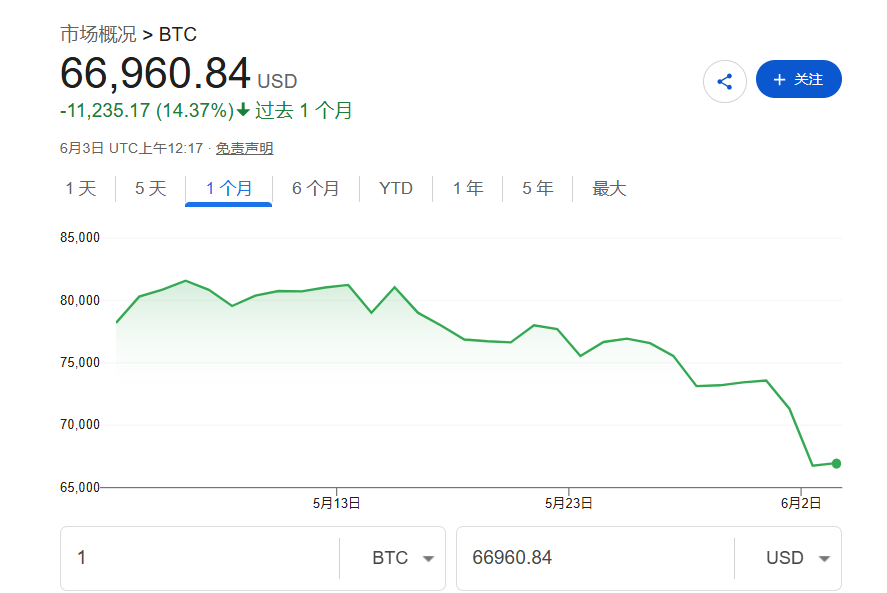
Bitcoin has been declining recently. It once fell to $66,123 intraday, hitting a two-month low, and was last quoted at $66,620; Ethereum dropped to $1,837 during the same period, a three-month low, and was last quoted at $1,855.

There are several explanations circulating in the market: ETF outflows, tense geopolitical situations, and an unexpected reduction by Strategy (formerly MicroStrategy). According to analysis by Bloomberg analyst Sid Verma, all these statements are correct, but they might only be superficial phenomena. The real issue is deeper—Bitcoin is losing an asset competition.

For a long time in the past, interest rates were near zero, holding cash meant depreciation; stock valuations were too high; AI was just a concept; and gold's gains were limited. Analysis points out that Bitcoin's competitor back then was not a specific asset, but "investors' dissatisfaction"—fear of inflation, discontent with existing options.

But now, the market has changed.
Losing Ground on Three Fronts

Analysts describe Bitcoin's current situation quite bluntly: it's stuck in an "awkward middle ground," under attack from three sides.

Hedge inflation? Gold wins. Investors worried about inflation are now more inclined to buy gold, energy stocks, and commodity producers, rather than Bitcoin. These assets have physical backing, pricing power, and a more straightforward logic.

Pursue growth? AI wins. Investors seeking high growth can now buy AI-benefiting companies with real revenue and real profits. Bitcoin doesn't generate cash flow and has no advantage in this race.

Gain crypto exposure? Stablecoins and infrastructure win. Even investors wanting crypto exposure don't necessarily have to buy Bitcoin. They can buy exchanges, stablecoin businesses, payment networks, tokenized finance companies—these targets' performance is directly linked to the actual adoption rate of the crypto industry, offering operating leverage and clearer logic.

To summarize in one sentence: Bitcoin is neither the best safe-haven asset, nor the best growth asset, nor the only crypto asset anymore.

Inflation Has Arrived, But Bitcoin Isn't Rising

One detail is quite telling.

This week, Cleveland Fed President Beth Hammack warned that inflation risks might be becoming "more persistent." A few years ago, such a statement would almost certainly have been interpreted by the market as positive for Bitcoin—high inflation, fiat depreciation, buy Bitcoin to hedge.

But this time, the market didn't react that way.

Investors' response to inflation has changed now—they are more inclined to buy assets with direct exposure to energy, commodities, and pricing power. Bitcoin's "digital gold" narrative is being eroded by actual gold and energy stocks.

ETF Outflows and Strategy's Reduction

Returning to the immediate triggers for this recent decline.

ETF outflows and Strategy's reduction—these events themselves are real. But Bloomberg's analysis believes treating them as the "cause" is a misreading—they are more like "symptoms," reflecting the same underlying reality: Capital has more places to go, and investors' demands on Bitcoin are also higher.

Investors are becoming more discerning: they don't just want "crypto exposure," they want to know what returns this exposure will bring, why Bitcoin and not something else.

The logic behind Bitcoin's bear market is no longer "it's a scam," "it's a bubble," "it's a failed technology." The new bear market logic is—Scarcity alone is no longer enough.


Related Questions

QAccording to the article, what is the new bear market logic for Bitcoin?

AThe new bear market logic is that scarcity itself is no longer sufficient. Investors now have more alternatives and are demanding clearer value propositions beyond just digital scarcity.

QWhat three key areas is Bitcoin losing ground in, according to the analyst's description?

ABitcoin is losing ground in three areas: 1) Hedging against inflation (to assets like gold and energy stocks), 2) Pursuing growth (to profitable AI companies), and 3) Gaining crypto exposure (to stablecoins and crypto infrastructure companies with clearer business models).

QHow did the market react to warnings about persistent inflation, and what does this indicate about Bitcoin's narrative?

AThe market did not react by buying Bitcoin, as it might have in the past. Instead, investors favored assets with direct exposure to energy, commodities, and pricing power. This indicates that Bitcoin's 'digital gold' narrative is being eroded by real gold and related assets.

QWhat does the article suggest is the real problem behind Bitcoin's recent price decline, beyond factors like ETF outflows?

AThe real, deeper problem is that Bitcoin is losing an asset competition. It is caught in an 'awkward middle ground' and is no longer seen as the best option for hedging, growth, or pure crypto exposure compared to newer, more specific alternatives.

QWhy are events like ETF outflows and Strategy's (MicroStrategy) share sale considered 'symptoms' rather than the 'cause' of Bitcoin's issues?

AThey are considered symptoms because they reflect the underlying reality that capital now has more attractive places to go. Investors are becoming more selective and demanding higher justification for holding Bitcoin over other assets.

Related Reads

a16z: Why Prediction Markets Could Become the Infrastructure for 'Future Probabilities'

The article explores the concept and potential of prediction markets, arguing that they are evolving from niche trading tools into a foundational infrastructure for assessing the probability of future events. A prediction market creates tradable contracts on specific event outcomes, using market price to aggregate dispersed information and approximate a collective probability assessment. This mechanism offers advantages over polls or expert forecasts by providing a real-time, incentivized signal, as participants risk real money on their judgments. Key strengths include the ability to generate probabilistic estimates, built-in financial incentives that encourage genuine information gathering, and the capacity to address specialized questions (e.g., AI model performance, geopolitical events) not easily captured by traditional financial markets. The author emphasizes that a prediction market is essentially a market—a tool for both resource allocation and information aggregation. However, the article also outlines significant challenges for reliability and effectiveness. Success depends on participation from well-informed traders, thoughtful contract design, unambiguous outcome resolution, and robust safeguards against manipulation (e.g., by insiders or groups seeking to influence public perception). Without these, prices may be mere noise or tools for propaganda. The future of prediction markets, therefore, lies not simply in scaling up trading volume, but in building more credible and transparent infrastructure. This includes clear rules for participation, auditable settlement mechanisms, and designs that mitigate manipulation. If these challenges can be addressed, prediction markets could become a vital public utility for navigating uncertainty, providing a new class of probability signals about the future.

marsbit38m ago

a16z: Why Prediction Markets Could Become the Infrastructure for 'Future Probabilities'

marsbit38m ago

Trading

Spot
Futures

Hot Articles

What is $BITCOIN

DIGITAL GOLD ($BITCOIN): A Comprehensive Analysis Introduction to DIGITAL GOLD ($BITCOIN) DIGITAL GOLD ($BITCOIN) is a blockchain-based project operating on the Solana network, which aims to combine the characteristics of traditional precious metals with the innovation of decentralized technologies. While it shares a name with Bitcoin, often referred to as “digital gold” due to its perception as a store of value, DIGITAL GOLD is a separate token designed to create a unique ecosystem within the Web3 landscape. Its goal is to position itself as a viable alternative digital asset, although specifics regarding its applications and functionalities are still developing. What is DIGITAL GOLD ($BITCOIN)? DIGITAL GOLD ($BITCOIN) is a cryptocurrency token explicitly designed for use on the Solana blockchain. In contrast to Bitcoin, which provides a widely recognized value storage role, this token appears to focus on broader applications and characteristics. Notable aspects include: Blockchain Infrastructure: The token is built on the Solana blockchain, known for its capacity to handle high-speed and low-cost transactions. Supply Dynamics: DIGITAL GOLD has a maximum supply capped at 100 quadrillion tokens (100P $BITCOIN), although details regarding its circulating supply are currently undisclosed. Utility: While precise functionalities are not explicitly outlined, there are indications that the token could be utilized for various applications, potentially involving decentralized applications (dApps) or asset tokenization strategies. Who is the Creator of DIGITAL GOLD ($BITCOIN)? At present, the identity of the creators and development team behind DIGITAL GOLD ($BITCOIN) remains unknown. This situation is typical among many innovative projects within the blockchain space, particularly those aligning with decentralized finance and meme coin phenomena. While such anonymity may foster a community-driven culture, it intensifies concerns about governance and accountability. Who are the Investors of DIGITAL GOLD ($BITCOIN)? The available information indicates that DIGITAL GOLD ($BITCOIN) does not have any known institutional backers or prominent venture capital investments. The project seems to operate on a peer-to-peer model focused on community support and adoption rather than traditional funding routes. Its activity and liquidity are primarily situated on decentralized exchanges (DEXs), such as PumpSwap, rather than established centralized trading platforms, further highlighting its grassroots approach. How DIGITAL GOLD ($BITCOIN) Works The operational mechanics of DIGITAL GOLD ($BITCOIN) can be elaborated on based on its blockchain design and network attributes: Consensus Mechanism: By leveraging Solana’s unique proof-of-history (PoH) combined with a proof-of-stake (PoS) model, the project ensures efficient transaction validation contributing to the network's high performance. Tokenomics: While specific deflationary mechanisms have not been extensively detailed, the vast maximum token supply implies that it may cater to microtransactions or niche use cases that are still to be defined. Interoperability: There exists the potential for integration with Solana’s broader ecosystem, including various decentralized finance (DeFi) platforms. However, the details regarding specific integrations remain unspecified. Timeline of Key Events Here is a timeline that highlights significant milestones concerning DIGITAL GOLD ($BITCOIN): 2023: The initial deployment of the token occurs on the Solana blockchain, marked by its contract address. 2024: DIGITAL GOLD gains visibility as it becomes available for trading on decentralized exchanges like PumpSwap, allowing users to trade it against SOL. 2025: The project witnesses sporadic trading activity and potential interest in community-led engagements, although no noteworthy partnerships or technical advancements have been documented as of yet. Critical Analysis Strengths Scalability: The underlying Solana infrastructure supports high transaction volumes, which could enhance the utility of $BITCOIN in various transaction scenarios. Accessibility: The potential low trading price per token could attract retail investors, facilitating wider participation due to fractional ownership opportunities. Risks Lack of Transparency: The absence of publicly known backers, developers, or an audit process may yield skepticism regarding the project's sustainability and trustworthiness. Market Volatility: The trading activity is heavily reliant on speculative behavior, which can result in significant price volatility and uncertainty for investors. Conclusion DIGITAL GOLD ($BITCOIN) emerges as an intriguing yet ambiguous project within the rapidly evolving Solana ecosystem. While it attempts to leverage the “digital gold” narrative, its departure from Bitcoin's established role as a store of value underscores the need for a clearer differentiation of its intended utility and governance structure. Future acceptance and adoption will likely depend on addressing the current opacity and defining its operational and economic strategies more explicitly. Note: This report encompasses synthesised information available as of October 2023, and developments may have transpired beyond the research period.

363 Total ViewsPublished 2025.05.13Updated 2025.05.13

What is $BITCOIN

Discussions

Welcome to the HTX Community. Here, you can stay informed about the latest platform developments and gain access to professional market insights. Users' opinions on the price of BTC (BTC) are presented below.

活动图片