Bitcoin Market Faces A Potential Profitability Reset As More Coins Slip Out Of Profit

bitcoinistPublished on 2026-06-12Last updated on 2026-06-12

Abstract

The Bitcoin market is experiencing significant pressure, with the price dropping to around $61,000, leading to a sharp decline in the percentage of BTC supply held in profit. Analysts note this metric is approaching a critical 45% threshold, historically associated with market stress and a potential "profitability reset." This shift indicates broad-based weakness, moving many holders from unrealized gains to losses, which often helps eliminate excess market speculation. The process involves a redistribution of coins from weaker to longer-term investors, potentially creating short-term volatility but a healthier market structure over time. While not pinpointing a market bottom, such low profitability levels have coincided with capitulation risks and long-term buying opportunities in past cycles. Current analysis points to key liquidity zones at $64,000-$66,500 (upside) and $58,000-$60,000 (downside), with the market undergoing a deep reset rather than a euphoric phase.

The Bitcoin market continues to take a hit, and investors both big and small are heavily feeling the ongoing market pressure, which has caused its price to drop to $61,000. The amount of BTC in profit territory is steadily dropping following the recent decline in price, putting the market in a more bearish condition.

Supply In Profit Contracts Amid Waning Bitcoin Price Action

With a substantial fall in the percentage of circulating supply held in profit, Bitcoin is nearing a turning point. After the sharp decline, crypto analysts suggest that the market is drawing closer to what they describe as a historical profitability reset.

CryptoZone highlighted in a CryptoQuant Quicktake post that the BTC on-chain structure is showing signs of a significant profitability contraction as the percentage of supply on profit metric falls toward the 45% threshold. Historically, this zone has coincided with periods of heightened market stress, where a large share of market players move from unrealized gains to unrealized losses.

According to the expert, this decline indicates that the recent price weakness is having a broad impact across the network rather than being limited to a small group of holders. With profitability metrics rapidly changing, this trend offers clues to the balance between fear, capitulation, and opportunity.
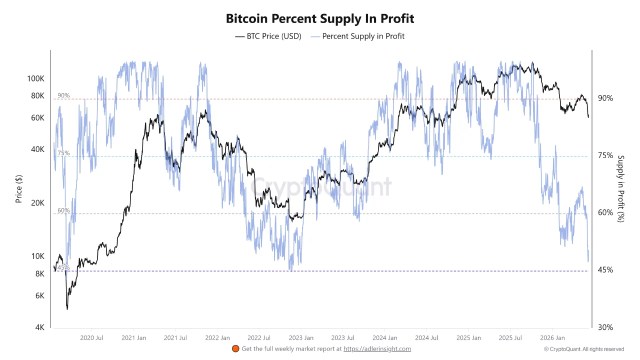
Source: Chart from CryptoZone on CryptoQuant

During previous market cycles, the expert stated that profitability levels above 90% were often linked to strong bullish momentum and widespread investor confidence. In contrast, when the metrics drop to 45%, it usually unfolds during late-stage corrections when sentiment becomes increasingly pessimistic.

Since the current correction began, a substantial portion of Bitcoin supply has already lost its profit cushion, reflecting a meaningful reset in market expectations. From an on-chain perspective, profitability compression is frequently used as a method to eliminate excess speculation from the market.

A Redistribution Process For The BTC Market

As weaker holders take out their positions under pressure, coins are slowly migrating toward investors with longer investment horizons. This redistribution process can generate short-term volatility. However, in the past, it has contributed to healthier market structures over time.

The metric nearing the 45% level is a development that should be monitored closely. While no single metric can determine an exact market bottom, previous cycles suggest that profitability readings in this range mostly occur with elevated capitulation risk and the emergence of long-term accumulation opportunities.

Currently, the data underscores a market that is witnessing a deep reset rather than operating on a phase of euphoria, highlighting the importance of monitoring holder behavior in the upcoming weeks. Crypto analyst Ted Pillows noted that Bitcoin is demonstrating decent liquidity clusters to both upside and downside.

On the upside, the crypto king has short-side liquidity around the $64,000 to $66,500 zone. Meanwhile, on the downside, BTC showcases long-side liquidity around the $58,000 to $60,000 range. Despite the significant decline, fresh longs are still coming in.

BTC trading at $62,775 on the 1D chart | Source: BTCUSDT on Tradingview.com

Related Questions

QAccording to the article, what is the significance of the Bitcoin 'supply in profit' metric approaching the 45% threshold?

AHistorically, the 45% threshold for the 'supply in profit' metric has coincided with periods of heightened market stress and late-stage corrections, where a large share of market players move from unrealized gains to unrealized losses. It signals a potential profitability reset and often occurs alongside elevated capitulation risk and the emergence of long-term accumulation opportunities.

QWhat are the current upside and downside liquidity clusters for Bitcoin as mentioned by crypto analyst Ted Pillows?

AAccording to analyst Ted Pillows, Bitcoin has short-side liquidity (upside) around the $64,000 to $66,500 zone. On the downside, it showcases long-side liquidity around the $58,000 to $60,000 range.

QWhat broader impact does the decline in the percentage of Bitcoin supply in profit indicate, according to the expert from CryptoZone?

AThe decline indicates that the recent price weakness is having a broad impact across the entire Bitcoin network, rather than being limited to just a small group of holders. It reflects a meaningful reset in market expectations and offers clues to the balance between fear, capitulation, and opportunity.

QHow does the article describe the process happening in the BTC market as weaker holders exit their positions?

AThe article describes it as a redistribution process. As weaker holders exit their positions under pressure, their coins slowly migrate toward investors with longer investment horizons. While this can generate short-term volatility, historically it has contributed to healthier market structures over time.

QWhat historical profitability levels are linked to strong bullish momentum, and what does the current level suggest about the market phase?

AHistorically, profitability levels above 90% are often linked to strong bullish momentum and widespread investor confidence. The current data, with metrics nearing 45%, underscores a market witnessing a deep reset rather than operating in a phase of euphoria, highlighting the importance of monitoring holder behavior.

Related Reads

Retail Ecology Dwindles, ZKsync Bets on Bank Pilots for a Breakthrough

Amidst declining retail activity, ZKsync is pivoting to target institutional banking as its primary growth strategy. The article explores this shift, contrasting it with the competitive "survival of the fittest" narrative by highlighting a cooperative model inspired by naturalist Peter Kropotkin. ZKsync is developing infrastructure like its private, permissioned Prividium suite for banks (e.g., Deutsche Bank's use case via Memento), enabling private transactions with public verifiability via zero-knowledge proofs. This appeals to institutions needing privacy, compliance, and Ethereum-based settlement security, unlike fully private chains (e.g., JPMorgan's Kinaxis) or consortium models (e.g., R3 Corda). However, this strategic focus has coincided with a steep decline in its public DeFi ecosystem, evidenced by plunging TVL and the departure of major protocols like Aave due to low fees. The network's future now hinges on banking adoption, with upcoming pilots like the Cari Network involving regional banks holding over $600 billion in deposits. A significant challenge is balancing this institutional focus with ZKsync's decentralized governance. Banks must operate on a network where rules and fees (denominated in the volatile ZK token) can be changed via community vote, and where a Security Council holds emergency control—a stark contrast to the predictable, contract-bound environments of traditional finance. The coming 18 months will test whether ZKsync can successfully onboard traditional banks onto a dynamically governed public chain or if institutions will ultimately revert to proprietary solutions.

Foresight News31m ago

Retail Ecology Dwindles, ZKsync Bets on Bank Pilots for a Breakthrough

Foresight News31m ago

The Recursive AI Anthropic Warned About: Tian Yuandong's New Company Has Just Taken the "First Step"

Anthropic recently highlighted the rapid progress toward "recursive self-improvement," where AI systems autonomously design and train their successors. In response, Recursive Superintelligence, a new company co-founded by former Meta researcher Tian Yuan Dong, has publicly demonstrated its first step toward automating AI research. The company released a system designed to autonomously execute the full AI research cycle: generating ideas, implementing code, running experiments, and learning from results. It validated this approach by achieving state-of-the-art results on three diverse benchmarks: 1. **NanoChat Autoresearch:** Optimizing a small language model's validation loss under a fixed 5-minute GPU budget, improving upon the community's best result. 2. **NanoGPT Speedrun:** Reducing the time to train a GPT model to a specific loss on 8 H100 GPUs from 79.7 seconds to 77.5 seconds, beating a highly optimized, human-driven community effort. 3. **SOL-ExecBench:** Improving the overall score on NVIDIA's suite of 235 GPU kernel optimization tasks by 18%, closing the gap to the hardware limit. The system discovered novel optimizations in this highly specialized domain without direct human expertise. Recursive's system operates as a general framework, capable of parallel exploration and cross-task knowledge transfer while incorporating safeguards against reward hacking. The company, backed by $650M in funding and a star-studded team including Richard Socher and Alexey Dosovitskiy, aims to create AI that recursively enhances its own research capabilities. This development represents an early but concrete move toward a new paradigm where AI accelerates its own advancement. It occurs alongside Anthropic's warnings about the need for industry coordination and potential pauses when recursive self-improvement thresholds are reached, highlighting the dual trajectory of rapid technical progress and growing calls for careful stewardship.

marsbit38m ago

The Recursive AI Anthropic Warned About: Tian Yuandong's New Company Has Just Taken the "First Step"

marsbit38m ago

The Gold Buy-on-the-Dip Guide: Watch Interest Rates, Not Just War

"Gold Buying Guide: Focus on Interest Rates, Not Just War" Four months ago, gold buyers likely didn't anticipate buying at a peak that even a war couldn't sustain. After hitting a record high of $5,596 on January 29, gold entered a bear market just 91 days later, its fastest decline since 2008. A key trigger was the Fed's hawkish shift, highlighting that monetary policy, not geopolitics, is the primary driver. The article argues that the traditional "buy gold in turmoil" script has changed. While the US-Iran conflict initially boosted prices, the sustained rally in oil prices heightened inflation fears, forcing central banks to maintain or consider tighter policy. Since gold yields no interest, higher rates increase its opportunity cost, eroding its appeal. This dynamic was evident when gold fell sharply on May 18 despite positive peace talks, as lower oil prices eased inflation and thus rate hike pressures. The recent sell-off is also part of a broader market deleveraging. Correlations between gold, Nasdaq, and Bitcoin spiked as leveraged investors sold liquid assets to cover losses, creating a synchronized downturn. Historically, gold bottoms align with policy shifts, not conflict resolutions. The 2008 and 2022 bear markets ended with shifts to extreme easing and peak inflation expectations, respectively. For potential buyers, the author suggests monitoring three signals: 1) Peak interest rate hike expectations, 2) Reopening of the Strait of Hormuz (to ease oil/inflation pressure), and 3) A return to net inflows for Gold ETFs, indicating the end of forced selling. While predicting the exact bottom is impossible, the author's personal strategy involves scaling into a position across price levels like $4000, $3700, and $3500, committing no more than 30% of the intended total allocation initially, and adding the remainder only if key signals emerge. The core conclusion: In turbulent times, watching interest rates is more crucial than watching wars.

marsbit44m ago

The Gold Buy-on-the-Dip Guide: Watch Interest Rates, Not Just War

marsbit44m ago

Recent On-Chain Review: No Clear Narrative Under U.S. Stock Market Pressure, Just Hype

This article analyzes the current state of the Solana meme coin and community token ecosystem, highlighting a market caught between two dominant forces: attention-based PvP and a gradual return to community-centric projects. The first part explores the "Attention PvP" dynamic, where success is driven by celebrity endorsements, viral events, and speed. Examples include $JOTCHUA, which surged after its meme creator's social media activity, and $WORLDCUP, which outperformed a similar Base chain project ($PITCH) largely due to influencer support. The recent "pump.fun GO" feature, allowing bounty tasks for token promotion, is critiqued for fostering sensationalist and often negative stunts—like people getting token tickers tattooed on their bodies for rewards—reminiscent of old internet shock content. In contrast, the article points to a resurgence of organic, community-driven tokens that survive market volatility through strong holder bases and shared ideology, not just hype. Influencer Ansem is cited, arguing that durable meme coins rely on communities willing to endure losses and promote their core message daily. Examples given are older tokens like $neet (anti-work ethos), $troll, $buttcoin, and $triplet, which have maintained relative price stability. A prime example of this community-build model is the new project $KINS, the token for the browser-based MMORPG Kintara. Its success stems not from advanced graphics but from consistently delivering updates, fostering player trust, and creating genuine engagement (e.g., in-game economies, events, property auctions). It has attracted a growing player base and even notable KOLs as participants, demonstrating that sustainable growth can come from building trust rather than orchestrating pumps. The article concludes by questioning whether the market is ultimately a game of mutual trust or mutual deception, expressing hope that such reflection might lead to a healthier ecosystem.

marsbit45m ago

Recent On-Chain Review: No Clear Narrative Under U.S. Stock Market Pressure, Just Hype

marsbit45m ago

Trading

Spot
Futures

Hot Articles

What is $BITCOIN

DIGITAL GOLD ($BITCOIN): A Comprehensive Analysis Introduction to DIGITAL GOLD ($BITCOIN) DIGITAL GOLD ($BITCOIN) is a blockchain-based project operating on the Solana network, which aims to combine the characteristics of traditional precious metals with the innovation of decentralized technologies. While it shares a name with Bitcoin, often referred to as “digital gold” due to its perception as a store of value, DIGITAL GOLD is a separate token designed to create a unique ecosystem within the Web3 landscape. Its goal is to position itself as a viable alternative digital asset, although specifics regarding its applications and functionalities are still developing. What is DIGITAL GOLD ($BITCOIN)? DIGITAL GOLD ($BITCOIN) is a cryptocurrency token explicitly designed for use on the Solana blockchain. In contrast to Bitcoin, which provides a widely recognized value storage role, this token appears to focus on broader applications and characteristics. Notable aspects include: Blockchain Infrastructure: The token is built on the Solana blockchain, known for its capacity to handle high-speed and low-cost transactions. Supply Dynamics: DIGITAL GOLD has a maximum supply capped at 100 quadrillion tokens (100P $BITCOIN), although details regarding its circulating supply are currently undisclosed. Utility: While precise functionalities are not explicitly outlined, there are indications that the token could be utilized for various applications, potentially involving decentralized applications (dApps) or asset tokenization strategies. Who is the Creator of DIGITAL GOLD ($BITCOIN)? At present, the identity of the creators and development team behind DIGITAL GOLD ($BITCOIN) remains unknown. This situation is typical among many innovative projects within the blockchain space, particularly those aligning with decentralized finance and meme coin phenomena. While such anonymity may foster a community-driven culture, it intensifies concerns about governance and accountability. Who are the Investors of DIGITAL GOLD ($BITCOIN)? The available information indicates that DIGITAL GOLD ($BITCOIN) does not have any known institutional backers or prominent venture capital investments. The project seems to operate on a peer-to-peer model focused on community support and adoption rather than traditional funding routes. Its activity and liquidity are primarily situated on decentralized exchanges (DEXs), such as PumpSwap, rather than established centralized trading platforms, further highlighting its grassroots approach. How DIGITAL GOLD ($BITCOIN) Works The operational mechanics of DIGITAL GOLD ($BITCOIN) can be elaborated on based on its blockchain design and network attributes: Consensus Mechanism: By leveraging Solana’s unique proof-of-history (PoH) combined with a proof-of-stake (PoS) model, the project ensures efficient transaction validation contributing to the network's high performance. Tokenomics: While specific deflationary mechanisms have not been extensively detailed, the vast maximum token supply implies that it may cater to microtransactions or niche use cases that are still to be defined. Interoperability: There exists the potential for integration with Solana’s broader ecosystem, including various decentralized finance (DeFi) platforms. However, the details regarding specific integrations remain unspecified. Timeline of Key Events Here is a timeline that highlights significant milestones concerning DIGITAL GOLD ($BITCOIN): 2023: The initial deployment of the token occurs on the Solana blockchain, marked by its contract address. 2024: DIGITAL GOLD gains visibility as it becomes available for trading on decentralized exchanges like PumpSwap, allowing users to trade it against SOL. 2025: The project witnesses sporadic trading activity and potential interest in community-led engagements, although no noteworthy partnerships or technical advancements have been documented as of yet. Critical Analysis Strengths Scalability: The underlying Solana infrastructure supports high transaction volumes, which could enhance the utility of $BITCOIN in various transaction scenarios. Accessibility: The potential low trading price per token could attract retail investors, facilitating wider participation due to fractional ownership opportunities. Risks Lack of Transparency: The absence of publicly known backers, developers, or an audit process may yield skepticism regarding the project's sustainability and trustworthiness. Market Volatility: The trading activity is heavily reliant on speculative behavior, which can result in significant price volatility and uncertainty for investors. Conclusion DIGITAL GOLD ($BITCOIN) emerges as an intriguing yet ambiguous project within the rapidly evolving Solana ecosystem. While it attempts to leverage the “digital gold” narrative, its departure from Bitcoin's established role as a store of value underscores the need for a clearer differentiation of its intended utility and governance structure. Future acceptance and adoption will likely depend on addressing the current opacity and defining its operational and economic strategies more explicitly. Note: This report encompasses synthesised information available as of October 2023, and developments may have transpired beyond the research period.

363 Total ViewsPublished 2025.05.13Updated 2025.05.13

What is $BITCOIN

Discussions

Welcome to the HTX Community. Here, you can stay informed about the latest platform developments and gain access to professional market insights. Users' opinions on the price of BTC (BTC) are presented below.

活动图片