Roll the Dice, Win BTC! WEEX Launches "World Cup x Monopoly" with Millions in USDT Giveaway

marsbitPublished on 2026-06-11Last updated on 2026-06-11

Abstract

"WEEX, a leading crypto exchange and official partner of LALIGA in Taiwan and Hong Kong, has launched the 'World Cup x Monopoly: Win Millions in USDT' event to celebrate the 2026 World Cup in North America. Running from June 11 to July 20, the activity combines a Monopoly-style 3D board game with football-themed rewards. Users can earn dice by completing tasks like signing up, depositing over 100 USDT, trading contracts or WXT spot, inviting friends, and using dice. Throwing dice moves them across the board to win prizes such as BTC, ETH, USDT airdrops, trial funds, and more dice. Participants also earn points by advancing on the board and completing weekly trading tasks. These points unlock milestone rewards, with top tiers offering up to 1,000 USDT. Additionally, points can be used in a World Cup match prediction game featuring dynamic odds, where supporting underdog teams yields higher potential returns. A live leaderboard ensures transparency. WEEX aims to merge football excitement with Web3 engagement through this major promotional campaign."

In the summer of 2026, the global football world officially enters the largest-ever "North American Carnival Season"! This is not only the first FIFA World Cup jointly hosted by the United States, Canada, and Mexico, but also the first with an expanded field of 48 teams and a record 104 matches. From the Azteca Stadium in Mexico City to the MetLife Stadium in New York, this sporting storm spanning four time zones is igniting the passion of billions of fans worldwide with unprecedented heat.

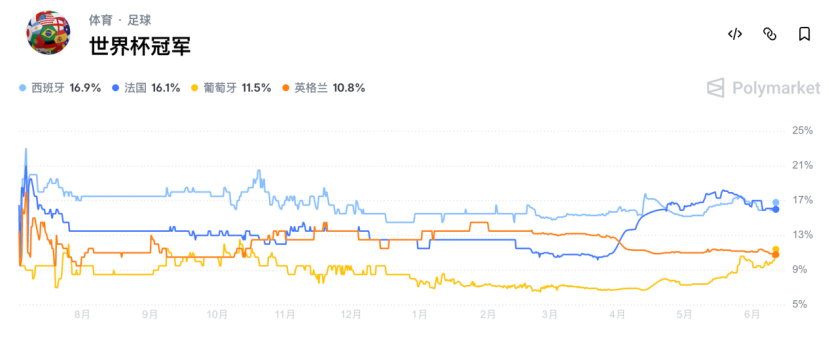
Latest data from the on-chain prediction platform Polymarket shows global capital is fiercely competing to predict the champion, with Spain currently topping the list with a 16.9% probability, followed closely by France (16.1%), Portugal (11.5%), and England (10.8%).
As a super incubator for the world's top football stars, LALIGA supplies this World Cup with a dense concentration of competitive talent. And as the official partner of LALIGA in the Taiwan and Hong Kong regions, the renowned crypto exchange WEEX is linking the passion of football with the future of digital assets—WEEX has grandly launched the "World Cup × Monopoly: Participate to Win Millions in USDT" mega-themed trading rewards event, allowing everyone to enjoy the football feast while opening the door to a wealth carnival!
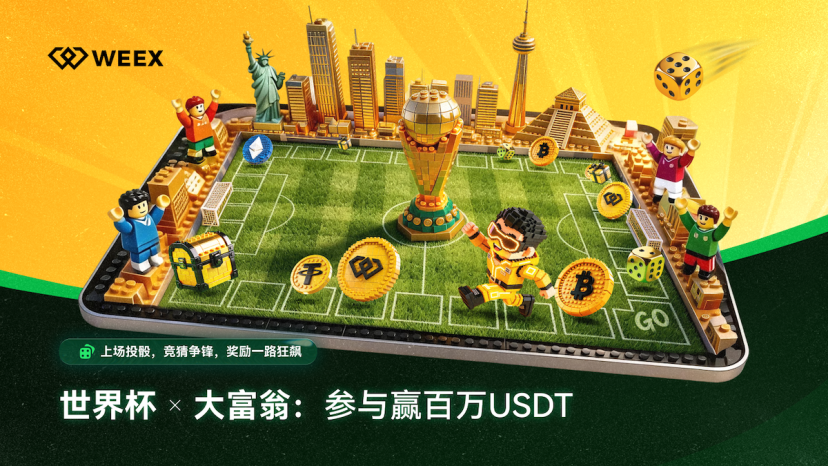
This event perfectly combines the classic Monopoly board game with interactive World Cup match activities. Starting officially at 00:00 on June 11 (UTC+8) and running through July 20, 23:59:59, it spans the entire World Cup season. The event features a low participation threshold and highly engaging interactive gameplay, consisting mainly of four core sections:

1. Complete Tasks, Get Dice

During the event, users can earn dice rewards by completing specified tasks:

Register for Event: Click the link https://www.weex.com/zh-CN/events/roll/world-cup-dice-rush to register and receive 1 die;

Deposit: Deposit a minimum of 100 USDT and maintain that balance for 1 full day to receive 1 die;

Contract Trading: After reaching the daily/cumulative contract trading volume requirements, manually claim dice rewards;

Spot Trading: After reaching the daily WXT spot trading volume requirement, manually claim dice rewards;

Use Dice: After the number of dice throws reaches the task requirement during the event, manually claim dice rewards;

Invite Friends: Invite friends to participate during the event, and after the cumulative number of valid invites reaches the requirement, manually claim dice rewards.

Different tasks correspond to different numbers of dice rewards. For details, please check the event page (https://www.weex.com/zh-CN/events/roll/world-cup-dice-rush).

2. Roll the Dice, Unlock Board Rewards

Once you have dice, you can roll them on the exquisite 3D Monopoly board.
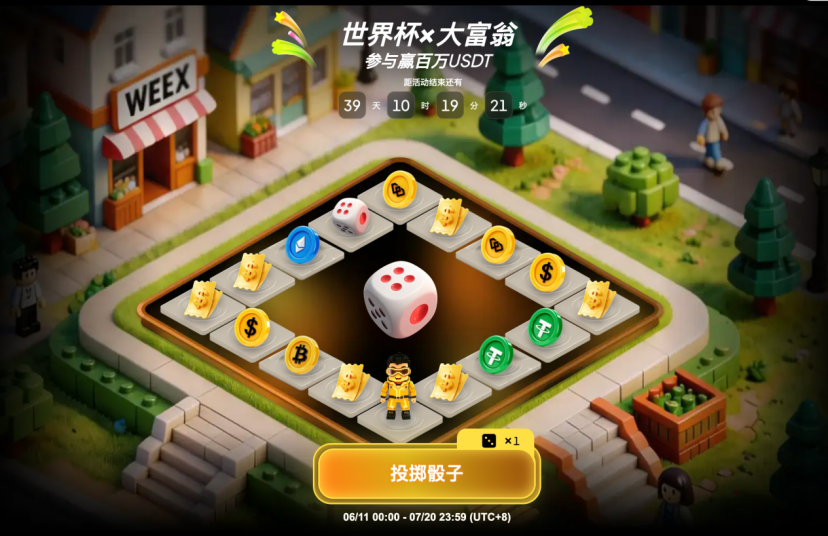
After rolling, advance on the board according to the dice number. Landing on the corresponding square grants you rewards, including: BTC, ETH, USDT airdrops, USDT trial funds, voucher airdrops, as well as dice and points rewards.
3. Accumulate Points, Unlock Milestone Rewards

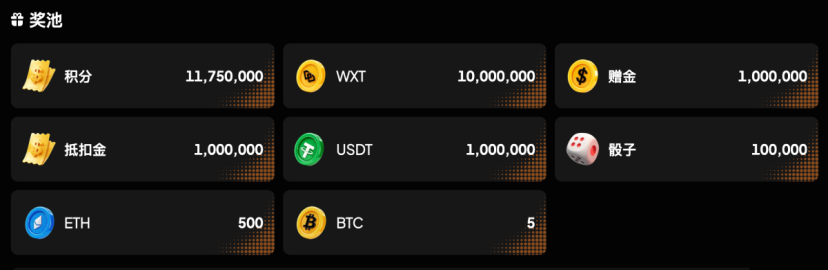
Users earn points by rolling dice to advance on the board and completing weekly trading tasks. Accumulated points unlock milestone rewards, including USDT, WXT airdrops, and USDT trial funds/vouchers. The higher the points, the more rewards you can unlock, with a single milestone offering up to 1,000 USDT.

4. Use Points for Match Interaction, Win More Points

You can also use your points to participate in World Cup match interactions, cheering for your supported team, aiming for bigger wins with small stakes to earn more points. WEEX introduces a dynamic odds mechanism: the lower the support rate for a team, the higher the potential points reward.
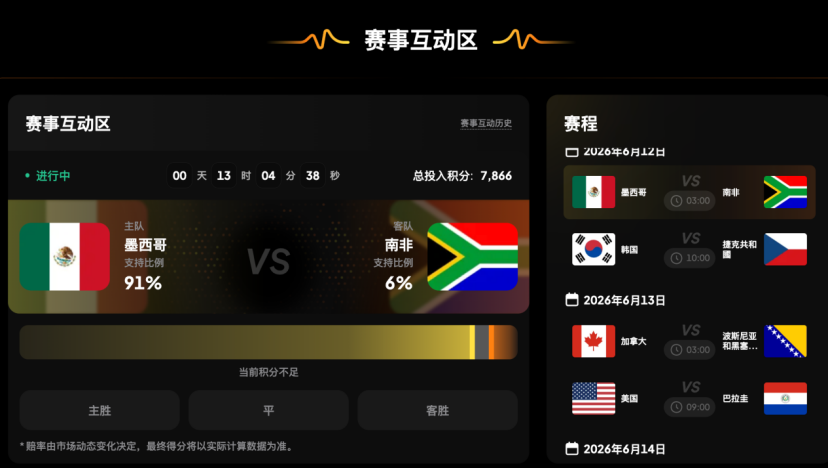
During the event, WEEX's official website will publish a real-time points leaderboard to ensure transparency and fairness. Users can check their own or other players' ranking data in real time.

As the World Cup whistle blows, the global fan carnival has already begun. As the official regional partner of LALIGA, WEEX not only provides you with a safe, smooth, and lightning-fast crypto asset trading experience but also infuses the beautiful game with a brand-new Web3 gameplay this summer. Quickly click the event link (https://www.weex.com/events/roll/world-cup-dice-rush) and join this Monopoly carnival with millions in USDT!

Related Questions

QWhat is the theme of the trading reward event launched by WEEX that coincides with the 2026 FIFA World Cup?

AThe theme is 'World Cup x Monopoly: Participate to Win Millions in USDT'. It combines the classic Monopoly board game with World Cup event interactions.

QAccording to the article, which team currently has the highest probability of winning the 2026 World Cup according to data from the on-chain prediction platform Polymarket?

AAccording to Polymarket data, Spain currently has the highest probability of winning at 16.9%.

QWhat are the four main components or core sections of the WEEX 'World Cup x Monopoly' event as outlined in the article?

AThe four core sections are: 1. Complete tasks to earn dice. 2. Roll dice to unlock board rewards. 3. Accumulate points to unlock milestone rewards. 4. Use points to participate in matchday interactions to win more points.

QWhat partnership does WEEX have that is mentioned in relation to the 2026 FIFA World Cup?

AWEEX is the official regional partner for LALIGA in Taiwan and Hong Kong. LALIGA is mentioned as a super incubator for top global football stars who will compete in the World Cup.

QHow can users earn dice (rolls) during the WEEX 'World Cup x Monopoly' event? Name at least two methods mentioned.

AUsers can earn dice by: 1. Registering/signing up for the event. 2. Making a deposit of 100 USDT or more and maintaining it for 1 day. 3. Meeting daily or cumulative contract trading volume targets. 4. Meeting daily WXT spot trading volume targets. 5. Using a certain number of dice (rolls). 6. Successfully inviting friends to participate.

Related Reads

The Largest IPO in History Ignites Heated Debate: Is SpaceX Worth $1.77 Trillion?

SpaceX's potential IPO is priced at $135 per share, aiming to raise $75 billion and valuing the company at approximately $1.77 trillion, which would make it the largest IPO in history. This valuation has sparked intense debate among investors. Bullish analysts, including major underwriters Goldman Sachs and Morgan Stanley, argue the valuation is justified by SpaceX's long-term potential. They see it not just as a rocket company but as a future leader in space infrastructure, with key growth drivers being Starlink satellite internet, low-cost rocket launches, and future AI-related ventures. They project revenues reaching hundreds of billions to trillions of dollars by 2030-2040. ARK Invest's model suggests a 2030 enterprise value could reach $2.5 trillion. Bearish analysts from independent research firms like Morningstar, PitchBook, and New Constructs contend the IPO price is excessively high, already pricing in unrealistic future growth. Using DCF and sum-of-the-parts models, they estimate fair value between $780 billion and $1.7 trillion, significantly below the IPO target. They highlight risks such as the speculative nature of AI projections, over-dependence on Elon Musk, high growth expectations, and corporate governance concerns. Trefis set a target price of just $79 per share. While both sides acknowledge SpaceX's unique position in commercial space, the core disagreement centers on whether the $135 share price offers a reasonable margin of safety or is overly optimistic. Despite the valuation controversy, reported strong demand for the IPO indicates significant market interest.

marsbit42m ago

The Largest IPO in History Ignites Heated Debate: Is SpaceX Worth $1.77 Trillion?

marsbit42m ago

After the Passage of the GENIUS Act and the CLARITY Act, What Is the Correct Architecture for On-Chain Yield?

The article discusses the evolution of on-chain credit, distinguishing three markets: overcollateralized crypto lending, unsecured lending (largely unsuccessful), and asset-backed credit (ABC). ABC, backed by identifiable real-world collateral with legal recourse, is identified as the fastest-growing category and the only one credibly addressing adverse selection—the core problem in credit where the riskiest borrowers self-select. Current growth in on-chain Real World Assets (RWAs), particularly tokenized private credit funds (e.g., Maple Finance, Centrifuge), is substantial but often merely "wraps" existing fund structures, inheriting their risks rather than solving adverse selection at the protocol level. The regulatory landscape is a key driver, with the US GENIUS Act (prohibiting stablecoin issuers from paying yield) and the proposed CLARITY Act (closing loopholes on indirect yield) set to redefine permissible yield-bearing products. This makes vaults (like ERC-4626) the critical architecture—they become the primary compliant vehicle for delivering yield, functioning as issuance, disclosure, distribution, and recovery mechanisms. The author's thesis is that the correct post-GENIUS/CLARITY architecture involves building ABC solutions where credit assessment, structure, and recovery are encoded directly into the smart contract vault layer, moving beyond mere tokenized fund wrappers to solve adverse selection fundamentally and ensure regulatory compliance.

Foresight News1h ago

After the Passage of the GENIUS Act and the CLARITY Act, What Is the Correct Architecture for On-Chain Yield?

Foresight News1h ago

TechFlow Intelligence Bureau: Anthropic's New Model Fable Sparks Controversy by Restricting Biosafety Research, US CPI Soars to 4.2%, a Three-Year High

**Summary of TechFlow Intelligence Report:** The newsletter covers several key tech and finance developments. In AI, Anthropic's new Fable model faced backlash for secretly limiting biomedical research capabilities and enforcing a 30-day data retention policy, prompting the company to promise more transparent adjustments. In a related story, Anthropic's founder revealed his departure from OpenAI was due to dishonesty from Sam Altman, not safety concerns. Meanwhile, OpenAI is considering significant price cuts to compete with Anthropic, potentially sparking a price war. In crypto/Web3, BlackRock filed a new amendment for a yield-generating Bitcoin ETF, while Bank of America's CEO warned that stablecoin yields could drain trillions from traditional banks. U.S. Senator Cynthia Lummis advocated for the U.S. to officially accumulate Bitcoin reserves. In hardware, Nvidia released the DiffusionGemma-2-6B image model optimized for efficient inference, and AMD promoted its unified memory architecture to challenge Nvidia's dominance. TSMC's CFO hinted at possible price increases due to soaring AI chip demand. A major legal ruling in Germany held Google legally responsible for inaccurate information generated by its AI Overviews feature. Google Chrome also moved to fully block ad-blocker workarounds like uBlock Origin. Macroeconomic headlines included U.S. CPI rising to 4.2% (a 3-year high) and Iran's complete closure of the Strait of Hormuz, raising oil price and inflation fears. South Korean markets saw continued volatility with massive foreign capital outflow. Other notable stories: Microsoft expanded its Copilot AI assistant "Mico" globally; a study found r/wallstreetbets users' stock picks outperformed Wall Street; a fully autonomous drone killed a human soldier for the first time, raising AI ethics concerns; and a Chinese hospital used brain-computer interface technology to help a blind person "see." The overarching theme connects debates over AI boundaries and responsibility (Anthropic's restrictions, Google's liability, lethal autonomous drones) with real-world economic and geopolitical turmoil (inflation, Strait of Hormuz closure, market instability), highlighting the tense interplay between technological advancement and global chaos.

marsbit1h ago

TechFlow Intelligence Bureau: Anthropic's New Model Fable Sparks Controversy by Restricting Biosafety Research, US CPI Soars to 4.2%, a Three-Year High

marsbit1h ago

Alibaba's Yet Another New Business Division: What Signal Does It Send?

Alibaba has established a new "Token Foundry" business unit, merging its Tongyi large model division and Future Life Lab. Led directly by Group CEO Wu Yongming, this marks the company's third significant AI organizational reshuffle in 2026, following the creation of the Alibaba Token Hub (ATH) and a Group Technology Committee. The move signals a strategic shift from consolidating AI resources to accelerating productization and commercialization. The "Token Foundry" name reflects Alibaba's ambition to become a foundational supplier in the AI era, focusing on model development and commercial application. Key teams, including those behind the high-performing HappyHorse video generation model, have been integrated into the new unit. Concurrently, Zhou Jingren, architect of the Qwen model series, has been appointed Group Chief Scientist to lead a new AI Future Research Institute, focusing on long-term technological breakthroughs like Agent capabilities. This restructuring creates a clear four-layer AI architecture within Alibaba: the research institute for frontier exploration, Token Foundry for core models and commercialization, MaaS for platform services, and business units like Qianwen (C端) and Wukong (B端) for end-user applications. The adjustments align with a global trend among tech giants like Google and Microsoft to centralize AI leadership under the CEO and deeply integrate research with business units. The urgency is driven by a narrowing competitive window. Alibaba has announced its AI business is now entering a commercialization phase, with AI-related revenue seeing triple-digit growth for eleven consecutive quarters. The company faces intense competition in the MaaS (Model-as-a-Service) sector from rivals like ByteDance and Tencent. The Token Foundry initiative represents Alibaba's effort to streamline execution and enhance competitiveness in this critical, fast-evolving landscape.

marsbit2h ago

Alibaba's Yet Another New Business Division: What Signal Does It Send?

marsbit2h ago

Trading

Spot
Futures

Hot Articles

What is $BITCOIN

DIGITAL GOLD ($BITCOIN): A Comprehensive Analysis Introduction to DIGITAL GOLD ($BITCOIN) DIGITAL GOLD ($BITCOIN) is a blockchain-based project operating on the Solana network, which aims to combine the characteristics of traditional precious metals with the innovation of decentralized technologies. While it shares a name with Bitcoin, often referred to as “digital gold” due to its perception as a store of value, DIGITAL GOLD is a separate token designed to create a unique ecosystem within the Web3 landscape. Its goal is to position itself as a viable alternative digital asset, although specifics regarding its applications and functionalities are still developing. What is DIGITAL GOLD ($BITCOIN)? DIGITAL GOLD ($BITCOIN) is a cryptocurrency token explicitly designed for use on the Solana blockchain. In contrast to Bitcoin, which provides a widely recognized value storage role, this token appears to focus on broader applications and characteristics. Notable aspects include: Blockchain Infrastructure: The token is built on the Solana blockchain, known for its capacity to handle high-speed and low-cost transactions. Supply Dynamics: DIGITAL GOLD has a maximum supply capped at 100 quadrillion tokens (100P $BITCOIN), although details regarding its circulating supply are currently undisclosed. Utility: While precise functionalities are not explicitly outlined, there are indications that the token could be utilized for various applications, potentially involving decentralized applications (dApps) or asset tokenization strategies. Who is the Creator of DIGITAL GOLD ($BITCOIN)? At present, the identity of the creators and development team behind DIGITAL GOLD ($BITCOIN) remains unknown. This situation is typical among many innovative projects within the blockchain space, particularly those aligning with decentralized finance and meme coin phenomena. While such anonymity may foster a community-driven culture, it intensifies concerns about governance and accountability. Who are the Investors of DIGITAL GOLD ($BITCOIN)? The available information indicates that DIGITAL GOLD ($BITCOIN) does not have any known institutional backers or prominent venture capital investments. The project seems to operate on a peer-to-peer model focused on community support and adoption rather than traditional funding routes. Its activity and liquidity are primarily situated on decentralized exchanges (DEXs), such as PumpSwap, rather than established centralized trading platforms, further highlighting its grassroots approach. How DIGITAL GOLD ($BITCOIN) Works The operational mechanics of DIGITAL GOLD ($BITCOIN) can be elaborated on based on its blockchain design and network attributes: Consensus Mechanism: By leveraging Solana’s unique proof-of-history (PoH) combined with a proof-of-stake (PoS) model, the project ensures efficient transaction validation contributing to the network's high performance. Tokenomics: While specific deflationary mechanisms have not been extensively detailed, the vast maximum token supply implies that it may cater to microtransactions or niche use cases that are still to be defined. Interoperability: There exists the potential for integration with Solana’s broader ecosystem, including various decentralized finance (DeFi) platforms. However, the details regarding specific integrations remain unspecified. Timeline of Key Events Here is a timeline that highlights significant milestones concerning DIGITAL GOLD ($BITCOIN): 2023: The initial deployment of the token occurs on the Solana blockchain, marked by its contract address. 2024: DIGITAL GOLD gains visibility as it becomes available for trading on decentralized exchanges like PumpSwap, allowing users to trade it against SOL. 2025: The project witnesses sporadic trading activity and potential interest in community-led engagements, although no noteworthy partnerships or technical advancements have been documented as of yet. Critical Analysis Strengths Scalability: The underlying Solana infrastructure supports high transaction volumes, which could enhance the utility of $BITCOIN in various transaction scenarios. Accessibility: The potential low trading price per token could attract retail investors, facilitating wider participation due to fractional ownership opportunities. Risks Lack of Transparency: The absence of publicly known backers, developers, or an audit process may yield skepticism regarding the project's sustainability and trustworthiness. Market Volatility: The trading activity is heavily reliant on speculative behavior, which can result in significant price volatility and uncertainty for investors. Conclusion DIGITAL GOLD ($BITCOIN) emerges as an intriguing yet ambiguous project within the rapidly evolving Solana ecosystem. While it attempts to leverage the “digital gold” narrative, its departure from Bitcoin's established role as a store of value underscores the need for a clearer differentiation of its intended utility and governance structure. Future acceptance and adoption will likely depend on addressing the current opacity and defining its operational and economic strategies more explicitly. Note: This report encompasses synthesised information available as of October 2023, and developments may have transpired beyond the research period.

363 Total ViewsPublished 2025.05.13Updated 2025.05.13

What is $BITCOIN

Discussions

Welcome to the HTX Community. Here, you can stay informed about the latest platform developments and gain access to professional market insights. Users' opinions on the price of BTC (BTC) are presented below.

活动图片