Rules Change Mid-Game, Polymarket’s Billion-Dollar Bitcoin Prediction Market Mired in Settlement Controversy

foresightnews_apiPublished on 2026-06-05Last updated on 2026-06-05

Abstract

A nearly $150 million prediction market contract on Polymarket is in turmoil after the platform refused to settle in favor of traders who correctly predicted that MicroStrategy (now Strategy) would sell Bitcoin. The core dispute revolves around a sale of 32 BTC, which occurred between May 26-31 but was officially disclosed in an SEC 8-K filing on June 1. The original contract stated it would resolve to "Yes" if Strategy sold any Bitcoin before May 31, 11:59 PM ET, using public disclosures and on-chain data as proof. After the filing on June 1, traders who saw the disclosure rushed to buy "Yes" contracts, believing it was conclusive evidence. However, Polymarket's operators later added a rule that the disclosure itself must occur by the deadline, not just the transaction, invalidating the filing as proof. This retroactive rule change has sparked accusations of market manipulation, leaving traders like "willo2," who invested $527,000, facing total losses. The controversy highlights a deeper structural flaw in Polymarket's decentralized settlement system, which relies on UMA's optimistic oracle. Disputed resolutions are ultimately decided by a vote among UMA token holders, a mechanism critics say is vulnerable to manipulation by large holders ("whales") who can vote in their own financial interest rather than on objective facts. Data suggests a high concentration of voting power and significant overlap between voters and Polymarket traders. The dispute emerges as prediction m...


By: Oluwapelumi Adejumo

Compiled by: Saoirse, Foresight News


A nearly $150 million prediction market contract is in chaos: the Polymarket platform is refusing to pay out winnings to traders who accurately predicted that Strategy would sell a portion of its Bitcoin. The core dispute centers on a mismatch between the actual transaction time and the official disclosure time, exposing fundamental systemic flaws in how decentralized prediction markets handle the settlement of large-scale contracts. Traders are now locked in a tug-of-war over a fine-print rule, facing the risk of having their expected millions in profits wiped out.


Strategy (formerly MicroStrategy), an asset management firm holding nearly $60 billion in Bitcoin, filed a regulatory 8-K form on June 1, confirming it sold 32 Bitcoins between May 26 and May 31, with a market value of approximately $2.5 million. For participants in Polymarket's "Will Strategy sell Bitcoin before May 31?" contract, this regulatory disclosure was supposed to be irrefutable proof for the "Yes" bet. However, the current disputed ruling heavily favors the "No" camp.


After the contract deadline, Polymarket's operators added a new rule: since the official disclosure of this sale landed on June 1, exceeding the deadline, the transaction would not be considered valid evidence for the contract. This last-minute rule change has sparked numerous accusations of market manipulation. At a critical juncture where the prediction market sector is striving for compliance with traditional finance, its decentralized, lottery-like settlement mechanisms are facing intense industry scrutiny.


Complete Timeline of the Disputed Contract


The controversy stems from the contract's original terms: the contract would be settled as "Yes" if Strategy sold any amount of Bitcoin before 11:59 PM ET on May 31. The rules explicitly stated that official company disclosure documents and on-chain data were the two primary sources for adjudication.
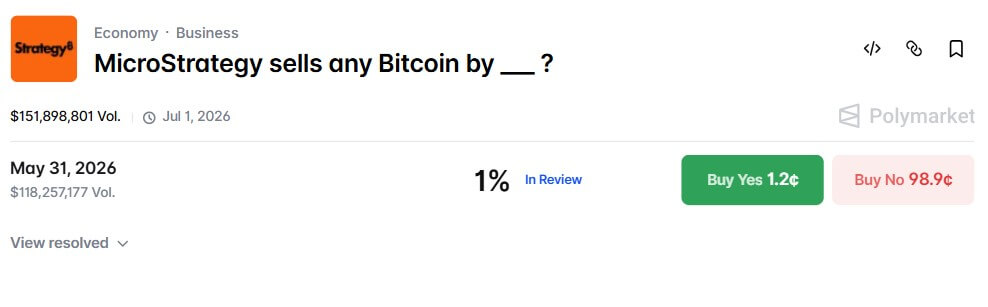

Polymarket contract regarding the disputed Bitcoin sale by Strategy (Source: Polymarket)


When Strategy submitted the mandatory disclosure document on June 1, trading for this contract remained open. Several traders, spotting the disclosure and perceiving an arbitrage opportunity, rushed to enter the market: user 'willo2' invested $527,000 to go all-in on "Yes," while the market odds still implied an 80% probability of a "No" outcome. This trader initially expected to secure a 20% arbitrage profit. However, as large buy orders flooded in, Polymarket retroactively added the rule, deeming the disclosure date invalid because it was past the deadline. As a result, this user lost their entire principal.


Willo posted on X platform in protest: "This limit was never written in the contract rules, it makes no logical sense, and Polymarket itself hasn't followed this standard before. If the disclosure had to be made by May 31, trading should have been halted directly at that time, but the market continued to operate normally afterward."


Industry analysts collectively criticized the platform's contradictory operations. Jeff Dorman, Chief Investment Officer of Arca, pointed out a fatal flaw: if the contract strictly required May 31 midnight as the final cutoff, the platform should have closed trading at that exact time. Allowing users to open positions on June 1 while later retroactively demanding the disclosure date align with the deadline is tantamount to setting a trap for traders who followed the contract's written rules. Jonatan Pallesen, a data researcher specializing in decentralized projects, stated bluntly:


The platform's failure to explicitly state hidden conventions upfront and its post-hoc addition of rules constitutes implicit fraud; institutional players familiar with the platform's unwritten rules can exploit these gaps to harvest ordinary retail traders, who default to expecting payouts based on factual transactions but end up suffering losses.


UMA Oracle Reveals Underlying Structural Flaws


The Strategy wager dispute has evolved from a single contract conflict into a collective interrogation of Polymarket's entire settlement system. Unlike traditional exchanges that rely on centralized clearinghouses and legal departments to execute derivatives settlements, Polymarket outsources the fact-finding entirely to the UMA (Universal Market Access) optimistic oracle. UMA's operating logic is: token holders determine disputed outcomes through on-chain voting; a trader can initiate a dispute by posting a $750 bond. If the disagreement persists unresolved, the final verdict is determined by a vote among UMA token holders weighted by their token holdings, based on stake proportion rather than objective fact-checking.


Many industry insiders warn that this system is highly susceptible to manipulation by whales. Prominent crypto analyst Eric Conner noted that token voting mechanisms inherently suffer from design flaws: large holders (whales) can exploit ambiguous rules to protect their own positions, disregarding objective facts to overturn settlement results and avoid significant losses.


Data from a Wall Street Journal investigation corroborates these concerns: in the vast majority of disputed orders on Polymarket, the top ten wallets hold over half the voting power; approximately 60% of active UMA voting accounts are linked to Polymarket trading addresses, and in one-fifth of dispute cases, voters themselves have a direct financial stake in the outcome. In the first five months of 2026, disputed orders on Polymarket exceeded 1,150, surpassing the platform's total for the entire previous year; constrained by its decentralized architecture, the platform's official team has no authority to overturn the final rulings issued by UMA's token vote.


Rapid Industry Expansion vs. The Reality of Decentralized Mechanisms


This billion-dollar dispute coincides with a critical window for the large-scale adoption of prediction markets. Over the past two years, Polymarket and Kalshi have worked vigorously to shed the "unregulated crypto casino" label and deeply integrate with the traditional financial ecosystem. DeFiLlama data shows that in May 2026, the combined trading volume of the two platforms exceeded $10 billion, a tenfold year-on-year surge; the platforms have successively secured data and content partnerships with the New York Stock Exchange, Dow Jones, Associated Press, and Fox News.


The regulatory landscape for the industry has fluctuated: in 2022, the U.S. Commodity Futures Trading Commission (CFTC) ordered Polymarket to cease U.S. operations and relocate overseas; Kalshi also engaged in prolonged litigation with the CFTC over the compliance of event contracts until winning a federal court case in late 2024. Following the 2024 U.S. election, regulatory winds shifted. Polymarket secured a U.S. federal derivatives license, with the CFTC explicitly stating that event contracts fall under commodity derivatives and are within its regulatory purview. CFTC Chairman Michael S. Selig stated: "Event contracts can help entities and individuals hedge against event risks and optimize portfolio exposure, while also conveying market expectations about events. The product attributes fall within the CFTC's regulatory responsibilities."


Even with compliance licenses, the settlement logic of decentralized prediction markets remains experimental. Traditional secondary markets rely on strong regulation and ample liquidity to anchor prices to real fundamentals; whereas in token-vote-based prediction markets, the definition of "factual truth" is always determined by voting games. Until adjudication mechanisms are perfected, traders in the rapidly expanding prediction market sector will remain subject to unwritten rules and on-chain voting juries that exist beyond the black-and-white text of contracts.


Related Questions

QWhat was the core issue that led to the settlement dispute on Polymarket's $150 million Bitcoin prediction contract?

AThe core issue was a mismatch between the actual transaction time and the official disclosure time, coupled with a rule change by Polymarket after the contract deadline. The platform ruled that MicroStrategy's sale of 32 BTC did not count for settlement because the official SEC 8-K filing disclosing the sale occurred on June 1st, after the contract's cutoff of May 31st at 23:59 ET, even though the sales themselves happened between May 26-31.

QHow did the user 'willo2' allegedly lose their investment in the disputed Polymarket contract?

AUser 'willo2' invested $527,000 to buy 'Yes' shares after MicroStrategy's 8-K filing was published on June 1st, believing the confirmed sale guaranteed a payout. However, Polymarket later applied a new rule stating the disclosure had to occur by the May 31st deadline to be valid. Since the filing was on June 1st, the 'No' outcome was favored, causing 'willo2' to lose their entire principal.

QWhat is the role of UMA's optimistic oracle in Polymarket's dispute resolution process, and what criticism has it faced?

AUMA's optimistic oracle is used to settle disputes on Polymarket. Its process involves token holders voting on-chain to determine the outcome. It has been criticized for a structural defect where large token holders (whales) can manipulate votes to favor their own positions, ignoring objective facts. Data shows the top 10 wallets hold over half the voting power, and many voters have direct ties to Polymarket addresses.

QWhat recent regulatory developments were mentioned regarding prediction markets like Polymarket and Kalshi?

AThe article mentions that after a 2024 court victory for Kalshi and a shifting regulatory landscape post-2024 elections, Polymarket secured a federal derivatives license in the U.S. The CFTC chairman stated that event contracts fall under the agency's jurisdiction as commodity derivatives, helping entities hedge risk and convey market expectations.

QAccording to the article, what fundamental tension exists in decentralized prediction markets as they scale?

AThe fundamental tension is between the industry's rapid growth and the experimental nature of its decentralized settlement logic. While traditional markets rely on strong regulation and liquidity to anchor prices to fundamentals, in token-voting prediction markets, the 'truth' or settlement outcome is ultimately determined by voting博弈 (game theory and博弈), leaving traders subject to unwritten rules and on-chain voting juries.

Related Reads

Earning 1000 Trillion in Half a Year, 'Pocketing' 20 Million per Capita: This Round of Wealth Creation in the Korean Stock Market is Unprecedented in Scale

The South Korean stock market is experiencing an unprecedented wealth surge in 2026, with household equity and fund asset values soaring by over 1,000 trillion KRW (~$730bn) year-to-date. This translates to an average per capita wealth increase of roughly 20 million KRW, fueled by a historic 109% rally in the KOSPI index. The boom is driven by three converging forces: an AI-driven semiconductor supercycle boosting giants like Samsung and SK Hynix; the government's "Value-Up" market reforms addressing long-standing corporate governance issues; and aggressive real estate regulations that have locked capital within financial markets, preventing profits from flowing back into property. This has triggered a wealth effect, boosting high-end consumption significantly. However, the gains are highly concentrated. The two semiconductor behemoths account for over half the index's value, but retail investors own relatively low stakes in them, systematically missing the biggest rallies. Wealth and consumption benefits are skewed towards luxury goods and imported cars, bypassing mainstream retail. Further risks stem from excessive leverage, with high trading volume in leveraged ETFs, and a market sentiment heavily reliant on the AI sector's fortunes and speculative rumors. While this cycle marks a potential shift from real estate to equities as a primary wealth generator for Koreans, its sustainability, amid structural imbalances and leverage, remains a critical test.

marsbit7m ago

Earning 1000 Trillion in Half a Year, 'Pocketing' 20 Million per Capita: This Round of Wealth Creation in the Korean Stock Market is Unprecedented in Scale

marsbit7m ago

imToken's 10th Anniversary Unveils Strategic Direction for the Next Decade: Evolving from a Trusted Main Wallet to a Personal Digital Hub

On its tenth anniversary, decentralized wallet imToken announced its strategic vision for the next decade: evolving from a "trusted main wallet" into a "personal control interface." This new direction aims to help users manage not only digital assets but also identity, permissions, and AI agent actions in an increasingly open and intelligent internet. imToken outlined that while the past decade focused on Store, Send, and Stake—securing assets, enabling transfers, and facilitating network participation—the future introduces a fourth core proposition: Sign. This expanded concept goes beyond transaction signing to encompass expressing intent, granting permissions, setting rules, delegating actions, and revoking authorizations. As AI agents gain autonomy, imToken emphasizes the need for clear, verifiable, and revocable user control over their actions. CEO Ben He stated that imToken's mission is shifting from enabling ownership of digital assets to ensuring user sovereignty over their entire digital world in the AI era. The company's core principle has been upgraded from "Digital Assets, Under Your Control" to "Your Digital World, Under Your Control." Future development will focus on three areas: upholding self-custody principles, extending security from transactions to authorizations and automated actions, and building product capabilities for managing permissions, delegations, policies, and revocations. imToken views the wallet's role as expanding into a trusted control interface for human-AI collaboration, where managing keys, signatures, and permissions forms the infrastructure for personal digital sovereignty. Founded in 2016, imToken serves millions of users across 150+ countries, providing non-custodial wallet services supporting over 50 blockchain networks.

marsbit10m ago

imToken's 10th Anniversary Unveils Strategic Direction for the Next Decade: Evolving from a Trusted Main Wallet to a Personal Digital Hub

marsbit10m ago

With 300 Million Financing to Accumulate ETH, the Hidden Concerns Behind BitMine's High-Yield Preferred Shares

BitMine, led by Thomas Lee, plans to raise up to $300 million through an initial public offering of 3 million shares of perpetual Series A preferred stock on the NYSE (ticker: BMNP). The stock offers a fixed 9.5% annual dividend. The funds are intended to further the company's accumulation of Ethereum, expand its staking node operations, and for general corporate purposes. This move comes as BitMine faces significant challenges. Its massive Ethereum holdings, over 5.3 million ETH (roughly 4.5% of circulating supply), are currently at an unrealized loss exceeding $8.5 billion due to the crypto market downturn. The company's core business model relies on staking these ETH holdings to generate yield, which it presents as the primary means to cover the new, substantial annual dividend obligation of approximately $28.5 million if the offering is fully subscribed. While the model is similar to MicroStrategy's bitcoin-focused strategy of using capital markets to fund crypto acquisitions, BitMine's product differs with its fixed, non-adjustable dividend rate. The company acknowledges risks, stating dividend payments could also come from cash reserves, asset sales, or future financing, and warns that staking yields may underperform or be illiquid during market stress. The 9.5% fixed rate reflects the higher risk premium demanded from investors for a company heavily exposed to Ethereum's volatility.

Foresight News13m ago

With 300 Million Financing to Accumulate ETH, the Hidden Concerns Behind BitMine's High-Yield Preferred Shares

Foresight News13m ago

A Year of Observing Agent Payments: The Cold Reality Behind the Hot Narrative

A Year in Agent Payments: The Cold Reality Behind a Hot Narrative This article examines the current state of "Agent payments," a year after it became a major trend at the intersection of AI, payments, and crypto. Despite significant investments from major players like Stripe, Visa, and Google, the author—having built products and spoken with merchants and developers—finds genuine, large-scale demand still lacking. Key findings across several hyped scenarios reveal structural challenges: * **Agent-to-Merchant Commerce:** For most product categories (e.g., clothing, electronics), AI shopping via chat is inferior to traditional visual e-commerce. Merchant interest is largely defensive, focused on future-proofing rather than current consumer demand. True potential exists only in specific, high-frequency/low-decision scenarios (like food orders) or for simplifying broken checkout experiences, but these require massive consumer distribution, favoring incumbents. * **Agent-to-API/Machine Commerce:** While stablecoin micropayments are touted for API calls, developers already solve small-value payments via prepaid credits and subscriptions. Large SaaS providers prefer enterprise contracts over fragmented micro-pricing. The market exists for long-tail services outside the top providers but is inherently smaller than the hype suggests. * **Agent-to-Agent Payments:** This remains a theoretical long-term vision with negligible real transaction volume. The core challenges—discovery, trust, negotiation, dispute resolution—are unsolved. While the potential for a new, high-speed settlement layer is real, it is not the current market. * **Agent Finance:** This is the sole area with existing, paying customers (fund managers, DeFi users). AI enhances real-time monitoring and autonomous rebalancing, offering real capability gains. However, competition favors established, regulated institutions with existing licenses and client relationships. The author concludes that the core deficiency in the Agent economy is not merely a payment layer, but a more complex **coordination** capability—figuring out how Agents and humans work together, verify task completion, and settle outcomes. Payment is just one component of settlement, which is itself part of coordination. For large companies, investing now is a defensive, long-term bet with minimal cost. For startups, however, the imperative is to find markets that exist today, not wait for a future wave that remains on the horizon.

marsbit15m ago

A Year of Observing Agent Payments: The Cold Reality Behind the Hot Narrative

marsbit15m ago

Trading

Spot
Futures

Hot Articles

What is $BITCOIN

DIGITAL GOLD ($BITCOIN): A Comprehensive Analysis Introduction to DIGITAL GOLD ($BITCOIN) DIGITAL GOLD ($BITCOIN) is a blockchain-based project operating on the Solana network, which aims to combine the characteristics of traditional precious metals with the innovation of decentralized technologies. While it shares a name with Bitcoin, often referred to as “digital gold” due to its perception as a store of value, DIGITAL GOLD is a separate token designed to create a unique ecosystem within the Web3 landscape. Its goal is to position itself as a viable alternative digital asset, although specifics regarding its applications and functionalities are still developing. What is DIGITAL GOLD ($BITCOIN)? DIGITAL GOLD ($BITCOIN) is a cryptocurrency token explicitly designed for use on the Solana blockchain. In contrast to Bitcoin, which provides a widely recognized value storage role, this token appears to focus on broader applications and characteristics. Notable aspects include: Blockchain Infrastructure: The token is built on the Solana blockchain, known for its capacity to handle high-speed and low-cost transactions. Supply Dynamics: DIGITAL GOLD has a maximum supply capped at 100 quadrillion tokens (100P $BITCOIN), although details regarding its circulating supply are currently undisclosed. Utility: While precise functionalities are not explicitly outlined, there are indications that the token could be utilized for various applications, potentially involving decentralized applications (dApps) or asset tokenization strategies. Who is the Creator of DIGITAL GOLD ($BITCOIN)? At present, the identity of the creators and development team behind DIGITAL GOLD ($BITCOIN) remains unknown. This situation is typical among many innovative projects within the blockchain space, particularly those aligning with decentralized finance and meme coin phenomena. While such anonymity may foster a community-driven culture, it intensifies concerns about governance and accountability. Who are the Investors of DIGITAL GOLD ($BITCOIN)? The available information indicates that DIGITAL GOLD ($BITCOIN) does not have any known institutional backers or prominent venture capital investments. The project seems to operate on a peer-to-peer model focused on community support and adoption rather than traditional funding routes. Its activity and liquidity are primarily situated on decentralized exchanges (DEXs), such as PumpSwap, rather than established centralized trading platforms, further highlighting its grassroots approach. How DIGITAL GOLD ($BITCOIN) Works The operational mechanics of DIGITAL GOLD ($BITCOIN) can be elaborated on based on its blockchain design and network attributes: Consensus Mechanism: By leveraging Solana’s unique proof-of-history (PoH) combined with a proof-of-stake (PoS) model, the project ensures efficient transaction validation contributing to the network's high performance. Tokenomics: While specific deflationary mechanisms have not been extensively detailed, the vast maximum token supply implies that it may cater to microtransactions or niche use cases that are still to be defined. Interoperability: There exists the potential for integration with Solana’s broader ecosystem, including various decentralized finance (DeFi) platforms. However, the details regarding specific integrations remain unspecified. Timeline of Key Events Here is a timeline that highlights significant milestones concerning DIGITAL GOLD ($BITCOIN): 2023: The initial deployment of the token occurs on the Solana blockchain, marked by its contract address. 2024: DIGITAL GOLD gains visibility as it becomes available for trading on decentralized exchanges like PumpSwap, allowing users to trade it against SOL. 2025: The project witnesses sporadic trading activity and potential interest in community-led engagements, although no noteworthy partnerships or technical advancements have been documented as of yet. Critical Analysis Strengths Scalability: The underlying Solana infrastructure supports high transaction volumes, which could enhance the utility of $BITCOIN in various transaction scenarios. Accessibility: The potential low trading price per token could attract retail investors, facilitating wider participation due to fractional ownership opportunities. Risks Lack of Transparency: The absence of publicly known backers, developers, or an audit process may yield skepticism regarding the project's sustainability and trustworthiness. Market Volatility: The trading activity is heavily reliant on speculative behavior, which can result in significant price volatility and uncertainty for investors. Conclusion DIGITAL GOLD ($BITCOIN) emerges as an intriguing yet ambiguous project within the rapidly evolving Solana ecosystem. While it attempts to leverage the “digital gold” narrative, its departure from Bitcoin's established role as a store of value underscores the need for a clearer differentiation of its intended utility and governance structure. Future acceptance and adoption will likely depend on addressing the current opacity and defining its operational and economic strategies more explicitly. Note: This report encompasses synthesised information available as of October 2023, and developments may have transpired beyond the research period.

363 Total ViewsPublished 2025.05.13Updated 2025.05.13

What is $BITCOIN

Discussions

Welcome to the HTX Community. Here, you can stay informed about the latest platform developments and gain access to professional market insights. Users' opinions on the price of BTC (BTC) are presented below.

活动图片