Promised Year of Crypto IPOs? Only One Went Public in Six Months, Down 70%

marsbitPublished on 2026-06-11Last updated on 2026-06-11

Abstract

The much-anticipated wave of crypto IPOs in 2026 has failed to materialize, with market conditions worsening dramatically. While SpaceX prepares for the largest IPO in history, raising $75 billion at a $1.75 trillion valuation, the crypto sector faces a frozen pipeline. The sole crypto IPO success this year, BitGo, serves as a cautionary tale. After launching on the NYSE in January at $18, its stock has plummeted approximately 70%. Other major contenders have stalled or delayed. Kraken, which secretly filed in late 2025, has put its plans on ice, seeing its valuation drop 33% to $13.3 billion. Consensys has postponed its filing until autumn at the earliest, and Bitpanda is poised to miss its self-imposed H1 deadline for a Frankfurt listing. This widespread retreat is driven by a severe liquidity crunch. Bitcoin has fallen below $60,000, with capital being diverted to AI stocks and the massive SpaceX offering. The poor performance of earlier crypto listings like Gemini and the stagnant price of Coinbase further dampen investor appetite. A key underlying pressure is the impending US midterm elections in November, which could alter the currently favorable regulatory landscape. Companies had hoped to go public during this window of policy certainty, but challenging market dynamics have overridden those plans. The transparency that comes with being a public company is now seen as a potential liability rather than a benefit in a down market. The industry's fate now hinges on a ...

Author: Claude, Deep Tide TechFlow

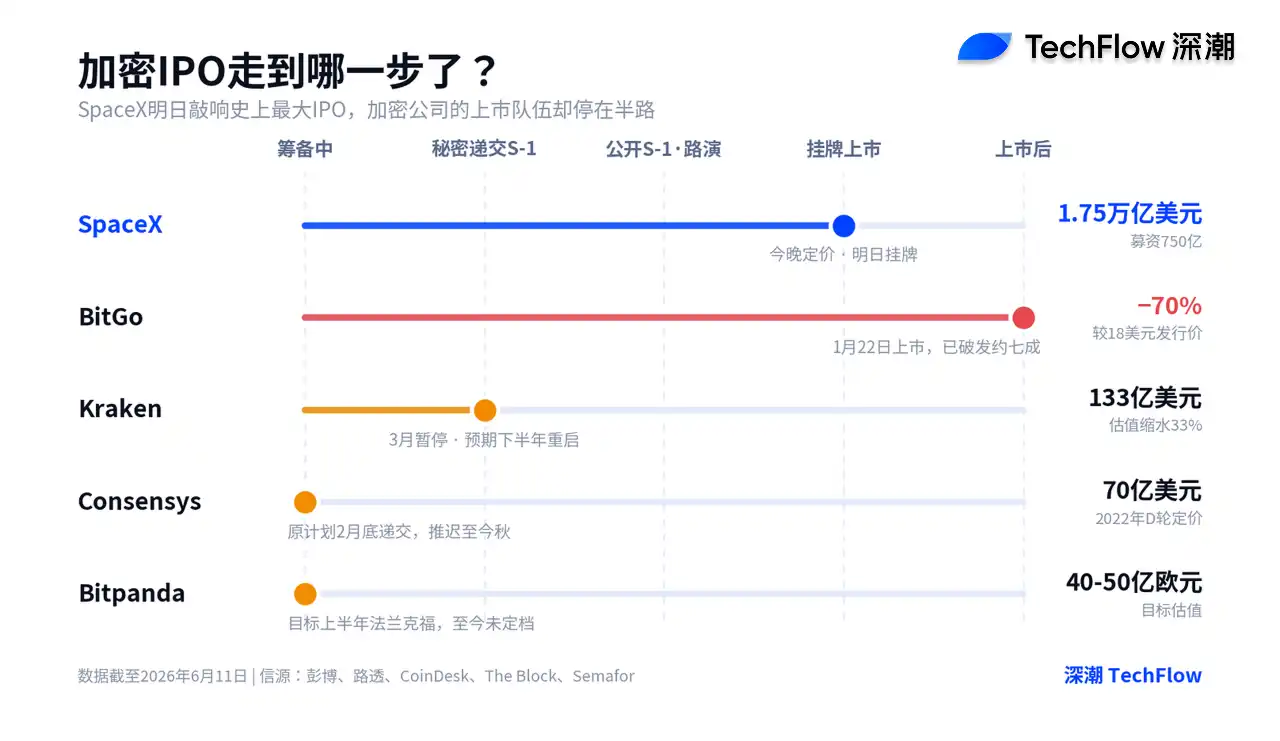
Deep Tide Introduction: SpaceX will price its offering tonight and list on Nasdaq tomorrow, aiming to raise $75 billion with a valuation of $1.75 trillion, marking the largest IPO ever. Meanwhile, the crypto IPO pipeline has frozen solid: the only company to list this year, BitGo, is down about 70% from its issue price; Kraken's valuation has shrunk 33% in five months; Consensys has been pushed back to autumn; Bitpanda is on the verge of missing its deadline. With just five months left until the midterm elections in November, the window for crypto companies to go public is narrowing.

After the U.S. stock market closes tonight, SpaceX will finalize its issue price. Tomorrow, the ticker SPCX will debut on Nasdaq. According to Reuters, the company plans to issue approximately 557 million shares at $135 per share, raising $75 billion at a valuation of $1.75 trillion. This will be the largest IPO in history by both fundraising size and valuation, with the fundraising amount more than double that of the previous record holder, Saudi Aramco.

Outside this grand feast, the queue of crypto companies waiting to go public is falling apart.
SpaceX Siphons Liquidity, Bitcoin Falls Below $60k Concurrently

SpaceX's listing pace is unusually fast. It confidentially filed its registration on April 1, publicly released its S-1 prospectus on May 20, and kicked off its roadshow on June 4, several days ahead of schedule due to an unexpectedly swift SEC review process. It took just over two months from confidential filing to bell-ringing.

The crypto market trended in the exact opposite direction during the same window. According to CoinDesk data, Bitcoin traded around $61,500 on June 10, down about 17% for the week and briefly falling below $60,000 for the first time in 2024. The Fear and Greed Index registered a reading of 9, indicating "Extreme Fear." The total crypto market cap shrank to around $2.21 trillion. The explanation for the capital flows isn't complicated: continuous outflows from Bitcoin ETFs, coupled with funds rotating towards the AI sector and SpaceX's subscription, have seen risk appetite sucked dry by this $1.75 trillion behemoth.

For any company wanting to go public, liquidity is oxygen. $75 billion in subscription demand is locked up by SpaceX alone. Filing a prospectus at this point is like flying a kite in a typhoon.

BitGo: The Year's Only Listing Sample, Stock Down About 70%

The crypto industry hasn't been without attempts. BitGo listed on the NYSE on January 22 with an issue price of $18, above the indicated range of $15 to $17, raising $213 million. It was the first and, so far, only crypto-native company to complete an IPO in 2026.

The start didn't look bad. It opened at $22.43 on its first day, up 24.6% from the issue price, and briefly surged to $24.5 intraday. But those gains were wiped out by the close, ending the day with just a 2.7% gain, followed by a steady decline. According to Benzinga data, BTGO closed at $5.61 on June 3, down about 69% from its issue price. Goldman Sachs cut its price target from $10.5 to $9 on June 4, and even this slashed target is 60% higher than the current price.

BitGo was once hoped to be the bellwether for 2026 crypto IPOs. Now it indeed serves as a bellwether, just pointing in the opposite direction. When Kraken paused its listing plans in March this year, multiple media reports cited BitGo's post-listing slump as a cautionary tale for management. If an infrastructure company with over $100 billion in assets under custody and a defensive business model fares this poorly, what valuation would a pure exchange story receive in the secondary market? The companies in line are well aware.

Kraken: Valuation Evaporates 33% in Five Months, Deutsche Börse Seizes Opportunity

Kraken is the company that progressed the furthest in the queue. On November 19, 2025, its parent company Payward confidentially submitted a draft S-1 to the SEC, shortly after completing an $800 million funding round with investors including Jane Street and Citadel Securities, valuing the company at $20 billion. Reuters reported at the time that its target was to go public in Q1 2026.

Then the market soured. In March this year, multiple media reports stated Kraken had frozen its listing plans. On April 14, co-CEO Arjun Sethi confirmed at the Semafor World Economy Summit in Washington that the confidential filing remained active but declined to provide a timeline, offering size, or valuation range. According to Semafor, Kraken was valued at $13.3 billion in a funding round in April, a 33% contraction from its peak last November.

This funding round contains a noteworthy subplot: Deutsche Börse Group invested $200 million for approximately 1.5% of Kraken's fully diluted shares, with the transaction expected to close in Q2. The operator of the Frankfurt Stock Exchange is buying in at a time when a U.S. exchange's valuation is at its lowest ebb. Considering Bitpanda's choice discussed below, the Germans' intent to snatch business as the U.S. window tightens is quite evident.

Media consensus currently expects Kraken's listing restart to wait until the second half of the year.

Consensys Pushed to Autumn, Bitpanda on the Verge of Missing Deadline

Consensys, the parent company of MetaMask, has a more straightforward script. According to a CoinDesk report on May 13, the company led by Ethereum co-founder Joe Lubin originally planned to confidentially file its S-1 with the SEC by the end of February, with JPMorgan and Goldman Sachs leading the underwriting. However, due to persistently weak market conditions, the IPO has been postponed until at least this autumn. Consensys' last valuation was from its Series D in 2022, a $450 million funding round at a $7 billion valuation. How much of this number can be preserved in the current market environment will only be known when the prospectus is unveiled.

Bitpanda's problem is the calendar. According to a Bloomberg report in January, this Vienna-based company, backed by Peter Thiel, plans to list in Frankfurt with a target valuation of €4-5 billion, with Goldman Sachs, Citigroup, and Deutsche Bank acting as underwriters. The schedule was set for the first half of the year, potentially Q1. Today is June 11, with less than three weeks left in H1, and the company has yet to officially announce a date. Unless it launches suddenly in the coming days, missing its own deadline is almost certain.

Looking at the four together: one listed but is down 70%, one filed but paused, one pushed to autumn, and one on the verge of missing its self-imposed deadline. The original Reddit post described these four as "sprinting to go public within 12 months." The wording isn't wrong, but the sense of direction is. This team isn't sprinting; they're each looking for an exit ramp.

Five Months Until the Midterm Elections

The clustering of crypto companies targeting 2026 for listings has a common, invisible deadline.

This year's regulatory climate has been relatively favorable for the crypto industry, but the U.S. midterm elections in early November could rewrite the congressional power balance. Many companies' timelines were originally compressed before the election, betting on five months of policy certainty.

Precedents aren't encouraging. Among the crypto companies that went public in 2025, Gemini's stock price had fallen over 60% from its issue price (data as of end-January), Bullish hovered around its issue price, and Coinbase, which listed in 2021, remains below its opening price from that year. Circle is a rare exception that has significantly outperformed its issue price. The pricing given by the secondary market with real money is more honest than any roadshow PowerPoint.

Returning to that Reddit post, the poster actually had a valid point: once an exchange goes public, its financials are no longer a black box. Quarterly audited reports will reveal whether revenue truly comes from trading fees, custody fees, or idle fund interest. Retail investors get their first chance to judge an exchange by numbers rather than "withdrawal smoothness."
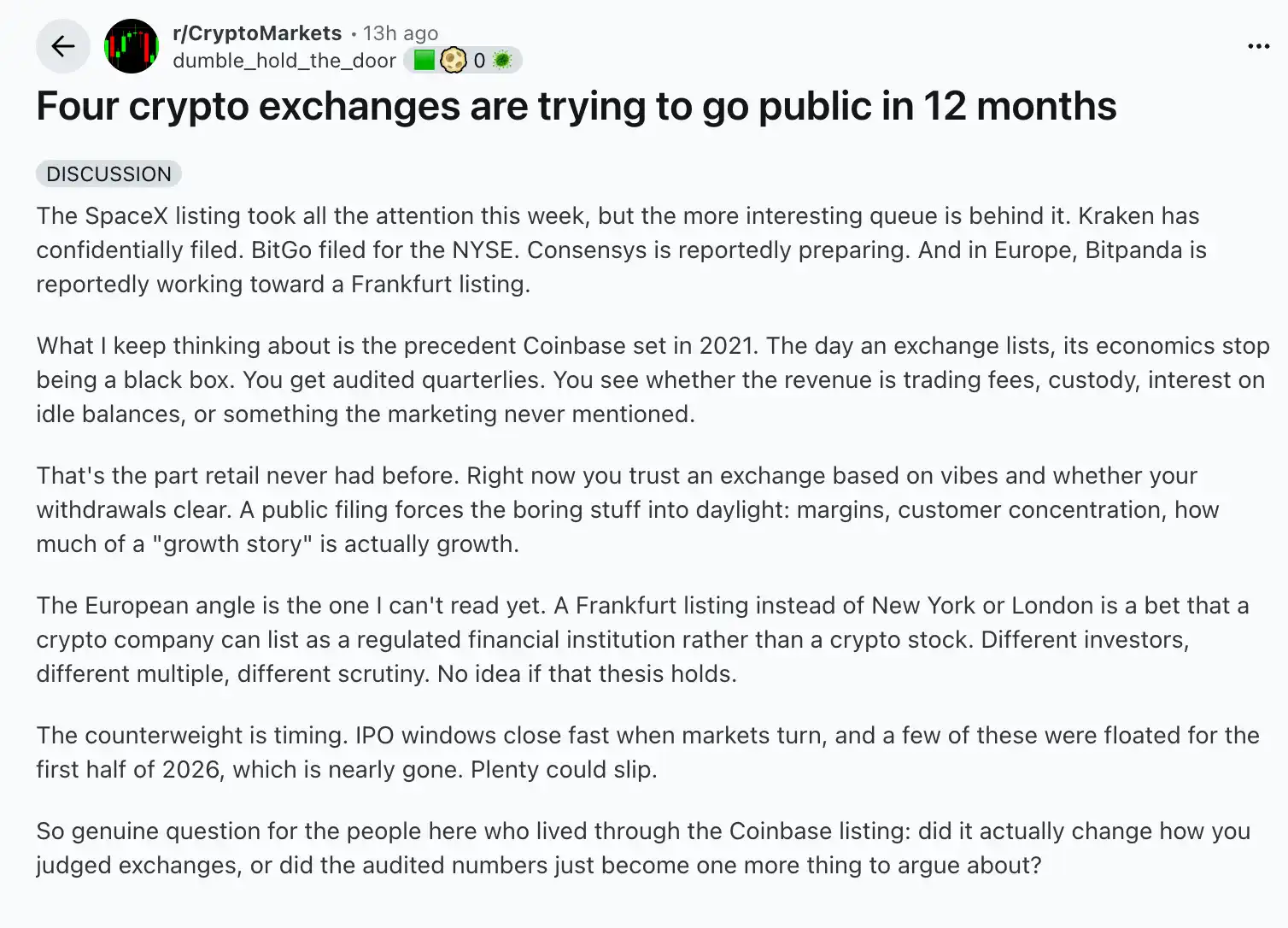
The problem is the sequence. Transparency is a consequence of going public, not the motivation for it. In a market with Bitcoin at $61,500 and the only listing sample down 70%, no company is in a hurry to lay its cards on the table.

Over the next five months, three specific milestones are worth watching: whether Kraken restarts in H2, whether Consensys actually files its S-1 in autumn, and when Bitpanda officially admits to missing its deadline.

There's another variable to be revealed tomorrow. If funds absorbed by SpaceX's listing flow back and market liquidity recovers, this window might crack open again. If even the largest IPO in history performs tepidly, this year's crypto listing wave will likely have to wait until after the elections.


Related Questions

QWhat major event is described as diverting liquidity from the crypto market, coinciding with Bitcoin's price drop?

AThe article describes the upcoming IPO of SpaceX as the major event. SpaceX's planned $75 billion offering, with a $1.75 trillion valuation, was reportedly locking up significant investor capital and risk appetite, creating a 'liquidity drain' that contributed to Bitcoin falling below $60,000.

QAccording to the article, which crypto company is the only one to have completed an IPO in 2026, and how has its stock performed?

AThe only crypto-native company to have completed an IPO in 2026 is BitGo (ticker: BTGO). Its stock has performed poorly, falling approximately 70% from its initial offering price of $18 to around $5.61 by early June.

QWhy did the article suggest several crypto companies originally aimed to go public before November 2026?

AThe article suggests these companies aimed for a pre-November 2026 timeline due to the U.S. midterm elections. They were betting on the current, relatively friendly regulatory environment for crypto, which could change depending on the election outcome, making the five months before the election a window of perceived policy certainty.

QWhat evidence does the article provide that the public listing pipeline for crypto companies is effectively frozen?

AThe article provides several pieces of evidence: BitGo's poor post-IPO performance (-70%), Kraken's paused plans and 33% valuation drop, Consensys's delay to autumn, and Bitpanda's likely missed self-imposed deadline for a first-half listing. It describes the situation as companies 'finding their own excuses' rather than sprinting to go public.

QWhat is one potential positive outcome for crypto companies if SpaceX's IPO goes well, according to the article's conclusion?

AThe article concludes that if SpaceX's IPO performs well and the massive capital it absorbed begins to flow back into the market, improving overall liquidity, the window for crypto IPOs might 'reopen a crack.' However, if even the largest IPO ever performs poorly, any significant crypto listing wave would likely be postponed until after the midterm elections.

Related Reads

a16z Partner: Being in the Flow of Capital Is the True Moat

A16z Partner: Standing in the Cash Flow is the True Moat Historically, many of the strongest companies built their moats by positioning themselves within "cash flows"—facilitating value creation and transfer in a network and taking a cut. The more value flows, the larger they grow. Crypto is the first modern technology natively built for this. With open ledgers, programmable settlement, and stablecoins enabling internet-speed global value transfer, it allows startups to inherit network effects from day one. Well-designed tokens align users, developers, and the protocol towards network growth, distributing value to contributors. This model isn't new (e.g., railroads, Visa, Google, AWS) but Crypto democratizes it. It lets entrepreneurs target areas with high inefficiency and profit extraction—like traditional finance's payments, custody, FX, and settlement—to compress costs, increase speed, and redistribute value by standing in the new flow. The opportunity extends beyond finance to emerging markets like GPU/compute, AI training data, energy, and space, where new, programmable infrastructure can be built without legacy constraints. Key questions for founders: Are you already in the cash flow? Does your revenue scale 10x with network activity? Where is profit extraction highest relative to value created in your market? The strategy is clear: compress the old cost structure, position yourself in the new value stream, and let the network compound.

marsbit14m ago

a16z Partner: Being in the Flow of Capital Is the True Moat

marsbit14m ago

Capturing 15 Top-Tier Zero-Day Vulnerabilities: A Consensus Protocol Debug Agent Framework Built by 0G Lab in Collaboration with Teams from NUS, PKU, and BUPT

"Agents Capture 15 Critical Zero-Day Bugs: 0G Lab's Multi-Agent Framework Automates Debugging in Consensus Protocols" Distributed consensus protocols are notoriously difficult to debug due to complex, intertwined states. A novel framework, Agora, developed by 0G Labs with researchers from NUS, Peking University, and Beijing University of Posts and Telecommunications, tackles this by fusing deep domain expertise with a collaborative multi-agent LLM architecture. Agora moves beyond the limitations of single LLMs and traditional testing like fuzzing. It employs three specialized agents: an Orchestrator for global state, a Strategy agent for generating attack scenarios using distributed systems knowledge, and a TestGen agent that creates executable tests. A core innovation is its efficient "Succinct Memory & Communication" mechanism and a dynamic test harness. This allows the system to translate abstract hypotheses into concrete tests across languages like Go and Rust, run them, capture failures, and refine the approach in a closed loop—all with minimal token overhead. In rigorous evaluations on production-level protocols including Raft, EPaxos, and components from etcd and Sui, Agora discovered 15 previously unknown deep logic bugs (e.g., execution divergence, liveness violations). In stark contrast, powerful standalone LLMs like GPT-5.2 and Claude 4.5 found zero such bugs. Agora achieved this with a high precision of 73.9% and at an average cost of only about $40 per bug found. The framework demonstrates high generalizability. Its decoupled design allows the "Multi-Agent + Hypothesis-Driven Testing" paradigm to be applied to other complex domains like database concurrency control, OS kernels, and Web3 smart contract auditing. By enabling efficient, automated detection of deep logic flaws, Agora points the way for AI-powered security in critical infrastructure, aligning with the growing trends of agentic systems and automated quality control.

marsbit18m ago

Capturing 15 Top-Tier Zero-Day Vulnerabilities: A Consensus Protocol Debug Agent Framework Built by 0G Lab in Collaboration with Teams from NUS, PKU, and BUPT

marsbit18m ago

a16z crypto Partner: Cash Flow Is the True Moat

Title: a16z Crypto Partner: Capital Flow is the True Moat In business history, enduringly successful enterprises often share a core logic: capturing value by facilitating its creation and transfer within an ecosystem, taking a share of the proceeds. The scale of value flowing through the ecosystem directly correlates with the company's growth. Cryptography is the first modern technology natively suited to this commercial logic. Startups that don't leverage this framework in product design and business model construction miss significant opportunities. Stablecoins enable internet-speed, 24/7 global settlement of value with end-to-end programmability. With open underlying channels for capital flow and transparent unit economics, every circulating dollar globally represents potential flow in this arena. Blockchain is inherently a network business model. All transactions are recorded on a shared ledger, and each new participant strengthens this foundational system for future developers. More users and applications increase the network's value for all. Crypto entrepreneurs start with built-in network effects, unlike traditional businesses that spend years building them on legacy infrastructure. Network tokens amplify this advantage. A well-designed token system aligns users, developers, service providers, and validators around a common goal—network growth—while distributing rewards based on contribution. All proceeds flow back to ecosystem participants, creating a virtuous cycle of value circulation. This is not a new logic; the crypto industry simply makes it easier for startups to implement and scale. Historic giants like railroads, Standard Oil, AT&T, and modern leaders like Google and AWS succeeded by positioning themselves at critical junctures of value flow. In finance, Visa processed $15.7 trillion in payments (net revenue: $35.9B), and top market makers like Jane Street thrive by being in the path of order flow, benefiting from volume. Combining capital flow with network effects creates one of business's most robust models. As Jeff Bezos noted, "Your margin is my opportunity." This is acutely true in traditional finance, where sectors like payments, custody, and settlements extract significant fees (e.g., 2-3% for card networks, 6-9% for cross-border transfers). These profits represent opportunities for disruption by reducing costs and increasing efficiency, as proven by Stripe and Square in payments. Crypto founders can build the next-generation infrastructure: programmable, instant, global, and inherently embedded in capital flow paths. Opportunities extend beyond finance to markets like compute/GPU trading, AI training data, energy, robotics, and critical minerals—areas poised for massive global value movement that existing channels cannot handle. These are blue oceans for new, programmable infrastructure centered on capital flow, free from entrenched platforms and intermediaries. Founders should ask: Is your business at the heart of a value flow? Does your revenue scale 10x with ecosystem transaction growth? Where are the highest margins relative to value created in your target market? The answers point to the opportunity: cut existing costs, enter new value flow arenas, and grow through network effects.

Foresight News19m ago

a16z crypto Partner: Cash Flow Is the True Moat

Foresight News19m ago

Unveiling the 'White-haired Stock God' Serenity: A Spiritual Remedy for Anxious Retail Investors

The article details the rise of Serenity, dubbed the "White-Haired Stock God," whose social media posts have recently caused significant volatility in China's A-share market. Previously gaining fame in international retail investor communities, Serenity is known for his "Chokepoint Investment" strategy targeting small monopolies in the AI supply chain, reportedly achieving returns over 3612% this year. His influence stems from his background as a former AI research scientist, detailed analysis, and a massive following on X, where his subscriber count has surpassed Elon Musk's. In early June, Serenity's Chinese-language posts mentioning A-shares like LeaderDrive (Lide Xiebo), Easun, and Innolight triggered immediate 20% surges in their stock prices. He later clarified that some recommendations were crowdsourced from followers and claimed he did not hold positions in these stocks, stating his actions were "just for fun" to offer a foreign perspective on Chinese markets. This activity drew scrutiny from Chinese financial media, which warned of potential "pump-and-dump" schemes and legal risks. While anonymous, clues suggest Serenity is likely a Chinese-speaking individual living in Japan. He maintains his anonymity due to past harassment but enjoys substantial monthly income from his paid subscriptions. The article posits that Serenity embodies the market's current appetite for a charismatic, successful figure during the AI bull run, serving as an "outward projection" of bullish sentiment. It concludes by noting the cyclical nature of such market icons, warning that the same crowds that elevate them often seek scapegoats when trends reverse.

Odaily星球日报24m ago

Unveiling the 'White-haired Stock God' Serenity: A Spiritual Remedy for Anxious Retail Investors

Odaily星球日报24m ago

Unveiling the 'White-Haired Stock God' Serenity: The Mental Elixir for Anxious Retail Investors

The anonymous stock influencer known as "White-Haired Stock God" Serenity has ignited a frenzy in the A-share market. From June 5-9, Serenity's posts on platform X mentioning A-shares like LeaderDrive, Easun, and Innolight triggered sharp price surges, with some stocks hitting 20% daily limits. Serenity, who claims a 3612% personal return this year, gained fame internationally using a "chokepoint investment" strategy focused on small, monopolistic AI supply chain companies. With over 810k X followers, his influence rivals top analysts. His recent foray into Chinese stocks, which he claims is "for fun" to offer a "foreign perspective," has drawn scrutiny. While Serenity denies holding positions in these A-shares and states his posts are not recommendations, his actions have caused significant market volatility. He monetizes through a $1/month subscription, earning an estimated $54k monthly. Facing accusations of market manipulation, he maintains he promotes "information democracy." Community analysis suggests Serenity is likely an English-speaking Chinese national living in Japan, based on his posting patterns and shared personal details. He maintains anonymity due to past harassment. Ultimately, Serenity is seen by many as a manifestation of the current AI bull market's euphoria—a mysterious, seemingly successful figure who fulfills the market's desire for a "stock god," though such personas often face intense scrutiny when market sentiment shifts.

marsbit24m ago

Unveiling the 'White-Haired Stock God' Serenity: The Mental Elixir for Anxious Retail Investors

marsbit24m ago

Trading

Spot
Futures

Hot Articles

How to Buy ONE

Welcome to HTX.com! We've made purchasing Harmony (ONE) simple and convenient. Follow our step-by-step guide to embark on your crypto journey.Step 1: Create Your HTX AccountUse your email or phone number to sign up for a free account on HTX. Experience a hassle-free registration journey and unlock all features.Get My AccountStep 2: Go to Buy Crypto and Choose Your Payment MethodCredit/Debit Card: Use your Visa or Mastercard to buy Harmony (ONE) instantly.Balance: Use funds from your HTX account balance to trade seamlessly.Third Parties: We've added popular payment methods such as Google Pay and Apple Pay to enhance convenience.P2P: Trade directly with other users on HTX.Over-the-Counter (OTC): We offer tailor-made services and competitive exchange rates for traders.Step 3: Store Your Harmony (ONE)After purchasing your Harmony (ONE), store it in your HTX account. Alternatively, you can send it elsewhere via blockchain transfer or use it to trade other cryptocurrencies.Step 4: Trade Harmony (ONE)Easily trade Harmony (ONE) on HTX's spot market. Simply access your account, select your trading pair, execute your trades, and monitor in real-time. We offer a user-friendly experience for both beginners and seasoned traders.

3.8k Total ViewsPublished 2024.03.29Updated 2026.06.02

How to Buy ONE

Discussions

Welcome to the HTX Community. Here, you can stay informed about the latest platform developments and gain access to professional market insights. Users' opinions on the price of ONE (ONE) are presented below.

活动图片