Another Corporate Bitcoin Treasury Strategy Ends: From High-Profile Entry to Liquidation at a Massive Loss in 11 Months

marsbitPublished on 2026-06-01Last updated on 2026-06-01

Abstract

French semiconductor company Sequans Communications has sold off its bitcoin holdings and terminated its corporate bitcoin treasury strategy less than a year after launching it, sustaining heavy losses. Facing delisting from the New York Stock Exchange in mid-2025 due to low market capitalization, Sequans announced a plan to hold over 3,000 bitcoin as a long-term reserve asset. The strategy was executed with Swan Bitcoin and backed by a $384 million private financing round. At its peak in October 2025, the company held 3,234 bitcoin with an average cost of approximately $116,643 per coin. However, the plan quickly unraveled. With bitcoin's price falling, Sequans sold 970 bitcoin in late 2025 to repay debt, contradicting the core "hold" philosophy of such corporate strategies. The company has now sold more bitcoin to fully repay its convertible notes and announced the termination of its bitcoin reserve strategy. It plans to liquidate its remaining 658 bitcoin. The venture resulted in significant financial damage. The company reported an unrealized loss of $67.4 million on its bitcoin holdings in 2025, contributing to a total net loss of $109.3 million for the year. Sequans' stock (SQNS) has plummeted over 80% since the strategy's launch and is down 77% year-to-date. CEO Georges Karam, who previously championed bitcoin's long-term value, now states the company will refocus entirely on its core IoT semiconductor business. The failed experiment highlights the risks for compan...

Original Author: Protos

Original Translation: Chopper, Foresight News

Eleven months ago, French semiconductor company Sequans Communications launched a corporate bitcoin reserve plan to combat the risk of delisting from the New York Stock Exchange. Today, this trial has come to a quiet end.

The chipmaker confirmed that it has fully repaid its convertible bonds by selling its bitcoin holdings and also plans to gradually liquidate its remaining 658 bitcoins. The company's bitcoin holdings once peaked at 3,234 coins.

Sequans had previously declared its intention to accumulate and hold over 3,000 bitcoins as a long-term reserve asset. Yet this so-called "long-term" ultimately lasted less than a year.

The company's stock (ticker SQNS) has fallen 77% year-to-date, with a staggering 97% cumulative decline over the past five years.

Sequans' bitcoin reserve plan was launched on June 23, 2025, a time when Swan Bitcoin and its CEO Cory Klippsten were actively promoting the project (Note: Swan Bitcoin was the exclusive operator and advisor for Sequans' bitcoin reserve strategy). This launch came just 18 days after the NYSE issued a delisting warning to Sequans, stating the company's market capitalization and shareholder equity had both fallen below the exchange's $50 million minimum threshold.

Sequans' latest announcement confirms full repayment of its convertible bonds.

Klippsten stated at the time, "Sequans has the potential to become a leader in the corporate bitcoin treasury space." Back then, SQNS stock was trading at $23.40; today it opened at just $3.98.

Bitcoin Reserve Strategy Fails Shortly After Launch

Following the market bubble burst in early summer 2025, the stock prices of many public companies with digital asset treasury strategies collectively weakened, dashing the bright prospects Sequans had painted.

Sequans CEO Georges Karam had earlier expressed strong confidence, firmly believing bitcoin was a superior asset with extremely high long-term investment value.

The company had selected Swan Bitcoin as its execution partner and Coinbase Prime as the custodian. Simultaneously, Northland Capital Markets and B. Riley Securities acted as joint lead underwriters, assisting the company in completing a $384 million private placement.

Of this capital, only $195 million came from the sale of American Depositary Receipts at $1.40 per share; the remaining $189 million was in the form of secured convertible bonds using bitcoin as collateral. This means that from day one, the bitcoin Sequans held in reserve was essentially pledged to creditors.

As of October 3, 2025, Sequans held a total of 3,234 bitcoins, with an average acquisition cost of approximately $116,643 per coin. As of this writing, the bitcoin price has fallen to $73,000.

Just one month later, the company gained notoriety for a piece of negative news: to repay a portion of its debt, it sold 970 bitcoins.

This action completely violated the core principle of the corporate bitcoin accumulation model. Michael Saylor, a pioneer of this approach, famously stated, "Even if you are desperate, do not sell your bitcoin." But Sequans ultimately chose to sell its coins to pay debt.
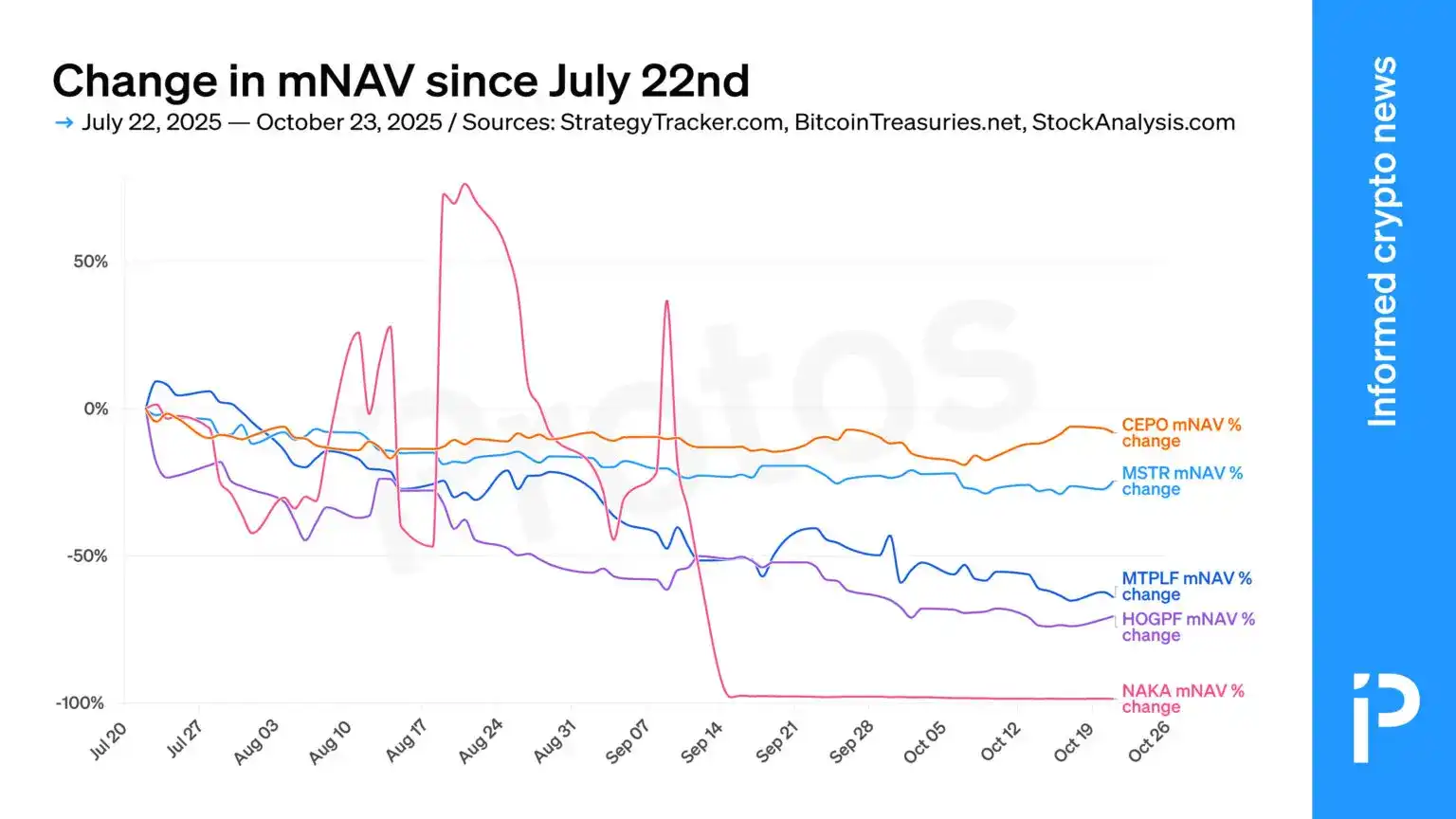
Percentage change in modified Net Asset Value per Share (mNAV) for several corporate bitcoin treasury companies since July 22, 2025.

"Bitcoin Reserve Strategy Officially Terminated"

Five more months passed, and Sequans completely halted the program. The company's announcement tersely stated: "The Bitcoin reserve strategy has been terminated."

Karam, the CEO who was once so bullish on bitcoin, now stated that this debt repayment is a significant turning point for the company, and Sequans will now fully focus on its core IoT semiconductor business to drive expansion.

All previous praise for bitcoin's value and promises to create long-term shareholder returns through crypto asset reserves have been abandoned. The current plan for the company is solely liquidation.

In fact, the exit signal was given three weeks earlier in the company's Q1 2026 earnings report. In the risk factors section, the company explicitly mentioned terminating its bitcoin reserve-related business. For that quarter, Sequans reported revenue of only $6.1 million and an operating loss of $50.5 million.

According to annual report data, Sequans posted a net loss of $109.3 million for the full year 2025. Within this, unrealized impairment losses on bitcoin assets alone amounted to $67.4 million, bringing the company's cumulative loss total to a staggering $145.1 million.

In summary, Sequans bought bitcoin high and sold low, ultimately generating tens of millions in losses.

The company had hoped to use its bitcoin reserves to strengthen its financial resilience and create long-term value for shareholders, but both goals have failed. Currently, SQNS stock is down over 80% from the day the bitcoin plan was launched and down 92% from its high over the past year.

Related Questions

QWhat was the main reason Sequans Communications started its corporate bitcoin reserve strategy?

ASequans Communications initiated its corporate bitcoin reserve strategy in June 2025 to counter the risk of delisting from the New York Stock Exchange after its market capitalization and shareholder equity fell below the exchange's minimum threshold.

QWho was the exclusive operator and advisor for Sequans' bitcoin reserve strategy?

ASwan Bitcoin, led by its CEO Cory Klippsten, was the exclusive operator and advisor for Sequans' bitcoin reserve strategy.

QHow many bitcoins did Sequans hold at its peak, and what was its average purchase cost per coin?

ASequans' bitcoin holdings peaked at 3,234 coins, with an average purchase cost of approximately $116,643 per bitcoin.

QWhat core tenet of the corporate bitcoin treasury strategy did Sequans violate when it sold part of its holdings?

ASequans violated the core tenet popularized by Michael Saylor: 'Don't sell your bitcoin, even if you're on the brink of disaster.' The company sold 970 bitcoins to repay part of its debt.

QWhat were the total net loss and the specific unrealized impairment loss related to bitcoin that Sequans reported for the year 2025?

AFor the year 2025, Sequans reported a total net loss of $109.3 million, which included an unrealized impairment loss on its bitcoin holdings of $67.4 million.

Related Reads

Vitalik: Building Index-Tracking Assets Based on Options Rather Than Debt

Vitalik Buterin proposes constructing index-tracking assets using synthetic options rather than debt-based mechanisms. The core problem is enabling exposure to a price index (T, e.g., USD/ETH) in a trust-minimized environment where only ETH is a trustless asset, relying solely on a decentralized oracle. Traditional approaches, like algorithmic stablecoins, use debt positions and require real-time, binding oracles for liquidations, which are difficult to secure. This article suggests a paradigm shift: eliminating liquidation and using options as the fundamental building block, requiring only a "slow" oracle. The design defines two synthetic assets, P and N, with parameters for the index T, a strike price S, and an expiry M. At any time, 1 ETH can be split to create a (P, N) pair or merged back. At expiry M, the oracle determines T's value x. P receives min(1, S/x) ETH, and N receives max(0, 1 - S/x) ETH. This structure inherently avoids insolvency risk (P+N=1) and can share an oracle with prediction markets. To gain stable exposure to T (e.g., USD), a user would hold deeply "in-the-money" P options (with S significantly below the current price) and periodically "roll" them to lower strikes as the price approaches the current strike, rebalancing their portfolio. This transfers the decision of *when* to act from a protocol-enforced liquidation (requiring a real-time oracle) to the user or an automated wrapper. Users can manage MEV risk and oracle dependency by choosing their rebalancing timing and data sources. A key trade-off is accepting some quadratic drift (deviation from perfect peg), estimated at 1-4% annualized volatility. Buterin argues this cost is reasonable compared to fiat currency volatility or equilibrium shifts in other stablecoins. The success of this model depends heavily on designing low-slippage market mechanisms for the rebalancing process, leveraging users' low time preference to execute trades patiently.

marsbit23m ago

Vitalik: Building Index-Tracking Assets Based on Options Rather Than Debt

marsbit23m ago

"Water Scarcity": The Hidden Fatal Flaw of AI Infrastructure

“Water Scarcity: The Hidden Vulnerability of AI Infrastructure” In June 2026, SpaceX revised its IPO prospectus to highlight a core resource constraint alongside power and processors: water. This move signals a pivotal shift where water scarcity has transformed from an operational cost to a major, uncontrollable investment risk, directly threatening AI data center expansion. The scale of the problem is immense. U.S. data centers consumed an estimated 17 billion gallons of water for direct cooling in 2023, with indirect water use for power generation exceeding 211 billion gallons. Giants like Google alone use billions of gallons annually, with single sites consuming volumes equivalent to a medium-sized city. This water is largely “consumptive,” evaporated into the atmosphere and lost. This massive demand is colliding with scarcity. Tech companies are building “water tigers” in arid regions, sparking community protests in places like Mexico and Arizona, where data centers can legally use millions of gallons daily—enough for tens of thousands of residents. These conflicts are not about illegality, but about a mismatch between historic water allocation frameworks and new, colossal demand. The consequences are real. Community opposition, largely centered on water, has reportedly stalled or canceled $64 billion in U.S. data center projects over two years. Simultaneously, investors are pressuring companies for greater water footprint transparency, viewing it as a financial risk, not just an ESG metric. Technological solutions like air or liquid cooling involve trade-offs between water and electricity use, with final choices dictated by local constraints. The irony is stark: while industry leaders envision AI as a utility “like water,” its physical infrastructure is straining real-world water supplies. The race for AI supremacy may ultimately be governed not by the fastest chip, but by the slowest water meter.

marsbit1h ago

"Water Scarcity": The Hidden Fatal Flaw of AI Infrastructure

marsbit1h ago

Global Card Issuance Enters a Compliance-Driven Era: WasabiCard is Building the Next-Generation Payment Infrastructure

Global card issuance is entering a compliance-driven era, with WasabiCard building next-generation payment infrastructure. The platform asserts that as stablecoins increasingly enter cross-border payments, corporate settlements, and global commerce, the industry is shifting focus from "availability" and "growth-driven" models to long-term, compliant operation under global frameworks. Competition will center on sustainable compliance and global infrastructure capabilities. Stablecoins are evolving from on-chain assets into key payment tools in global business, with card issuance acting as critical infrastructure connecting digital assets to traditional payment networks like Visa and Mastercard. This expansion has revealed structural issues, including cross-regional issuance, BIN resource management, and insufficient AML and risk controls. In response, the industry is moving away from reliance on "grey efficiency" towards prioritizing compliance, risk management, and long-term operational stability. WasabiCard outlines its strategy: collaborating with licensed principals and local partners for localized operations, building robust KYC/AML systems, strictly separating commercial and consumer BIN usage, and enhancing global issuance, payment, and cross-border fund flow infrastructure. The goal is to build stable, scalable payment infrastructure amid evolving global regulations, shifting industry competition from scale to infrastructure capability. As stablecoins integrate further with global commerce, payment infrastructure will become a fundamental, embedded component of internet business. WasabiCard will continue to develop capabilities in global card issuance, stablecoin payments, cross-border fund flows, and API-driven financial workflows.

marsbit1h ago

Global Card Issuance Enters a Compliance-Driven Era: WasabiCard is Building the Next-Generation Payment Infrastructure

marsbit1h ago

Trading

Spot
Futures

Hot Articles

What is $BITCOIN

DIGITAL GOLD ($BITCOIN): A Comprehensive Analysis Introduction to DIGITAL GOLD ($BITCOIN) DIGITAL GOLD ($BITCOIN) is a blockchain-based project operating on the Solana network, which aims to combine the characteristics of traditional precious metals with the innovation of decentralized technologies. While it shares a name with Bitcoin, often referred to as “digital gold” due to its perception as a store of value, DIGITAL GOLD is a separate token designed to create a unique ecosystem within the Web3 landscape. Its goal is to position itself as a viable alternative digital asset, although specifics regarding its applications and functionalities are still developing. What is DIGITAL GOLD ($BITCOIN)? DIGITAL GOLD ($BITCOIN) is a cryptocurrency token explicitly designed for use on the Solana blockchain. In contrast to Bitcoin, which provides a widely recognized value storage role, this token appears to focus on broader applications and characteristics. Notable aspects include: Blockchain Infrastructure: The token is built on the Solana blockchain, known for its capacity to handle high-speed and low-cost transactions. Supply Dynamics: DIGITAL GOLD has a maximum supply capped at 100 quadrillion tokens (100P $BITCOIN), although details regarding its circulating supply are currently undisclosed. Utility: While precise functionalities are not explicitly outlined, there are indications that the token could be utilized for various applications, potentially involving decentralized applications (dApps) or asset tokenization strategies. Who is the Creator of DIGITAL GOLD ($BITCOIN)? At present, the identity of the creators and development team behind DIGITAL GOLD ($BITCOIN) remains unknown. This situation is typical among many innovative projects within the blockchain space, particularly those aligning with decentralized finance and meme coin phenomena. While such anonymity may foster a community-driven culture, it intensifies concerns about governance and accountability. Who are the Investors of DIGITAL GOLD ($BITCOIN)? The available information indicates that DIGITAL GOLD ($BITCOIN) does not have any known institutional backers or prominent venture capital investments. The project seems to operate on a peer-to-peer model focused on community support and adoption rather than traditional funding routes. Its activity and liquidity are primarily situated on decentralized exchanges (DEXs), such as PumpSwap, rather than established centralized trading platforms, further highlighting its grassroots approach. How DIGITAL GOLD ($BITCOIN) Works The operational mechanics of DIGITAL GOLD ($BITCOIN) can be elaborated on based on its blockchain design and network attributes: Consensus Mechanism: By leveraging Solana’s unique proof-of-history (PoH) combined with a proof-of-stake (PoS) model, the project ensures efficient transaction validation contributing to the network's high performance. Tokenomics: While specific deflationary mechanisms have not been extensively detailed, the vast maximum token supply implies that it may cater to microtransactions or niche use cases that are still to be defined. Interoperability: There exists the potential for integration with Solana’s broader ecosystem, including various decentralized finance (DeFi) platforms. However, the details regarding specific integrations remain unspecified. Timeline of Key Events Here is a timeline that highlights significant milestones concerning DIGITAL GOLD ($BITCOIN): 2023: The initial deployment of the token occurs on the Solana blockchain, marked by its contract address. 2024: DIGITAL GOLD gains visibility as it becomes available for trading on decentralized exchanges like PumpSwap, allowing users to trade it against SOL. 2025: The project witnesses sporadic trading activity and potential interest in community-led engagements, although no noteworthy partnerships or technical advancements have been documented as of yet. Critical Analysis Strengths Scalability: The underlying Solana infrastructure supports high transaction volumes, which could enhance the utility of $BITCOIN in various transaction scenarios. Accessibility: The potential low trading price per token could attract retail investors, facilitating wider participation due to fractional ownership opportunities. Risks Lack of Transparency: The absence of publicly known backers, developers, or an audit process may yield skepticism regarding the project's sustainability and trustworthiness. Market Volatility: The trading activity is heavily reliant on speculative behavior, which can result in significant price volatility and uncertainty for investors. Conclusion DIGITAL GOLD ($BITCOIN) emerges as an intriguing yet ambiguous project within the rapidly evolving Solana ecosystem. While it attempts to leverage the “digital gold” narrative, its departure from Bitcoin's established role as a store of value underscores the need for a clearer differentiation of its intended utility and governance structure. Future acceptance and adoption will likely depend on addressing the current opacity and defining its operational and economic strategies more explicitly. Note: This report encompasses synthesised information available as of October 2023, and developments may have transpired beyond the research period.

363 Total ViewsPublished 2025.05.13Updated 2025.05.13

What is $BITCOIN

Discussions

Welcome to the HTX Community. Here, you can stay informed about the latest platform developments and gain access to professional market insights. Users' opinions on the price of BTC (BTC) are presented below.

活动图片