XRP Network Sees Steep Pullback In New User Activity From Its 2024 High

bitcoinistPublished on 2026-05-08Last updated on 2026-05-08

Abstract

XRP's network activity has significantly cooled in May, with a sharp decline in new user adoption. According to Glassnode data, daily new wallet addresses have plummeted by over 85%, falling from a peak of 18,000 in December 2024 to around 2,700. This drop indicates waning retail investor interest, which previously fueled the network's growth. Concurrently, monthly active supply has also decreased, suggesting the speculative wave from late 2024 has largely unwound. While market sentiment has shifted, causing a broader pullback, XRP's price decline appears driven more by a lack of buyers than by strong selling pressure. Notably, significant long futures positions are being accumulated at current levels, potentially capping price upside despite emerging buying interest.

XRP’s waning price performance seems to have finally influenced the network’s activity, which has seen a notable cooldown in the month of May. Just a few days into May, the network is struggling to attract new wallet addresses. After over a year, new addresses have fallen to one of their lowest levels.

New XRP Addresses Drop Dramatically

The XRP network’s activity and its price are starting to move toward the same negative direction. While the recent momentum in price is slowly fading away, user growth across the network appears to have sharply cooled down.

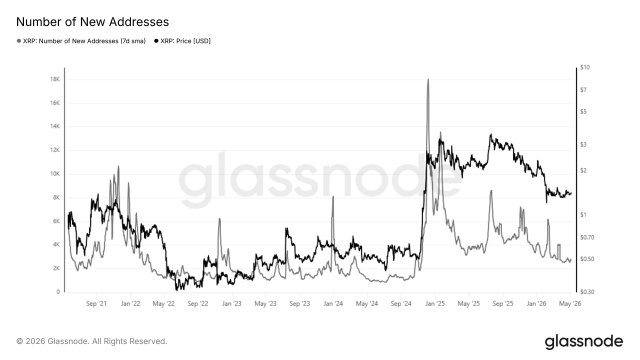
The slowdown is a result of a significant drop in the number of new wallet addresses created on the network. According to the chart from Glassnode, a popular research and on-chain data analytics platform, the metric has fallen from its peak in late 2024. Currently, the tide of new user onboarding and involvement that formerly drove network growth has slowed in recent months.

Glassnode announced that new wallet addresses on the XRP network have collapsed from 18,000 XRP in a single day in December to about 2,700 XRP per day as of yesterday. This drop from the 2024 high to today’s levels represents a more than 85% decrease after over a year.

In the ever-evolving crypto market, new addresses are often linked to retail investors. Therefore, the declining new addresses’ activity points to a sign of weakening retail involvement, particularly during times of increased speculation and market excitement.
Source: Chart from Glassnode on X

Amid this fading, new wallet addresses created on the XRP network, its monthly active supply is telling a different story. As reported by Glassnode, the monthly active supply is exhibiting bearish activity, dropping from 7.4 billion XRP per day to around 2 billion per day over the same period.

Looking at the setup, the platform has highlighted that the speculative wave that pushed that altcoin’s surge in late 2024 has largely unwound at the network level. In the meantime, this development could either mark a temporary pause or a large change in the adoption trends of the altcoin.

A Continued Decline In Waning Downside Pressure

Market sentiment has heavily shifted, causing a wave of pullback across major crypto assets. XRP was impacted by this drawdown, which has now fallen further despite the absence of significant downside pressure. Such a trend is developing a disconnect in the market where buyers are stepping back, rather than sellers forcefully taking control.

During the period, CW, a verified author at the CryptoQuant platform, has revealed that a trader is net buying a massive volume of futures positions at the current price level. While strong upside pressure is starting to emerge, the price is not rising significantly. This may be linked to the persistent purchase of long positions by a trader, which is currently blocking the rise.

XRP trading at $1.38 on the 1D chart | Source: XRPUSDT on Tradingview.com

Related Questions

QAccording to the article, what has happened to the number of new wallet addresses on the XRP network in May?

AThe number of new wallet addresses on the XRP network has dropped dramatically, falling from a peak of around 18,000 per day in December 2024 to about 2,700 per day as of early May, representing a more than 85% decrease.

QWhat does the decline in new addresses typically indicate about market participants?

AThe decline in new addresses typically indicates weakening retail investor involvement, as new addresses are often linked to retail investors, especially during periods of high market speculation and excitement.

QBesides new addresses, what other key metric is showing bearish activity on the XRP network according to Glassnode?

AAccording to Glassnode, the monthly active supply on the XRP network is also showing bearish activity, dropping from 7.4 billion XRP per day to around 2 billion XRP per day over the same period.

QWhat possible reason does the article suggest for XRP's price not rising significantly despite emerging buying pressure?

AThe article suggests that a trader's persistent large-scale purchase of long futures positions at the current price level may be blocking a significant price rise, even as upside pressure starts to emerge.

QWhat does the article state about the speculative wave that drove XRP's surge in late 2024?

AThe article states that the speculative wave that pushed XRP's surge in late 2024 has largely unwound at the network level, signaling a significant cooldown.

Related Reads

Smart Money Hoards $40 Billion in Cash, Retail Bets $2.6 Trillion on Calls: The Critical Moment of the US Stock Market's AI Narrative

Title: Smart Money Hoards $40 Billion in Cash, Retail Traders Bet $2.6 Trillion on Call Options: The Tipping Point for the AI Narrative in U.S. Stocks The U.S. stock market is experiencing a striking divergence. While the S&P 500 hits new highs, the financial sector is down 6% year-to-date, underperforming more than during the 2008 and COVID crises. In contrast, a record $2.6 trillion in S&P 500 call options traded in a single day, and the Philadelphia Semiconductor Index RSI is at its highest since 1999. This reflects a clear split: "smart money" is retreating while retail traders chase gains. Key data points highlight this critical juncture in the AI-driven rally: 1. SoftBank had to cut its $10 billion loan target against its OpenAI stake to $6 billion, as lenders questioned the valuation of the private AI giant, signaling primary market skepticism. 2. The explosive $2.6 trillion daily options volume, with 60% being calls, is described by a Goldman Sachs partner as a "semi-irrational chase," drawing parallels to the 1999 tech bubble. 3. The financial sector's severe underperformance relative to the S&P 500 is a classic technical warning signal, indicating potential underlying economic stress. 4. Apollo Global Management, despite strong earnings, is building a $40 billion cash buffer in its insurance business, preparing for what its CEO calls a 30-35% probability of an exogenous shock from geopolitics, inflation, and AI's economic disruption. 5. Consumer behavior mirrors this split: while Whirlpool plunged on a worsening macro outlook for big-ticket items, DoorDash rose on strong demand for small, immediate services. Together, these conflicting signals from primary markets, secondary markets, leading sectors, and top institutions suggest market risk premia have compressed to a precarious level. The current price action may be increasingly reliant on speculative sentiment rather than fundamental support, marking a potential tipping point for the AI investment narrative.

marsbit19m ago

Smart Money Hoards $40 Billion in Cash, Retail Bets $2.6 Trillion on Calls: The Critical Moment of the US Stock Market's AI Narrative

marsbit19m ago

Tiger Research: AI Agents Will Now Need Identity Verification

Tiger Research: AI Agents Now Need "ID Verification" AI agents are increasingly capable of autonomously executing contracts, making payments, and conducting trades. However, a critical issue remains unresolved: how to verify the identity of the agent on the other side of a transaction. This article examines the emerging competition to establish a KYA (Know Your Agent) standard and the current state of regulatory progress. **Core Points:** 1. As AI agents operate independently in A2A (agent-to-agent) scenarios, the focus shifts from KYC (Know Your Customer) to KYA for identity verification. 2. KYA is not universally required; it's essential primarily when independently deployed agents interact with open ecosystems like DEXs, engage in A2A payments, or pay merchants, not within centralized platforms. 3. A standards battle is underway, with four key players approaching KYA from different angles: * **ERC-8004:** A blockchain-native approach, creating agent IDs as NFTs with on-chain registries for identity, reputation, and validation. * **Visa TAP:** Leverages Visa's payment network to issue verified "Agent Intent" credentials, bundling agent identity into its payment rails. * **Trulioo:** Adapts the SSL certificate model to issue dynamic "Digital Agent Passports," verifying both developer (KYB) and user (KYC) credentials. * **Sumsub:** Focuses on real-time risk detection and re-verification of the human behind an agent during suspicious transactions, rather than pre-issuing certificates. 4. Regulatory momentum is building. The EU AI Act, the U.S. NIST, and Singapore's national AI governance framework are prioritizing agent identity management. The rollout of KYA standards is likely to follow a pattern similar to the FATF Travel Rule, becoming a watershed moment for the industry. The market is unlikely to have a single winner. Different approaches will dominate specific niches: ERC-8004 for on-chain autonomous transactions, Visa TAP for payment-bound commerce, Trulioo for regulated finance, and Sumsub for fraud-prone scenarios. The key differentiator will be which players successfully integrate their identity infrastructure earliest as adoption scales.

marsbit1h ago

Tiger Research: AI Agents Will Now Need Identity Verification

marsbit1h ago

Perspective: The current AI supercycle will last 15 years, but most are still buying stocks in the first FOMO stage

This article outlines a 15-year AI supercycle, segmented into four investment stages. It argues that while most investors are still focused on the first stage, smart money is already moving to the third. **Stage 1: The Foundation (2023-2025) - Priced In** The semiconductor layer (e.g., NVIDIA, AMD) is complete. While growth continues, the historic entry opportunity is over as risk/reward has compressed. **Stage 2: The Build-Out (2025-2027) - In Progress** This phase involves building the necessary physical infrastructure: power/utilities (CEG), cooling (VRT), networking (ANET), and nuclear SMRs (OKLO, SMR). Significant upside remains, but obvious names have already moved. **Stage 3: The Asymmetric Bet (2026-2028) - Positioning Window** AI moves into the physical world. Key areas include robotics/autonomy (Tesla Optimus), space/defense/drones (Rocket Lab, LUNR), and critical materials. This stage presents the best asymmetric risk/reward and is where positioning should occur now. **Stage 4: The Endgame (2028+) - Software Dominance** The mega-cap cloud platforms (Microsoft, Alphabet, Amazon, Meta), with their massive capital expenditure, will build the AI software layer and AGI infrastructure, aiming to win the entire cycle. **Core Conclusion:** The cycle is confirmed in Stage 2. Stage 3 (robotics, space, defense, nuclear SMRs) is where capital is currently rotating for maximum opportunity, while the majority of investors are expected to be 12 months behind this shift.

marsbit1h ago

Perspective: The current AI supercycle will last 15 years, but most are still buying stocks in the first FOMO stage

marsbit1h ago

Trading

Spot
Futures

Hot Articles

What is XRP 2.0

XRP 2.0: A New Frontier in the Cryptocurrency Landscape Introduction to XRP 2.0 In the ever-evolving realm of cryptocurrency, new projects continuously emerge, vying for attention and adoption. One such promising initiative is XRP 2.0, a novel cryptocurrency project designed to leverage advanced blockchain technology and robust encryption methodologies. While the name draws parallels with Ripple’s XRP, it’s crucial to note that XRP 2.0 operates independently, focusing on enhancing transaction security, privacy, and scalability. As the digital financial landscape increasingly embraces decentralized solutions, XRP 2.0 aims to contribute meaningfully to web3 and the overall expansion of crypto projects. What is XRP 2.0? At its core, XRP 2.0 is a cryptocurrency project that aims to create a secure and decentralized digital currency ecosystem. Its foundational technology integrates sophisticated blockchain principles with cutting-edge encryption techniques. The overarching goal of XRP 2.0 is to establish itself as a reliable and efficient platform enabling swift transaction execution while prioritizing enhanced privacy protections for its users. The project is promoted as a solution to many limitations faced by existing cryptocurrencies, proposing a system that can handle a higher volume of transactions with improved speed and privacy. This versatility positions XRP 2.0 as a significant contender in a marketplace riddled with various digital currencies. Who is the Creator of XRP 2.0? The identity of the creator behind XRP 2.0 has been flagged as ‘Wilbur.’ However, comprehensive details regarding Wilbur or their associated entity remain elusive. The anonymity of many cryptocurrency creators is not an uncommon phenomenon in the industry, often designed to maintain a degree of privacy and security. Who are the Investors of XRP 2.0? As of now, specific information related to the investment foundations or organizations supporting XRP 2.0 is not publicly available. In the cryptocurrency sector, the backing by reputed investors can significantly influence a project's credibility and success, yet the transparency regarding the financial supporters of XRP 2.0 has not been established. How Does XRP 2.0 Work? XRP 2.0 stands out by employing a combination of blockchain technology and advanced encryption algorithms that ensures secure and decentralized transactions. Its innovative structure includes unique features designed to foster user engagement and broaden functionalities beyond conventional cryptocurrency transactions. Among these features, XRP 2.0 incorporates AI-powered capabilities, such as text-to-image and text-to-speech functionalities. These additions are designed to enhance the interactive experience for users, promoting broader applicability across various sectors. By bridging technological advancements with user-centered design, XRP 2.0 aims to capture the attention of a diverse range of individuals and enterprises looking to integrate cryptocurrency solutions into their operational frameworks. Timeline of XRP 2.0 Understanding XRP 2.0 requires examining the milestones that have defined its journey thus far: July 23, 2023: XRP 2.0 is introduced as a novel cryptocurrency project, aiming to revolutionize secure and decentralized transaction capabilities in the blockchain domain. September 8, 2023: The launching of another project, XRP20, occurs, marking the emergence of an ERC-20 token on the Ethereum blockchain that remains unrelated to XRP 2.0. November 13, 2023: The XRP Ledger undergoes a significant update with the release of rippled server software version 2.0.0. It is essential to note that this development is disconnected from the XRP 2.0 cryptocurrency project. Key Points About XRP 2.0 To distill the essence of XRP 2.0, several critical factors emerge: Unique Features: The inclusion of features like AI-powered text-to-image and text-to-speech further diversifies the potential applications of XRP 2.0. Blockchain Technology: The framework utilizes advanced blockchain mechanisms and encryption protocols, ensuring a secure and decentralized environment for transactions. Scalability and Privacy: XRP 2.0 prioritizes enhanced privacy protections in transaction processes and the scalability necessary to accommodate a growing user base. No Affiliation with Ripple: Importantly, despite its name, XRP 2.0 does not have any allegiance or collaboration with Ripple’s XRP, distinguishing its operational framework and objectives within the cryptocurrency ecosystem. Conclusion XRP 2.0 represents an ambitious venture into the cryptocurrency sphere, aiming to offer a combination of security, privacy, and efficiency in digital transactions. By integrating sophisticated technologies and user-friendly features, the project sets out to broaden the horizons of what cryptocurrency can achieve in today's digital economy. While the anonymity of its creator and lack of disclosed investors might raise questions for some, XRP 2.0's focus on advanced functionalities and decentralisation enhances its appeal amidst an increasingly crowded crypto market. As the cryptocurrency landscape continues to evolve, XRP 2.0 may yet emerge as a pivotal player in the expansion of secure and scalable blockchain solutions.

941 Total ViewsPublished 2024.04.01Updated 2024.12.03

What is XRP 2.0

Discussions

Welcome to the HTX Community. Here, you can stay informed about the latest platform developments and gain access to professional market insights. Users' opinions on the price of XRP (XRP) are presented below.

活动图片