Bitcoin's Historically Rare Pattern: When August Rises, September Always Pulls Back, Followed by an Average 44% Surge in October

marsbitPublished on 2026-08-26Last updated on 2026-08-26

Abstract

Historical Seasonal Pattern for Bitcoin Resurfaces: Strong August (Up 25% YTD) Points to Potential September Dip, Followed by October Rally Bitcoin is on track for its strongest August performance since 2017, with gains of approximately 25% for the month as of late August, trading between $78K-$79K. This has revived discussion of a historical seasonal pattern observed since 2013. Data shows that in the four previous years where Bitcoin posted a positive return in August (2013, 2017, 2020, 2021), the following September consistently closed in negative territory, with an average decline of about -5.9%. Notably, a positive September has never followed a positive August in Bitcoin's history. However, the pattern shows a potential silver lining. Following each instance of a "Green August" followed by a "Red September," the subsequent month of October has historically seen significant rallies. The average gain for October after such a sequence is approximately +44%. While this pattern highlights a recurring seasonal trend, analysts caution that it is based on a limited sample size of only four occurrences. Each period had distinct macroeconomic and market conditions. Therefore, past performance is not a reliable indicator of future results, and whether 2026 will follow this sequence remains to be seen as September trading begins.

Author: Claude, Deep Tide TechFlow

Deep Tide Intro: As of August 26th, Bitcoin is on track for its strongest August since 2017, with an intra-month gain of approximately 25%. Historical data shows that since 2013, Bitcoin has never had a 'green September' following a 'green August'. Every green August has been followed by a red September (averaging a pullback of about -5.9%), which was then followed by an average surge of about 44% in October. This pattern is being re-examined by the market.
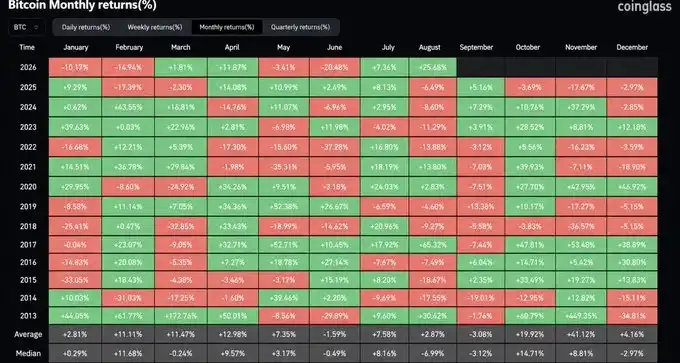
Bitcoin is on track for its most bullish August since 2017. As of August 26th, the price is trading in the $78k to $79k range, representing an intra-month gain of about 25%.

Meanwhile, an observation about seasonal patterns is spreading rapidly within the crypto community. Crypto Zombie points out that Bitcoin has never historically seen a 'green September' immediately following a 'green August'. And every time a green August was followed by a red September, the September pullback tended to be relatively mild, while October saw a significant breakout.

Green August Has Never Been Followed by Green September

According to public Bitcoin monthly return data, since 2013, Bitcoin has recorded positive returns in August four times: 2013 (+30.9%), 2017 (+64.2%), 2020 (+2.7%), and 2021 (+13.6%).

All four of these 'green Augusts' were followed by negative Septembers:

  • September 2013: -1.3%
  • September 2017: -7.9%
  • September 2020: -7.5%
  • September 2021: -7.0%

The average pullback was about -5.9%. Not once was there an exception with a 'green September'.

Mild Pullback Followed by Average ~44% Surge in October

More crucial is the subsequent performance. Following the four instances of the 'green August + red September' combination mentioned above, October saw significant positive returns every time:

  • October 2013: +67.3%
  • October 2017: +47.9%
  • October 2020: +28.0%
  • October 2021: +39.9%

The average gain was approximately +44% to +46% (there are slight variations depending on the data source and closing price calculations).

This sequence is summarized as: following a green August, the September pullback is relatively contained, and October often sees a strong rebound.

Current August is Essentially Locked in as 'Green'

As of publication, Bitcoin's August 2026 intra-month gain is already close to 25%, making it the strongest August since 2017. The price has risen from around $63k in late July to the current range of $78k-$79k.

Historically, August overall has been weak, but this year's strong performance has shifted market focus to the specific path of 'September-October following a green August'.

It's important to emphasize that historical seasonality does not constitute a prediction of the future. The full sample size is only four instances, and the macroeconomic environment and market structure behind each instance differed significantly. Currently, we are still at the tail end of August, and September has not yet begun. Whether this pattern repeats still requires validation from actual price action.

Related Questions

QAccording to the article, what is the historical trend for Bitcoin's performance in September following a positive August?

AThe article states that historically, Bitcoin has never had a 'green September' (positive return) following a 'green August' since 2013. Following the four recorded green Augusts, September always closed with a negative return, with an average pullback of about -5.9%.

QWhat pattern does the article highlight for Bitcoin's price in October after the 'green August, red September' sequence?

AThe article highlights that after the 'green August, red September' sequence, October has historically seen significant positive returns. The average surge in October following this pattern is approximately 44%.

QHow strong is Bitcoin's performance in August 2026 according to the data in the article?

AAs of August 26, 2026, Bitcoin is on track for its strongest August since 2017, with a monthly gain of approximately 25%, pushing its price to the $78,000-$79,000 range.

QWhat caution does the article provide regarding the historical seasonal pattern it describes?

AThe article cautions that the historical seasonal pattern does not constitute a prediction for the future. It notes the full sample is only four instances and that each period had different macro environments and market structures. It emphasizes that the pattern still needs to be validated by actual price action.

QIn which years did Bitcoin experience a 'green August' according to the historical data presented?

AAccording to the article, Bitcoin experienced a 'green August' (positive monthly return) in the years 2013 (+30.9%), 2017 (+64.2%), 2020 (+2.7%), and 2021 (+13.6%).

Related Reads

a16z Deep Dive: Stop Chasing the 'AI Smell', Here's a Practical Guide to Writing with AI

"Don't Obsess Over AI Detection: A Practical Guide to Writing Alongside AI" by Steph Zinn (a16z Crypto) This guide moves beyond the flawed premise that AI-generated text can be easily spotted by a set of "tells" and that these features automatically mean poor quality. Instead, it focuses on how writers and founders can use LLMs effectively by understanding, controlling, and editing the common stylistic tendencies of AI-assisted prose. The article breaks down AI writing "tells" into four key dimensions: **1. Rhetorical Features (Insight-Shaped Writing):** AI often produces semantically empty, "corporate-sounding" filler language—vague profundities, hedging phrases, excessive parallelism, and summary statements. The advice is to ruthlessly edit these out, using prompts to make language more specific and direct. **2. Voice Features (The Alexa Voice):** Default AI writing relies on a narrow, fungible vocabulary of low-friction, abstract words and cliché phrases that lack personality. While this generic voice is acceptable for support docs or mass communications, founders should preserve their unique voice for impactful writing. Use LLMs to identify and replace jargon, aiming for concrete, distinctive word choices. **3. Structural Features (Form Without Function):** AI tends towards over-structured text with excessive subheadings, lists, roadmaps, and the rigid "three-point" framework. While clear structure is good for readability and SEO, it shouldn't force ideas into unnatural containers. Choose a structure that serves the format and purpose, borrowing from effective examples. **4. Punctuation Features (Dash Panic):** The overuse of em dashes and colons has become a hallmark, but writers shouldn't avoid useful punctuation just to seem "human." The key is avoiding repetitive, distracting patterns. Use punctuation that is grammatically correct and supports the flow of your argument. The core argument is that many so-called AI flaws are just amplified versions of existing bad writing habits. The goal isn't to eliminate AI's role but to use it as a tool while maintaining editorial control. The final question shouldn't be "Can this be detected as AI?" but "Does this writing effectively do its job?"

marsbit10m ago

a16z Deep Dive: Stop Chasing the 'AI Smell', Here's a Practical Guide to Writing with AI

marsbit10m ago

Podcast Notes | Conversation with Tom Lee: Bitmine Acquiring Nearly 5% of Total ETH Supply Is Not the End Goal, ETH Price Target Set at $10,000

In a podcast interview, Tom Lee, Chairman of BitMine Immersion Technologies, discusses the company's strategy to accumulate nearly 5% of the total Ethereum supply within 14 months, using equity financing and avoiding debt. BitMine has consistently purchased ETH for over 60 consecutive weeks, with recent weeks combining buybacks with purchases. The company's substantial ETH holdings generate approximately $300 million in annual staking rewards, covering operational costs like the dividends for its 9.5% perpetual preferred stock (BMNP). Lee positions ETH as a store-of-value asset, likening it to stocks or land, rather than a pure cash-flow instrument. Looking ahead, Lee suggests BitMine may continue buying beyond the 5% target if institutional adoption grows. He outlines a bullish price target for ETH: surpassing $5,000 in a new crypto bull cycle and potentially exceeding $10,000 within 1-2 years, driven by Wall Street tokenization and AI-related demand. The discussion also covers BitMine's evolution into an ecosystem player, funding Ethereum Foundation spin-offs and developing its Maven staking platform. Lee acknowledges his significant financial interests are tied to ETH's price and BitMine's performance. The interview provides a framework for evaluating ETH as a long-term asset, emphasizing staking yield sustainability and future institutional demand, while noting the uncertainties surrounding macro cycles and real-world adoption.

marsbit11m ago

Podcast Notes | Conversation with Tom Lee: Bitmine Acquiring Nearly 5% of Total ETH Supply Is Not the End Goal, ETH Price Target Set at $10,000

marsbit11m ago

Pricing Risk Assets in 8 Hours: Tonight's PCE to Set the Discount Rate, Nvidia to Test Earnings Tomorrow Morning

"Pricing Risk Assets in 8 Hours: PCE to Set the Discount Rate Tonight, NVIDIA to Test Profits Tomorrow Morning" Risk asset prices hinge on two variables: the numerator (earnings expectations) and the denominator (the discount rate). Both will be recalibrated within eight hours. First, at 20:30 Beijing time, the US Bureau of Economic Analysis releases July PCE inflation data and the second estimate of Q2 GDP. Consensus expects mild core PCE growth, but a surge in key PPI components poses an upside risk. A hotter-than-expected print could push Treasury yields and the dollar higher, threatening the recent rally in Bitcoin (BTC) above $80K, which was fueled by falling yields. A benign reading would support risk assets. Market sentiment is already "greedy" (Fear & Greed Index at 74), making it vulnerable to disappointment. Second, around 04:20, NVIDIA reports its Q2 FY27 earnings. While consensus revenue of ~$91.85B slightly exceeds company guidance, the market has priced in a beat. The key will be the magnitude of the beat and, crucially, the Q3 guidance. As a bellwether for tech and AI narratives, NVIDIA's results will significantly impact overall risk appetite and AI-related crypto tokens. The combination creates four scenarios: 1) Benign PCE & strong NVIDIA guidance confirms the bullish trend. 2) Hot PCE & strong NVIDIA leads to conflicted signals and likely volatility for BTC. 3) Benign PCE & weak NVIDIA guidance pressures tech but offers some macro support for BTC. 4) Hot PCE & weak NVIDIA guidance presents a "double whammy," risking a sharp pullback in BTC toward the $75K-$76K support zone. The outcomes will set the tone for markets ahead of the upcoming Jackson Hole symposium.

marsbit44m ago

Pricing Risk Assets in 8 Hours: Tonight's PCE to Set the Discount Rate, Nvidia to Test Earnings Tomorrow Morning

marsbit44m ago

Trading

Spot
活动图片