Author: Zhou, ChainCatcher
Recently, the Ethereum Foundation has once again been hit by personnel changes, with core researchers Carl Beek and Julian Ma officially announcing their departure.
Since the beginning of this year, at least 7 core members or senior contributors have left one after another, from the Co-Executive Director to protocol researchers, from upgrade coordinators to cryptography experts. This has sparked clear concerns in the community about the Foundation's stability and execution capabilities.
Meanwhile, institutional holdings data have been released one after another. Goldman Sachs reduced its position in BlackRock's ETHA by about 70%, the Harvard University Endowment Fund completely liquidated its previously purchased nearly $87 million Ethereum ETF holdings, and Korea's seventh-largest pension relief company recorded a loss of approximately $32.73 million due to investing in an Ethereum leveraged ETF.
Furthermore, the Ethereum Foundation recently unstaked 21,271 ETH from Lido and has repeatedly sold ETH on-chain for treasury rebalancing.
The internal core team is leaving, external large capital is exiting, and the Foundation itself is reducing its holdings. Ethereum is being 'voted with their feet' by different types of participants simultaneously.
Trigger for the Departure Wave: The Signing Controversy Over the Mission Statement
The direct trigger for this wave of departures is the new 38-page Mission Statement released by the Foundation in March.
The statement explicitly states that the Foundation is not the owner or central authority of Ethereum, but merely one of many supporters. It proposes gradually reducing its own influence and introduces the concept of a walkaway test, meaning the Ethereum ecosystem should be able to operate independently and healthily even if the Foundation completely withdraws.
The statement also emphasizes the CROPS principles: Censorship Resistance & Capture Resistance, Open Source, Privacy, and Security.
Vitalik Buterin subsequently publicly expressed support, stating he would double down on Ethereum and positioning it as a "technical safe haven" — maintaining user self-sovereignty and ensuring that no individual, organization, or ideology can form absolute control in cyberspace.
However, the execution of the statement has sparked controversy. Reportedly, the Foundation required internal employees to sign off on the statement's content, or potentially face departure or compensation adjustments. The Foundation even created a "SOURCE SEPPUKU LICENSE" meme graphic, expressing the resolve to "self-terminate" if it fails to fulfill its commitments.
This contradictory approach of "declaring an intention to step back, yet mandating loyalty signatures" became a significant catalyst for this round of departures.

Within just four months, 7 core members or senior contributors have left one after another:
- February: Co-Executive Director Tomasz Stańczak stepped down after only 11 months in the role;
- April: Josh Stark, deeply involved in upgrades like The Merge and Dencun, and Protocol Guild coordinator Trent Van Epps, departed;
- May: Protocol co-leads Barnabé Monnot, Tim Beiko, Alex Stokes (on leave) as well as researcher Carl Beek (7-year tenure, led KZG ceremony and early Beacon Chain design) and Julian Ma (4-year tenure, led FOCIL and Fast Confirmation Rule) left.
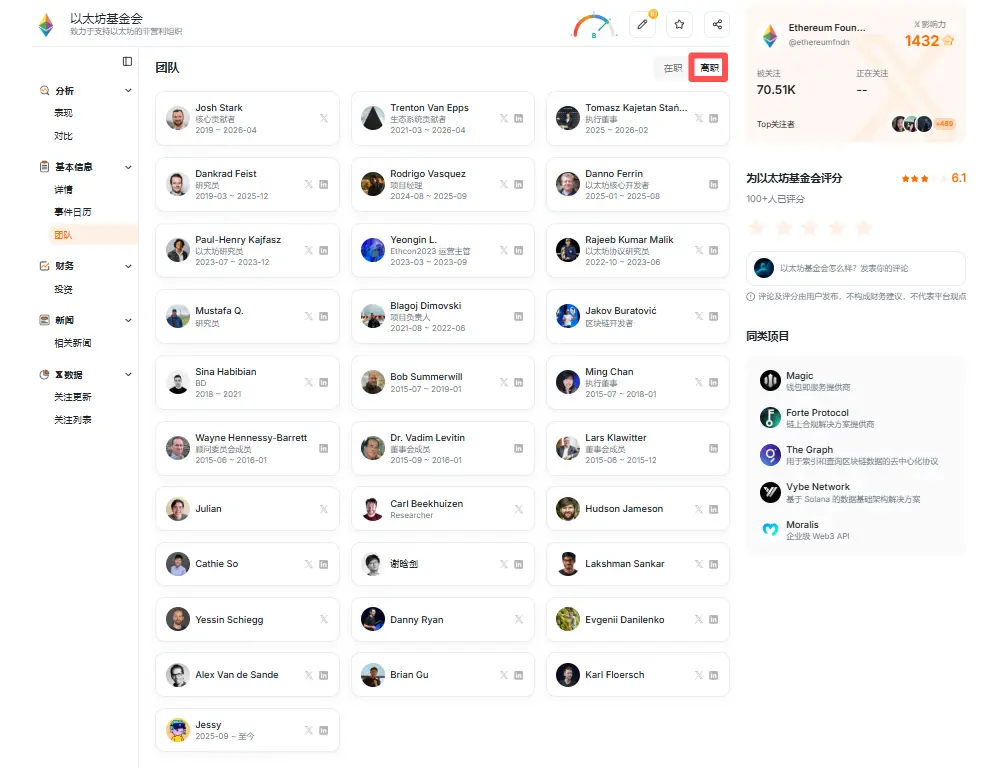
List of Ethereum Foundation Departures Source: RootData
What these people took with them is far more than just job titles; it's a wealth of tacit knowledge and intuition difficult to document. This includes the trade-offs and judgments made in past upgrades, the trust relationships between different teams, how to handle controversies during EIP proposal advancement, and the coordination skills in All Core Devs meetings that can only be understood implicitly.
Protocol Guild contributor cheeky-gorilla stated at the EthCC[9] conference that salaries for Ethereum L1 core developers are 50% to 60% lower than comparable market positions, while high-performance new chains like Monad and leading L2 projects are poaching with compensation packages over 10 times higher. He pointed out that once experienced senior researchers familiar with the underlying protocol logic are lost, key roadmap items like PeerDAS and Verkle trees face the risk of a substantive standstill.
This risk might already be materializing. The Glamsterdam upgrade, originally planned for June 2026, has seen delays. Based on the latest testnet progress and Interop meeting feedback, the actual mainnet launch is more likely to be postponed to the third quarter. The core goal of Glamsterdam is to increase the Gas limit from the current ~60 million to 200 million, a crucial step for Ethereum to enhance its mainnet competitiveness.
Recently, the EF appointed three new co-leads — Will Corcoran, Kev Wedderburn, and Fredrik Svantes — to take over the Protocol team. Their tenures at EF range from 2 to 7 years. However, trust takes time to build, coordination networks take time to rebuild, and Ethereum's upgrade pace doesn't seem to be able to wait that long.
Meanwhile, the EF recently unstaked 21,271 ETH from Lido and has repeatedly sold ETH on-chain for treasury rebalancing. Against the backdrop of personnel turmoil already raising external concerns, this series of on-chain operations has further amplified market anxiety.
Dual Pressure from External Competition and Institutional Confidence
The internal turmoil coincides with the most intense period of external competition.
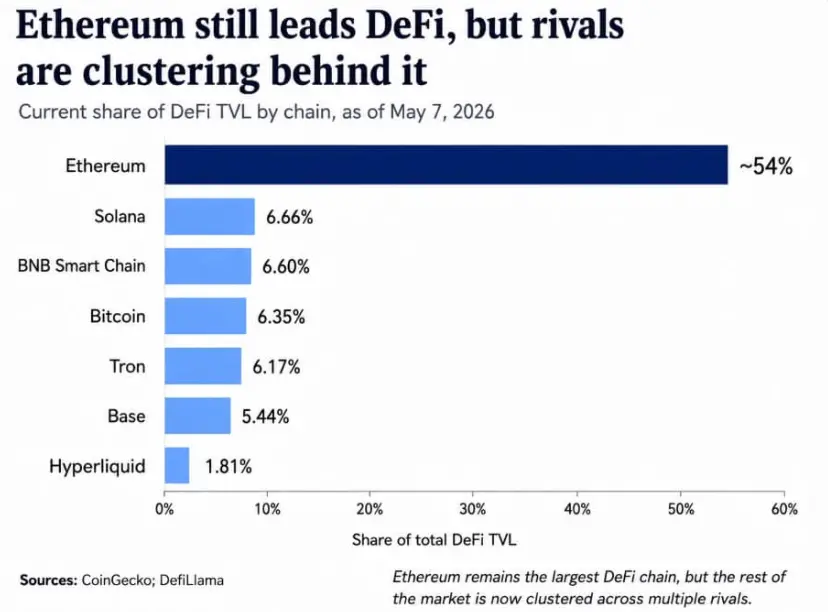
According to DefiLlama data, as of early May, Ethereum's share of Total Value Locked in DeFi has dropped from 63.5% at the beginning of 2025 to about 54% currently, hitting a near one-year low. Ethereum's DeFi TVL is approximately $45.4 billion, still significantly leading, but public chains like Solana (6.66%), BNB Chain (6.60%), Bitcoin (6.35%), Tron (6.17%), Base (5.44%), and Hyperliquid (1.81%) are gradually eroding its share.
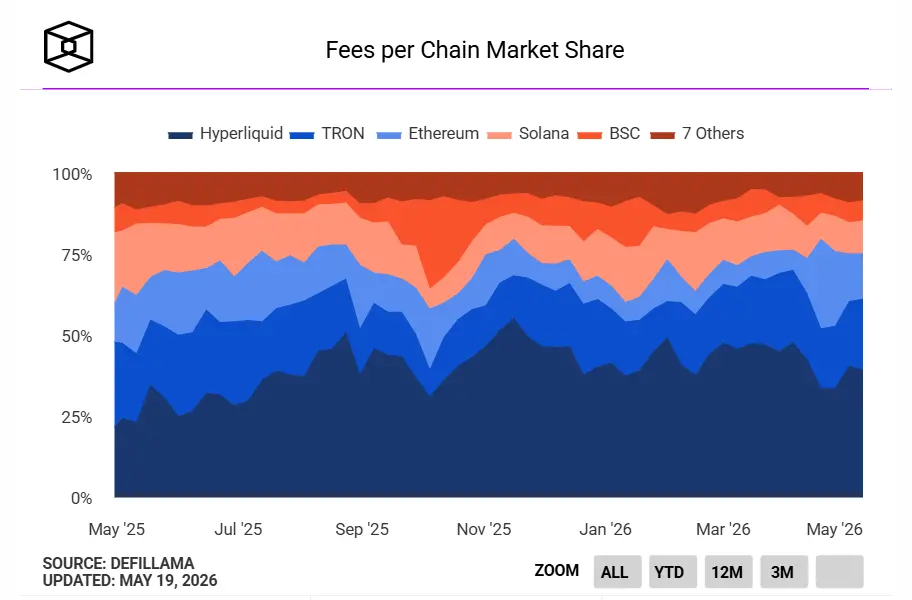
In terms of fee revenue, in the first week of May, Hyperliquid captured about 43% of the market share with approximately $11 million in fees, leading all public chains. In contrast, Ethereum's fee revenue was about $3 million, accounting for only about 13%. Solana's fee revenue was about $2 million, making up about 10%.
Regarding the RWA market, as traditional asset management institutions accelerate the push for on-chain assets, various public chains are competing for institutional issuers. The current on-chain RWA market cap exceeds $65 billion, up about 44% from around $45 billion at the beginning of the year. Among them, Ethereum currently holds about 33% market share and remains the primary deployment network for institutional tokenized assets; Provenance Blockchain accounts for about 27%, while BNB Chain, XRP Ledger, and Solana each hold about 6%.
Meanwhile, a new trend is emerging. Crypto KOL Kaylyn (@kaylyn_0x) pointed out that due to the decreasing cost and technical barriers of launching a chain, Wall Street institutions are beginning to actively explore building their own public chains or hybrid architectures to gain stronger compliance control and predictable performance. Circle's Arc public chain is a typical case; its testnet has already processed over 150 million transactions, has secured $222 million in funding from institutions like BlackRock, and its mainnet is about to launch. Its future threat to Ethereum's position as an institutional settlement layer should not be underestimated.
At the secondary market operation level, Q1 holdings reports show that Goldman Sachs significantly reduced its Ethereum exposure in the first quarter, cutting its position in BlackRock's iShares Ethereum Trust (ETHA) by about 70%, leaving only about $114 million. The Harvard University Endowment Fund completely liquidated its previously purchased nearly $87 million in Ethereum ETF holdings.
Additionally, Korea's seventh-largest pension relief company, Bumo Sarang, invested 59.5 billion won of operating funds last year into the daily double-return leveraged ETF of Ethereum-themed stock Bitmine, incurring a loss of 49.3 billion won (approximately $32.73 million).
These actions may reflect that some traditional institutions are losing patience with Ethereum's short-term returns and long-term stability.
Conclusion
Multiple signals collectively point to Ethereum's current core challenge: a dual lag in execution capability and narrative appeal regarding its positioning as an institution-grade mature infrastructure.
In his speech at the Hong Kong Web3 Carnival, Vitalik Buterin clearly stated that Ethereum is not competing on speed, but aims to be the most secure and decentralized "world computer" and "technical safe haven." His latest lengthy article further elaborates that AI-assisted formal verification is the core of Ethereum's next stage, with the goal of making Ethereum a "safety kernel" whose security can be mathematically proven.
This vision is clear, and the technical path is credible. But realizing the vision requires stable coordination capabilities and continuous accumulation of experience — it's just that precisely during this most critical window, these two things are rapidly diminishing.