Franklin Templeton brings ETFs on-chain as Ethereum hosts over $13B in tokenized assets

ambcryptoPublished on 2026-03-25Last updated on 2026-03-25

Abstract

Franklin Templeton is launching two ETFs that can be traded directly through crypto wallets 24/7, marking a shift in how traditional financial products are accessed. One fund tracks the S&P 500, while the other focuses on short-term U.S. Treasuries. Both will be issued on Ethereum, enabling peer-to-peer trading without relying on traditional brokers or market hours. The move aligns with the growing tokenized real-world asset market on Ethereum, which has reached approximately $13.6 billion in value, with U.S. Treasury products making up the majority at $11.8 billion. The firm is collaborating with Ondo Finance to support the tokenized distribution of the funds.

Franklin Templeton is launching two exchange-traded funds that can be traded directly through crypto wallets around the clock. It marks a shift in how traditional financial products are accessed and settled.

The move brings equity and bond exposure onto blockchain rails, at a time when tokenized assets on Ethereum alone are approaching $13.6 billion.

The asset manager said the funds — one tracking the S&P 500 and another focused on short-term U.S. Treasuries — will be issued on Ethereum and available for trading 24/7.

Investors will be able to buy, sell, and hold shares using self-custody wallets, removing the need for traditional brokerage accounts and standard market hours.

Franklin Templeton is also working with Ondo Finance to support the tokenized distribution of the funds.

According to Bloomberg, the collaboration will allow the ETFs to trade in crypto wallets continuously, bypassing the brokerage infrastructure that has traditionally defined ETF access.

Franklin Templeton launches ETFs that trade directly in crypto wallets

The two ETFs are designed as fully on-chain products, allowing peer-to-peer trading without relying on centralized intermediaries.

While access through traditional brokers will still be supported, the core functionality shifts toward wallet-based ownership and transfer.

Franklin Templeton said the funds will operate under a hybrid structure, allowing shares to be created or redeemed in both fiat currency and stablecoins. This model is intended to bridge conventional financial systems with blockchain-based settlement.

The firm has already expanded its digital asset footprint in recent years. This includes the launch of an on-chain money market fund and is now extending that approach to broader asset classes.

How the funds work without brokers or market hours

Unlike traditional ETFs, which are limited by exchange trading hours and settlement timelines, the new funds are designed to function continuously. Transactions can occur at any time, with ownership recorded directly on-chain.

This setup reduces reliance on intermediaries and shortens settlement cycles, while giving investors direct control over their holdings through self-custody wallets.

The funds will also be compatible with platforms that support on-chain settlement, allowing participation from both crypto-native users and traditional investors.

Tokenized assets on Ethereum near $13.6B as Treasuries dominate growth

Franklin Templeton’s move comes as tokenized real-world assets continue to expand on Ethereum.

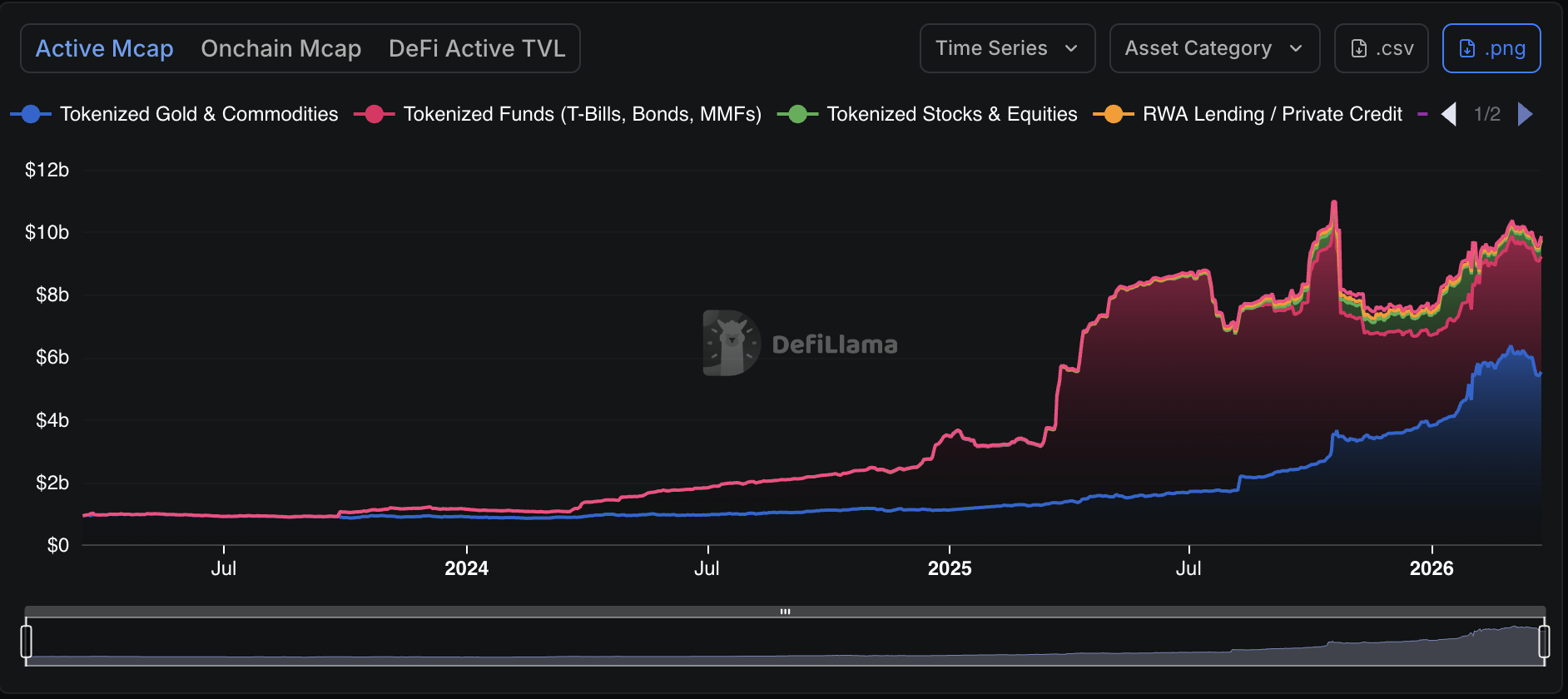
Data shows total on-chain RWA market capitalization on the network has reached approximately $13.6 billion. Also, around $9.86 billion is actively circulating across 36 issuers.
Source: DefiLlama

Within that market, tokenized U.S. Treasury products account for roughly $11.8 billion, making them the largest segment.

This aligns closely with Franklin Templeton’s decision to include a Treasury-focused ETF, suggesting the firm is targeting an already established demand base.

Growth has accelerated since 2024, with tokenized funds and credit products driving most of the expansion. The trend points to increasing institutional participation, as asset managers test blockchain-based distribution and settlement models.

The ETFs are expected to launch in the coming weeks, pending regulatory clearance.


Final Summary

  • Franklin Templeton’s ETFs shift trading from broker-led systems to wallet-based, 24/7 access on Ethereum.
  • The launch aligns with a $13.6B tokenized asset market where Treasuries already dominate demand.

Related Questions

QWhat is Franklin Templeton launching and on which blockchain?

AFranklin Templeton is launching two exchange-traded funds (ETFs) that can be traded directly through crypto wallets, and they are being issued on the Ethereum blockchain.

QHow do these new ETFs differ from traditional ETFs in terms of trading and settlement?

AUnlike traditional ETFs limited by exchange hours and settlement timelines, these new funds can be traded 24/7 with transactions settled directly on-chain, reducing reliance on intermediaries and allowing peer-to-peer trading.

QWhat is the total value of tokenized real-world assets on Ethereum mentioned in the article?

AThe total on-chain real-world asset market capitalization on Ethereum has reached approximately $13.6 billion.

QWhich type of tokenized asset dominates the current on-chain market, and what is its approximate value?

ATokenized U.S. Treasury products dominate the market, accounting for roughly $11.8 billion of the total tokenized assets on Ethereum.

QWho is Franklin Templeton collaborating with to support the tokenized distribution of these funds?

AFranklin Templeton is working with Ondo Finance to support the tokenized distribution of the funds.

Related Reads

A Hair Dryer Blows Away $34,000 from Polymarket

A hairdryer was used to manipulate a temperature sensor at Paris Charles de Gaulle Airport (LFPG) on April 6 and 15, 2026, causing short-lived artificial temperature spikes. These false readings were used to exploit a prediction market on Polymarket, where users bet on Paris’s daily maximum temperature. The attacker targeted low-probability high-temperature outcomes, which settled as "Yes" based on the corrupted data, netting a total of $34,000 in profit. The attacker’s a newly created anonymous account funded just two days before the first incident. After the successful manipulations, the funds were quickly moved through mixers and decentralized exchanges to avoid tracing. French meteorological experts and authorities confirmed the anomalies were inconsistent with actual weather conditions and nearby station data, pointing to physical intervention. Legal action was initiated for "disrupting automated data processing systems," which carries severe penalties under French law. Polymarket’s market rules relied solely on a single, publicly accessible sensor and did not account for subsequent data revisions, making the system vulnerable to such physical oracle attacks. In response, Polymarket silently switched its data source to Paris-Le Bourget Airport (LFPB) without public explanation or refunding the exploited funds. The incident highlights the risks of single-point data dependencies in prediction markets and the low-cost, high-reward potential of real-world manipulation.

marsbit12m ago

A Hair Dryer Blows Away $34,000 from Polymarket

marsbit12m ago

In-Depth Report on the On-Chain Lending Market: When Off-Chain Credit Meets On-Chain Liquidation

The on-chain lending market has evolved from a peripheral DeFi niche into core financial infrastructure. As of early 2026, total value locked (TVL) in on-chain lending protocols has reached $64.3 billion, accounting for 53.54% of total DeFi TVL, making it the largest and most mature vertical within decentralized finance. Aave dominates the sector with approximately $32.9 billion in TVL, commanding nearly half of the market—a leadership position that is unlikely to be challenged in the foreseeable future. However, the path of on-chain lending forward is not without risk. Liquidation cascades, credit defaults, and cross-chain vulnerabilities remain systemic threats hanging over the industry. At the same time, a deeper structural transformation is underway: on-chain lending is shifting from a “leverage tool for crypto-native users” to a “compliant gateway for institutional capital”. The scale of RWA (Real World Asset) lending has surpassed $18.5 billion, with U.S. Treasuries and government securities increasingly serving as core collateral. Institutional capital inflows are reshaping both the user base and risk appetite of the sector. This report systematically analyzes the evolution of on-chain lending definitions, competitive dynamics, core risks, and future trends, providing a comprehensive industry outlook for investors and trade practitioners. Key findings suggest that the “one dominant player with several strong challengers” structure will persist in the short term, while fixed-rate lending, compliant collateral, and institutional credit underwriting will define the next phase of competition. For investors focused on DeFi infrastructure, three key opportunity tracks stand out, namely, the Aave ecosystem (Morpho, Spark), RWA lending protocols (Ondo, Maple) and fixed-rate innovation (Notional, Pendle).

HTX Learn1h ago

In-Depth Report on the On-Chain Lending Market: When Off-Chain Credit Meets On-Chain Liquidation

HTX Learn1h ago

Trading

Spot
Futures

Hot Articles

Discussions

Welcome to the HTX Community. Here, you can stay informed about the latest platform developments and gain access to professional market insights. Users' opinions on the price of ETH (ETH) are presented below.

活动图片