Author: Zhou, ChainCatcher
This year, Bitcoin pioneer Adam Back and the company he founded, Blockstream , have repeatedly become the focus of discussion in the crypto community.
In February, documents related to Jeffrey Epstein released by the U.S. Department of Justice disclosed that Epstein had invested in Blockstream in 2014 through a fund associated with Joichi Ito.
In April, an investigative report published by The New York Times listed Adam Back as one of the strongest candidates for Bitcoin's creator, Satoshi Nakamoto.
At the same time, Bitcoin treasury company BSTR, which he helped promote, is preparing to go public via a SPAC.
However, new controversies soon emerged. Earlier this month, investigative account NatInfoSec published a lengthy article, accusing Blockstream of potentially raising tens of billions of dollars from investors under the guise of mining revenues, with questionable actual mining farms and hash rate support, and a structure bearing Ponzi scheme characteristics.
The article uses strong language. Although some of its inferences still require independent verification, the several doubts it raises have prompted a re-evaluation of Blockstream by the market.
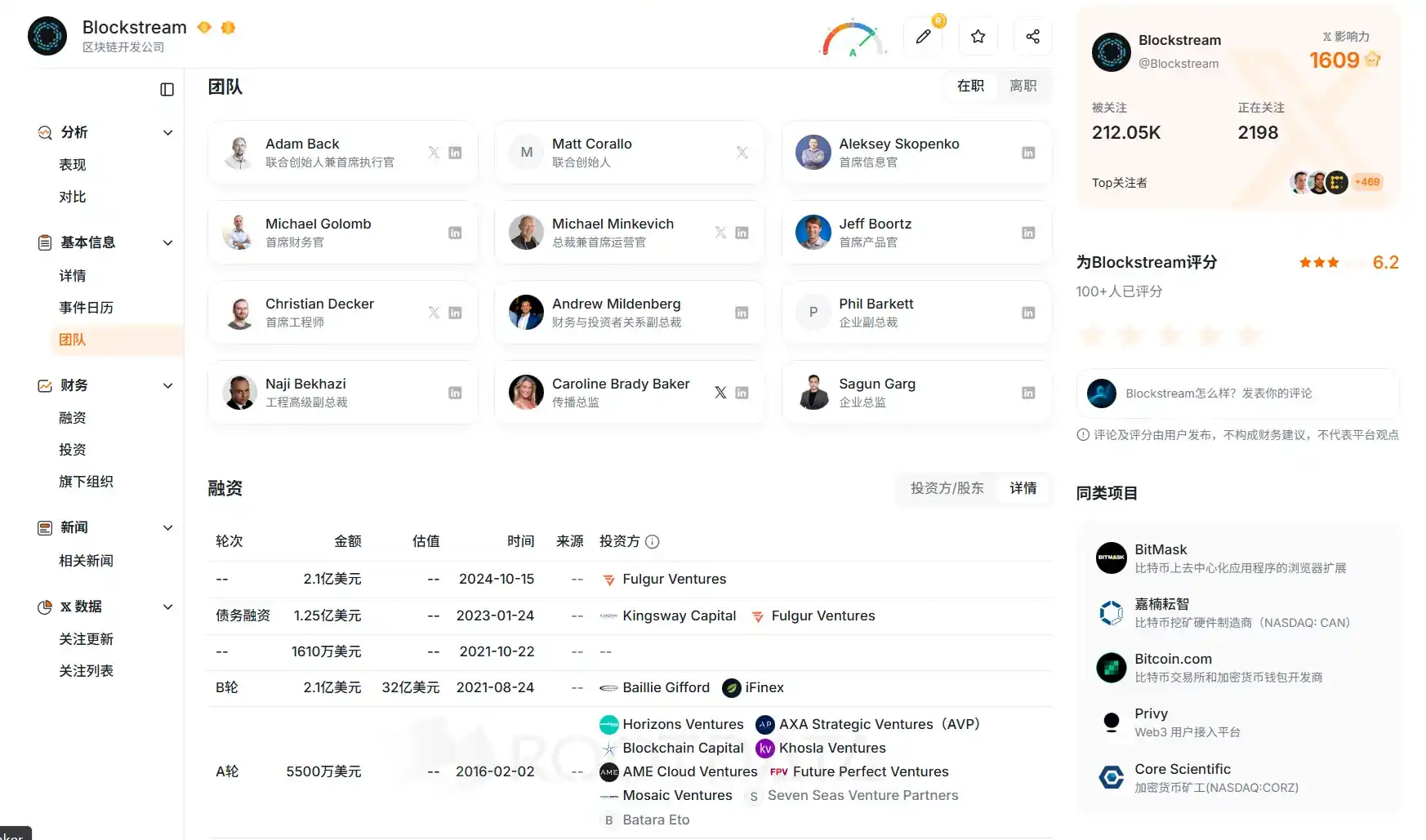
Image source:RootData
Chain of Allegations: Hash Rate, Returns, and Disclosure Issues
1. Doubts Over Hash Rate and Payment Ability
This is the most financially solid part of the entire accusation. NatInfoSec points out that to meet the obligations of the currently issued BMN notes, Blockstream would need to operate over 20 EH/s of hash rate. Including contractual buffer terms, the required hash rate could be as high as 35 to 45 EH/s. However, Blockstream's own dashboard shows the current actual hash rate is only 15 EH/s.
A mining farm of this scale should appear in public records: Texas ERCOT grid connection filings, Quebec Hydro power purchase agreements, customs import data for ASIC equipment, hash rate attribution in mining pools, and coinbase signatures on-chain. NatInfoSec claims it found no evidence matching the scale of Blockstream's notes in these public channels.
From NatInfoSec's perspective, if mining output cannot cover payment obligations, one must question where the BTC investors ultimately receive comes from. The article specifically mentions the 'Substitute Performance BTC' mechanism in BMN2 terms, stating this clause allows Blockstream to fulfill delivery obligations with BTC from any source within the 48-month contract period, without prior notice, disclosure of the source, or any quantity limit.
The article also states that BMN1 once supplemented payments by buying BTC on the open market. This shifts the core question of BMN from 'is the mining revenue sufficient' further to 'is the source of payments verifiable'.
2. High Returns and High-Risk Liabilities
The article mentions that Blockstream has issued various tiers of related notes through platforms like STOKR, with yields rising from around 9.775% to 18%, and the latest tier approaching 20%. However, some maturity arrangements do not directly repay principal but roll over into new notes with higher yields. These claims, however, still require verification against the original issuance documents.
As is well known, Bitcoin mining is a highly cyclical industry. Mining rig prices, network hash rate, difficulty adjustments, electricity costs, and BTC prices all fluctuate in real-time, making it very difficult for mining companies to commit to static fixed returns externally. A fixed annualized return around 20%, against this industry backdrop, requires clear explanation from the issuer.
3. Chris Cook's Criminal Record and Disclosure Issues
The most impactful part of the allegations concerns the background of Christopher William Cook.
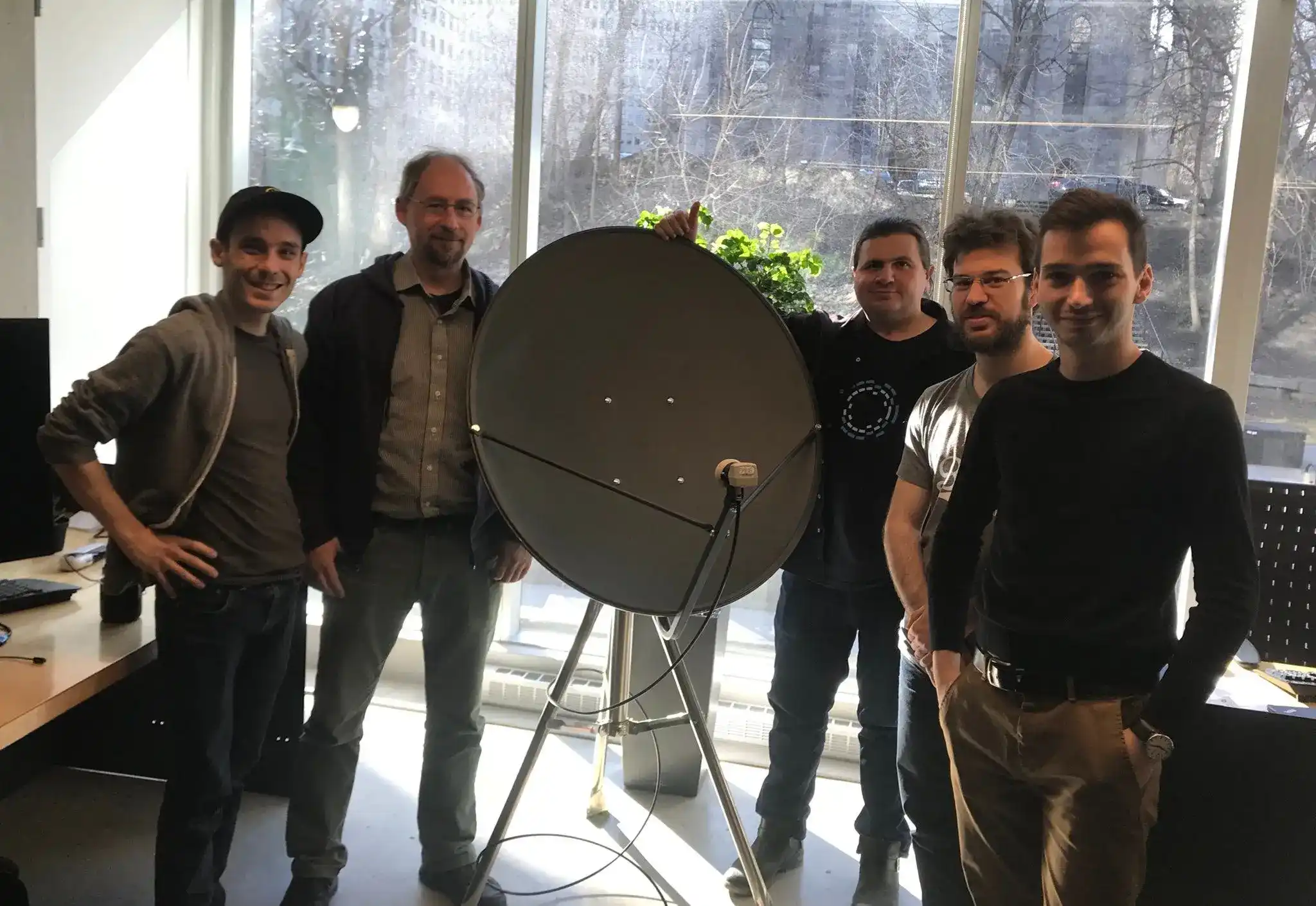
NatInfoSec states that Cook was an important manager of Blockstream's mining operations and currently serves as CEO of Exacore. The article notes that Exacore is a related operating entity spun off from Blockstream's mining business. After reviewing U.S. federal court records, it found that Cook was sentenced in 2008 by the U.S. District Court for the Southern District of Florida to 41 months in federal prison for mail fraud (Case No. 06-80187) and ordered to pay approximately $1.85 million in restitution.
The core method of the case was commercial credit fraud: using multiple shell companies, forged financial statements, and bank information to defraud over 30 retailers of goods worth over $1.8 million, then reselling them for cash.
The article points out that this criminal record does not appear in any BMN issuance documents. Additionally, Blockstream's marketing materials on the STOKR platform claimed Cook 'previously worked at NASA,' but his actual connection to NASA was only a student tour program he participated in at age 18.
Furthermore, NatInfoSec lists additional clues such as Cook's recent purchases of luxury homes, airplanes, yachts, Trump Media stock investments, and several supplier lawsuits, alleging fund flow and governance risks behind BMN.
4. BSTR/SPAC Involvement Controversy
NatInfoSec also attempts to extend the BMN controversy to Bitcoin Standard Treasury Company (BSTR). Market information shows BSTR, associated with Adam Back, is preparing to go public via SPAC. NatInfoSec questions why Cook's criminal record and BMN's massive potential liabilities are absent from SEC registration filings and raises concerns about BSTR's governance structure, including Adam Back signing agreements representing both sides of the transaction and custodian Komainu having equity ties to Blockstream.
However, this is the most easily rebuttable part of the accusation. The legal relationships, guarantee structures, and liability boundaries between BMN, Blockstream, Exacore, and BSTR are currently unclear. If the notes have no group guarantees and are not part of the BSTR listing entity, directly equating BMN risk with BSTR risk may constitute over-extension.
BitMEX Douses Flames, Community Demands Verifiability
On June 21, BitMEX Research published a commentary, systematically reviewing NatInfoSec's allegations. BitMEX acknowledged that Cook's criminal past is likely true and that NatInfoSec likely identified the same person. Regarding the near-20% yields, BitMEX also expressed concern, believing the issuer needs to provide further explanation.
However, for the other allegations, BitMEX considered the evidence insufficient or misleading. Regarding the non-disclosure of Cook's record in BSTR's SEC filings, BitMEX judged that Cook is not a director of BSTR, and mining operations are not expected to be included in the listing entity, thus no mandatory disclosure obligation exists. Regarding whether BMN liabilities should be counted against BSTR, BitMEX argued there are no group guarantee clauses in BMN documents; they are legally separate entities. Regarding the allegation of insufficient L-BTC collateral, BitMEX believed the original article cited data from a code error on the liquid.network website, which has been fixed, now showing normal.
Furthermore, the controversy continued to ferment at the community level. Former Blockstream CSO, now Jan3 CEO Samson Mow defended the BSTR narrative on X. He argued the market should not focus only on short-term controversies but see that more Bitcoin treasury companies are about to enter. Mow claimed BSTR is entering the market with $1.5 billion, poised to be a key competitor in the BTC asset accumulation space.
But critics quickly brought the question back to BMN itself. Well-known Bitcoin commentator Matthew R. Kratter responded, directly questioning whether Adam Back's so-called 'cloud mining ponzi' allegations would affect BSTR's launch. He further pressed for which mining pool Blockstream uses, whether outsiders could verify pool shares accordingly, and demanded a response on whether Cook's background should have been disclosed in SEC filings.
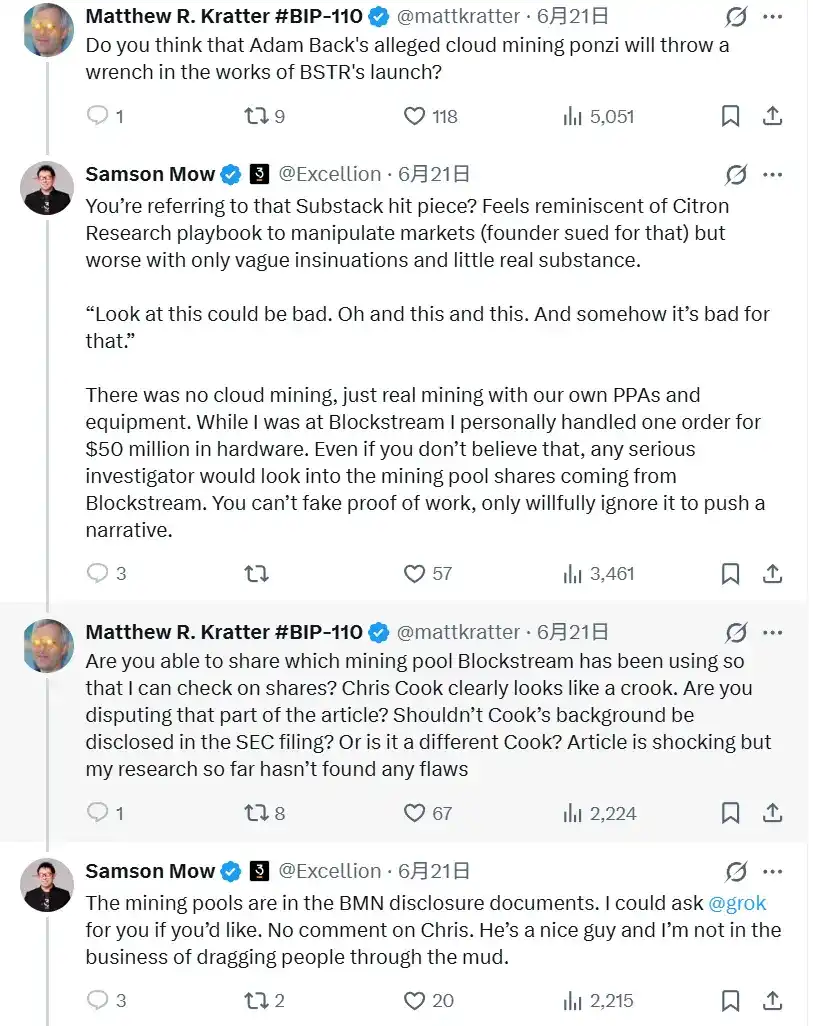
Debate escalated around hash rate verifiability. Mow responded that the term 'cloud mining' was inaccurate, that Blockstream engages in real mining using its own PPAs and equipment. He also stated that during his tenure at Blockstream, he personally handled a $50 million hardware order and suggested serious investigators should look at mining pool shares from Blockstream, not ignore PoW evidence.
But skeptics did not accept this explanation. Developer Chris Guida countered, asking where the public could openly verify hash rate coming from Blockstream. He argued that merely knowing which pools are mentioned in BMN documents does not prove that the valid shares in those pools actually come from Blockstream, unless Blockstream or the pools publicly label the hash rate source.
This debate distilled the core issue of BMN to one point: Whether Blockstream has real mining is not the only question; the real question is whether investors and external observers can independently verify that hash rate, revenue, and payment sources.
BMN Questions Remain: Real Assets and Liability Boundaries
Although community views on this event are clearly divided, they have not resolved the questions surrounding BMN itself. Regarding this mining note product, the market still lacks several key pieces of information.
First, what exactly is the actual issuance size, outstanding obligations, and liability boundaries of BMN. Authorized issuance size, actual issuance size, outstanding size, maturity structure, and related guarantees are not the same thing. The market needs to know within which entity the risk of this mining note resides, and whether it could spill over to Blockstream or other related companies.
Second, whether the mining farm hash rate is sufficient to support payment expectations. If publicly visible information on mining farm locations, power contracts, mining equipment scale, pool revenues, and historical output does not match issuance size and payment arrangements, outsiders will naturally question whether returns come from real mining or other funding sources.
Third, where exactly the near-20% fixed returns come from. High returns themselves do not equal fraud, but in a strongly cyclical industry, they demand greater transparency.
Fourth, whether the BTC or L-BTC paid to investors is verifiable. If BMN payments involve L-BTC on the Liquid network, then on-chain transparency, peg-out risks, and proof of reserves will become genuine concerns for investors.
Fifth, what is Cook's actual authority and beneficial relationship in BMN and Exacore. If he holds a core position in fund use, mining farm assets, or note design, the importance of disclosure increases.
These questions do not directly prove Blockstream has engaged in fraud, but objectively, as a mining note product offered to investors, its relatively high yield carries comparatively evident risks. This leaves BMN with significant room requiring further explanation regarding actual scale, fund usage, revenue sources, and governance disclosures.
As of publication, Blockstream has not issued a systematic response to the related controversies.