Latest: Korean QFI Has Bought Changxin Technology

marsbitPublished on 2026-08-19Last updated on 2026-08-19

Abstract

Latest Data Shows Korean QFI Has Purchased Changxin Technology According to data from SEIBro (under Korea Securities Depository, KSD), Korean investors, acting as Qualified Foreign Investors (QFI), have been actively purchasing shares of Changxin Technology (stock code 688825), a company recently listed on China's Sci-Tech Innovation Board (STAR Market). Over the past month until August 18, they made a net purchase of this stock worth approximately $45.32 million (around CNY 307 million), making it the top A-share by net purchase volume for Korean investors during that period. This activity has significantly boosted overall Korean net buying in A-shares. As Changxin Technology is not yet included in the Stock Connect schemes, QFI is currently the only channel for overseas investors like these Koreans to access its shares. SEIBro data indicates Korean buying began as early as July 28, the stock's second trading day. The stock appeared in Korean investor purchase lists using a temporary virtual ISIN code in settlement instructions, as its official international code had not yet been assigned. The listing has garnered significant international attention. On its first trading day (July 27), the actively managed U.S. ETF Tema Memory ETF (DISK) swiftly added Changxin Technology to its portfolio, giving it a substantial 10.56% weighting. Another active ETF, Roundhill Memory ETF (DRAM), also quickly included the stock. Furthermore, global index provider MSCI has added Changxin Tec...

SEIBro data shows that Korean investors purchased Changxin Technology through QFI at the first opportunity.

Data from SEIBro, under the Korea Securities Depository (KSD), shows that as of August 18, over the past month, the A-share stock with the highest purchase amount by Korean investors was a mysterious stock. During this period, Korean investors net purchased this stock for $45.322233 million (approximately 307.53 million yuan). Extending the period to the past three months, this stock still ranked first on the list of A-shares with the highest net purchases by Korean investors.

SEIBro data shows that this stock currently has no ISIN code. ISIN is a 12-digit International Securities Identification Number compiled according to the ISO 6166 standard, providing a globally unique identifier for each security. It is widely used in cross-border trading and registration/settlement and is independent of the security codes used internally by exchanges. After completing necessary procedures, each security has a unique ISIN code globally.

Which company is behind this stock? How did Korean investors buy it?

Regarding this, the KSD Securities Data Department exclusively explained to this newspaper that this security has not yet been assigned an ISIN code. When Korean securities companies, acting as Qualified Foreign Investors (QFI), trade this security, they must submit settlement instructions to KSD. Submitting settlement instructions requires using an ISIN code. Therefore, the relevant Korean securities companies chose to temporarily use a provisional virtual code, and the name of this security is displayed based on this virtual ISIN.

The KSD Securities Data Department further stated that this security is only traded on China's STAR Market and has not been included in the Shanghai-Hong Kong Stock Connect mechanism. Therefore, currently, information about this security can only be retrieved using its local code (688825).

And this code belongs to Changxin Technology, which was recently listed on the STAR Market.

As Changxin Technology has not yet entered the Stock Connect mechanism, Korean investors can currently only purchase it through the Qualified Foreign Investor (QFI) channel.

To date, overseas investors can buy A-shares through either the Stock Connect channel or the QFI channel. Using the Stock Connect channel, investors do not need to apply for qualifications and can buy through the Hong Kong Exchange platform; using the Qualified Foreign Investor channel, investors need to apply for QFI qualification. Currently, the application process has been significantly simplified.

The large purchases of Changxin Technology by Korean investors have significantly increased their overall net purchase amount of A-shares.

As of August 18, over the past month, Korean investors net purchased $45.3222 million worth of Changxin Technology and $44.27 million worth of Zhongji Innolight (H shares). The former is the A-share stock with the largest net purchase amount, and the latter is the H-share stock with the largest net purchase amount.

Furthermore, a search of SEIBro by this reporter revealed that as of July 28, Changxin Technology had already appeared among the stocks with the highest net purchases by Korean investors in the previous week. As of July 27, Changxin Technology was not on the list of the top 50 A-share stocks by net purchase amount for Korean investors in the previous week (it is also possible that Korean investors had already bought it, but Changxin Technology did not enter the top 50 A-share stock list by net purchase amount). This indicates that, at the latest on July 28, the second day of Changxin Technology's listing, Korean investors had already started buying.
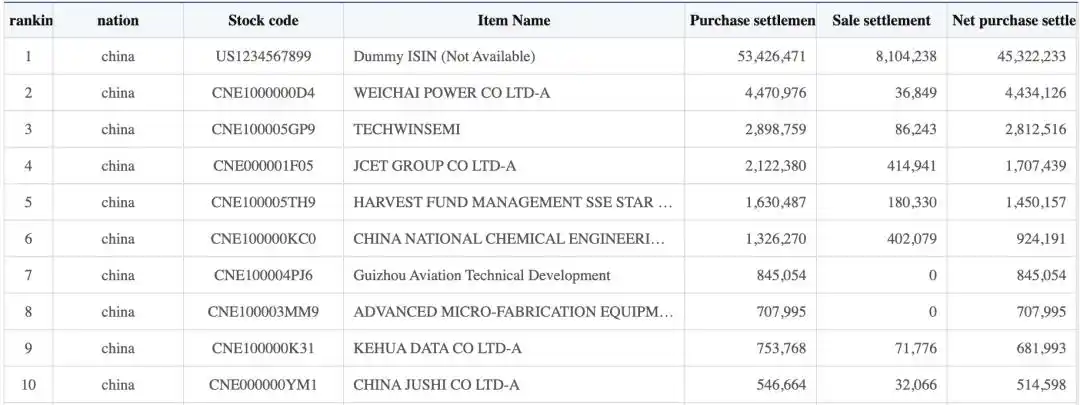
Besides Changxin Technology, SEIBro data shows that as of August 18, over the past month, other A-share stocks (including ETFs) that Korean investors bought in larger amounts included: Weichai Power, Demingli, Changdian Technology, STAR Chip ETF Harvest, China National Chemical Engineering, Hangyu Technology, AMEC, Kehua Data, China Jushi.
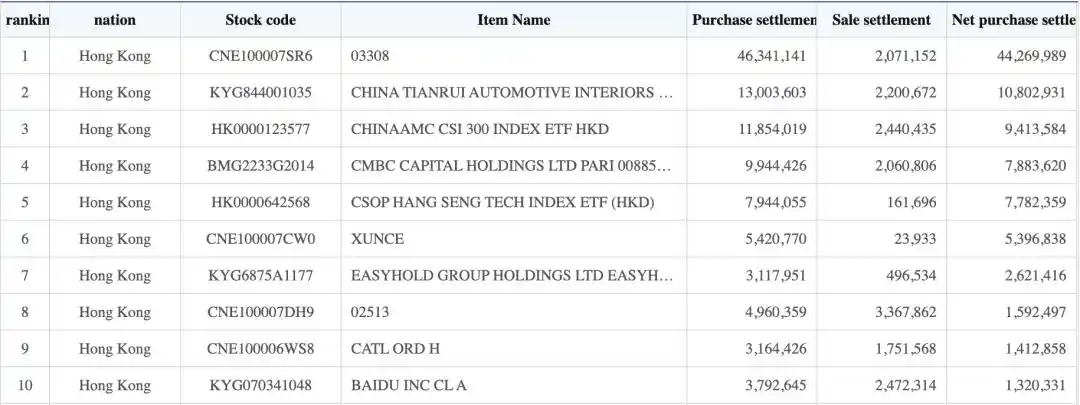
As of August 18, over the past month, H-share stocks that Korean investors bought in larger amounts, besides Zhongji Innolight, included Tianrui Automotive Interior, CSOP CSI 300 Index ETF, CMBC Capital Holdings Limited, CSOP Hang Seng Tech ETF, etc.

Listed on the same day, overseas active ETFs quickly included it

The listing of Changxin Technology sparked a strong response overseas. On July 27, the very day Changxin Technology was listed, Tema ETFs announced that it had included Changxin Technology in the holdings of the Tema Memory ETF (ticker: DISK), making it one of the fund's top holdings with a weight of 10.56%. DISK thus became the US-listed ETF with the highest exposure to Changxin Technology.

Yuri Khodjamirian, Chief Investment Officer of Tema ETFs, stated that with increasing AI demand, a global shortage of memory supply is pushing memory prices and profits significantly higher. Among the world's leading memory manufacturers, Changxin Storage has a unique position, capable of serving China's rapidly growing AI ecosystem.The investment by DISK was completed on the morning of Changxin Storage's IPO day, demonstrating the proactive responsiveness and professional judgment needed to capture such investment opportunities that are out of reach for most investors.

Subsequently, another active ETF, the Roundhill Memory ETF (DRAM), also quickly included Changxin Technology. Furthermore, global index giants took action. For example, the MSCI China All Shares Index has also included Changxin Technology, and ETFs tracking this index will passively purchase Changxin Technology.

Previously, VanEck, in an interview with this newspaper, also indicated that its China Semiconductor ETF could include Changxin Technology as soon as September.

This article is from the WeChat public account "China Fund News" (ID: chinafundnews), author: Wu Juanjuan

Related Questions

QWhat is the stock code of Changxin Technology on the STAR Market?

AThe stock code of Changxin Technology on the STAR Market is 688825.

QWhich investment channel are Korean investors currently using to buy shares of Changxin Technology?

AKorean investors are currently buying shares of Changxin Technology through the Qualified Foreign Investor (QFI) channel, as the stock is not yet included in the Stock Connect program.

QAccording to SEIBro data, what was the approximate net purchase amount of Changxin Technology by Korean investors over the past month as of August 18th?

AAccording to SEIBro data, Korean investors had a net purchase amount of approximately 45.32 million USD (about 307.53 million RMB) for Changxin Technology over the past month as of August 18th.

QWhich U.S.-listed ETF quickly added Changxin Technology to its holdings on the day of its IPO, and what was the stock's initial weight?

AThe Tema Memory ETF (ticker: DISK) added Changxin Technology to its holdings on the day of its IPO. The stock's initial weight in the ETF was 10.56%.

QWhy did Korean securities firms use a temporary virtual ISIN code for Changxin Technology in their settlement instructions to KSD?

AKorean securities firms used a temporary virtual ISIN code because Changxin Technology had not yet been assigned an official ISIN code. Since submitting settlement instructions to the Korea Securities Depository (KSD) requires an ISIN code, a temporary virtual code was used as a placeholder.

Related Reads

U.S. Market Trend (August 20): U.S. Treasury Intervention Halts Stock Decline; Moderna's Cancer Vaccine Breakthrough Sparks 180% Surge

U.S. Stocks Rebound on Treasury Intervention; Moderna Soars 180% on Cancer Vaccine Breakthrough Key Points: • U.S. stocks ended a three-day decline, with the rebound driven primarily by the U.S. Treasury Department's move to significantly increase its long-term bond repurchase ceiling. This action briefly pushed the 30-year Treasury yield down by about 10 basis points, easing long-term interest rate pressures. • Despite this, the market faced a countervailing force from the hawkish July FOMC meeting minutes, which revealed broader support for potential rate hikes among officials due to lingering inflation concerns. • Moderna shares skyrocketed nearly 180% after announcing positive Phase 3 trial results for its personalized mRNA cancer vaccine in partnership with Merck, which also rose nearly 13%. This fueled a major rally in the healthcare sector. • Contrary to the broader market, the Philadelphia Semiconductor Index fell over 2%, highlighting persistent pressure on the AI hardware chain. Concerns include AI's potential inflationary impact and questions about application-side cash flows supporting high capital expenditures. • Commodities and cryptocurrencies rallied alongside the equity rebound, supported by a weaker dollar and lower long-term yields. Geopolitical risks continued to underpin oil prices. Outlook: Market focus shifts to whether long-term bond yields stabilize post-intervention, upcoming U.S. economic data (jobless claims, Philly Fed index), and the impact of SK Hynix's massive share buyback plan on the memory chip sector. The tech sector's full recovery remains contingent on the semiconductor index's performance.

marsbit8m ago

U.S. Market Trend (August 20): U.S. Treasury Intervention Halts Stock Decline; Moderna's Cancer Vaccine Breakthrough Sparks 180% Surge

marsbit8m ago

The 19 Must-Know Top Chinese and American Entrepreneurs Born After 2000 • The 21st-Century Successors Have Arrived

The 21st century's first generation of entrepreneurs, born in the 2000s, are already taking center stage. This analysis of publicly prominent founders reveals distinct trends between China and the U.S., shaped by their respective ecosystems. In China, young founders are heavily focused on giving AI a physical presence, tackling challenges in robotics and hardware. Examples include Huang Yi (RoboParty, humanoid robots), Qin Shentao (Yuanchen Taichu, embodied AI data infrastructure), and founders working on robotic hands, home cleaning robots, and computing power networks. Their paths often emerge from university labs and robotics competitions, prioritizing prototype demonstration, cost control, and manufacturing delivery. In contrast, their U.S. counterparts frequently leverage software, AI, and capital networks to rapidly reorganize digital services and information flows. Startups like Mercor (AI talent/data, reaching $10B revenue), Etched (AI chips), and various AI-powered SaaS tools for consumers and SMBs demonstrate a focus on user growth, subscription models, and global scalability. However, this velocity has also led to high-profile cases questioning business practices and credibility. The key differentiator for this generation is not merely youth, but the compressed early stage of venture creation. Access to open-source tools, AI models, mature supply chains, and willing venture capital allows them to bypass traditional career ladders. Yet, while technology lowers the barrier to product creation, it does not reduce the challenges of building a sustainable company—managing teams, ensuring reliable delivery, and establishing trust remain hard-earned skills. The article concludes that the true test for these founders will be the "second growth": evolving from product creators into responsible company leaders capable of sustained execution and organizational building. For established businesses, the rise of these fast-moving, technologically adept teams necessitates new strategies for collaboration, competition, and investment.

marsbit12m ago

The 19 Must-Know Top Chinese and American Entrepreneurs Born After 2000 • The 21st-Century Successors Have Arrived

marsbit12m ago

A Trillion-Dollar Consumer Credit Market Lacks Key Players

The trillion-dollar global consumer credit market remains largely untapped by blockchain technology. While projects like Pharos have rapidly attracted millions in stablecoin deposits for short-term consumer loans in emerging markets, they represent early attempts to bring this massive asset class on-chain. The core challenge isn't technical tokenization, but the "repackaging" of countless small, heterogeneous loans into standardized, investable products that digital asset funds can understand and price. Current approaches primarily change the *distribution* of capital—using stablecoins for settlement and smart contracts for transparency—but do not eliminate underlying credit risk. Several models are emerging: Pharos and Huma Finance/Tala focus on connecting high-yield emerging market loans to global crypto capital. Figure stands out by building full-stack, regulated infrastructure, securing AAA ratings for its securitizations and proving blockchain assets can meet traditional institutional standards. Conversely, Goldfinch's difficulties highlight that on-chain transparency cannot replace offline credit underwriting and collection capabilities. The article identifies a four-layer value chain: 1) loan origination, 2) credit structuring & securitization, 3) on-chain infrastructure, and 4) capital. The current gap is in the second layer—the mature capital markets expertise for structuring, rating, credit enhancement, and institutional distribution. This is the critical link needed to transform scattered loans into large-scale, trustworthy on-chain credit assets, bridging traditional finance's rigor with blockchain's new capital pools.

marsbit48m ago

A Trillion-Dollar Consumer Credit Market Lacks Key Players

marsbit48m ago

Interpretation of SEC's New Crypto Regulatory Rules: Fundraising Below $5 Million Exempt from Registration, Is Altcoin Season Making a Comeback?

The U.S. Securities and Exchange Commission (SEC) has proposed a new regulatory framework titled "Regulation Crypto Assets." This proposal aims to establish tailored exemptions for crypto asset fundraising and a pathway for tokens to transition out of being classified as securities. The core provisions include two exemptions from standard securities registration: 1. **Startup Exemption**: Allows early-stage projects to raise up to $5 million over four years with simplified, narrative-based disclosures, avoiding full registration. 2. **Fundraising Exemption**: Permits raising up to $75 million within any 12-month period. It requires audited financial statements and imposes ongoing reporting obligations, similar to the Regulation A+ framework. A key component is the **Investment Contract Safe Harbor**. This rule allows a token initially sold as an investment contract (a security) to lose that designation once the issuer has completed or permanently ceased the "essential managerial efforts" promised to investors. This theoretically clears regulatory hurdles for tokens where development is finished or abandoned. The proposal defines a narrow scope, applying only to crypto assets that are not securities themselves and are part of an investment contract involving no other assets. This SEC initiative is seen as a response to the stalled progress of the comprehensive *CLARITY Act* in Congress. It represents a shift from relying solely on the historical Howey test, which the SEC admits is ill-suited for dynamic crypto assets. The proposal is currently in a 60-day public comment period, with a final rule likely months away, leaving the U.S. regulatory landscape for crypto in a transitional state.

Odaily星球日报1h ago

Interpretation of SEC's New Crypto Regulatory Rules: Fundraising Below $5 Million Exempt from Registration, Is Altcoin Season Making a Comeback?

Odaily星球日报1h ago

Trading

Spot
活动图片