Today, a tweet from two days ago started trending widely. It contained only five words: Scott Gray has left OpenAI.
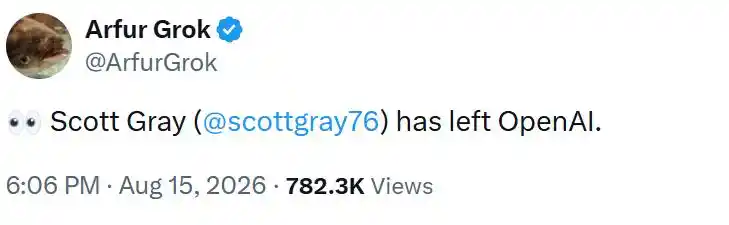
This renowned engineer, known as the "God of CUDA Kernels" and the "world's strongest GPU programmer," has become another heavyweight talent lost by OpenAI this year. He has not confirmed the news on X himself, and his LinkedIn page has not been updated yet. However, his personal bio on both X and Bluesky has already been changed from "GPU Geek at @OpenAI" to "Former GPU geek at @OpenAI." Moreover, he added a line in front: "Currently independent, exploring some neuroscience-inspired AI approaches."
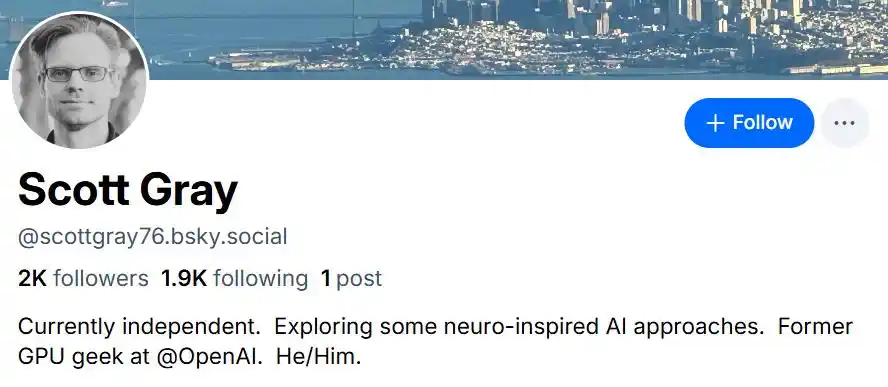
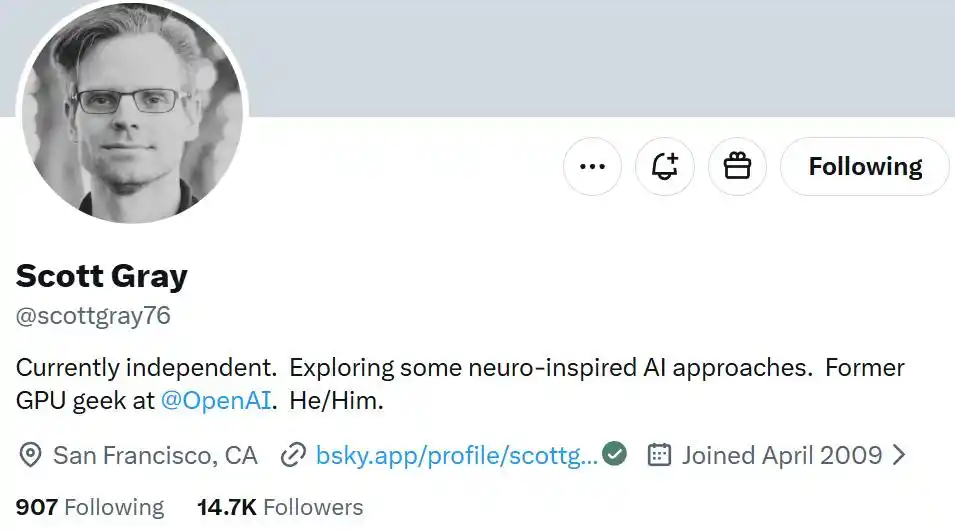
An engineer who spent ten years at OpenAI announced his departure with a single line in his bio.
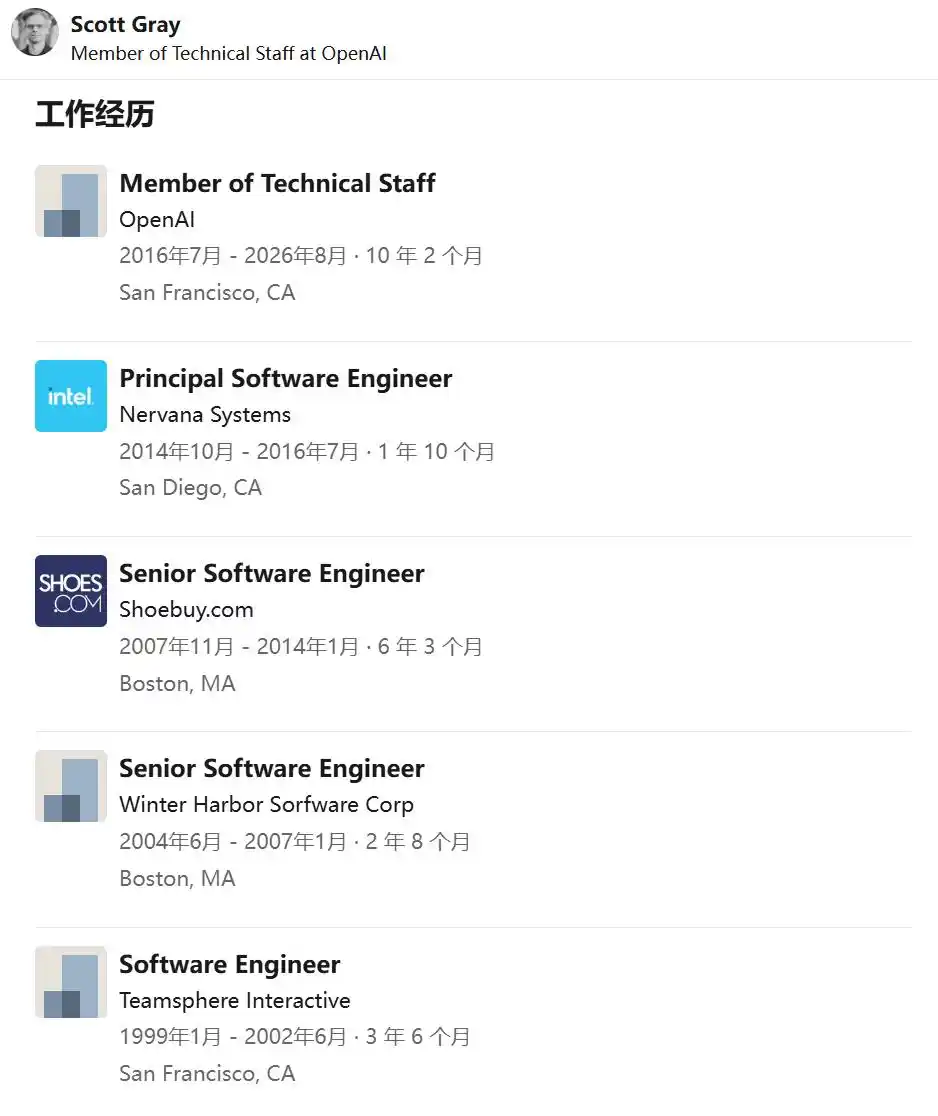
Quite a coincidence. Exactly ten years ago, on August 16, OpenAI published a blog post titled "Team update," introducing five full-time members who joined that month. The list included Dario Amodei, Filip Wolski, Jack Clark, Scott Gray, and Zain Shah.
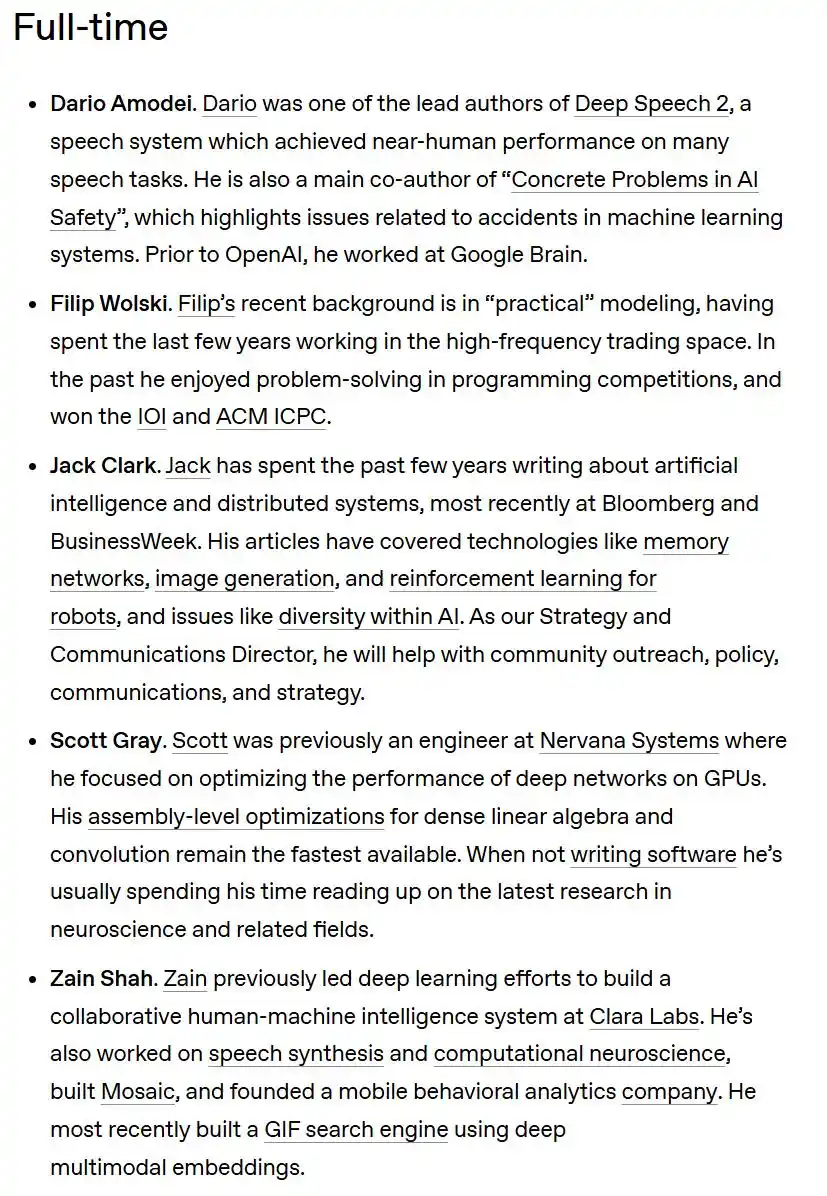
https://openai.com/index/team-update-august/
Ten years later today, Dario is the CEO of Anthropic, Jack Clark handles policy at Anthropic, and Scott Gray has marked OpenAI as "former."
As of now, OpenAI has not released any statement regarding Scott Gray's departure, and Gray himself has not posted any detailed explanation. The common source for all current reports is the change in his social media bios, followed by a viral爆料post on X. Specific details such as the exact departure date, next destination, or whether he has already started a new company are not publicly available.
Another notable detail on his account: Gray's last original X post was on November 20, 2023. The content was a single sentence: "OpenAI is nothing without its people." That was three days after Sam Altman was fired by the board. Over seven hundred employees signed a petition demanding the board's resignation, and this sentence was repeatedly copied and pasted within OpenAI at the time, considered a collective show of loyalty. Since then, he has replied to some tweets (the last replies stopped after February 2025) but has not posted any new original content.

Introduction to Scott Gray
We previously had an article dedicated to introducing Scott Gray. Refer to "God of CUDA Kernels, World's Strongest GPU Programmer? Who is this Behind-the-Scenes Master at OpenAI?" Here is a brief overview.
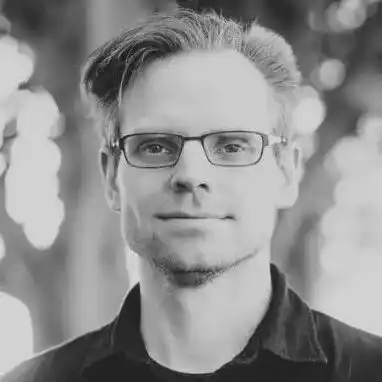
His fame began during his time at Nervana Systems. At that time, the vast majority of developers relied on NVIDIA's CUDA C/C++ and official libraries like cuBLAS and cuDNN. Multiple layers of software abstraction shielded hardware details but also created performance ceilings. Gray's judgment was that it was necessary to bypass these abstraction layers. Thus, he wrote maxas, an assembler for the Maxwell architecture, allowing developers to write SASS machine code directly, manually allocate registers, manage memory latency, and control instruction pipelines.
To prove this path was viable, he hand-wrote an SGEMM kernel using maxas. On the GM204 GPU, this kernel achieved 98% of the hardware's theoretical peak performance and was 4.8% faster than NVIDIA's official closed-source, expert-hand-written cuBLAS. The subsequent maxDNN extended the same methodology to convolution: achieving stable computational efficiency between 93% and 95% on all convolutional layers of AlexNet, while cuDNN's efficiency at the time fluctuated wildly between 32% and 57%.
This became the foundational methodology for all his subsequent work: not accepting the performance ceilings imposed by abstraction layers.
In that August 2016 OpenAI team update, the official introduction of him was only two technical sentences, essentially saying he previously focused on optimizing the performance of deep networks on GPUs at Nervana, and his assembly-level optimizations for dense linear algebra and convolution "remain the fastest to this day." The same paragraph also mentioned that when not writing code, he usually reads the latest research in neuroscience and related fields.
It seems that ten years later, his new direction of "neuroscience-inspired AI approaches" is actually a return to that enduring interest.
After joining OpenAI, his role shifted from "optimizer" to "enabler." In 2017, together with Alec Radford and Durk Kingma, he released block-sparse GPU kernels. Unlike unstructured sparsity that removes individual weights, block sparsity cuts the weight matrix into fixed-size blocks and zeroes out entire blocks. Dedicated kernels completely skip zero-value blocks during computation, achieving speeds several orders of magnitude faster than cuBLAS handling dense matrices or cuSPARSE handling general sparse matrices. This set of kernels was open-sourced at the time, directly catalyzing a series of subsequent sparse attention works.
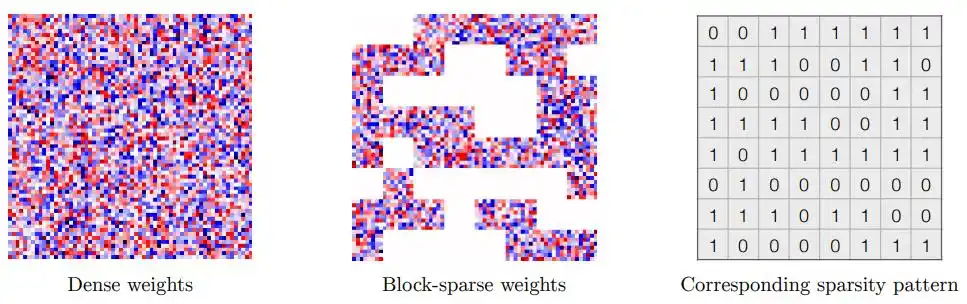
OpenAI Block Sparse Kernel Diagram, https://cdn.openai.com/blocksparse/blocksparsepaper.pdf
Following this thread, the 2019 paper "Generating Long Sequences with Sparse Transformers" was authored by Rewon Child, Scott Gray, Alec Radford, and Ilya Sutskever—reducing the time and memory overhead of attention from O(n²) to O(n√n). The paper explicitly listed "fast attention training kernels" as one of three key contributions.
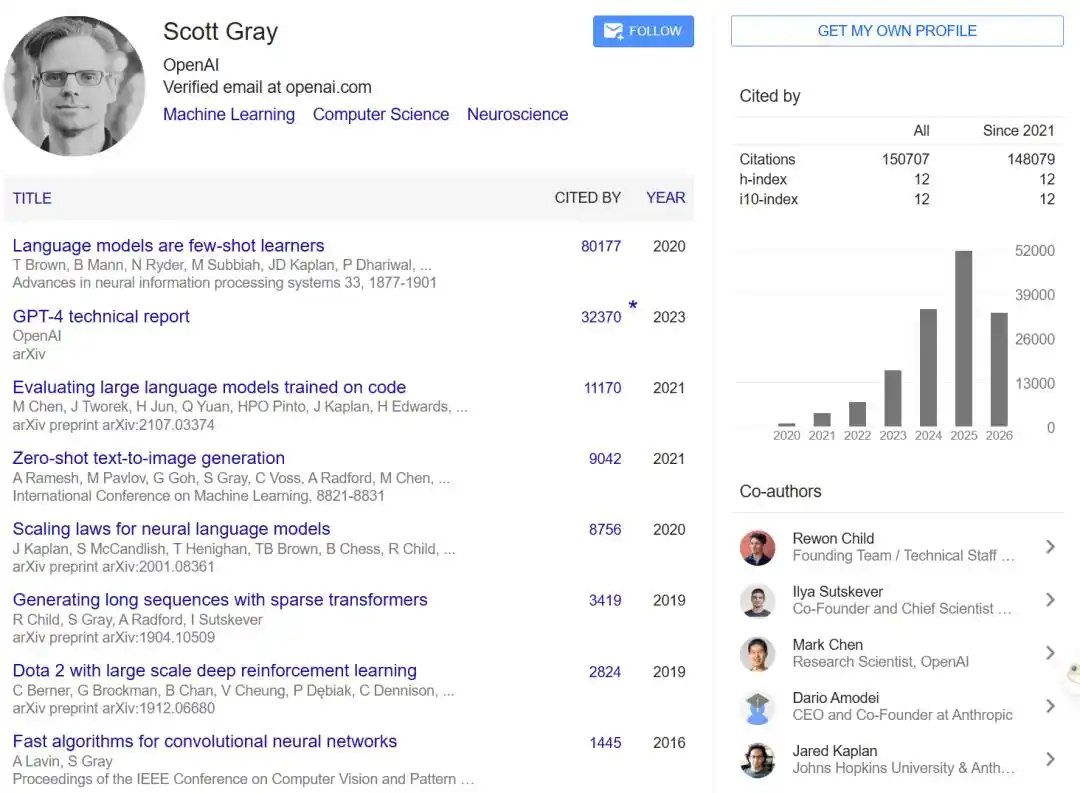
Moving forward, his name appears in the author list for GPT-3, "Scaling Laws for Neural Language Models," DALL·E, and the technical report for OpenAI Five.
During this time, he also earned the nickname "God of CUDA Kernels." That was in September 2025. Former OpenAI employee Rohan Pandey posted on X, saying that approximately only one person at the company was responsible for the inference-side CUDA kernels. Colleagues called the attention kernel he wrote "the Bob kernel," which executed trillions of times daily on hundreds of thousands of GPUs. After the post went viral, comments widely speculated that "Bob" was Scott Gray.
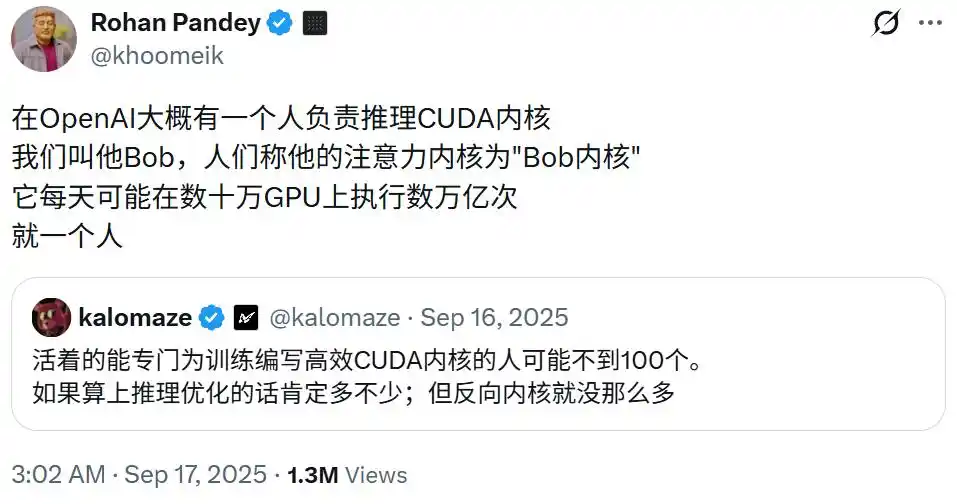
Related posts also mentioned: there are probably fewer than a hundred people worldwide who can write high-performance CUDA kernels for the training process (especially backpropagation). This skill requires simultaneous expertise in parallel computing theory, GPU hardware architecture, and deep learning algorithms, while most practitioners remain at the application or inference optimization layer.
And now, Scott Gray has left.
2026: OpenAI Has Lost Quite a Few People
OpenAI has lost a significant number of talents this year. According to a compilation by X blogger Chubby, OpenAI has seen 12 senior leaders depart this year, covering operations, business, product, research, safety, ethics, and hardware.
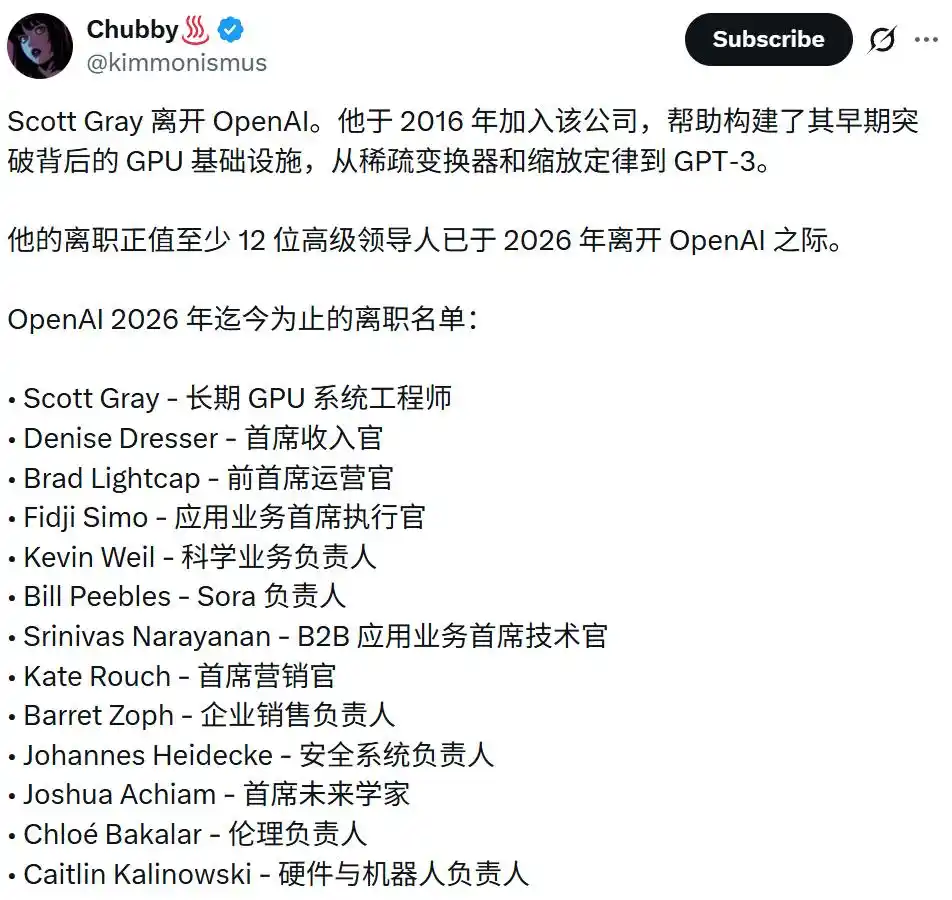
A few days ago, Brad Lightcap, who worked at OpenAI for eight years and served as CFO and COO, announced his departure on X, stating he wanted to "start something new." Two days later, Chief Revenue Officer Denise Dresser, who just took the position in December last year, announced her departure, to be succeeded by former Wiz President & COO Dali Rajic.
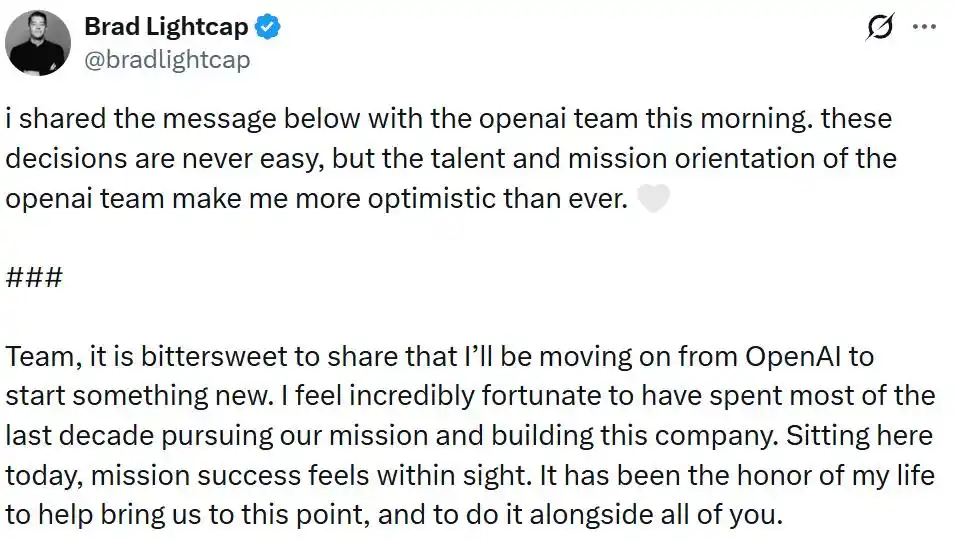
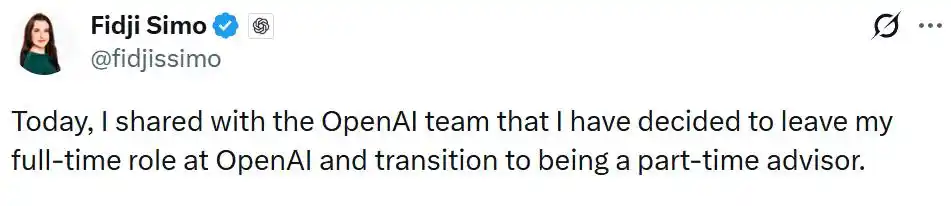
On the business and product front, CEO of Applications Fidji Simo took a leave of absence in April for health reasons and stepped down from full-time to become a part-time advisor in July; former CMO Kate Rouch stepped down in April due to treatment needs; CTO of Enterprise Business Srinivas Narayanan also announced his departure in April. On the research and product side, Kevin Weil, who led OpenAI for Science, and Sora lead Bill Peebles both announced their departures on the same day in April; Weil is currently working on an AI science startup. Barret Zoph returned to OpenAI in January from Thinking Machines Lab to lead enterprise AI sales but left again in June; the company did not specify a reason.
Three people from the safety and ethics lines departed concentrated in July: Safety Systems Lead Johannes Heidecke left during a safety team reorganization, with his responsibilities merged into the research department led by Mia Glaese; Chief Futurist Joshua Achiam left after nearly nine years—the mission alignment team he previously led was disbanded in February this year; Ethics Lead Chloé Bakalar left less than a year after joining. Earlier, in March, Robotics and Consumer Hardware Lead Caitlin Kalinowski resigned due to disagreement with the company's cooperation with the Pentagon. She stated on LinkedIn that such issues should undergo more thorough review and later added that her objection was primarily about the governance process.
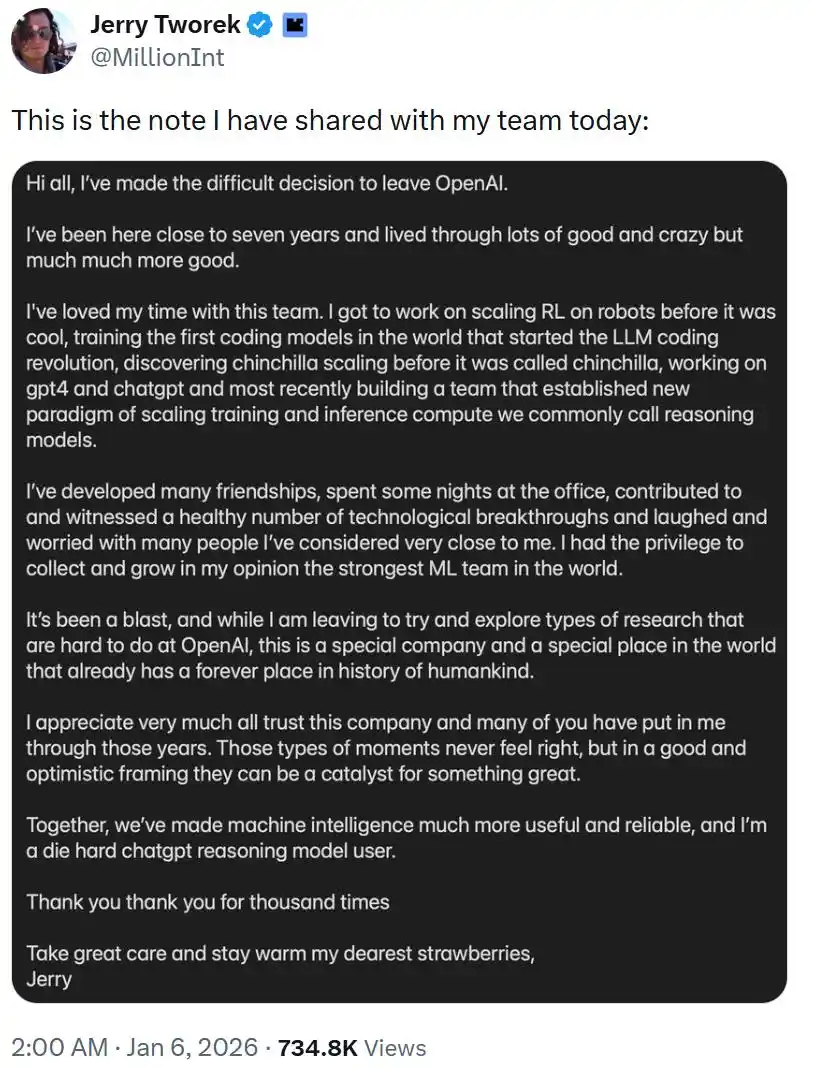
This list also missed one: in January this year, Research VP Jerry Tworek, responsible for reasoning models, left after nearly seven years to start his own venture, citing a desire to pursue research directions "difficult to do within OpenAI."
Conclusion
Scott Gray's departure may not immediately alter OpenAI's model release cadence. A decade of accumulated engineering systems will not come to a halt because one person leaves. However, for a company increasingly reliant on scale, efficiency, and cost control, losing an engineer who could push hardware performance to its limits and was deeply involved in multiple generations of core models is still not a change that can be taken lightly.
The timing of this departure is also noteworthy: OpenAI is preparing to go public, transforming into a giant corporation pursuing revenue and participating in a global infrastructure race. Now, some of the people who originally shaped it are also re-evaluating what they want to do next.
Scott Gray's choice wasn't to join another frontier lab or announce a startup. He simply stated in his personal bio that he is independently exploring "neuroscience-inspired AI approaches." From the engineer who read neuroscience papers in his spare time in the 2016 official introduction, to writing neuroscience back into his personal bio ten years later, this seems more like a return after a long detour: after squeezing the existing computing paradigm to its absolute limit, he began searching for another possibility.
In 2023, Gray wrote, "OpenAI is nothing without its people." Looking back today, this statement was both a stance during that company crisis and seems like a belated footnote. OpenAI will not lose everything because of any one person's departure. But ultimately, a company's direction is shaped by those who stay, those who leave, and the respective problems they choose to explore.
This article is from the WeChat public account "Almost Human" (ID: almosthuman2014), author: Focus on AI