Shocking: OpenAI Fully Open-Sources Codex Harness

marsbitPublished on 2026-08-21Last updated on 2026-08-21

Abstract

OpenAI has open-sourced the core framework of Codex, called "Harness," under an Apache-2.0 license. This move allows developers to deeply integrate AI agents into their own applications and workflows, moving beyond the limitations of generic chat interfaces. The Harness is the underlying execution system that manages an AI agent's complete lifecycle: understanding tasks, maintaining memory, using tools, handling failures, and requesting human approvals. OpenAI demonstrated that optimizations to the Harness alone can dramatically boost a model's performance, tripling scores on a benchmark while using significantly fewer tokens. The release includes three key components: a CLI tool (`codex exec`) for automated tasks, official SDKs (TypeScript/Python) for programmatic control, and the `app-server` for embedding agents directly into products. This enables features like persistent state, real-time event streaming, and human-in-the-loop controls. Early adopters showcase its versatility beyond coding. Examples include a tax preparation system that cut processing time by one-third, Cisco's platform for building apps with natural language, and a demo logistics dashboard where agents analyze data and propose actions within the existing interface. This paradigm shift grants developers full control over the user interface, context, tools, and security boundaries. AI becomes an invisible assistant within specialized software, rather than a separate chatbot. By open-sourcing the engine...

Just yesterday, OpenAI rolled out another major update.

This isn't a new model release, but its impact on developers may even surpass that of a model iteration itself.

OpenAI officially announced: it is fully open-sourcing the core underlying framework (Harness) of the renowned Codex as a platform!
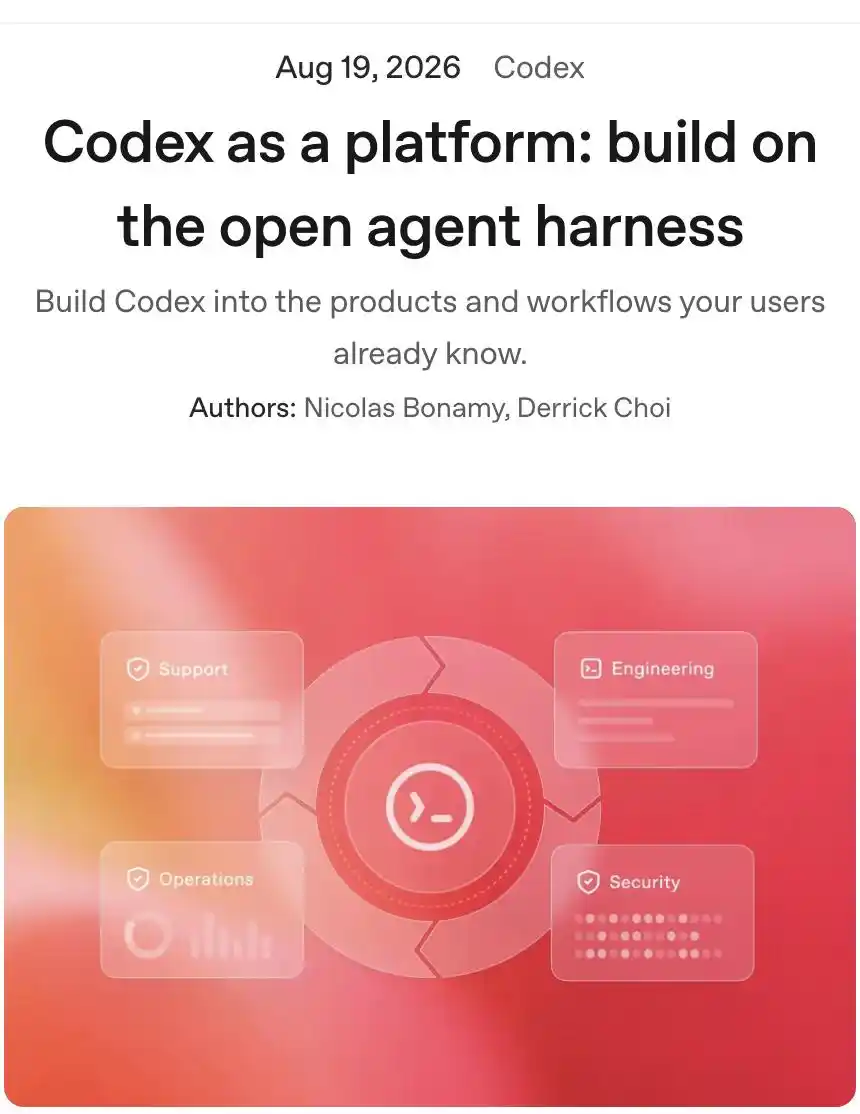
In other words, OpenAI is giving away the engine that powers its top-tier AI agents for free.

Developers no longer need to force their business workflows into a generic chat box!

You can seamlessly embed the most powerful AI agent loop directly into your own products, engineering tools, operational dashboards, or even the most tedious financial reporting software.

OpenAI President Greg Brockman excitedly reposted on X, saying: "Codex can power far more than just coding tools!"

You can build your own products directly on Codex Harness.
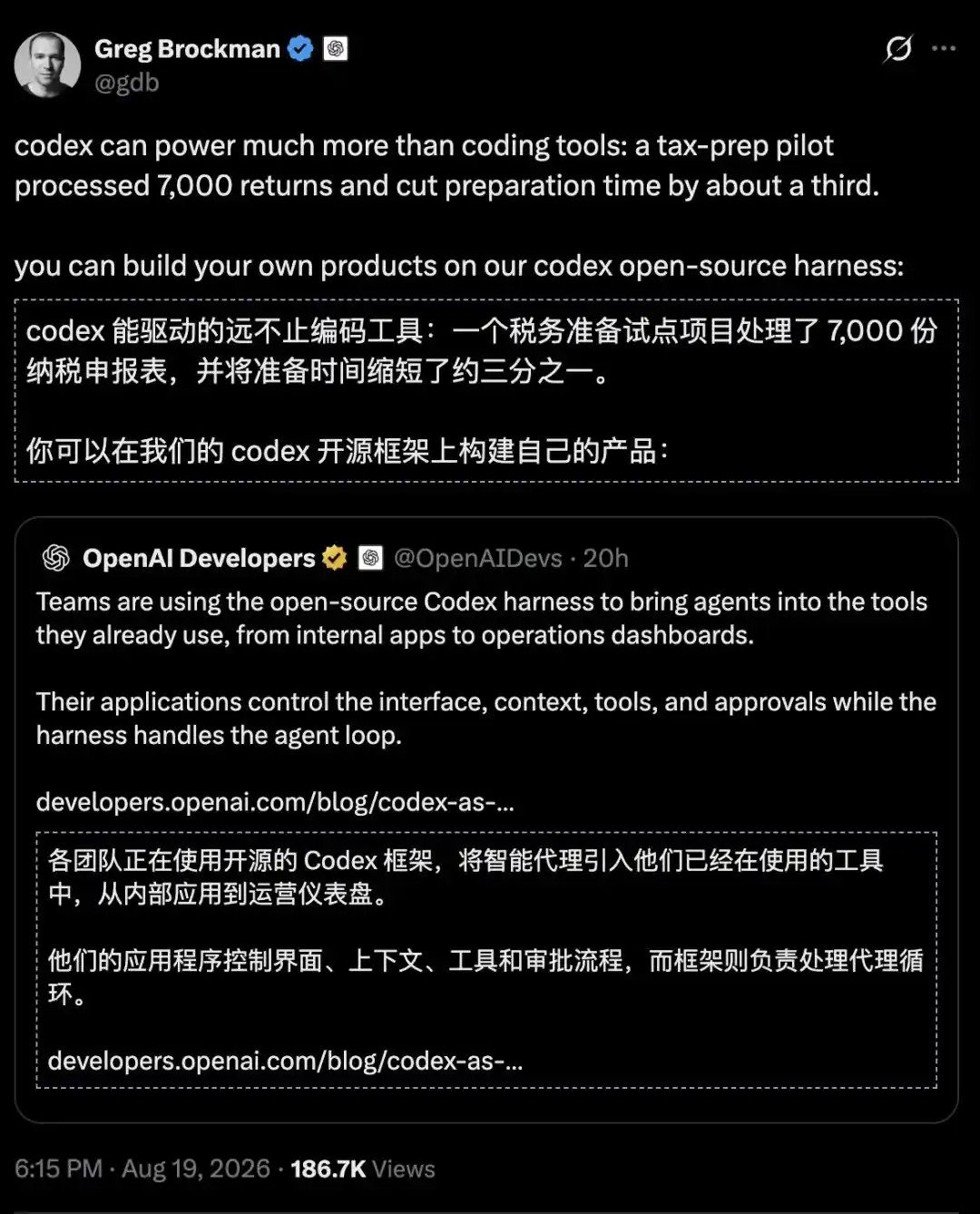
From now on, you own your turf—the interface, data, and approval permissions are all yours, with AI only responsible for being the "workhorse" in the background.

How will OpenAI's latest "open-source move" completely reshape the future paradigm of software development?

The World Has Suffered from "Generic Chat Boxes" for Too Long

Think about how we use AI today.

Whether it's writing code, performing data analysis, or handling customer complaints, the standard procedure seems to be: open a webpage/sidebar, face a monotonous chat input box, type out some background context, and then hope the AI provides a perfect answer.

If the answer is wrong, you continue "haggling" in the chat box.
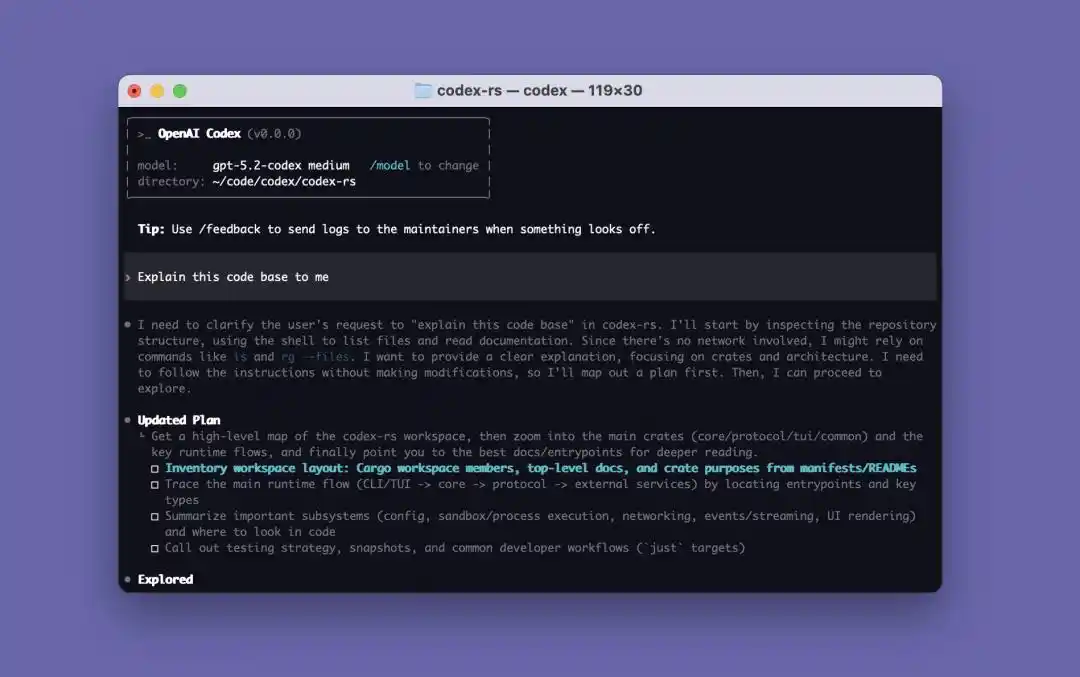
Most people encountered Codex through apps, command-line interfaces (CLI), or IDE extensions.

But from OpenAI's perspective, this single-mode interaction experience is far too narrow!

OpenAI pointed out incisively in its official blog:

Instead of forcing every team to cram their familiar workflows into a generic code assistant, why not bring the Agent directly into software designed around actual work?

After all, security analysts look at alert queues and affected service statuses; support engineers look at account histories and product logs; product managers look at requirement boards.

For these real workers, the important thing is not the "chat box," but the business dashboard in front of them. The interface exists for a reason—it is itself the most crucial "context."

Now, with the open-sourcing of Codex Harness, this "anti-wrapping" revolution has officially begun.

Demystifying Harness: The "Strongest Exoskeleton" for AI Agents

So, what exactly is Harness, the star of this open-source release?

Many mistakenly believe a powerful AI Agent = good model + good Prompt.

That's completely wrong!

A truly operational agent in business requires an extremely complex underlying execution system.

It needs to understand tasks, maintain memory across long conversations, review relevant information, proficiently call various tools, display progress externally, handle crashes and failures, pause to request human approval at critical moments, and finally return useful results.

This "execution system" and "agent loop" that handles all the heavy lifting is Harness.
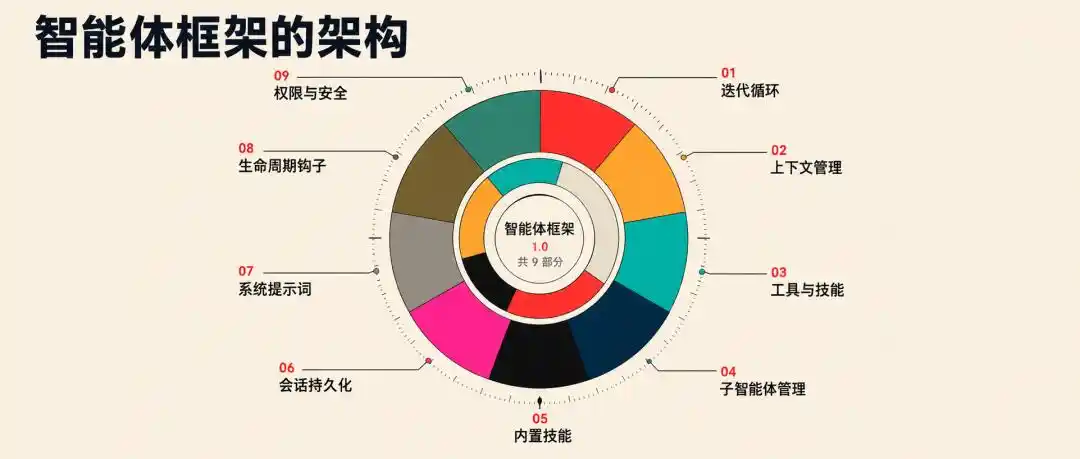
With this open-source release, OpenAI has proven one thing: A well-designed Harness can even transform a model's capabilities.

OpenAI provided highly convincing data to demonstrate how critical harness design is.

On the extremely challenging ARC-AGI-3 benchmark, they made just two key adjustments to the Harness—reasoning preservation and context compression.

The result? The score of the GPT-5.6 Sol model instantly skyrocketed from 13.3% to 38.3%! Even more astonishingly, the number of output tokens decreased sixfold!

This means, with Harness's enhancement, the AI not only became three times smarter but also saved you massive amounts on API call costs.

The evidence shows that while model capability is important, how you manage that model (i.e., Harness design) is the key determinant of an Agent's final performance.

Three Open-Source Components for Zero-Friction Integration

To truly enable developers to "use it out of the box," OpenAI released a complete suite of three open-source components under the Apache-2.0 license.

Just head to the openai/codex repository on GitHub, and you can unlock this powerful arsenal.

https://github.com/openai/codex

First is the CLI tool `codex exec`, which can run automated pipelines.

If you just need the AI to run a script, execute a CI (Continuous Integration) task, or handle a one-off background task, use the CLI directly.

It runs a bounded Agent workflow and returns structured output. Simple, direct, efficient.

Second is the official Codex SDK, the ultimate control stick for programmers.

If you're building an application and need to start, resume, or stream Codex tasks programmatically, the official SDK (supporting TypeScript / Python) provides a direct programming interface.

You can precisely control the lifecycle of threads and tasks with code.

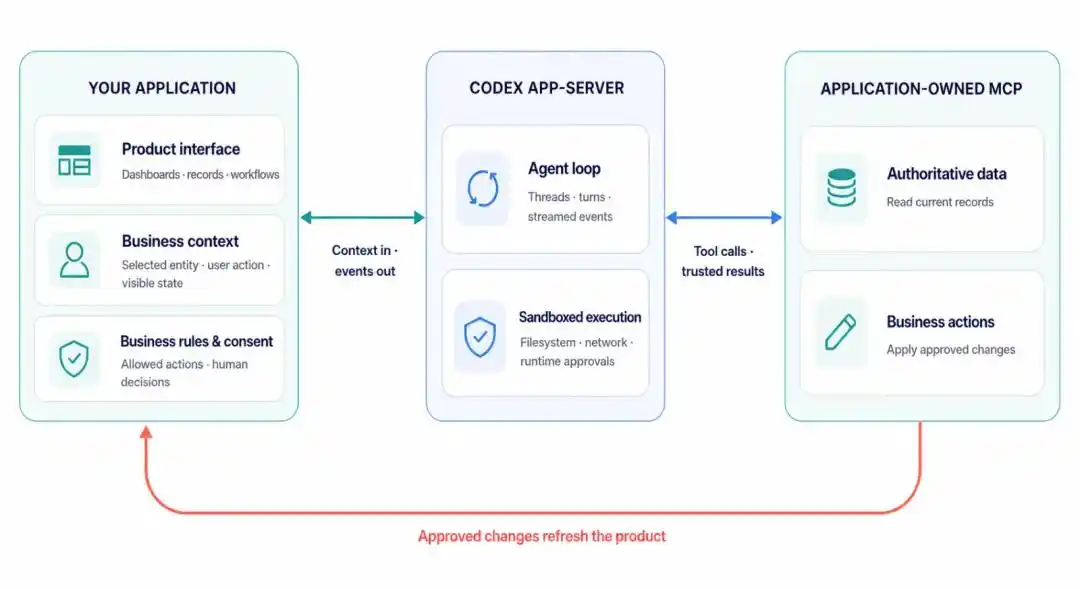
Third, and the shining star of this open-source release, is the Codex app-server. It is the core engine for deep product integration.

When the Agent needs to become an integral part of your product, the app-server is the best choice. It connects your application to a local Codex process via a detailed client protocol (JSON-RPC).

You can use it to:

Maintain persistent conversation state;

Stream events (see what the AI is doing in real-time);

Interrupt the AI's work mid-process;

Expose your own application's tools for the AI to use;

Handle human-in-the-loop approval requests.
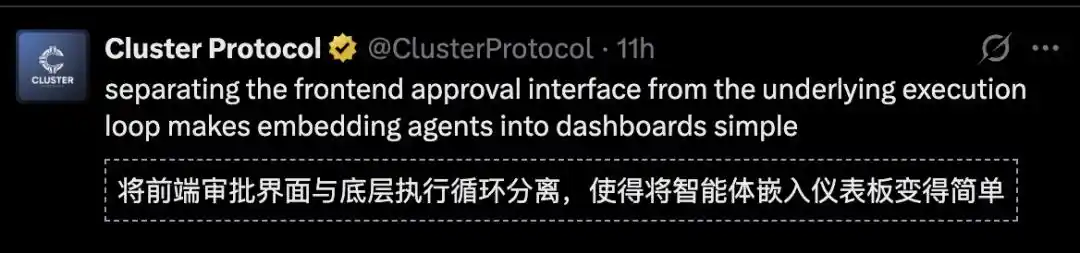
As noted developer @ClusterProtocol remarked:

Separating the front-end approval interface from the underlying execution loop makes embedding Agents into business dashboards unprecedentedly simple!
Far More Than Just Coding! The "Efficiency Nuclear Weapon" for All Industries

If you think Codex is just for writing code, you're sorely mistaken.

As Brockman stated, Codex can power far more than just coding tools.

Let's look at what miracles the first adopters are creating with it:
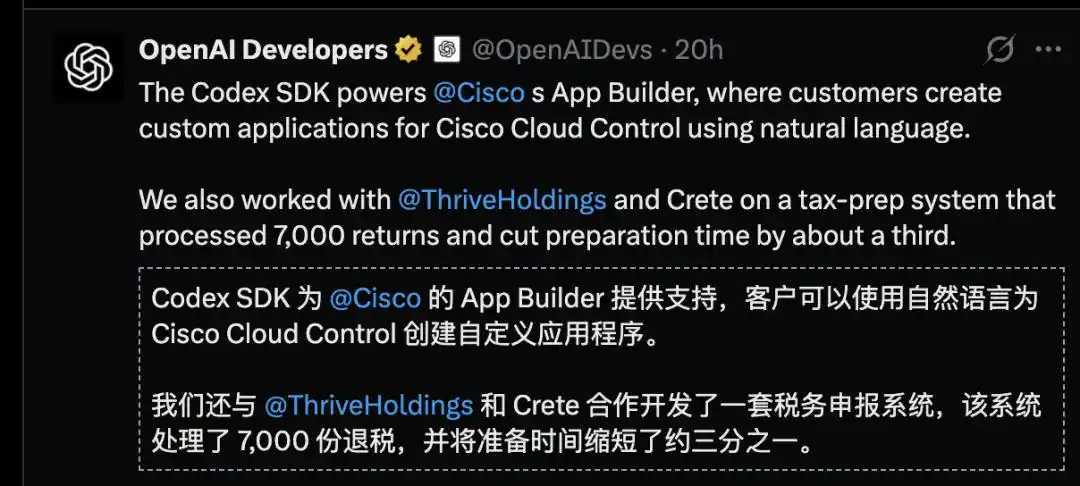
Case One: A "Divine Assistant" for Tax Filing

Can you imagine AI handling tax returns? Financial work fears errors the most, with extremely low fault tolerance.

Partners Thrive Holdings and Crete used this open-source Harness, embedding it into a professional tax preparation workflow.

The system not only handles complex tax logic but also perfectly integrates feedback from tax professionals.

The results were staggering. This pilot project successfully processed up to 7,000 tax returns, slashing preparation time by roughly one-third!
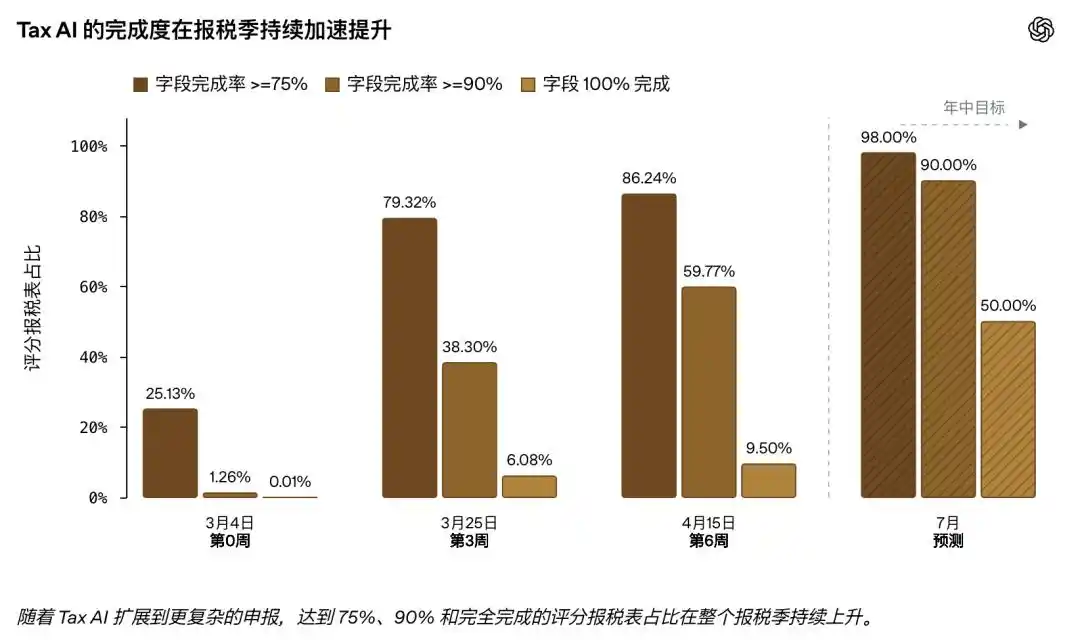
This demonstrates the immense power of embedding AI into vertical, professional tools.

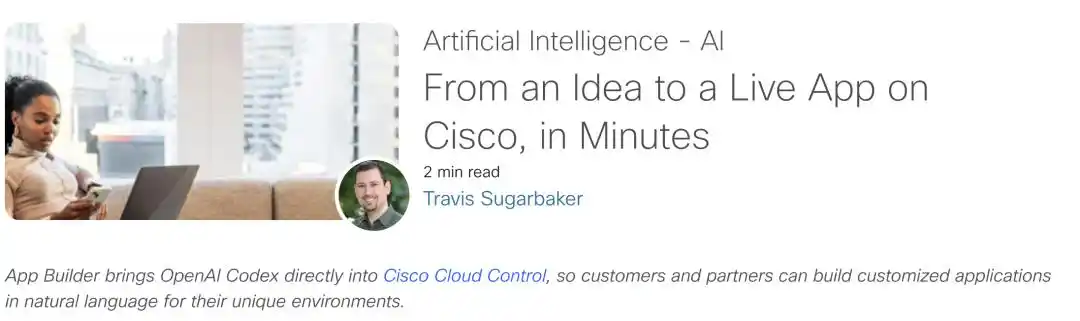
Case Two: Tech Giant Cisco's Cloud Manager

Tech giant Cisco used the Codex SDK to build an App Builder within its cloud control platform.

Now, Cisco's customers can use natural language directly to create custom applications, with all the complex underlying logic flow handled silently in the background by Codex Harness.
Official Demo Template: Logistics Dashboard "Relay"

To help everyone understand more intuitively, OpenAI showcased an official demo called Relay, a virtual logistics operations dashboard application.

In this dashboard, there is no distracting "ChatGPT chat box."

1. Interaction Revolution: Users don't need to write Prompts from scratch. They simply select a delayed shipment and click "Compare Recovery Options."

2. Seamless Context Integration: The application automatically feeds the current interface's shipment details and logistics data as context to the AI.

3. MCP Integration: Codex automatically calls the application's own MCP tools to fetch the latest real-time operational data.

4. Human Oversight: After the Agent analyzes the optimal re-booking solution, it must pop up an approval dialog. The AI only executes the write operation when the operator clicks "Approve."

5. Status Synchronization: Once the operation is complete, the business dashboard automatically refreshes.
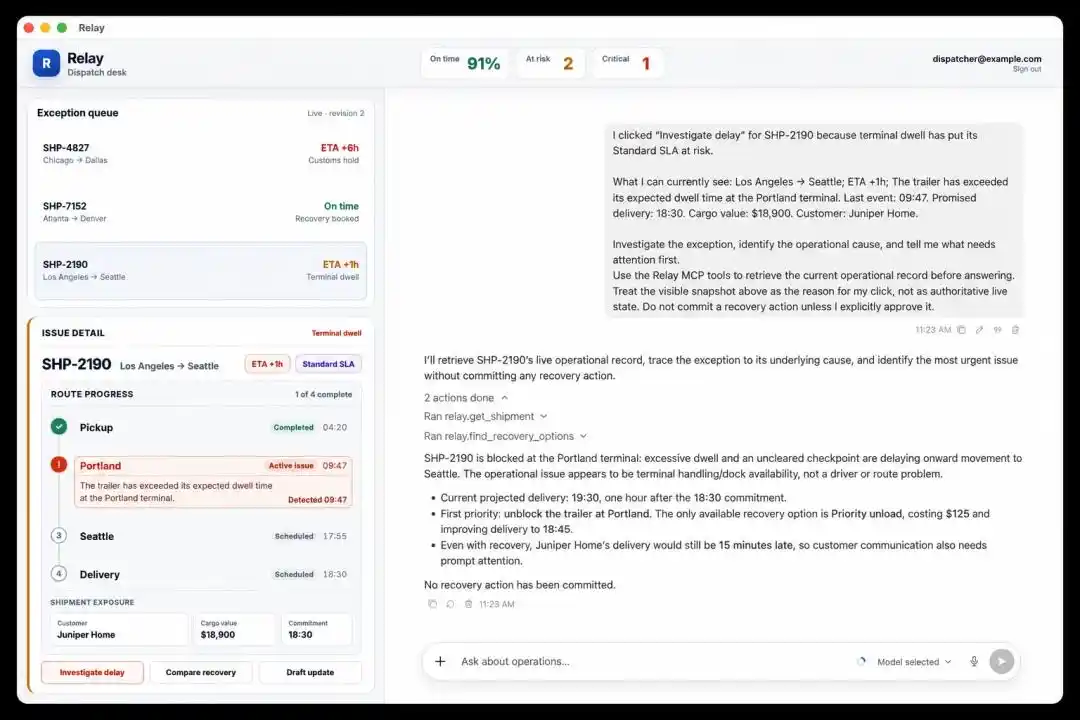
In this process, Harness handles the agent loop, memory maintenance, tool interaction, and real-time feedback; while your product retains control over its own dashboard, data records, and authority. This is true "human-machine collaboration."

Redefining Boundaries, Returning Power and Soul to Application Developers

Why do we say this open-source move changes the software building paradigm?

Because over the past year, many developers fell into the "wrapping" trap. Everyone was building ChatBots, products became more similar, and competitive moats grew shallower.

Opening Codex as a platform gives developers "supreme control" in three dimensions:

Codex gives you absolute interface control. Stop forcing users to adapt to a chat box!

Let your users continue using their familiar dashboards, editors, maps, and lists. AI should be an invisible helper, not a screen-hogging protagonist.

Absolute context and tool control allows you to safely expose your company's core systems, confidential documents, and internal APIs directly to the Agent via MCP services.

AI is no longer an outsider "unaware of company policies," but an expert fluent in your business systems.

Finally, absolute operational boundaries and security control are crucial for enterprise-level applications. The host application decides where the Agent runs and what files it can access.

Most importantly, you can define which dangerous actions (like modifying databases or sending emails to customers) require a human click to proceed.

This model of "front-end business rules are yours, underlying Agent loop is OpenAI's" completely removes the final barrier for AI adoption in enterprise scenarios.

The Apache-2.0 license for Codex Harness means anyone can modify and use it commercially.

The real test is: how many developers will abandon the comfortable chat box and disassemble the agent into components to install into their own products.

Codex Harness embodies a profound product philosophy—

Our goal is not to replace all professional interfaces with a single omnipotent chat box; it's to give those interfaces a smart brain.

When generic chat boxes disappear, native AI applications will flourish.

The era of zero-barrier AI Agents has arrived.

References:

https://x.com/gdb/status/2090246288478814281?s=20https://developers.openai.com/blog/codex-as-a-platform

This article is from the WeChat public account "New Zhiyuan," author: ASI Apocalypse

Related Questions

QWhat is the core component that OpenAI open-sourced, as mentioned in the article, and what is its primary purpose?

AOpenAI open-sourced the core framework of Codex, called the 'Harness'. Its primary purpose is to serve as the underlying execution system for AI agents, managing complex tasks such as task comprehension, maintaining memory in long conversations, reviewing relevant information, calling various tools, displaying progress, handling failures, and requesting human approvals. It allows developers to integrate powerful AI agent capabilities directly into their own products and workflows.

QAccording to the article, what key benefit did OpenAI demonstrate by adjusting the Harness design in the ARC-AGI-3 benchmark test?

AOpenAI demonstrated that by making two key adjustments to the Harness design—'retaining reasoning' and 'context compression'—the performance of the GPT-5.6 Sol model on the difficult ARC-AGI-3 benchmark jumped from 13.3% to 38.3%. Furthermore, the token output was reduced sixfold. This shows that a well-designed Harness can significantly improve an AI model's effectiveness and efficiency, making it smarter while also reducing API costs.

QWhat are the three main components released under the Apache-2.0 license as part of the Codex Harness open-source project?

AThe three main components released are: 1) The CLI tool `codex exec`, which runs automated pipelines for bounded agent workflows. 2) The official Codex SDK for TypeScript/Python, providing a programmatic interface for developers to control tasks. 3) The Codex app-server, a core engine that allows seamless integration of agents into products via a JSON-RPC client protocol, enabling persistent state, event streaming, tool exposure, and human-in-the-loop approvals.

QThe article presents several use cases for the open-sourced Codex Harness beyond coding. Describe one of these industry applications and its reported impact.

AOne industry application is in tax preparation, developed by partners Thrive Holdings and Crete. They embedded the Codex Harness into a professional tax preparation workflow. The system handled complex tax logic and integrated feedback from tax professionals. This pilot project successfully processed up to 7,000 tax returns and reduced tax preparation time by approximately one-third.

QHow does the article suggest the open-sourcing of Codex Harness will change the paradigm of software development and AI application integration?

AThe article suggests it will shift development away from creating generic 'chatbot' interfaces. Instead, it empowers developers to embed intelligent AI agents directly into existing, specialized business applications (like dashboards, editors, or logistics boards). This gives developers absolute control over the user interface, context/data access, and operational safety (e.g., requiring human approval for critical actions). It promotes the creation of 'native AI applications' where the AI works invisibly within the user's familiar workflow, rather than forcing users into a separate chat interface.

Related Reads

Claude Code Easily Compromised with Just a Fake Tool

Researchers have demonstrated a novel attack, dubbed ToolLeak, that can easily compromise AI coding assistants like Claude Code. The method exploits a "mode gap" by stealing the system prompts (instructions) not through direct chat queries, but by tricking the model into leaking them as parameters during tool calls. This extracted information is then used to craft a "two-channel prompt injection" attack. Attackers register a malicious tool with a description formatted to mimic legitimate instructions, prompting the AI agent to call it. The tool's return value then instructs the agent to execute a malicious command (e.g., `curl | bash`), achieving Remote Code Execution (RCE). In tests against six major AI programming tools (Cursor, Claude Code, Copilot, Windsurf, Cline, Trae) using older versions, all were fully compromised, with attack success rates reaching up to 1.0. Notably, Claude Code's secondary guard model (Haiku) was overridden by the main model (Sonnet), which had been manipulated by the injected instructions. Newer versions show improved defenses. Claude Code and Cursor implemented mitigations like "progressive tool description exposure," reducing RCE success to 0 and 0.3 respectively in some configurations. However, tools like Cline, Windsurf, and Trae paired with certain models remained fully vulnerable. The research underscores that architectural isolation is crucial for defense, as long as tool return values can ambiguously function as both data and executable instructions, the threat of tool hijacking persists. The paper "TIPExploit: Tool-Invocation Prompt Extraction and Exploitation in AI Coding Agents" has been accepted at ISSTA 2026.

marsbit2m ago

Claude Code Easily Compromised with Just a Fake Tool

marsbit2m ago

Bernstein Analysis: Samsung's HBM4 Accelerates Volume, Q3 Revenue May Overtake SK Hynix

South Korea’s July memory export data, serving as an early indicator for HBM business in Q3, shows overall HBM demand remains robust. While total exports to Taiwan and Malaysia declined 32% month-on-month from June’s peak—largely due to seasonality—they were still up 13% compared to April and rose 64% year-on-year. However, a divergence emerged between Samsung and SK Hynix. Samsung’s exports from Chungcheongnam-do (a proxy for its HBM shipments) surged, reaching $2.2 billion in July, up 122% from April. Based on regression analysis, Bernstein estimates Samsung’s Q3 HBM revenue could hit around $12 billion, roughly 30% above its prior forecast, driven by a rapid ramp in higher-value HBM4. The unit value of Samsung’s exports has doubled since April, signaling a shift toward HBM4, which carries a significantly higher price. In contrast, exports linked to SK Hynix from Chungcheongbuk-do and Icheon fell 28% month-on-month and 27% versus April. Bernstein’s base model suggests SK Hynix’s Q3 HBM revenue could drop to about $5.6 billion, though this could rebound to $12 billion if shipments concentrate later in the quarter as historically seen. The weakness may relate to potential delays in HBM4 shipments for Nvidia’s Rubin platform. Notably, HBM pricing is decoupling from general DRAM, with HBM4 mix driving average selling prices rather than broad-based hikes. Exports to Malaysia also surged, possibly linked to Intel’s EMIB packaging facilities, though the exact drivers remain unclear. While July data reinforces Samsung’s accelerating momentum in HBM4, it is insufficient to confirm a full-year market share reversal. Key factors to watch are Samsung’s August-September export performance, whether SK Hynix recovers lost ground, and upcoming 2027 HBM contract pricing negotiations.

marsbit3m ago

Bernstein Analysis: Samsung's HBM4 Accelerates Volume, Q3 Revenue May Overtake SK Hynix

marsbit3m ago

The New Rules of the AI Race: Nvidia Shifts from Chips to Energy Resources and Construction Sites

Nvidia is providing a $105 billion financial guarantee for the construction of OpenAI's data center campus in Ohio, signaling a strategic shift in the AI industry from competing on chips to battling for physical infrastructure and energy resources. The guarantee, detailed in an SEC filing, acts as insurance against tenant default rather than direct construction funding. OpenAI must repay any sums drawn. Nvidia will also invest $1.5 billion in SB Energy for the project's power component. The planned campus has a capacity of 4.25 GW, with OpenAI's current commitments to Nvidia reaching 12 GW. This move underscores that leading AI development now requires securing space, power, and financial backing for massive, long-term projects. Tech giants are taking on roles akin to developers and financial institutions. Concurrently, AI firms are diversifying suppliers: OpenAI and Anthropic have signed major deals with AMD for GPU deployments. Nvidia is also scaling its financial model through partnerships with investment firms to mobilize over $500 billion in external capital. The paradigm in AI is shifting from hardware supremacy to building comprehensive ecosystems. Future industry growth will depend on balancing innovation with real-world infrastructure capabilities, turning abstract computations into tangible industrial projects. An AI analysis notes the deal's resemblance to vendor financing schemes from the telecom bubble of the late 1990s and questions the long-term viability of gas-dependent energy infrastructure for AI, should market growth slow.

cryptonews.ru12m ago

The New Rules of the AI Race: Nvidia Shifts from Chips to Energy Resources and Construction Sites

cryptonews.ru12m ago

Trading

Spot
活动图片