Bitcoin Acts as a Geopolitical 'Barometer', Will Risk Appetite Return as Markets Open on Monday?

华尔街日报Published on 2026-03-01Last updated on 2026-03-01

Abstract

Bitcoin's V-shaped reversal following escalating Middle East tensions is being interpreted by some analysts as a positive signal for global risk assets at Monday's market open. As the only tradeable risk asset over weekends, Bitcoin acts as a real-time sentiment barometer, and its rebound suggests recovering risk appetite. Despite an initial sharp drop after Israel's airstrike on Iran, Bitcoin quickly recovered and surged past pre-conflict levels following reports of Ayatollah Khamenei's death. Academy Securities strategist Peter Tchir remains optimistic about a "risk-on" market opening, noting that oil prices have already partially priced in geopolitical risks, rising from $60 to $72 per barrel. Additionally, key oil transport channels remain unobstructed, and ample crude inventories provide a buffer against supply disruptions. This marks the third time Bitcoin has served as a weekend sentiment indicator during major Middle East conflicts, but this rebound was notably stronger, indicating a shift in market perception.

Bitcoin's V-shaped reversal following the sharp escalation of tensions in the Middle East is being interpreted by some market participants as a positive signal for the opening of global risk assets on Monday.

Academy Securities strategist Peter Tchir stated in a report that, as the only tradable risk asset over the weekend, Bitcoin has historically been a barometer of market sentiment, and its rebound suggests that risk appetite is recovering. Meanwhile, oil prices have already partially priced in some geopolitical risks, providing further support for markets to open in a risk-on mode on Monday.

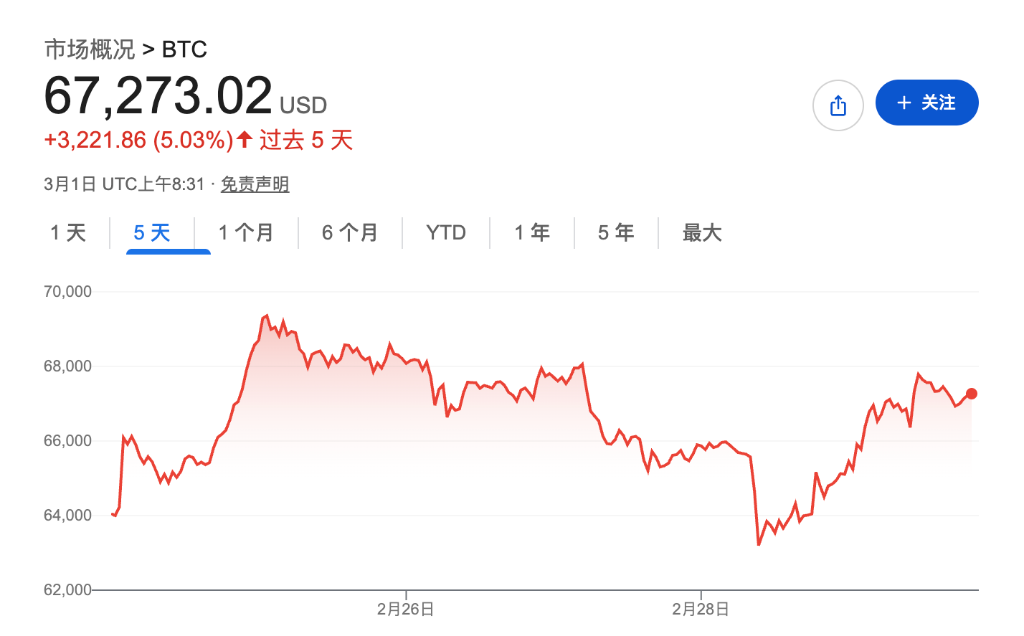
As the U.S.-Iran situation evolved, Bitcoin experienced a reversal from a "sharp decline" to a "significant rally." Following news of Israel's airstrike on Iran, digital assets plummeted sharply, but as Iranian state media confirmed the death of Khamenei, the market quickly reversed and surged. Bitcoin not only recovered its losses but also rose above the levels seen before the conflict erupted.

According to a CCTV News broadcast, Iran's Supreme Leader Khamenei was killed in an attack on the morning of February 28. Israel claimed that Khamenei and his senior aides, including Ali Shamkhani, Secretary of Iran's Defense Committee, and Mohammad Pakpour, Commander of the Islamic Revolutionary Guard Corps, were killed in the airstrike.

In the report, Tchir expressed optimism that markets would open in a "risk-on" mode on Monday. He noted that oil prices had risen from around $60 per barrel at the end of last year to $72 per barrel last Friday, indicating that some conflict risk premiums had already been priced in by the market. Additionally, with Iran's leadership severely weakened, the logic of its strategic calculations has been disrupted—"now it's time to seek a dignified exit."

Bitcoin's Role as a "Barometer"

The report stated that this is the third time in recent years that Bitcoin has acted as a real-time barometer of market sentiment during a major Middle East conflict over the weekend. Each time, the initial reaction was a sharp decline, but this time, the strength of the rebound was entirely different.

On April 13, 2024, when Iran launched a large number of suicide drones at Israel, the conflict also occurred early Saturday morning while global markets were closed. Bitcoin's initial reaction at the time was a sharp decline.

On June 21-22, 2025, "Operation Midnight Hammer" used B-2 bombers carrying massive bunker-buster bombs to destroy three nuclear facilities at Fordow, Natanz, and Isfahan. The timing once again fell on a Saturday morning, and Bitcoin again experienced a knee-jerk decline.

The key difference this conflict compared to the previous two is that Bitcoin achieved a significant rebound after the sharp decline, with its final price higher than the pre-event level. In the report, Tchir interpreted this price action as a "risk-on" signal.
Oil Prices Have Partially Priced in Conflict Risks

The energy market is a core variable for measuring the macroeconomic impact of this conflict. Academy Securities strategist Peter Tchir outlined multiple factors influencing oil prices in the report:

First, risks have been partially priced in. Brent crude has risen from around $60 per barrel at the end of last year to $72 per barrel last Friday. This increase reflects both U.S. winter energy demand and a certain degree of conflict risk premium. This means that a significant portion of the potential "bad news" for oil prices has already been anticipated ahead of Monday's opening.

Second, supply channels remain unimpeded for now. Tchir pointed out that there are currently no signs of the Strait of Hormuz or other key oil transportation channels being blocked. He stated: If there is an opportunity to de-escalate without affecting channel transit, this is the core premise for oil prices remaining contained.

Finally, buffer inventories provide a safety cushion. Major global oil-consuming nations have ample crude reserves, and U.S. inventory levels are also relatively high. Therefore, short-term supply disruptions of about a week are expected to have limited impact. Based on this assessment, Tchir expects near-term contracts could test $80 but does not anticipate significant volatility in the forward curve.


Related Questions

QWhat role does Bitcoin play in the context of geopolitical events according to the article?

ABitcoin acts as a 'barometer' for market sentiment, particularly during weekends when traditional markets are closed, reflecting real-time shifts in risk appetite in response to geopolitical developments.

QHow did Bitcoin react to the recent escalation in the Middle East, and what was the significance of its movement?

ABitcoin initially fell sharply following the Israeli airstrike on Iran but then reversed into a significant rally, surpassing pre-conflict levels. This V-shaped recovery is interpreted as a signal of returning risk appetite.

QWhat reasons does Peter Tchir give for being optimistic about a 'risk-on' mode at Monday's market open?

ATchir cites Bitcoin's rebound as a positive indicator, notes that oil prices have already priced in some geopolitical risk premium, and suggests that the disruption to Iran's leadership may lead to a de-escalation, supporting a risk-on opening.

QHow has the oil market preemptively responded to the geopolitical risks, according to the analysis?

AOil prices had already risen from around $60 per barrel at the end of last year to $72 by Friday, partially factoring in conflict risk premiums, which means some negative impact is already anticipated by the market.

QWhat key difference does the article highlight between the recent Bitcoin price movement and its behavior during past Middle East conflicts?

AUnlike previous conflicts where Bitcoin fell and did not fully recover, this time it not only rebounded strongly from its drop but also traded above its pre-event level, indicating a stronger risk-on signal.

Related Reads

Trading

Spot
Futures

Hot Articles

What is $BITCOIN

DIGITAL GOLD ($BITCOIN): A Comprehensive Analysis Introduction to DIGITAL GOLD ($BITCOIN) DIGITAL GOLD ($BITCOIN) is a blockchain-based project operating on the Solana network, which aims to combine the characteristics of traditional precious metals with the innovation of decentralized technologies. While it shares a name with Bitcoin, often referred to as “digital gold” due to its perception as a store of value, DIGITAL GOLD is a separate token designed to create a unique ecosystem within the Web3 landscape. Its goal is to position itself as a viable alternative digital asset, although specifics regarding its applications and functionalities are still developing. What is DIGITAL GOLD ($BITCOIN)? DIGITAL GOLD ($BITCOIN) is a cryptocurrency token explicitly designed for use on the Solana blockchain. In contrast to Bitcoin, which provides a widely recognized value storage role, this token appears to focus on broader applications and characteristics. Notable aspects include: Blockchain Infrastructure: The token is built on the Solana blockchain, known for its capacity to handle high-speed and low-cost transactions. Supply Dynamics: DIGITAL GOLD has a maximum supply capped at 100 quadrillion tokens (100P $BITCOIN), although details regarding its circulating supply are currently undisclosed. Utility: While precise functionalities are not explicitly outlined, there are indications that the token could be utilized for various applications, potentially involving decentralized applications (dApps) or asset tokenization strategies. Who is the Creator of DIGITAL GOLD ($BITCOIN)? At present, the identity of the creators and development team behind DIGITAL GOLD ($BITCOIN) remains unknown. This situation is typical among many innovative projects within the blockchain space, particularly those aligning with decentralized finance and meme coin phenomena. While such anonymity may foster a community-driven culture, it intensifies concerns about governance and accountability. Who are the Investors of DIGITAL GOLD ($BITCOIN)? The available information indicates that DIGITAL GOLD ($BITCOIN) does not have any known institutional backers or prominent venture capital investments. The project seems to operate on a peer-to-peer model focused on community support and adoption rather than traditional funding routes. Its activity and liquidity are primarily situated on decentralized exchanges (DEXs), such as PumpSwap, rather than established centralized trading platforms, further highlighting its grassroots approach. How DIGITAL GOLD ($BITCOIN) Works The operational mechanics of DIGITAL GOLD ($BITCOIN) can be elaborated on based on its blockchain design and network attributes: Consensus Mechanism: By leveraging Solana’s unique proof-of-history (PoH) combined with a proof-of-stake (PoS) model, the project ensures efficient transaction validation contributing to the network's high performance. Tokenomics: While specific deflationary mechanisms have not been extensively detailed, the vast maximum token supply implies that it may cater to microtransactions or niche use cases that are still to be defined. Interoperability: There exists the potential for integration with Solana’s broader ecosystem, including various decentralized finance (DeFi) platforms. However, the details regarding specific integrations remain unspecified. Timeline of Key Events Here is a timeline that highlights significant milestones concerning DIGITAL GOLD ($BITCOIN): 2023: The initial deployment of the token occurs on the Solana blockchain, marked by its contract address. 2024: DIGITAL GOLD gains visibility as it becomes available for trading on decentralized exchanges like PumpSwap, allowing users to trade it against SOL. 2025: The project witnesses sporadic trading activity and potential interest in community-led engagements, although no noteworthy partnerships or technical advancements have been documented as of yet. Critical Analysis Strengths Scalability: The underlying Solana infrastructure supports high transaction volumes, which could enhance the utility of $BITCOIN in various transaction scenarios. Accessibility: The potential low trading price per token could attract retail investors, facilitating wider participation due to fractional ownership opportunities. Risks Lack of Transparency: The absence of publicly known backers, developers, or an audit process may yield skepticism regarding the project's sustainability and trustworthiness. Market Volatility: The trading activity is heavily reliant on speculative behavior, which can result in significant price volatility and uncertainty for investors. Conclusion DIGITAL GOLD ($BITCOIN) emerges as an intriguing yet ambiguous project within the rapidly evolving Solana ecosystem. While it attempts to leverage the “digital gold” narrative, its departure from Bitcoin's established role as a store of value underscores the need for a clearer differentiation of its intended utility and governance structure. Future acceptance and adoption will likely depend on addressing the current opacity and defining its operational and economic strategies more explicitly. Note: This report encompasses synthesised information available as of October 2023, and developments may have transpired beyond the research period.

363 Total ViewsPublished 2025.05.13Updated 2025.05.13

What is $BITCOIN

Discussions

Welcome to the HTX Community. Here, you can stay informed about the latest platform developments and gain access to professional market insights. Users' opinions on the price of BTC (BTC) are presented below.

活动图片