Meme Coin Reappears, Does the Bitcoin Ecosystem Really Have Something New?

marsbitPublished on 2026-05-26Last updated on 2026-05-26

Abstract

The Bitcoin ecosystem is heating up again with new projects and substantial price surges. Key developments include: **Bound Exchange:** Merging former entities radfi and Bound, this platform has gained attention after its $BOUND token surged ~46x. It simplifies trading by allowing deposits in various cryptocurrencies (SOL, ETH, etc.) for conversion to BTC to trade Runes, avoiding long Bitcoin confirmation waits. It features a 2-of-2 multi-signature wallet with a timelock for user asset security and a price protection mechanism for launchpad tokens to manage sell pressure. **Tacit:** This privacy-focused protocol for Bitcoin assets remains active, with its $TAC token holding a stable ~$5.5M market cap. Developers recently implemented double-blind tokens and are working on a permissionless ETH-BTC bridge using zero-knowledge proofs. **Alkanes & $DIESEL:** While not new, the Alkanes protocol's $DIESEL token has risen ~17x since late April. Its limited circulating supply (under 10% of the total 1.562 million) and a revised mining mechanism—where participants bid for block rewards—contribute to its volatile "meme coin" status. These projects, featuring simplified UX, security innovations, and speculative assets, are driving renewed excitement and questions about substantial new developments in the Bitcoin ecosystem.

The recent emergence of the new Bitcoin asset protocol Tacit has reignited market interest in the Bitcoin ecosystem. And lately, a new 10x "golden dog" has appeared in the Bitcoin ecosystem, making everyone exclaim that the familiar "ordi" flavor is back. Why has the Bitcoin ecosystem been so hot recently? Has something genuinely new emerged?

Bound Exchange

The predecessor of this platform was radfi, which previously gained attention due to the "Node Monkey" strategy coin $NODESTRAT. $NODESTRAT is similar to $PUNKSTR on Ethereum, both utilizing trading fees to repurchase NFTs, then listing them for sale with different profit targets. The profits from selling these NFTs are then partially used to buy back and burn the token, creating a flywheel effect.

Previously, radfi and Bound operated separately. radfi handled Bitcoin/Rune AMM and Launchpad, while Bound focused on stablecoins. Now, the two have merged into Bound. The merged platform offers comprehensive features, including trading, lending, Launchpad, and an NFT marketplace.

Bound recently attracted market attention because its token $BOUND has surged approximately 46 times since May 21st.
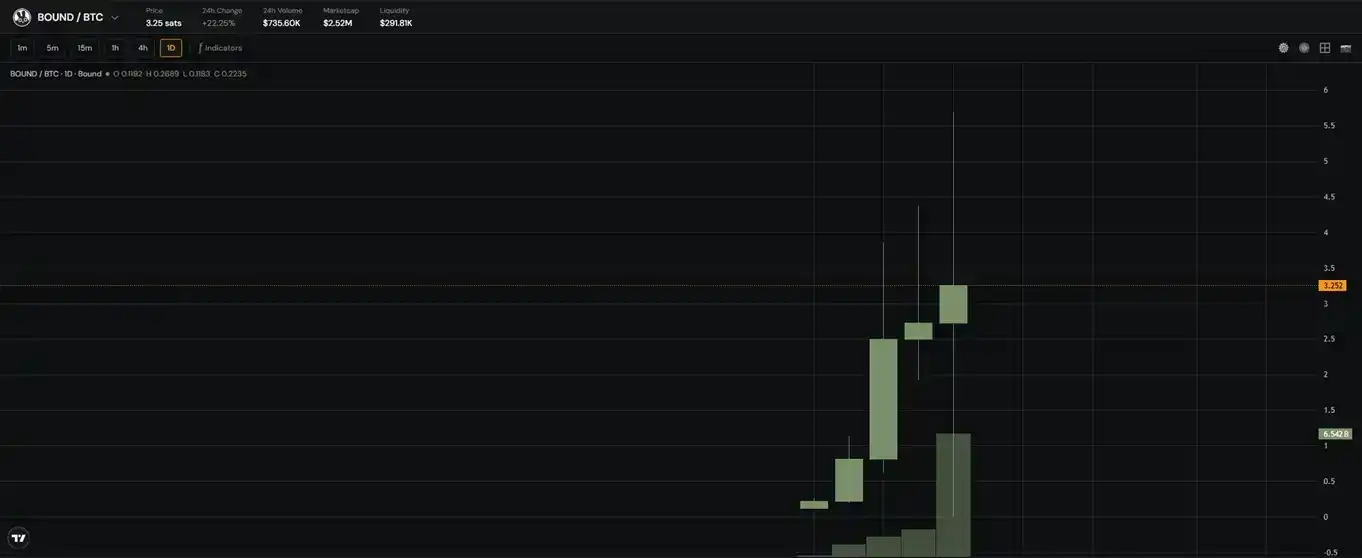
Returning to the project itself, the main points praised by the community about Bound are as follows:

Greatly simplified trading process. Traditional Rune AMMs typically require depositing Bitcoin first, then waiting for several block confirmations. This confirmation time can be as short as half an hour, but longer if block production is slow, potentially taking over an hour. On Bound, besides depositing Bitcoin, users can also deposit SOL, ETH, HYPE, or BNB. These are swapped to BTC via corresponding BTC trading pairs, allowing users to directly trade Rune tokens on the platform. The overall time required is significantly reduced, naturally enhancing the user experience.

Instant trade confirmation. Avoiding long waits for Bitcoin block confirmations has been a goal for platforms dealing with Runes in the Bitcoin ecosystem. This isn't inherently difficult; once funds are deposited and confirmed on the platform, trades can be processed internally/off-chain first, using the Bitcoin mainnet as a confirmation layer. However, the key issue is solving the security problem. Previous platforms like odin.fun also gained popularity but eventually faded after repeated asset theft incidents. Bound's solution is to add a 2-of-2 multisig to user asset deposit addresses. One signature is held by the user (stored as a passkey on the user's device), and the other is held by the platform's backend.

This means even if the Bound platform is hacked, assets cannot be stolen because the hacker can only satisfy one signature layer. There's another question: what if the platform runs away? Therefore, Bound added a timelock. If Bound's signature expires after 3 months, users can directly withdraw their assets using their own passkey.

Price protection mechanism. Bound's official Twitter account retweeted an explanation by @SkyAAmen regarding this mechanism: "For Rune tokens launched via Launchpad, the post-launch token price is calculated based on the average minting price. 75% of the raised liquidity is placed below this price to act as a floor against potential selling pressure, while the remaining 25% is paired above this price."
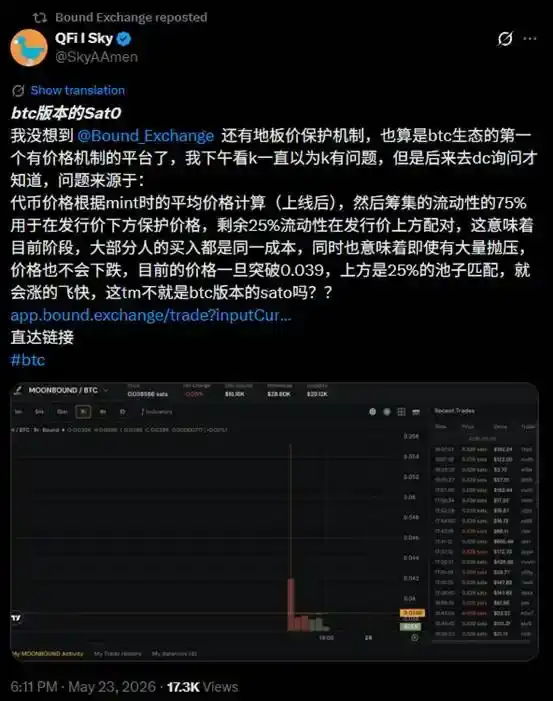
Regarding token issuance, Bound also introduced a virtual mempool, which can be understood as a virtual chain tracking Bitcoin mainnet block production. Users minting new Rune tokens on the Launchpad don't pay fees to miners; the money is instead used for the aforementioned price protection and liquidity provision. Additionally, to reward holders, those who mint 1 million tokens or more and do not sell can share 50% of the trading fees.

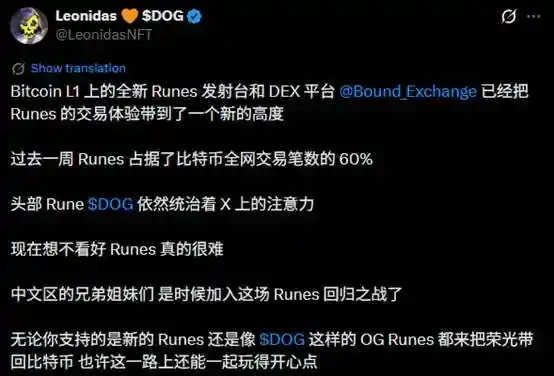
The above three points are the main advantages. Furthermore, Leonidas, a well-known figure in the Bitcoin ecosystem, has also expressed support for Bound:
Tacit

BlockBeats previously published a detailed article introducing Tacit:

New Protocol Tacit: The ZEC of the Bitcoin Ecosystem?

Currently, the price of Tacit's leading token $TAC remains stable, with a corresponding market cap of approximately $5.5 million. The developer @z0r0zzz continues to maintain a high update frequency. On May 23rd, they implemented double-blind tokens on Bitcoin, further strengthening the protocol's privacy features. Additionally, work is ongoing on a permissionless ETH-BTC bridge implemented via SP1 zero-knowledge proofs.

Alkanes

We have also previously introduced Alkanes: Another 10x Runner in Bitcoin Ecosystem, What is the New Asset Protocol Alkanes? This protocol gained attention because $DIESEL has risen approximately 17 times since late April and is still climbing:
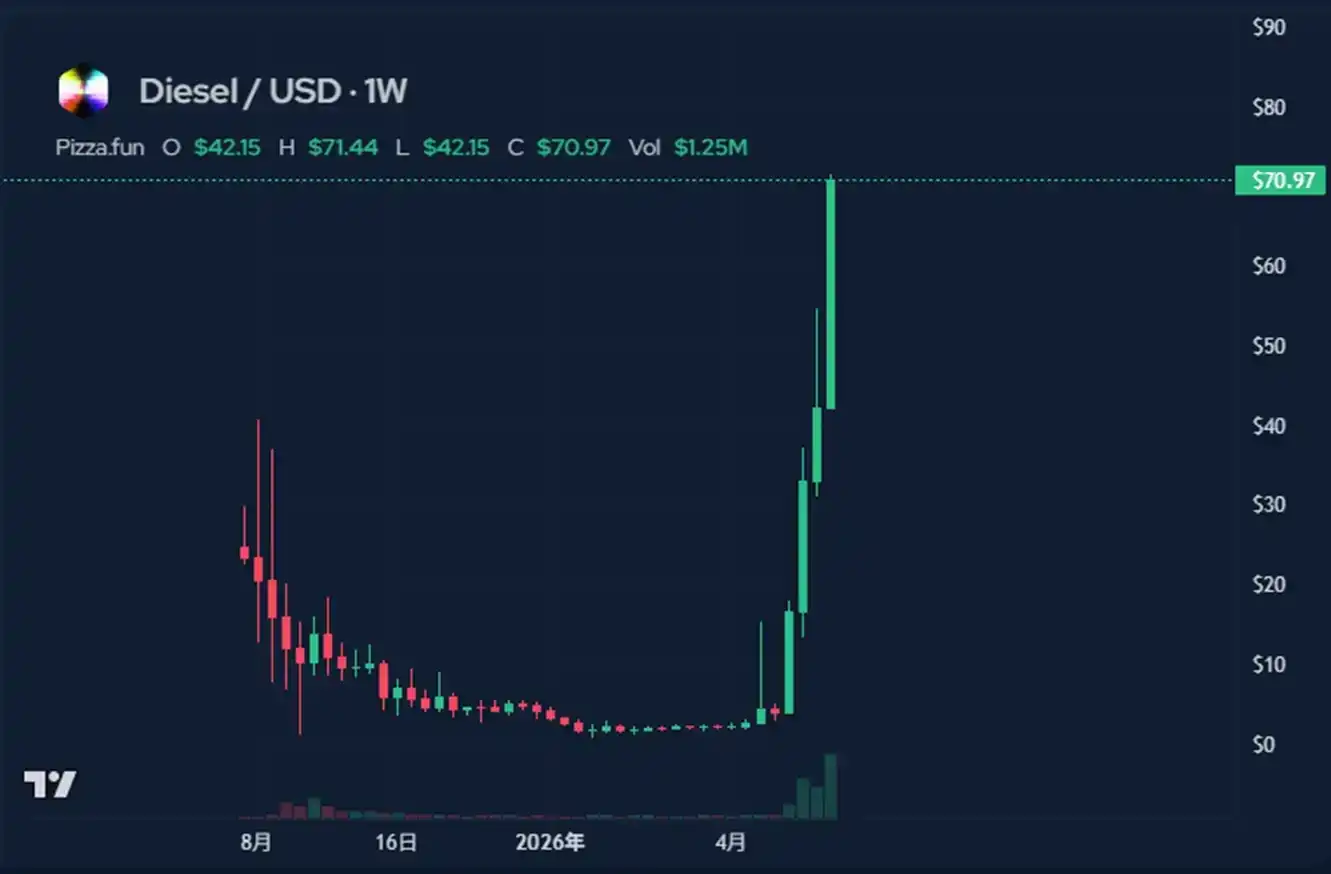
Alkanes isn't a new protocol. In fact, Oyl Wallet, which initially led it, is no longer active. The subfrost team now responsible for protocol updates and maintenance consists of the original technical team from Oyl Wallet that handled Alkanes. Despite Oyl's disbandment, the subfrost team has been consistently updating, implementing significant performance optimizations such as embedding contracts into the indexer.

However, the substantial rise of $DIESEL is likely due to its very small actual circulating supply. The previous mining mechanism for $DIESEL awarded the entire block's $DIESEL reward to the single minting transaction that paid the highest miner fee within that block. This essentially allowed "scientists" (automated traders/bots) to dominate, making it difficult for ordinary users to participate. In August last year, the mining mechanism was updated. Now, all successful minting transactions in a block share the $DIESEL reward proportionally based on their bid amount. This means those who believe in $DIESEL's value can mine more. Mining has become a small "beast" (auction) occurring every block, with a fixed total reward (currently about 3.125 $DIESEL per block, synchronized with Bitcoin's halving cycle), but the bidding situation within each block changes.

Simultaneously, 50% of all funds bid for minting $DIESEL within a block are converted into $DIESEL and directed to the project's treasury for protocol development. Therefore, although the $DIESEL production per block is about 3.125 tokens, the amount users actually receive from minting is less, as a portion goes directly to the project team.

The total supply of $DIESEL is 1,562,000 tokens. Currently, approximately 640,000 tokens have been mined and are potentially circulating, but the actual amount available for trading might be less than 10% of the total supply. Combined with the recent massive price surge, I'd call it the "meme coin" of the Bitcoin ecosystem.


Related Questions

QWhat is the Bound platform, and why has it recently gained significant attention in the Bitcoin ecosystem?

ABound is a comprehensive financial platform formed by merging radfi and Bound's previous services. It offers trading, lending, Launchpad, and an NFT marketplace. It gained significant attention because its token $Bound surged approximately 46 times since May 21st. Key praised features include a simplified trading process using multiple cryptocurrencies, instant transaction confirmations via a 2-of-2 multi-sig security model, and a price protection mechanism for new token launches.

QHow does the Bound platform address the security concerns associated with off-chain trading confirmations?

ABound addresses security by implementing a 2-of-2 multi-signature setup for user deposit addresses. One signature key is held by the user (a passkey on their device), and the other is held by the platform's backend. This means even if the platform is hacked, assets cannot be stolen as the hacker only controls one signature. Additionally, a timelock feature is added: if Bound's signature expires after 3 months, users can withdraw their assets directly using their own passkey.

QWhat is the Alkanes protocol, and what is notable about its token $DIESEL?

AAlkanes is a Bitcoin-native asset protocol. Its notable token, $DIESEL, has increased in price by about 17 times since late April and is still rising. It is considered a 'weird coin' or '妖币' in the Bitcoin ecosystem. This dramatic rise is attributed to its very small circulating supply (likely less than 10% of its total 1.562 million supply is tradeable). Its mining mechanism was updated to allow proportional reward distribution based on bidding, making it more accessible than its previous 'scientist-dominated' model.

QWhat recent update did the Tacit protocol implement, and what is its primary focus?

AOn May 23rd, the Tacit protocol implemented dual-blind tokens on Bitcoin, significantly enhancing the protocol's privacy features. Tacit's primary focus is on privacy, aiming to be a privacy-preserving asset protocol within the Bitcoin ecosystem, similar to Zcash (ZEC). The developer is also working on a permissionless ETH-BTC bridge using SP1 zero-knowledge proofs.

QAccording to the article, what is a major user experience improvement offered by the Bound platform for trading Runes?

AA major user experience improvement is the significant simplification and speed-up of the trading process. Instead of only depositing Bitcoin and waiting for multiple block confirmations (which can take 30 minutes to over an hour), users on Bound can deposit various cryptocurrencies like SOL, ETH, HYPE, or BNB. These are converted to BTC via corresponding trading pairs on the platform, allowing users to trade Rune tokens almost immediately without the long Bitcoin network confirmation wait, greatly enhancing the user experience.

Related Reads

Kelp DAO's $400 Million Bad Debt Was Covered, But at a $12 Billion Cost to Aave

On May 26th, Kelp DAO successfully transferred its final batch of rsETH, completing the 37-day process of fully backing rsETH 1:1 after a security incident. However, the resolution came at a significant cost to Aave. The protocol's TVL plummeted by over $12 billion in the following month. Furthermore, a separate legal battle over 30,766 frozen ETH continues in court, posing ongoing reputational risk. The recovery was enabled by an unprecedented, one-time coalition dubbed "DeFi United," involving major contributions from Aave's founder, treasury, Consensys, Mantle, and others. Despite this, the event triggered a major outflow of funds, with whales like Justin Sun moving capital to competitors like Spark. Aave's path to regaining its position relies heavily on the successful execution of its multi-pronged strategy. Its new V4 protocol, designed for open, heterogeneous asset markets, faces delays due to internal governance disputes. Meanwhile, the V3 version remains the core revenue generator, and the permissioned Horizon fork is targeting institutional RWA (Real-World Assets) growth—a segment less impacted by the rsETH incident but dependent on traditional finance adoption timelines. The key takeaway is that while the immediate bad debt was covered, Aave paid a steep price in lost trust and capital. Recovering market share depends on accelerating V4's rollout and advancing its institutional RWA offerings, both of which face external and internal hurdles. The "DeFi United" safety net is unlikely to be replicable for future crises.

marsbit35m ago

Kelp DAO's $400 Million Bad Debt Was Covered, But at a $12 Billion Cost to Aave

marsbit35m ago

TechFlow Intelligence Report: Xiaomi Announces 200 Billion HKD Stock Buyback Plan, Spot Gold Falls Nearly 1%

TechFlow Report: Xiaomi announced a HK$200 billion stock buyback plan, while spot gold fell nearly 1%. A wider range of tech headlines includes Google unveiling its powerful video editing model Gemini Omni and the original "Attention is All You Need" authors advocating for a move beyond Transformer architecture. In other AI news, IBM reported its first successful use of a quantum computer to train an AI model, and Qwen3.5 released uncensored local model versions. The crypto/Web3 sector saw discussions on opaque stablecoin products and DEX fee changes. Major tech companies are under scrutiny: Uber's COO publicly questioned the ROI of AI investments, Motorola was accused of hijacking Amazon app links for affiliate codes, and Google faced criticism for using web data to fuel its AI. U.S. markets are focused on high S&P 500 valuations (31.8x P/E) and an intense concentration of capital in semiconductor stocks, with warnings about the sustainability of the AI data center boom. Geopolitical tensions, featuring simultaneous U.S. airstrikes on Iran and peace talks, caused significant oil price volatility. Other notable developments include Ferrari's first pure EV priced at 4.35 million yuan and Boston Dynamics' Atlas robot learning soccer from videos. The underlying theme suggests the AI narrative is shifting from boundless potential to requiring tangible results, while traditional geopolitical risks remain a powerful force in markets.

marsbit38m ago

TechFlow Intelligence Report: Xiaomi Announces 200 Billion HKD Stock Buyback Plan, Spot Gold Falls Nearly 1%

marsbit38m ago

Coin & Stock Barometer: Bitcoin Miner MARA Holdings Spends Over $860,000 on Bulletproof Vehicle Services for Executives; Bitmine Included in Preliminary List for FTSE Russell 1000 Index (May 19)

Crypto Market Wrap & Key Corporate Updates (May 19) The crypto market saw a decline followed by a minor rebound, while U.S. crypto-related stocks fell broadly. In corporate news: **MARA Holdings**, a Bitcoin miner, disclosed spending over $869,000 on vehicle ballistic armor services for its CEO and CFO under its security program. The board cited higher risks associated with the company's public disclosure of holding substantial Bitcoin assets. According to BitcoinTreasuries.NET, Elon Musk's **SpaceX and Tesla** collectively hold 30,221 BTC ($2.3B), which would rank them as the fifth-largest public company holder if combined. **DDC Enterprise Limited** increased its Bitcoin holdings by 200 BTC, bringing its total to 2,583 BTC. The firm stated it plans to continue accumulating BTC based on liquidity, not short-term price movements. Bitcoin treasury company **Nakamoto** announced a 1-for-40 reverse stock split to regain compliance with Nasdaq's minimum bid price requirement. The company reported a Q1 2026 net loss of $238.8M, partly due to a $102.5M unrealized loss on its Bitcoin holdings. **Tether** acquired SoftBank's stake in **Twenty One Capital (XXI)**, increasing its control. Tether's CEO expressed strengthened confidence in XXI's long-term Bitcoin strategy. Fundstrat's **Tom Lee** stated that **Bitmine (BMNR)** has been included in the preliminary list for the FTSE Russell 1000 Index. Concurrently, two new wallets suspected to be linked to Bitmine withdrew 60,000 ETH ($126M) from Bitgo and Kraken. Solana treasury company **Solmate Infrastructure** announced a registered direct offering of shares to raise approximately $11.4 million. **AI Financial**, a WLFI treasury company, reported a Q1 2026 net loss of $271.5M and raised substantial doubt about its ability to continue as a going concern, partly due to unrealized losses on its WLFI token holdings. **SUI Group** disclosed it holds over 108.7 million SUI tokens (~$115M), with its market cap to net asset value ratio at 0.91x. *Disclaimer: This summary is for informational purposes only and does not constitute investment advice.*

marsbit54m ago

Coin & Stock Barometer: Bitcoin Miner MARA Holdings Spends Over $860,000 on Bulletproof Vehicle Services for Executives; Bitmine Included in Preliminary List for FTSE Russell 1000 Index (May 19)

marsbit54m ago

China's AI Fronts: From Yan'an to Midway

This article analyzes the competitive landscape of China's AI industry through a dual-front war analogy: the "Eastern Front" of business model competition and the "Western Front" of global strategic positioning. **The Eastern Front: The Scramble for Supply Lines and Monetization** The "Eastern Front" examines the contrasting strategies of three Chinese tech giants—Tencent, Alibaba, and ByteDance—in the face of AI's high marginal costs. Tencent integrates AI as a catalyst within its existing ecosystems (advertising, gaming, cloud) for monetization, prioritizing high-value scenarios over user growth. Alibaba bets on a full-stack, self-developed approach from chips to applications, aiming to control costs and ecosystem, though this requires immense patience and resources. ByteDance, with Doubao as its flagship, pursues a traditional traffic-driven, "super app" strategy but faces severe monetization challenges as its massive user base incurs unsustainable operational costs. The central challenge for all is building a reliable "supply line" (sustainable funding/profit) and achieving efficient monetization, moving beyond being mere "token factories." **The Western Front: "Preserving Land" vs. "Preserving People"** The "Western Front" frames a global strategic divergence. The U.S. model ("preserving land") focuses on closed-source, high-premium models (e.g., Anthropic) targeting lucrative enterprise markets. China's strategy ("preserving people") leverages open-source models (e.g., Alibaba's Qwen, DeepSeek) and extremely low pricing to attract global developers and capture long-tail markets, akin to a "surround the cities from the countryside" approach. The goal is to make Chinese models the default infrastructure, locking in future ecosystem value. However, the critical test is whether this open-source ecosystem can achieve a commercial闭环, converting developer adoption into tangible revenue (e.g., via cloud services), and bridging the monetization gap with Western models that charge for value, not just tokens. **Conclusion: The Long March from Factory to Brand** The article concludes that China's AI industry possesses technology, users, and scenarios but must integrate them to create and capture value. Its ultimate success depends on navigating both fronts: companies must establish sustainable monetization on the Eastern Front, while the industry's Western strategy must evolve from simply "preserving people" (developer adoption) to truly "preserving both people and land" — transforming open-source ecosystem dominance into commercial success and premium brand value. This journey from being a "token factory" to a "value highland" will require strategic patience and the ability to outlast competitors in a prolonged contest.

marsbit1h ago

China's AI Fronts: From Yan'an to Midway

marsbit1h ago

Trading

Spot
Futures

Hot Articles

Discussions

Welcome to the HTX Community. Here, you can stay informed about the latest platform developments and gain access to professional market insights. Users' opinions on the price of MEME (MEME) are presented below.

活动图片