Ignore the Price Noise, Bitcoin Adoption Is in Full Bloom

marsbitPublished on 2026-02-25Last updated on 2026-02-25

Abstract

Despite a 50% price drop from its all-time high, Bitcoin adoption continues to grow significantly across multiple sectors. Key trends from 2025 highlight this expansion: institutions purchased a record 829,000 BTC, with corporations, governments, and ETFs driving accumulation. Registered Investment Advisors (RIAs) have been net buyers for eight consecutive quarters, with 29 of the top 30 U.S. RIAs now holding Bitcoin, albeit with small allocations. Corporate adoption tripled, with many S&P 500 companies quietly accumulating BTC. Merchant adoption surged 74% globally, as businesses like SteaknShake demonstrated Bitcoin's ability to reduce transaction costs. The Lightning Network grew 300%, now processing over $1.1 billion monthly. Five new sovereign nations, including sovereign wealth funds and a central bank, added Bitcoin to their reserves. Notably, Bitcoin's volatility has continued its decade-long decline, approaching levels of gold and the S&P 500, making it more attractive to risk-averse capital. This broad-based adoption, spanning individuals, institutions, and nations, underscores deepening trust in Bitcoin as a unique, global, and scarce digital currency, setting the stage for accelerated growth in the coming years.

Although the price of Bitcoin is down 50% from its all-time high, its adoption continues to grow—it's just not reflected in the price. The following 8 major adoption trends might surprise you.

Institutions Are Buying Bitcoin at a Record Pace

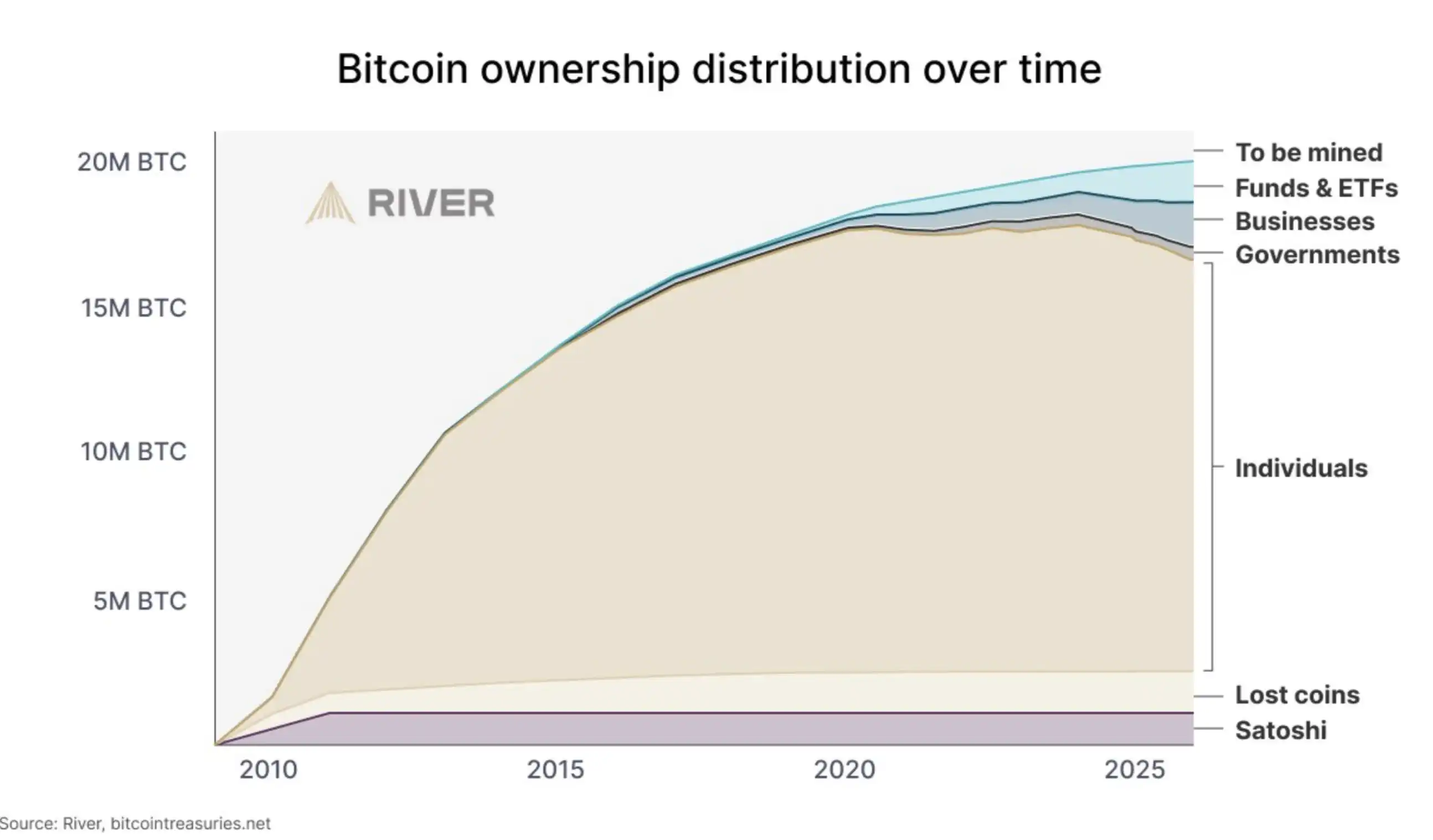
In 2025, various institutions cumulatively added 829,000 Bitcoins, including corporations, governments, funds, and ETFs.

Importantly, these institutions represent millions of ordinary investors who are accessing Bitcoin for the first time through brokerage accounts, pensions, sovereign wealth funds, and corporate balance sheets.
Who sold the Bitcoin to them?

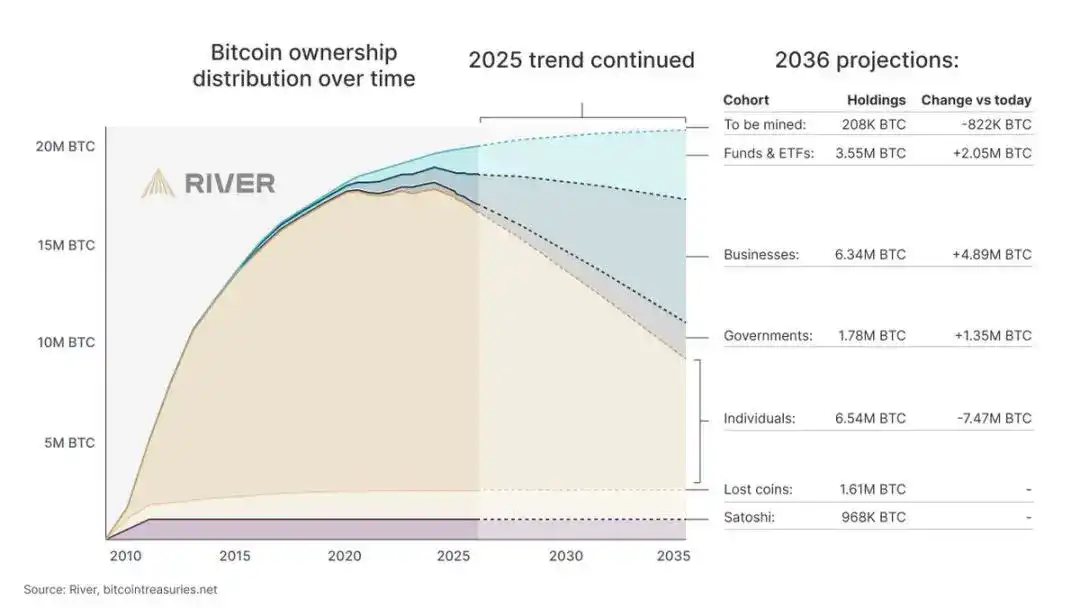
In 2025, the selling pressure mainly came from long-term holders and whales—early participants who built their positions years ago and are now gradually selling into a deeper, more liquid market. If this trend continues, institutions could hold the majority of the circulating supply within a decade, but currently, individuals still control about two-thirds of the supply.

They ultimately determine the marginal price at which institutions can build their positions. Institutional entry does not replace individual ownership; it expands the entire market's on-ramp. Many of today's ETF holders will become tomorrow's self-custody users.

Investment Advisors Have Been Net Buyers for 8 Consecutive Quarters

Registered Investment Advisors (RIAs) are the world's largest group of investors, managing about $146 trillion in client assets. They have only just begun allocating since the launch of Bitcoin ETFs in 2024. Even in these early stages, their behavior has been very positive:

Over the past two years, RIAs have invested approximately $1.5 billion per quarter into Bitcoin ETFs, without a single quarter of net selling.
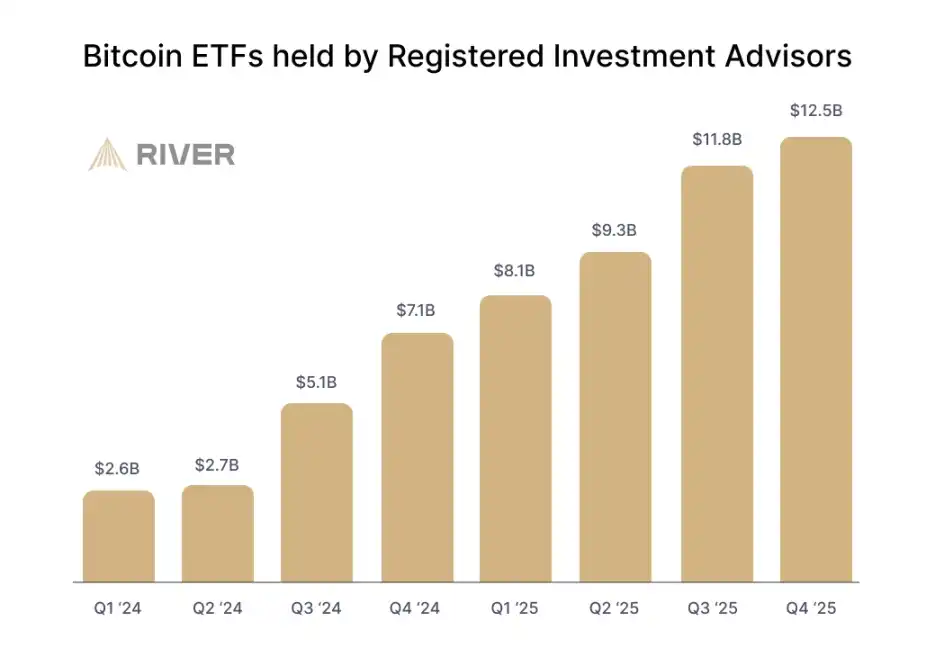
Bitcoin adoption among RIAs is widespread: 29 of the top 30 US RIAs have allocated to Bitcoin, but the average allocation is extremely low, at just 0.008%.

60% of top US banks are building Bitcoin products

With the warming US regulatory environment, banks can now custody Bitcoin and offer Bitcoin products to their clients.

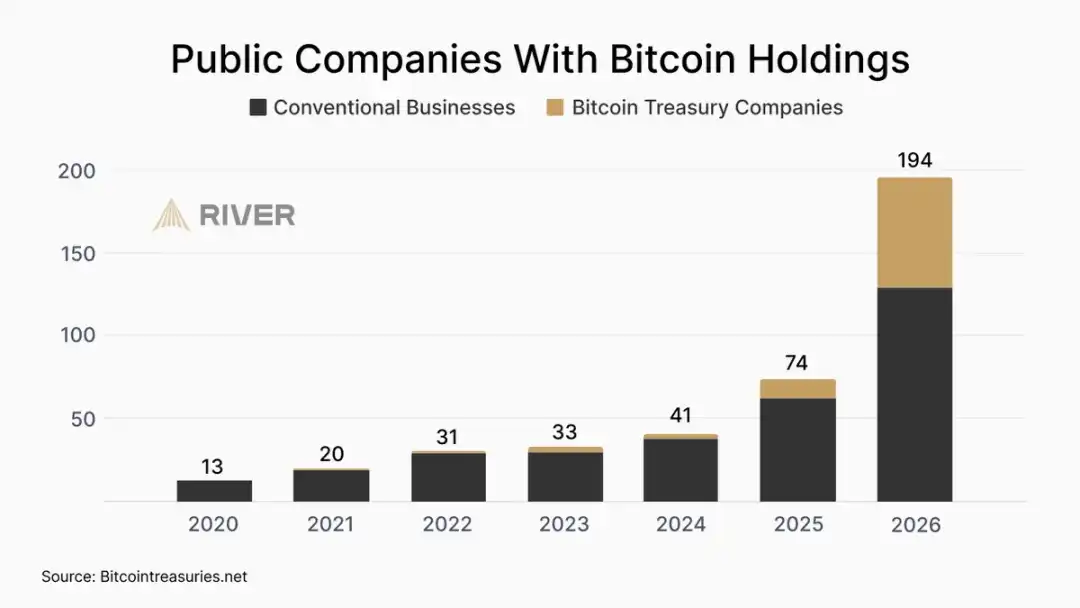
Public Company Adoption Rate Grew 2.5x in 2025

In 2025, corporations became the largest buyers of Bitcoin, led mainly by crypto-native treasury companies.
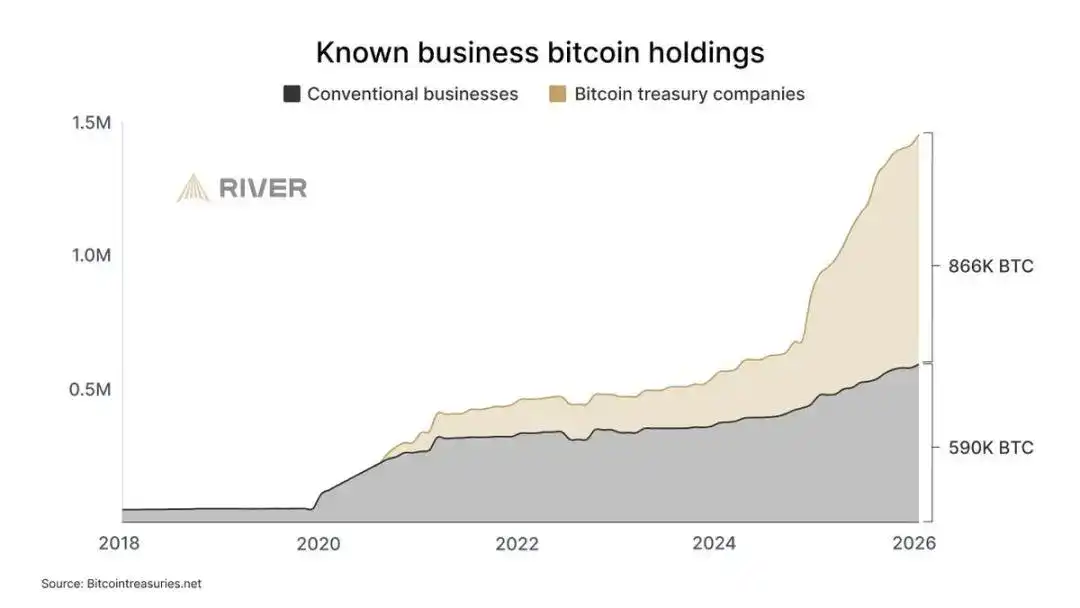
Beyond dedicated crypto treasury companies, a significant number of large corporations are also accumulating Bitcoin quietly and in small amounts.

This type of corporate adoption is expected to become widespread among S&P 500 constituents in the coming years.

Merchant Adoption Grew 74% in 2025

The number of US businesses accepting Bitcoin payments has tripled, and global usage grew by 74%. Companies like SteaknShake have proven that Bitcoin payments can reduce transaction costs and increase profits.
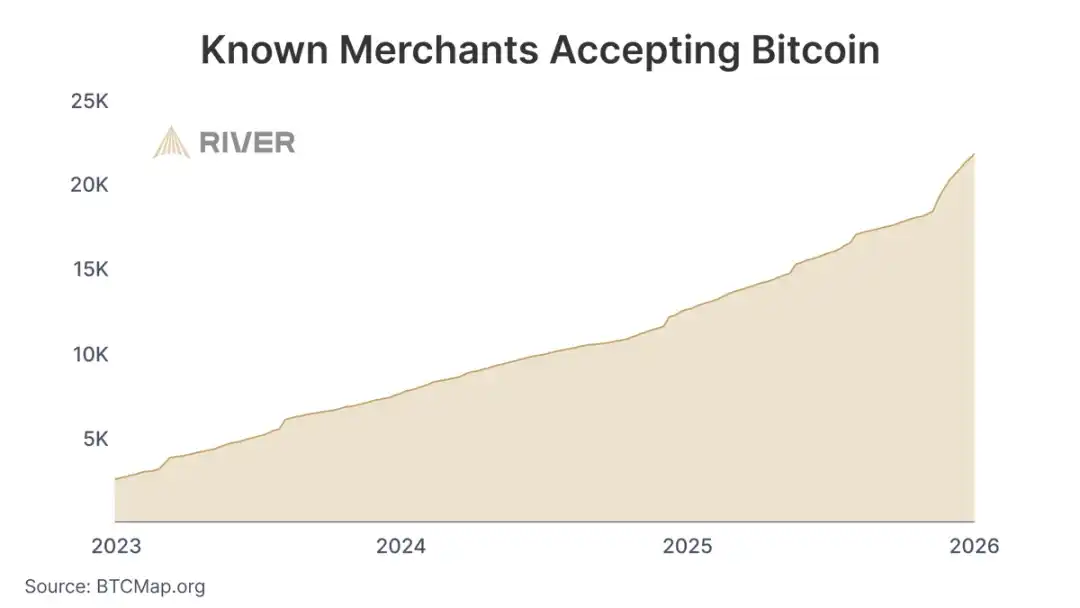
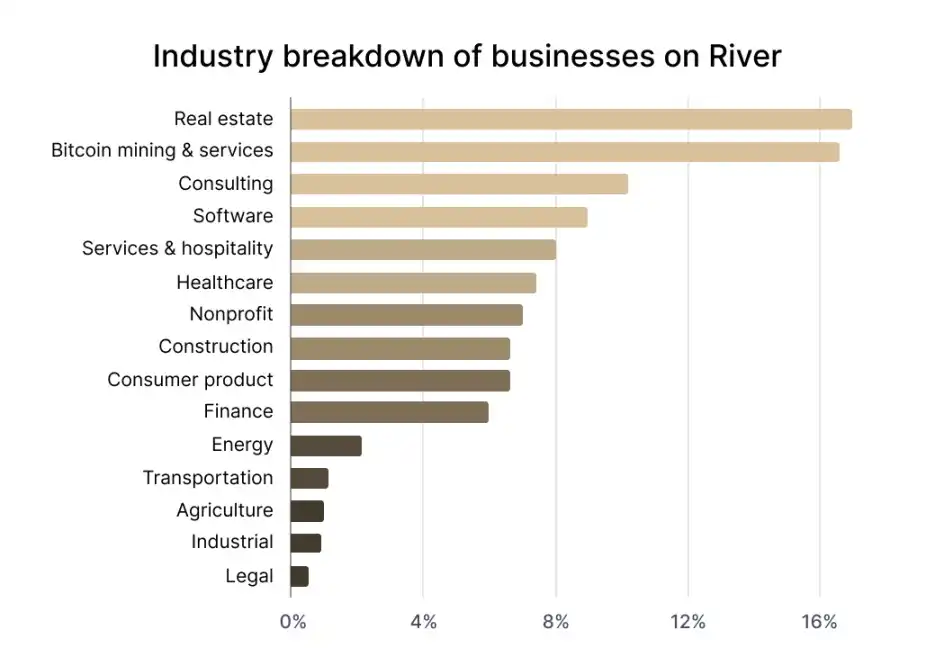
These are mostly small and medium-sized companies that do not publicly disclose their Bitcoin strategies. River serves over 3,000 businesses across various industries and has witnessed the most rapid adoption growth among small, private companies.

Lightning Network Grew 300% in 2025

It is estimated that the Lightning Network now processes over $1.1 billion in monthly transaction volume. The growth is primarily driven by organic adoption from exchanges and merchants.


5 New Sovereign Nations Now Hold Bitcoin

In 2025, 5 more countries became Bitcoin holders, including: 2 sovereign wealth funds (Luxembourg, Saudi Arabia) and 1 central bank (Czech National Bank).

These nations acquired Bitcoin through official mining, direct purchases by central banks/funds, ETFs, donations, confiscations, and hacker recoveries.

<极速>
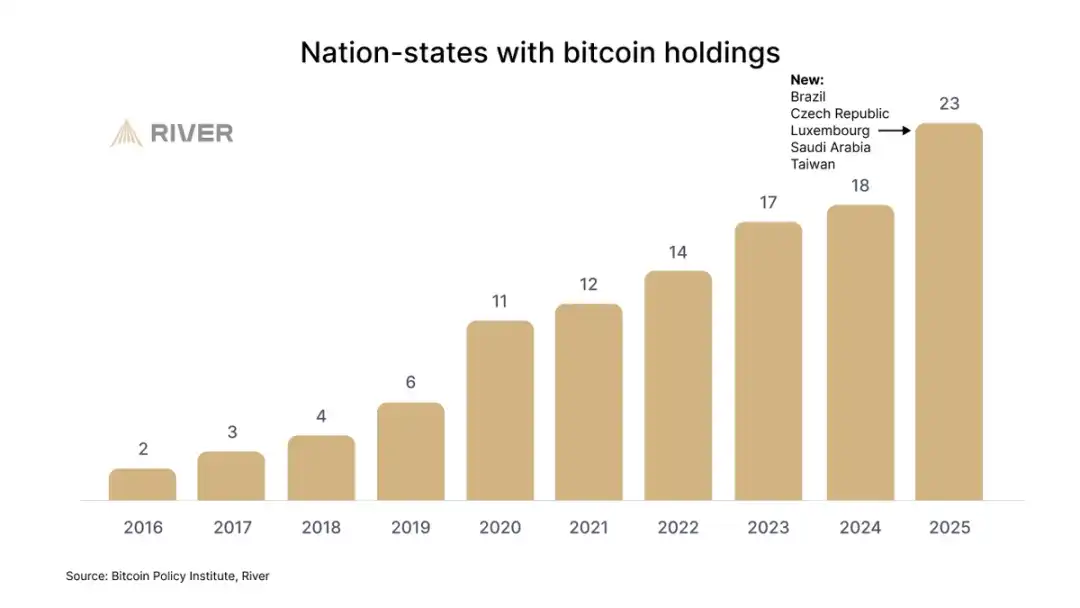
Furthermore, it has been 4 years since any country banned Bitcoin (since Afghanistan in 2022). Clearly, embracing Bitcoin is in the best interest of nations.


Bitcoin Is No Longer "Too Volatile"

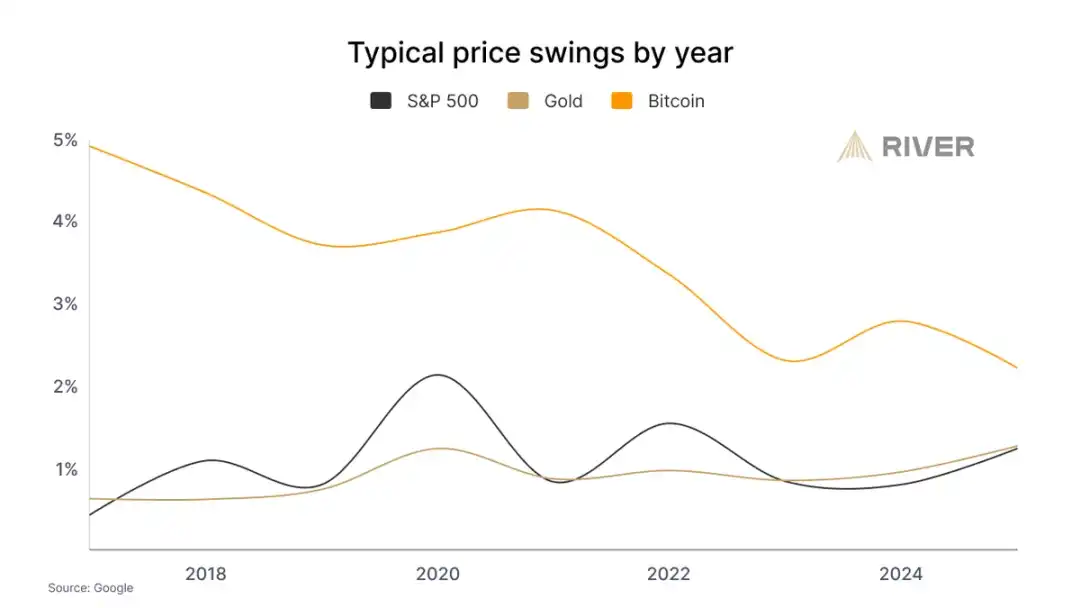
Bitcoin has continued its decade-long trend of decreasing volatility and is approaching the levels of gold and the S&P 500.

Why is this important? It signals that Bitcoin is being viewed as a mature asset class. Lower volatility means a lower barrier to entry for risk-averse capital.

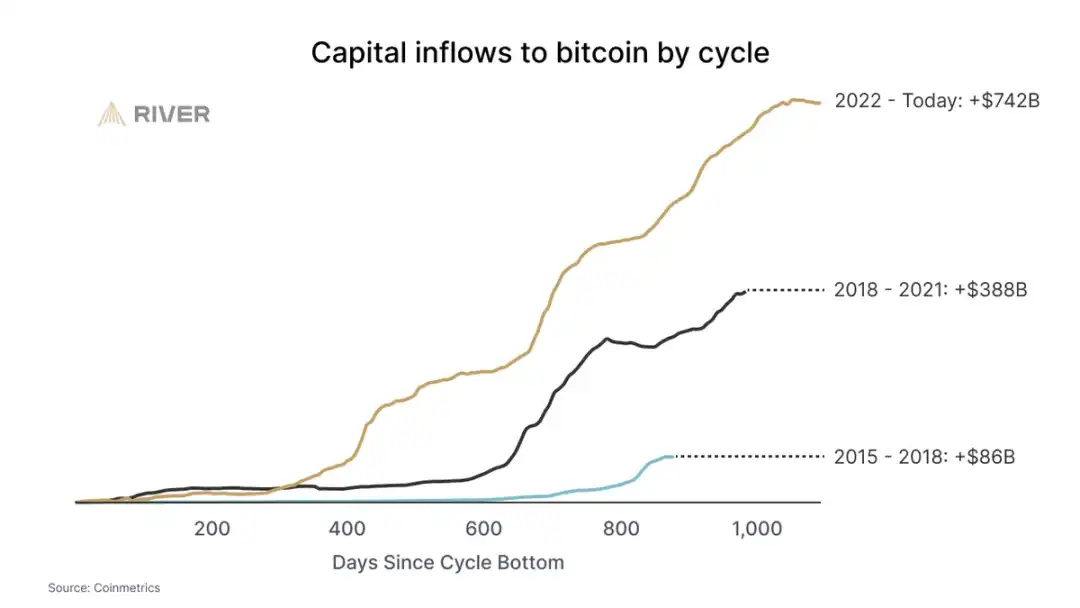
In the long run, this opens the door to larger pools of capital. The last bull market proved this: the amount of capital Bitcoin attracted in three years exceeded the sum of all previous history.


Looking Ahead

Despite Bitcoin's weak price performance over the past year, the adoption curve tells a completely different story. Current adoption won't cause the price to skyrocket 10x overnight, but in many ways, it is more meaningful.

Every year, the trust of individuals, corporations, institutions, and sovereign nations in Bitcoin deepens, as it continues to prove itself as the world's only scarce, immutable digital currency. We expect that Bitcoin adoption will not only continue its current trends in the coming years but will also accelerate significantly.

Related Questions

QWhat are the key trends in Bitcoin adoption mentioned in the article, despite its price being 50% below the all-time high?

AThe key trends include record institutional buying, continuous net purchases by investment advisors, a 2.5x increase in corporate adoption, a 74% growth in merchant adoption, a 300% surge in Lightning Network usage, five new sovereign nations holding Bitcoin, and a significant decrease in Bitcoin's volatility.

QHow have institutions contributed to Bitcoin's adoption in 2025 according to the article?

AInstitutions accumulated 829,000 Bitcoins in 2025, including purchases by corporations, governments, funds, and ETFs. This represents millions of individual investors accessing Bitcoin through brokerage accounts, pensions, sovereign funds, and corporate treasuries for the first time.

QWhat role do Registered Investment Advisors (RIAs) play in Bitcoin adoption?

ARIAs, managing about $146 trillion in client assets, have been net buyers of Bitcoin ETFs for eight consecutive quarters, with approximately $1.5 billion invested per quarter. 29 of the top 30 U.S. RIAs have allocated to Bitcoin, though the average allocation is only 0.008%.

QHow has merchant adoption changed in 2025, and what benefits does Bitcoin payment offer?

AMerchant adoption grew by 74% globally in 2025, with the number of U.S. businesses tripling. Companies like SteaknShake have demonstrated that Bitcoin payments can lower transaction costs and increase profits, with small private companies showing the fastest adoption growth.

QWhat does the article indicate about Bitcoin's volatility and its implications?

ABitcoin's volatility has continued a decade-long decline, approaching levels similar to gold and the S&P 500. This trend signals Bitcoin's maturation as an asset class, lowering the entry barrier for risk-averse capital and potentially unlocking larger pools of investment.

Related Reads

Research Status Report on AI Payment Protocols: The New Paradigm of Payment in the Agent Economy

AI Payment Protocol Research Status Report: A New Paradigm for Agent Economy Payments This report analyzes the rapid evolution of payment infrastructure designed for AI agents, driven by major industry moves from OpenAI, Google, Visa, Mastercard, Coinbase, and Stripe between late 2025 and early 2026. The core challenge is that traditional payment systems, built for human interaction, are incompatible with AI agents that require machine-readable interfaces, millisecond authorizations, and support for high-frequency micro-transactions. The emerging infrastructure is forming a two-layer architecture: 1. **Intent Orchestration Layer:** Translates agent intent into executable transactions. Two key segments exist: * **Agent Shopping for Humans:** Focuses on enabling agents to shop on human-centric e-commerce platforms. Protocols include OpenAI & Stripe's closed **Agentic Commerce Protocol (ACP)** and Google's open **Universal Commerce Protocol (UCP)** for standardized merchant interfaces. * **Agent-to-Agent (A2A) Transactions:** Solves trust issues in environments without human merchants, using blockchain-based smart contracts like **ERC-8183** for task execution and payment escrow. 2. **Settlement Layer:** Handles the actual movement of funds. Key competing protocols include: * **Stripe's SPT & Card Network Upgrades (Visa/Mastercard):** Extend existing card payments with delegated authorization tokens, ideal for standard retail but unsuitable for micro-payments. * **Coinbase's x402:** Uses the HTTP 402 status code for on-chain atomic swaps with stablecoins (e.g., USDC), enabling low-fee, account-less payments. * **Circle's Nanopayments:** An x402 enhancement for extreme micro-payments using off-chain batch processing. * **MPP (Stripe & Tempo):** A unified, pluggable framework supporting multiple payment rails (stablecoins, fiat, card tokens, Lightning Network) within a single "payment session." **Current State & Opportunities:** While core protocols are live, commercial adoption lags due to fragmentation in the intent layer. The key opportunities are: * **Settlement Layer:** Building multi-rail Agent wallets that abstract complexity and can route transactions across different payment protocols is a definitive, high-value opportunity. * **A2A Economy:** A significant blue-ocean opportunity exists in creating API services for agents to consume (e.g., data analysis, content creation) on a pay-per-use model (e.g., via HTTP 402), moving beyond subscription models. The future will see a dual-track evolution: consumer-facing agent commerce relying on card rails, and A2A transactions thriving on stablecoin rails. The inflection point will be when enterprises delegate spending authority to agents, making multi-rail wallets and service directories critical, unclaimed infrastructure.

marsbit4h ago

Research Status Report on AI Payment Protocols: The New Paradigm of Payment in the Agent Economy

marsbit4h ago

Trading

Spot
Futures

Hot Articles

What is $BITCOIN

DIGITAL GOLD ($BITCOIN): A Comprehensive Analysis Introduction to DIGITAL GOLD ($BITCOIN) DIGITAL GOLD ($BITCOIN) is a blockchain-based project operating on the Solana network, which aims to combine the characteristics of traditional precious metals with the innovation of decentralized technologies. While it shares a name with Bitcoin, often referred to as “digital gold” due to its perception as a store of value, DIGITAL GOLD is a separate token designed to create a unique ecosystem within the Web3 landscape. Its goal is to position itself as a viable alternative digital asset, although specifics regarding its applications and functionalities are still developing. What is DIGITAL GOLD ($BITCOIN)? DIGITAL GOLD ($BITCOIN) is a cryptocurrency token explicitly designed for use on the Solana blockchain. In contrast to Bitcoin, which provides a widely recognized value storage role, this token appears to focus on broader applications and characteristics. Notable aspects include: Blockchain Infrastructure: The token is built on the Solana blockchain, known for its capacity to handle high-speed and low-cost transactions. Supply Dynamics: DIGITAL GOLD has a maximum supply capped at 100 quadrillion tokens (100P $BITCOIN), although details regarding its circulating supply are currently undisclosed. Utility: While precise functionalities are not explicitly outlined, there are indications that the token could be utilized for various applications, potentially involving decentralized applications (dApps) or asset tokenization strategies. Who is the Creator of DIGITAL GOLD ($BITCOIN)? At present, the identity of the creators and development team behind DIGITAL GOLD ($BITCOIN) remains unknown. This situation is typical among many innovative projects within the blockchain space, particularly those aligning with decentralized finance and meme coin phenomena. While such anonymity may foster a community-driven culture, it intensifies concerns about governance and accountability. Who are the Investors of DIGITAL GOLD ($BITCOIN)? The available information indicates that DIGITAL GOLD ($BITCOIN) does not have any known institutional backers or prominent venture capital investments. The project seems to operate on a peer-to-peer model focused on community support and adoption rather than traditional funding routes. Its activity and liquidity are primarily situated on decentralized exchanges (DEXs), such as PumpSwap, rather than established centralized trading platforms, further highlighting its grassroots approach. How DIGITAL GOLD ($BITCOIN) Works The operational mechanics of DIGITAL GOLD ($BITCOIN) can be elaborated on based on its blockchain design and network attributes: Consensus Mechanism: By leveraging Solana’s unique proof-of-history (PoH) combined with a proof-of-stake (PoS) model, the project ensures efficient transaction validation contributing to the network's high performance. Tokenomics: While specific deflationary mechanisms have not been extensively detailed, the vast maximum token supply implies that it may cater to microtransactions or niche use cases that are still to be defined. Interoperability: There exists the potential for integration with Solana’s broader ecosystem, including various decentralized finance (DeFi) platforms. However, the details regarding specific integrations remain unspecified. Timeline of Key Events Here is a timeline that highlights significant milestones concerning DIGITAL GOLD ($BITCOIN): 2023: The initial deployment of the token occurs on the Solana blockchain, marked by its contract address. 2024: DIGITAL GOLD gains visibility as it becomes available for trading on decentralized exchanges like PumpSwap, allowing users to trade it against SOL. 2025: The project witnesses sporadic trading activity and potential interest in community-led engagements, although no noteworthy partnerships or technical advancements have been documented as of yet. Critical Analysis Strengths Scalability: The underlying Solana infrastructure supports high transaction volumes, which could enhance the utility of $BITCOIN in various transaction scenarios. Accessibility: The potential low trading price per token could attract retail investors, facilitating wider participation due to fractional ownership opportunities. Risks Lack of Transparency: The absence of publicly known backers, developers, or an audit process may yield skepticism regarding the project's sustainability and trustworthiness. Market Volatility: The trading activity is heavily reliant on speculative behavior, which can result in significant price volatility and uncertainty for investors. Conclusion DIGITAL GOLD ($BITCOIN) emerges as an intriguing yet ambiguous project within the rapidly evolving Solana ecosystem. While it attempts to leverage the “digital gold” narrative, its departure from Bitcoin's established role as a store of value underscores the need for a clearer differentiation of its intended utility and governance structure. Future acceptance and adoption will likely depend on addressing the current opacity and defining its operational and economic strategies more explicitly. Note: This report encompasses synthesised information available as of October 2023, and developments may have transpired beyond the research period.

363 Total ViewsPublished 2025.05.13Updated 2025.05.13

What is $BITCOIN

Discussions

Welcome to the HTX Community. Here, you can stay informed about the latest platform developments and gain access to professional market insights. Users' opinions on the price of BTC (BTC) are presented below.

活动图片

Top Questions