Why Has Bitcoin Risen Against the Trend Amid Turmoil?

marsbitPublished on 2026-04-15Last updated on 2026-04-15

Abstract

Title: Why Bitcoin Defies Market Turmoil and Rises Against the Odds? Amidst the recent Iran conflict, Bitcoin demonstrated unexpected strength, rising 12% while traditional risk assets like the S&P 500 fell 1% and gold dropped 10%. This challenges the conventional view of Bitcoin is a risk-on asset. Matt Hougan, Bitwise CIO, argues that Bitcoin’s surge is not due to ignorance of geopolitical tensions or long-term money printing expectations, but is directly driven by the conflict itself. Hougan proposes a dual-investment thesis for Bitcoin: it acts both as a "digital gold" competing in the $38 trillion store-of-value market, and as a speculative bet on becoming a genuine global currency. While the first narrative has dominated the past five years, the second—once a distant possibility—is gaining relevance as global financial systems become increasingly weaponized. The 2022 SWIFT sanctions against Russia marked a turning point, prompting nations to explore alternative financial networks. Iran’s recent move to demand Bitcoin payments for shipping tolls in the Strait of Hormuz exemplifies this shift. Such developments increase the probability of Bitcoin being used as a neutral, apolitical settlement medium and amplify global monetary system volatility. This dual role suggests Bitcoin’s potential market extends beyond gold’s $38 trillion valuation. Its pricing is now influenced not only by liquidity or tech stock trends but also by growing uncertainties in the international f...

Editor's Note: While the market has grown accustomed to categorizing Bitcoin as a "risk asset," the recent market movement triggered by the Iran conflict has delivered a clear signal that deviates from the consensus: against a backdrop of falling traditional assets and failing safe-haven assets, Bitcoin has instead strengthened.

Author Matt Hougan (current Bitwise CIO, co-founder of Future Proof, former CEO of ETF.com) argues that Bitcoin's rise is not "ignoring the war," nor is it solely the result of "money printing expectations," but is directly driven by the geopolitical conflict itself.

Hougan proposes a more explanatory framework—Bitcoin is not a single asset, but a "stacked bet": on one hand, it is competing with gold for the status of a "store of value"; on the other hand, it is also making a bet, albeit with low probability but high elasticity, on becoming a true global currency.

In the past, this second layer of logic was more of a distant imagination. However, as the financial system is gradually "weaponized," this hypothesis is beginning to move from the fringe to reality. From SWIFT sanctions to the rise of parallel settlement networks, to Iran's attempt to collect shipping passage fees in Bitcoin, Bitcoin is no longer just a tool against inflation; it is also being incorporated into the borderlands of national-level games.

Against this backdrop, Bitcoin's pricing logic has also changed. It is no longer driven solely by liquidity, tech stocks, or risk appetite, but has begun to price in the "uncertainty of the global monetary system." When conflicts increase the probability of its "monetary attributes" being realized while amplifying the volatility of the global financial system, the upside potential of this asset is also reopened.

If the narrative of Bitcoin over the past five years has focused on "digital gold," what is emerging now is a more complex dual role: both a store of value and a potential depoliticized settlement medium. And once this structure is established, its market boundaries may no longer be limited to the $38 trillion corresponding to gold.

Below is the original text:

Bitcoin has performed relatively strongly since the outbreak of the Iran conflict. Since the U.S. and Israel began airstrikes against Iran on February 28, Bitcoin has risen by 12%, while the S&P 500 index has fallen by 1%, and gold has dropped by 10%.
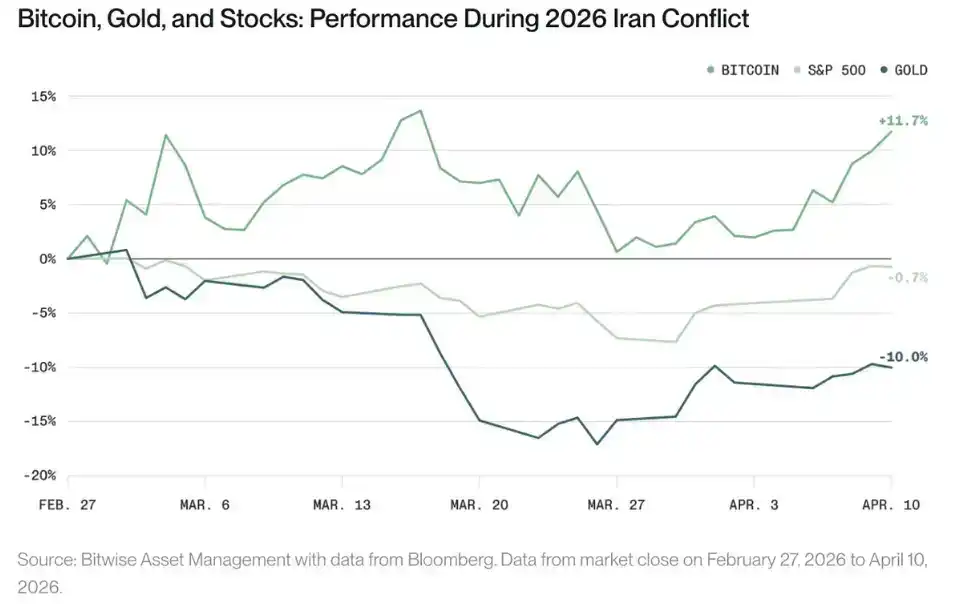
This has surprised many. Bitcoin has long been viewed as a risk asset, and many originally believed it should fall during the "risk-off" sentiment triggered by geopolitical conflict. Consequently, various explanations have emerged: some argue that geopolitics is irrelevant to Bitcoin; others point out that wars often lead to money printing, which in the long run benefits Bitcoin.

Neither explanation is accurate. Bitcoin's strong performance during this crisis stems precisely from the conflict itself. Understanding this is important.

One Investment, Two Bets

Buying Bitcoin is essentially betting on two things simultaneously.

First, you are betting that Bitcoin will become "digital gold" and compete with physical gold in the $38 trillion "store of value" market. This is Bitcoin's primary use case currently and a bet I find very attractive. As I have explained before, simply capturing about 17% of this market over the next decade could potentially drive Bitcoin's price to $1 million.

But when you buy Bitcoin, you are actually making a second bet—that one day, perhaps, Bitcoin will function like a traditional currency.

In the past, I have always viewed this as an "out-of-the-money call option": a speculative bet on a future that is unlikely to materialize. After all, for most of Bitcoin's existence, this possibility seemed extremely remote to most people. Until a few years ago, the global financial system was almost entirely built on the U.S. dollar track, and using a volatile, early-stage "cryptocurrency" for international trade sounded more like a fantasy at the time.

The turning point came in 2022, when the U.S. kicked Russia out of the dollar-centric SWIFT system. The French finance minister called it a "financial nuclear bomb" at the time, and countries became alert. China quickly built a parallel financial system, and other countries also took action. Russia moved 99% of its financial activities to these new systems, and other countries began to experiment.

At the time, I pondered that weaponizing SWIFT might open up space for Bitcoin: if countries gradually become reluctant to rely on the dollar system, it seems logical that at some stage they might turn to a "depoliticized" alternative.

And in this Iran conflict, we are seeing an early (and unsettling) manifestation of this trend: Iran stated in an interview with the Financial Times that it would begin charging all ships passing through the Strait of Hormuz a "toll" of $1 per barrel (approximately $20 million per day), to be settled in Bitcoin.

Obviously, this move raises important concerns about sanctions evasion and money laundering. Although in a sense it might be preferable to the status quo—for years, Iran has been evading U.S. sanctions through China's financial systems, which are harder to track than cryptocurrencies—it also brings new risks.

At the same time, it reveals a reality beyond the current conflict: in a world where countries are weaponizing financial systems, Bitcoin is gradually becoming a depoliticized alternative.

Option Pricing Logic

This is also why I analogize Bitcoin's potential as a currency to an "out-of-the-money call option."

The value of an option typically stems from two points: either the probability of reaching the target price increases, or the volatility of the underlying market rises.

In this Iran conflict, both occurred: first, the probability of Bitcoin being used as a "currency" rose; second, the uncertainty and volatility of the global monetary system increased.

This analytical framework can help us understand two important things. First, in future geopolitical conflicts, Bitcoin is likely to continue rising—especially in regions caught between the U.S. and Chinese systems. Second, Bitcoin's potential market size may far exceed the $38 trillion gold market.

Over the past five years, we have almost exclusively viewed Bitcoin as a "store of value." But if it begins to play a dual role as both a "store of value" (like gold) and a "payment currency" (like the dollar), then we may need to readjust our expectations for its long-term potential upward.


Related Questions

QWhy did Bitcoin's price rise during the Iran conflict, contrary to its typical classification as a risk asset?

ABitcoin's rise was driven by the geopolitical conflict itself, as it began to function as a potential 'depoliticized' alternative in global finance, especially after Iran announced it would accept Bitcoin for shipping fees, increasing its perceived utility as a currency.

QWhat are the two simultaneous bets an investor makes when buying Bitcoin, according to Matt Hougan?

AFirst, a bet that Bitcoin will become 'digital gold' and compete in the $38 trillion store-of-value market. Second, a speculative bet that Bitcoin might eventually function as a traditional global currency, though this was historically seen as unlikely.

QHow did the weaponization of financial systems (e.g., SWIFT sanctions against Russia) create an opportunity for Bitcoin?

AThe exclusion of Russia from SWIFT alerted nations to the risks of relying on dollar-centric systems, prompting some to explore alternatives. This increased the probability of Bitcoin being adopted as a neutral, decentralized settlement option in international trade.

QWhat analogy does Hougan use to describe Bitcoin's potential as a global currency, and why did its value increase during the Iran crisis?

AHougan compares it to an 'out-of-the-money call option.' Its value rose during the Iran conflict because both the probability of Bitcoin becoming a currency increased (e.g., Iran's adoption) and global monetary system volatility grew, enhancing the option's potential payoff.

QHow might Bitcoin's dual role as both a store of value and a payment currency affect its long-term market potential?

AIf Bitcoin serves both roles, its market size could exceed the $38 trillion gold market, as it would not only compete with gold but also potentially replace or supplement traditional fiat currencies in cross-border settlements, expanding its addressable market significantly.

Related Reads

TechFlow Intelligence Bureau: KelpDAO Attack Causes Nearly $300 Million Loss, Triggers Aave Withdrawal Wave, RAVE Crashes 95% in a Single Day

China's AI firm DeepSeek is seeking external funding for the first time, with a valuation exceeding $10 billion, signaling intensifying competition and high R&D costs in the domestic large model sector. Meanwhile, OpenAI CEO Sam Altman faces scrutiny over potential conflicts of interest between his personal investments and OpenAI’s business ahead of a possible IPO. In Web3, KelpDAO suffered a $294 million attack due to forged cross-chain messages on LayerZero, leading to massive withdrawals from Aave and a resulting 18% drop in AAVE tokens. Separately, RAVE cryptocurrency collapsed by 95% in a single day amid suspected insider manipulation. Geopolitically, Iran is now demanding Bitcoin payments for transit through the Strait of Hormuz, reflecting both internal governmental discord and the growing adoption of crypto in tense regions. In semiconductors, Nvidia CEO Jensen Huang showed rare public frustration over questions regarding chip sales to China, while the industry faces renewed price hikes. Tesla continues expanding its Robotaxi service, and a Chinese humanoid robot outperformed humans in a half-marathon, marking a milestone in robotics. Despite Middle East tensions and market uncertainties, U.S. stocks continue to rise, prompting discussions about market optimism versus risk blindness. Overall, today’s developments highlight systemic vulnerabilities—in tech, finance, and geopolitics—while also showcasing innovation in crises.

marsbit3h ago

TechFlow Intelligence Bureau: KelpDAO Attack Causes Nearly $300 Million Loss, Triggers Aave Withdrawal Wave, RAVE Crashes 95% in a Single Day

marsbit3h ago

Trading

Spot
Futures

Hot Articles

What is $BITCOIN

DIGITAL GOLD ($BITCOIN): A Comprehensive Analysis Introduction to DIGITAL GOLD ($BITCOIN) DIGITAL GOLD ($BITCOIN) is a blockchain-based project operating on the Solana network, which aims to combine the characteristics of traditional precious metals with the innovation of decentralized technologies. While it shares a name with Bitcoin, often referred to as “digital gold” due to its perception as a store of value, DIGITAL GOLD is a separate token designed to create a unique ecosystem within the Web3 landscape. Its goal is to position itself as a viable alternative digital asset, although specifics regarding its applications and functionalities are still developing. What is DIGITAL GOLD ($BITCOIN)? DIGITAL GOLD ($BITCOIN) is a cryptocurrency token explicitly designed for use on the Solana blockchain. In contrast to Bitcoin, which provides a widely recognized value storage role, this token appears to focus on broader applications and characteristics. Notable aspects include: Blockchain Infrastructure: The token is built on the Solana blockchain, known for its capacity to handle high-speed and low-cost transactions. Supply Dynamics: DIGITAL GOLD has a maximum supply capped at 100 quadrillion tokens (100P $BITCOIN), although details regarding its circulating supply are currently undisclosed. Utility: While precise functionalities are not explicitly outlined, there are indications that the token could be utilized for various applications, potentially involving decentralized applications (dApps) or asset tokenization strategies. Who is the Creator of DIGITAL GOLD ($BITCOIN)? At present, the identity of the creators and development team behind DIGITAL GOLD ($BITCOIN) remains unknown. This situation is typical among many innovative projects within the blockchain space, particularly those aligning with decentralized finance and meme coin phenomena. While such anonymity may foster a community-driven culture, it intensifies concerns about governance and accountability. Who are the Investors of DIGITAL GOLD ($BITCOIN)? The available information indicates that DIGITAL GOLD ($BITCOIN) does not have any known institutional backers or prominent venture capital investments. The project seems to operate on a peer-to-peer model focused on community support and adoption rather than traditional funding routes. Its activity and liquidity are primarily situated on decentralized exchanges (DEXs), such as PumpSwap, rather than established centralized trading platforms, further highlighting its grassroots approach. How DIGITAL GOLD ($BITCOIN) Works The operational mechanics of DIGITAL GOLD ($BITCOIN) can be elaborated on based on its blockchain design and network attributes: Consensus Mechanism: By leveraging Solana’s unique proof-of-history (PoH) combined with a proof-of-stake (PoS) model, the project ensures efficient transaction validation contributing to the network's high performance. Tokenomics: While specific deflationary mechanisms have not been extensively detailed, the vast maximum token supply implies that it may cater to microtransactions or niche use cases that are still to be defined. Interoperability: There exists the potential for integration with Solana’s broader ecosystem, including various decentralized finance (DeFi) platforms. However, the details regarding specific integrations remain unspecified. Timeline of Key Events Here is a timeline that highlights significant milestones concerning DIGITAL GOLD ($BITCOIN): 2023: The initial deployment of the token occurs on the Solana blockchain, marked by its contract address. 2024: DIGITAL GOLD gains visibility as it becomes available for trading on decentralized exchanges like PumpSwap, allowing users to trade it against SOL. 2025: The project witnesses sporadic trading activity and potential interest in community-led engagements, although no noteworthy partnerships or technical advancements have been documented as of yet. Critical Analysis Strengths Scalability: The underlying Solana infrastructure supports high transaction volumes, which could enhance the utility of $BITCOIN in various transaction scenarios. Accessibility: The potential low trading price per token could attract retail investors, facilitating wider participation due to fractional ownership opportunities. Risks Lack of Transparency: The absence of publicly known backers, developers, or an audit process may yield skepticism regarding the project's sustainability and trustworthiness. Market Volatility: The trading activity is heavily reliant on speculative behavior, which can result in significant price volatility and uncertainty for investors. Conclusion DIGITAL GOLD ($BITCOIN) emerges as an intriguing yet ambiguous project within the rapidly evolving Solana ecosystem. While it attempts to leverage the “digital gold” narrative, its departure from Bitcoin's established role as a store of value underscores the need for a clearer differentiation of its intended utility and governance structure. Future acceptance and adoption will likely depend on addressing the current opacity and defining its operational and economic strategies more explicitly. Note: This report encompasses synthesised information available as of October 2023, and developments may have transpired beyond the research period.

363 Total ViewsPublished 2025.05.13Updated 2025.05.13

What is $BITCOIN

Discussions

Welcome to the HTX Community. Here, you can stay informed about the latest platform developments and gain access to professional market insights. Users' opinions on the price of BTC (BTC) are presented below.

活动图片