Barron's: FTX Sends Crypto Reeling. The Whales Move in to Profit

BarronsPublished on 2022-11-21Last updated on 2022-11-21

Abstract

Still, buying the dip looks risky. FTX’s collapse raises fundamental questions about the future of crypto, from the role of unregulated exchanges and brokerages to how tough regulation will be. Bets seem centered on Bitcoin, the closest thing crypto has to a blue-chip asset. Other tokens have been hit harder. Alt-coin Solana, for one, has lost nearly $9 billion of market cap as its token plunged 66% in price. Forced selling of more tokens, including Bitcoin, may be coming as the fallout from FTX spreads.

Cryptocurrency markets have been slammed by the sudden bankruptcy of FTX. But amid the carnage, some big traders—whales—were buying. Bitcoin, the largest crypto, was plumbing two-year lows at $16,600 on Friday—down from some $21,000 before FTX’s woes became public and roughly $69,000 in November 2021, the high. “The crypto world is still [being] rocked by FTX, and traders are still in shock,” says Naeem Aslam, an analyst at broker AvaTrade.

Some bargain hunters stepped in, betting on Bitcoin as a classic distressed asset play. “Many Bitcoin whales have chosen this time of panic to accumulate, as the number of addresses with more than 10,000 Bitcoin exploded over the past week or so,” notes Marcus Sotitriou, an analyst at digital asset broker GlobalBlock.
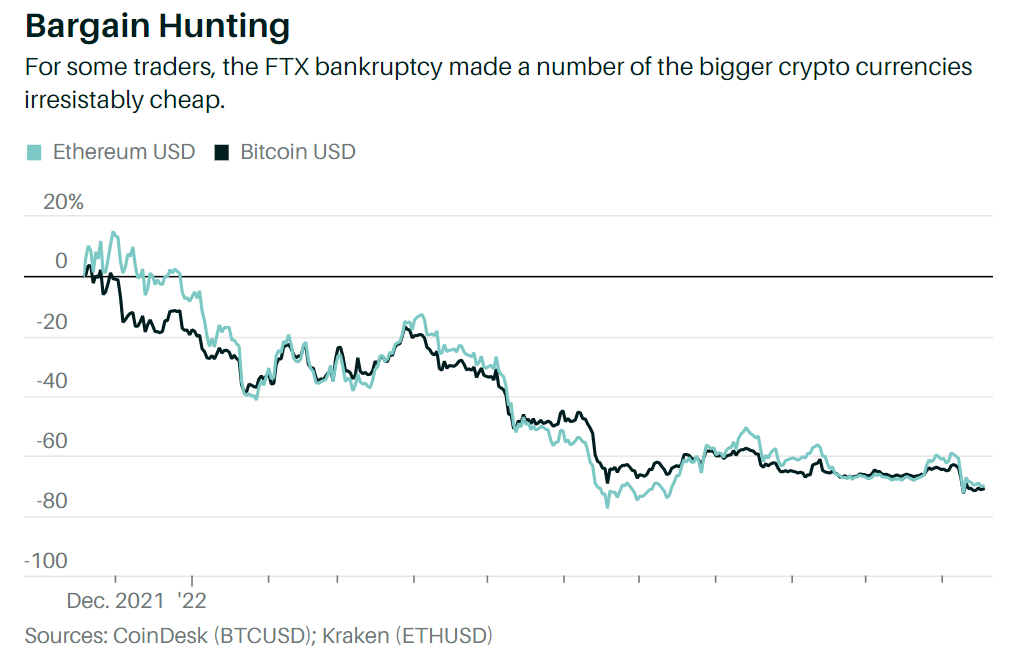
At recent prices, 10,000 Bitcoin would be worth almost $170 million, making the whales influential market players, and potential long-term holders. They may be high-net-worth investors or crypto-native hedge funds, though it’s less likely institutional investors are taking the plunge, he adds. Still, it’s likely that most institutional and retail investors will wait to see what markets and regulators do.
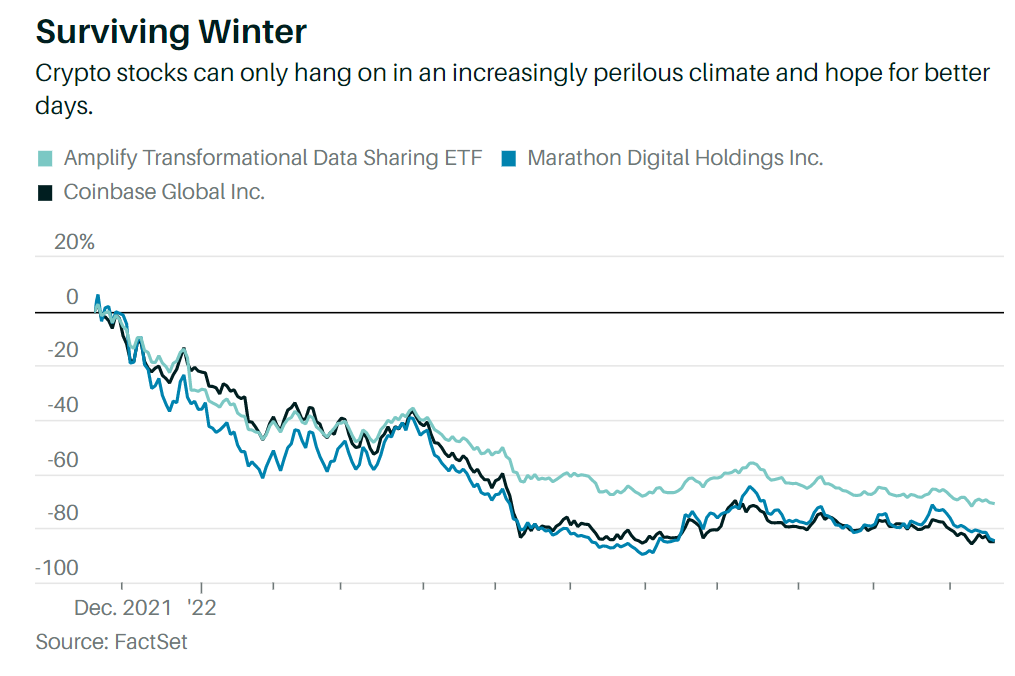
Still, buying the dip looks risky. FTX’s collapse raises fundamental questions about the future of crypto, from the role of unregulated exchanges and brokerages to how tough regulation will be. Bets seem centered on Bitcoin, the closest thing crypto has to a blue-chip asset. Other tokens have been hit harder. Alt-coin Solana, for one, has lost nearly $9 billion of market cap as its token plunged 66% in price. Forced selling of more tokens, including Bitcoin, may be coming as the fallout from FTX spreads.


Related Reads

Research Report Analysis: Morgan Stanley Details SanDisk SNDK, The Truth About Cloud Data Center Pricing Power and AI Inference Benefits

Morgan Stanley raised its price target for SanDisk (SNDK) from $1100 to $1750 on June 22, maintaining an Overweight rating. The upgrade is driven by AI inference demand reshaping the NAND market, particularly for KV Cache and context window storage in cloud data centers. These cloud clients exhibit price inelasticity and sign long-term contracts, granting SanDisk significant pricing power. SanDisk's New Business Model (NBM) agreements, covering over one-third of FY27 bit shipments with 3-5 year terms and fixed price/price collar structures, are crucial. They are projected to sustain gross margins around 80% even at floor prices, providing a buffer against cyclical downturns. Morgan Stanley forecasts gross margins to surge from 30.3% in FY25 to 86.7% in FY27e. With NAND supply expected to remain tight into 2026/2027 and cloud/data centers becoming the largest end-market, SanDisk holds supply-side pricing power. The company targets 15-19% bit growth via technology transitions, not capacity expansion. Revenue is projected to grow ~6.6x from FY25 to FY27, with EPS rising from $2.74 to $14.73, driven by high-margin cloud business. Key upside catalysts include faster enterprise SSD adoption and edge AI growth. Downside risks involve slower industry growth, competitor capex increases, market share loss, and competition from Chinese players like YMTC. The investment thesis rests on AI-driven structural demand, NBM's margin protection, and sustained supply tightness. The $1750 target implies ~28x FY27e P/E.

marsbit16m ago

Research Report Analysis: Morgan Stanley Details SanDisk SNDK, The Truth About Cloud Data Center Pricing Power and AI Inference Benefits

marsbit16m ago

A Threefold Performance Leap! NEAR Achieves 200ms Physical Block Time Limit with SPICE

NEAR's core development team, Near One, has announced its next major protocol evolution: SPICE (Separation of Consensus and Execution). Currently in development, SPICE represents the most significant upgrade before the full implementation of Nightshade 3.0. Its core innovation is decoupling the consensus layer, responsible for ordering transactions, from the execution layer, which processes them. This allows the consensus layer to run at full speed without waiting for transaction execution to complete. Once deployed, SPICE is projected to triple NEAR's block production speed, achieving a 200ms block time, which is considered the physical limit due to the speed of light and network latency. This leap will dramatically reduce transaction latency and finality, with transactions confirming in roughly 0.4 seconds—faster than a typical card payment. The upgrade also enables more complex, long-running transactions and significantly improves user experience for applications like NEAR Intents and near.com. Beyond raw speed, SPICE enhances network scalability and security. It enables deeper parallelism, efficiently distributing workload across shards and improving resource utilization. The simpler block structure and lighter contracts also facilitate formal verification and security auditing. Furthermore, SPICE lays the critical groundwork for future Nightshade 3.0 features, most notably atomic cross-shard transactions, which would simplify complex contract logic and eliminate development hurdles caused by asynchronous execution. The Near One team is actively developing SPICE, targeting deployment in the coming months.

Foresight News1h ago

A Threefold Performance Leap! NEAR Achieves 200ms Physical Block Time Limit with SPICE

Foresight News1h ago

Trading

Spot
Futures
活动图片