
Цены на видеокарты до и после майнинг-бума

Crypto.ruPublished on 2022-11-19Last updated on 2022-11-19

Abstract

Рынок компьютерных комплектующих нестабилен. Стоимость многих устройств меняется ежемесячно. Иногда колебания очень сильные. Например, из-за майнинг-бума в 2021 году видеокарты (GPU или ГП) многих производителей подорожали минимум в 2 раза. Тогда покупка графических процессоров была дорогим удовольствием. Начинающим пользователям ПК интересно, сколько стоили видеокарты до майнинга. Редакция Crypto.ru подготовила ответ.

Рынок компьютерных комплектующих нестабилен. Стоимость многих устройств меняется ежемесячно. Иногда колебания очень сильные. Например, из-за майнинг-бума в 2021 году видеокарты (GPU или ГП) многих производителей подорожали минимум в 2 раза. Тогда покупка графических процессоров была дорогим удовольствием. Начинающим пользователям ПК интересно, сколько стоили видеокарты до майнинга. Редакция Crypto.ru подготовила ответ.

Сколько стоили видеокарты до майнинга

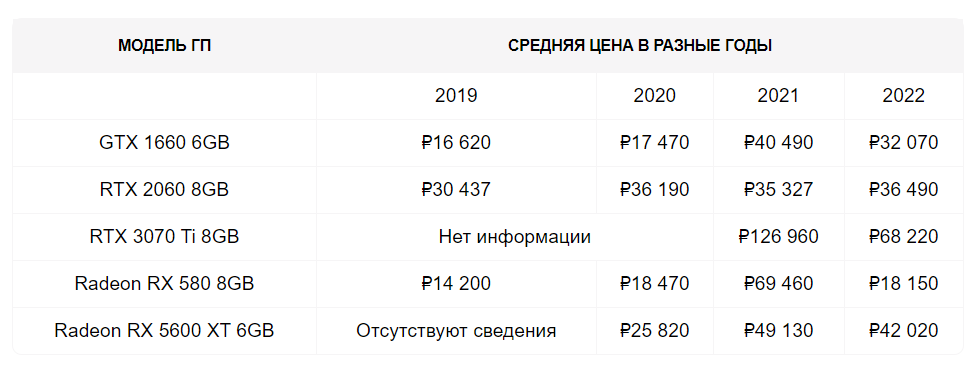
До бума добычи криптовалют цены на GPU были низкими. Когда популярность майнинга начала расти, стала увеличиваться и стоимость графических процессоров. Часть производителей повысила цену на 250% и выше. Например, купить Radeon RX 580 в 2020 году можно было за ₽18 470, но в 2021-м ее стоимость увеличилась до ₽69 460 в среднем.
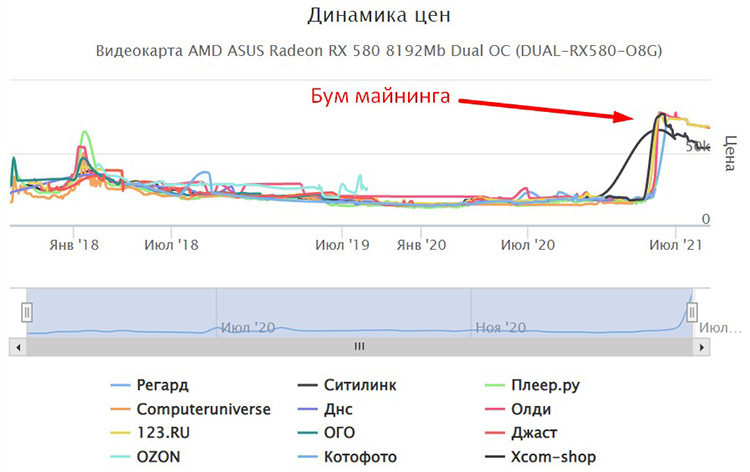
Изменения стоимости Radeon RX 580 с начала 2018-го до середины 2021 года

Цены на видеокарты после начала майнинга

Цены на видеокарты до бума майнинга и после сильно различаются. Динамику можно отследить в таблице ниже.
Какие факторы влияют на рост цен на видеокарты

Стоимость GPU складывается из многих экономических аспектов. Но основных факторов всего 4:

  • Востребованность.
  • Объемы производства графических процессоров (ГП).
  • Стоимость изготовления.
  • Наличие компонентов.

Спрос

Именно спрос определяет, насколько дорогостоящими будут ГП. Чем сильнее покупателям нужен товар, тем более высокую стоимость обычно устанавливают производители.

Скорость производства

В продаже находится не бесконечное число GPU. Предложение ограничено скоростью изготовления. В свою очередь, она зависит от 2 факторов:

-Производственные мощности компаний, которые выпускают компьютерную технику. Чем быстрее корпорации изготавливают видеокарты, тем дешевле их продукт. Это объясняется необходимостью уравнивать показатели спроса и предложения. Если востребованность продуктов небольшая, производители часто вынуждены делать их более доступными для увеличения продаж.

-Наличие чипов. Если у производителей много микросхем, они могут изготавливать GPU большими партиями. Но при отсутствии чипов компании начинают замедлять скорость или вовсе останавливать выпуск техники. В таких случаях дефицит ГП увеличивается, поэтому они дорожают.

Цена производства

Рыночная экономика изменчива. Электронные компоненты периодически дорожают и дешевеют. Однако в среднем показатели медленно растут. От них зависит, во сколько будет обходиться производство GPU. Например, бывают такие ситуации (в упрощенном виде):

  1. Продавцы компонентов увеличивают стоимость поставок.
  2. Покупатели электроники (изготовители комплектующих) начинают получать убытки от продажи выпускаемой техники по прежним ценам.
  3. Производители увеличивают стоимость своих продуктов.
  4. Ритейлеры (торговые сети) следом поднимают цены.

Бывают и ситуации, когда поставщики электроники начинают продавать компоненты дешевле. При этом производителям GPU могут снижать стоимость не в ущерб себе. Такой ход увеличивает продажи, что повышает операционную прибыль.

Наличие микросхем

С 2020 года мир живет в условиях дефицита электронных чипов. Нехватка полупроводников в разное время составляла от 10 до 30%. В результате спрос на технику, которая основана на микросхемах, стал больше предложения.

Высокий спрос выгоден производителям. При большой востребованности товаров компании могут применять 2 приема для увеличения прибыли:

  • Начать быстрее изготавливать и продавать технику.
  • Сделать товар более дорогостоящим.

При дефиците микросхем компании не могут повышать скорость производства. Поэтому корпорации обычно используют второй прием. Но в этом случае они теряют часть покупателей.

Будущие перспективы

В последние годы большую часть ГП майнеры применяли для добычи Ethereum. Но 15 сентября 2022 года произошло слияние сетей ETH1 и ETH2. Тогда основной блокчейн Эфириум перешел с алгоритма консенсуса Proof-of-Work на механизм Proof-of-Stake. Поэтому применение тысяч ГП стало бесполезным. При алгоритме Proof-of-Stake высокий хешрейт не нужен.

После слияния ETH майнеры начали переходить на добычу других монет — ETC, RVN. Поэтому сложности их сетей резко увеличились. Это привело к сильному снижению доходности майнинга. Многие криптовалютные добытчики стали работать в убыток и распродавать оборудование. Результат такого поведения — снижение спроса на ГП. Видеокарты стали никому не нужны. В ответ производители комплектующих начали снижать стоимость.

Трудно спрогнозировать, какое будущее у майнинга. Часть пользователей считает, что он будет стабилизироваться после начала бычьего тренда. Другие же предрекают конец рынку криптовалют из-за отрицательной доходности добычи. В первом случае GPU могут начать медленно дорожать, а во втором — продолжат дешеветь.

Резюме

До майнинга компьютерные видеокарты стоили дешево. Купить ГП средней мощности тогда можно было примерно за ₽20-25 тыс. Но после начала криптовалютного майнинга рыночные цены на видеокарты стали резко увеличиваться. Производители компьютерных комплектующих повысили стоимость на 150-200% в среднем.


Related Reads

Preferred Stock Is Not the Trigger for Corporate Bankruptcy, MicroStrategy's Dollar Reserves Can Cover Dividend and Interest Payments Until February 2027

Preferred Shares Are Not the Catalyst for Corporate Bankruptcy; MicroStrategy's Dollar Reserves Can Cover Dividend and Interest Payments Until February 2027. This article analyzes the nature of preferred shares used by MicroStrategy (MSTR). Legally equity but economically similar to debt, these shares, including its Bitcoin-linked STR convertible preferred notes (STRC), offer fixed or floating dividends. Crucially, MicroStrategy's preferred shares lack rigid redemption clauses, meaning they are not classified as traditional debt. This eliminates principal repayment pressure and means missed dividends do not constitute default or trigger bankruptcy, creating a "self-contradictory virtuous cycle." The article clarifies that if funds are short, MicroStrategy can defer or suspend preferred share dividends (except for non-cumulative types like STRD) without immediate risk. The real potential crisis point lies with its convertible bonds. If a prolonged bear market prevents conversion, MicroStrategy might need to sell Bitcoin to repay these bonds starting from the earliest maturity in September 2027, potentially creating a downward spiral. Preferred dividend suspensions would only exacerbate market panic in such a scenario. Recent financial activity shows MicroStrategy strengthened its position through four weeks of common stock (MSTR) issuances, raising over $851 million without issuing new preferred shares. It increased its dollar reserves to approximately $1.4 billion, which is sufficient to cover all preferred share dividends and interest until around March 2027. While Bitcoin purchases slowed recently, this prioritization of cash reserves enhances the company's near-term financial safety. The analysis concludes that if the Bitcoin bear market ends by early 2025 as anticipated, MicroStrategy can resume issuing MSTR stock in a rising market to replenish reserves and manage future dividend obligations, thereby reducing the long-term pressure from its preferred share structure.

marsbit1h ago

Preferred Stock Is Not the Trigger for Corporate Bankruptcy, MicroStrategy's Dollar Reserves Can Cover Dividend and Interest Payments Until February 2027

marsbit1h ago

Giants Wage the Context War, Reconstructing AI Moats

The article "Giants Launch the Context War, Reconstructing AI's Moat" discusses how leading AI companies—OpenAI, Anthropic, and Google—are shifting their competitive focus from model size to acquiring, managing, and utilizing user context (Context). Initially, Context referred to the length of text a model could process, leading to a "arms race" for longer context windows. However, the competition has evolved through three key phases: expanding text capacity (long context windows), enabling memory across sessions, and finally, integrating AI into real user environments like browsers and desktops to capture dynamic task states. Each company is pursuing a distinct strategy. OpenAI is building Context around the ChatGPT account, turning it into a central hub that accumulates user understanding across various integrated applications and tools. Anthropic, lacking a major user base, focuses on high-value verticals like coding, empowering its Claude model to actively gather Context through GUI interaction (Computer Use) and system connections (MCP protocol). Google, with vast existing user data from products like Search and Gmail, faces the challenge of restructuring this data into actionable, AI-understandable Context for its Gemini model within its ecosystem. The core argument is that the nature of competitive advantage in AI is changing. The internet era prized network effects—connecting more users. The AI era values "individual depth": the ability to build deep, task-specific understanding of a user. This creates a new moat through 1) the compounding value of accumulated Context, 2) deep integration with user tools and permissions, and 3) the establishment of trust for complex tasks. Therefore, the battle for Context is fundamentally about capturing "task entry points" and converting existing digital ecosystems into environments where AI can effectively understand and act, rather than merely scaling user numbers.

marsbit1h ago

Giants Wage the Context War, Reconstructing AI Moats

marsbit1h ago

Foundation Steps Back, Ethlabs Steps Forward: Ethereum Undergoes Its Largest Restructuring in History

On June 23rd, the Ethereum ecosystem witnessed two major shifts, signaling a significant governance realignment. First, former Ethereum Foundation researchers established Ethlabs, a new independent non-profit. Backed by major ETH holders like Bitmine and SharpLink, Ethlabs aims to address practical needs for institutional adoption, including faster settlement, native asset issuance, cross-chain transactions, and mainnet scaling. Secondly, the Ethereum Foundation announced a major restructuring, laying off 54 employees (20% of its staff) to become a leaner entity focused on protocol governance and maintenance rather than being the primary builder. This move represents a pivotal correction. Criticisms had mounted over the Foundation's perceived slowness, lack of clear strategy, and over-reliance on Vitalik Buterin's influence. Ethlabs emerges as a more execution-oriented, "industrialized" layer focused on market adoption—bridging the gap between research and real-world use. Notably, Vitalik Buterin is absent from its list of supporters, interpreted as an intentional step to avoid excessive personal endorsement and allow the organization to build independent credibility. The Ethereum Foundation's downsizing and redefinition mark a retreat from its former central coordinating role. It now aims to share the "privilege of stewarding Ethereum" with other emerging groups like Ethlabs, the Ethereum Applications Guild, and The Ethereum Economic Zone. Analysts frame this dual shift as the Foundation ensuring Ethereum remains "correct" (credibly neutral), while Ethlabs must prove it remains "effective" (competitive and attractive for capital and adoption). This addresses community "shareholder-like anxiety" about ETH's market performance. While risks exist—such as concerns over shifting from Foundation centrality to large-holder influence—the consensus is that the greater risk for Ethereum was inaction, caught between technical idealism and organizational inertia. These steps aim to create a more multi-stakeholder, execution-driven future for the network.

链捕手9h ago

Foundation Steps Back, Ethlabs Steps Forward: Ethereum Undergoes Its Largest Restructuring in History

链捕手9h ago

Second Half of U.S. Crypto Policy: The Clarity Act Aims for 60 Votes, CFTC's "One-Person Commission" Becomes Biggest Variable

In a pivotal year for US crypto policy, the "CLARITY Act" is advancing in the Senate but faces a high hurdle, needing 60 votes to pass. Key challenges include bridging partisan divides on ethics and swaying undecided Republican senators within a tight legislative calendar of only about 40 working days. The policy "second half" involves intense negotiations on a broader framework for Web3 and DeFi, including crypto tax reforms and the Blockchain Regulatory Certainty Act. A significant uncertainty is the understaffed CFTC, operating with four commissioner vacancies, which complicates regulatory clarity. Meanwhile, the departure of key "crypto champions"—SEC Commissioner Hester Peirce and Senator Cynthia Lummis—will impact ongoing policy efforts. Industry experts are cautiously optimistic but realistic. Sara K. Weed notes that while progress is being made, CLARITY is unlikely to pass this Congress, pushing agencies like the SEC and CFTC to provide more guidance. Sulolit Mukherjee suggests meaningful crypto tax legislation is more likely to be attached to larger must-pass bills. Rashan Colbert discusses the jurisdictional debate over prediction markets, emphasizing the need for a regulatory framework that fosters their development as financial tools rather than treating them broadly as gambling. The clock is ticking, but opportunities remain for substantive progress through continued bipartisan dialogue and pragmatic efforts.

marsbit12h ago

Second Half of U.S. Crypto Policy: The Clarity Act Aims for 60 Votes, CFTC's "One-Person Commission" Becomes Biggest Variable

marsbit12h ago

Trading

Spot
Futures
活动图片