8.5 Million USDT Flees Overnight, Can High-Yield Stablecoin Vaults Still Be Trusted for Deposits?

marsbitPublished on 2026-06-24Last updated on 2026-06-24

Abstract

Amid a market-wide crisis of confidence in the stablecoin yield sector, Altura experienced a significant bank run, with users withdrawing over 8.5 million USDT within 24 hours. This occurred despite Altura clarifying it held no direct exposure to MainStreet, another yield protocol whose partnership with a third-party auditor had ended. The event highlights a critical vulnerability in yield-generating products: a disconnect between user expectations for instant liquidity and the underlying assets' varied, often illiquid, settlement cycles (e.g., exchange holdings, private credit, RWA). Even without asset losses, the mere fear of delayed redemptions can trigger a self-fulfilling liquidity crisis. The incident underscores that in DeFi, market confidence is a hard operational metric, as users may prioritize exiting over waiting for assets to mature, forcing protocols into unfavorable liquidations. The key test for Altura and the broader industry will be managing orderly redemptions and transparent communication to rebuild trust.

Written by: Liam Akiba Wright

Compiled by: Chopper, Foresight News

TL;DR

  • Altura stated that users withdrew over 8.5 million USDT within 24 hours before it began an orderly vault shutdown.
  • This run indicates that even if a stablecoin yield product has no direct asset link to disputes with other protocols, it can still face liquidity run pressure.
  • The unresolved question is: Can the platform's remaining positions fulfill redemptions on time? Different investment strategies have significantly varying liquidation cycles.

The MainStreet reserve audit controversy has triggered a collapse in market confidence across the entire stablecoin yield sector, with Altura experiencing a single-day outflow exceeding 8.5 million USDT, leading the project team to decide to wind down its vaults in an orderly manner.

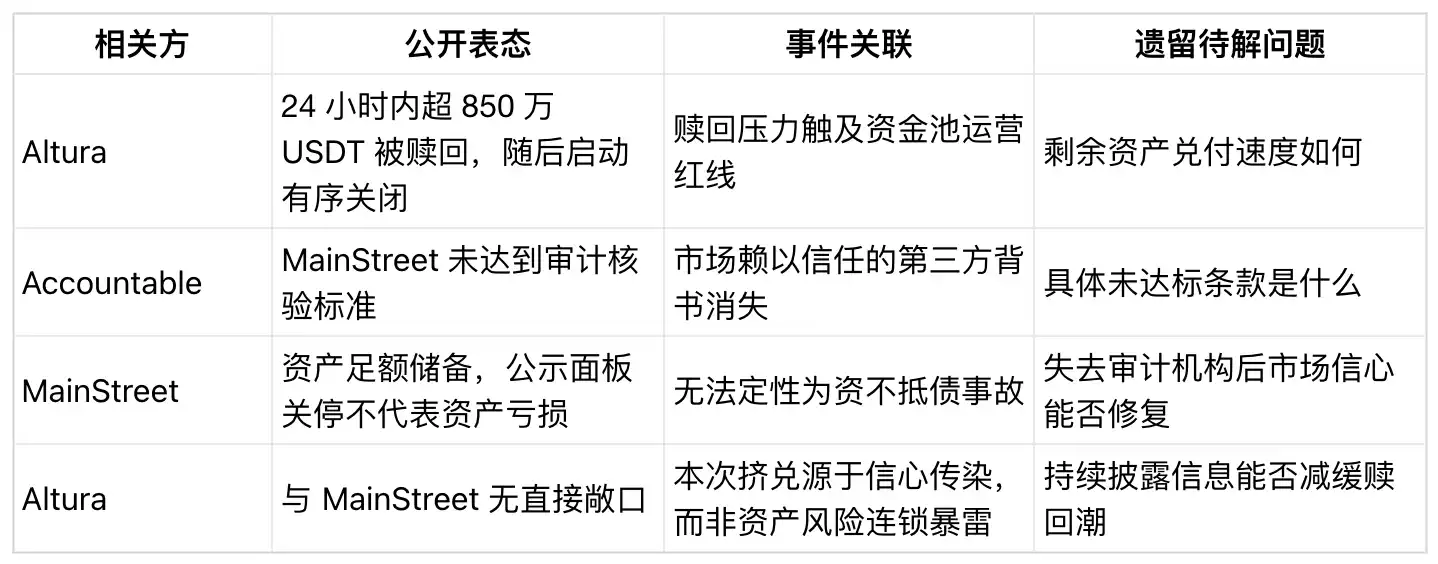
Altura CEO Ranveer Arora said the total user redemptions before the vault shutdown exceeded $8.5 million. Altura also stated it has no connection whatsoever to MainStreet or its underlying investment strategies. The core of this run is not asset risk contagion but a chain reaction triggered by collective loss of confidence in similar yield products.

The trigger was third-party audit firm Accountable terminating its cooperation with MainStreet, citing MainStreet's failure to meet audit verification standards. MainStreet publicly claimed its assets are fully reserved. However, the lack of third-party audit backing led to widespread skepticism among users holding similar yield products: If everyone redeems at once, can the fund pool fulfill redemptions quickly?

This is precisely the operational risk exposed by the Altura incident. From a user's perspective, the redemption action seems simple. However, the platform's assets are dispersed across different segments like exchange positions, private credit loans, and real-world asset (RWA) settlements, each with vastly different capital return cycles.

MainStreet later stated that shutting down the third-party reserve dashboard does not indicate asset losses or portfolio impairment.

Altura's own risk disclaimer is also crucial: the project explicitly stated it does not hold any MainStreet-related assets, and its HyperEVM lending pools, USDT/AVLT trading markets, and Ethereum lending positions were unaffected by this event.

But when users see an audit firm terminating cooperation with a stablecoin yield product, the focus shifts. It's no longer about whether a neighboring protocol has risk exposure, but whether all similar products can withstand a concentrated redemption wave.
Under a Concentrated Redemption Wave, Liquidity Becomes the Core Contradiction

Stablecoin users often focus only on the token itself; USDT in this event is also a core settlement medium in the crypto market. USDT's peg to $1 has remained stable, with a total market cap of approximately $186 billion and a 24-hour trading volume exceeding $51 billion.

This market scale has a dual impact: on one hand, the underlying liquidity for USDT is extremely ample, making it difficult for a single USDT-denominated fund pool to shake the overall stablecoin market; but on the other hand, the fund pool's own liquidity depends entirely on its capital allocation, asset placement channels, settlement rules, and whether counterparties can match users' expected redemption speed.

Altura's announcement also highlights this reality: funds held on exchanges can be liquidated more quickly compared to private credit or RWA investments; but exchange withdrawals are also subject to platform procedures, transfer channels, and market conditions. Private credit and RWA assets have fixed repayment cycles, where loan recovery, share redemption, and settlement windows cannot match DeFi users' demand for instant withdrawals.

The mismatch in capital return cycles across different assets means that even without actual asset losses, market sentiment can determine a product's survival. Users who redeem first can withdraw instantly, while those who redeem later must wait for asset maturity and liquidation. This expectation drives everyone to redeem early. The mere possibility of staged payouts is enough to accelerate a bank run.

The redemption scale in this event is significant. Altura's overall fund pool is valued at tens of millions of dollars, with the 8.5 million USDT single-day redemption representing a very high proportion. Large-scale concentrated withdrawals force an investment portfolio originally focused on yield generation to pivot towards liquidity-prioritized asset allocation.

Redemption Cycle: The Next Key Observation Metric

Looking at the entire stablecoin sector, this lesson cannot be ignored. The total stablecoin market cap is hundreds of billions, with daily trading volumes in the tens of billions. Various yield-generating stablecoin products promise principal stability plus yield, but most underlying investment strategies cannot be liquidated instantly.

Such products are operationally viable, but risks are concentrated at the operational level. Reserve proof disclosures, third-party audits, exchange holdings, private credit, RWA investments—the liquidity shortcomings of these links are only fully exposed when users abandon the pursuit of yield and simply want their cash back.

For Altura, the core observation point moving forward is the wind-down process: whether assets can be redeemed orderly, the frequency of platform disclosure updates, the scale of capital inflows at each stage, and whether it can prevent users from fire-selling long-term assets to exit hastily. Current information only suggests liquidity vulnerabilities; it cannot prove underlying asset losses at Altura.

For stablecoin yield products industry-wide, the test from this event is whether third-party audit backing can stabilize confidence during market volatility, rather than becoming a trigger for panic. Reserve dashboards and third-party verification are tools meant to reduce market uncertainty, but negative news about terminated audit cooperation spreads far faster than project clarifications.

This is the insight the Altura run offers the industry: in the DeFi fund pool sector, market confidence is by no means an irrelevant soft metric. It directly determines whether users are willing to deposit funds long-term, allowing sufficient liquidation cycles for the underlying investment strategies.


Related Questions

QWhat was the main cause of the massive withdrawal of over 8.5 million USDT from Altura?

AThe massive withdrawal was primarily caused by a collective loss of market confidence across the stablecoin yield sector, triggered when third-party auditor Accountable terminated its partnership with another yield platform, MainStreet, due to unmet audit verification standards. This raised widespread user concerns about the liquidity and ability of all similar yield products to handle concentrated redemptions, leading to a bank run on Altura, despite it having no direct asset exposure to MainStreet.

QWhat key risk did the Altura incident expose regarding stablecoin yield products?

AThe incident exposed the critical liquidity risk inherent in stablecoin yield products. These products invest assets across various strategies (exchange holdings, private credit, real-world assets) with mismatched settlement cycles. While profitable under normal conditions, they cannot instantly liquidate these assets to meet a sudden, concentrated demand for redemptions, turning market confidence into a decisive factor for survival.

QAccording to the article, what is the next crucial indicator to watch for Altura following the bank run?

AThe next crucial indicator is the wind-down process and redemption timeline. Key aspects to observe include whether assets can be redeemed in an orderly manner, the frequency of platform updates on progress, the scale of funds returned at each stage, and whether the process avoids forcing users to sell long-term assets at a discount to exit hastily.

QHow did the article describe the paradoxical role of third-party audits and reserve proofs in this event?

AThe article described them as having a paradoxical role. While intended to reduce market uncertainty and build trust, the negative news of an audit partnership termination (with MainStreet) spread much faster than any project's clarifying statements. This turned a tool for stability into a potential trigger for panic, demonstrating that in a crisis, market confidence can be fragile and heavily influenced by perception.

QWhat fundamental operational reality do stablecoin yield products face, as highlighted by the Altura case?

AThey face the fundamental reality that their underlying investment strategies, which generate yield, are largely incompatible with instant liquidation. The promise of 'stable principal + yield' relies on users not simultaneously demanding their cash back. The mismatch between long-duration, illiquid investments and the potential for immediate, mass redemptions creates an inherent operational vulnerability that is only tested during a loss of confidence.

Related Reads

From Gold to Bitcoin: Fixed Supply + Institutional Frenzy, Might It Repeat the 'Explosive' Price Trend?

"From Gold to Bitcoin: Fixed Supply and Institutional Frenzy May Lead to 'Explosive' Price Rally Analysts suggest Bitcoin's price action could mirror gold's over the past two decades, following the launch of spot Bitcoin ETFs. Gold ETFs, introduced in 2004, drove gold's price surge to a current market cap near $28 trillion. Both gold and Bitcoin are non-yielding stores of value, with prices driven purely by investor sentiment rather than cash flows or credit. Gold ETFs experienced dramatic cycles: explosive growth, painful drawdowns, and slow recoveries, with each cycle reaching higher peaks. Bitcoin ETFs, approved in early 2024, saw rapid institutional adoption but are now facing similar volatility. Recent warnings highlight the risk of significant ETF outflows disrupting the current rebound. BlackRock's IBIT, a leading Bitcoin ETF, has sold nearly 100,000 BTC to meet redemptions while still holding over 733,000. The core parallel is fixed supply: when demand surges, prices explode, but demand is often volatile and wave-like, not steady. Institutional interest, through ETFs and corporate adoption, remains a key support pillar, helping to cushion sell-offs. If Bitcoin captures even a fraction of gold's role as a store of value, its upside potential is immense, though the path will be marked by high volatility. For investors, focusing on long-term trends and managing risk is crucial as this 'price explosion' narrative unfolds."

Foresight News4m ago

From Gold to Bitcoin: Fixed Supply + Institutional Frenzy, Might It Repeat the 'Explosive' Price Trend?

Foresight News4m ago

Why Is AI Agent Shopping Hard to Popularize?

The article argues that the popular narrative of "AI agent shopping" – equipping AI with a wallet to autonomously handle purchases – is fundamentally flawed and oversimplifies the complexity of shopping. It deconstructs shopping into two core actions: **information retrieval** (standardized, easily automated) and **value judgment** (deeply subjective and human-centric). The narrative mistakenly assumes AI can fully handle both. Value judgment itself has two layers: **evaluation** (assessing options against criteria) and **demand definition** (setting the criteria, weights, and values). The latter is inherently human and dynamic, as preferences are not fixed but constructed during the decision-making process ("constructive preferences"). The real dividing line for automation is not product standardization, but whether the **act of choosing** itself holds experiential value. For mundane purchases (e.g., printer paper), full AI delegation works. For experiential goods (e.g., wine, furniture), the joy of selection is core to consumption, so AI should act as an assistant that narrows options, leaving the final choice to humans. The "AI wallet" concept confuses three separate elements: decision-making, execution, and fund custody. Current payment industry solutions (e.g., from Stripe, Mastercard, Google, Visa) show that limited, scoped payment authorization tokens are sufficient for most consumer scenarios, not full fund custody. The true use case for autonomous AI wallets is in **B2B procurement** and **machine-to-machine (M2M) settlements** for standardized, high-frequency, low-value transactions. The real bottlenecks for AI shopping are not payment technology, but **1) the lack of trusted data sources** (e.g., fake reviews, counterfeit goods) and **2) the impossibility of automating human demand definition**. The conclusion is that the focus should be on safely automating the assessment and filtering process while reserving for humans the rights to define their criteria and enjoy the final act of choice. For experiential goods, the platform's competitive advantage shifts to providing a superior selection experience.

Foresight News1h ago

Why Is AI Agent Shopping Hard to Popularize?

Foresight News1h ago

After Nine Months of Shorting, a Full Turn to Long: Renowned Trader Opens Bitcoin Positions Around 64K, Crypto Market Long-Short Divergence Intensifies

After nine months of being short, prominent crypto trader Doctor Profit has closed all his bearish positions and started buying Bitcoin near $64,000, signaling a complete bullish reversal. He argues that structural market changes—such as impending U.S. regulation (CLARITY Act) and institutional adoption via securities tokenization—are rewriting the traditional four-year cycle script, potentially bringing the market bottom forward from the widely expected September/October timeframe. This view finds some technical support from on-chain analyst gumsays, who notes a bullish divergence on Bitcoin's weekly chart has persisted for 147 days, nearing the 161-day duration seen before the 2022 cycle low. However, cycle researcher Jake Pahor presents a counter-argument based on historical data. Analyzing patterns since 2014, he identifies three common features of past bear market bottoms: a ~12-month duration from peak to trough, a sustained period of extreme fear (with a proprietary risk score below 20), and the price falling below Bitcoin's realized price (~$53,000 currently). The current cycle, only nine months from its October 2025 peak, meets none of these conditions. The debate highlights a market torn between "front-running" a potential early bottom driven by new fundamentals and waiting for confirmation through traditional on-chain and sentiment metrics. While Doctor Profit opts for aggressive buying, Pahor maintains a disciplined, tiered accumulation strategy, continuing weekly buys at current risk levels but reserving larger orders for if more extreme fear emerges.

marsbit1h ago

After Nine Months of Shorting, a Full Turn to Long: Renowned Trader Opens Bitcoin Positions Around 64K, Crypto Market Long-Short Divergence Intensifies

marsbit1h ago

Senior Trader's Confession: How to Trade Market's False Expectations?

Veteran trader's case study: trading the market's "wrong expectations". This trade centered on a textbook "expectation error" after a weak CPI report. While the market initially priced in broad monetary easing (sending Nasdaq to 30,060), the crucial 30-year real yield hit a 20-year high. This signaled a fractured transmission mechanism: short-term rates eased, but long-term funding costs (vital for tech valuations) refused to fall. The trader executed five short positions on the Nasdaq (NQ) as it fell from 30,060 to 28,768. The core methodology: don't just trade the data, but analyze the market's implied causal chain and identify where it breaks. In this case, the chain was: Weak CPI → Policy Easing → Lower Long-Term Funding Costs → NQ Valuation Expansion. The break occurred between policy easing and long-term rates. The "veto variable" – long-term real yields – refused to confirm the bullish narrative. Trades were structured around "fast variables" (price) temporarily repairing while "slow variables" (funding conditions) remained broken. The article outlines a repeatable framework: 1) Map the market's implied causal chain. 2) Identify the veto variable. 3) Observe if it rejects the narrative. 4) Enter when price still follows the old script. 5) Choose the cleanest asset expression (e.g., short NQ, not broad S&P). 6) Define both invalidation and fulfillment exit conditions. The key insight: Alpha often comes not from an information edge, but from a "reaction function edge" – recognizing when the market is applying an outdated causal logic to new data. The critical question: What causal chain is the market's first reaction relying on, and is that chain still valid today?

marsbit1h ago

Senior Trader's Confession: How to Trade Market's False Expectations?

marsbit1h ago

Trading

Spot
活动图片