摩根大通首次执行DeFi交易,都做了什么?

区块律动Published on 2022-11-03Last updated on 2022-11-03

Abstract

摩根大通为什么选择与Polygon和Aave合作?

10 月 19 日,新加坡金融管理局(MAS)宣布启动「守护者项目」(Project Guardian),该项目将与金融业展开合作,旨在测试资产 Token 化和 DeFi 应用的可行性,同时也对金融稳定性和完整性进行风险控制。

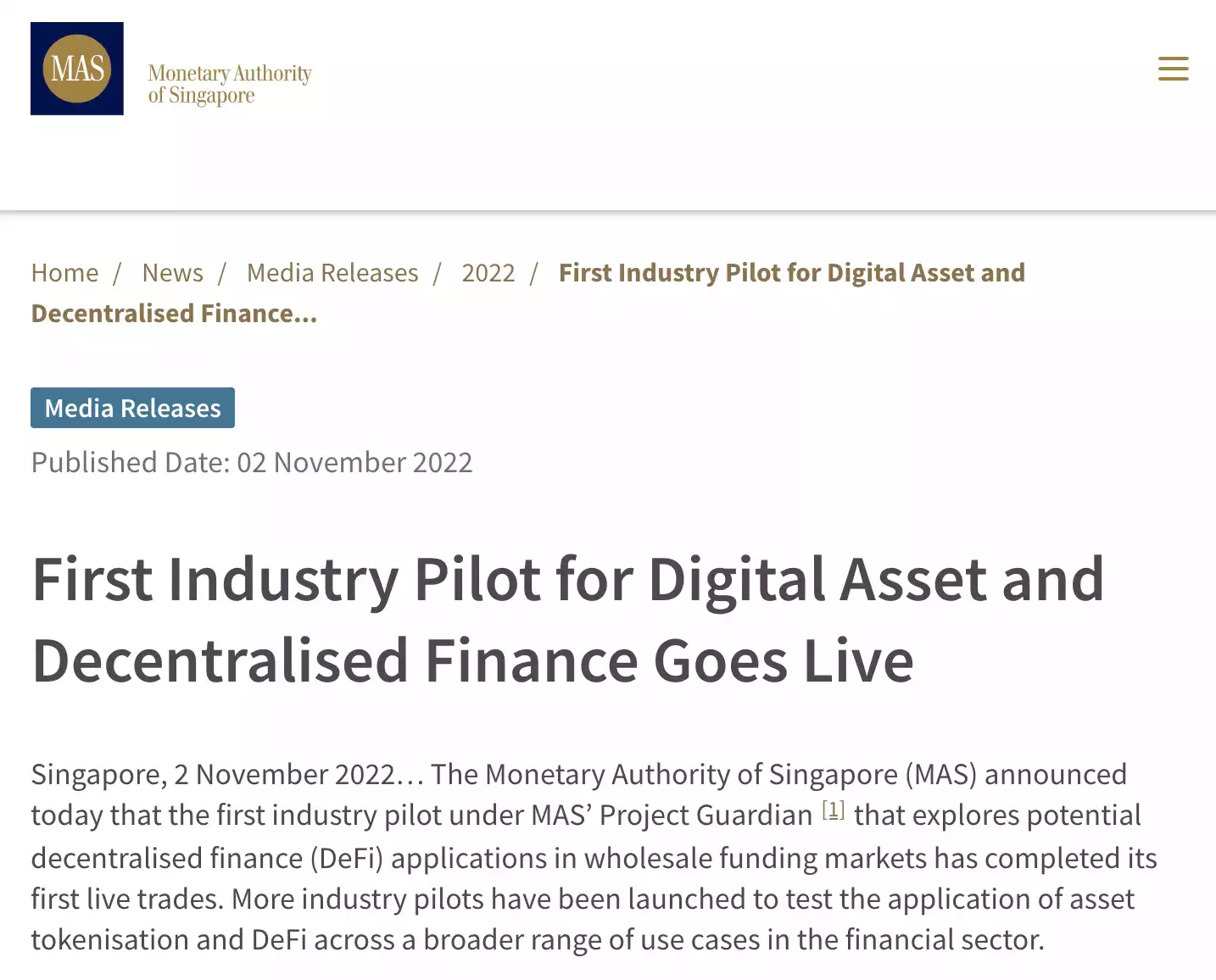
11 月 2 日,MAS 宣布,其 Project Guardian 的第一个探索批发融资市场中潜在 DeFi 应用的行业试点项目(First Industry Pilot)已完成首次实时交易。其中,星展银行(DBS Bank)、摩根大通(JP Morgan)和 SBI Digital Asset Holdings 针对由 Token 化新加坡政府债券、日本政府债券、日元(JPY)和新加坡元(SGD)组成的流动性池进行外汇和政府债券交易。该试点成功进行一笔涉及 Token 化日元和新加坡元存款的实时跨货币交易。

摩根大通 Blockchain Launch 和 Onyx 数字资产部门主管、企业以太坊联盟(Enterprise Ethereum Alliance)董事会成员 Ty Lobban 发布文章详细解释了摩根大通在 Project Guardian 扮演怎样的角色,BlockBeats 对其整理翻译如下:

摩根大通已使用 DeFi、Token 化存款和可验证凭证(Verifiable Credentials, VC)在公链上执行了第一次实时交易,这是 MAS 主导的 Project Guardian 中的一部分。

我们开创了不少世界先例,既然交易发生在公链上,本文将公开、透明地解释我们具体做了哪些事情。

第一步,我们使用 Polygon 网络进行交易。

我们起初想在以太坊上执行此交易,但由于我们希望用相对低廉的 Gas 费来进行一系列身份验证相关的昂贵操作,(我们选择了 Polygon)。当然,鉴于 MAS 的目标是开放的、可互操作的网络,Guardian 在未来也将探索其他区块链的可能。

第二步,我们使用 Aave 以采用其「许可池概念」。

我们部署了 Aave Arc 的修订版本,以便设置某些参数,例如利率和外汇汇率。请点击链接查看我们部署的借贷池。

注:Aave Arc 是一个需要权限的流动性池,专门为机构在 DeFi 领域保持监管合规而设计。这些流动性池将与 Aave 上的现有池分开,并且需要广泛 KYC。

第三步,我们发行了 Token 化的新元存款。

这种存款 Token将被纳入是摩根大通的综合债务。这是一种原生 Token,提供稳定的链上价值,没有 Stablecoin 面临的可扩展性问题。这是首个由银行发行的 Token 化存款。请点击链接查看摩根大通发行的 SGD Token 化存款合约。

第四步,我们使用万维网联盟 W3C 可验证证书 VC 为 Aave(或任何其他 DeFi 协议)提供合规访问权限。

相比白名单地址,VC 能提供更加精细的控制,包括风险限制、资产限制等。而且,我们实现了链上 VC 身份验证。

链上 VC 验证非常繁复,它为身份带来了可组合性。我们希望用为数不多的、专业的验证者,并在 dApp 中使用它们,从而为身份带来进一步的标准化和可移植性,就好像「身份乐高积木」!

我们设计的原则是确保 VC 合规检查可以与任何 DeFi 协议一起使用,而这些协议不需要了解 VC 的任何信息,从而使 DeFi 前端无需进行 KYC。合规性被推到边缘,而不是 dApp。

请点击链接查看验证器。我们在 Project Guardian 中为每个公司创建了一个验证器。所以每个公司都有自己的规则,但是任何人都可以查阅和验证这些规则。链上 VC 验证严格意义上并不是由我们开创的,我的构建并不完美,仍在探索 ZKP 技术。

补充说明:作为一家受到严格监管的银行,摩根大通禁止洗钱行为,因此 KYC 是必要的。考虑到以上问题,我们希望通过使用 VC 和白名单提高我们使用 DeFi 资金池的安全性。机构 DeFi 是值得期待的。

第五步,我们构建了一个机构钱包。

1. 交易者永远无法访问公司资金;

2. 仅有经批准的 DeFi 协议可以被机构访问;

3. VC 与交易指令捆绑,即 VC 上链则可以进行交易,否则交易失败;

总之,这是受监管的大型金融机构通过公链上基于 VC 的 DeFi 第一次进行 Token 化存款的实时交易。

Related Reads

Research Report Analysis: Morgan Stanley Details SanDisk SNDK, The Truth About Cloud Data Center Pricing Power and AI Inference Benefits

Morgan Stanley raised its price target for SanDisk (SNDK) from $1100 to $1750 on June 22, maintaining an Overweight rating. The upgrade is driven by AI inference demand reshaping the NAND market, particularly for KV Cache and context window storage in cloud data centers. These cloud clients exhibit price inelasticity and sign long-term contracts, granting SanDisk significant pricing power. SanDisk's New Business Model (NBM) agreements, covering over one-third of FY27 bit shipments with 3-5 year terms and fixed price/price collar structures, are crucial. They are projected to sustain gross margins around 80% even at floor prices, providing a buffer against cyclical downturns. Morgan Stanley forecasts gross margins to surge from 30.3% in FY25 to 86.7% in FY27e. With NAND supply expected to remain tight into 2026/2027 and cloud/data centers becoming the largest end-market, SanDisk holds supply-side pricing power. The company targets 15-19% bit growth via technology transitions, not capacity expansion. Revenue is projected to grow ~6.6x from FY25 to FY27, with EPS rising from $2.74 to $14.73, driven by high-margin cloud business. Key upside catalysts include faster enterprise SSD adoption and edge AI growth. Downside risks involve slower industry growth, competitor capex increases, market share loss, and competition from Chinese players like YMTC. The investment thesis rests on AI-driven structural demand, NBM's margin protection, and sustained supply tightness. The $1750 target implies ~28x FY27e P/E.

marsbit5m ago

Research Report Analysis: Morgan Stanley Details SanDisk SNDK, The Truth About Cloud Data Center Pricing Power and AI Inference Benefits

marsbit5m ago

A Threefold Performance Leap! NEAR Achieves 200ms Physical Block Time Limit with SPICE

NEAR's core development team, Near One, has announced its next major protocol evolution: SPICE (Separation of Consensus and Execution). Currently in development, SPICE represents the most significant upgrade before the full implementation of Nightshade 3.0. Its core innovation is decoupling the consensus layer, responsible for ordering transactions, from the execution layer, which processes them. This allows the consensus layer to run at full speed without waiting for transaction execution to complete. Once deployed, SPICE is projected to triple NEAR's block production speed, achieving a 200ms block time, which is considered the physical limit due to the speed of light and network latency. This leap will dramatically reduce transaction latency and finality, with transactions confirming in roughly 0.4 seconds—faster than a typical card payment. The upgrade also enables more complex, long-running transactions and significantly improves user experience for applications like NEAR Intents and near.com. Beyond raw speed, SPICE enhances network scalability and security. It enables deeper parallelism, efficiently distributing workload across shards and improving resource utilization. The simpler block structure and lighter contracts also facilitate formal verification and security auditing. Furthermore, SPICE lays the critical groundwork for future Nightshade 3.0 features, most notably atomic cross-shard transactions, which would simplify complex contract logic and eliminate development hurdles caused by asynchronous execution. The Near One team is actively developing SPICE, targeting deployment in the coming months.

Foresight News1h ago

A Threefold Performance Leap! NEAR Achieves 200ms Physical Block Time Limit with SPICE

Foresight News1h ago

Trading

Spot
Futures
活动图片