[Key interpretation] Long term investors of BTC finally began to sell, and the long position explosion suggested that the market fell sharply

HuobiPublished on 2022-10-21Last updated on 2022-10-24

Abstract

Bulls continued to break positions accounted for the majority, indicating that the market is changing downward.

1. BTC retraction rollback continuation

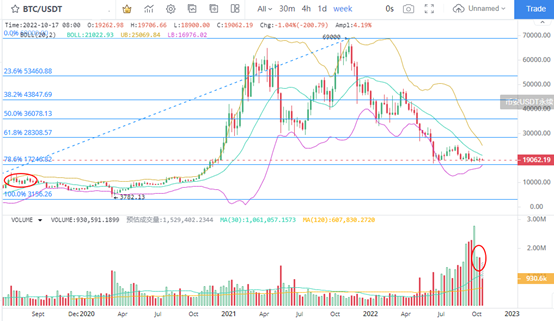
The weekly K line chart of BTC shows that the trading volume has shrunk for two consecutive weeks, indicating that the market is in the adjustment stage, and BTC prices may be at a new low this week. In terms of trading volume, the trading volume corresponding to the weekly K line is low, and it is likely that the trading volume will shrink this week. Therefore, it is judged that BTC is still in a weak operation stage, and once it breaks down, it will see a low of $14000 in the previous period.
2. BTC main force makes a profit and escapes

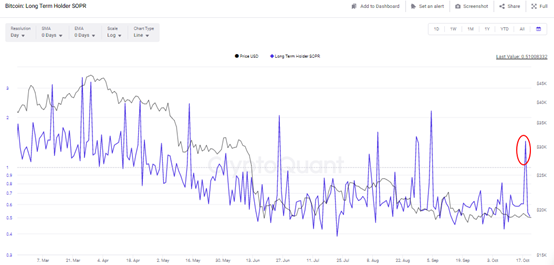
The main force of BTC made a lot of profit flight. From the numerical point of view, the profit flight of long-term investors occurred on October 18. As shown in the figure, the proportion of SOPR on October 18 reached 1.436, which means that long-term investors with 43% currency gains have changed hands with BTC in large numbers, indicating that BTC prices have shown signs of downward selection in the near future. In terms of trading, although the short-term fluctuation intensity of BTC remains at a low level, it is still brewing the trend of closing price retreat.
3. ETH represents an upward breakthrough

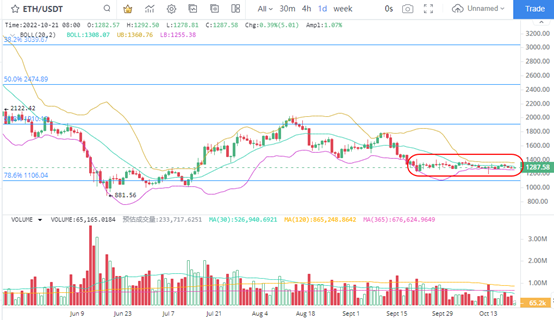
In terms of the daily K line, the ETH price kept fluctuating at a low level, and the breakthrough still did not occur, but the horizontal consolidation continued. In terms of trading volume, the current trading volume of ETH is obviously lower than the isometric line of different cycles after it started to scale down on October 1. At least for the moment, ETH investors have failed to expand trading volume, the time of low volatility adjustment has exceeded expectations, and the price may still fall during the sideways consolidation period.
4. Increase in the number of long positions in the overall market

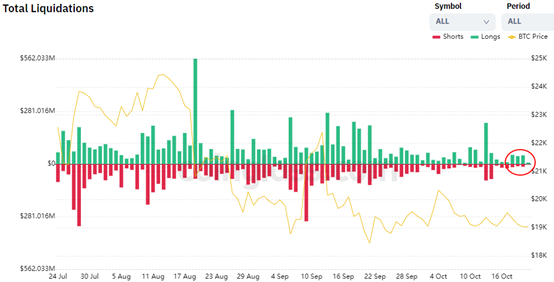
The number of positions of ETH investors increased slightly, and the number of positions of bulls recently was significantly higher than that of bears. From October 18 to October 20, the short positions of ETH were $16.95 million, $11.94 million and $14.51 million, while the long positions were $48.71 million, $41.97 million and $46.08 million, respectively. Compared with the size of short positions, the accumulated long positions can reach 93.36 million dollars. That is to say, after the number of long positions is significantly higher than that of short positions, the overall market is now on the eve of a break down.

Related Reads

The Real Battlefield of AI Lies in the 'Dark Forest'

The article "AI's Real Battlefield is in the 'Dark Forest'" discusses the shifting dynamics in the global AI landscape, contrasting the strategic directions of Chinese and U.S. AI developers. Chinese companies like Alibaba (with its "HappyHorse" video model), ByteDance (Seedance 2.0), and Kuaishou (Kling 3.0) have taken the lead in text-to-video generation, surpassing OpenAI’s now-discontinued Sora. These models are deeply integrated into their parent companies’ content ecosystems (e.g., Douyin, Kuaishou), serving to reduce content creation costs and enhance user engagement rather than operating as standalone profit centers. In contrast, U.S. firms are pivoting toward high-stakes enterprise and security applications. Anthropic’s Claude Mythos model demonstrates advanced capabilities in autonomously discovering and exploiting software vulnerabilities, prompting concern at the highest levels of U.S. financial and governmental institutions. OpenAI responded with its own GPT-5.4-Cyber, signaling a strategic shift from consumer-facing products to enterprise-grade tools focused on cybersecurity and programming. The divergence is attributed to fundamental differences in resources and market structures. U.S. companies, backed by vast computational resources (e.g., Amazon and Google supply Anthropic with substantial funding and TPU access), can pursue deep, specialized R&D in high-value B2B sectors. Chinese firms, facing significant compute power constraints and a less mature enterprise SaaS market, have found success by leveraging their massive consumer platforms and optimizing for cost-efficiency. The article warns that the AI race is entering a "dark forest" phase—a reference to competitive dynamics where cybersecurity capabilities could determine digital sovereignty. While Chinese models like Zhipu AI’s GLM-5.1 show promise in narrowing the gap in coding proficiency, the author stresses that achieving parity in security-critical AI will require asymmetric strategies, including greater investment in coding models, adaptation to domestic hardware, and exploring international markets in the Global South.

marsbit1h ago

The Real Battlefield of AI Lies in the 'Dark Forest'

marsbit1h ago

Trading

Spot
Futures
活动图片