
Value Held by Blockchain Oracles Slides 61% in 7 Months, Chainlink Dominates by 45%

newsbtcPublished on 2022-10-11Last updated on 2022-10-11

Abstract

While the crypto economy has shed significant value, losing more than $2 trillion since the highs recorded at the end of 2021

Value Held by Blockchain Oracles Slides 61% in 7 Months, Chainlink Dominates by 45%

While the crypto economy has shed significant value, losing more than $2 trillion since the highs recorded at the end of 2021, a great deal of value was erased from smart contract platform tokens and decentralized finance (defi) protocols. One sector of the defi ecosystem that’s recorded heavy losses this year is the blockchain oracles space, as a great number of oracles secure a lot less value than they did seven months ago. While there are more than two dozen oracles today and there were only 17 at the beginning of the year, the total value secured by oracles has decreased by 61.74% since mid-February.

Today There’s a Lot More Blockchain Oracles but Less Value Secured by All of Them Since Mid-February

Blockchain oracles have seen significant growth since the inception of these protocols but in 2022, the protocols secure a lot less value than they did seven months ago. A blockchain oracle is essentially middleware that connects a blockchain network to external systems via smart contracts, and the medium provides data sources that are verifiable and shared in a decentralized fashion.
Value Held by Blockchain Oracles Slides 61% in 7 Months, Chainlink Dominates by 45%

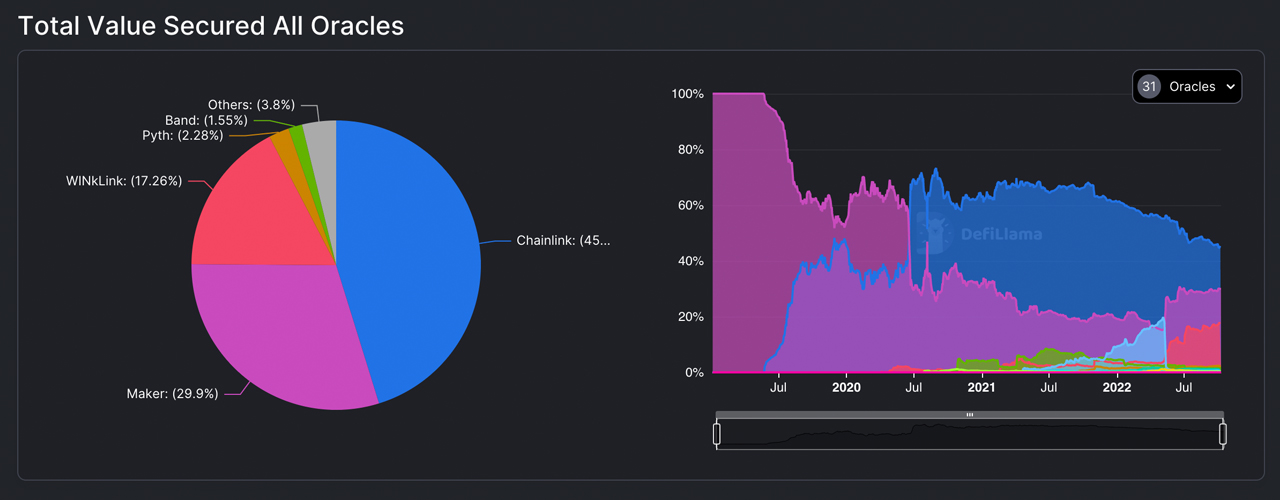
Value secured by blockchain oracles in October 2022.

Data from defillama.com shows that Chainlink is the largest blockchain oracle in terms of total value secured by all oracles, and the Chainlink oracle secures 206 protocols. Chainlink commands roughly 45% of the $25.612 billion secured by 31 oracles today and the oracle is followed by projects such as Makerdao, Winklink, Pyth, and Band.
Value Held by Blockchain Oracles Slides 61% in 7 Months, Chainlink Dominates by 45%

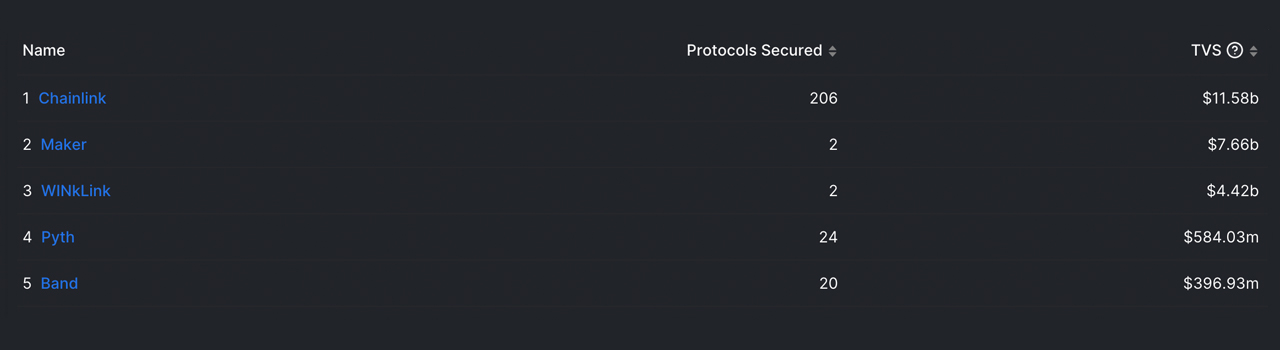
Value secured by blockchain oracles in October 2022. Top-five oracles on October 10, 2022.

Maker commands $7.66 billion, while Winklink secures $4.42 billion and Pyth secures around $584.03 million. The fifth-largest oracle according to defillama.com metrics is Band, with around 1.55% of the total $25.61 billion secured, or around $396 million. While $25 billion is quite a bit of funds secured by decentralized blockchain oracles, it’s 61.74% less than the funds oracles secured on February 12, 2022.
Value Held by Blockchain Oracles Slides 61% in 7 Months, Chainlink Dominates by 45%

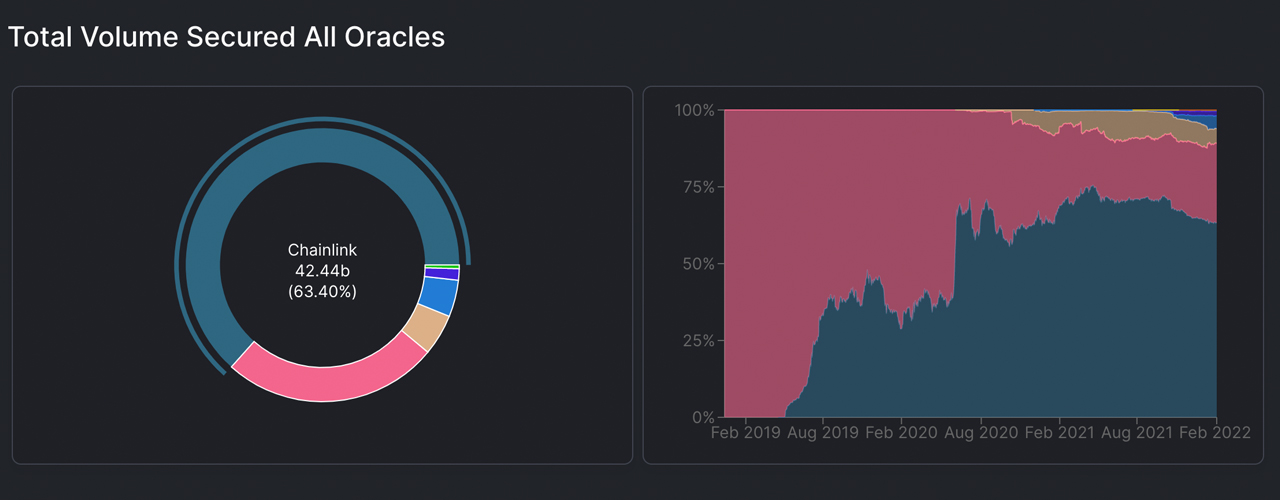
Value secured by blockchain oracles in February 2022.

At that time over seven months ago, Chainlink’s total value was larger than the total value secured by 31 oracles today. On February 12, Chainlink secured $42.44 billion and Makerdao secured $17.14 billion on that day. 17 oracles were monitored by defillama.com at the time and collectively they secured $66.946 billion in value.
Value Held by Blockchain Oracles Slides 61% in 7 Months, Chainlink Dominates by 45%

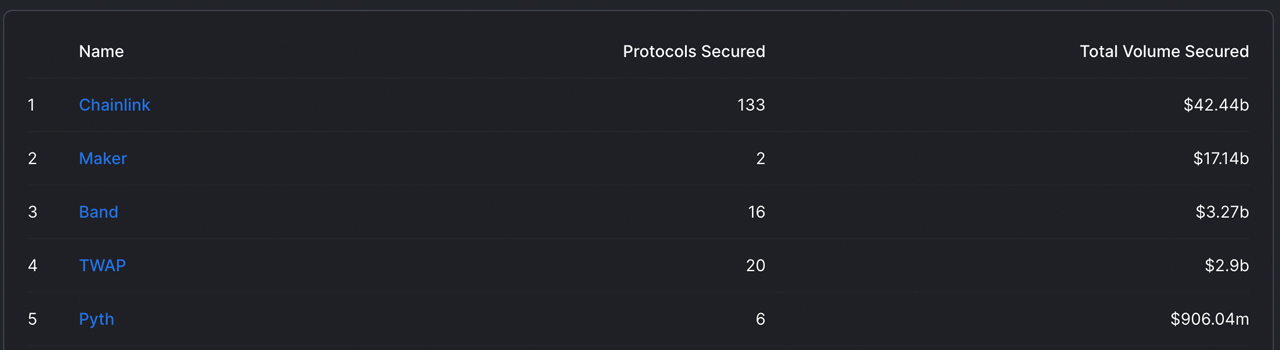
Value secured by blockchain oracles in February 2022. Top-five oracles on February 12, 2022.

Seven months ago the top five oracles were Chainlink, Makerdao, Band, TWAP, and Pyth. Moreover, while Chainlink secures 206 protocols today, back then it only secured 133 protocols. Four of today’s top five oracles have native tokens as well, and the token values are down a great deal since their all-time highs (ATH).

Chainlink (LINK) is down 85% since the ATH recorded on May 10, 2021, and makerdao (MAKER) is down 84% from its ATH on May 3, 2021. Winklink (WIN) has shed 96% since April 5, 2021, and band protocol (BAND) is down 94.7% since the coin’s ATH recorded over a year ago on April 15, 2021. Despite the loss in value, native tokens are more valuable than they were at inception.

LINK, for instance, is up 5,053.1% higher during the last five years against the U.S. dollar since November 29, 2017. BAND is up 496% since its inception, WIN is up 168.4% during the last two years, and MAKER has gained 449.1% in two years as well.

Moreover, the total value secured by oracles is a whole lot larger than it was three years ago. Blockchain oracle proponents believe the technology will be able to disrupt a number of industries as they grow, as legacy oracles today provide data that is questionable at best.

Related Reads

Uncovering the Truth About Agent Commerce, Payments, and Infrastructure

Decoding Agent Commerce, Payments, and Infrastructure: The Reality Over the past year, I've been building infrastructure for the Agent economy, engaging with major players like Stripe, Visa, Coinbase, Google, and dozens of startups. A clear conclusion emerges: true, large-scale demand does not yet exist. Startups face structural challenges. Data points illustrate this gap. Stripe's Agent commerce platform has over 1,000 merchants but only single-digit transacting agents. Visa's Agent payment token requires 9-month KYC and a $250M revenue threshold, accessible only to giants like Amazon. On-chain analysis reveals actual daily Agent transaction volume is around $17k, half of which are test transactions. The article analyzes four potential markets: **1. Agent-to-Merchant (A2M):** Current AI shopping UX is often inferior to traditional e-commerce for visual, comparison-heavy purchases (clothing, electronics). Chat interfaces are a step back. Real merchant interest is defensive "Agent Engine Optimization," fearing future obsolescence, not current demand. Potential exists in high-frequency, low-decision purchases (e.g., food delivery) or simplifying terrible UX (complex checkouts, non-native shoppers), but these require massive consumer distribution channels dominated by giants like DoorDash and Amazon. **2. Agent-to-API (A2A):** Developers already have subscriptions and billing for core APIs (compute, data). The argument for micro-payments via crypto for sub-dollar API calls is addressed by pre-paid balances today. The deeper issue is supplier resistance; major SaaS firms rely on enterprise contracts, not fractional cent pricing. Opportunity lies in the long tail of niche services, but this is a smaller market catering to developers, a historically low-paying group. **3. Agent-to-Agent (A2A):** This remains a theoretical long-term vision with near-zero current transaction volume. It involves unique challenges: discovery, trust, negotiation, dispute resolution. When it materializes, it will require a fundamentally new settlement infrastructure for high-speed, variable-value, multi-party transactions. It's a real long-term bet, but not the current market. **4. Agent-to-Finance (A2F):** This is the only category with existing, paying demand. Integrating AI into financial workflows (trading, portfolio management) is a natural evolution and enables new capabilities like autonomous rebalancing. However, competition favors incumbents with regulatory licenses, compliance infrastructure, and existing client relationships. **The Real Issue:** Why is infrastructure still being built? Incumbents can afford long-term bets, and payment companies see every problem as a nail for their payment hammer. However, payment is just one piece. The core challenge is *coordination*—orchestrating work between Agents and humans, verifying outcomes, and settling results. Payment is part of settlement, which is part of coordination. Companies that solve the coordination problem will subsume payments, not the other way around. Startups lack the infinite runway of giants and must find today's real market, which, after a year of exploration, lies outside these four categories—in an area with real, growing, and underserved activity.

marsbit5h ago

Uncovering the Truth About Agent Commerce, Payments, and Infrastructure

marsbit5h ago

Trading

Spot
Futures

Hot Articles

How to Buy BAND

Welcome to HTX.com! We've made purchasing Band Protocol (BAND) simple and convenient. Follow our step-by-step guide to embark on your crypto journey.Step 1: Create Your HTX AccountUse your email or phone number to sign up for a free account on HTX. Experience a hassle-free registration journey and unlock all features.Get My AccountStep 2: Go to Buy Crypto and Choose Your Payment MethodCredit/Debit Card: Use your Visa or Mastercard to buy Band Protocol (BAND) instantly.Balance: Use funds from your HTX account balance to trade seamlessly.Third Parties: We've added popular payment methods such as Google Pay and Apple Pay to enhance convenience.P2P: Trade directly with other users on HTX.Over-the-Counter (OTC): We offer tailor-made services and competitive exchange rates for traders.Step 3: Store Your Band Protocol (BAND)After purchasing your Band Protocol (BAND), store it in your HTX account. Alternatively, you can send it elsewhere via blockchain transfer or use it to trade other cryptocurrencies.Step 4: Trade Band Protocol (BAND)Easily trade Band Protocol (BAND) on HTX's spot market. Simply access your account, select your trading pair, execute your trades, and monitor in real-time. We offer a user-friendly experience for both beginners and seasoned traders.

2.1k Total ViewsPublished 2024.03.29Updated 2026.06.02

How to Buy BAND

Discussions

Welcome to the HTX Community. Here, you can stay informed about the latest platform developments and gain access to professional market insights. Users' opinions on the price of BAND (BAND) are presented below.

活动图片