XRP Losing 6% of Its Value, Reversal Could Be Ahead

u.todayPublished on 2022-09-27Last updated on 2022-09-28

Abstract

The most recent success of XRP in the court did not last as long as some investors would have hoped.

Contents

  • Has top been reached?
  • LUNC's unexpected 40% recovery
  • Bitcoin is still in trouble

The most recent success of XRP in the court did not last as long as some investors would have hoped, and the cryptocurrency is rapidly losing around 6% of its value in the last few hours, showing that bulls are losing control over the asset on the market.
Has top been reached?
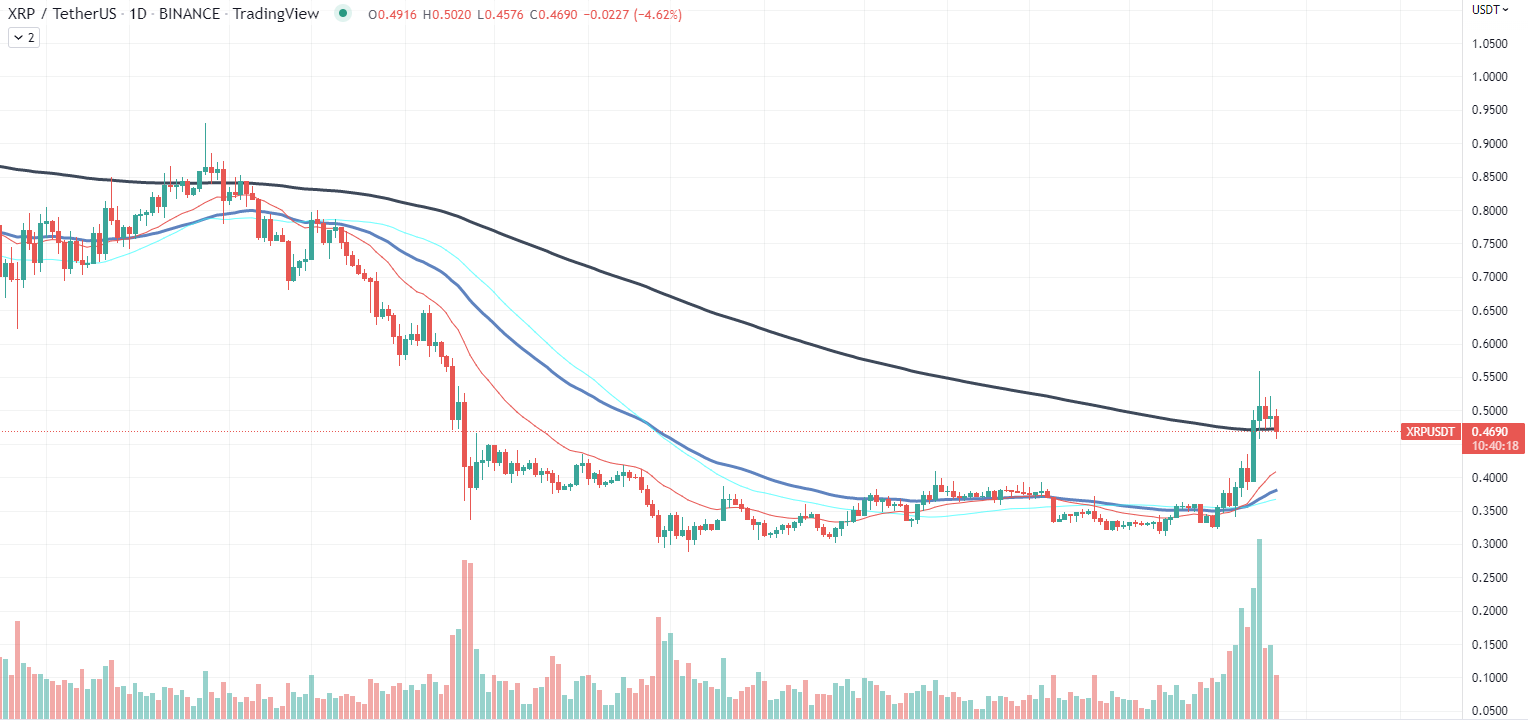
In our previous market review, we highlighted the importance of the 200-day moving average, which acts as a barrier for assets moving in the downtrend. XRP bulls had no other choice but to push the price of the asset further up in order to avoid an even lower plunge.
Unfortunately, the lack of trading volume and gradual decrease in inflows led to the 18% reversal from the local high of $0.56. If bulls are unable to hold the asset's value above the aforementioned moving average, we will most likely see the return to the downtrend that the asset has been in for a year.
XRP Data

Source: TradingView On shorter-term timeframes, the asset looks more positive as it broke through important local resistance levels. However, with the price performance of the asset showing a worsening tendency, XRP will fall below support levels on shorter timeframes.
LUNC's unexpected 40% recovery
The Luna Classic price performance was a true rollercoaster with its burning mechanism implementation and the initial denial received by Binance and other large centralized cryptocurrency exchanges and unexpected agreement to implement the transaction fee.
Thanks to the positive decision, LUNC saw a massive 40% price increase as the asset will most likely become deflationary if the transaction fee works as intended. Previously, LUNC developers proposed the implementation of a 1.2% fee from each transaction on the network.
Coins taken from each operation will go on the burn address right away, creating pressure on the circulating supply of the token and easing up the pressure on the market.
However, most analysts do not believe in LUNC's long-term growth as the token does not have much usage apart from speculation, which is why deflation cannot become a solution to the poor performance of LUNC in the future.
Bitcoin is still in trouble
Despite the recovery we saw on the market recently, Bitcoin still remains in a poor state as the first cryptocurrency is facing enormous selling pressure caused by the massive U.S. Dollar rally.
The currency reached a 20-year high in a disruptive manner, gaining almost 4% in less than a month despite the forecast of most analysts that bet on the short-term correction against a bracket of foreign currencies.
As for now, the $19,000 support level is still holding, but bulls are not rushing to invest new capital to push the price of the first cryptocurrency higher. The prolonged consolidation from here is the most likely scenario, considering the conditions of the market we are seeing today.

Related Reads

OpenAI's "Most Open" Move: Codex No Longer Exclusively Favors GPT

OpenAI has significantly opened up its Codex programming agent by introducing a "model provider" configuration layer that allows users to connect it with various open-source models, not just its proprietary GPT. Through a configuration file or a simple `--oss` command-line flag, Codex can now route requests to local services like Ollama or LM Studio, or to third-party APIs such as Mistral or DeepSeek. This move is seen as one of OpenAI's most "open" steps, potentially lowering costs and enhancing privacy for developers who can run code generation offline. However, integration isn't seamless for all models. Codex primarily uses OpenAI's newer Responses API, while many open-source models rely on the older Chat Completions interface. This creates compatibility issues, especially for advanced features like function calling. The developer community is already building "routing" or adapter layers (e.g., CC Switch, LiteLLM) to translate between these protocols, enabling hybrid setups where GPT handles planning and open-source models handle execution. Analysts interpret this as a strategic shift for OpenAI: from competing solely on model superiority to controlling the platform and interface standards. By making Codex a flexible, pluggable entry point for AI-assisted programming, OpenAI aims to become the central hub in the developer toolchain ecosystem, even as users gain the freedom to switch underlying models.

marsbit40m ago

OpenAI's "Most Open" Move: Codex No Longer Exclusively Favors GPT

marsbit40m ago

When 500 Million People Abandon ChatGPT

ChatGPT's Global AI Assistant Market Share Drops Below 50% Three and a half years after its groundbreaking launch, ChatGPT faces a pivotal moment. While it remains the largest AI assistant globally, its market share has fallen below 50% for the first time, reaching 46.4% as of May, according to Sensor Tower's 2026 AI landscape report. Google's Gemini (27.7%) and Anthropic's Claude (10.3%) are now its main competitors, with Grok, Perplexity, and others also gaining ground. The market has evolved from awe and initial adoption into a phase of product comparison, ecosystem integration, and commercialization. User behavior has matured significantly. Loyalty is low; users readily switch between assistants for specific tasks. Gemini benefits from deep integration within Google's ecosystem (Search, Gmail, Android), while Claude has carved a niche among productivity-focused users with strong retention, nearly matching ChatGPT's. User choice is now influenced by a complex mix of capability, ecosystem, price, use case, and even brand trust. Commercialization is accelerating. AI app downloads continue but growth is slowing, while user spending is rising. Over $4.2 billion was spent in-app during H1 2026. Claude leads in premium subscription conversion rates (13%). OpenAI is expanding its revenue streams, testing ads shown to 17% of ChatGPT users daily by May. This shift highlights the immense financial pressure of model training and inference costs. Despite revenue growth, OpenAI's cash burn is intense, reaching $3.7 billion in Q1 2026. The company projects this could rise to $25-57 billion in the coming years, underscoring the industry-wide challenge of scaling profitably. The symbolism is clear: ChatGPT no longer defines the AI assistant market alone. The era of a single dominant product is over. Gemini, Claude, and specialized tools are collectively shaping user habits and business models. As AI assistants move from novelty to utility—judged on accuracy, efficiency, and value—they are becoming embedded in everyday digital life. ChatGPT may have lost its majority, but AI as a whole is winning, entering a mature, competitive, and diverse new phase.

marsbit42m ago

When 500 Million People Abandon ChatGPT

marsbit42m ago

Trading

Spot
Futures
活动图片