$6 Trillion in Assets On-Chain: Why Canton Network is Wall Street's New Darling

比推Published on 2026-01-09Last updated on 2026-01-09

Abstract

Canton Network is gaining significant traction as a blockchain platform focused on real-world assets, with reported support for over $6 trillion in on-chain assets and a daily transaction volume of $280 billion. Backed by major traditional finance institutions like DTCC and J.P. Morgan, it functions as an interoperability layer connecting independent networks ("cantons"), similar to Cosmos. The network relies on 13 permissioned "Super Validators" for consensus, many of which are operated by early investors. Canton uses a native utility token, Canton Coin (CC), which is burned as gas fees, creating deflationary pressure. Similar to Bitcoin, it employs a programmed halving schedule—the second halving is imminent, potentially reducing supply and impacting short-term token prices. While its privacy-focused, customizable design appeals to institutional players, concerns remain about centralized control and insider advantages, as Super Validators heavily influence token distribution and featured applications. The upcoming halving presents a speculative opportunity, but long-term value depends on sustainable network utility rather than supply shocks alone.

Source: Bankless

Author: Jack Inabinet

Original Title: How Canton Network Works


Canton Network is quickly becoming the latest focus in the cryptocurrency industry. Does this signal a brewing explosive opportunity in a new wave of L1 ecosystems?

This blockchain, focused on real-world assets, recently made headlines for its high-profile integration with traditional finance giants (including the Depository Trust & Clearing Corporation DTCC and JPMorgan Chase), claiming to support over $6 trillion in on-chain real-world assets and a daily trading volume of $280 billion.

Today, we will delve into the technical architecture and token economic model of the Canton Network to better understand the design logic of this groundbreaking network.

Super Validator-Led Technical Architecture

Canton is essentially an interoperability layer connecting independent networks (these networks are also called "cantons"), with a design philosophy similar to the model in the Cosmos ecosystem that allows independent chains to communicate directly.
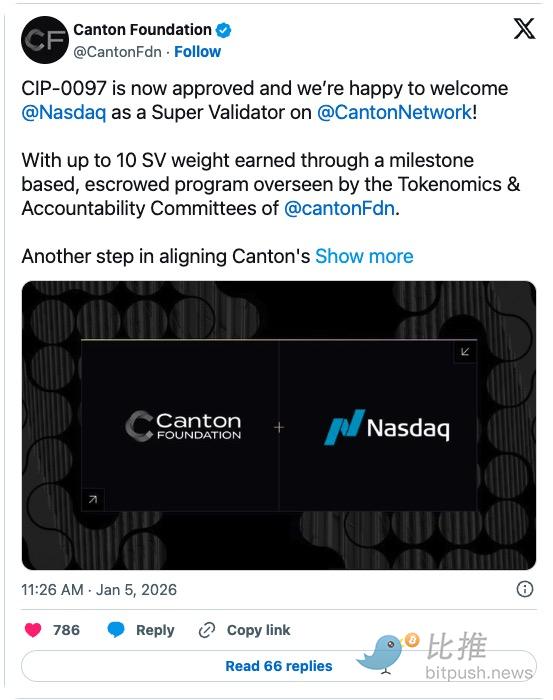
Regarding its consensus mechanism, the Canton Network is validated by an invite-only set of 13 "Super Validator" nodes, many of which are operated by the network's investors. One node is operated by the Canton Foundation, which is composed of early enterprise supporters, brand partners, and investors.

Most activity on the network occurs at the independent "canton" level, similar to how the Osmosis exchange in the Cosmos interoperability ecosystem aggregates the main liquidity and user activity. The validators of these independent cantons are responsible for processing all data on their independent "shard" and enjoy high flexibility in customizing the rules of that independent execution environment, including preferences for gas fees and data sharing.

Due to the inherently opaque design architecture adopted by Canton, the authenticity and sources of its published metrics (such as asset size and transaction volume) are difficult to verify independently.

However, representative independent application cases have emerged in the ecosystem: for example, the recently launched Temple Digital Group exchange, supported by YZi Labs, is operating as an independent Canton sub-network.

Token Economics

The Canton Network is built around its native utility token, Canton Coin (ticker CC), which is designed to "reward actual network usage rather than speculative behavior."

Similar to Ethereum, Canton burns tokens when users pay gas fees, creating deflationary pressure on CC. When the network is used for transactions, settlements, data synchronization, or asset transfers, all fees paid in CC are burned, permanently removed from circulation.

Similar to Bitcoin, Canton employs a programmatic token issuance curve, with regular halving events. New CC tokens can be continuously minted by various network participants by adding "measurable utility" to the network.
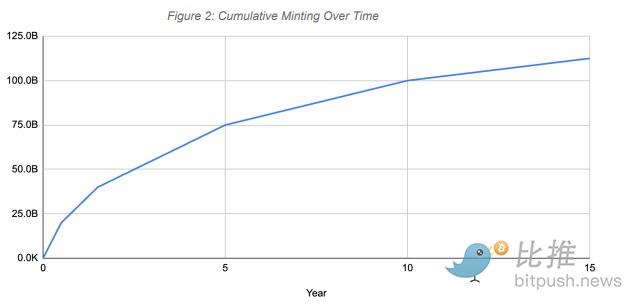
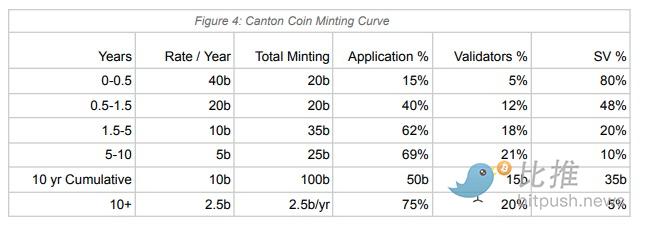
Currently, permitted Canton Super Validators (primarily early investors) are eligible for 48% of the CC issuance as a reward for maintaining global consensus. Validators receive 12% of the total CC supply, allocated mainly based on the value of Canton Coin transfers initiated by their users, and potentially rewarded based on node uptime if the minting cap allows.

Similar to Berachain, Canton also allocates tokens directly to applications in the form of gas fee rebates. "Featured" applications (which can be designated by Super Validators) can mint CC up to 100 times the burned fees, while non-featured applications can mint up to 80% of the burned fees.

It is worth noting that, at the time of writing, CC token minting is still proceeding according to the plan for years 0.5 to 1.5 in the chart below. However, with the second Canton halving scheduled to occur in just three days, the CC minting rate will soon be halved, and its distribution will be adjusted according to the plan for years 1.5 to 5 in the chart below.

For investors seeking trading opportunities, the supply reduction from the CC halving event may, through supply and demand dynamics, push the token price higher in the short term, regardless of the network's fundamental investment thesis.
Conclusion: A Glossy Narrative with Underlying Concerns

Canton undoubtedly presents a compelling investment story, but its potential opportunities are matched by outstanding questions.

Its highly configurable, privacy-focused design holds clear appeal for traditional finance giants, but the network's complex token economic structure and centralized control system introduce significant insider advantages, increasing the risk of imbalanced token distribution.

The permitted Super Validators, through their ability to designate "Featured" applications, continue to wield excessive influence over Canton's issuance. This means the flow of CC tokens will remain heavily controlled by insiders, even though this group's own issuance is set to decrease by approximately 80% within days.

The sudden rise of the Canton Network on the eve of its second halving adds another layer of suspense to the market. In the early halving phases, the supply shock effect is often most pronounced—while the upcoming emission cut for CC creates a clear catalytic opportunity for short-term trading, long-term investors should still view it with caution: the price impact from supply constriction should not be conflated with sustainable fundamental value.


Twitter:https://twitter.com/BitpushNewsCN

Bitpush TG Discussion Group:https://t.me/BitPushCommunity

Bitpush TG Subscription: https://t.me/bitpush

Original link:https://www.bitpush.news/articles/7601459

Related Questions

QWhat is the Canton Network and why is it gaining attention in the cryptocurrency industry?

ACanton Network is a blockchain focused on real-world assets, gaining attention for integrating traditional finance giants like DTCC and JPMorgan, claiming to support over $6 trillion in on-chain real assets and process $280 billion in daily transaction volume.

QHow does Canton Network's technical architecture work, particularly regarding its consensus mechanism?

ACanton Network uses an interoperability layer connecting independent networks called 'cantons', with consensus managed by 13 invitation-only 'Super Validators' nodes, many operated by the network's investors, similar to how Cosmos enables direct communication between independent chains.

QWhat is the role of the native utility token Canton Coin (CC) in the network's economy?

ACanton Coin (CC) is used for paying gas fees, which are burned to create deflationary pressure. It features programmed token issuance with periodic halvings, and new CC can be minted by network participants who add measurable utility, with allocations to validators and featured applications.

QWhat are the potential risks and concerns associated with Canton Network's token economics and control structure?

AConcerns include centralized control by Super Validators who have significant influence over token distribution and featured applications, creating potential insider advantages and risks of imbalanced token allocation, despite the deflationary mechanisms and halving events.

QHow does Canton Network's upcoming halving event impact CC token supply and potential market effects?

AThe upcoming halving will reduce CC issuance by half, potentially creating short-term price increases due to supply shock, but long-term investors should distinguish between supply-driven price effects and sustainable fundamental value.

Related Reads

Altman Admits: Overestimated AI Snatching Jobs! Huang Renxun: The Unemployment Narrative Is Completely Backwards

Sam Altman has revised his earlier predictions about AI rapidly replacing jobs, admitting he overestimated the speed at which AI would eliminate entry-level white-collar roles. Speaking on the "Invest Like the Best" podcast, he stated that people do not truly want an AI CEO, as accountability and human connection remain critical. He found that individuals prefer interacting with people who can be held responsible for decisions. Similarly, NVIDIA's Jensen Huang argued that the narrative of AI destroying jobs is misguided. He distinguishes between tasks and jobs, noting that while AI can automate specific tasks, entire jobs—encompassing communication, judgment, coordination, and accountability—are not eliminated. He cited examples like radiologists and software engineers, where demand for these roles has increased as AI handles repetitive tasks, allowing for business expansion and the creation of more positions. Data from a University of Maryland and LinkUp study supports this, showing that U.S. job postings for new graduates have actually risen, countering the fear of vanishing entry-level roles. However, a significant shift is occurring: the traditional entry-level tasks that help newcomers gain experience are being automated, making initial career access more challenging. The key insight is that as AI takes over standardized tasks, the enduring value of human work shifts toward areas of responsibility, trust-building, and final decision-making—aspects that AI cannot replicate. The real "moat" for professionals lies in these irreplaceable human elements.

marsbit3m ago

Altman Admits: Overestimated AI Snatching Jobs! Huang Renxun: The Unemployment Narrative Is Completely Backwards

marsbit3m ago

Weekly Editor's Picks (0725-0731)

Weekly Editor's Picks (0725-0731) provides a curated selection of deep analysis, filtering out market noise. Key themes from this week include: **Macro & Policy:** The Federal Reserve's upcoming meeting is marked by high uncertainty, balancing cooling inflation data against persistent price pressures. Meanwhile, the U.S. crypto regulatory Clarity Act faces critical political hurdles, with its 2026 passage probability seen as low. **Investing & Crypto:** Analysis suggests long-term crypto success depends on conviction through volatile cycles, focusing on assets like Bitcoin and core smart contract platforms. A trend noted is the increasing similarity between global equity markets (especially tech) and crypto, driven by narrative and leverage. Several major crypto protocols show strong revenue growth, but this isn't always translating to token price appreciation due to sell pressure and structural factors. **AI & Semiconductors:** Nvidia's rising credit default swap rates signal market concern over AI infrastructure financing risks. The storage sector experienced volatility as markets began pricing in potential 2027 oversupply. Despite a record profitable quarter, SK Hynix's results were deemed "below expectations," reflecting heightened investor demands for future growth visibility. **Markets & DeFi:** TradeXYZ demonstrated remarkable accuracy in pre-market pricing for a major A股 listing. The token ONDO saw gains, linked to its growing role in the on-chain tokenized stock ecosystem. **Ethereum:** Post-Pectra upgrade, a major structural shift is underway as Lido begins migrating millions of ETH to new validator architectures designed for capital efficiency. **Also Highlighted:** Butian's bullish stock market move; OpenAI's Altman promising major advances; Samsung and SK Hynix securing large AI chip deals; Apple reaching a $5T market cap; and ongoing discussions around exchange security following Poolin's bankruptcy case.

marsbit38m ago

Weekly Editor's Picks (0725-0731)

marsbit38m ago

Low Investment Isn't Apple's Immunity Pass

While Meta and Google face investor scrutiny over ballooning AI capital expenditures, Apple's minimal AI investment has paradoxically become a strength. Its market cap recently reclaimed the global top spot, surpassing $5 trillion. The irony is deep: Apple's own AI efforts have lagged, with "Apple Intelligence" delayed and core talent lost, forcing reliance on partners like Google Gemini and Alibaba's Qianwen. Its Q3 FY2026 (Q2 CY) earnings initially seemed stellar. Revenue hit $109.4B (up 16% YoY), with iPhone and Mac sales, growing 22% and 29% respectively, driving most of the growth. However, the stock fell over 8% post-earnings. The primary concern was a weaker Q4 revenue growth forecast of 9-11%, below expectations, due to looming supply chain constraints. Apple is feeling the indirect cost of the AI boom. Soaring memory and chip prices, fueled by massive data center investments from Microsoft, Amazon, and others, are forcing Apple to raise Mac and iPad prices significantly. The upcoming iPhone launch is also expected to see substantial price hikes. Despite avoiding heavy AI infrastructure spending—its capital expenditures are actually down 28%—Apple cannot escape the industry-wide supply and cost pressures. While Apple's operating cash flow remains robust, its substantial R&D spending (up 32% YoY) has yet to yield major AI breakthroughs. As Tim Cook prepares to step down as CEO, Apple faces a challenging transition: balancing its premium hardware success against the strategic and cost pressures of the AI era it has so far cautiously navigated.

marsbit1h ago

Low Investment Isn't Apple's Immunity Pass

marsbit1h ago

PA Graphics Explanation | One Chart to Understand the Major Web3 Events in August 2026

**PANews Crypto Calendar: Key Web3 Events in August 2026** PANews introduces its revamped crypto calendar, featuring comprehensive coverage, flexible filtering, and easy export options. The market in August will be shaped by multiple key events across macroeconomics, regulation, tokenomics, and project developments: * **Macro & Policy:** Key US economic data releases (July Non-Farm Payrolls, CPI), the Federal Reserve meeting minutes, and the Jackson Hole Economic Symposium will be in focus. On the regulatory front, the US Senate plans to release a new draft of the *CLARITY Act*, while the EU's expanded crypto ban against Belarus comes into effect. * **Token Unlocks:** Significant token unlocks are scheduled for assets including ENA, AVAX, CONX, ZRO, and KAITO, which may influence market volatility. * **Project Updates & Shutdowns:** Several services, including Exchange Art, Ctrl Wallet, Zapper, NFTfi, and Summer.fi, are set to cease operations or undergo major adjustments. Users are advised to manage their assets accordingly. * **Corporate Activity:** Q2 earnings reports from companies like SpaceX, Circle, and Nvidia are due. Unitree Robotics will initiate its IPO subscription on the STAR Market, and Moonshot AI plans to begin a Pre-IPO financing round. * **Industry Events:** Major conferences such as Bitcoin Asia 2026 and the 2026 Digital Expo will take place. The overarching market narrative for August will revolve around macroeconomic expectations, regulatory developments, token unlock schedules, and ongoing industry consolidation.

marsbit1h ago

PA Graphics Explanation | One Chart to Understand the Major Web3 Events in August 2026

marsbit1h ago

Trading

Spot
活动图片