$6 Trillion Deposit Drain Theory Sends Banking Industry into Panic

marsbitPublished on 2026-01-20Last updated on 2026-01-20

Abstract

The article discusses how the U.S. CLARITY Act, which prohibits crypto exchanges from paying yields on payment stablecoins, is part of a broader effort to protect traditional banks' profitable net interest margins. Large banks like JPMorgan benefit from near-zero deposit rates while earning significantly higher returns by investing in assets like Treasury bills. The banking industry warns that stablecoin yield offerings could lead to $6.6 trillion in deposit outflows, harming lending capacity. However, the article argues that these funds often remain within the traditional financial system, as stablecoin reserves are held in cash and short-term Treasuries. The real concern for banks is competition from higher-yielding alternatives like USDC rewards and DeFi protocols, which force them to offer better rates. This situation mirrors historical debate around Regulation Q and the rise of money market funds in the 1970s. The stablecoin market has grown rapidly, reflecting demand for digital dollars that offer both liquidity and yield. The author suggests that, much like money market funds, stablecoin yields represent a technological shift that benefits consumers and will likely be adopted despite resistance from incumbent institutions.

Written by: Kolten

Compiled by: AididiaoJP, Foresight News

The U.S. CLARITY Act has sparked a discussion about the future of money and banking. A core provision of the bill is: prohibiting digital asset service providers, such as cryptocurrency exchanges, from paying yields to their customers solely for holding "payment stablecoins."

This ban on third-party platforms is actually an extension of the 2025 GENIUS Act, which already prohibited stablecoin issuers themselves from paying interest. The banking industry supports these measures to protect its lucrative "spread" income.

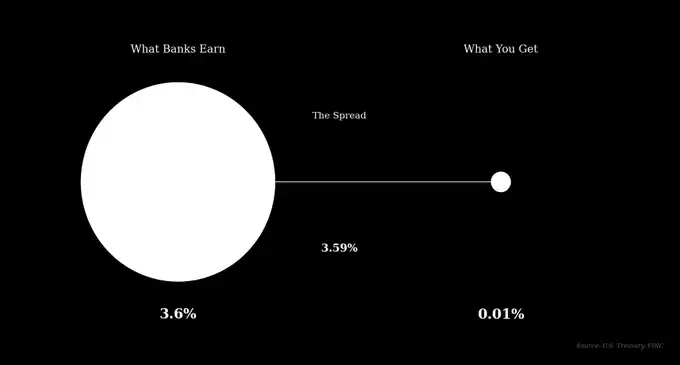
Simply put, the traditional bank model is: attract deposits with low interest rates, then lend or invest in assets like government bonds at higher rates. The difference between the interest earned and the interest paid is the bank's net interest margin (or spread).
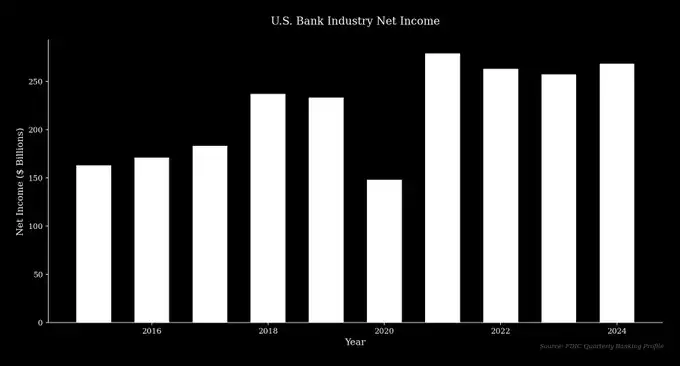
This model is highly profitable. For example, in 2024, JPMorgan Chase reported revenue of $180.6 billion and a net profit of $58.5 billion, with net interest income of $92.6 billion being the primary contributor.
Emerging fintech provides depositors with direct channels to obtain higher yields, introducing competitive pressure that the banking industry has long avoided. Consequently, some large traditional banks are attempting to protect their business models through regulatory means—a strategy that is both logical and has historical precedent.

The Division in Banking

As of early 2026, the average annualized interest rate for U.S. savings accounts was 0.47%, while basic savings account rates at major banks like JPMorgan Chase and Bank of America were only 0.01%. During the same period, the risk-free 3-month U.S. Treasury yield was about 3.6%. This means major banks can absorb deposits, buy Treasuries, and easily earn a spread of over 3.5%.
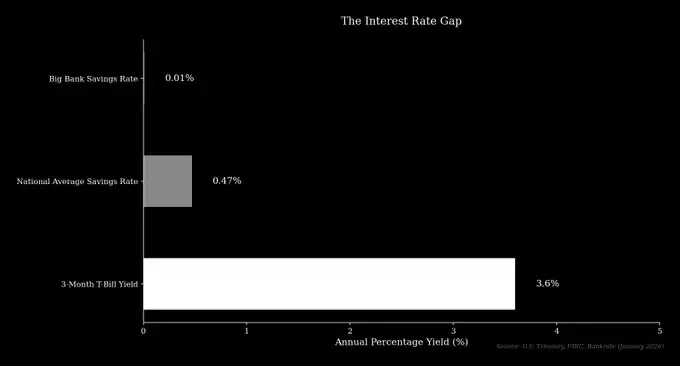
JPMorgan Chase has deposits of approximately $2.4 trillion; theoretically, this spread alone could generate over $85 billion in income. While a simplified calculation, it sufficiently illustrates the point.
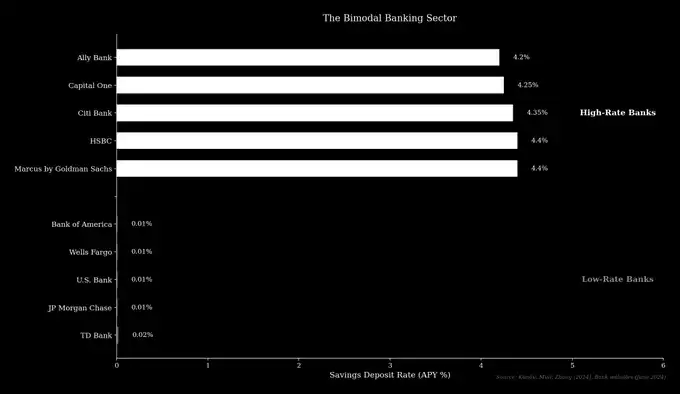
Since the global financial crisis, the banking industry has gradually divided into two types of institutions:

  • Low-rate banks: Typically large traditional banks that attract deposits from rate-insensitive customers through extensive branch networks and brand recognition.
  • High-rate banks: Such as Goldman Sachs' Marcus, Ally Bank, etc., mostly online banks that compete by offering deposit rates close to market levels.

Research shows the deposit rate disparity among the top 25 U.S. banks has widened from 0.70% in 2006 to over 3.5% currently.
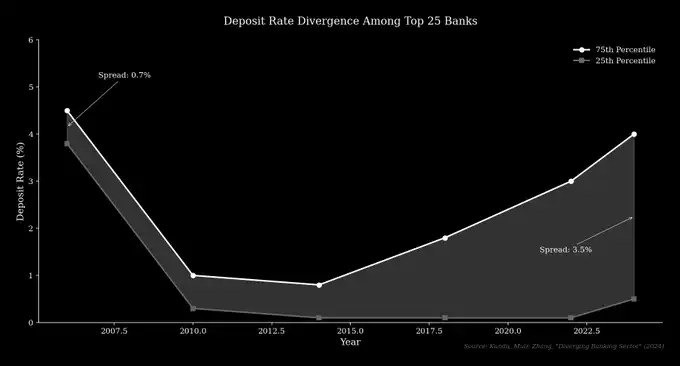
The profitability of low-rate banks is fundamentally based on depositors who do not actively seek higher returns.

The "$6 Trillion Deposit Drain Theory"

Banking groups claim that allowing stablecoins to pay yields could lead to "deposit outflows" of up to $6.6 trillion, draining credit resources from the economy. The CEO of Bank of America stated at a conference in January 2026: "Deposits are not just a conduit for funds; they are a source of credit. Outflows of deposits will weaken banks' lending capacity, forcing them to rely more on costlier wholesale funding."

He argued that small and medium-sized businesses would be the first affected, while Bank of America itself would be "less impacted." This argument equates stablecoins absorbing deposits with funds leaving the banking system, but this is not always the case.

When a customer buys stablecoins, dollars are transferred into the issuer's reserve account. For example, USDC's reserves are managed by BlackRock and held in cash and short-term U.S. Treasuries. These assets remain within the traditional financial system—the total amount of deposits may not decrease, they merely shift from individual accounts to issuer accounts.

The Real Concern

What the banking industry truly fears is: deposits flowing from their own low-interest accounts to higher-yielding alternatives. For example, Coinbase's USDC rewards or DeFi products like Aave offer yields far exceeding those of most banks. For the customer, it's a choice between keeping money at a major bank earning 0.01% or converting to stablecoins earning over 4%—a difference of more than 400 times.

This trend is changing depositor behavior: funds are moving from transactional accounts to interest-bearing accounts, and depositors are becoming more rate-sensitive. A fintech analyst points out: "The real competitor for banks is not stablecoins, but other banks. Stablecoins are merely accelerating competition among banks, ultimately benefiting consumers."

Research also confirms: when market interest rates rise, deposits flow from low-rate banks to high-rate banks. And high-rate banks are expanding their personal and business lending operations—the capital flows brought by stablecoins will likely have a similar effect, directing capital to more competitive institutions.

History Repeats Itself

The current debate over stablecoin yields closely resembles the controversy surrounding "Regulation Q" last century. This regulation set a cap on bank deposit rates, aiming to prevent "excessive competition." In the high-inflation, high-interest environment of the 1970s, market rates far exceeded the cap, harming depositor returns.

In 1971, the first money market fund was created, allowing depositors to earn market returns and support check payments. Similarly, protocols like Aave now allow users to earn yields without going through a bank. Money market fund assets surged from $45 billion in 1979 to $180 billion two years later, and now exceed $8 trillion.

Banks and regulators initially resisted money market funds as well, but the interest rate caps were eventually abolished for being unfair to depositors.

The Rise of Stablecoins

The stablecoin market is also experiencing rapid growth: its total market capitalization soared from $4 billion in early 2020 to over $300 billion in 2026. The largest stablecoin, USDT, saw its market cap surpass $186 billion in 2026. This reflects market demand for "digital dollars that are freely transferable and can earn yield."

The debate over stablecoin yields is essentially a modern version of the money market fund debate. The banks opposing stablecoin yields are primarily the low-rate traditional banks that benefit from the current system. Their goal is to protect their own business model, while this new technology clearly offers more value to consumers.

History shows that technology providing a better solution will eventually be embraced by the market. Regulators need to decide: whether to facilitate this transition or delay its progress.


Related Questions

QWhat is the core provision of the US CLARITY Act mentioned in the article?

AThe core provision of the US CLARITY Act is to prohibit digital asset service providers, such as cryptocurrency exchanges, from paying yields to their customers solely for holding payment stablecoins.

QWhy do traditional banks support the CLARITY Act and the earlier GENIUS Act?

ATraditional banks support these acts to protect their profitable net interest margin (or spread) income. They aim to prevent competition from fintech alternatives that offer customers higher yields, which could cause deposits to flow out of their low-interest accounts.

QWhat is the '6.6 trillion dollar deposit outflow theory' proposed by banking groups?

ABanking groups claim that if stablecoins are allowed to pay yields, it could lead to a massive outflow of up to $6.6 trillion in deposits from the banking system, potentially reducing the availability of credit in the economy.

QHow does the article compare the current debate over stablecoin yields to a historical financial regulation?

AThe article compares it to the debate over Regulation Q, which set caps on bank deposit rates. In the 1970s, money market funds emerged to offer market yields to depositors, similar to how stablecoins and DeFi protocols now offer higher returns, leading to the eventual abolition of those caps.

QWhat has been the growth trend of the stablecoin market since 2020 according to the article?

AThe stablecoin market has experienced rapid growth, with its total market capitalization surging from $4 billion in early 2020 to over $300 billion by 2026, with USDT's market cap alone exceeding $186 billion.

Related Reads

Qualcomm: AI Hype Subsides, When Will Smartphones Emerge from the Gloom?

Qualcomm reported its Q3 FY2026 results (ending June 2026), with revenue of $9.95B, down 4% YoY but above expectations. Gross margin declined to 53.1%, pressured by rising costs across manufacturing and memory. Key business segments showed mixed performance: Handset revenue fell 19.6% YoY to $5.09B, dragged by an 11% decline in non-Apple Android shipments and weaker high-end mix. Conversely, Automotive revenue surged 61% to $1.59B, and IoT grew 9% to $1.83B. Core operating profit dropped 41% YoY due to margin compression and higher expenses. Management's Q4 FY2026 guidance projects revenue of $9.7B-$10.5B, in line with consensus, but Non-GAAP EPS guidance of $2.05-$2.25 fell short of expectations. Amidst persistent weakness in its core handset market, Qualcomm is pursuing growth in AI, focusing on Edge AI (smartphones, PCs, automotive) and Data Center AI. Its data center strategy includes four pillars: AI accelerators (e.g., AI200), commercial CPUs (Dragonfly C1000), custom silicon, and connectivity solutions. While these initiatives initially boosted its stock, concerns over AI capital expenditure sustainability have since erased those gains. The company targets $5B in data center revenue for FY2027 and $15B for FY2029. The report concludes that with the traditional handset business still under pressure, the data center opportunity is currently viewed as a longer-term option, and a more conservative valuation based on core operations may be warranted until AI contributions materialize.

marsbit2m ago

Qualcomm: AI Hype Subsides, When Will Smartphones Emerge from the Gloom?

marsbit2m ago

From TPU to Self-Evolving Agents: How Jeff Dean Predicts the Next Step in AI

At the 2026 YC Startup School, Jeff Dean outlined his vision for AI's next phase, shifting focus from simply scaling models to building intelligent, autonomous systems. He believes AI's progress is no longer just about creating smarter models, but about integrating them into systems capable of long-term, iterative work, automated experimentation, and continuous learning. This evolution moves the competition from "who has the bigger model" to "who can best organize intelligence." Dean suggests AI capabilities are now comparable to a junior engineer, enabling the automation of complex workflows. However, the true challenge and opportunity lie in managing these AI "workers" at scale. He emphasizes the importance of **context engineering**—structuring tools, memory, and feedback loops—over raw model power. For startups, this means building deep expertise in niche domains where general models currently fail (near 0-1% success rates), leveraging proprietary data, specialized tools, and domain-specific evaluators. A recurring theme is re-examining fundamental constraints. Dean's past work, like moving Google's search index to memory or creating the TPU, stemmed from questioning outdated assumptions about hardware and cost. He sees similar inflection points today, particularly in **specialized inference hardware** to drastically reduce latency and energy consumption for real-time Agent operation. Notably, he points out that in modern AI systems, the dominant cost is often not computation but **data movement**. Reliable, long-running Agents require robust system design, borrowing concepts from distributed computing like checkpointing, state management, and parallel exploration to handle failures and maintain progress over days or weeks. As AI automates execution, the scarcest human skills will shift to **defining clear specifications**, **judging what problems are worth solving** (taste), and designing effective feedback loops. Ultimately, Dean's framework prioritizes understanding the problem deeply, identifying the true bottlenecks, and systematically building closed-loop systems where AI can not only perform tasks but also improve AI itself.

marsbit2m ago

From TPU to Self-Evolving Agents: How Jeff Dean Predicts the Next Step in AI

marsbit2m ago

Trading

Spot
活动图片




