Author: Cathy
Original Title: 6% Annualized Return, Musk Declares War on Traditional Banks
In early March 2026, American actor William Shatner—Captain Kirk from Star Trek—posted a screenshot on X.
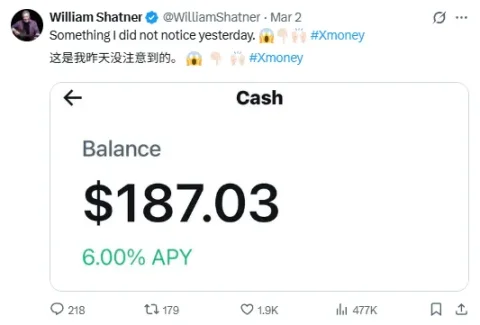
Nothing major—just him testing a new product called X Money.
In the screenshot was a line of numbers: Annualized Yield: 6%.
The post didn’t go viral, but it quietly sent shockwaves through financial circles.
Not because of William Shatner, but because of that 6%.
Open an ordinary savings account at JPMorgan Chase, and the deposit interest rate is 0.01%. At Wells Fargo, it’s about the same. Deposit $100, and a year later the big bank gives you one cent. With X Money, you get $6.
A difference of 600 times.
This is how Musk is waging war on traditional finance—not with a technical white paper, not with regulatory lobbying, but with a screenshot.
A Black Metal Card
The concept of X Money is easy to grasp: a digital wallet that can send, receive, and store money, paired with a physical debit card.
But every detail exudes ambition.
That debit card is made of black metal, laser-engraved with your X username (Handle). Not your legal name, not an account number, but your social identity on the X platform.
This design is no accident. It ties your social account to your spending power. Every time you pull out the card to pay, you’re not just showing a payment tool—you’re displaying your digital identity. The stickiness of the X ecosystem is built layer by layer in this way.
On the settlement side, X Money is integrated with Visa Direct. Traditional bank ACH transfers take 1 to 3 business days to clear; Visa Direct enables near-instant settlement. For the gig economy and content creators, this speed difference is a tangible improvement in experience.
Deposits are held by Cross River Bank (a member of the FDIC), with each user protected by up to $250,000 in federal deposit insurance.
To summarize the product in one sentence: 6% APY, laser-engraved black metal card, instant settlement, zero overseas fees, $250k insurance cap.
Just looking at the spec sheet, it’s hard to find fault.
How Can It Offer 6%?
This is the most critical question.
Where does the money for the 6% APY come from? X Money isn’t burning cash to subsidize users—at least, that’s not the current business logic. The answer lies in an inconspicuous difference in cost structure.
Traditional big banks maintain a complete physical network: branch offices, tellers, ATM fleets, IT systems decades old. These are huge fixed costs; no matter the deposit size, that overhead remains.
X Money, however, is a cloud-native, API-first platform with no physical branches and no legacy baggage. The front-end user experience is handled by X, while banking compliance and fund custody are handled by Cross River Bank. This embedded finance model—"front-end to the tech company, back-end to the licensed bank"—drastically reduces operational costs, and the savings are passed on to users.
This logic itself isn’t new. Robinhood, Ally Bank, and SoFi have taken the same path.
But X Money has something most traditional fintech companies lack: over 500 million monthly active users, with a user acquisition cost (CAC) close to zero.
No need to spend money to attract new users; just keep the money of users already on X within X.
Who Is Threatened
The competitors X Money aims to squeeze are more numerous than they appear.
First, the traditional deposit market.
The business model of big banks relies on one premise: depositors have no better options, or can’t be bothered to switch.
The 6% APY shatters that premise. When over 500 million X users have access to this rate, the pressure for capital migration becomes real. To retain depositors, banks will have to raise their own deposit interest rates, compressing net interest margins. About 60% of U.S. banking revenue comes from net interest income. This is no small matter—it’s a systemic shake-up of the profit structure.
Second, the payment middle layer.
Social payment players like Venmo, PayPal, and Cash App have grown accustomed to their positions in this field. But none of them has a social platform with over 500 million users as a traffic entry point.
The core logic of X Money is to build a "closed loop of funds": money comes in, circulates within the X ecosystem for content rewards, subscriptions, merchandise purchases, and doesn’t need to flow out. Once this loop is formed, the intermediary role of PayPal and others will be marginalized.
Finally, cross-border remittances.
According to World Bank data from Q1 2025, the average cost of global cross-border remittances is about 6.49%, and transfers often take days to arrive. Leveraging Visa Direct’s global network, X Money aims to significantly reduce this cost and achieve near-real-time settlement. The business of Western Union and MoneyGram in markets with dense X user bases, like India, Indonesia, and Brazil, is X Money’s most direct target.
The Regulatory Battlefield
However, whether these threats materialize depends largely on regulation.
X Payments LLC has already obtained money transmitter licenses (MTLs) in over 40 states and Washington, D.C. But one state remains unyielding: New York.
New York state lawmakers have publicly written to the Department of Financial Services (DFS), urging it to deny X a license. Reasons include: Musk’s historically adversarial stance toward regulators, vulnerabilities in X’s identity verification mechanisms, and a more sensitive allegation—that during Musk’s tenure leading the Government Efficiency Department (DOGE), his staff reportedly accessed consumer payment data from the Consumer Financial Protection Bureau (CFPB), data that theoretically contains competitors’ trade secrets.
A regulator simultaneously participating in competition—if this allegation is substantiated, it could trigger a series of antitrust lawsuits.
Another variable is the GENIUS Act. Signed into law in July 2025, this stablecoin legislation explicitly prohibits issuers of payment stablecoins from paying any form of yield or interest to holders.
Currently, the 6% APY paid on fiat deposits by X Money operates under traditional banking deposit agreements, which under current frameworks poses no direct issue. But if X intends to convert account balances into stablecoins in the future, or deeply integrate crypto assets like Dogecoin or XRP, the GENIUS Act’s yield ban would directly block that path.
Musk needs to prove to regulators that the 6% is compliant bank deposit interest, not a disguised unregistered security yield, nor prohibited stablecoin dividends.
Grok Enters the Fray</p
If the 6% APY is X Money’s entry ticket, Grok is the moat it aims to build.
X’s AI, Grok, is being deeply integrated with financial functions. Musk’s vision is for Grok to be not just a chatbot, but an "intelligent agent" capable of handling financial duties—recommending buys and sells based on real-time sentiment on the platform, automatically allocating funds among products of different risk levels, and even allowing users to jump directly to a trading interface via the "Smart Cashtags" feature while scrolling through posts.
This is a new product形态: consuming content and managing assets happen in the same interface.
Traditional wealth management firms charge fees based on information asymmetry and human services. When AI can process vast amounts of social data and market signals at millisecond speeds, that information advantage shrinks.
For creators, the change is more direct: tips, subscription shares, ad revenue go directly into the X wallet with 6% APY, without passing through intermediary bank accounts. X is positioning itself as the settlement hub for creators—their de facto "bank".
Summary
The success of WeChat Pay and Alipay in China made countless U.S. tech companies envious, yet none managed to replicate it. The reasons are multifaceted: more fragmented U.S. financial regulation, consumer habits favoring credit card cashback culture, and barriers between different platforms.
X Money is the closest attempt to date to achieve this goal.
It has a user base, AI capabilities, Visa’s global network, a founder who disregards established rules—and a host of regulators and politicians waiting to cause trouble for it.
The outcome of this clash between these two forces will become clearer over the next 18 months. If X Money can secure the New York license, maintain compliance within the boundaries of the GENIUS Act, and successfully operationalize Grok’s AI wealth management features—it might just complete the experiment of an American super-app.
If not, all that will remain is a sleek black metal card and a memory of a good 6% rate.
For traditional banks and payment giants, the difference between these two outcomes is existential.
Twitter:https://twitter.com/BitpushNewsCN
Bitpush TG Discussion Group:https://t.me/BitPushCommunity
Bitpush TG Subscription: https://t.me/bitpush