Dubai establishes watchdog to regulate virtual assets under first crypto law

cryptoslatePublished on 2022-03-10Last updated on 2022-03-10

Abstract

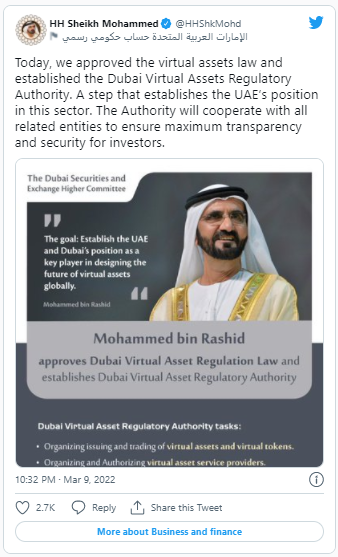
Dubai’s ruler and vice president Sheikh Mohammed bin Rashid Al Maktoum announced the adoption of a new law that aims to regulate virtual assets such as cryptocurrencies and NFTs.

Dubai’s ruler and vice president Sheikh Mohammed bin Rashid Al Maktoum announced the adoption of a new law that aims to regulate virtual assets such as cryptocurrencies and NFTs.

The UAE has been at the forefront of crypto and blockchain adoption for a number of years now and is looking to solidify its position as a leading global financial hub. Under the law, Dubai intends to create an advanced legal framework that will protect investors and establish international standards to govern the virtual asset industry.
VARA

As a first step, the Emirate will set up a new regulator — the Virtual Asset Regulatory Authority, or VARA — to oversee the virtual asset sector throughout Dubai. It will have full legal and financial autonomy and will be linked to the Dubai World Trade Centre Authority, or DWTCA.

“The Dubai Virtual Asset Regulatory Authority will provide a full range of VA [virtual asset] services in co-ordination with the Central Bank of the UAE and the Securities and Commodities Authority,”

DWTCA’s Director General Helal Al-Marri said.

VARA will have full authority to license, regulate and govern the virtual asset industry. It’s jurisdiction will include special development zones, as well as free zones, but exclude the Dubai International Financial Centre, which is working on its own set of regulation for virtual assets.

VARA will also be tasked with establishing and organizing the rules and controls that will govern the sector. This will include classification and specification of virtual assets; how virtual asset activities will be carried out; how virtual assets will be managed; as well as how clearing and settlement will take place.

Late to the party?

The UAE has been courting the virtual assets industry for a number of years and its banks now have a history of experimenting with blockchain technology but this is the first time the country has officially made a move to regulate the sector on a broad scale.

The Dubai Financial Centre has been looking into virtual asset regulation since mid-2021 but is still in the consultation stage. Binance, the world’s biggest crypto exchange, is not licensed in the UA but it is in Bahrain.

The small Island nation in the middle of two seas is giving the UAE a run for its money when it comes to becoming a global hub for virtual assets. Bahrain established banking regulation for crypto and licensed the first crypto-firm in 2019.

Meanwhile, in contrast to the UAE’s central bank, the Bahraini central bank accepts cryptocurrencies as an official method of payment.

Get your daily recap of Bitcoin, DeFi, NFT and Web3 news from CryptoSlate
It's free and you can unsubscribe anytime.

Related Reads

Global Crypto Regulation "Closing the Net": Hong Kong, EU, US Simultaneously Take Action, Is the Compliance Window Closing?

Global Crypto Regulation Tightens: Hong Kong, EU, and US Simultaneously Enforce Rules, Closing the Compliance Window? The global virtual asset regulatory landscape is shifting from rule-making to enforcement. Recent moves by Hong Kong, the EU, and the US signal a coordinated push towards market restructuring based on licensing, product classification, custody, and client segmentation. **Hong Kong**'s SFC issued a circular on "Relevant Stablecoins" on May 27, formally establishing a two-tier regulatory architecture where the HKMA oversees issuance and the SFC oversees trading and distribution. This creates differentiated, often lighter-touch, rules for compliant, licensed stablecoins compared to other virtual assets, fitting into a broader strategy to develop stablecoins as settlement infrastructure, tokenized securities as investment products, and licensed VATP platforms as distribution channels. The **European Union** is approaching a critical deadline, with the MiCA transition period ending on July 1. After this date, unlicensed Crypto-Asset Service Providers (CASPs) must cease serving EU clients. With only about 210 authorized CASPs across 23 member states so far, a significant market consolidation is expected, as the application process now takes 6-9 months. In the **United States**, the CLARITY Act passed a key Senate committee vote on May 14. This landmark bill aims to clarify jurisdiction between the SEC and CFTC, establish registration rules for trading platforms and custodians, and create a federal framework for stablecoin regulation. A key compromise prohibits "passive yield" on stablecoin balances but allows "activity rewards" tied to specific functions like payments. The convergence of these regulatory actions highlights a fundamental shift: stablecoins, with a payment volume rivaling major card networks, are being treated as critical financial infrastructure rather than unregulated digital assets. The core message is clear: compliance is transitioning from an operational cost to a mandatory license for market access, determining which players will participate in the next phase of the digital asset economy.

marsbit12m ago

Global Crypto Regulation "Closing the Net": Hong Kong, EU, US Simultaneously Take Action, Is the Compliance Window Closing?

marsbit12m ago

Trading

Spot
Futures

Hot Articles

How to Buy SNT

Welcome to HTX.com! We've made purchasing Status Network Token (SNT) simple and convenient. Follow our step-by-step guide to embark on your crypto journey.Step 1: Create Your HTX AccountUse your email or phone number to sign up for a free account on HTX. Experience a hassle-free registration journey and unlock all features.Get My AccountStep 2: Go to Buy Crypto and Choose Your Payment MethodCredit/Debit Card: Use your Visa or Mastercard to buy Status Network Token (SNT) instantly.Balance: Use funds from your HTX account balance to trade seamlessly.Third Parties: We've added popular payment methods such as Google Pay and Apple Pay to enhance convenience.P2P: Trade directly with other users on HTX.Over-the-Counter (OTC): We offer tailor-made services and competitive exchange rates for traders.Step 3: Store Your Status Network Token (SNT)After purchasing your Status Network Token (SNT), store it in your HTX account. Alternatively, you can send it elsewhere via blockchain transfer or use it to trade other cryptocurrencies.Step 4: Trade Status Network Token (SNT)Easily trade Status Network Token (SNT) on HTX's spot market. Simply access your account, select your trading pair, execute your trades, and monitor in real-time. We offer a user-friendly experience for both beginners and seasoned traders.

1.7k Total ViewsPublished 2024.03.29Updated 2026.06.02

How to Buy SNT

Discussions

Welcome to the HTX Community. Here, you can stay informed about the latest platform developments and gain access to professional market insights. Users' opinions on the price of SNT (SNT) are presented below.

活动图片