贝森特回购美国国债,涨的为什么是比特币?

marsbitPublished on 2026-08-25Last updated on 2026-08-25

Abstract

8月19日,美国财政部长贝森特将长期国债单次回购上限翻倍,试图压低处于近二十年高位的长期收益率。但市场认为,这一操作并未触及推高收益率的根本原因,如巨额预算赤字、AI热潮下的企业抢钱以及地缘政治推高的通胀压力。因此,长期收益率仅短暂下跌后便再度回升。 市场将此解读为美国政府急于管理债务成本的信号,重新点燃了对货币贬值的担忧。资本因而轮动至比特币、黄金等非主权稀缺资产进行对冲,导致这些资产价格大涨。同时,美元指数下跌,外汇市场波动加剧。 报道进一步指出,贝森特此次行动打破了财政部“常规且可预测”的债务管理传统,其激进时机可能适得其反,反而增加投资者对未来政策不确定性的担忧,进而要求更高的风险溢价,最终可能推高长期收益率。市场开始讨论是否出现了“贝森特看跌期权”。最终,政策未能扭动目标中的收益率曲线,却显著搅动了加密货币、贵金属和外汇市场。

8 月 19 日,美国财政部长 Scott Bessent 出手了。

他把 10 年、20 年和 30 年期国债的单次回购上限,从 20 亿美元提高到至少 40 亿美元——直接翻倍。时机是长端收益率触及近二十年最高:前一天,30 年期收益率摸到 5.33%,2007 年以来的最高值。

他给自己这个动作起了个名字,叫「财政部的扭转操作」,致敬美联储 1960 年代那次著名的扭转操作。他说,当前的收益率跟「均衡」水平不符。

曲线确实扭了,但就一天。
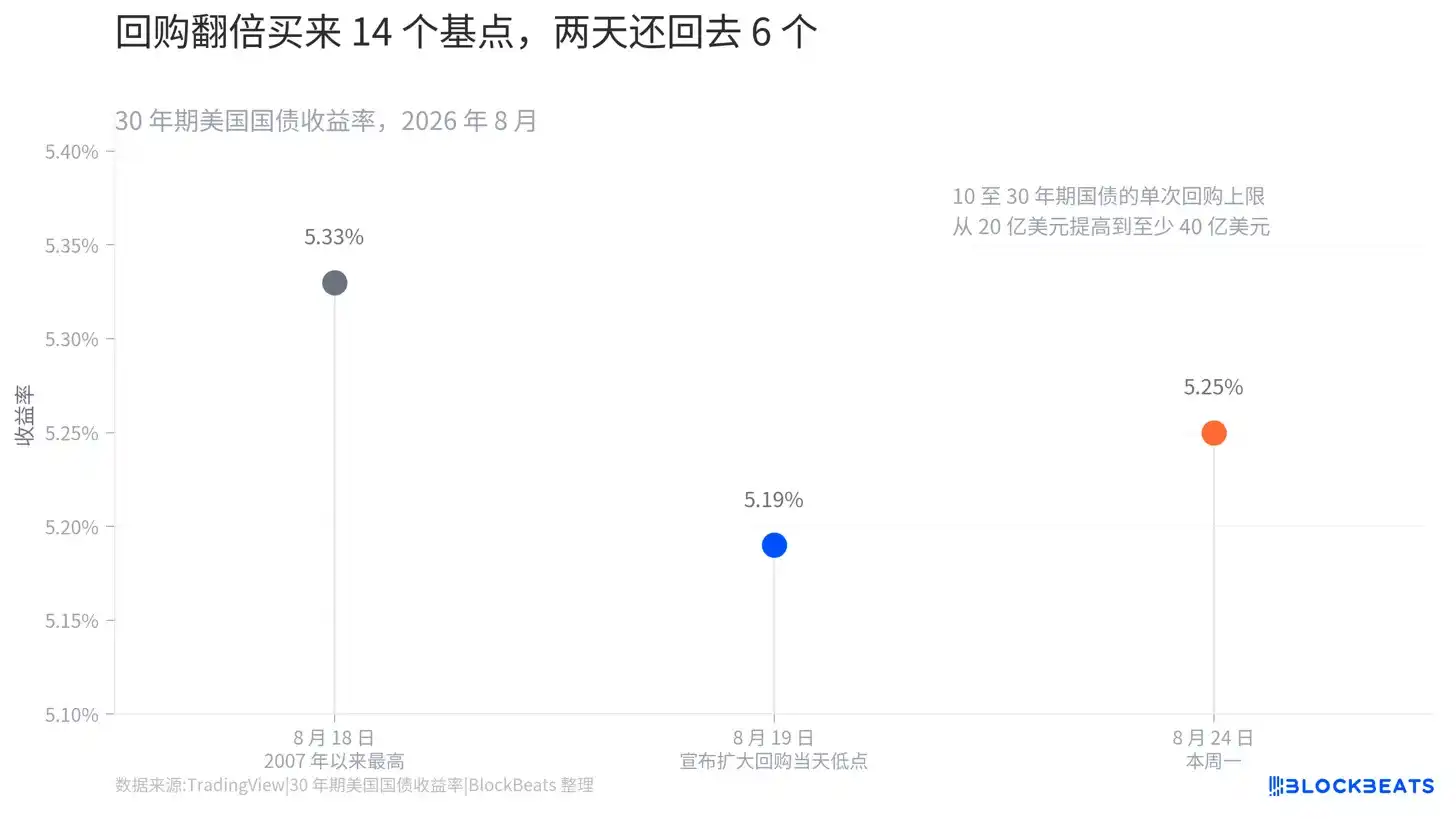
宣布当天,30 年期收益率跌到 5.19%,14 个基点。然后它一路往回爬,到本周一还在 5.25%。10 年期收益率上周五收在 4.73%,接近他上任以来的最高点。

真正大涨的是另外一些东西:比特币冲到接近 8 万美元,带动数十亿美元空头爆仓;黄金逼近三个月高位;XRP 一周涨了 51%。

财政部买自己的债,为什么能压低利率?

先说清楚这里面的机械原理,它其实不复杂。

国债收益率是整个经济的基准利率。它不只是政府借钱的成本,也是住房抵押贷款、企业贷款和许多其他债务的定价参照。收益率一高,政府和美国家庭的利息负担同时加重——在中期选举之前,这是个特别扎眼的问题。

财政部下场在公开市场上买回自己发出去的债,等于凭空多出一个买家。需求上去,债券价格上涨;而债券价格和收益率是反向的,价格涨,收益率就落。

但这里有个关键前提:财政部不是美联储,它不能凭空创造货币。它买债的钱,要么来自现有的现金,要么得借。而借钱通常意味着多发短期国库券——所以回购与其说是「买回债务」,不如说是债务置换:总量不变,把长的换成短的。

富国银行分析师 Angelo Manolatos 估算,为了给扩大后的回购计划融资,财政部每个季度需要多发 160 亿美元的短期国库券。

这套路数本身也不新。自 2025 年特朗普第二任期开始,财政部就把所有新增的借款需求都塞进了一年以内的短期券——推高短端利率,但不碰长端。有意思的是,Bessent 在当上财长之前,批评前任耶伦的正是这一点。

那它为什么没管用?

因为把收益率推上去的那些力量,一样都没被这次操作碰到。

Satori Insights 创始人 Matt King 把这层说得最透:「通往长端持久缓解的每一条路,都要经过这届政府不想要的东西。」他列的三条路是:更小的预算赤字、股市下跌、AI 投资减少。

三条都堵着。

债务在创纪录。 美国国债本周有一项口径已经超过 40 万亿美元。Bessent 承诺的减赤计划在国会前景不妙——共和党控制的国会今年无意做净预算削减,而本财年赤字预计 2.1 万亿美元。

企业也在抢钱。 AI 热潮带动的公司债发行激增。Alphabet 本月早些时候卖出了期限长达 40 年的债券。

通胀跳起来了。 特朗普对伊朗开战搅乱了能源市场,油价自 7 月初以来涨了约 30%,布伦特原油到每桶 93 美元。

美联储自己也说不清。 主席 Kevin Warsh 的策略让投资者困惑,新主席的杰克逊霍尔首秀还没讲。

更尴尬的是,市场并不认为这里有什么需要修的东西。发明了「债券义警」这个词的 Edward Yardeni 在 Bessent 出手前大约一小时对彭博电视说:「我认为我们已经回到了正常的利率水平,4% 到 5% 就是正常。」财政部说这次干预是为了支持流动性,而摩根大通的利率策略团队上周四的报告写的是:「今年市场功能已经明显改善。」

高盛和富国等机构的判断更直接:除非财政和通胀压力真正缓解,否则增加长端回购扭转不了长期收益率的上行趋势,收益率曲线还会继续陡峭化。

那涨的为什么是比特币?

因为市场读到的不是「问题解决了」,而是「他们真的很着急」。

Sygnum 首席投资官 Fabian Dori 的解释很完整:「财政部把长债回购翻倍,目的是安抚债市、在曲线长端提供流动性......这不是印钞,机制在财政部而不是央行的资产负债表上,但信号很重要:管理美国债务成本已经成为一项主动的政策优先事项,这重新点燃了货币贬值的叙事。黄金和白银与比特币一起上涨,这件事很能说明问题——资本正在轮动进入稀缺的、非主权的价值储存物。」

Citadel 证券的批评更不留情面:这种通过回购压制长期借贷成本的做法,属于「金融压制」,可能削弱美元、加剧通胀。它的判断是,压低长端收益率消除不了财政和通胀压力,只会把压力转移到外汇市场。

外汇市场那边确实先动了。对冲基金在 Bessent 公布计划前就加大了做空美元的押注,美元创下近三周最大单日跌幅,期权市场对美元下跌的对冲需求升到 2 月以来最高。本周一,美元指数还徘徊在多月低位。

这笔钱到底从哪儿出?

这是本周新冒出来的一个变数。

CNBC 周一援引两位财政部高级官员说,财政部可能动用它在美联储的现金账户——财政部一般账户(TGA)——来给回购买单。8 月 20 日,这个账户的余额是 9350 亿美元。

TGA 本质上就是美国联邦政府的支票账户,用来支付日常开销:社保支票、联邦雇员工资、国防合同、国债的利息和本金。今年它被刻意加厚过,部分原因是财政部要退给进口商约 1660 亿美元——最高法院今年早些时候裁定,特朗普的一大块进口关税是违法的。

动用 TGA 的好处是不用发新债,坏处是直接消耗国家的现金储备。2015 年财政部定过一条规矩:账户里至少要留够五天的支出,或者不低于 1500 亿美元,以防万一被债券市场关在门外。

消息一出,10 年期收益率当天最多跌了 4 个基点,到 4.69%。

周一的记者会上,Bessent 被问到这件事——那场记者会的主题其实是对伊朗的制裁。他的回答是:财政部会继续执行 8 月初公布的常规拍卖计划,包括长债拍卖;扩大后的回购目前还一张债券都没买,10 年期和 20 年期的回购要到 9 月 10 日才开始。

他还想扭动什么?

Bessent 的收益率曲线管理,野心不止于国债。

他把那些为 AI 大举借债的超大规模科技公司也算了进去。他说这些投资终将以更快的、非通胀性的经济增长回报,但眼下「它正在造成短期的资本竞争」。然后他给出了一条建议:

「如果我坐在首席财务官的位子上,我会考虑多发一些所谓的『腹部』债务。」——也就是五年期。

美国财政部长在公开场合建议企业的财务总监该发什么期限的债,这件事本身就值得停一下。

另一条线更远,通向稳定币。去年通过的《天才法案》规定,美国发行的锚定美元的稳定币,只能用特定资产背书,其中包括 93 天以内到期的国债。Bessent 引用过一个预测:稳定币可能长成接近 4 万亿美元的市场,并且写过,「这可能降低政府的借贷成本」。

目前全部稳定币的市值约 3000 亿美元,而美国货币市场基金接近 8 万亿。但布鲁金斯学会 Hutchins 中心的一份评论指出了这里的杠杆在哪:银行每 1 美元资产通常只持有 8 美分的国库券,而 1 美元的稳定币,通常由接近 80 美分的国库券支持。

这就是特朗普上周在白宫接待加密行业高管、敦促国会通过《清晰法案》的另一层背景。Circle 和 Coinbase 上周都涨了 20% 以上。

他打破的那条规矩

财政部有一条几十年的传统,叫「常规且可预测」——债务管理方式的任何改变,都要经过内部和市场参与者的充分讨论。Bessent 自己在去年 11 月的一次主旨演讲里,反复背书过这条原则。

这次的加码,距离该计划的季度暂定日历发布只有两周。

Wrightson ICAP 高级经济学家 Lou Crandall 周一在报告里写下了这次事件最准确的一句评价:「增加长端回购这个决定本身未必激进,但这个决定的时机和框定方式,肯定是激进的。」

代价可能会以最讽刺的方式出现:如果投资者开始担心拍卖规模随时会有意外变化,他们会要求更高的溢价才肯买国债——尤其是最长期的那些。

也就是说,为了压低长端收益率而打破的规矩,本身可能推高长端收益率。

市场上已经有人开始讨论,是不是出现了一个「贝森特看跌期权」,就像当年人们相信格林斯潘总会出手托住股市那样。

至于特朗普,他在上周否认自己指示过 Bessent 干预债市。

那根曲线,他确实扭动了。只是扭起来的是美元、黄金和比特币,不是他想扭的那一根。

Related Questions

Q美国财政部长贝森特通过什么具体操作试图降低长期国债收益率?

A他将10年、20年和30年期国债的单次回购上限,从20亿美元提高到至少40亿美元,即直接翻倍。他称此动作为“财政部的扭转操作”,意在通过在公开市场上回购长期国债来增加需求、推高价格,从而压低长期收益率。

Q为什么文章认为贝森特的回购操作没能有效压低长期国债收益率?

A文章认为,推高收益率的根本力量并未被触及。这些力量包括:创纪录的政府预算赤字、AI热潮带来的企业债发行激增(与企业竞争资金)、因地缘政治冲突(如特朗普对伊朗开战)导致的油价和通胀上升,以及美联储政策的不确定性。市场认为当前4%-5%的利率水平是“正常”的,而非需要干预的问题。

Q根据文章,财政部的回购操作为何会推高比特币、黄金等资产的价格?

A市场将财政部急于干预债市、主动管理债务成本的举动,解读为一种“金融压制”和可能削弱美元的信号。这重新点燃了“货币贬值”的叙事,促使资本从主权货币体系流出,转而流入被视为稀缺、非主权的价值储存物,如比特币和黄金,以对冲美元贬值和通胀风险。

Q贝森特关于企业发债和稳定币的言论,透露出财政部怎样的长期意图?

A他建议为AI投资而大量举债的科技公司多发“腹部”(如五年期)债务,以减少对长期国债市场的资本竞争。同时,他看好《天才法案》下以短期国债背书的稳定币市场,认为其巨大潜力(可能增长至近4万亿美元)能成为国债的重要新买家,从而长期有助于降低政府借贷成本。

Q文章指出贝森特的这次操作打破了财政部的哪条重要传统?其潜在代价是什么?

A他打破了财政部“常规且可预测”的债务管理传统。在没有充分市场讨论的情况下,在季度计划公布仅两周后就突然大幅加码回购计划。其潜在讽刺性代价是:这种不可预测性可能增加投资者的不确定性,导致他们在购买长期国债时要求更高的风险溢价,反而可能推高长期收益率,与操作初衷背道而驰。

Related Reads

U.S. Aims at Iran's Crypto Sector Due to Oil Payments Exceeding $100 Billion

The U.S. Treasury Department has expanded sanctions on Iran to target its digital asset sector, citing over $100 million in cryptocurrency payments allegedly used to facilitate Iranian oil sales. The Treasury’s Office of Foreign Assets Control (OFAC) announced new sectoral sanctions covering digital assets, technology, gold, aviation, and shipping, alongside sanctions against nearly 60 entities, individuals, and vessels linked to nuclear, missile, cyber, and oil networks. The move allows OFAC to sanction foreign persons and firms operating in or supporting Iran’s crypto sector, which the Treasury stated is increasingly used as a "tool of choice" to circumvent sanctions, including by the Islamic Revolutionary Guard Corps (IRGC). Specific targets include Ukrainian broker Ivan Obukhov and his UAE-registered firm Foscom FZE, accused of processing over $100 million in crypto payments to facilitate oil sales for the IRGC’s Quds Force. This follows recent U.S. actions against Iran-linked crypto exchanges, including sanctions against UK-based Zedcex and Zedxion in January, four Iranian exchanges including Nobitex in June, and exchanges Shelbit and Aban Tether in August. Unlike previous targeted sanctions, the new measures establish a framework to penalize broader involvement in Iran’s crypto sector, significantly expanding OFAC’s authority under Executive Order 13902. Designated persons’ U.S.-linked property will be blocked, and foreign banks facilitating significant transactions for them may face U.S. account restrictions.

cryptonews.ru3m ago

U.S. Aims at Iran's Crypto Sector Due to Oil Payments Exceeding $100 Billion

cryptonews.ru3m ago

Conversation with Charles Zhang: Amidst the AI Frenzy, Why Pursue 'Anti-Efficiency' Content?

Dialogue with Charles Zhang: In the Era of AI's Sprint, Why Create "Anti-Efficiency" Content Standing out among China's early internet pioneers, Charles Zhang, founder and CEO of Sohu, maintains a distinct personal identity. He keeps a consistent public presence and embodies traits of high-energy individuals: sleeping only 4-5 hours daily, running 5km or marathons, and hosting frequent offline tech forums and dialogues with Nobel laureates. He has shifted focus from external business expansion to internal self-reconstruction, adhering to his own pace. "People aren't afraid of being busy; the busier you are, the better your health. Having nothing to do can lead to emotional issues and poor health." Marking the 10th anniversary of his live-streamed "Charles Zhang's English Class," he recently took it offline for a real-world classroom session. Following this, he discussed the course's decade-long journey, Sohu Video's content ecosystem, and the value of content in the AI era. **Pen and Mouth Diligence: A Class Against Instant Mastery** His English class began in August 2016 on "Qianfan Live." He spends about 40 minutes daily preparing, reviewing dozens of news headlines, reading five in detail, and selecting three for the lesson. Over ten years, he has completed over 2000 live sessions totaling more than 110,000 minutes, with over 52 million views. Initially, the stream was a way to "talk more" and combat emotional struggles. He started by repeating after TV news anchors, then moved to live-streaming with the launch of Qianfan Live. It was 40% for personal emotional regulation ("like a monk chanting sutras"), 30% to deliver authentic news, and 30% to promote the new platform. This daily "ritual" helped him overcome depression, leading to what he calls his "peak life state." From a product perspective, it was counter-intuitive—launched without prior market research or growth strategies, based on the founder's personal need that resonated with users. Yet, his content creation follows a strict routine. The decade of covering geopolitics, economics, tech, health, and society has built a vast "knowledge compound interest" system. In an age of AI summaries and algorithmic content, Zhang insists on "hard work": meticulous reading, handwritten notes, and manually created teaching materials, refusing AI-generated content. The English class is now a fixed daily rhythm; preparing for his weekly physics class requires a full day of solitary deduction on a blackboard. In his live streams, Zhang positions himself as a "content creator," not a CEO or teacher. He sees physics as extreme brain training and English as a "sensor" to understand the world. This explains why a top entrepreneur persists for a decade in seemingly "unprofessional" pursuits—it's the information input and psychological healing method he found during a low point. It's fundamentally an "anti-efficiency" commitment. He believes the meaning of reading lies in finding community and spiritual support, not just fleeting conversation points. For today's media, he states: "Reading news isn't the goal. As humans with many confusions, we need reference points, to find a group, find kindred spirits, or seek support and spiritual nourishment. Large language models can't satisfy these starting points; they only give you information." This offers solace and a value defense for media professionals impacted by AI summaries. **"Don't Think Earth Stops Turning Because AI Arrived"** A content creator expressed anxiety: after feeding their article to AI, it produced a more comprehensive, profound version, making their work feel valueless. Zhang responded with an analogy: "Carrots from the market, with a bit of soil, not glossy, taste delicious and flavorful. Tomatoes forced by chemical fertilizer have no taste at all." He sees AI giving world content a "plastic feel," but acknowledges its significant role in improving information access efficiency, especially in physics and social science research where he often queries AI for quick professional answers. The key, Zhang stresses, is that the outside world still needs to guide our perspective. LLMs provide "information," while the outside world offers "viewpoints." He cares deeply about *what* that external viewpoint is and *how* someone thinks about an issue. "Don't think the Earth stops turning because AI arrived," he analyzes. AI currently replaces rule-based work, noting significant impact on the software industry with many programmers laid off as even less experienced people can now write decent code. However, AI cannot yet replace arts, social sciences, emotions, and creative content. "Hollywood remains thriving, producing great works. Oscars will continue, Nobel Literature Prizes will still be awarded—all by real people, with works conceived by real people." While wary of AI, Zhang isn't anti-technology and is open to its applications. Sohu itself has launched AI assistants. In Sohu's AI practice, Zhang defines his role as a "large language model corpus provider." He believes LLM training is inseparable from human-original content as its data foundation, so original content retains irreplaceable value. "The era of self-media indeed offers everyone new ways to discover their strengths and achieve growth." He suggests every young person should consider self-media. Most importantly, the bottom line of content creation should be "authenticity." If using AI avatars, they must be clearly labeled; not doing so and misleading viewers wastes their time, especially when people still prefer real human content. Behind AI's sprint lie unavoidable realities. As AI quickly provides seemingly perfect answers, people grow accustomed to accepting "summarized" results, omitting processes of questioning, deduction, and trial-and-error, leading to a decline in deep thinking. Zhang's "anti-efficiency" practice with his two live-streamed classes is his answer to AI's狂奔: In an algorithm-driven era chasing ultimate efficiency, don't expect AI to fill inner voids. Read books, speak in front of a camera, sweat on a running track, and build connections with real people.

marsbit13m ago

Conversation with Charles Zhang: Amidst the AI Frenzy, Why Pursue 'Anti-Efficiency' Content?

marsbit13m ago

Zcash's ETF Gilding: How a Privacy Coin Was Packaged by Wall Street into a Compliant Asset

The article traces the decade-long path of Zcash (ZEC), a privacy-focused cryptocurrency, to its potential launch as the first privacy coin spot ETF, with Grayscale's ZCSH filing in August 2026. It argues ZEC's suitability stemmed not from regulatory acceptance of its privacy technology, but from its centralized, institutional structure from inception—a commercial company (ECC) with venture capital backing and a Founder's Reward—making it easier to package than decentralized alternatives. Three key institutions, intertwined in a network, drove the process: Grayscale (owned by DCG, an early ZEC investor), which had held ZEC in a trust since 2017; Coinbase, providing custody, prime brokerage, derivatives, and venture investment; and ZODL, a new for-profit entity formed in 2026 when ECC's core development team split from the non-profit foundation. The major regulatory hurdle was SEC scrutiny (2023-2026) over ZEC's historical structure, which resembled an unregistered investment contract due to automatic block rewards to ECC and the Foundation. This was resolved through governance changes (NU6 upgrade in 2024) that ended direct funding and shifted control to community voting, coinciding with a broader shift in SEC enforcement policy. Notably, the law firm Davis Polk represented both the Zcash Foundation in its SEC defense and Grayscale in the ETF filing. The push is also driven by DCG's dire financial needs amid Genesis bankruptcy lawsuits, seeking high-fee products (the ZEC ETF charges 2.5%). Concurrently, major mining operations by entities like Cypherpunk Technologies (backed by Winklevoss Capital) and DCG's Fortitude Mining expanded, motivated by profitability and aiming to influence the network. The article concludes with irony: to become a compliant ETF asset, ZEC must shed its core privacy feature for the fund's holdings, which will be held in transparent, auditable addresses. Wall Street is not adopting privacy technology but packaging the *concept* of privacy into a tradable, fee-generating financial product. The transformation was not a single master plan but the result of a network of aligned interests capitalizing on regulatory, governance, and market shifts over ten years.

marsbit23m ago

Zcash's ETF Gilding: How a Privacy Coin Was Packaged by Wall Street into a Compliant Asset

marsbit23m ago

Bitcoin Core Developer Warns That Bitcoin Payments Are Disappearing at 'Bitcoin Beach'

A Bitcoin Core developer, John Atack, who has lived in El Salvador since 2022, shared a concerning anecdote about Bitcoin adoption in the country. While dining at El Zonte, a region known as "Bitcoin Beach," he paid with Bitcoin and was told it was the first such payment the establishment had received in a month. Staff explained Bitcoin payments, once common, have now virtually disappeared, with nearly all customers using cards. An employee even declined a Bitcoin tip, stating she had forgotten how to use her wallet and declaring "It's already dead." Atack emphasized this was a single observation but noted the employee had witnessed the payment evolution over three years. His comments sparked mixed reactions. Some disputed his experience, with one user confirming successful Bitcoin payments in the same area. However, Bitcoin reporter Juan Galt acknowledged an underlying "economic problem," arguing that expecting price appreciation makes using Bitcoin for everyday transactions counterintuitive to economic incentives needed for a circular crypto economy. Despite the concerning report, Atack also reflected that El Salvador remains a global leader in cryptocurrency adoption and progressive legislation, sometimes causing locals to take these advancements for granted. The story highlights the ongoing challenges of mainstream Bitcoin adoption for daily commerce, even in pioneering nations.

cryptonews.ru25m ago

Bitcoin Core Developer Warns That Bitcoin Payments Are Disappearing at 'Bitcoin Beach'

cryptonews.ru25m ago

Trading

Spot
活动图片