Securitize Drops 40% in First Week of Trading as Tokenization Industry Enters Patent Wars

Foresight NewsPublished on 2026-07-08Last updated on 2026-07-08

Abstract

The article discusses the recent stock performance of Securitize (NYSE: SECZ) and a looming patent war in the tokenization industry. Securitize, a leading tokenization platform and transfer agent for BlackRock's BUIDL fund, debuted on the NYSE via a SPAC merger on July 2. After an initial rise, its stock plummeted nearly 40% within a week, closing at $8.06 on July 7. Analysts attribute the sharp decline largely to typical post-SPAC investor turnover and broader pressure on crypto-related stocks, rather than fundamental business deterioration. Concurrently, Securitize faces significant legal challenges. On June 15, infrastructure rival tZERO accused Securitize of patent infringement concerning its core DS Protocol and Vault Registrar products. Securitize preemptively filed a lawsuit on June 22 seeking a declaratory judgment of non-infringement. tZERO, holding 105 patents, has indicated it has identified at least six other market participants for potential infringement actions, signaling a broader industry-wide patent conflict. A separate lawsuit was also filed by Liquid Rarity Exchange. The article concludes that while Securitize's stock drop may be a temporary SPAC-related correction, the patent disputes initiated by tZERO represent a more profound, long-term risk for the entire tokenization sector, potentially shifting competitive dynamics from business execution to intellectual property litigation.


Written by: Sanqing, Foresight News


On July 2nd, Securitize (NYSE:SECZ) officially listed on the New York Stock Exchange via a SPAC merger completed with Cantor Equity Partners II. The stock rose on its first trading day, an event initially seen by the market as a landmark signaling the acceptance of the tokenization industry by traditional capital markets. However, the script took a sharp turn just a few trading days later. By the close on July 7th, SECZ was trading at $8.06, plummeting 25.92% for the day, having touched an intraday low of $8.00. This represented a pullback of approximately 40% from its peak during the first week of trading.
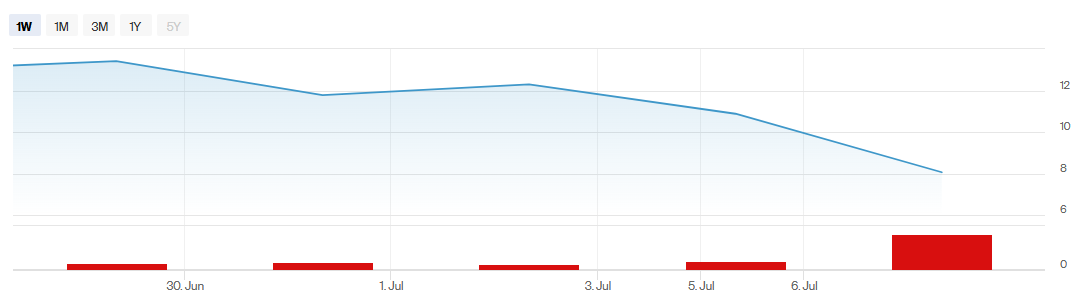

Source: NYSE


This is a company selected by BlackRock's tokenized money market fund BUIDL as its transfer agent, widely recognized by the capital markets as a leading platform in the tokenization space, with a pre-merger valuation of $1.25 billion. The stark contrast of its post-listing decline has led many investors to scrutinize the gap between the "tokenization narrative" and the "secondary market reality."


SPAC Mechanism Exposes Issues Before Fundamentals


In recent years, crypto-related companies that have gone public via SPAC have almost universally undergone similar valuation re-pricing during the handover period.


Twenty One Capital (XXI), also orchestrated by an entity affiliated with Cantor Fitzgerald, fell about 25% on its first day of trading on the NYSE via a SPAC merger on December 9th, 2025, closing at $11.42. It continued to decline thereafter, with its share price once falling below $6, a drop of over 80% from its peak of $49. ProCap Financial (BRR), a Bitcoin treasury company that completed its merger around the same time, debuted at $10 and is now trading around $2.4, a decline of roughly 76%.


Several market participants attribute the recent sharp decline to the SPAC structure itself rather than a deterioration in company fundamentals.


According to a CoinDesk report, Jeff Dorman of Arca stated publicly that this volatility is more a result of the SPAC mechanism than a worsening of fundamentals. Post-SPAC listing, the investor base undergoes a complete shift—from the original SPAC subscribers who prefer fixed income to long-term equity holders focused on fundamentals. This handover process inherently creates significant volatility.


Market confidence in the "tokenization" story itself has not collapsed; what has collapsed is confidence in the SPAC pricing mechanism. Despite the falling stock price, Securitize tokenized $295 million worth of its own stock on its first trading day and deployed it on Solana and Avalanche.


Securitize's decline also coincided with broader pressure on U.S.-listed crypto-related stocks. By early July, shares of Coinbase and Circle had fallen approximately 63% and 74%, respectively, from their respective all-time highs set in July 2025. Over the same period, the S&P 500 index retreated only about 2% from its June peak. When the entire sector's stocks are more volatile than their underlying assets, a newly listed tokenization platform can hardly remain unscathed.


Patent Lawsuit Reveals Industry Fissures


On June 15th, tokenization infrastructure company tZERO sent a "cease and desist and reservation of rights" letter to Securitize, alleging that its two core products, DS Protocol and Vault Registrar, infringe patents held by tZERO. The allegations specifically involve U.S. Patents No. 11,216,802 ("Smart Contract Rules for Self-Executing Security Tokens") and No. 11,394,560 ("Cryptographic Integration Platform").


tZERO demanded that Securitize cease commercialization of the relevant products by June 18th or face injunctive relief and claims for monetary damages.


Securitize took the offensive, filing a declaratory judgment action for non-infringement on June 22nd in the U.S. District Court for the District of Delaware (Case No. 1:26-cv-00722, Securitize, Inc. v. tZERO Group, Inc. et al.). It seeks a court declaration that its products do not infringe tZERO's patents, characterizing the allegations as "baseless," "lacking in substance," and "contrary to the spirit of fair competition in the industry."


The case is currently in its early stages, assigned to Judge Gregory B. Williams. There have been no substantive pleadings, counterclaims, motions to dismiss, or settlement announcements. This means the case could still take various paths, including an out-of-court settlement, partial dismissal, or even a withdrawal of the allegations by tZERO.


The weight of this lawsuit far exceeds that of an ordinary commercial dispute.


tZERO's patent assertions were not made on a whim. Founded in 2014 and stemming from the vision of a security token trading platform by Overstock.com (a longstanding U.S. online retailer whose founder, Patrick Byrne, was an early blockchain evangelist), the company initiated a strategic review of its intellectual property portfolio following a management reshuffle at the end of 2025.


According to tZERO's announcement on June 15th regarding the progress of its IP portfolio enforcement, it holds 105 patents across 23 patent families. Its business scope spans core aspects of tokenization infrastructure, including compliant security token systems, crypto asset integration, and KYC verification processes.


More critically, tZERO has explicitly stated that its patent review has identified "at least six" other market participants with potential infringements, covering areas such as compliant RWA platforms, institutional infrastructure, prime brokers, and decentralized exchanges. It plans to issue infringement warning letters to more companies after completing its analysis.


As of July 8th, the case remains in its early stages, with neither party having submitted substantive pleadings, counterclaims, or settlement documents.


However, the patent pressure facing Securitize is not limited to tZERO. Concurrently, Liquid Rarity Exchange has also filed a separate lawsuit against Securitize over two other patents, seeking damages and injunctive relief.


In other words, Securitize might be the first, but not the only one. According to data from rwa.xyz, the RWA market has accelerated its expansion from approximately $22 billion at the beginning of the year to over $33 billion, moving from the "proof-of-concept" stage to "actual deployment."


This is the backdrop against which tZERO has chosen to turn its long-dormant patent portfolio into a commercial bargaining chip. When the patent barriers within the tokenization industry begin to be actively asserted, nearly every platform claiming to "master core technologies" risks being drawn into similar disputes. This warrants more long-term attention than a single stock price pullback.


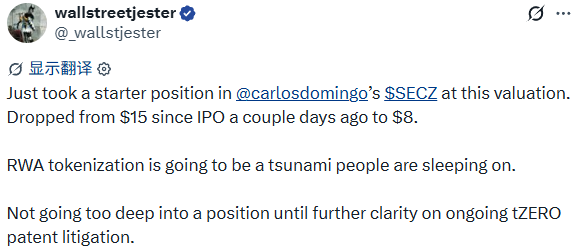
As X user wallstreetjester noted, he "just opened a position" in SECZ but clearly stated he "will not add significantly until the lawsuit has clearer progress." This represents the genuine sentiment of a segment of potential buyers.


Primary Market Believes in Institutions, Secondary Market Believes in Liquidity


Securitize's shareholder roster is impressively distinguished. It was chosen by BlackRock's BUIDL fund as its transfer agent, and during its PIPE financing round, it attracted institutional investors like Borderless Capital and Hanwha Investment. The SPAC transaction itself was initiated by an affiliate of Cantor Fitzgerald.


This narrative of "joint endorsement by traditional financial institutions" is highly persuasive during primary market fundraising and was a key support for Securitize's $1.25 billion pre-merger valuation.


However, the secondary market doesn't care about endorsements; it only cares about liquidity. The market still buys into the "tokenization" story; what has cooled off is merely the short-term pricing of Securitize's specific stock.


BlackRock's name might make primary market investors willing to pay for the valuation story, but it cannot convince the secondary market to continue holding shares when patent disputes are unresolved and SPAC handover pressure persists. Trust is a static brand asset; liquidity is the dynamic outcome of market博弈. This sharp decline precisely proves there is no necessary conversion rate between the two.


Securitize's share price will eventually stabilize or rebound as the investor base transition completes, a near-inevitable phase of growing pains for SPAC-listed companies. However, the patent war ignited by tZERO warrants vigilance from all participants in the tokenization industry.


With tZERO holding 105 patents and targeting at least six potential infringers, the next round of competition in the tokenization industry may no longer be just about compliance licenses, institutional relationships, or trading volume.


For platforms still relying on the valuation story of "we were the first to implement a certain technical solution," a cease-and-desist letter could bring that story to an abrupt halt at any moment.


Securitize's fall has wiped out short-term valuation; but tZERO's lawsuit may have unveiled a patent war that the entire tokenization industry is not yet prepared to face.


Related Questions

QWhat are the main reasons for Securitize's (SECZ) sharp stock price decline shortly after its NYSE listing?

AThe primary reasons for SECZ's decline are attributed to the inherent volatility of the SPAC listing mechanism and sector-wide pressure on crypto-related stocks. The SPAC structure triggered a shift in investor base from SPAC investors to long-term equity holders, causing significant price volatility during the handover. Simultaneously, the entire crypto-stock sector, including companies like Coinbase and Circle, has been underperforming the broader market, creating a negative backdrop for SECZ.

QWhat is the core nature of the legal dispute between tZERO and Securitize mentioned in the article?

AtZERO has accused Securitize of patent infringement, specifically alleging that Securitize's DS Protocol and Vault Registrar products violate two of its U.S. patents related to self-executing smart contract rules for security tokens and crypto integration platforms. Securitize responded by filing a declaratory judgment lawsuit, asking the court to confirm that its products do not infringe and characterizing tZERO's claims as baseless.

QHow does the article contrast the forces driving primary market valuation versus secondary market performance for companies like Securitize?

AThe article contrasts that in the primary market, valuation is driven by institutional trust and prestigious backers (like BlackRock, Cantor Fitzgerald), which supported Securitize's $1.25 billion pre-merger valuation. However, the secondary market prioritizes liquidity and immediate risk factors over brand endorsements. It reacts to concrete issues like pending patent lawsuits and SPAC-related selling pressure, leading to a disconnect between the initial valuation narrative and the stock's trading reality.

QWhat broader implication does the tZERO vs. Securitize patent lawsuit hold for the tokenization industry according to the article?

AThe lawsuit signals the potential start of a widespread patent war within the tokenization industry. tZERO's announcement that it has identified at least six other market participants as potential infringers suggests that patent enforcement could become a new, critical competitive dimension. This shift moves the industry beyond competition based solely on compliance, institutional relationships, and trading volume, introducing legal and intellectual property risks that could disrupt many platforms' business narratives.

QAccording to the article, what is the current status of the patent lawsuits against Securitize as of July 8th?

AAs of July 8th, the legal cases are in their early stages. The primary lawsuit filed by Securitize against tZERO (case 1:26-cv-00722) is before Judge Gregory B. Williams, with no substantive pleadings, counterclaims, motions to dismiss, or settlement news filed yet. Additionally, Securitize faces a separate, independent patent infringement lawsuit from Liquid Rarity Exchange. The outcomes remain uncertain, with possibilities ranging from out-of-court settlement to case dismissal.

Related Reads

After Three Consecutive Quarters of Decline, Can the Crypto Market Find a Window for Stabilization in Q3?

The cryptocurrency market has just concluded its worst-performing quarter since 2022, with total capitalization dropping 12.6% to $2.1 trillion. All core metrics indicate capital is leaving the sector, not just rotating within it. Bitcoin fell 14.2% and Ethereum dropped 25.4% in Q2, breaking their previous correlation with US tech stocks. A key driver is the reversal in US spot Bitcoin ETF flows, which saw a net outflow of approximately $4.67 billion in Q2, including a record monthly outflow near $4.5 billion in June. While recent data suggests long-term holders are accumulating again, sustained ETF outflows mean continued selling pressure. Market focus is now singularly on the Federal Reserve. The upcoming July FOMC meeting is seen as the most critical event for Q3. A dovish signal could support Bitcoin reclaiming a $68,000-$84,000 range, while a hawkish stance might establish a new trading band around $50,000-$56,000. Additionally, regulatory uncertainty persists, with the progress of the crucial *CLARITY Act* stalling in the Senate, reducing its perceived 2026 passage probability to 40-45%. Despite the broad downturn, a few sectors showed growth. Prediction markets saw nominal volume surge 48.7% year-over-year to $113.8 billion, and tokenized collectibles transaction volume rose 143% quarterly to $1.4 billion. The Real-World Asset (RWA) tokenization sector also continued steady growth, now representing ~$28.1 billion in on-chain value. The market's foundation for an extreme crash appears limited, with Bitcoin price hovering near its 200-week moving average. However, the trading paradigm has shifted from narrative-driven speculation to decisions based on price action, policy developments, and interest rate expectations, making a broad sentiment-driven rally unlikely in the near term.

marsbitYesterday 08:36

After Three Consecutive Quarters of Decline, Can the Crypto Market Find a Window for Stabilization in Q3?

marsbitYesterday 08:36

BIT Trading Moment: BTC Still Suppressed by Weekly 200 EMA, Rejection May Restart Decline; Storage and Semiconductors that Surged Last Night Begin Falling in Evening Trading

**Crypto & Stock Market Wrap: Bitcoin Tests Resistance, Stocks Retreat After AI Surge** Bitcoin consolidates around $66,000, facing key resistance near $68,000—an area seen as a major psychological and technical hurdle where previous rallies have failed. Analysts note the cryptocurrency is caught between its 200-week moving average (~$63,333) and 200-week EMA (~$68,328). A clear break above $68k is needed to signal a stronger bullish trend, while a rejection could lead to a retest of $63k support. Market sentiment remains cautious, with low futures open interest pointing to a low-liquidity rebound rather than a full bull market. Bitcoin spot ETFs saw another $203 million inflow. US stock futures pointed lower after a strong Tuesday session led by a massive rebound in semiconductors and memory stocks. The rally was fueled by renewed optimism about AI-driven hardware demand, with Micron, SanDisk, and SK Hynix surging. However, those gains reversed in pre-market trading. Super Micro Computer (SMCI) soared over 20% after hours on strong guidance and a record backlog. Other standouts included Rocket Lab and nuclear energy plays Oklo and X-Energy. Rising oil prices (Brent above $91) and climbing Treasury yields (10-year near 4.64%), however, are reigniting inflation concerns and acting as a headwind for equities. In Asia, markets were mixed. South Korea's KOSPI pared early gains to close slightly higher as semiconductor stocks like SK Hynix gave back initial surges. Japan's Nikkei edged lower as the yen hit a fresh 38-year low against the dollar, raising fears of potential market intervention. Key events to watch include the Samsung Galaxy launch, AMD's AI event, and a slew of major tech earnings from Alphabet, Tesla, and IBM after the close on Wednesday, followed by the ECB meeting and Intel's earnings on Thursday.

marsbitYesterday 08:28

BIT Trading Moment: BTC Still Suppressed by Weekly 200 EMA, Rejection May Restart Decline; Storage and Semiconductors that Surged Last Night Begin Falling in Evening Trading

marsbitYesterday 08:28

Former CFTC Chairman, Circle President Tarbert: Preaching Long-Termism While Cashing Out $30 Million Himself

Former CFTC Chairman and Circle President Heath Tarbert has consistently advocated for a long-term vision in public, urging patience from investors as Circle’s stock price has fallen significantly from its peak. However, it has been revealed that since Circle’s IPO, Tarbert has continuously sold his CRCL shares through pre-arranged trading plans, cashing out approximately $30 million, without making any public market purchases. This contrast between his public messaging and personal actions has drawn criticism. Tarbert joined Circle in July 2023 as Chief Legal Officer, leveraging his regulatory experience to help guide the company through its IPO and expansion. Despite promoting stablecoins as long-term infrastructure, he established a 10b5-1 trading plan just before Circle went public, leading to substantial stock sales over the following year. In March 2026, he initiated another plan to sell more shares. His career trajectory highlights a pattern of moving between high-level regulatory roles and influential positions in the financial sector. After resigning as CFTC Chairman in early 2021, he joined Citadel Securities as Chief Legal Officer just 27 days later, during a period of intense regulatory scrutiny for the firm. He later joined Circle, aiding its efforts to navigate regulatory challenges for its public listing. While Tarbert's expertise in policy and compliance is valuable to companies like Circle, his actions—advocating long-term confidence while personally divesting—raise questions about the alignment between his public statements and his private financial decisions, leaving investors who followed his advice to bear the market risks.

marsbitYesterday 08:06

Former CFTC Chairman, Circle President Tarbert: Preaching Long-Termism While Cashing Out $30 Million Himself

marsbitYesterday 08:06

Gate Research Institute: The 'Wall Street-ization' Wave of Crypto Financial Products – Competition or Integration?

The article titled "Gate Research Institute: Are Crypto Financial Products Sparking a 'Wall Street' Wave—Competition or Convergence?" explores the evolving relationship between the crypto ecosystem and traditional finance (TradFi). The piece begins by reflecting on Bitcoin's original 2009 vision of decentralization, disintermediation, and moving away from banks. It then contrasts this with the 2024 landscape, where key crypto assets like Bitcoin are increasingly held through Wall Street products like ETFs issued by giants like BlackRock. The article questions whether this signifies that TradFi is systematically taking over the rights to issue, price, custody, and distribute crypto financial assets. The core argument is that this is not a zero-sum takeover but rather a bidirectional convergence where each side addresses the other's weaknesses. Crypto offers 24/7 global markets, programmable settlement, and open access but lacks compliant channels, institutional-grade custody, deep fiat liquidity, and mainstream distribution. TradFi possesses these but is constrained by legacy systems, limited operating hours, and slow settlement. Two primary convergence paths are highlighted: * **Path A (CEX to TradFi):** Exemplified by Gate, which has progressed from offering tokenized stocks and CFDs to providing direct, real stock trading (US, Hong Kong, South Korea) within its platform, using USDT. * **Path B (TradFi to Crypto):** Exemplified by Robinhood, which has integrated crypto trading, acquired exchanges like Bitstamp, and is moving traditional assets like stocks onto the blockchain via tokenization and its own Layer 2. Both paths are ultimately competing to become the next-generation, unified financial account—a "super account" where users can seamlessly trade cryptocurrencies, stocks, ETFs, RWA (Real World Assets), and tokenized treasury products in one interface. The growth of RWA and tokenized treasuries (e.g., BlackRock's BUIDL) is presented as the asset-layer fusion, providing stable, yield-bearing assets on-chain and acting as a bridge between the two worlds. In conclusion, the "Wall Street-ization" of crypto is framed as a mutual transformation. Decentralized ideals persist in the protocol layer, while at the application layer, a more efficient, global, and accessible unified capital market is emerging from this convergence. The future competition lies not between crypto exchanges and stockbrokers, but between platforms vying to offer the most comprehensive asset coverage, liquidity, and user experience within a single account.

marsbitYesterday 08:01

Gate Research Institute: The 'Wall Street-ization' Wave of Crypto Financial Products – Competition or Integration?

marsbitYesterday 08:01

Trading

Spot
活动图片




