Le cuivre, l'or de 2026

marsbitPublished on 2026-06-16Last updated on 2026-06-16

Abstract

Le cuivre, longtemps considéré comme un simple baromètre économique (le "Dr. Copper"), est en train de voir sa narration évoluer fondamentalement. Si son prix reste lié au cycle manufacturier, de nouvelles demandes structurelles émergent massivement : les centres de données IA, l'expansion des réseaux électriques, les véhicules électriques, le stockage d'énergie et la réindustrialisation. Chaque utilisation d'électricité nécessite du cuivre. Le cœur du récit haussier réside dans les contraintes sévères de l'offre. Ouvrir une nouvelle mine de cuivre prend en moyenne 17 ans, les découvertes récentes sont rares et la teneur du minerai baisse. L'Agence Internationale de l'Énergie prévoit un déficit potentiel de 30% d'ici 2035. Cette rareté croissante, combinée à des risques géopolitiques dans les pays producteurs, lui confère une caractéristique de "valeur refuge", attirant désormais les capitaux macro (comme Druckenmiller) et les traders. Les actions minières du cuivre (comme Freeport-McMoRan, Southern Copper ou, en Chine, Luoyang Moly) amplifient ce mouvement, offrant un effet de levier sur le prix du métal, mais avec une volatilité et des risques spécifiques (coûts, permis, fiscalité). En résumé, le cuivre ne deviendra pas de l'or, mais il n'est plus uniquement un métal industriel cyclique. Sa "monétisation" ou "sécurisation", portée par la transition électrique mondiale et une offre rigide, ne fait que commencer.

Auteur original : Jia Liu

Le cuivre pourrait-il devenir une autre forme d'or à notre époque ?

Au cours des deux dernières années, le marché a compris les infrastructures d'IA comme une histoire de puces. Les GPU de NVIDIA, les capacités de production de TSMC, les rendements de la HBM, les goulets d'étranglement de l'emballage CoWoS, presque toutes les discussions ont tourné autour des tranches de silicium. Mais un centre de données d'IA ne se contente pas d'acheter des GPU et de les brancher pour qu'ils fonctionnent. Il nécessite également un raccordement au réseau électrique, des transformateurs, des canalisations de bus, des câbles, des systèmes de refroidissement liquide, des interconnexions par fibre optique et de grandes quantités de métal.

Dans notre précédent article « L'ère de l'IA, le moment de la "grande famine" pour la fibre optique et le cuivre », nous avons déjà évoqué brièvement un point : la demande de l'IA descend du niveau des puces vers celui de la fibre optique et du cuivre.

Cet article approfondit la manière dont le récit autour du cuivre a évolué cette année. Pourquoi le marché considère-t-il de plus en plus le cuivre comme l'or ? Pourquoi les capitaux macroéconomiques commencent-ils à acheter du cuivre ? Pourquoi les sociétés minières et les négociants en matières premières disent-ils tous qu'il n'y a « pas assez de cuivre » ? Pourquoi n'est-il plus seulement ce métal industriel utilisé pour juger des cycles économiques ?

Dr. Copper n'est plus seulement le reflet du cycle manufacturier

Dans le monde financier anglophone, il existe une vieille expression : Dr. Copper, que les médias financiers chinois traduisent parfois par « Docteur Cuivre ». Ce nom signifie que le prix du cuivre est comme un médecin de l'économie, capable de diagnostiquer à l'avance la santé de l'économie mondiale.

Car le prix du cuivre est indissociable du secteur manufacturier. Lorsque le lancement de projets immobiliers en Chine est important, que les stocks manufacturiers sont reconstitués, que la demande en électroménager, automobiles, câbles, tuyaux augmente, le prix du cuivre grimpe. Lorsque le cycle se retourne, le cuivre suit également la baisse. Le prix du cuivre est essentiellement le reflet du cycle immobilier chinois, du cycle manufacturier mondial et du cycle commercial.

Mais aujourd'hui, la demande de cuivre a de nouvelles variables : les centres de données d'IA, l'expansion des réseaux électriques, les véhicules électriques, le stockage d'énergie, l'industrie militaire, la réindustrialisation, tous augmentent la demande structurelle de cuivre.

Partout où l'électricité est utilisée, le cuivre est indispensable.

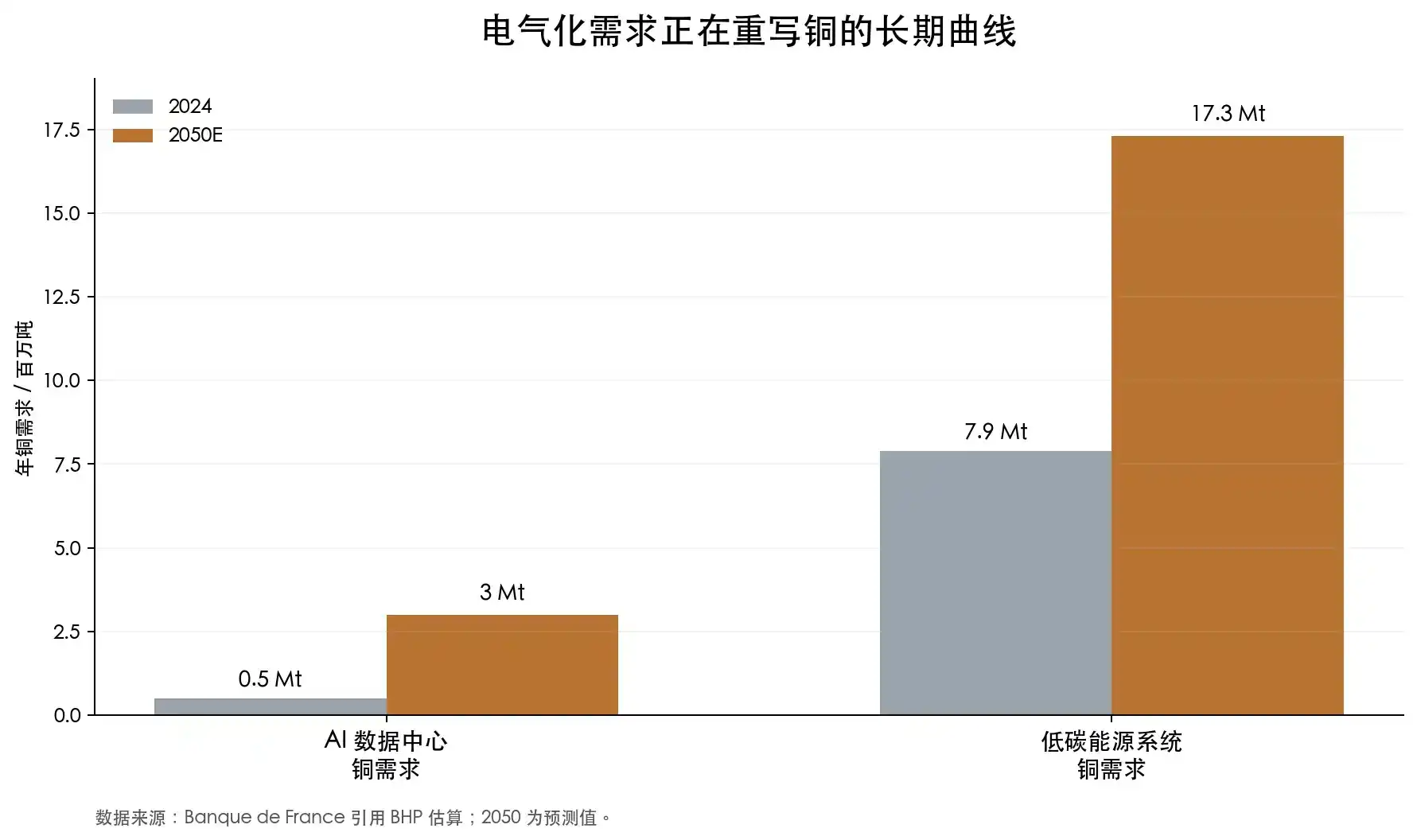
La Banque de France, dans une analyse sur les centres de données d'IA et le marché du cuivre, cite une estimation de BHP : la demande de cuivre pour les centres de données d'IA pourrait passer d'environ 500 000 tonnes en 2024 à environ 3 millions de tonnes d'ici 2050. Sur la même période, la demande de cuivre pour les systèmes énergétiques bas carbone pourrait passer de 7,9 millions de tonnes à 17,3 millions de tonnes. L'article cite également un cas concret : la construction du centre de données de Microsoft à Chicago a consommé 2 177 tonnes de cuivre.

Isolément, ce chiffre n'est pas particulièrement important sur le marché mondial du cuivre. Mais le point clé n'est pas la quantité de cuivre utilisée par un centre de données particulier, mais le fait que derrière un centre de données d'IA, il n'y a pas qu'une demande ponctuelle, mais tout un ensemble de besoins en infrastructures électriques. Plus les GPU sont denses, plus la puissance des baies est élevée, plus un centre de données ressemble à une usine à haute consommation d'énergie. Une usine a besoin d'électricité, et l'électricité nécessite un réseau, des transformateurs, des câbles, des canalisations de bus, des équipements de commutation et des systèmes de refroidissement.
Bien sûr, on ne peut pas non plus attribuer simplement toute l'histoire du cuivre à l'IA.

Richard Holtum, PDG du géant mondial du commerce de matières premières Trafigura, a rappelé lors de la LME Week 2025 que les centres de données et la défense sont certes en vogue, mais que l'essentiel de la demande de cuivre pour la prochaine décennie proviendra toujours des infrastructures traditionnelles, de la construction, de l'urbanisation et des biens de consommation. Il a également mentionné que la consommation de cuivre pour les climatiseurs dépassait encore celle des centres de données.

Ce point de vue offre également une nouvelle perspective : l'augmentation de la demande de cuivre n'est pas soutenue uniquement par l'IA, sa demande augmente parce que presque tous les scénarios d'utilisation de l'électricité se développent simultanément.

La plus grande logique de bull market du cuivre, c'est qu'on ne peut pas l'extraire assez vite

La première impression que beaucoup ont du cuivre est celle d'un « métal industriel », pensant toujours que si le prix augmente, les mines extrairont davantage et l'offre suivra naturellement. Mais la réalité n'est pas ainsi.

Pour une grande mine de cuivre, de la découverte, l'exploration, la confirmation des ressources, l'étude de faisabilité, le financement, les permis, la construction, jusqu'à la mise en production, il faut généralement plus d'une décennie. Un rapport de l'AIE montre qu'un nouveau projet de cuivre nécessite en moyenne environ 17 ans de la découverte à la production. Cela signifie que si le marché découvre soudainement en 2026 qu'il n'y a pas assez de cuivre, une nouvelle offre massive ne pourra pas nécessairement apparaître en 2028 ou 2029 ; une grande partie de l'offre devra attendre les années 2030.

Robert Friedland, fondateur et coprésident exécutif de la société minière canadienne Ivanhoe Mines, insiste constamment sur ce problème. Il est l'un des plus grands bulls du cuivre dans le secteur minier mondial, possédant le projet de cuivre de classe mondiale Kamoa-Kakula en République Démocratique du Congo. Son expression est toujours très radicale : le monde ne réalise pas encore de combien de cuivre il a réellement besoin. Au cours des dix dernières années, le monde n'a pas préparé suffisamment de nouvelles mines de cuivre pour l'ère de l'électrification.

Ce n'est pas seulement son jugement. Les données de l'AIE vont également dans ce sens.

La teneur moyenne des mines de cuivre dans le monde a diminué d'environ 40 % depuis 1991. Une baisse de teneur signifie que pour obtenir la même tonne de cuivre qu'autrefois, il faut maintenant extraire plus de minerai, consommer plus d'électricité, utiliser plus d'eau, traiter plus de stériles. L'AIE mentionne également que parmi les gisements de cuivre découverts au cours des 35 dernières années, seuls 5 % l'ont été au cours de la dernière décennie. Peu de nouvelles découvertes, baisse de la teneur des vieilles mines, allongement des délais de construction des projets, augmentation des dépenses en capital. L'AIE estime que, sur la base du pipeline de projets actuels, le marché du cuivre pourrait faire face à un déficit d'offre de 30 % d'ici 2035.

Le cuivre n'est donc pas un actif du type « l'offre apparaît immédiatement après une hausse des prix » comme dans un cycle de matières premières ordinaire. Les projets de mines de cuivre ressemblent de plus en plus à de grands projets d'infrastructure : il faut trouver le minerai, obtenir les permis, gérer les relations communautaires, résoudre les problèmes d'eau, faire face aux examens environnementaux et subir les changements de politique fiscale des pays ressources.

Le Chili, le Pérou, la RDC, la Zambie, l'Indonésie, la Mongolie, ces endroits ont tous d'importantes ressources en cuivre, et présentent également différentes formes de risques politiques, fiscaux, communautaires ou opérationnels. Plus le cuivre est stratégique, plus les pays ressources ont tendance à augmenter leur part ; plus le prix du cuivre est élevé, plus les sociétés minières risquent de faire face à des hausses d'impôts et à des renégociations.

La phase de fusion révèle également des tensions.

Après être entré dans une fonderie, le concentré de cuivre est transformé en cuivre raffiné. Les fonderies facturent aux mines des frais de traitement et d'affinage, appelés dans le secteur TC/RC (treatment charge et refining charge). Normalement, lorsque l'offre de concentré est abondante, les fonderies ont un fort pouvoir de négociation et les TC/RC sont élevés ; lorsque le concentré est rare, les fonderies se disputent la matière première et les TC/RC chutent.

Un aspect assez inhabituel en 2026 est que, tandis que le prix du cuivre atteint de nouveaux sommets, les frais de traitement en fonderie tombent à des niveaux historiquement bas. L'AIE indique que le TC/RC annuel de référence pour 2026 est tombé à 0 dollar par tonne, et que le TC/RC au comptant est négatif depuis 2024.

Cela est plus révélateur que le simple examen des stocks en bourse. Car le goulot d'étranglement du cuivre ne se situe pas seulement au niveau du produit fini raffiné, mais aussi au niveau des mines et du concentré. Si la matière première en amont est rare, même de nombreuses fonderies ne serviront à rien. La Chine a considérablement augmenté ses capacités de fusion du cuivre au cours des vingt dernières années. L'AIE indique que la Chine représente plus de 90 % de la croissance mondiale de la production de cuivre raffiné depuis 2005 et qu'en 2025, elle représentera environ la moitié de la production mondiale de cuivre raffiné. La capacité en aval est forte, mais les mines en amont sont tendues, ce qui amplifie la fragilité de la chaîne d'approvisionnement.

La rareté de l'or provient de ses réserves, de ses coûts d'extraction et de ses attributs monétaires. Le cuivre n'est certes pas de l'or, mais lorsque son offre nouvelle se ralentit de plus en plus, ses ressources se concentrent de plus en plus et ses attributs stratégiques se renforcent, il commence également à posséder une certaine sensation de rareté similaire à celle de l'or.

Pourquoi les capitaux macroéconomiques commencent-ils à aimer le cuivre

Autrefois, le cuivre appartenait principalement aux négociants en matières premières et aux analystes miniers. Aujourd'hui, il attire de plus en plus les capitaux macroéconomiques.

Prenez Stanley Druckenmiller, par exemple. Il est l'un des investisseurs macroéconomiques les plus connus aux États-Unis, ayant autrefois géré le Quantum Fund avec George Soros, avant de fonder Duquesne Family Office. Sa caractéristique est de jouer les grands cycles, avec des positions importantes sur des trades de haute conviction, c'est pourquoi le marché suit attentivement son opinion sur l'IA, le dollar, les obligations et les matières premières.

Il a récemment mentionné dans un entretien avec Morgan Stanley que son portefeuille était principalement piloté par l'IA ces dernières années, mais qu'il s'est maintenant tourné vers un positionnement plus macroéconomique et géopolitique. Il a mentionné détenir du cuivre, être bearish sur le dollar, et détenir également de l'or comme couverture géopolitique.

Sa logique est la suivante : si le dollar s'affaiblit, les matières premières libellées en dollars en bénéficieront. L'élargissement des déficits budgétaires, la poursuite des investissements publics, la hausse des risques géopolitiques favorisent les achats d'or ; dans le même environnement, l'expansion des réseaux électriques, l'industrie militaire, les centres de données d'IA, les systèmes énergétiques et le retour des activités manufacturières généreront également une demande pour des actifs physiques, et le cuivre se trouve à l'intersection de toutes ces tendances.

Druckenmiller représente la perspective des capitaux macroéconomiques, mais dans le monde du trading des matières premières, les expressions sont encore plus radicales.

Pierre Andurand en est l'exemple le plus typique. Il est un gérant de hedge funds européen renommé dans les matières premières, ayant commencé dans le trading énergétique, cofondé BlueGold Capital, puis fondé Andurand Capital. Il a donné un jugement très radical dans un entretien avec le Financial Times : le prix du cuivre pourrait atteindre 40 000 dollars la tonne dans les prochaines années.

L'opinion de Jeff Currie mérite également d'être mentionnée. Jeff Currie a longtemps été responsable de la recherche sur les matières premières chez Goldman Sachs, avant de rejoindre Carlyle. C'est l'une des personnalités les plus influentes de la recherche sur les matières premières à Wall Street. Il a déjà avancé l'expression « copper is the new oil » (le cuivre est le nouveau pétrole), signifiant qu'à l'ère de la transition énergétique, le cuivre pourrait jouer un rôle de ressource de base similaire à celui du pétrole à l'ère des énergies fossiles. En 2024, il a de nouveau qualifié le cuivre de l'un de ses trades ayant la plus haute conviction.
Les données montrent également que les capitaux affluent.

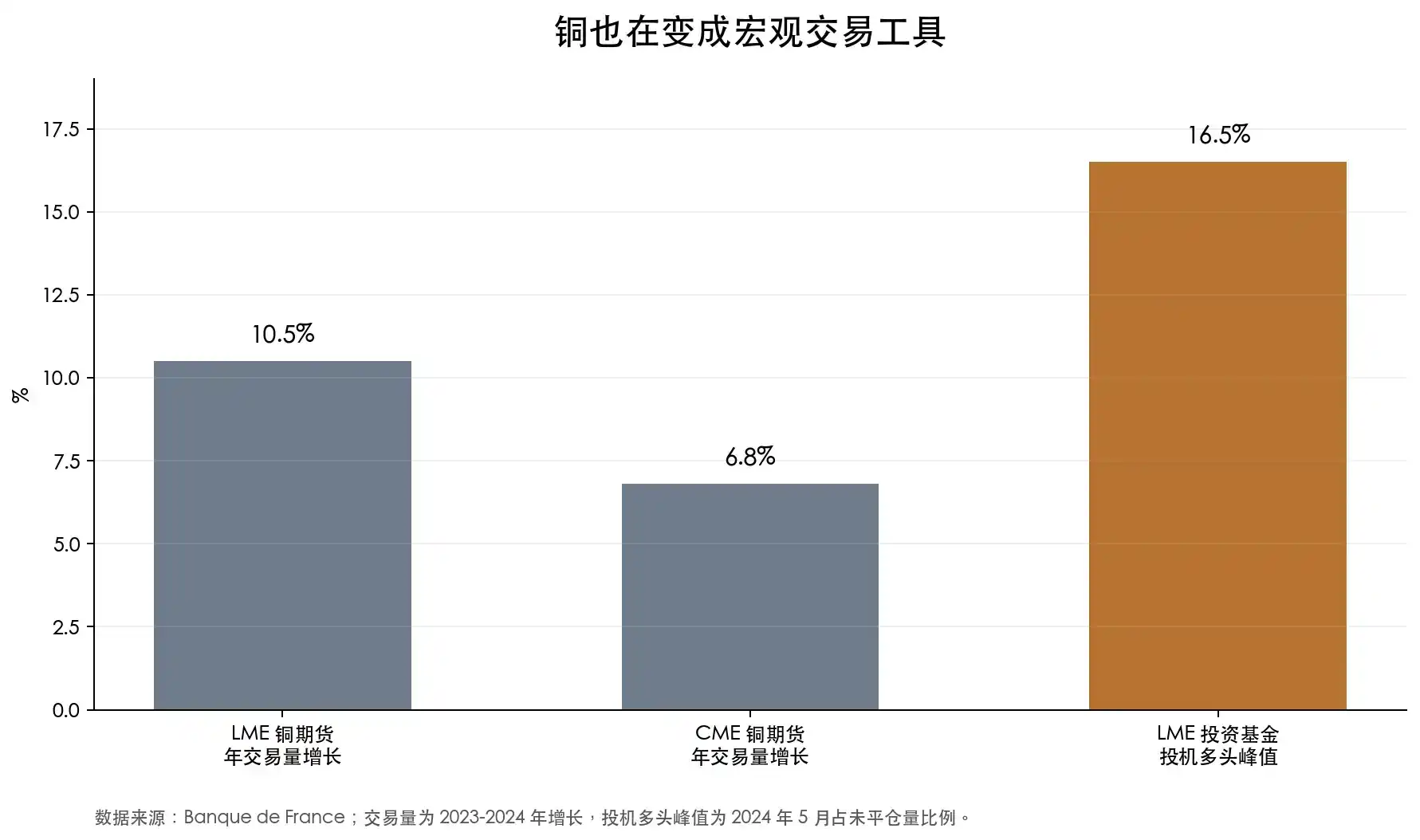
La Banque de France mentionne qu'entre 2023 et 2024, le volume annuel des transactions sur les contrats à terme du cuivre du LME a augmenté de 10,5 %, et celui du CME de 6,8 % ; sur le LME, les positions longues spéculatives des fonds d'investissement ont atteint 16,5 % des positions ouvertes en mai 2024. Il ne s'agit pas d'un simple recomplètement des stocks physiques, mais de capitaux financiers utilisant le cuivre comme outil de trading macroéconomique.

Actions minières du cuivre : l'effet de levier du cuivre

Dans un marché haussier de l'or, les actions aurifères amplifient généralement les fluctuations du prix de l'or. Dans un marché haussier du cuivre, les actions minières du cuivre ont un effet d'amplificateur similaire.

Une hausse du prix du cuivre représente une pression sur les coûts pour les utilisateurs finaux, mais pour les sociétés minières disposant déjà de capacités de production, cela peut signifier une expansion des marges. Par exemple, si le prix du cuivre passe de 9 000 dollars la tonne à 12 000 dollars la tonne, et si le coût en cash de la société minière n'augmente pas simultanément, une grande partie des 3 000 dollars supplémentaires ira directement dans le compte de résultats. C'est précisément pour cette raison que les actions minières du cuivre ont naturellement un levier opérationnel. Une hausse du prix du cuivre peut entraîner une hausse encore plus forte des bénéfices des sociétés minières ; une baisse du prix du cuivre entraînera une contraction plus rapide des bénéfices.

Ces deux dernières années, le marché a déjà pris en compte cet effet de levier.

Prenons l'exemple du marché A. De juin 2024 à juin 2026, China Molybdenum est l'exemple le plus typique de forte élasticité. Son argument principal réside dans ses actifs cuivre-cobalt en RDC, notamment Tenke Fungurume et KFM. En se basant sur une estimation approximative du prix de clôture ajusté, China Molybdenum a enregistré une hausse d'environ 129 % sur cette période, avec une hausse maximale approchant les 260 %. Il ne s'agit pas de la performance d'une action cyclique ordinaire, mais d'une revalorisation par le marché des ressources en cuivre à l'étranger.

Des sociétés comme Jiangxi Copper, Tongling Nonferrous Metals et Yunnan Copper reflètent mieux la volatilité combinée du prix du cuivre et de l'activité de fonderie. Jiangxi Copper a enregistré une hausse d'environ 82 % sur la période, avec un pic dépassant 200 % ; Tongling Nonferrous a progressé d'environ 77 %, avec un pic d'environ 159 % ; Yunnan Copper n'a augmenté que d'environ 29 %, mais a également atteint un pic de plus de 130 %.

Ces actions illustrent l'autre facette des actions minières du cuivre : en période de hausse, l'élasticité est importante ; en période de reflux, les corrections sont également brutales.

En observant les corrections depuis les sommets, la volatilité est plus évidente. Yunnan Copper a corrigé d'environ 45 % depuis son pic sur la période, Jiangxi Copper d'environ 41 %, China Molybdenum, North Copper, Zijin Mining ont également subi des corrections de plus de 30 %. Les actions minières du cuivre ne sont pas le prix du cuivre lui-même ; elles sont le résultat de l'interaction entre le prix du cuivre, les coûts, les stocks, les TC/RC, l'avancement des projets, les risques liés aux pays ressources et le sentiment du marché actions.

Sur le marché américain, le représentant typique des actions minières du cuivre est Freeport-McMoRan, ticker FCX. C'est l'un des principaux producteurs de cuivre américains, avec des actifs incluant Morenci aux États-Unis, Cerro Verde au Pérou et Grasberg en Indonésie. Pour les capitaux mondiaux, FCX est presque l'un des outils les plus couramment utilisés pour obtenir une exposition au prix du cuivre sur le marché américain. Les données de MarketWatch montrent que FCX a atteint un sommet sur 52 semaines à 72,09 dollars le 2 juin 2026, mais a chuté de 9,07 % en une seule journée le 5 juin, corrigeant de plus de 12 % par rapport au sommet en quelques jours.

Southern Copper, ticker SCCO, est un autre représentant de qualité des actions minières du cuivre. Ses actifs sont principalement au Pérou et au Mexique, avec une forte exposition au cuivre et une forte rentabilité. IBD a mentionné plus tôt cette année que SCCO avait progressé jusqu'à 55 % sur l'année et avait atteint un sommet historique. Comparé à FCX, SCCO ressemble davantage à un actif cuivre de haute pureté et de bonne qualité de bénéfices, mais il n'échappe pas non plus aux risques liés au prix du cuivre et aux pays ressources.

Si les investisseurs ne souhaitent pas miser sur une seule entreprise, ils peuvent se tourner vers les ETF sur les mines de cuivre. Par exemple, le Global X Copper Miners ETF, un ETF qui suit les sociétés minières de cuivre dans le monde.

Cependant, les actions minières du cuivre sont bien plus complexes que le cuivre.

La valeur d'une société minière ne dépend pas seulement du prix du cuivre, mais aussi de la teneur de la mine, du coût en cash, de la durée de vie des réserves, des dépenses en capital, du pays d'implantation, de la politique fiscale, des relations avec la main-d'œuvre, des permis environnementaux, des conditions de transport et de l'exécution par la direction. Le prix du cuivre peut revaloriser l'ensemble du secteur, mais à terme, une forte différenciation apparaîtra entre les entreprises.

Les risques liés aux pays ressources sont particulièrement importants. De nombreuses mines de cuivre de qualité se trouvent au Chili, au Pérou, en RDC, en Zambie, en Mongolie, en Indonésie. Une bonne dotation en ressources ne garantit pas une stabilité des rendements pour les actionnaires. Plus le cuivre a de la valeur, plus les gouvernements seront tentés de recalculer leur part ; plus le projet est grand, plus les problèmes communautaires, environnementaux, d'eau et d'infrastructure seront difficiles à gérer.

L'inflation des coûts peut également grignoter les bénéfices. Lorsque le prix du cuivre augmente, les coûts de l'énergie, des équipements, de la main-d'œuvre, de l'acier et du financement augmentent souvent également. Un projet de développement qui semble très prometteur peut, à cause de dépassements de budget en capital, de retards de mise en production, d'obstacles aux permis, ne finalement laisser que peu de bénéfices aux actionnaires.

Les sociétés minières de cuivre en phase de développement présentent des risques plus élevés. Leur récit porte sur les réserves et la production futures, mais de la ressource à la réserve exploitable, de l'étude de faisabilité au financement, du permis à la construction, chaque étape peut échouer. La logique de long terme du cuivre est valable, mais cela ne signifie pas que chaque action minière de cuivre se concrétisera.

Ainsi, les actions minières du cuivre sont mieux comprises comme une expression à effet de levier de la logique du prix du cuivre, plutôt que comme un simple substitut au prix du cuivre lui-même. Elles peuvent offrir une plus grande élasticité, mais entraîner également des corrections plus importantes. Les entreprises qui méritent vraiment d'être étudiées sont celles à faible coût, longue durée de vie, avec une voie d'expansion claire, un bilan solide et des risques politiques contrôlables.

Cela fait également partie de la « dorification » du cuivre : la logique de rareté du cuivre ne s'arrête pas au marché physique et à terme ; elle est en train d'être repackagée par le marché actions, les ETF et les capitaux spéculatifs. La hausse du prix du cuivre est un niveau de trading, la hausse des actions minières du cuivre en est un autre. Le premier reflète la matière première elle-même, le second reflète l'imagination que le marché est prêt à payer pour cette pénurie de long terme.

La « dorification » du cuivre ne fait que commencer

Ce monde a besoin de plus d'électricité, et plus d'électricité signifie plus de cuivre.

Bien sûr, le cuivre ne deviendra pas vraiment de l'or. Il n'a pas les attributs monétaires purs de l'or et ne se débarrassera pas du cycle économique. Un ralentissement de l'économie mondiale, un affaiblissement du secteur manufacturier, un refroidissement des actifs risqués, tous ces facteurs pèseront sur le prix du cuivre. Le cuivre continuera à fluctuer, et peut-être même de manière violente.

Mais le changement réside dans le fait que la logique fondamentale du cuivre n'est plus la même qu'avant.

Autrefois, les fortes baisses du prix du cuivre survenaient souvent lors d'un affaiblissement de la demande combiné à un excès d'offre. Aujourd'hui, le côté offre n'est pas aussi détendu. Le vieillissement des mines, la baisse des teneurs, l'allongement des délais d'obtention des permis, la concurrence pour la matière première au niveau de la fusion, la redistribution des bénéfices par les pays ressources, tous ces facteurs font que le cuivre est de plus en plus difficile à considérer simplement comme un produit cyclique ordinaire.

Il reste peut-être un métal industriel, mais il n'est plus seulement le reflet du cycle industriel.

La « dorification » du cuivre ne fait que commencer.

Related Questions

QPourquoi le cuivre est-il parfois appelé « Dr. Copper » et comment son rôle a-t-il évolué récemment ?

ALe cuivre est appelé « Dr. Copper » car son prix était historiquement considéré comme un indicateur avancé de la santé de l'économie mondiale, reflétant les cycles de la construction et de la fabrication. Récemment, son rôle a évolué : au-delà des cycles industriels traditionnels, la demande de cuivre est désormais tirée par de nouveaux moteurs structurels comme les centres de données IA, l'expansion des réseaux électriques, les véhicules électriques et la réindustrialisation, ce qui lui confère une dimension stratégique et une rareté croissante.

QQuels sont les principaux facteurs qui limitent l'offre de cuivre et contribuent à sa rareté croissante ?

APlusieurs facteurs limitent l'offre de cuivre : 1) Les longs délais de développement des nouvelles mines (environ 17 ans de la découverte à la production). 2) La baisse continue de la teneur moyenne des minerais (environ -40% depuis 1991), nécessitant plus de ressources pour extraire la même quantité. 3) Le manque de découvertes majeures récentes. 4) L'inflation des coûts en capital et les défis croissants en matière de permis, d'environnement et de relations avec les communautés locales dans les pays ressources. L'Agence Internationale de l'Énergie estime un déficit d'offre potentiel de 30% d'ici 2035.

QComment les investisseurs macroéconomiques, comme Stanley Druckenmiller, justifient-ils leur intérêt pour le cuivre ?

ALes investisseurs macroéconomiques comme Stanley Druckenmiller voient dans le cuivre un actif bénéficiant de plusieurs tendances structurelles : un dollar américain potentiellement plus faible (qui soutient les matières premières libellées en USD), des déficits budgétaires importants, des investissements publics massifs dans les infrastructures (réseaux, défense, centres de données) et la réindustrialisation. Le cuivre se trouve à l'intersection de ces thèmes, agissant à la fois comme un actif réel (physical asset) et un proxy pour la transition énergétique et technologique, similairement à l'or pour la couverture géopolitique.

QPourquoi les actions des sociétés minières de cuivre sont-elles considérées comme un « levier » sur le prix du cuivre, et quels sont les risques associés ?

ALes actions minières du cuivre sont un levier car leurs profits et leur valorisation boursière sont très sensibles aux variations du prix du métal. Une hausse du prix se traduit de manière amplifiée dans leurs marges, offrant un potentiel de rendement supérieur. Cependant, les risques sont multiples : exposition aux risques politiques et fiscaux des pays hôtes (Chili, Pérou, RDC, etc.), inflation des coûts opérationnels et en capital, délais et dépassements de budgets sur les nouveaux projets, et volatilité boursière souvent plus forte que celle du métal lui-même. Elles ne sont donc pas un substitut pur au cuivre.

QQue signifie l'expression « la 'dorification' du cuivre » utilisée dans l'article, et en quoi ce processus est-il différent du passé ?

AL'expression « la 'dorification' du cuivre » fait référence au fait que le cuivre acquiert certaines caractéristiques similaires à l'or : une perception de rareté structurelle (due aux contraintes d'offre à long terme), un statut d'actif refuge ou de couverture macroéconomique, et un afflux d'intérêt de la part des capitaux financiers (hedge funds, ETF) au-delà des acteurs traditionnels du secteur physique. La différence avec le passé est que le cuivre n'est plus seulement un simple baromètre cyclique de l'industrie ; il est désormais soutenu par des moteurs de demande structurels et une offre contrainte, ce qui modifie sa dynamique fondamentale et en fait un actif plus stratégique.

Related Reads

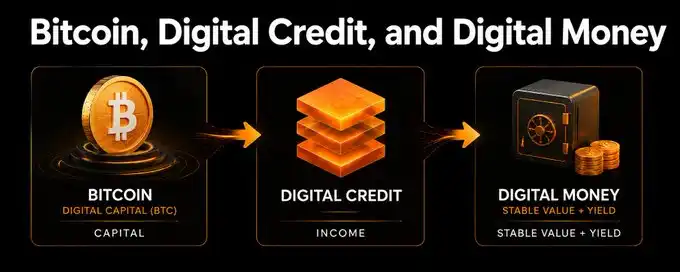
Saylor's Latest Long Read: Bitcoin is Not Money, It's Digital Capital, and Money is Built Upon It

Michael Saylor presents his "Digital Asset Stack" theory, positioning Bitcoin as the foundational layer of digital capital. He argues Bitcoin itself should remain unchanged—no staking, inflation, or protocol alterations. Instead, a five-layer financial architecture should be built atop it: Digital Capital (BTC), Digital Credit (e.g., yield instruments like STRC), Digital Currency (stable, yield-bearing instruments pegged to fiat), Digital Yield (leveraged/structured products), and Digital Equity (e.g., MSTR stock, absorbing residual volatility). Saylor asserts this stack transforms Bitcoin's high-volatility, high-energy capital into tailored products: stable currencies for payments/savings, yield instruments for income seekers, and equity for growth investors. This approach meets diverse needs—corporate treasuries, banks, retirees, emerging market users—without compromising Bitcoin's core properties (scarcity, decentralization). The "killer use case" is rebuilding global money, credit, and capital markets on Bitcoin, bridging the fiat world with a superior digital asset foundation. The system leverages traditional finance principles (risk layering, structured products) while using Bitcoin as the ultimate collateral. This expands Bitcoin's utility, drives adoption, and offers a better monetary experience: digital, yield-bearing, stable-value tools for everyday use.

marsbit5m ago

Saylor's Latest Long Read: Bitcoin is Not Money, It's Digital Capital, and Money is Built Upon It

marsbit5m ago

Can SK Hynix's Stock Double Again in This Rally?

The article discusses the highly optimistic price target of approximately $3,500 for SK Hynix stock, set by Aletheia Capital. This target is significantly above the consensus range of $2,000-$2,520 from major brokerages. The core debate is whether SK Hynix deserves a fundamental re-rating beyond its traditional cyclical discount, based on the long-term impact of AI-driven demand. The $3,500 target hinges on three key assumptions holding simultaneously until at least 2027: 1) Continued shortage and high pricing for HBM (High Bandwidth Memory), a critical component for AI chips; 2) Sustained high prices for standard DRAM, as HBM production consumes capacity and constrains general supply; and 3) Strong AI server demand generating substantial, above-expectation free cash flow. SK Hynix's leading ~58% market share in HBM and its early certification with key clients like Nvidia provide a competitive advantage, allowing it to capture significant supply chain premiums. The HBM shortage is seen not just as a niche growth driver but as a catalyst that amplifies profitability across the entire memory business by tightening overall DRAM supply. However, the article cautions that this target represents an optimistic "tail scenario." Key risks include potential supply increases from competitors (Samsung, Micron) by 2027, a possible slowdown in HBM price growth, and high capital expenditures that could erode the projected free cash flow. The divergence in analyst targets reflects the market's uncertainty over whether the current AI-driven boom will temporarily elevate earnings or permanently raise the memory industry's profit baseline.

marsbit8m ago

Can SK Hynix's Stock Double Again in This Rally?

marsbit8m ago

Has the Cryptocurrency Market Hit Bottom? Here's What Institutions Think

"Has the crypto market bottomed out? Major institutions are divided on the outlook, according to a recent analysis by Matt Hougan, Chief Investment Officer of Bitwise. Three prominent research firms published in-depth reports on the topic with differing conclusions. Galaxy Digital argues Bitcoin has not yet found its bottom, pointing to only 4 out of 13 historical bottoming indicators being met. Their analysis suggests a potential bottom range of $30,000 to $54,000. NYDIG adopts a more cautious stance, noting that while metrics are close to historical bear market lows, a classic panic-selling capitulation event is missing. They acknowledge the possibility of a bottom but consider it unlikely, citing structural changes from institutional adoption. In contrast, Standard Chartered Bank asserts the bottom is already in at around $59,000. Their revised bullish view, predicting a year-end target of $100,000, hinges on anticipated reductions in ETF selling pressure linked to events like a potential SpaceX IPO. Despite the surface-level disagreement on the exact price floor, the reports share significant common ground crucial for long-term investors. All three institutions agree that a market bottom will likely form within the current year, that current prices are closer to the bottom than to previous cycle highs, and that Bitcoin is poised for another major bull cycle in the future. The core takeaway is that while the precise bottom level remains debated, the long-term value proposition for Bitcoin remains strong and may even be strengthening. Key supportive trends include rising global debt, persistent inflation, declining trust in traditional institutions, accelerating digitization, and improving market infrastructure. Therefore, for investors with a long-term horizon, the focus should shift from pinpointing the exact bottom to recognizing that the cycle's peak is likely still ahead, making current levels an attractive entry point for substantial potential upside."

Foresight News29m ago

Has the Cryptocurrency Market Hit Bottom? Here's What Institutions Think

Foresight News29m ago

Trading

Spot
Futures

Hot Articles

What is LINON

Linde plc Tokenized Stock (Ondo): Revolutionizing Traditional Equity Access Through Blockchain Innovation The emergence of Linde plc Tokenized Stock (Ondo), represented by the ticker $LINON, signifies a monumental shift in the fusion of traditional financial structures and decentralized finance (DeFi). This innovative financial instrument showcases the tremendous potential of blockchain technology to democratize access to traditional equity markets while ensuring the security and regulatory compliance necessary for institutional-grade financial products. Through Ondo Finance's pioneering tokenization platform, $LINON provides a seamless pathway for global investors to engage with one of the world's leading industrial gas companies, Linde plc, creating a blockchain-native representation of the underlying equity. Introduction to Linde plc Tokenized Stock The landscape of financial markets is witnessing a groundbreaking transformation through the tokenization of real-world assets. Linde plc Tokenized Stock (Ondo) epitomizes this revolutionary approach by bridging the gap between conventional stock ownership and blockchain-enabled financial infrastructure. The $LINON token allows investors to gain exposure to one of the prominent industrial companies worldwide through decentralized technology. Operating within Ondo Finance's comprehensive ecosystem, $LINON symbolizes a practical application of tokenization technology that enhances accessibility, efficiency, and global connectivity in traditional financial markets. By leveraging blockchain infrastructure, this tokenized stock enables international investors to participate in U.S. equity markets, overcoming traditional barriers associated with cross-border investing. The significance of $LINON goes beyond technological innovation; it represents a fundamental shift in asset structuring, distribution, and trading in the digital age. This tokenized stock maintains all the economic benefits associated with traditional Linde plc shares while offering improved liquidity, programmable compliance features, and seamless integration with decentralized finance protocols. The development of $LINON indicates a growing acceptance of blockchain technology as a viable means for traditional finance, exemplifying how even well-established assets like Linde plc can integrate into blockchain systems. This approach preserves the core attributes that appeal to investors while introducing advanced capabilities that enhance the overall investment proposition. Project Overview and Objectives Linde plc Tokenized Stock (Ondo) encapsulates a strategic effort to democratize access to traditional equity markets through advanced blockchain technologies. The primary objective of $LINON is to provide approved global investors seamless access to the economic exposure associated with Linde plc shares, furthering an effort to create a more inclusive financial ecosystem. Beyond the digital representation of traditional assets, $LINON endeavors to eliminate barriers of geography and time zones that limit investor participation. Its design ensures that blockchain technology can elevate traditional investment vehicles without undermining the security or compliance requirements expected by investors. Key goals of the project include enhanced liquidity provision, programmable compliance mechanisms, and interoperability with other blockchain networks. Each $LINON token is fortified by actual Linde plc securities housed at U.S.-registered broker-dealers, allowing holders to reap economic advantages akin to traditional stockholders, such as dividend reinvestment. Furthermore, $LINON aims to establish new industry standards for institutional-grade tokenized securities, paving the way for traditional assets to embrace blockchain technology while remaining compliant with regulatory frameworks. By associating itself with a company as reputable as Linde plc, the project opens avenues for exploring tokenized equities catering to both conservative institutional players and daring retail investors. Project Creator and Development Team The vision for Linde plc Tokenized Stock (Ondo) comes from Nathan Allman, founder and CEO of Ondo Finance. His background in traditional finance coupled with expertise in blockchain technology positions him uniquely to navigate the complexities of asset tokenization. Allman's academic journey began at Brown University, focusing on Economics and Biology, equipping him with valuable analytical skills. His time at Goldman Sachs in the Digital Assets division strengthened his understanding of the interplay between financial institutions and emerging technologies, laying the groundwork for his later endeavors in alternative investment strategies. Under Allman's guidance, Ondo Finance has emerged as a leader in asset tokenization, launching $LINON as a flagship example of the company's larger mission towards revolutionizing traditional financial systems using blockchain technology. His commitment to leveraging blockchain for creating institutional-grade financial products has shaped the landscape of real-world asset tokenization. Investment and Funding Structure The growth of Ondo Finance, the platform powering Linde plc Tokenized Stock (Ondo), is bolstered by robust financial backing from prestigious venture capital firms and strategic investors. This strong investment foundation underpins the development of the key infrastructure essential for compliant tokenized securities like $LINON. In August 2021, Ondo Finance secured $4 million in seed funding led by a major venture capital firm, which enabled the company to commence platform development and establish the necessary regulatory processes for tokenizing real-world assets. This early investment cemented Ondo Finance's credibility within the industry. The Series A funding round followed, garnering $20 million with participation from renowned firms committed to transformative technology companies. This backing demonstrated substantial institutional confidence in Ondo Finance's vision, allowing it to hone its approach to asset tokenization through mechanisms that ensure compliance and accessibility. Noteworthy contributors, including institutional investors and experienced partners, have added significant value to Ondo Finance’s development efforts. Their involvement underscores the confidence across sectors in Ondo Finance's approach to bridging traditional finance with blockchain innovations. Technical Infrastructure and Innovation The technical architecture that underpins Linde plc Tokenized Stock (Ondo) represents a sophisticated melding of traditional finance systems and cutting-edge blockchain technology. The architecture's foundation is built on the Ethereum network, renowned for its security and programmability—both critical for intricate financial instruments. The $LINON tokenization process comprises creating a blockchain-native representation of Linde plc shares that preserves economic benefits while augmenting investor capabilities. Each token corresponds to actual shares held at U.S.-registered broker-dealers, creating a compliant custody structure that legitimizes the asset's existence and value. Automated compliance systems are integrated into the tokenization process, managing critical components such as know-your-customer (KYC) verification and anti-money laundering (AML) protocols. This incorporation of programmable compliance empowers $LINON to uphold regulatory standards essential for institutional proliferation. Cross-chain interoperability characterizes the advanced technical features of $LINON. While initially deployed on Ethereum, the framework is designed for expansion to other networks such as Solana and BNB Chain. This adaptability enhances liquidity and accessibility, allowing investors to select their preferred blockchain ecosystems. Historical Timeline and Development Crafting the history of Linde plc Tokenized Stock (Ondo) unfolds in parallel with the evolution of Ondo Finance's tokenization platform. The timeline's inception dates back to March 2021 when Nathan Allman laid the foundations for creating institutional-grade financial products on blockchain infrastructure. The initial funding round in August 2021 provided crucial resources for developing the platform and establishing partnerships necessary for effective tokenization. By January 2023, Ondo Finance launched its tokenized treasury products, establishing mechanisms that would facilitate future tokenized equities such as $LINON. A pivotal milestone arose in February 2025 when Ondo Chain—a Layer 1 blockchain designed specifically for asset tokenization—was introduced. This infrastructure enhances capabilities vital for institutional markets, demonstrating Ondo Finance's long-term commitment to tokenization. Subsequently, the launch of Ondo Global Markets in September 2025 marked the official debut of $LINON. This milestone showcased the successful transition from development to active trading, enabling investors around the world to access American financial markets seamlessly. Ongoing development plans include a targeted expansion of available tokenized assets to over 1,000 by the end of 2025, pointing to a bright future for Ondo Finance's ecosystem and its mission to broaden tokenized equity accessibility. Regulatory Compliance and Legal Framework The legal architecture governing Linde plc Tokenized Stock (Ondo) emphasizes a sophisticated approach to regulatory compliance, allowing tokenized securities to be implemented within a blockchain-based framework. The legal structure governing $LINON spans multiple jurisdictions while maintaining a robust legal footing. Compliance systems ensure that only eligible investors can access the token, enforced through automated verification that aligns with international regulations. This innovative regulatory technology promises real-time enforcement of complex requirements, considerably enhancing efficiency in operating within the regulatory landscape. The custody framework undergirding $LINON ensures that the underlying shares are securely held at U.S.-registered broker-dealers, complying with necessary regulations while delivering blockchain-driven access to investors. The token maintains its economic equivalency and security through this carefully structured custody arrangement. KYC and AML compliance systems are embedded within the smart contract architecture, ensuring integrity and adherence to regulatory practices while fostering transparency for investors. The jurisdictional restrictions mark a commitment to navigating the evolving landscape of international securities laws. Market Impact and Industry Significance The advent of Linde plc Tokenized Stock (Ondo) holds profound implications for the broader financial landscape, symbolizing a clear shift towards blockchain-enabled markets. $LINON serves as a proof-of-concept for integrating traditional companies into blockchain ecosystems, showcasing the potential benefits such as broader accessibility and improved efficiency. The market's response to $LINON indicates a growing acceptance of tokenization among institutional investors, contributing to the emergence of an expanding sector wherein traditional assets can be interconnected with blockchain innovations. The success of $LINON further solidifies market confidence, indicating an overarching shift towards recognizing asset tokenization as a transformative force in finance. Future Development and Expansion Plans The future trajectory for Linde plc Tokenized Stock (Ondo) centers around the expansion of the tokenization ecosystem and enhanced infrastructure supporting blockchain-enabled financial services. Plans for cross-chain integration usher in new opportunities for liquidity and flexibility within the investment framework, with existing capabilities poised for continuous enhancement. With the introduction of Ondo Chain, Ondo Finance aims to transition $LINON to an optimized blockchain environment specifically designed for asset tokenization. This new infrastructure heralds exciting prospects for the development of institutional-grade financial products, ensuring ongoing compatibility with contemporary investment strategies. Further integration with decentralized finance protocols signifies a commitment to empowering $LINON holders through advanced financial strategies. The anticipated expansion of available tokenized assets promises to broaden investor access, enhancing the utility and appeal of the platform. In alignment with ambitions for regulatory expansion, ongoing efforts to secure approvals for new jurisdictions will enhance investor access, further positioning $LINON at the forefront of the burgeoning tokenization market. Conclusion Linde plc Tokenized Stock (Ondo), as represented by the $LINON token, stands at the intersection of traditional finance and blockchain innovation. It embodies a transformative milestone in how financial assets are structured, distributed, and engaged within modern investment ecosystems. The technical sophistication behind $LINON, combined with its regulatory compliance framework, illustrates that asset tokenization can improve financial infrastructure rather than simply digitizing existing products. This pioneering effort not only enhances investor access to U.S. equity markets but also signifies an evolution of how traditional financial services can integrate blockchain technology. As the asset tokenization market grows exponentially, with prospects suggesting significant valuation increases, $LINON paves the way for a future where tokenized securities become standard fixtures in the financial landscape. The trajectory of $LINON will undoubtedly influence how traditional finance adapts to a transformed, blockchain-powered world.

3.2k Total ViewsPublished 2025.12.05Updated 2025.12.05

What is LINON

What is CRMON

Salesforce Tokenized Stock (Ondo): Revolutionising Traditional Equity Access Through Blockchain Innovation The emergence of Salesforce Tokenized Stock (CRMON) marks a pivotal advancement in integrating traditional financial markets with blockchain technology. This innovative approach offers investors unprecedented access to equity exposure through tokenisation. Developed by Ondo Finance, CRMON provides tokenholders with economic exposure equivalent to holding Salesforce stock (CRM) while automatically reinvesting dividends. This effectively bridges the gap between conventional equity markets and decentralised finance (DeFi). Introduction and Comprehensive Overview of Salesforce Tokenized Stock In recent years, the financial landscape has dramatically transformed due to blockchain technology, fundamentally altering how investors access and interact with traditional assets. The development of Salesforce Tokenized Stock (CRMON) is a prime example of this evolution, representing a sophisticated fusion of conventional equity markets with cutting-edge distributed ledger technology. CRMON is a tokenised version of Salesforce stock, emerging from the innovative work of Ondo Finance, a leading platform in the real-world asset tokenisation sector that positions itself as a bridge between traditional finance and decentralised systems. Designed to provide tokenholders with economic exposure that mirrors the performance of the underlying Salesforce stock, CRMON incorporates automatic dividend reinvestment mechanisms. This eliminates many traditional barriers associated with international equity investment, such as complex brokerage relationships, currency conversion challenges, and restricted trading hours. The tokenisation process reimagines stock ownership as a blockchain-native asset while maintaining its economic equivalence with the underlying security, offering enhanced portability and integration capabilities within decentralised finance ecosystems. CRMON transcends its individual utility as an investment instrument to represent a fundamental shift in how financial markets can operate in an increasingly digital world. By maintaining full backing through U.S.-registered broker-dealers and implementing robust compliance frameworks, CRMON demonstrates that tokenised securities can achieve the regulatory standards necessary for institutional adoption while delivering the technological advantages of blockchain infrastructure. Understanding Tokenized Real-World Assets and CRMON's Strategic Position Tokenised real-world assets signify one of the most significant innovations in modern finance, fundamentally reimagining how traditional securities are represented, traded, and utilised within digital ecosystems. CRMON operates as a tokenised equity instrument correlating directly with Salesforce stock while optimising accessibility and efficiency. This aligns with Ondo Finance's broader mission to democratise access to institutional-grade financial products through innovative tokenisation strategies. The tokenisation process guarantees complete economic equivalence with the underlying Salesforce equity. Each CRMON token represents a proportional claim on Salesforce stock held by qualified custodians, with dividend payments automatically reinvested to maintain continuous exposure to total return performance. This structure simplifies dividend management and ensures that tokenholders receive the full economic benefit of their equity exposure, encompassing both capital appreciation and income generation. Ondo Finance's strategy in tokenising Salesforce stock demonstrates its expertise in creating compliant, institutional-grade products that meet traditional financial markets' stringent requirements. The platform’s focus on merging regulatory compliance with blockchain benefits positions it at the forefront of decentralised finance, captivating both institutional and retail investors seeking blockchain-native solutions. The Technology and Innovation Framework Behind CRMON The technological infrastructure supporting CRMON integrates blockchain technology with traditional financial mechanisms, delivering institutional-grade security and compliance while maintaining the operational advantages of decentralised systems. Built on the Ethereum blockchain, CRMON utilises robust smart contract capabilities to ensure transparent, secure operations. The smart contract architecture incorporates layered security and compliance mechanisms, enabling automated compliance checks and real-time asset backing verification. Integration with oracle services maintains accurate pricing and dividend information, ensuring CRMON reflects the underlying Salesforce stock's accurate performance. This architecture delivers automated dividend reinvestments and other corporate actions, eliminating manual processing requirements and directly enhancing tokenholder benefits. Ondo Finance ensures CRMON's security structure includes daily third-party verification of holdings, independent collateral agents, and a multiple-layer custody system through partnerships with established financial institutions. This framework safeguards tokenholder interests against operational risks while providing robust asset backing. The user interface enhances integration capabilities, allowing seamless interaction between CRMON and various decentralised finance protocols, as well as cryptocurrency exchanges. This interoperability enables users to leverage their tokenised equity across multiple platforms, creating sophisticated investment strategies that marry traditional equity characteristics with blockchain-native innovation. Leadership and Corporate Structure of Ondo Finance The leadership team behind CRMON and Ondo Finance blends expertise from traditional finance and blockchain technology, presenting a robust combination of skills essential for successfully bridging conventional markets with decentralised finance. Nathan Allman, the founder and CEO, emerged from a distinguished financial background before establishing Ondo Finance in 2021. Allman's experience includes notable roles at major financial institutions, including significant contributions to developing cryptocurrency market services. His insights into regulatory compliance were paramount in developing products like CRMON that successfully unify traditional securities with blockchain technology. With a team of professionals boasting substantial experience in both conventional finance and blockchain sectors, Ondo Finance's leadership comprises diverse expertise that covers every aspect of tokenised asset development. Justin Schmidt serves as President and COO, contributing unique operational expertise, while Chris Tyrell brings essential compliance knowledge. Investment Landscape and Funding History The investment landscape surrounding Ondo Finance reflects significant institutional confidence in its mission to tokenise real-world assets. The company has raised substantial funds through various investment rounds, attracting leading venture capital firms and strategic investors that recognise the transformative potential of tokenised securities like CRMON. Notably, Ondo Finance completed a successful Series A funding round in 2022, led by well-known venture capital firms. This funding success validates Ondo Finance's innovative approach to creating compliant, institutional-grade tokenised products. In total, Ondo Finance has successfully secured substantial funding, raising significant capital for product development and market expansion, including a noteworthy token sale that reinforced its governance structure through the establishment of the ONDO token. The diverse composition of investors reflects broad market confidence in Ondo Finance's business model, demonstrating support from both traditional and blockchain-native organisations. Operational Mechanics and Technical Implementation The operational framework supporting CRMON exemplifies sophisticated integration of traditional financial mechanisms with blockchain technology. The technical implementation introduces multiple layers of security, compliance, and operational efficiency to meet institutional standards while enhancing accessibility. The tokenisation process begins by acquiring actual Salesforce stock through U.S.-registered broker-dealers, ensuring each CRMON token maintains direct correlation with the underlying equity performance. Smart contracts automate operational processes, including dividend reinvestment and corporate action processing, facilitating a streamlined user experience. The Minting and redemption processes allow authorised participants to manage CRMON tokens effectively. During U.S. trading hours, institutions can mint new tokens by depositing stablecoins that are used to purchase corresponding Salesforce equity. This structure maintains a tight correlation with underlying assets, enhancing liquidity and price discovery. Additionally, the infrastructure supports twenty-four-hour token transfer capabilities, providing CRMON holders with operations outside traditional market hours. This represents a significant advantage over conventional securities ownership, thus promoting integration with decentralised finance applications. Plans for cross-chain compatibility through partnerships signal further ambitions for CRMON's market reach. By expanding to other blockchain networks, Ondo Finance aims to enhance accessibility and user engagement with tokenised equity products. Timeline and Historical Development of Tokenized Equity Innovation The timeline of CRMON's development and Ondo Finance's broader tokenised capabilities demonstrates a systematic innovation process beginning with the company's founding in 2021. 2021: Ondo Finance is founded by Nathan Allman and co-founders, launching initial products focused on structured vault offerings on the Ethereum blockchain. 2022: The company completes substantial funding rounds—both equity and token sales—totaling significant capital and launching initial tokenised U.S. Treasury products. 2023-2024: Ondo Finance experiences substantial growth, establishing partnerships with major financial institutions while expanding its product offerings beyond fixed-income securities. February 2025: Ondo Global Markets is announced, marking the transition into equity tokenisation with plans for accessing over one hundred U.S. stocks and ETFs. September 2025: The official launch of Ondo Global Markets includes CRMON alongside other tokenised equity offerings, marking a significant evolution in Ondo Finance's product ecosystem. This timeline highlights the organisation's rapid growth and its capability to adapt its technological and compliance frameworks to accommodate different asset classes effectively while maintaining security and regulatory integrity. Regulatory Framework and Compliance Approach Ondo Finance's regulatory framework showcases a sophisticated compliance strategy, essential for achieving institutional adoption in the tokenised securities market. The company's strong partnerships with U.S.-registered broker-dealers promote adherence to Securities and Exchange Commission regulations and apply robust investor protections. Acquisitions, such as Oasis Pro—a registered broker-dealer—significantly enhance Ondo Finance's compliance capabilities, ensuring thorough alignment with existing regulatory structures. The company employs independent verification procedures that foster transparency, aiming for a solid performance standards reputation. Furthermore, Ondo Finance's commitment extends to international regulatory compliance, ensuring token access remains restricted to eligible investors while adhering to pertinent cross-border securities regulations. Comprehensive attention to tax implications and reporting requirements fortifies the security and compliance landscape of CRMON, ensuring that investor obligations remain manageable. Future Prospects and Market Positioning The forward-looking landscape for CRMON and Ondo Finance illustrates substantial growth opportunities driven by institutional adoption of blockchain technology and escalating demand for efficient alternatives to conventional securities ownership. Market projections indicate the tokenised asset sector could value multiple trillion dollars by 2030. With plans to scale CRMON offerings significantly and integrate it with a dedicated blockchain infrastructure—Ondo Chain—Ondo Finance aims to elevate its institutional-grade tokenised asset operations. Additionally, the development of strategic partnerships enhances distribution capabilities while establishing the company's credibility in the financial market. Furthermore, the integration of tokenised equity with decentralised finance protocols offers new potential for innovative financial products and strategies previously impossible with traditional securities. These factors underscore CRMON's positioning to effectively capture increased market share and deliver innovative solutions for international investment exposure. Conclusion Salesforce Tokenized Stock (CRMON) symbolises a transformative development within financial markets, successfully bridging traditional equity ownership with blockchain technology to create unprecedented accessibility for global investors. Through Ondo Finance's sophisticated tokenisation framework, CRMON provides complete economic exposure to Salesforce equity performance while enhancing operational advantages that exceed traditional ownership. The launch of CRMON reflects the broader evolution of financial markets towards blockchain infrastructures that maintain regulatory compliance while delivering increased efficiency. Ondo Finance's extensive approach to regulatory adherence, institutional-grade security, and technological innovation solidifies CRMON as a model for future tokenised securities, delivering access previously unattainable in conventional brokerage structures. As the tokenised asset sector continues to develop, CRMON is well-positioned to address historical inefficiencies in capital markets while providing investors with innovative solutions for accessing traditional securities. The outlook for CRMON looks exceptionally promising, supported by ambitious expansion plans, technological innovations, and strategic partnerships, thereby representing a pioneering model of modern financial infrastructure evolving through blockchain integration.

3.3k Total ViewsPublished 2025.12.05Updated 2025.12.05

What is CRMON

What is SHOPON

Shopify Tokenized Stock (Ondo): A Comprehensive Analysis of Real-World Asset Tokenization in Web3 This article delves into the Shopify Tokenized Stock (Ondo), recognised by its ticker symbol $SHOPON, exploring its implications at the intersection of traditional finance and blockchain technology. As a part of Ondo Finance's tokenized securities platform, Shopify’s tokenized stock exemplifies advancements in democratizing access to global capital markets through innovative digital assets. Introduction and Overview of Shopify Tokenized Stock (Ondo) Shopify Tokenized Stock (Ondo), or $SHOPON, portrays a pivotal innovation in the realm of tokenized securities, allowing investors to gain economic exposure akin to directly owning shares of Shopify Inc. This token, developed under the umbrella of Ondo Finance, not only provides investors with the ability to hold digital representations of the company’s stock but also integrates features such as automatic reinvestment of dividends. This advancement represents a substantial shift in the landscape of decentralized finance (DeFi), linking conventional equity markets with blockchain solutions designed to enhance accessibility, transparency, and liquidity. By eliminating geographical barriers and enabling 24/7 trading capabilities, $SHOPON is positioned as a bridge connecting traditional financial instruments and the emerging Web3 ecosystem. What is Shopify Tokenized Stock (Ondo), $SHOPON? The $SHOPON token serves as a digital manifestation of Shopify Inc.'s shares, engineered to provide a direct correlation to the underlying asset's performance. Through the utilization of blockchain technology, the token gives holders a mechanism to participate in the economic benefits associated with equity ownership, including capital appreciation and dividend distribution. The unique aspect of $SHOPON lies in its automatic dividend reinvestment mechanism, which allows returns to compound without necessitating active management by the investor. This feature inherently enhances its attractiveness as an investment vehicle, particularly for individuals seeking passive income growth alongside exposure to high-performing equities. The tokenization process is facilitated by the custody of actual Shopify shares through regulated intermediaries, ensuring that every $SHOPON token is verifiably backed by real equity. This structure empowers investors with the dual advantages of both traditional financial characteristics and the innovative benefits tied to blockchain technology. Who is the Creator of Shopify Tokenized Stock (Ondo)? The creator of Shopify Tokenized Stock (Ondo), Nathan Allman, is an experienced figure in the finance sector, formerly associated with Goldman Sachs. His rich background includes significant expertise in digital asset development, bridging the gap between traditional finance and cryptocurrencies. Allman’s educational journey, marked by studies at Brown University, provided him with a deep understanding of economics and biology, equipping him with analytical skills that inform his strategic vision. In 2021, he founded Ondo Finance, committing to developing tokenized securities that meet institutional-grade standards while leveraging blockchain's transformative capabilities. Under Allman's leadership, Ondo Finance has focused on creating compliant and innovative financial products that empower a diverse investor base. Who are the Investors of Shopify Tokenized Stock (Ondo)? The investment landscape surrounding Shopify Tokenized Stock (Ondo) is notably robust, underpinned by significant institutional support. Primarily, Pantera Capital stands out as a strategic partner through the Ondo Catalyst initiative, a $250 million commitment aimed at accelerating the development of on-chain capital markets. This partnership not only signifies institutional confidence in the potential of tokenized assets but also reinforces Ondo Finance's operational capabilities and market positioning. The funding pathways have included earlier rounds that amassed millions in seed funding and further structural investments, solidifying relationships with both venture capital firms and private investors. Moreover, the financial framework is complemented by strategic partnerships with established financial institutions and technology companies, enhancing Ondo’s infrastructure and operational expertise. How Does Shopify Tokenized Stock (Ondo), $SHOPON Work? At the core of $SHOPON's operational framework is a sophisticated system integrating traditional finance mechanisms with blockchain technology. The custody of actual Shopify shares ensures that token holders retain authentic economic exposure, safeguarding their investments in line with recognized legal structures. The smart contracts employed in managing $SHOPON handle various functions, including automatic dividend reinvestment and ownership transfer, offering instant settlement and increased liquidity, marking a significant departure from conventional trading systems plagued by multi-day settlement delays. By providing interoperability with other decentralized finance applications, $SHOPON empowers holders with potentially lucrative opportunities for advanced investment strategies, including lending and automated market making. This complex integration presents a unique value proposition, catering to both traditional and crypto-native investors. The innovative structure of $SHOPON also allows for real-time settlements and transactions documented on the blockchain, delivering unparalleled transparency and security—a major advancement over standard equity trading practices. Timeline of Shopify Tokenized Stock (Ondo) March 2021: Nathan Allman establishes Ondo Finance, initially focusing on decentralized finance yield optimization. August 2021: Completion of a $4 million seed funding round led by Pantera Capital. January 2023: Launch of initial tokenized treasury security products, laying the groundwork for future equity tokenization. July 2025: Announcement of the Ondo Catalyst initiative, a strategic investment program valued at $250 million, aimed at propelling the development of tokenization in capital markets. September 3, 2025: Launch of Ondo Global Markets featuring over 100 tokenized U.S. stocks and ETFs, including $SHOPON. Technical Implementation and Blockchain Infrastructure Shopify Tokenized Stock (Ondo) operates on a technical architectural framework that marries blockchain protocols with traditional financial custody arrangements. The ecosystem leverages Ethereum's smart contract capabilities, providing seamless transaction management while ensuring compliance with regulatory standards through established financial custodians. Central to this architecture are security measures and transparent transaction records that affirm the legitimacy of each tokenholder's economic stake. With automated features managed by intricate smart contracts, $SHOPON not only streamlines ownership transfers but also allows for the tactical reinvestment of dividends—a hallmark of modern investment strategies. Moreover, the incorporation of LayerZero technology facilitates cross-chain interoperability, making $SHOPON accessible across multiple blockchain environments while preserving its functional robustness. This forward-thinking technical design positions $SHOPON as an adaptable asset within the larger DeFi milieu. Regulatory Framework and Compliance Architecture $SHOPON's regulatory framework is built upon the meticulous navigation of existing financial regulations that govern securities. The custody arrangements for the underlying Shopify shares are managed by U.S.-regulated broker-dealers, ensuring compliance and protection for investors. By maintaining a separation between the blockchain tokenization process and traditional custody, $SHOPON adheres to legal requirements while offering innovative functionalities that challenge conventional constraints. This dual-layered compliance approach enhances investor confidence and underscores Ondo Finance's commitment to regulatory integrity. Notably, the availability of $SHOPON is tailored to international investors from regions such as Asia-Pacific, Europe, and Africa, as regulatory parameters in the U.S. and U.K. present challenges in accessing tokenized securities. Market Access and Global Distribution Strategy The distribution strategy of $SHOPON is keenly designed to optimize global access while conforming to regulatory standards. The platform aims to establish comprehensive coverage for eligible investors across multiple regions, effectively dismantling traditional barriers through the implementation of blockchain technology. Integration with various cryptocurrency wallets and exchanges also promotes user-friendliness and accessibility, establishing a streamlined experience for investors to manage their holdings. Moreover, the 24/7 trading capabilities afforded by the tokenized model allow participants to react promptly to market shifts, fundamentally transforming how global equities are accessed and traded. Technology Integration and Cross-Chain Functionality The remarkable technological underpinnings of $SHOPON propagate its multi-chain functionality, set to expand its reach beyond Ethereum to networks such as Solana and BNB Chain. Such cross-chain capabilities allow users flexibility when navigating between blockchains, concurrently leveraging distinct network attributes to optimize their trading experience. LayerZero serves as the backbone for ensuring decentralized transfers between networks while providing the requisite security and speed, quintessential for maintaining investor trust. This comprehensive interoperability illustrates $SHOPON's commitment to being a versatile, user-centric asset in the evolving investment landscape. Ecosystem Integration and DeFi Compatibility Incorporating $SHOPON into broader DeFi protocols signifies its potential beyond traditional stock ownership. Token holders can leverage their holdings for various sophisticated strategies and applications, enhancing investment returns and liquidity management. By establishing a presence in lending protocols and automated trading systems, $SHOPON effectively democratizes access to advanced financial strategies previously limited to institutional investors. Such integration contributes to a more competitive and dynamic financial landscape, where individual investors can capitalize on tools typically reserved for larger entities. Risk Management and Security Framework Security remains paramount in the operational infrastructure of $SHOPON. The tokenization framework employs multiple layers of protection—beginning with regulated custody of the underlying Shopify shares. The operational protocols establish rigorous auditing, key management, and transaction monitoring standards, thus safeguarding against potential vulnerabilities. Moreover, meticulous adherence to evolving regulatory requirements provides an extra layer of security, fortifying investor protections and institutional compliance. Market Impact and Industry Implications The introduction of Shopify Tokenized Stock (Ondo) heralds a transformative shift in how financial markets operate, emphasizing the potential of tokenized securities to reshape traditional investment paradigms. The successful integration of $SHOPON encapsulates the efficiencies inherent in blockchain technology and opens avenues for new user demographics previously barred from extensive market participation. The impact extends beyond the immediate benefits to token holders, indicating broader trends that may challenge the status quo of investment services, particularly in addressing geographic restrictions and operational costs typically associated with traditional brokerage platforms. Undeniably, $SHOPON encapsulates the potential for traditional institutions to innovate further, leveraging the increasing demand for seamless blockchain access to complement existing financial infrastructure. Future Development Roadmap and Strategic Vision As Ondo Finance looks forward, the trajectory of $SHOPON rests on ambitious goals aimed at broadening the spectrum of available tokenized assets significantly. Over the next few years, plans are in place to expand to more than 1,000 tokenized securities, further enhancing market participation and investment options for individuals worldwide. Continued integration with traditional financial actors, development of specialized institutional products, and enhancements in automated trading capabilities will ensure that $SHOPON maintains its position at the forefront of financial innovation. Regulatory collaboration will also remain a focal point, establishing a framework that not only supports the compliance requirements but also promotes a healthy environment for tokenized asset proliferation. Conclusion and Market Significance In summary, Shopify Tokenized Stock (Ondo), represented by the ticker $SHOPON, is more than merely a tokenized equity offering; it embodies the innovation possible when traditional finance collides with modern blockchain applications. With a robust technical architecture, a commitment to compliance, and a clear strategic vision, $SHOPON exemplifies the potential for tokenized assets to enhance liquidity, accessibility, and functionality in capital markets. As the global investment landscape evolves, the transformative implications of $SHOPON extend beyond individual investors to revolutionize how financial instruments are perceived, traded, and utilized within both traditional and decentralized frameworks.

3.2k Total ViewsPublished 2025.12.05Updated 2025.12.05

What is SHOPON

Discussions

Welcome to the HTX Community. Here, you can stay informed about the latest platform developments and gain access to professional market insights. Users' opinions on the price of ERA (ERA) are presented below.

活动图片