El cobre, el oro de 2026

marsbitPublished on 2026-06-16Last updated on 2026-06-16

Abstract

¿Podría el cobre convertirse en el nuevo oro de nuestra era? Históricamente vinculado a los ciclos industriales, el cobre ve ahora transformada su narrativa. La demanda ya no depende solo de sectores tradicionales como la construcción, sino de nuevas fuerzas estructurales: centros de datos de IA, expansión de redes eléctricas, vehículos eléctricos, almacenamiento de energía y reindustrialización. Donde hay electricidad, hay necesidad de cobre. El verdadero argumento alcista radica en la oferta. Desarrollar una nueva mina de cobre tarda unos 17 años de media. Los depósitos son cada vez más pobres y los nuevos descubrimientos, escasos. La Agencia Internacional de la Energía (AIE) estima un posible déficit del 30% para 2035. Los cuellos de botella aparecen también en la fundición, con tarifas de tratamiento (TC/RC) en mínimos históricos, lo que refleja una escasez de concentrado. Este panorama atrae a fondos macro. Inversores como Stanley Druckenmiller ven en el cobre un activo tangible beneficiado por un posible dólar débil, grandes déficits fiscales y transición energética. Pierre Andurand llega a pronosticar precios de 40.000 dólares por tonelada. Las acciones mineras, como Freeport-McMoRan (FCX) o Southern Copper (SCCO), actúan como palancas de este movimiento, ofreciendo mayor elasticidad pero también mayor volatilidad y riesgos específicos (políticos, costes, permisos). En resumen, el cobre no perderá su cíclico carácter industrial, pero su lógica de base ha cambiado. ...

Autor original: Jia Liu

¿Podría el cobre convertirse en el nuevo oro de nuestra era?

En los últimos dos años, el mercado ha entendido la infraestructura de la IA como una historia de chips. Las GPU de NVIDIA, la capacidad de TSMC, el rendimiento de HBM, los cuellos de botella en el empaquetado CoWoS... casi todas las discusiones giraban en torno a las obleas de silicio. Pero un centro de datos de IA no funciona simplemente conectando las GPU. También requiere conexión a la red eléctrica, transformadores, canalizaciones de bus, cables, sistemas de refrigeración líquida, interconexiones de fibra óptica y grandes cantidades de metal.

En el artículo anterior "La era de la IA: el momento de 'gran hambruna' de la fibra óptica y el cobre", ya mencionamos brevemente algo: la demanda de IA está descendiendo desde los chips hacia la fibra óptica y el cobre.

Este artículo profundiza en cómo ha evolucionado la narrativa del cobre este año. ¿Por qué el mercado empieza a ver al cobre como el nuevo oro? ¿Por qué los fondos macro están comprando cobre? ¿Por qué las mineras y los comerciantes de materias primas afirman que "no hay suficiente cobre"? ¿Por qué ya no es solo ese metal industrial que se usaba para medir los ciclos económicos?

El 'Dr. Cobre' ya no es solo un reflejo del ciclo manufacturero

En los mercados financieros angloparlantes existe el viejo dicho "Dr. Copper", que los medios financieros chinos a veces traducen como "Doctor Cobre". Este nombre significa que el precio del cobre actúa como un médico económico, capaz de diagnosticar de antemano la salud de la economía global.

Esto se debe a que el precio del cobre está intrínsecamente ligado a la manufactura. Cuando la construcción de viviendas en China se activa, la manufactura repone inventarios, y aumenta la demanda de electrodomésticos, automóviles, cables y tuberías, el precio del cobre sube. Cuando el ciclo decae, el cobre también cae. El precio del cobre era esencialmente un reflejo del ciclo de la construcción china, la manufactura global y el comercio.

Pero hoy, la demanda de cobre tiene nuevas variables de influencia: los centros de datos de IA, la expansión de la red eléctrica, los vehículos eléctricos, el almacenamiento de energía, la industria militar y la reindustrialización están incrementando la demanda estructural de cobre.

Dondequiera que se use electricidad, se necesita cobre.

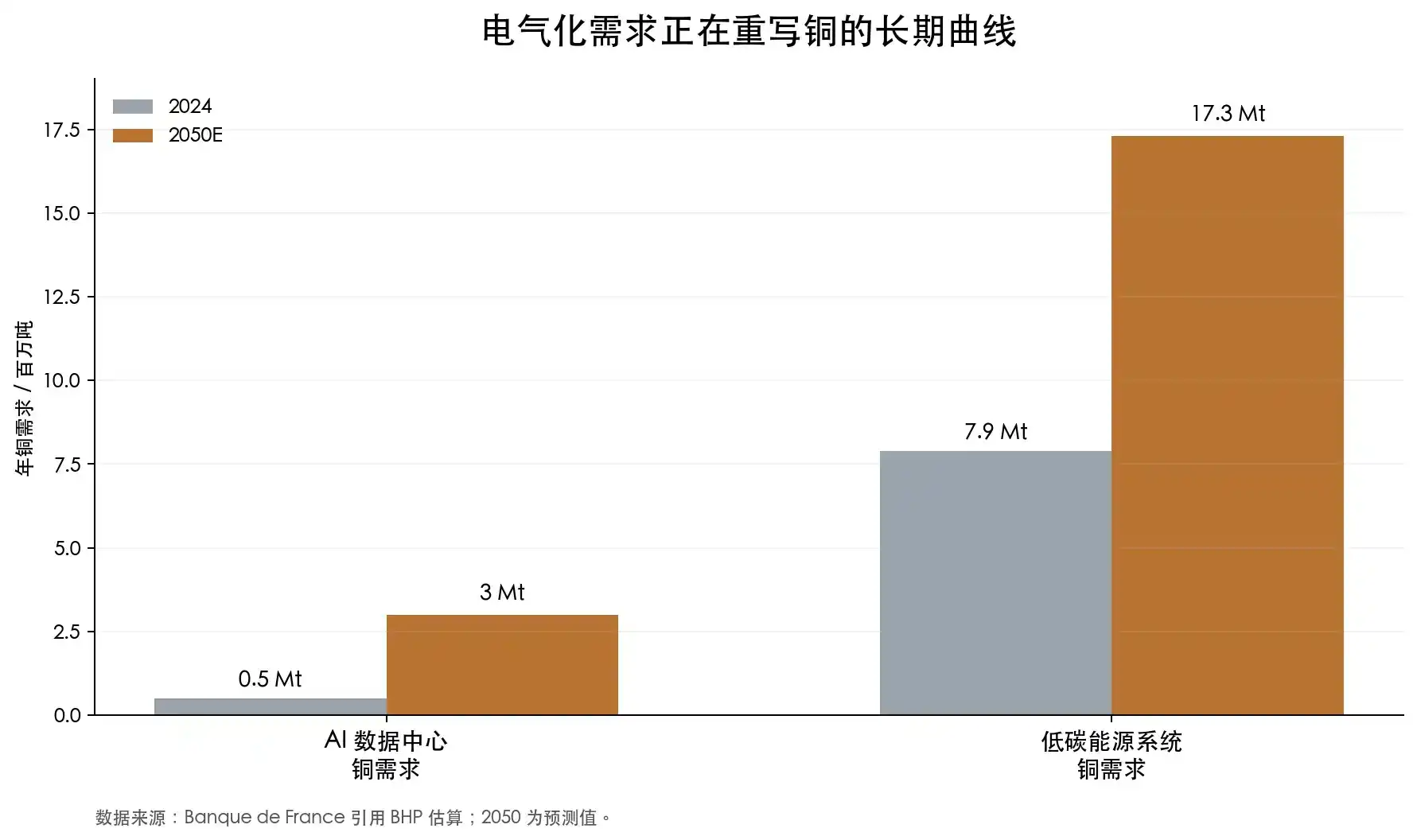
El Banco de Francia, en un análisis sobre los centros de datos de IA y el mercado del cobre, citó una estimación de BHP: la demanda de cobre para centros de datos de IA podría pasar de aproximadamente 500,000 toneladas en 2024 a unos 3 millones de toneladas en 2050. En el mismo período, la demanda de cobre para sistemas de energía baja en carbono podría aumentar de 7.9 millones de toneladas a 17.3 millones. El artículo también cita un caso concreto: la construcción del centro de datos de Microsoft en Chicago consumió 2,177 toneladas de cobre.

Si observamos este número de forma aislada, no parece especialmente grande en el mercado global del cobre. Pero el punto clave no es cuánto cobre usa un centro de datos específico, sino que detrás de los centros de datos de IA no hay una demanda puntual, sino toda una serie de necesidades de infraestructura eléctrica. Cuanto más densas son las GPU y mayor la potencia por rack, más se asemeja un centro de datos a una fábrica de alto consumo energético. Las fábricas necesitan electricidad, y la electricidad requiere red eléctrica, transformadores, cables, canalizaciones de bus, equipos de conmutación y sistemas de refrigeración.
Por supuesto, tampoco podemos atribuir toda la historia del cobre simplemente a la IA.

Richard Holtum, CEO del gigante del comercio de materias primas Trafigura, advirtió en la LME Week 2025 que, aunque los centros de datos y la defensa están en auge, la mayor parte de la demanda de cobre en la próxima década seguirá procediendo de infraestructuras tradicionales, construcción, urbanización y bienes de consumo. También mencionó que el cobre utilizado en aires acondicionados aún supera al usado en centros de datos.

Esta perspectiva nos ofrece un nuevo ángulo: el aumento de la demanda de cobre no se sostiene únicamente en un punto como la IA, sino que su crecimiento radica en que casi todos los escenarios de uso de electricidad se están expandiendo simultáneamente.

La lógica más sólida del mercado alcista del cobre es que no se puede extraer tan rápido

Mucha gente tiene la primera impresión del cobre como "metal industrial", pensando que si el precio sube, las minas extraerán más y la oferta aumentará naturalmente. Pero la realidad no es así.

Una mina de cobre grande, desde su descubrimiento, exploración, confirmación de recursos, estudio de viabilidad, financiación, permisos, construcción hasta su puesta en producción, suele llevar más de una década. Los informes de la AIE muestran que los nuevos proyectos de cobre requieren un promedio de unos 17 años desde el descubrimiento hasta la producción. Esto significa que si el mercado en 2026 descubre repentinamente que no hay suficiente cobre, es posible que la nueva oferta a gran escala no aparezca en 2028 o 2029, sino que muchas llegarán recién en la década de 2030.

Robert Friedland, fundador y copresidente ejecutivo de la minera canadiense Ivanhoe Mines, ha enfatizado repetidamente este problema. Es uno de los mayores defensores del cobre en la industria minera global, con el proyecto de cobre de clase mundial Kamoa-Kakula en la República Democrática del Congo. Su discurso siempre es muy directo: el mundo aún no se da cuenta de cuánto cobre necesita realmente. En la última década, el mundo no ha preparado suficientes minas de cobre nuevas para la era de la electrificación.

Esta no es solo su opinión. Los datos de la AIE también respaldan esta dirección.

La ley promedio de las minas de cobre globales ha disminuido aproximadamente un 40% desde 1991. Una menor ley significa que, para obtener la misma tonelada de cobre, hoy hay que extraer más mineral, consumir más electricidad, usar más agua y procesar más desechos. La AIE también menciona que, de los yacimientos de cobre descubiertos en los últimos 35 años, solo el 5% se encontró en la última década. Hay pocos descubrimientos nuevos, las leyes de las minas viejas disminuyen, los ciclos de construcción de proyectos se alargan y los gastos de capital siguen aumentando. La AIE estima que, basándose en la cartera actual de proyectos, el mercado del cobre podría enfrentar un déficit de oferta del 30% para 2035.

Por lo tanto, el cobre no es un activo del ciclo de materias primas común donde "la oferta aparece inmediatamente después de que suba el precio". Los proyectos de cobre se parecen cada vez más a grandes obras de infraestructura: hay que buscar el yacimiento, obtener permisos, manejar relaciones comunitarias, resolver problemas de agua, enfrentar revisiones ambientales y soportar cambios en la política tributaria de los países con recursos.

Chile, Perú, República Democrática del Congo, Zambia, Indonesia, Mongolia... todos estos lugares tienen importantes recursos de cobre, pero también presentan diferentes formas de riesgo político, fiscal, comunitario u operativo. Cuanto más estratégico es el cobre, más incentivos tienen los países con recursos para aumentar su participación; cuanto más alto es el precio del cobre, más expuestas están las mineras a aumentos de impuestos y renegociaciones.

La fase de fundición también muestra tensiones.

El concentrado de cobre que llega a las fundiciones se procesa en cobre refinado. Las fundiciones cobran a las minas unas tarifas de tratamiento y refinación, conocidas en la industria como TC/RC (treatment charge y refining charge). Normalmente, cuando la oferta de concentrado es abundante, las fundiciones tienen mayor poder de negociación y las TC/RC son altas; cuando el concentrado escasea, las fundiciones compiten por la materia prima y las TC/RC caen.

Un aspecto inusual de 2026 es que, mientras el precio del cobre alcanzaba máximos históricos, las tarifas de tratamiento y refinación cayeron a mínimos. La AIE señala que la tarifa de referencia anual TC/RC para 2026 cayó a 0 dólares por tonelada, y las TC/RC en el mercado spot han sido negativas desde 2024.

Esto es más clave que solo observar los inventarios en las bolsas. Porque el cuello de botella no está solo en el producto final (cobre refinado), sino también en las minas y el concentrado. Si la materia prima en la fuente es escasa, de poco sirve tener muchas fundiciones. China ha expandido enormemente su capacidad de fundición de cobre en las últimas dos décadas. La AIE indica que China representa más del 90% del crecimiento global en producción de fundición de cobre desde 2005, y para 2025 representará aproximadamente la mitad de la producción mundial. Con una fuerte capacidad en la fase intermedia y escasez en la fase minera inicial, la fragilidad de la cadena de suministro se amplifica.

La escasez del oro proviene de sus reservas, costos de extracción y propiedades monetarias. El cobre, por supuesto, no es oro. Pero cuando su nueva oferta se vuelve cada vez más lenta, sus recursos más concentrados y su atributo estratégico más fuerte, comienza a adquirir una cierta sensación de escasez similar a la del oro.

¿Por qué a los fondos macro les gusta ahora el cobre?

El cobre antes pertenecía principalmente a los operadores de materias primas y los analistas mineros. Ahora, atrae cada vez más a los fondos macro.

Por ejemplo, Stanley Druckenmiller, uno de los inversores macro más conocidos de Estados Unidos, quien gestionó junto a George Soros el Quantum Fund y luego fundó Duquesne Family Office. Su característica es operar en ciclos largos y concentrarse en operaciones de alta convicción, por lo que el mercado presta mucha atención a su visión sobre la IA, el dólar, los bonos y las materias primas.

Recientemente, en una entrevista con Morgan Stanley, mencionó que su cartera en los últimos años estaba impulsada principalmente por la IA, pero que ahora ha girado hacia un posicionamiento más macro y geopolítico. Mencionó mantener cobre, ser bajista en el dólar y también mantener oro como cobertura geopolítica.

Su lógica es: si el dólar se debilita, las materias primas cotizadas en dólares se beneficiarán. Con déficits fiscales en aumento, los gobiernos siguen invirtiendo, los riesgos geopolíticos aumentan, el oro encuentra compradores; en el mismo entorno, la expansión de la red eléctrica, la industria militar, los centros de datos de IA, los sistemas energéticos y el regreso de la manufactura generarán demanda de activos físicos, y el cobre se encuentra en la intersección de estas direcciones.

Druckenmiller representa la perspectiva de los fondos macro, pero en el círculo de operadores de materias primas hay expresiones aún más agresivas.

Pierre Andurand es uno de los más típicos. Es un conocido gestor de fondos de cobertura europeo especializado en materias primas. Comenzó operando energía, cofundó BlueGold Capital y luego fundó Andurand Capital. En una entrevista con el Financial Times, dio un pronóstico muy agresivo: el precio del cobre podría alcanzar los 40,000 dólares por tonelada en los próximos años.

También vale la pena mencionar la opinión de Jeff Currie. Jeff Currie fue durante mucho tiempo el responsable de investigación de materias primas en Goldman Sachs y luego se unió a Carlyle, siendo una de las personas más influyentes en la investigación de materias primas de Wall Street. Él propuso hace tiempo la idea de que "el cobre es el nuevo petróleo", queriendo decir que en la era de la transición energética, el cobre podría desempeñar un papel de recurso básico similar al del petróleo en la era de los combustibles fósiles. En 2024, volvió a calificar al cobre como una de sus operaciones de mayor convicción.
Los datos también muestran que el capital está entrando.

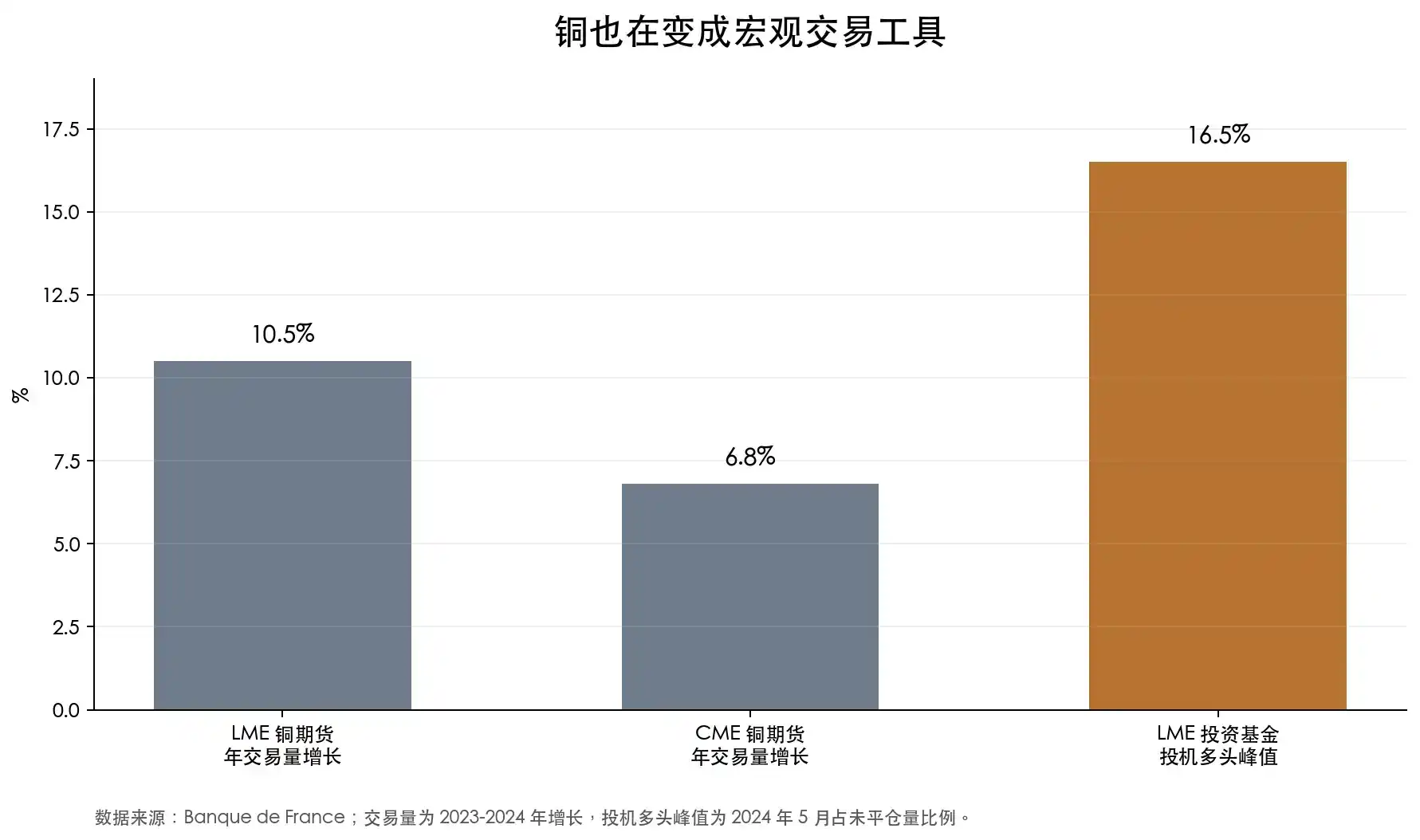
El Banco de Francia menciona que entre 2023 y 2024, el volumen anual de operaciones de futuros de cobre en la LME aumentó un 10.5%, y en la CME un 6.8%. En los futuros de cobre de la LME, las posiciones largas especulativas de fondos de inversión alcanzaron el 16.5% del interés abierto en mayo de 2024. Esto no es una simple reposición de inventarios físicos, sino capital financiero tratando al cobre como una herramienta de operación macro.

Acciones mineras de cobre: el apalancamiento del cobre

En un mercado alcista del oro, las acciones de oro suelen amplificar las fluctuaciones del precio del oro. En un mercado alcista del cobre, las acciones mineras de cobre tienen una propiedad similar de amplificación.

El aumento del precio del cobre supone una presión de costos para los usuarios finales, pero para las mineras que ya tienen capacidad productiva, puede significar una expansión de los márgenes. Por ejemplo, si el precio del cobre sube de 9,000 a 12,000 dólares por tonelada, y el costo en efectivo de la minera no aumenta proporcionalmente, gran parte de esos 3,000 dólares adicionales irá directamente a la cuenta de resultados. Precisamente por esto, las acciones mineras de cobre tienen un apalancamiento operativo natural. Un aumento en el precio del cobre puede traducirse en un aumento aún mayor en las ganancias de la minera; una caída del precio del cobre puede contraer las ganancias más rápidamente.

El mercado ya ha reflejado este apalancamiento en los últimos dos años.

Tomando como ejemplo el mercado de valores chino (A-shares), entre junio de 2024 y junio de 2026, China Molybdenum Co. (CMOC) fue el ejemplo más típico de alta elasticidad. Su argumento central son sus activos de cobre y cobalto en la República Democrática del Congo, especialmente Tenke Fungurume y KFM. Según un cálculo aproximado del precio de cierre ajustado, CMOC registró una apreciación de aproximadamente un 129% en ese período, con ganancias máximas cercanas al 260%. Este no es el rendimiento de una acción cíclica común, sino una revalorización del mercado de los recursos de cobre en el extranjero.

Empresas como Jiangxi Copper, Tongling Nonferrous y Yunnan Copper reflejan mejor la volatilidad combinada del precio del cobre y los atributos de fundición. Jiangxi Copper registró una apreciación de aproximadamente el 82%, con ganancias máximas superiores al 200%; Tongling Nonferrous, una apreciación de aproximadamente el 77%, con ganancias máximas de alrededor del 159%; Yunnan Copper solo tuvo una apreciación de aproximadamente el 29%, pero sus ganancias máximas también superaron el 130%.

Todas estas acciones muestran la otra cara de las acciones mineras de cobre: cuando llega el ciclo, la elasticidad es grande; cuando el ciclo retrocede, la corrección también es fuerte.

Observando las correcciones desde los máximos, la volatilidad es más evidente. Yunnan Copper corrigió aproximadamente un 45% desde su máximo en el período, Jiangxi Copper corrigió aproximadamente un 41%, y CMOC, Northern Copper y Zijin Mining también tuvieron correcciones superiores al 30%. Las acciones mineras de cobre no son el precio del cobre en sí mismo; son el resultado de la combinación del precio del cobre, costos, inventarios, TC/RC, avance de proyectos, riesgos del país de los recursos y el sentimiento del mercado de capitales.

En el mercado estadounidense, el representante más típico de las acciones mineras de cobre es Freeport-McMoRan (FCX). Es uno de los principales productores de cobre de EE.UU., con activos como Morenci en EE.UU., Cerro Verde en Perú y Grasberg en Indonesia. Para el capital global, FCX es casi una de las herramientas más utilizadas en el mercado estadounidense para obtener exposición al precio del cobre. Los datos de MarketWatch muestran que FCX alcanzó un máximo de 52 semanas el 2 de junio de 2026 en 72.09 dólares, pero el 5 de junio cayó un 9.07% en un solo día, retrocediendo más del 12% desde el máximo en pocos días.

Southern Copper (SCCO) es otro representante de alta calidad de las acciones mineras de cobre. Sus activos están principalmente en Perú y México, tiene alta exposición al cobre y una fuerte rentabilidad. IBD mencionó a principios de este año que SCCO había subido un 55% en el año y alcanzado máximos históricos. Comparado con FCX, SCCO se asemeja más a un activo de cobre puro y de alta calidad de ganancias, pero tampoco escapa al riesgo del precio del cobre y del país de los recursos.

Si los inversores no quieren apostar por una sola empresa, también pueden observar los ETF de mineras de cobre. Por ejemplo, el Global X Copper Miners ETF, un ETF que sigue a empresas mineras de cobre globales.

Sin embargo, las acciones mineras de cobre son mucho más complejas que el propio cobre.

El valor de una minera no depende solo del precio del cobre, sino también de la ley de la mina, el costo en efectivo, la vida útil de las reservas, los gastos de capital, el país donde opera, la política fiscal, las relaciones laborales, los permisos ambientales, las condiciones de transporte y la capacidad ejecutiva de la gerencia. El precio del cobre puede elevar la valoración de todo el sector, pero al final habrá una gran divergencia entre empresas.

El riesgo del país de los recursos es especialmente importante. Muchas de las mejores minas de cobre se encuentran en Chile, Perú, República Democrática del Congo, Zambia, Mongolia e Indonesia. Tener buenos recursos no garantiza retornos estables para los accionistas. Cuanto más valioso es el cobre, más incentivos tiene el gobierno para recalcular su participación; cuanto más grande es el proyecto, más difíciles son los problemas comunitarios, ambientales, de agua e infraestructura.

La inflación de costos también puede devorar las ganancias. Cuando sube el precio del cobre, a menudo también suben los costos de energía, equipos, mano de obra, acero y financiación. Un proyecto de desarrollo que parece muy atractivo puede, debido a sobrecostos en el capital, retrasos en la puesta en producción u obstáculos en los permisos, terminar dejando pocos beneficios para los accionistas.

Las empresas mineras de cobre en etapa temprana tienen un riesgo aún mayor. Su historia se basa en reservas y producción futuras, pero desde los recursos medidos hasta las reservas explotables, desde el estudio de viabilidad hasta la financiación, desde los permisos hasta la construcción, cada paso puede fallar. Que la lógica a largo plazo del cobre sea sólida no significa que cada acción minera de cobre vaya a cumplirla.

Por lo tanto, las acciones mineras de cobre se entienden mejor como una expresión apalancada de la lógica del precio del cobre, y no como un simple sustituto del precio en sí. Pueden ofrecer mayor elasticidad, pero también conllevan mayores correcciones. Lo que realmente vale la pena estudiar son las empresas con bajos costos, larga vida útil, una ruta clara de expansión de la producción, un balance sólido y riesgos políticos controlables.

Esta también es parte de la "aurificación" del cobre: la lógica de su escasez no se limita al mercado físico y de futuros; está siendo reempaquetada por el mercado de valores, los ETF y el capital especulativo. El aumento del precio del cobre es una capa de la operación; el aumento de las acciones mineras de cobre es otra. El primero refleja la materia prima en sí; el segundo refleja cuánta imaginación está dispuesto a pagar el mercado por esta escasez a largo plazo.

La "aurificación" del cobre apenas comienza

Este mundo necesita más electricidad, y más electricidad significa más cobre.

Por supuesto, el cobre no se convertirá realmente en oro. No tiene las propiedades monetarias puras del oro, ni se liberará de los ciclos económicos. Una desaceleración de la economía global, un debilitamiento de la manufactura o un enfriamiento de los activos de riesgo pueden presionar a la baja el precio del cobre. El cobre seguirá siendo volátil, incluso posiblemente muy volátil.

Pero el cambio radica en que la lógica subyacente del cobre ya no es la misma que en el pasado.

Antes, las fuertes caídas del precio del cobre solían ocurrir cuando la demanda se debilitaba y se sumaba un exceso de oferta. Hoy, el lado de la oferta no es tan flexible. El envejecimiento de las minas, la disminución de la ley, los ciclos de permisos más largos, la competencia por materia prima en la fundición, la redistribución de beneficios por parte de los países con recursos... todos estos factores hacen que el cobre sea cada vez más difícil de considerar simplemente como un producto cíclico común.

Sigue siendo un metal industrial, pero ya no es solo un reflejo del ciclo industrial.

La "aurificación" del cobre apenas comienza.

Related Questions

Q¿Cuál es la principal razón por la que el cobre se está comparando cada vez más con el oro en el contexto actual?

ALa principal razón es el cambio estructural en la demanda de cobre. Más allá del ciclo manufacturero tradicional, factores como los centros de datos de IA, la expansión de las redes eléctricas, los vehículos eléctricos, el almacenamiento de energía y la reindustrialización están creando una demanda estructural creciente. Además, la oferta no puede responder rápidamente debido a los largos ciclos de desarrollo de nuevas minas (hasta 17 años), la disminución de la ley del mineral y los crecientes desafíos regulatorios y políticos en los países productores, creando una sensación de escasez similar a la del oro.

QSegún el artículo, ¿por qué los grandes fondos macroeconómicos, como Stanley Druckenmiller, están interesados en el cobre?

ALos fondos macroeconómicos ven al cobre como un activo que se beneficia de múltiples tendencias macroeconómicas y geopolíticas simultáneas. Estas incluyen: posibles debilidad del dólar (que beneficia a las materias primas cotizadas en esa moneda), grandes déficits fiscales, inversión gubernamental en infraestructura, riesgos geopolíticos (que también impulsan el oro) y, lo más importante, la demanda física estructural proveniente de la transición energética, los centros de datos de IA, la modernización de redes eléctricas y la reindustrialización. El cobre se encuentra en la intersección de todas estas tendencias.

Q¿Qué indicador clave menciona el artículo que muestra la tensión en la cadena de suministro del cobre, más allá de los inventarios?

AUn indicador clave son las tarifas de tratamiento y refinación (TC/RC) para el concentrado de cobre. En 2026, estas tarifas han caído a niveles históricamente bajos, con la referencia anual fijada en 0 dólares por tonelada y los precios spot volviéndose negativos desde 2024. Esto indica una escasez de concentrado de cobre (materia prima de las fundiciones). Aunque la capacidad de fundición (especialmente en China) es alta, la tensión en la materia prima minera expone la vulnerabilidad de la cadena de suministro.

Q¿Cómo funcionan las acciones de las empresas mineras de cobre (como Freeport-McMoRan) en relación con el precio del cobre?

ALas acciones de las empresas mineras de cobre actúan como un "apalancamiento" o amplificador de los movimientos del precio del cobre. Cuando sube el precio del cobre, una parte significativa del incremento (por encima del costo de producción en efectivo) va directamente a los márgenes de beneficio de la empresa, lo que puede generar un aumento porcentual mayor en sus ganancias y, por lo tanto, en el precio de sus acciones. Sin embargo, también son más volátiles: cuando el precio del cobre cae, las ganancias y las acciones pueden caer más bruscamente. Además, su valor depende de muchos otros factores como costos, riesgos país y la ejecución de proyectos.

Q¿Qué quiere decir el artículo con la frase "la 'dorificación' del cobre acaba de comenzar"?

ALa frase "la 'dorificación' del cobre acaba de comenzar" significa que el cobre está empezando a adquirir algunas características atribuidas tradicionalmente al oro, principalmente una narrativa de escasez estructural a largo plazo y su papel como activo refugio macroeconómico/geopolítico. No significa que el cobre vaya a reemplazar las propiedades monetarias del oro, sino que su lógica de inversión ha cambiado: ya no es solo un reflejo del ciclo económico industrial, sino un commodity con una base de demanda estructural amplia y una oferta que responde lentamente, atrayendo a un nuevo tipo de inversor (fondos macro) y otorgándole una cualidad más "estratégica" y menos cíclica en la mente del mercado.

Related Reads

M&A Deals in the Crypto Market Are Unusually Active

Title: M&A Activity in Crypto Market Becomes Unusually Active A rare signal is emerging in the crypto primary market: mergers and acquisitions (M&A) are nearing half of all financing deals. According to RootData, this month, M&A cases in the crypto industry reached 10, while financing rounds numbered only 14, meaning M&A accounts for approximately 42% of primary market transactions—the highest level in history. This does not signal a sudden industry boom. Instead, the rapid rise in M&A share primarily reflects the continued downturn in the financing market. Since November 2024, monthly crypto M&A deals have remained between 10-20, while financing deals have plummeted from around 100 to about 50, possibly hitting a new low this month. For project teams, this means the traditional path of relying on narratives, token expectations, and ecosystem subsidies to maintain valuations is narrowing. For leading companies, it presents a rare window to acquire teams, licenses, technology, liquidity, and market access at lower prices, with less competition and stronger bargaining power. Key active buyers include Coinbase, Kraken, Ripple, MoonPay, Polymarket, Kaiko, Sol Strategies, GSR, Keyrock, Jupiter, Paxos, and Ondo Finance. Their M&A logic is consistent: acquiring key capabilities at lower costs during the industry downturn. This is driven by more attractive valuations, reduced time and trial-and-error costs, the acquisition of licenses and compliance resources, and the integration of industry upstream and downstream segments. Current M&A focuses are concentrated in four areas: trading infrastructure (e.g., Coinbase acquiring Deribit, Kraken acquiring NinjaTrader), payments and stablecoins (e.g., MoonPay, Ripple expanding payment networks), compliance licenses, and asset issuance/distribution (e.g., acquisitions related to RWA and token issuance platforms like Coinbase's purchases of Liquifi and Echo). The rise in M&A is altering the primary market's exit logic. It provides an alternative path to the token-dependent model, encouraging teams to build tangible products, revenue, and strategic value that can be integrated. This could inject confidence into the market, showing that asset buyers and exit possibilities still exist, albeit with a stricter focus on real utility. However, this trend also indicates the crypto industry is becoming more centralized. As asset issuance, trading, market-making, custody, payments, and data gradually consolidate in the hands of a few major players, the industry's initial emphasis on openness and anti-monopoly is being reshaped by commercial realities. Coupled with rising compliance barriers, this signals the end of the low-barrier era for crypto entrepreneurship.

链捕手13m ago

M&A Deals in the Crypto Market Are Unusually Active

链捕手13m ago

M&A Deals Are Exceptionally Active in the Crypto Market

Mergers and acquisitions (M&A) activity in the cryptocurrency primary market has reached a historic high, accounting for approximately 42% of total deals in the current month, nearly matching the number of financing rounds. This shift does not signal a new boom cycle but rather reflects a severe contraction in the venture capital funding environment. As financing dwindles, established industry giants—including major exchanges, payment firms, and infrastructure providers—are seizing the opportunity to acquire strategic assets at lower valuations. Key drivers behind the surge in M&A include depressed project valuations, the need to quickly acquire talent and technology to capture short market windows, the pursuit of crucial regulatory licenses, and the strategic expansion into adjacent business verticals such as derivatives, payments, stablecoins, and real-world asset (RWA) issuance. Major acquisitions, like Coinbase's purchase of Deribit and Kraken's acquisition of NinjaTrader, exemplify the push to expand into high-margin areas like derivatives and multi-asset trading. This trend is reshaping the industry's exit landscape, offering an alternative to token-based exits and incentivizing startups to build tangible products and revenue streams with inherent strategic value for acquisition. However, it also points toward increasing centralization, as critical functions—trading, custody, payments, compliance—become concentrated within a few large, well-capitalized platforms, potentially raising barriers to entry for new ventures.

marsbit13m ago

M&A Deals Are Exceptionally Active in the Crypto Market

marsbit13m ago

Solana Privacy Ecosystem Panorama: A Complete Privacy Stack from Compute to AI

**Title: The Solana Privacy Ecosystem: A Full-Stack View from Compute to AI** **Summary:** This article provides a comprehensive overview of the emerging privacy landscape on the Solana blockchain, characterizing it as still in early development. It identifies two primary verticals—Neobanks and Private DeFi—as key drivers, while noting gaps in tooling and user experience. The discussion centers on two main approaches to private computation: Arcium, which utilizes Multi-Party Computation (MPC) networks (Multi-Party eXecution Environments) to process encrypted data with final settlement on Solana; and Magic Block, which leverages Trusted Execution Environments (TEEs) via its Private Ephemeral Rollup (PER). Both enable confidential applications like dark pools and private DeFi with minimal code changes. Building on this infrastructure, projects are creating privacy-focused applications. Umbra, built on Arcium, offers Encrypted Token Accounts (ETAs) for private balances, transfers, and selective disclosure for compliance. Other wallets like Privacy Cash and Hush provide mixer-like functionality for SOL. For private trading, encifherio uses TEEs to encrypt swap details routed through Jupiter, while VanishTrade and Darklake focus on shielding transaction intent and liquidity routing, with Darklake introducing a "blind slippage pool" to prevent front-running. Further applications include private prediction markets (e.g., Melee Markets using Arcium's encrypted order books) and private AI. Loyal exemplifies the latter, using both Magic Block and Arcium to enable decentralized AI agents that store user data, conversations, and transactions confidentially on-chain. The article concludes by framing privacy not as a single technology but as an evolving "ultimate privacy stack," with experts like Helius's Mert envisioning a future combination of Fully Homomorphic Encryption (FHE) and Zero-Knowledge proofs (ZK). Helius Privacy itself is developing a ZK-based UTXO privacy layer for Solana.

Foresight News19m ago

Solana Privacy Ecosystem Panorama: A Complete Privacy Stack from Compute to AI

Foresight News19m ago

Trading

Spot
Futures

Hot Articles

What is LINON

Linde plc Tokenized Stock (Ondo): Revolutionizing Traditional Equity Access Through Blockchain Innovation The emergence of Linde plc Tokenized Stock (Ondo), represented by the ticker $LINON, signifies a monumental shift in the fusion of traditional financial structures and decentralized finance (DeFi). This innovative financial instrument showcases the tremendous potential of blockchain technology to democratize access to traditional equity markets while ensuring the security and regulatory compliance necessary for institutional-grade financial products. Through Ondo Finance's pioneering tokenization platform, $LINON provides a seamless pathway for global investors to engage with one of the world's leading industrial gas companies, Linde plc, creating a blockchain-native representation of the underlying equity. Introduction to Linde plc Tokenized Stock The landscape of financial markets is witnessing a groundbreaking transformation through the tokenization of real-world assets. Linde plc Tokenized Stock (Ondo) epitomizes this revolutionary approach by bridging the gap between conventional stock ownership and blockchain-enabled financial infrastructure. The $LINON token allows investors to gain exposure to one of the prominent industrial companies worldwide through decentralized technology. Operating within Ondo Finance's comprehensive ecosystem, $LINON symbolizes a practical application of tokenization technology that enhances accessibility, efficiency, and global connectivity in traditional financial markets. By leveraging blockchain infrastructure, this tokenized stock enables international investors to participate in U.S. equity markets, overcoming traditional barriers associated with cross-border investing. The significance of $LINON goes beyond technological innovation; it represents a fundamental shift in asset structuring, distribution, and trading in the digital age. This tokenized stock maintains all the economic benefits associated with traditional Linde plc shares while offering improved liquidity, programmable compliance features, and seamless integration with decentralized finance protocols. The development of $LINON indicates a growing acceptance of blockchain technology as a viable means for traditional finance, exemplifying how even well-established assets like Linde plc can integrate into blockchain systems. This approach preserves the core attributes that appeal to investors while introducing advanced capabilities that enhance the overall investment proposition. Project Overview and Objectives Linde plc Tokenized Stock (Ondo) encapsulates a strategic effort to democratize access to traditional equity markets through advanced blockchain technologies. The primary objective of $LINON is to provide approved global investors seamless access to the economic exposure associated with Linde plc shares, furthering an effort to create a more inclusive financial ecosystem. Beyond the digital representation of traditional assets, $LINON endeavors to eliminate barriers of geography and time zones that limit investor participation. Its design ensures that blockchain technology can elevate traditional investment vehicles without undermining the security or compliance requirements expected by investors. Key goals of the project include enhanced liquidity provision, programmable compliance mechanisms, and interoperability with other blockchain networks. Each $LINON token is fortified by actual Linde plc securities housed at U.S.-registered broker-dealers, allowing holders to reap economic advantages akin to traditional stockholders, such as dividend reinvestment. Furthermore, $LINON aims to establish new industry standards for institutional-grade tokenized securities, paving the way for traditional assets to embrace blockchain technology while remaining compliant with regulatory frameworks. By associating itself with a company as reputable as Linde plc, the project opens avenues for exploring tokenized equities catering to both conservative institutional players and daring retail investors. Project Creator and Development Team The vision for Linde plc Tokenized Stock (Ondo) comes from Nathan Allman, founder and CEO of Ondo Finance. His background in traditional finance coupled with expertise in blockchain technology positions him uniquely to navigate the complexities of asset tokenization. Allman's academic journey began at Brown University, focusing on Economics and Biology, equipping him with valuable analytical skills. His time at Goldman Sachs in the Digital Assets division strengthened his understanding of the interplay between financial institutions and emerging technologies, laying the groundwork for his later endeavors in alternative investment strategies. Under Allman's guidance, Ondo Finance has emerged as a leader in asset tokenization, launching $LINON as a flagship example of the company's larger mission towards revolutionizing traditional financial systems using blockchain technology. His commitment to leveraging blockchain for creating institutional-grade financial products has shaped the landscape of real-world asset tokenization. Investment and Funding Structure The growth of Ondo Finance, the platform powering Linde plc Tokenized Stock (Ondo), is bolstered by robust financial backing from prestigious venture capital firms and strategic investors. This strong investment foundation underpins the development of the key infrastructure essential for compliant tokenized securities like $LINON. In August 2021, Ondo Finance secured $4 million in seed funding led by a major venture capital firm, which enabled the company to commence platform development and establish the necessary regulatory processes for tokenizing real-world assets. This early investment cemented Ondo Finance's credibility within the industry. The Series A funding round followed, garnering $20 million with participation from renowned firms committed to transformative technology companies. This backing demonstrated substantial institutional confidence in Ondo Finance's vision, allowing it to hone its approach to asset tokenization through mechanisms that ensure compliance and accessibility. Noteworthy contributors, including institutional investors and experienced partners, have added significant value to Ondo Finance’s development efforts. Their involvement underscores the confidence across sectors in Ondo Finance's approach to bridging traditional finance with blockchain innovations. Technical Infrastructure and Innovation The technical architecture that underpins Linde plc Tokenized Stock (Ondo) represents a sophisticated melding of traditional finance systems and cutting-edge blockchain technology. The architecture's foundation is built on the Ethereum network, renowned for its security and programmability—both critical for intricate financial instruments. The $LINON tokenization process comprises creating a blockchain-native representation of Linde plc shares that preserves economic benefits while augmenting investor capabilities. Each token corresponds to actual shares held at U.S.-registered broker-dealers, creating a compliant custody structure that legitimizes the asset's existence and value. Automated compliance systems are integrated into the tokenization process, managing critical components such as know-your-customer (KYC) verification and anti-money laundering (AML) protocols. This incorporation of programmable compliance empowers $LINON to uphold regulatory standards essential for institutional proliferation. Cross-chain interoperability characterizes the advanced technical features of $LINON. While initially deployed on Ethereum, the framework is designed for expansion to other networks such as Solana and BNB Chain. This adaptability enhances liquidity and accessibility, allowing investors to select their preferred blockchain ecosystems. Historical Timeline and Development Crafting the history of Linde plc Tokenized Stock (Ondo) unfolds in parallel with the evolution of Ondo Finance's tokenization platform. The timeline's inception dates back to March 2021 when Nathan Allman laid the foundations for creating institutional-grade financial products on blockchain infrastructure. The initial funding round in August 2021 provided crucial resources for developing the platform and establishing partnerships necessary for effective tokenization. By January 2023, Ondo Finance launched its tokenized treasury products, establishing mechanisms that would facilitate future tokenized equities such as $LINON. A pivotal milestone arose in February 2025 when Ondo Chain—a Layer 1 blockchain designed specifically for asset tokenization—was introduced. This infrastructure enhances capabilities vital for institutional markets, demonstrating Ondo Finance's long-term commitment to tokenization. Subsequently, the launch of Ondo Global Markets in September 2025 marked the official debut of $LINON. This milestone showcased the successful transition from development to active trading, enabling investors around the world to access American financial markets seamlessly. Ongoing development plans include a targeted expansion of available tokenized assets to over 1,000 by the end of 2025, pointing to a bright future for Ondo Finance's ecosystem and its mission to broaden tokenized equity accessibility. Regulatory Compliance and Legal Framework The legal architecture governing Linde plc Tokenized Stock (Ondo) emphasizes a sophisticated approach to regulatory compliance, allowing tokenized securities to be implemented within a blockchain-based framework. The legal structure governing $LINON spans multiple jurisdictions while maintaining a robust legal footing. Compliance systems ensure that only eligible investors can access the token, enforced through automated verification that aligns with international regulations. This innovative regulatory technology promises real-time enforcement of complex requirements, considerably enhancing efficiency in operating within the regulatory landscape. The custody framework undergirding $LINON ensures that the underlying shares are securely held at U.S.-registered broker-dealers, complying with necessary regulations while delivering blockchain-driven access to investors. The token maintains its economic equivalency and security through this carefully structured custody arrangement. KYC and AML compliance systems are embedded within the smart contract architecture, ensuring integrity and adherence to regulatory practices while fostering transparency for investors. The jurisdictional restrictions mark a commitment to navigating the evolving landscape of international securities laws. Market Impact and Industry Significance The advent of Linde plc Tokenized Stock (Ondo) holds profound implications for the broader financial landscape, symbolizing a clear shift towards blockchain-enabled markets. $LINON serves as a proof-of-concept for integrating traditional companies into blockchain ecosystems, showcasing the potential benefits such as broader accessibility and improved efficiency. The market's response to $LINON indicates a growing acceptance of tokenization among institutional investors, contributing to the emergence of an expanding sector wherein traditional assets can be interconnected with blockchain innovations. The success of $LINON further solidifies market confidence, indicating an overarching shift towards recognizing asset tokenization as a transformative force in finance. Future Development and Expansion Plans The future trajectory for Linde plc Tokenized Stock (Ondo) centers around the expansion of the tokenization ecosystem and enhanced infrastructure supporting blockchain-enabled financial services. Plans for cross-chain integration usher in new opportunities for liquidity and flexibility within the investment framework, with existing capabilities poised for continuous enhancement. With the introduction of Ondo Chain, Ondo Finance aims to transition $LINON to an optimized blockchain environment specifically designed for asset tokenization. This new infrastructure heralds exciting prospects for the development of institutional-grade financial products, ensuring ongoing compatibility with contemporary investment strategies. Further integration with decentralized finance protocols signifies a commitment to empowering $LINON holders through advanced financial strategies. The anticipated expansion of available tokenized assets promises to broaden investor access, enhancing the utility and appeal of the platform. In alignment with ambitions for regulatory expansion, ongoing efforts to secure approvals for new jurisdictions will enhance investor access, further positioning $LINON at the forefront of the burgeoning tokenization market. Conclusion Linde plc Tokenized Stock (Ondo), as represented by the $LINON token, stands at the intersection of traditional finance and blockchain innovation. It embodies a transformative milestone in how financial assets are structured, distributed, and engaged within modern investment ecosystems. The technical sophistication behind $LINON, combined with its regulatory compliance framework, illustrates that asset tokenization can improve financial infrastructure rather than simply digitizing existing products. This pioneering effort not only enhances investor access to U.S. equity markets but also signifies an evolution of how traditional financial services can integrate blockchain technology. As the asset tokenization market grows exponentially, with prospects suggesting significant valuation increases, $LINON paves the way for a future where tokenized securities become standard fixtures in the financial landscape. The trajectory of $LINON will undoubtedly influence how traditional finance adapts to a transformed, blockchain-powered world.

3.2k Total ViewsPublished 2025.12.05Updated 2025.12.05

What is LINON

What is CRMON

Salesforce Tokenized Stock (Ondo): Revolutionising Traditional Equity Access Through Blockchain Innovation The emergence of Salesforce Tokenized Stock (CRMON) marks a pivotal advancement in integrating traditional financial markets with blockchain technology. This innovative approach offers investors unprecedented access to equity exposure through tokenisation. Developed by Ondo Finance, CRMON provides tokenholders with economic exposure equivalent to holding Salesforce stock (CRM) while automatically reinvesting dividends. This effectively bridges the gap between conventional equity markets and decentralised finance (DeFi). Introduction and Comprehensive Overview of Salesforce Tokenized Stock In recent years, the financial landscape has dramatically transformed due to blockchain technology, fundamentally altering how investors access and interact with traditional assets. The development of Salesforce Tokenized Stock (CRMON) is a prime example of this evolution, representing a sophisticated fusion of conventional equity markets with cutting-edge distributed ledger technology. CRMON is a tokenised version of Salesforce stock, emerging from the innovative work of Ondo Finance, a leading platform in the real-world asset tokenisation sector that positions itself as a bridge between traditional finance and decentralised systems. Designed to provide tokenholders with economic exposure that mirrors the performance of the underlying Salesforce stock, CRMON incorporates automatic dividend reinvestment mechanisms. This eliminates many traditional barriers associated with international equity investment, such as complex brokerage relationships, currency conversion challenges, and restricted trading hours. The tokenisation process reimagines stock ownership as a blockchain-native asset while maintaining its economic equivalence with the underlying security, offering enhanced portability and integration capabilities within decentralised finance ecosystems. CRMON transcends its individual utility as an investment instrument to represent a fundamental shift in how financial markets can operate in an increasingly digital world. By maintaining full backing through U.S.-registered broker-dealers and implementing robust compliance frameworks, CRMON demonstrates that tokenised securities can achieve the regulatory standards necessary for institutional adoption while delivering the technological advantages of blockchain infrastructure. Understanding Tokenized Real-World Assets and CRMON's Strategic Position Tokenised real-world assets signify one of the most significant innovations in modern finance, fundamentally reimagining how traditional securities are represented, traded, and utilised within digital ecosystems. CRMON operates as a tokenised equity instrument correlating directly with Salesforce stock while optimising accessibility and efficiency. This aligns with Ondo Finance's broader mission to democratise access to institutional-grade financial products through innovative tokenisation strategies. The tokenisation process guarantees complete economic equivalence with the underlying Salesforce equity. Each CRMON token represents a proportional claim on Salesforce stock held by qualified custodians, with dividend payments automatically reinvested to maintain continuous exposure to total return performance. This structure simplifies dividend management and ensures that tokenholders receive the full economic benefit of their equity exposure, encompassing both capital appreciation and income generation. Ondo Finance's strategy in tokenising Salesforce stock demonstrates its expertise in creating compliant, institutional-grade products that meet traditional financial markets' stringent requirements. The platform’s focus on merging regulatory compliance with blockchain benefits positions it at the forefront of decentralised finance, captivating both institutional and retail investors seeking blockchain-native solutions. The Technology and Innovation Framework Behind CRMON The technological infrastructure supporting CRMON integrates blockchain technology with traditional financial mechanisms, delivering institutional-grade security and compliance while maintaining the operational advantages of decentralised systems. Built on the Ethereum blockchain, CRMON utilises robust smart contract capabilities to ensure transparent, secure operations. The smart contract architecture incorporates layered security and compliance mechanisms, enabling automated compliance checks and real-time asset backing verification. Integration with oracle services maintains accurate pricing and dividend information, ensuring CRMON reflects the underlying Salesforce stock's accurate performance. This architecture delivers automated dividend reinvestments and other corporate actions, eliminating manual processing requirements and directly enhancing tokenholder benefits. Ondo Finance ensures CRMON's security structure includes daily third-party verification of holdings, independent collateral agents, and a multiple-layer custody system through partnerships with established financial institutions. This framework safeguards tokenholder interests against operational risks while providing robust asset backing. The user interface enhances integration capabilities, allowing seamless interaction between CRMON and various decentralised finance protocols, as well as cryptocurrency exchanges. This interoperability enables users to leverage their tokenised equity across multiple platforms, creating sophisticated investment strategies that marry traditional equity characteristics with blockchain-native innovation. Leadership and Corporate Structure of Ondo Finance The leadership team behind CRMON and Ondo Finance blends expertise from traditional finance and blockchain technology, presenting a robust combination of skills essential for successfully bridging conventional markets with decentralised finance. Nathan Allman, the founder and CEO, emerged from a distinguished financial background before establishing Ondo Finance in 2021. Allman's experience includes notable roles at major financial institutions, including significant contributions to developing cryptocurrency market services. His insights into regulatory compliance were paramount in developing products like CRMON that successfully unify traditional securities with blockchain technology. With a team of professionals boasting substantial experience in both conventional finance and blockchain sectors, Ondo Finance's leadership comprises diverse expertise that covers every aspect of tokenised asset development. Justin Schmidt serves as President and COO, contributing unique operational expertise, while Chris Tyrell brings essential compliance knowledge. Investment Landscape and Funding History The investment landscape surrounding Ondo Finance reflects significant institutional confidence in its mission to tokenise real-world assets. The company has raised substantial funds through various investment rounds, attracting leading venture capital firms and strategic investors that recognise the transformative potential of tokenised securities like CRMON. Notably, Ondo Finance completed a successful Series A funding round in 2022, led by well-known venture capital firms. This funding success validates Ondo Finance's innovative approach to creating compliant, institutional-grade tokenised products. In total, Ondo Finance has successfully secured substantial funding, raising significant capital for product development and market expansion, including a noteworthy token sale that reinforced its governance structure through the establishment of the ONDO token. The diverse composition of investors reflects broad market confidence in Ondo Finance's business model, demonstrating support from both traditional and blockchain-native organisations. Operational Mechanics and Technical Implementation The operational framework supporting CRMON exemplifies sophisticated integration of traditional financial mechanisms with blockchain technology. The technical implementation introduces multiple layers of security, compliance, and operational efficiency to meet institutional standards while enhancing accessibility. The tokenisation process begins by acquiring actual Salesforce stock through U.S.-registered broker-dealers, ensuring each CRMON token maintains direct correlation with the underlying equity performance. Smart contracts automate operational processes, including dividend reinvestment and corporate action processing, facilitating a streamlined user experience. The Minting and redemption processes allow authorised participants to manage CRMON tokens effectively. During U.S. trading hours, institutions can mint new tokens by depositing stablecoins that are used to purchase corresponding Salesforce equity. This structure maintains a tight correlation with underlying assets, enhancing liquidity and price discovery. Additionally, the infrastructure supports twenty-four-hour token transfer capabilities, providing CRMON holders with operations outside traditional market hours. This represents a significant advantage over conventional securities ownership, thus promoting integration with decentralised finance applications. Plans for cross-chain compatibility through partnerships signal further ambitions for CRMON's market reach. By expanding to other blockchain networks, Ondo Finance aims to enhance accessibility and user engagement with tokenised equity products. Timeline and Historical Development of Tokenized Equity Innovation The timeline of CRMON's development and Ondo Finance's broader tokenised capabilities demonstrates a systematic innovation process beginning with the company's founding in 2021. 2021: Ondo Finance is founded by Nathan Allman and co-founders, launching initial products focused on structured vault offerings on the Ethereum blockchain. 2022: The company completes substantial funding rounds—both equity and token sales—totaling significant capital and launching initial tokenised U.S. Treasury products. 2023-2024: Ondo Finance experiences substantial growth, establishing partnerships with major financial institutions while expanding its product offerings beyond fixed-income securities. February 2025: Ondo Global Markets is announced, marking the transition into equity tokenisation with plans for accessing over one hundred U.S. stocks and ETFs. September 2025: The official launch of Ondo Global Markets includes CRMON alongside other tokenised equity offerings, marking a significant evolution in Ondo Finance's product ecosystem. This timeline highlights the organisation's rapid growth and its capability to adapt its technological and compliance frameworks to accommodate different asset classes effectively while maintaining security and regulatory integrity. Regulatory Framework and Compliance Approach Ondo Finance's regulatory framework showcases a sophisticated compliance strategy, essential for achieving institutional adoption in the tokenised securities market. The company's strong partnerships with U.S.-registered broker-dealers promote adherence to Securities and Exchange Commission regulations and apply robust investor protections. Acquisitions, such as Oasis Pro—a registered broker-dealer—significantly enhance Ondo Finance's compliance capabilities, ensuring thorough alignment with existing regulatory structures. The company employs independent verification procedures that foster transparency, aiming for a solid performance standards reputation. Furthermore, Ondo Finance's commitment extends to international regulatory compliance, ensuring token access remains restricted to eligible investors while adhering to pertinent cross-border securities regulations. Comprehensive attention to tax implications and reporting requirements fortifies the security and compliance landscape of CRMON, ensuring that investor obligations remain manageable. Future Prospects and Market Positioning The forward-looking landscape for CRMON and Ondo Finance illustrates substantial growth opportunities driven by institutional adoption of blockchain technology and escalating demand for efficient alternatives to conventional securities ownership. Market projections indicate the tokenised asset sector could value multiple trillion dollars by 2030. With plans to scale CRMON offerings significantly and integrate it with a dedicated blockchain infrastructure—Ondo Chain—Ondo Finance aims to elevate its institutional-grade tokenised asset operations. Additionally, the development of strategic partnerships enhances distribution capabilities while establishing the company's credibility in the financial market. Furthermore, the integration of tokenised equity with decentralised finance protocols offers new potential for innovative financial products and strategies previously impossible with traditional securities. These factors underscore CRMON's positioning to effectively capture increased market share and deliver innovative solutions for international investment exposure. Conclusion Salesforce Tokenized Stock (CRMON) symbolises a transformative development within financial markets, successfully bridging traditional equity ownership with blockchain technology to create unprecedented accessibility for global investors. Through Ondo Finance's sophisticated tokenisation framework, CRMON provides complete economic exposure to Salesforce equity performance while enhancing operational advantages that exceed traditional ownership. The launch of CRMON reflects the broader evolution of financial markets towards blockchain infrastructures that maintain regulatory compliance while delivering increased efficiency. Ondo Finance's extensive approach to regulatory adherence, institutional-grade security, and technological innovation solidifies CRMON as a model for future tokenised securities, delivering access previously unattainable in conventional brokerage structures. As the tokenised asset sector continues to develop, CRMON is well-positioned to address historical inefficiencies in capital markets while providing investors with innovative solutions for accessing traditional securities. The outlook for CRMON looks exceptionally promising, supported by ambitious expansion plans, technological innovations, and strategic partnerships, thereby representing a pioneering model of modern financial infrastructure evolving through blockchain integration.

3.3k Total ViewsPublished 2025.12.05Updated 2025.12.05

What is CRMON

What is SHOPON

Shopify Tokenized Stock (Ondo): A Comprehensive Analysis of Real-World Asset Tokenization in Web3 This article delves into the Shopify Tokenized Stock (Ondo), recognised by its ticker symbol $SHOPON, exploring its implications at the intersection of traditional finance and blockchain technology. As a part of Ondo Finance's tokenized securities platform, Shopify’s tokenized stock exemplifies advancements in democratizing access to global capital markets through innovative digital assets. Introduction and Overview of Shopify Tokenized Stock (Ondo) Shopify Tokenized Stock (Ondo), or $SHOPON, portrays a pivotal innovation in the realm of tokenized securities, allowing investors to gain economic exposure akin to directly owning shares of Shopify Inc. This token, developed under the umbrella of Ondo Finance, not only provides investors with the ability to hold digital representations of the company’s stock but also integrates features such as automatic reinvestment of dividends. This advancement represents a substantial shift in the landscape of decentralized finance (DeFi), linking conventional equity markets with blockchain solutions designed to enhance accessibility, transparency, and liquidity. By eliminating geographical barriers and enabling 24/7 trading capabilities, $SHOPON is positioned as a bridge connecting traditional financial instruments and the emerging Web3 ecosystem. What is Shopify Tokenized Stock (Ondo), $SHOPON? The $SHOPON token serves as a digital manifestation of Shopify Inc.'s shares, engineered to provide a direct correlation to the underlying asset's performance. Through the utilization of blockchain technology, the token gives holders a mechanism to participate in the economic benefits associated with equity ownership, including capital appreciation and dividend distribution. The unique aspect of $SHOPON lies in its automatic dividend reinvestment mechanism, which allows returns to compound without necessitating active management by the investor. This feature inherently enhances its attractiveness as an investment vehicle, particularly for individuals seeking passive income growth alongside exposure to high-performing equities. The tokenization process is facilitated by the custody of actual Shopify shares through regulated intermediaries, ensuring that every $SHOPON token is verifiably backed by real equity. This structure empowers investors with the dual advantages of both traditional financial characteristics and the innovative benefits tied to blockchain technology. Who is the Creator of Shopify Tokenized Stock (Ondo)? The creator of Shopify Tokenized Stock (Ondo), Nathan Allman, is an experienced figure in the finance sector, formerly associated with Goldman Sachs. His rich background includes significant expertise in digital asset development, bridging the gap between traditional finance and cryptocurrencies. Allman’s educational journey, marked by studies at Brown University, provided him with a deep understanding of economics and biology, equipping him with analytical skills that inform his strategic vision. In 2021, he founded Ondo Finance, committing to developing tokenized securities that meet institutional-grade standards while leveraging blockchain's transformative capabilities. Under Allman's leadership, Ondo Finance has focused on creating compliant and innovative financial products that empower a diverse investor base. Who are the Investors of Shopify Tokenized Stock (Ondo)? The investment landscape surrounding Shopify Tokenized Stock (Ondo) is notably robust, underpinned by significant institutional support. Primarily, Pantera Capital stands out as a strategic partner through the Ondo Catalyst initiative, a $250 million commitment aimed at accelerating the development of on-chain capital markets. This partnership not only signifies institutional confidence in the potential of tokenized assets but also reinforces Ondo Finance's operational capabilities and market positioning. The funding pathways have included earlier rounds that amassed millions in seed funding and further structural investments, solidifying relationships with both venture capital firms and private investors. Moreover, the financial framework is complemented by strategic partnerships with established financial institutions and technology companies, enhancing Ondo’s infrastructure and operational expertise. How Does Shopify Tokenized Stock (Ondo), $SHOPON Work? At the core of $SHOPON's operational framework is a sophisticated system integrating traditional finance mechanisms with blockchain technology. The custody of actual Shopify shares ensures that token holders retain authentic economic exposure, safeguarding their investments in line with recognized legal structures. The smart contracts employed in managing $SHOPON handle various functions, including automatic dividend reinvestment and ownership transfer, offering instant settlement and increased liquidity, marking a significant departure from conventional trading systems plagued by multi-day settlement delays. By providing interoperability with other decentralized finance applications, $SHOPON empowers holders with potentially lucrative opportunities for advanced investment strategies, including lending and automated market making. This complex integration presents a unique value proposition, catering to both traditional and crypto-native investors. The innovative structure of $SHOPON also allows for real-time settlements and transactions documented on the blockchain, delivering unparalleled transparency and security—a major advancement over standard equity trading practices. Timeline of Shopify Tokenized Stock (Ondo) March 2021: Nathan Allman establishes Ondo Finance, initially focusing on decentralized finance yield optimization. August 2021: Completion of a $4 million seed funding round led by Pantera Capital. January 2023: Launch of initial tokenized treasury security products, laying the groundwork for future equity tokenization. July 2025: Announcement of the Ondo Catalyst initiative, a strategic investment program valued at $250 million, aimed at propelling the development of tokenization in capital markets. September 3, 2025: Launch of Ondo Global Markets featuring over 100 tokenized U.S. stocks and ETFs, including $SHOPON. Technical Implementation and Blockchain Infrastructure Shopify Tokenized Stock (Ondo) operates on a technical architectural framework that marries blockchain protocols with traditional financial custody arrangements. The ecosystem leverages Ethereum's smart contract capabilities, providing seamless transaction management while ensuring compliance with regulatory standards through established financial custodians. Central to this architecture are security measures and transparent transaction records that affirm the legitimacy of each tokenholder's economic stake. With automated features managed by intricate smart contracts, $SHOPON not only streamlines ownership transfers but also allows for the tactical reinvestment of dividends—a hallmark of modern investment strategies. Moreover, the incorporation of LayerZero technology facilitates cross-chain interoperability, making $SHOPON accessible across multiple blockchain environments while preserving its functional robustness. This forward-thinking technical design positions $SHOPON as an adaptable asset within the larger DeFi milieu. Regulatory Framework and Compliance Architecture $SHOPON's regulatory framework is built upon the meticulous navigation of existing financial regulations that govern securities. The custody arrangements for the underlying Shopify shares are managed by U.S.-regulated broker-dealers, ensuring compliance and protection for investors. By maintaining a separation between the blockchain tokenization process and traditional custody, $SHOPON adheres to legal requirements while offering innovative functionalities that challenge conventional constraints. This dual-layered compliance approach enhances investor confidence and underscores Ondo Finance's commitment to regulatory integrity. Notably, the availability of $SHOPON is tailored to international investors from regions such as Asia-Pacific, Europe, and Africa, as regulatory parameters in the U.S. and U.K. present challenges in accessing tokenized securities. Market Access and Global Distribution Strategy The distribution strategy of $SHOPON is keenly designed to optimize global access while conforming to regulatory standards. The platform aims to establish comprehensive coverage for eligible investors across multiple regions, effectively dismantling traditional barriers through the implementation of blockchain technology. Integration with various cryptocurrency wallets and exchanges also promotes user-friendliness and accessibility, establishing a streamlined experience for investors to manage their holdings. Moreover, the 24/7 trading capabilities afforded by the tokenized model allow participants to react promptly to market shifts, fundamentally transforming how global equities are accessed and traded. Technology Integration and Cross-Chain Functionality The remarkable technological underpinnings of $SHOPON propagate its multi-chain functionality, set to expand its reach beyond Ethereum to networks such as Solana and BNB Chain. Such cross-chain capabilities allow users flexibility when navigating between blockchains, concurrently leveraging distinct network attributes to optimize their trading experience. LayerZero serves as the backbone for ensuring decentralized transfers between networks while providing the requisite security and speed, quintessential for maintaining investor trust. This comprehensive interoperability illustrates $SHOPON's commitment to being a versatile, user-centric asset in the evolving investment landscape. Ecosystem Integration and DeFi Compatibility Incorporating $SHOPON into broader DeFi protocols signifies its potential beyond traditional stock ownership. Token holders can leverage their holdings for various sophisticated strategies and applications, enhancing investment returns and liquidity management. By establishing a presence in lending protocols and automated trading systems, $SHOPON effectively democratizes access to advanced financial strategies previously limited to institutional investors. Such integration contributes to a more competitive and dynamic financial landscape, where individual investors can capitalize on tools typically reserved for larger entities. Risk Management and Security Framework Security remains paramount in the operational infrastructure of $SHOPON. The tokenization framework employs multiple layers of protection—beginning with regulated custody of the underlying Shopify shares. The operational protocols establish rigorous auditing, key management, and transaction monitoring standards, thus safeguarding against potential vulnerabilities. Moreover, meticulous adherence to evolving regulatory requirements provides an extra layer of security, fortifying investor protections and institutional compliance. Market Impact and Industry Implications The introduction of Shopify Tokenized Stock (Ondo) heralds a transformative shift in how financial markets operate, emphasizing the potential of tokenized securities to reshape traditional investment paradigms. The successful integration of $SHOPON encapsulates the efficiencies inherent in blockchain technology and opens avenues for new user demographics previously barred from extensive market participation. The impact extends beyond the immediate benefits to token holders, indicating broader trends that may challenge the status quo of investment services, particularly in addressing geographic restrictions and operational costs typically associated with traditional brokerage platforms. Undeniably, $SHOPON encapsulates the potential for traditional institutions to innovate further, leveraging the increasing demand for seamless blockchain access to complement existing financial infrastructure. Future Development Roadmap and Strategic Vision As Ondo Finance looks forward, the trajectory of $SHOPON rests on ambitious goals aimed at broadening the spectrum of available tokenized assets significantly. Over the next few years, plans are in place to expand to more than 1,000 tokenized securities, further enhancing market participation and investment options for individuals worldwide. Continued integration with traditional financial actors, development of specialized institutional products, and enhancements in automated trading capabilities will ensure that $SHOPON maintains its position at the forefront of financial innovation. Regulatory collaboration will also remain a focal point, establishing a framework that not only supports the compliance requirements but also promotes a healthy environment for tokenized asset proliferation. Conclusion and Market Significance In summary, Shopify Tokenized Stock (Ondo), represented by the ticker $SHOPON, is more than merely a tokenized equity offering; it embodies the innovation possible when traditional finance collides with modern blockchain applications. With a robust technical architecture, a commitment to compliance, and a clear strategic vision, $SHOPON exemplifies the potential for tokenized assets to enhance liquidity, accessibility, and functionality in capital markets. As the global investment landscape evolves, the transformative implications of $SHOPON extend beyond individual investors to revolutionize how financial instruments are perceived, traded, and utilized within both traditional and decentralized frameworks.

3.2k Total ViewsPublished 2025.12.05Updated 2025.12.05

What is SHOPON

Discussions

Welcome to the HTX Community. Here, you can stay informed about the latest platform developments and gain access to professional market insights. Users' opinions on the price of ERA (ERA) are presented below.

活动图片