Anthropic到底在招什么人?1680份简历给出答案

marsbitPublished on 2026-06-15Last updated on 2026-06-15

Abstract

本文通过对1680份Anthropic工程师履历的分析,揭示了这家AI公司的真实人才需求:其核心并非外界想象中的研究员,而是经验丰富的“建设者”(Builder)。数据显示,Anthropic的工程团队在过去18个月内快速扩张,一半以上员工入职不足一年。新员工普遍资深,加入前工作经验中位数为12.2年,且大量来自Google、Meta、Amazon、Microsoft等以工程能力著称的公司。 Anthropic更像一家高度工程化的基础设施公司。工程师背景主要集中在基础设施、后端、分布式系统等领域,博士占比仅13.7%,多数为拥有本科或硕士学历的资深工程师。公司最大的人才来源是Google,而非OpenAI或DeepMind等研究实验室。 对于早期职业人才,进入通道门槛极高,通常依赖顶级公司实习、竞赛成绩、论文发表或AI安全项目经历。作者建议,求职者应将简历重点放在展示构建和维护大规模系统的实际能力上,而非研究背景。前沿AI竞争的底层,正日益演变为工程与基础设施能力的比拼。

编者按:外界常把 Anthropic 想象成一个由博士、研究员和前沿模型专家组成的 AI 实验室,但这份对 1,680 名工程师履历的拆解,给出了一个更现实的答案:Anthropic 的核心并不只是「研究」,而是「建设」。


本文通过分析 5,306 个 LinkedIn 上标注 Anthropic 在职的个人资料,并进一步筛选出其中 1,680 名工程师履历,得出一个反直觉结论:Anthropic 最核心的人才画像,并非外界想象中的「研究员」,而是一批经验丰富的「建设者」(builder,能把大规模系统真正搭起来、跑起来、扩展开来的人)。

数据显示,Anthropic 的工程团队几乎是在过去 18 个月内快速成型:当前一半以上工程师入职不到一年,但新员工普遍非常资深,加入前工作经验中位数达到 12.2 年,且大量来自 Google、Meta、Amazon、Microsoft、Stripe、Databricks、Snowflake、Palantir 等以工程能力和基础设施著称的公司。

这也解释了 Anthropic 工程组织的真实重心:相比外界关注的模型研究,它更像一家高度工程化的基础设施公司。其工程师背景主要集中在基础设施、后端、分布式系统、数据库和安全等方向;博士占比仅 13.7%,多数人是拥有本科或硕士学历的资深工程师。

早期职业人才并非完全没有机会,但门槛同样极高:顶级科技公司实习、竞赛成绩、论文发表,或 AI 安全 / 对齐项目经历,往往成为替代工作年限的筛选信号。

作者最后给出的建议也很直接:如果想加入 Anthropic,不要把简历写成投给研究实验室的样子,而要突出你真正构建、扩展和维护过的大规模系统。前沿 AI 竞争的底层,越来越接近一场工程能力与基础设施能力的竞争。

以下为原文:

Builders,而不是研究员

我抓取了所有 LinkedIn 上将 Anthropic 列为当前雇主的个人资料,共 5,306 人。随后筛选出其中真正属于工程岗位的 1,680 人,并进一步查看了他们过往职位描述中的 7,986 条记录,分析他们加入 Anthropic 之前都在做什么。

以下是结果。

几乎是在一夜之间把组织扩张起来的
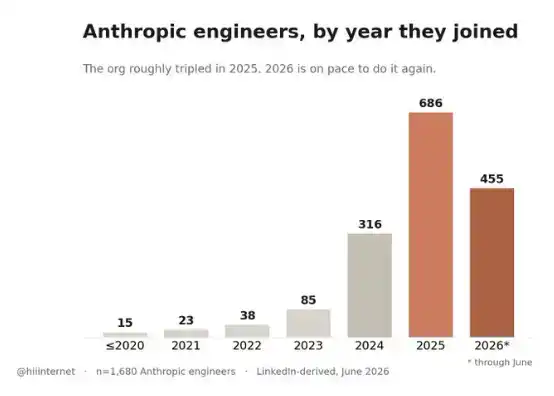
在 2021 年以前就加入 Anthropic、且至今仍在职的工程师只有 15 人。2025 年,这个组织的工程团队几乎扩大了三倍,当年新增 686 名工程师;2026 年的招聘速度也有望与之相当,截至 6 月已经新增 455 人。

当前工程团队中,有一半人在 Anthropic 的任职时间不到一年。53% 的人是在过去 12 个月内加入的。中位任职时长:10 个月。

这是一个大体量组织,却几乎是在约 18 个月内搭建起来的。

几乎只招资深工程师
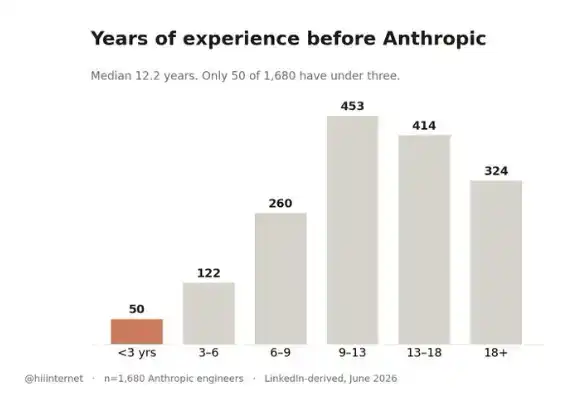
加入 Anthropic 之前的工作经验中位数为 12.2 年。中间 50% 的人拥有 8.8 年至 16.5 年经验。在这 1,680 人中,工作经验不足 3 年的只有 50 人。44% 的人拥有 13 年或更长工作经验。应届生招聘基本不存在。

也就是说,Anthropic 的典型新员工,是一位拥有 12 年经验、但入职 Anthropic 只有 10 个月的工程师。

明显更偏向基础设施,而不是传统意义上的研究
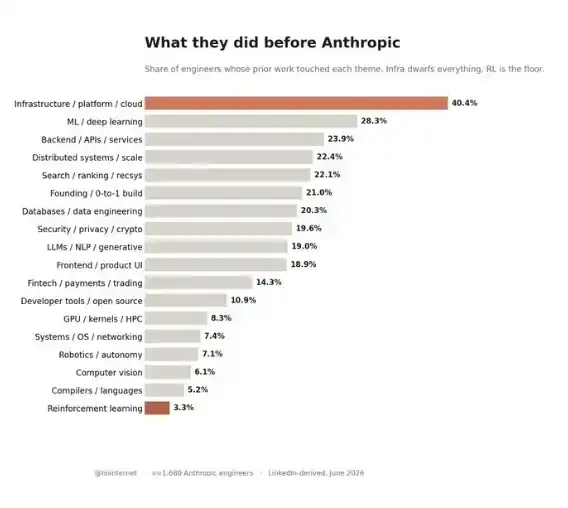
基础设施背景出现在 40% 的工程师履历中。后端、分布式系统、数据库和安全等方向,各自占比约 20%。强化学习,也就是 RLHF 中的那个「RL」,只出现在 3.3% 的人履历中。

典型的 Anthropic 工程师,过去十年通常是在一家超大规模云厂商,或一家重基础设施的创业公司里,构建大规模生产系统。

他们自列的技能也说明了同一件事:Python 585 人,Java 566 人,C++ 443 人,JavaScript 376 人,SQL 302 人,Linux 230 人,分布式系统 189 人,AWS 154 人。那些听起来更「性感」的模型训练工作当然存在,但占比很低。

最大的人才来源不是实验室,而是 Google
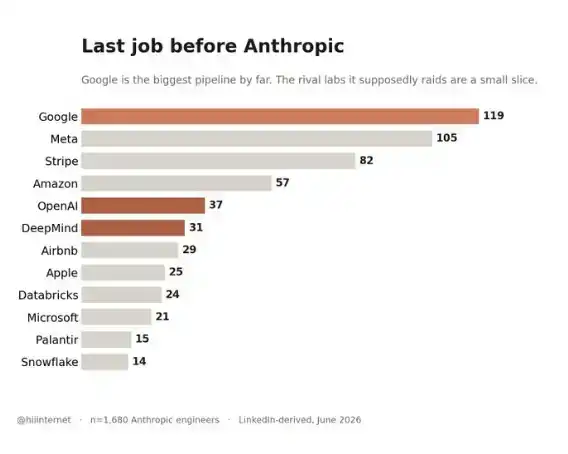
大家都以为 Anthropic 主要从 OpenAI 和 DeepMind 挖人。但它最大的人才管道,远远领先的,是 Google。那些竞争对手实验室,只是图表中间的两根小柱子。

Anthropic 明显更偏好那些以工程严谨性著称的公司:Stripe、Databricks、Snowflake、Palantir、Airbnb。

如果看这些工程师历史上曾经在哪里工作过,排名是:Google 405 人,Meta 273 人,Amazon 197 人,Microsoft 171 人,Stripe 124 人,Apple 87 人,Stanford 68 人,DeepMind 62 人,Airbnb 51 人,OpenAI 48 人。当前工程团队中,有一半人,也就是 50%,履历中至少出现过一次 FAANG。

当然,他们也在从其他 AI 实验室挖人。OpenAI 是前五大直接来源之一,DeepMind 是前六大直接来源之一。大约有 94 名工程师是从其他前沿 AI 实验室直接跳槽到 Anthropic 的。

关于博士的迷思
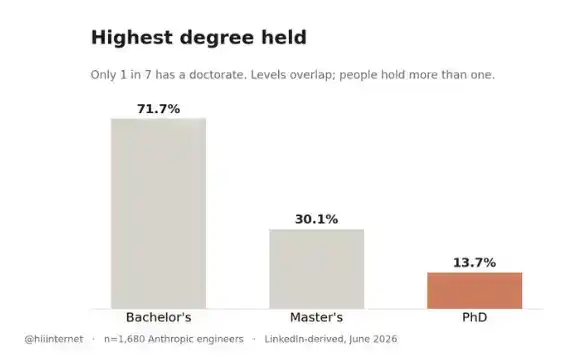
只有 13.7% 的人拥有博士学位。大约七个人里才有一个。

Anthropic 的典型招聘对象,不是研究科学家,而是拥有本科或硕士学历的资深工程师。那种「整个实验室都是博士」的想象,在工程团队层面基本是错的。

专业背景分布也完全符合一个「建设型组织」的画像:计算机科学 819 人,其次是数学 78 人、物理 70 人、计算机工程 69 人。哲学也进入了前 20 名,共 13 人,这可能和安全方向有关。

Stanford 在招聘来源中明显领先
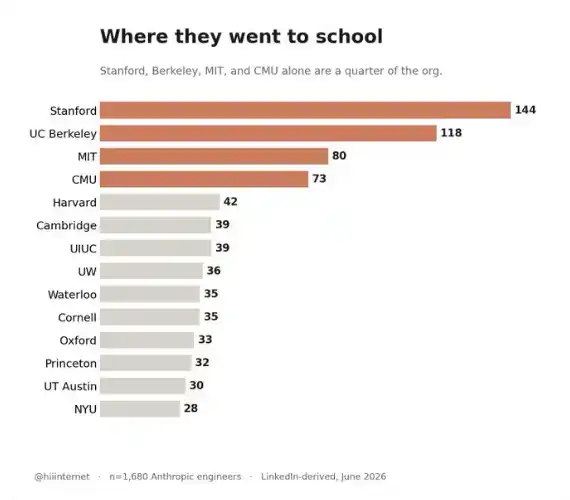
从学校来看,历史累计排名为:Stanford 144 人,Berkeley 118 人,MIT 80 人,CMU 73 人,Harvard 42 人,Cambridge 39 人,UW 36 人,Waterloo 和 Cornell 各 35 人,Oxford 33 人,Princeton 32 人。前四所学校加起来,占了整个工程团队的四分之一。

80% 的人拥有同一个职位头衔。

「Member of Technical Staff」(技术团队成员)。

一位前 Instagram CTO、几位 Adept 前创始人、Stanford 教职人员,在 Anthropic 的头衔都只是「MoTS」。这种职位头衔的扁平化显然是有意为之。资历和具体职能,在设计上被隐藏了起来。

早期职业阶段的人,唯一能进入 Anthropic 的通道在哪里?
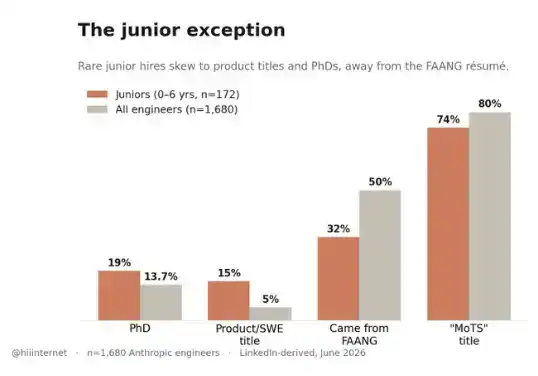
有 172 名工程师工作经验不足 6 年,其中 50 人不足 3 年。但他们并不是普通意义上的应届生。他们大致分成两类,中间几乎没有普通的中级工程师。

和整个工程团队相比,他们呈现出明显不同的特征:博士比例更高,达到 19%,而整体为 13.7%;产品 / SWE 头衔占比是整体的三倍,达到 15%,而整体只有 5%;他们拥有 FAANG 履历的概率也低得多,只有 32%,而整体是 50%。

他们替代工作年限的,是另一种声望资本:

实习管道。 其中 50% 的人列出了以下公司的实习经历:Meta 16 人,Google 10 人,DeepMind 6 人,Microsoft 5 人,Amazon 5 人,此外还有 Jane Street、Two Sigma、HRT、Optiver、Nvidia。

从量化交易到 AI 实验室。 9% 的人曾经过顶级交易机构,包括 Jane Street、Two Sigma、Five Rings、HRT、Optiver、Citadel。这是一批年轻的数学 / 计算机竞赛型人才,通过高频交易行业进入 AI 实验室。

对齐方向 Fellowship。 6% 的人接触过 MATS、SERI、Redwood 或 ARC。这是一个几乎只对早期人才开放、在资深群体中几乎不存在的入口。

一个非常清晰的画像是:MIT,IOI 银牌,Codeforces 2900+ 分,工作四年后直接进入强化学习和安全方向。他们筛选的依据不是工作年限,而是竞赛排名和论文发表。

这些年轻工程师也比资深工程师更国际化。低年资工程师的学校来源包括:Berkeley 15 人,Stanford 14 人,Cambridge 10 人,MIT 7 人,清华 7 人,Oxford 6 人,此外还有 Imperial、NUS、上海交通大学、ETH Zürich。

那么,你应该如何理解这些信息?

如果你想以工程师身份加入 Anthropic,就不要把简历写成投给研究实验室的样子,而要把它写成投给基础设施公司的样子。展示你真正构建过、扩展过的系统。这才是正在被录用的简历。

早期职业阶段是唯一例外。在这个阶段,门槛不是普通工作经验,而是顶级实习、竞赛排名,或者论文。

如果你正在和 Anthropic 抢人,你的目标对象也不是「博士」或「实验室背景」本身,而是那些来自超大规模云厂商或工程声誉极强公司的资深 Builders:他们大约有 12 年经验,可能来自 Stripe、Databricks、Snowflake、Palantir。Anthropic 已经在这个人才池里大力捕鱼。


Related Questions

Q根据文章分析,Anthropic 最核心的人才画像是什么?与外界普遍印象有何不同?

AAnthropic 最核心的人才画像是一批经验丰富的‘建设者’,即能把大规模系统真正搭起来、跑起来、扩展开来的资深工程师。这与外界将其想象成主要由博士、研究员组成的AI实验室不同,其核心在于‘建设’而非‘研究’。

Q文章提到Anthropic的工程师团队有何显著特点?请列举至少三个关键数据或事实。

A1. 团队扩张迅速:工程团队在过去18个月内快速成型,超过一半的工程师入职不到一年。2. 成员经验资深:新员工加入前的工作经验中位数达12.2年。3. 背景偏工程:工程师背景主要集中在基础设施、后端、分布式系统等方向,博士比例仅13.7%,大多来自Google、Meta等以工程能力著称的公司。

Q对于早期职业阶段的候选人,进入Anthropic的主要途径有哪些?

A早期职业阶段候选人主要通过以下途径进入Anthropic:1. 顶级科技公司实习经历(如Meta、Google)。2. 出色的竞赛成绩(如IOI、Codeforces高分)。3. 相关论文发表。4. AI安全/对齐项目经历(如参与MATS、SERI等项目)。这些替代了传统的工作年限要求。

Q文章指出Anthropic工程师的最大人才来源是哪里?这反映了公司怎样的招聘偏好?

AAnthropic工程师的最大人才来源是Google,远超过其他AI实验室。这反映了公司更偏好那些来自以工程严谨性和强大基础设施能力著称的科技公司(如Google、Meta、Amazon、Stripe、Databricks等)的资深工程师,而非单纯的研究背景。

Q根据文章最后给出的建议,如果想以工程师身份加入Anthropic,应该如何准备简历?

A简历不应写成投给研究实验室的样子,而应写成投给基础设施公司的样子。重点突出自己真正构建过、扩展过和维护过的大规模生产系统,展示扎实的工程能力和实践经验。

Related Reads

M&A Deals in the Crypto Market Are Unusually Active

Title: M&A Activity in Crypto Market Becomes Unusually Active A rare signal is emerging in the crypto primary market: mergers and acquisitions (M&A) are nearing half of all financing deals. According to RootData, this month, M&A cases in the crypto industry reached 10, while financing rounds numbered only 14, meaning M&A accounts for approximately 42% of primary market transactions—the highest level in history. This does not signal a sudden industry boom. Instead, the rapid rise in M&A share primarily reflects the continued downturn in the financing market. Since November 2024, monthly crypto M&A deals have remained between 10-20, while financing deals have plummeted from around 100 to about 50, possibly hitting a new low this month. For project teams, this means the traditional path of relying on narratives, token expectations, and ecosystem subsidies to maintain valuations is narrowing. For leading companies, it presents a rare window to acquire teams, licenses, technology, liquidity, and market access at lower prices, with less competition and stronger bargaining power. Key active buyers include Coinbase, Kraken, Ripple, MoonPay, Polymarket, Kaiko, Sol Strategies, GSR, Keyrock, Jupiter, Paxos, and Ondo Finance. Their M&A logic is consistent: acquiring key capabilities at lower costs during the industry downturn. This is driven by more attractive valuations, reduced time and trial-and-error costs, the acquisition of licenses and compliance resources, and the integration of industry upstream and downstream segments. Current M&A focuses are concentrated in four areas: trading infrastructure (e.g., Coinbase acquiring Deribit, Kraken acquiring NinjaTrader), payments and stablecoins (e.g., MoonPay, Ripple expanding payment networks), compliance licenses, and asset issuance/distribution (e.g., acquisitions related to RWA and token issuance platforms like Coinbase's purchases of Liquifi and Echo). The rise in M&A is altering the primary market's exit logic. It provides an alternative path to the token-dependent model, encouraging teams to build tangible products, revenue, and strategic value that can be integrated. This could inject confidence into the market, showing that asset buyers and exit possibilities still exist, albeit with a stricter focus on real utility. However, this trend also indicates the crypto industry is becoming more centralized. As asset issuance, trading, market-making, custody, payments, and data gradually consolidate in the hands of a few major players, the industry's initial emphasis on openness and anti-monopoly is being reshaped by commercial realities. Coupled with rising compliance barriers, this signals the end of the low-barrier era for crypto entrepreneurship.

链捕手13m ago

M&A Deals in the Crypto Market Are Unusually Active

链捕手13m ago

M&A Deals Are Exceptionally Active in the Crypto Market

Mergers and acquisitions (M&A) activity in the cryptocurrency primary market has reached a historic high, accounting for approximately 42% of total deals in the current month, nearly matching the number of financing rounds. This shift does not signal a new boom cycle but rather reflects a severe contraction in the venture capital funding environment. As financing dwindles, established industry giants—including major exchanges, payment firms, and infrastructure providers—are seizing the opportunity to acquire strategic assets at lower valuations. Key drivers behind the surge in M&A include depressed project valuations, the need to quickly acquire talent and technology to capture short market windows, the pursuit of crucial regulatory licenses, and the strategic expansion into adjacent business verticals such as derivatives, payments, stablecoins, and real-world asset (RWA) issuance. Major acquisitions, like Coinbase's purchase of Deribit and Kraken's acquisition of NinjaTrader, exemplify the push to expand into high-margin areas like derivatives and multi-asset trading. This trend is reshaping the industry's exit landscape, offering an alternative to token-based exits and incentivizing startups to build tangible products and revenue streams with inherent strategic value for acquisition. However, it also points toward increasing centralization, as critical functions—trading, custody, payments, compliance—become concentrated within a few large, well-capitalized platforms, potentially raising barriers to entry for new ventures.

marsbit14m ago

M&A Deals Are Exceptionally Active in the Crypto Market

marsbit14m ago

Solana Privacy Ecosystem Panorama: A Complete Privacy Stack from Compute to AI

**Title: The Solana Privacy Ecosystem: A Full-Stack View from Compute to AI** **Summary:** This article provides a comprehensive overview of the emerging privacy landscape on the Solana blockchain, characterizing it as still in early development. It identifies two primary verticals—Neobanks and Private DeFi—as key drivers, while noting gaps in tooling and user experience. The discussion centers on two main approaches to private computation: Arcium, which utilizes Multi-Party Computation (MPC) networks (Multi-Party eXecution Environments) to process encrypted data with final settlement on Solana; and Magic Block, which leverages Trusted Execution Environments (TEEs) via its Private Ephemeral Rollup (PER). Both enable confidential applications like dark pools and private DeFi with minimal code changes. Building on this infrastructure, projects are creating privacy-focused applications. Umbra, built on Arcium, offers Encrypted Token Accounts (ETAs) for private balances, transfers, and selective disclosure for compliance. Other wallets like Privacy Cash and Hush provide mixer-like functionality for SOL. For private trading, encifherio uses TEEs to encrypt swap details routed through Jupiter, while VanishTrade and Darklake focus on shielding transaction intent and liquidity routing, with Darklake introducing a "blind slippage pool" to prevent front-running. Further applications include private prediction markets (e.g., Melee Markets using Arcium's encrypted order books) and private AI. Loyal exemplifies the latter, using both Magic Block and Arcium to enable decentralized AI agents that store user data, conversations, and transactions confidentially on-chain. The article concludes by framing privacy not as a single technology but as an evolving "ultimate privacy stack," with experts like Helius's Mert envisioning a future combination of Fully Homomorphic Encryption (FHE) and Zero-Knowledge proofs (ZK). Helius Privacy itself is developing a ZK-based UTXO privacy layer for Solana.

Foresight News19m ago

Solana Privacy Ecosystem Panorama: A Complete Privacy Stack from Compute to AI

Foresight News19m ago

Trading

Spot
Futures

Hot Articles

How to Buy PEOPLE

Welcome to HTX.com! We've made purchasing ConstitutionDAO (PEOPLE) simple and convenient. Follow our step-by-step guide to embark on your crypto journey.Step 1: Create Your HTX AccountUse your email or phone number to sign up for a free account on HTX. Experience a hassle-free registration journey and unlock all features.Get My AccountStep 2: Go to Buy Crypto and Choose Your Payment MethodCredit/Debit Card: Use your Visa or Mastercard to buy ConstitutionDAO (PEOPLE) instantly.Balance: Use funds from your HTX account balance to trade seamlessly.Third Parties: We've added popular payment methods such as Google Pay and Apple Pay to enhance convenience.P2P: Trade directly with other users on HTX.Over-the-Counter (OTC): We offer tailor-made services and competitive exchange rates for traders.Step 3: Store Your ConstitutionDAO (PEOPLE)After purchasing your ConstitutionDAO (PEOPLE), store it in your HTX account. Alternatively, you can send it elsewhere via blockchain transfer or use it to trade other cryptocurrencies.Step 4: Trade ConstitutionDAO (PEOPLE)Easily trade ConstitutionDAO (PEOPLE) on HTX's spot market. Simply access your account, select your trading pair, execute your trades, and monitor in real-time. We offer a user-friendly experience for both beginners and seasoned traders.

7.1k Total ViewsPublished 2024.03.29Updated 2026.06.02

How to Buy PEOPLE

Discussions

Welcome to the HTX Community. Here, you can stay informed about the latest platform developments and gain access to professional market insights. Users' opinions on the price of PEOPLE (PEOPLE) are presented below.

活动图片