Bitcoin 1 Month Old Supply Is Down To Historical Bottom Zone

BitcoinistPublished on 2022-08-27Last updated on 2022-08-27

Abstract

On-chain data shows the percentage of the Bitcoin supply aged between one week and one month old has now declined to the historical bottom zone.

On-chain data shows the percentage of the Bitcoin supply aged between one week and one month old has now declined to the historical bottom zone.

Only 3.8% Of The Total Bitcoin Supply Is Now In The 1 Week To 1 Month Old Bracket

As pointed out by an analyst in a CryptoQuant post, short-term buying seems to have been going down in the BTC market recently.

One way of calculating the capitalization of Bitcoin is the “realized cap,” where each coin is multiplied with the price at which it was last moved, and then a sum is taken for the entire supply.

This is different from the normal market cap, where the sum is taken after all the coins have been simply weighted against the current value of BTC.

The indicator of relevance here is the “realized cap UTXO age bands,” which tells us about the individual percentage contribution to the realized cap from the different coin age groups in the market.

In this case, specifically, the percentage of the “1 week to 1 month old” supply is considered. Here is the chart showing the trend in the contribution from this group:
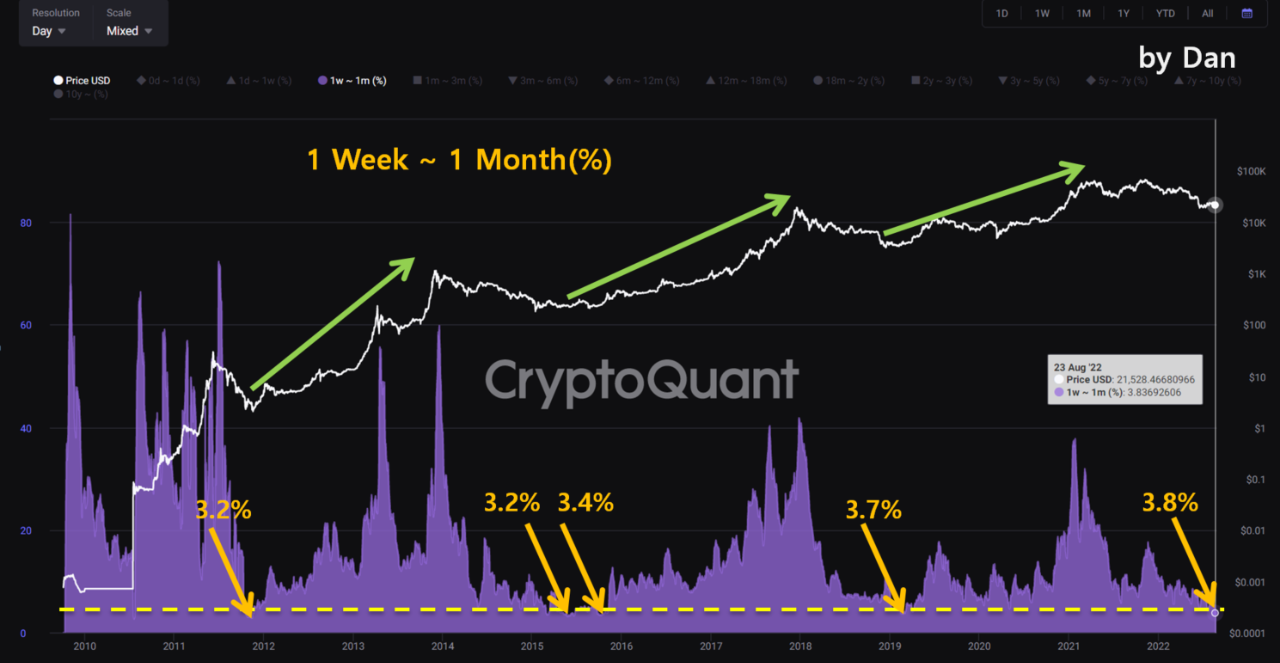
As you can see in the above graph, bottoms in the price of Bitcoin have historically taken place around when the percentage of the 1 week to 1 month old supply has dipped below the 4% mark.

Recently, the indicator’s value has observed a decline and it is now at around 3.8%, below this historical threshold.

The quant explains in the post that when bears are just starting, investors continue to buy without realizing a bear market is going on. However, when the bear has lasted a long time, most of these holders stop buying more.

The 1 week to 1 month old supply signifies the short-term buying taking place in the market. It declining to these lows suggests that the bear is now at a stage where most investors have stopped accumulating more.

If past trend holds this time as well, then the percentage of this supply going down into the bottom zone may mean Bitcoin could be at or near a bear bottom for the cycle.

BTC Price

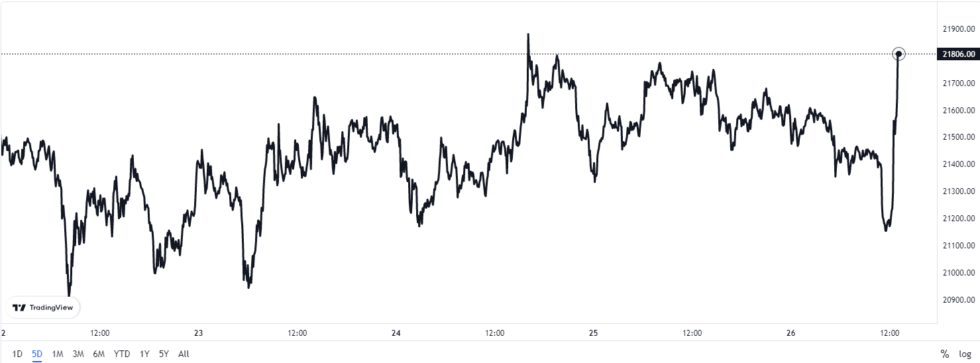
At the time of writing, Bitcoin’s price floats around $21.8k, up 1% in the last week. Over the past month, the crypto has gained 2% in value.

The below chart shows the trend in the price of the coin over the last five days.
Related Reads

Can You Make a Steady Profit by Blindly Following Polymarket's Pre-Game Win Probability to Bet on NBA Games?

**Can You Consistently Profit by Blindly Following Pre-Game Win Probabilities on Polymarket for NBA Games?** A backtest of the entire NBA 2025-26 regular season (1,096 games) was conducted to test the strategy of always betting $100 on the team with the higher pre-game win probability on Polymarket. The results show that this strategy is not profitable. The total amount wagered was $109,600, with a return of $107,545.20, resulting in a net loss of $2,054 and a Return on Investment (ROI) of -1.87%. This indicates that the market is highly efficient, and pre-game probabilities are accurately priced, leaving no simple arbitrage opportunity. In fact, blindly following the market would have been slightly less profitable than betting against it. However, a deeper analysis by team revealed significant differences. Certain teams consistently outperformed market expectations when they were favored to win: * Portland Trail Blazers (POR): 19% ROI * Philadelphia 76ers (PHI): 14% ROI * San Antonio Spurs (SAS): 12% ROI * Los Angeles Lakers (LAL): 11% ROI * Charlotte Hornets (CHA): 9% ROI In contrast, the market was highly efficient for the top-performing teams, offering minimal returns (e.g., Boston Celtics ROI: 4%, Denver Nuggets ROI: -5%). Results for the weakest teams were too inconsistent due to small sample sizes. The key finding is that team-specific factors, rather than the probability percentage itself, drive potential value, making a one-size-fits-all strategy ineffective.

Odaily星球日报4m ago

Can You Make a Steady Profit by Blindly Following Polymarket's Pre-Game Win Probability to Bet on NBA Games?

Odaily星球日报4m ago

Are Altcoins Soaring? Is the Bull Market Back?

Recent days have seen significant volatility in altcoins while Bitcoin remained relatively stable. Some low-market-cap tokens, with circulations under $20 million, surged by several hundred percent within days—without fundamental improvements, ecosystem breakthroughs, or new institutional inflows. This is not a true altseason. The Altseason Index stands at 34, and Bitcoin dominance is at 58.5%, indicating the market is still in a "Bitcoin season." The altcoin market cap has shrunk by ~40% since its peak in December 2024, falling to around $700 billion. This severe decline has made it cheaper for large holders to accumulate significant portions of circulating supply, enabling price manipulation. A case in point is SIREN, where a single entity allegedly controlled up to 88% of the circulating supply. Such concentration allows a small group to dictate price movements. Additionally, deeply negative funding rates (as low as -0.3% every 8 hours, annualized to -328%) force short sellers to pay high fees, accelerating liquidations and further fueling upward price spikes. On-chain activity, like a 97% weekly increase in BSC DEX volume, suggests excitement, but it is largely driven by existing capital, not new inflows. Institutional flows into altcoin ETFs (like those for Solana and XRP) have been weak or negative, indicating caution rather than rotation into altcoins. This rally is a signal of structural fragility, not broad bullish momentum. Until Bitcoin dominance falls significantly and new capital enters the altcoin space, these pumps are echoes of manipulation—not the return of a true bull market.

marsbit39m ago

Are Altcoins Soaring? Is the Bull Market Back?

marsbit39m ago

Trading

Spot
Futures

Hot Articles

What is $BITCOIN

DIGITAL GOLD ($BITCOIN): A Comprehensive Analysis Introduction to DIGITAL GOLD ($BITCOIN) DIGITAL GOLD ($BITCOIN) is a blockchain-based project operating on the Solana network, which aims to combine the characteristics of traditional precious metals with the innovation of decentralized technologies. While it shares a name with Bitcoin, often referred to as “digital gold” due to its perception as a store of value, DIGITAL GOLD is a separate token designed to create a unique ecosystem within the Web3 landscape. Its goal is to position itself as a viable alternative digital asset, although specifics regarding its applications and functionalities are still developing. What is DIGITAL GOLD ($BITCOIN)? DIGITAL GOLD ($BITCOIN) is a cryptocurrency token explicitly designed for use on the Solana blockchain. In contrast to Bitcoin, which provides a widely recognized value storage role, this token appears to focus on broader applications and characteristics. Notable aspects include: Blockchain Infrastructure: The token is built on the Solana blockchain, known for its capacity to handle high-speed and low-cost transactions. Supply Dynamics: DIGITAL GOLD has a maximum supply capped at 100 quadrillion tokens (100P $BITCOIN), although details regarding its circulating supply are currently undisclosed. Utility: While precise functionalities are not explicitly outlined, there are indications that the token could be utilized for various applications, potentially involving decentralized applications (dApps) or asset tokenization strategies. Who is the Creator of DIGITAL GOLD ($BITCOIN)? At present, the identity of the creators and development team behind DIGITAL GOLD ($BITCOIN) remains unknown. This situation is typical among many innovative projects within the blockchain space, particularly those aligning with decentralized finance and meme coin phenomena. While such anonymity may foster a community-driven culture, it intensifies concerns about governance and accountability. Who are the Investors of DIGITAL GOLD ($BITCOIN)? The available information indicates that DIGITAL GOLD ($BITCOIN) does not have any known institutional backers or prominent venture capital investments. The project seems to operate on a peer-to-peer model focused on community support and adoption rather than traditional funding routes. Its activity and liquidity are primarily situated on decentralized exchanges (DEXs), such as PumpSwap, rather than established centralized trading platforms, further highlighting its grassroots approach. How DIGITAL GOLD ($BITCOIN) Works The operational mechanics of DIGITAL GOLD ($BITCOIN) can be elaborated on based on its blockchain design and network attributes: Consensus Mechanism: By leveraging Solana’s unique proof-of-history (PoH) combined with a proof-of-stake (PoS) model, the project ensures efficient transaction validation contributing to the network's high performance. Tokenomics: While specific deflationary mechanisms have not been extensively detailed, the vast maximum token supply implies that it may cater to microtransactions or niche use cases that are still to be defined. Interoperability: There exists the potential for integration with Solana’s broader ecosystem, including various decentralized finance (DeFi) platforms. However, the details regarding specific integrations remain unspecified. Timeline of Key Events Here is a timeline that highlights significant milestones concerning DIGITAL GOLD ($BITCOIN): 2023: The initial deployment of the token occurs on the Solana blockchain, marked by its contract address. 2024: DIGITAL GOLD gains visibility as it becomes available for trading on decentralized exchanges like PumpSwap, allowing users to trade it against SOL. 2025: The project witnesses sporadic trading activity and potential interest in community-led engagements, although no noteworthy partnerships or technical advancements have been documented as of yet. Critical Analysis Strengths Scalability: The underlying Solana infrastructure supports high transaction volumes, which could enhance the utility of $BITCOIN in various transaction scenarios. Accessibility: The potential low trading price per token could attract retail investors, facilitating wider participation due to fractional ownership opportunities. Risks Lack of Transparency: The absence of publicly known backers, developers, or an audit process may yield skepticism regarding the project's sustainability and trustworthiness. Market Volatility: The trading activity is heavily reliant on speculative behavior, which can result in significant price volatility and uncertainty for investors. Conclusion DIGITAL GOLD ($BITCOIN) emerges as an intriguing yet ambiguous project within the rapidly evolving Solana ecosystem. While it attempts to leverage the “digital gold” narrative, its departure from Bitcoin's established role as a store of value underscores the need for a clearer differentiation of its intended utility and governance structure. Future acceptance and adoption will likely depend on addressing the current opacity and defining its operational and economic strategies more explicitly. Note: This report encompasses synthesised information available as of October 2023, and developments may have transpired beyond the research period.

363 Total ViewsPublished 2025.05.13Updated 2025.05.13

What is $BITCOIN

Discussions

Welcome to the HTX Community. Here, you can stay informed about the latest platform developments and gain access to professional market insights. Users' opinions on the price of BTC (BTC) are presented below.

活动图片