Beosin : 36 incidents de sécurité majeurs en mai, avec des pertes totales dépassant 76 millions de dollars

marsbitPublished on 2026-06-10Last updated on 2026-06-10

Abstract

**Résumé des principaux incidents de sécurité en mai : plus de 76 millions de dollars de pertes** Selon les données de Beosin Alert, le mois de mai a enregistré 36 incidents de sécurité majeurs dans l'écosystème Web3, entraînant des pertes totales d'environ 76,15 millions de dollars. Les causes principales étaient les vulnérabilités des contrats intelligents (17 incidents) et les fuites de clés privées (10 incidents). L'incident le plus important a touché le pont cross-chain Verus-Ethereum Bridge, avec une perte de 11,58 millions de dollars due à un défaut de vérification des messages. Echo Protocol a subi une perte de 5,13 millions de dollars suite à une fuite de clé privée. Les ponts cross-chain ont été les plus touchés en valeur (près de 28 millions de dollars), tandis que les projets DeFi ont été les plus fréquemment attaqués (14 fois). Ethereum a concentré la majorité des pertes (plus de 48,76 millions de dollars), mais des incidents ont également eu lieu sur BNB Chain, Monad, TON, Monero et Bitcoin, illustrant une tendance multi-chaînes. L'analyse met en lumière trois types d'attaques : 1. **Verus** : Un défaut dans la vérification des preuves de messages cross-chain, similaire à des failles ayant touché Wormhole et Nomad par le passé. 2. **Trusted Volumes** : Une faille dans les paramètres de signature permettant de détourner les vérifications d'autorisation. 3. **StablR (et autres)** : Plusieurs incidents dus à des fuites de clés privées, souvent liés à une mau...

Rédigé par : Beosin

Selon les données de surveillance de la plateforme Beosin Alert, en mai 2026, le montant total des pertes liées aux divers incidents de sécurité s'élève à environ 76,15 millions de dollars. Il y a eu un total de « 36 » incidents majeurs de piratage, principalement dus à des vulnérabilités de contrat et à des fuites de clés privées. Parmi eux, 17 incidents de sécurité étaient dus à des vulnérabilités de contrat/réseau, et 10 incidents de pertes étaient dus à des fuites de clés privées. La sécurité du code et la sécurité opérationnelle de l'écosystème DeFi sont confrontées à des défis majeurs.

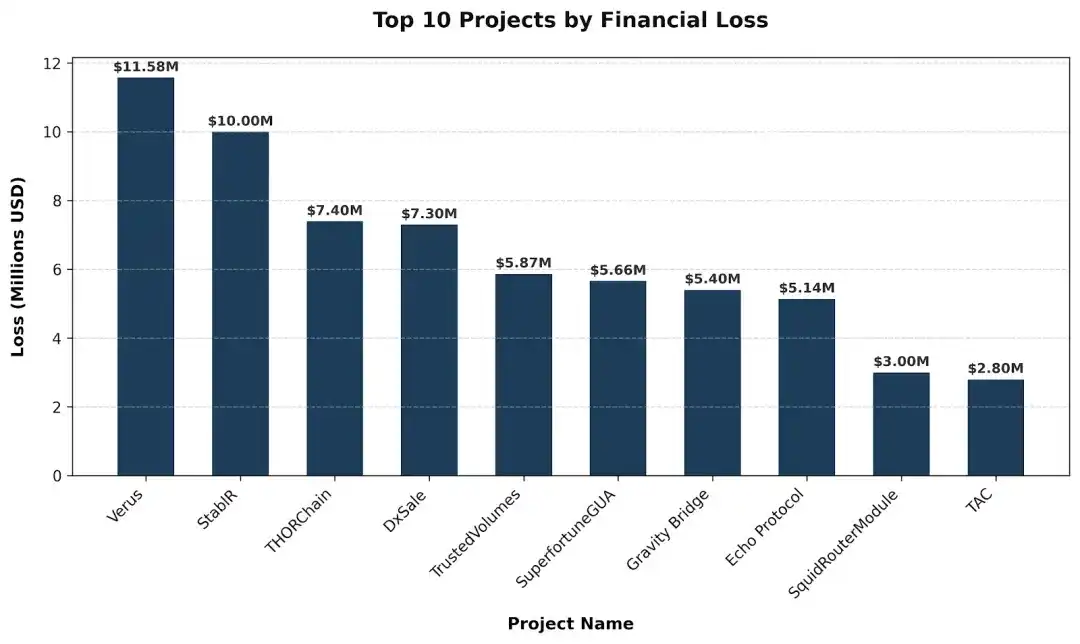
Top 10 des protocoles en pertes pour mai

Le pont inter-chaînes Verus-Ethereum, reliant la chaîne Verus L1 à Ethereum, a été attaqué en raison d'une vulnérabilité de contrat, entraînant les pertes les plus importantes, s'élevant à 11,58 millions de dollars. Echo Protocol a été attaqué suite à une fuite de clé privée, permettant au pirate de frapper 1000 eBTC (valeur nominale d'environ 76,7 millions de dollars), mais en raison de la liquidité limitée, le profit réel final a été d'environ 5,13 millions de dollars.
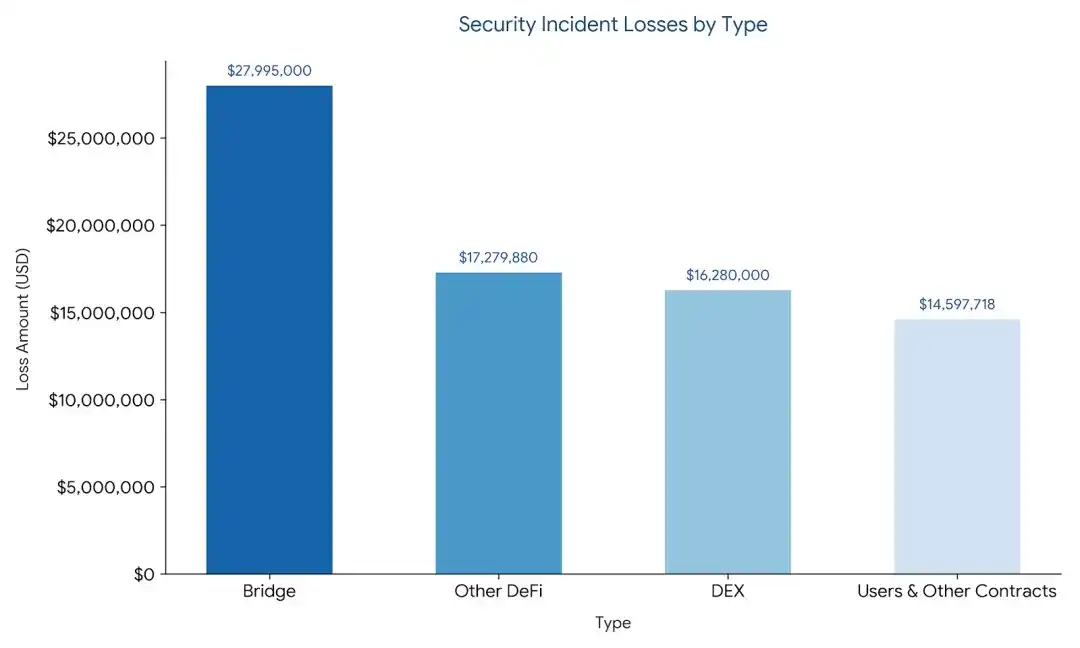
Types de projets attaqués et situation des pertes par chaîne

Les cibles des attaques couvraient divers types tels que les ponts inter-chaînes, les échanges décentralisés, les protocoles de prêt, les marchés de prédiction, les stablecoins et les utilisateurs ordinaires. Parmi eux, les ponts inter-chaînes ont subi les pertes les plus élevées, avec un montant de 27,995 millions de dollars, et les projets liés au DeFi ont été les plus fréquemment attaqués, avec un total de 14 incidents.
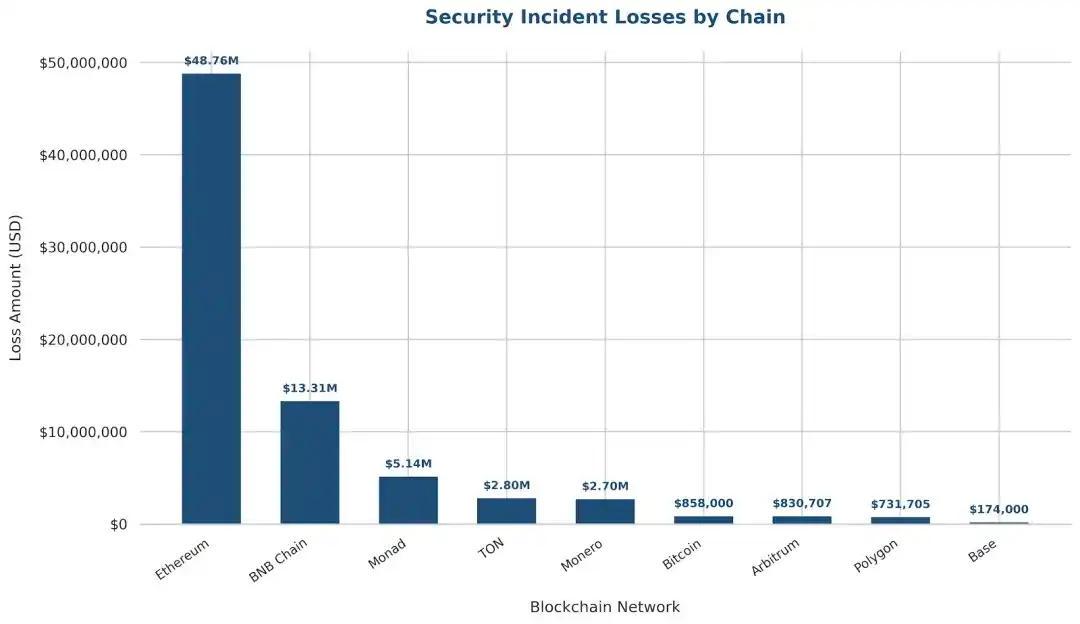
En mai, la chaîne ayant subi le plus de pertes était Ethereum, avec un montant dépassant 48,76 millions de dollars. La plupart des incidents de sécurité impliquant des ponts inter-chaînes et de nombreux protocoles DeFi se concentrent toujours sur Ethereum. Viennent ensuite BNB Chain, Monad, TON, et des incidents de sécurité ont également eu lieu sur Monero et Bitcoin, montrant une tendance d'attaques multi-chaînes.
Analyse des principaux incidents de sécurité

1. Verus : Défaut de vérification des messages inter-chaînes

Le fonctionnement du pont Verus-Ethereum Bridge repose sur un soumissionnaire fournissant des données de preuve attestant de l'existence sur la chaîne Verus d'une sortie qualifiée et notariée. Le contrat du pont vérifie ces preuves sur Ethereum avant de libérer les actifs. La vulnérabilité réside dans le fait que le contrat de pont côté Ethereum vérifie bien la preuve venant de la chaîne Verus, mais ne vérifie pas si ces données correspondent à une sortie originale valide. Cela a permis à un attaquant de construire une fausse sortie passant la vérification et d'extraire des fonds largement supérieurs à son dépôt.

Partie du code contenant la vulnérabilité :
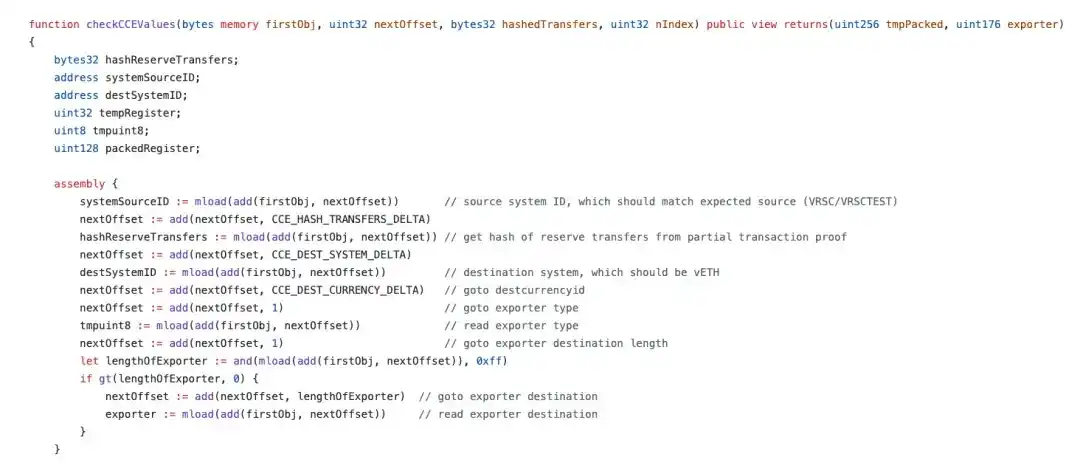
La vulnérabilité de cet incident est du même type que celles qui ont causé des pertes de 320 millions de dollars à Wormhole et de 190 millions de dollars à Nomad en 2022 : le pont a vérifié le message lui-même, mais pas la valeur des fonds sous-jacents.

2. Trusted Volumes : Défaut des paramètres de signature

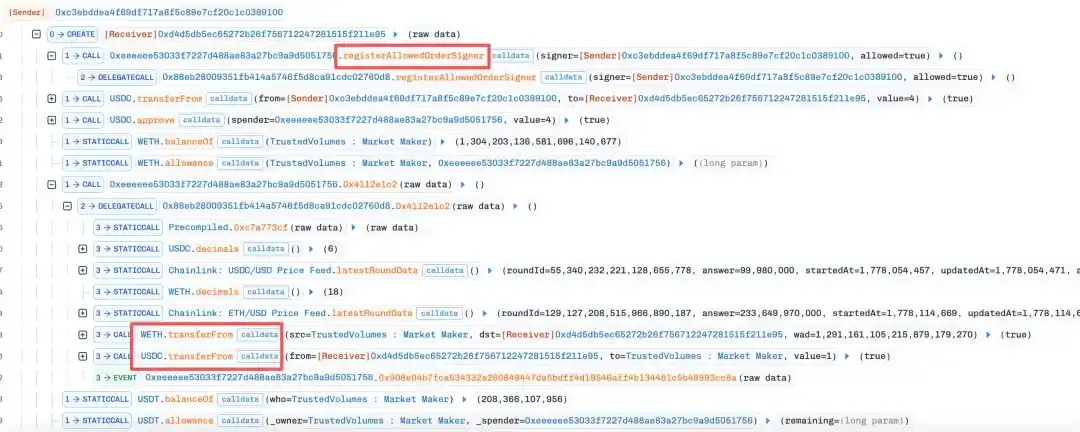
L'attaquant a exploité un défaut de conception de la signature dans le processus de demande de prix (RFQ) de TrustedVolumes. Lors du transfert réel, en utilisant des données de signature personnalisées, il a défini l'expéditeur du transfert comme le contrat Resolver de TrustedVolumes, ce qui a passé la vérification, permettant ainsi de transférer les actifs du contrat Resolver pour en tirer profit.

Partie du code contenant la vulnérabilité :
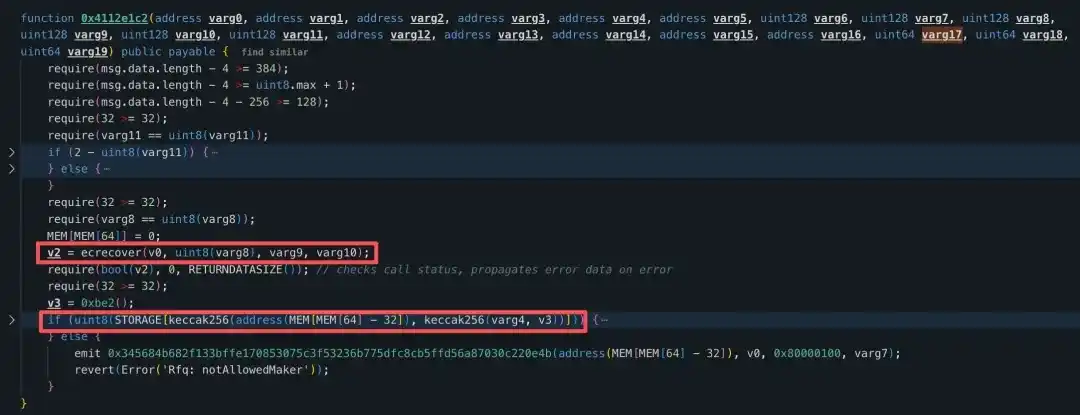
La vérification de l'autorisation faisait référence à varg4, tandis que l'exécution du transfert de fonds référençait d'autres paramètres. L'absence de vérification a conduit à une inadéquation entre le domaine du signataire autorisé et l'adresse de débit réel.

L'attaquant n'avait donc qu'à signer une commande avec l'adresse du signataire enregistrée, où maker = Exploit (passant la vérification de signature), et les autres paramètres de signature (jeton, montant) pouvaient être définis sur des valeurs arbitraires, par exemple une fausse commande 1:1, pour qu'elle passe la vérification de prix raisonnable par l'oracle, puis transférer les actifs du contrat du protocole :
3. Les incidents de fuite de clés privées, exemple de StablR

Plusieurs incidents de fuite de clés privées sont survenus en mai, avec des pertes totales dépassant 25 millions de dollars. StablR, en tant qu'émetteur de stablecoins conformes, est devenu une leçon typique en matière de gouvernance de sécurité pour les stablecoins et le secteur DeFi.

StablR a lancé deux produits de stablecoins conformes : EURR et USDR. Le portefeuille multi-signature contrôlant la frappe d'EURR est 0x8278D2881dBF8F6Fc01c98d196c4b16F1aade5Bc ; le portefeuille multi-signature contrôlant la frappe d'USDR est 0xF45392bd2D6e6b8C5Dc26BA6c8a12889419B82F3.

Comme ces 2 portefeuilles multi-signatures ne nécessitaient qu'1 signature pour initier une transaction, l'attaquant, en contrôlant l'adresse propriétaire 0xC73fD562de86d7860EE636C20813Bcb2cF4D550d, a ajouté l'adresse 0xD4677B5A8B1b97EA213Fdb876b0FcBAB3f9F6CD1 à ces 2 portefeuilles multi-signatures, prenant ainsi le contrôle des permissions de frappe du projet :
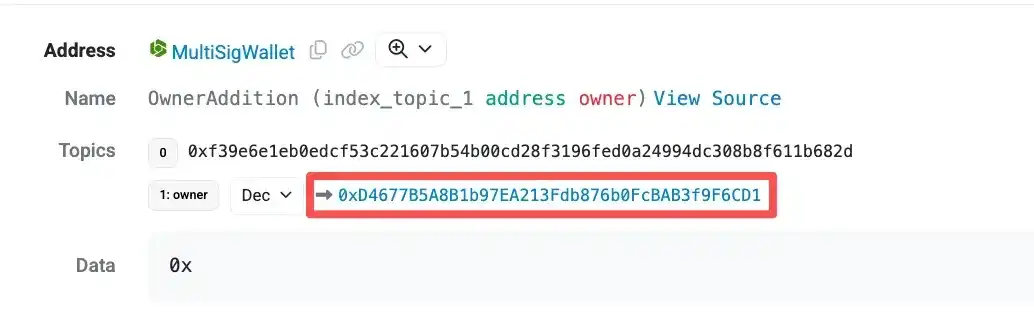
Ce type d'incident ne relève pas d'une vulnérabilité de code, mais d'un problème de sécurité opérationnelle de l'équipe du projet : ne pas avoir correctement sauvegardé les clés privées des adresses privilégiées, ne pas utiliser de multi-signature à seuil élevé pour les opérations à haute valeur/risque, absence de délai d'exécution (timelock) pour les opérations de frappe importantes, manque de mécanisme de réponse d'urgence rapide.

Tendances des menaces à la sécurité Web3

La tendance la plus profonde en matière de sécurité Web3 en 2026 est l'expansion systémique de la surface d'attaque. Les vulnérabilités apparaissent simultanément dans le code, l'infrastructure, l'interopérabilité et les processus humains. Compter uniquement sur quelques audits de sécurité ou des outils ne peut couvrir les domaines de la sécurité opérationnelle, des terminaux employés, de l'infrastructure cloud et de la chaîne d'approvisionnement logicielle. Cela impose des exigences plus élevées en matière de sécurité opérationnelle continue pour les projets Web3.

De plus, les attaques contre les contrats anciens/abandonnés sont fréquentes, leurs vulnérabilités ou autorisations étant facilement exploitables par les attaquants. Les développeurs ou opérateurs de contrats devraient réexaminer la sécurité de leurs anciens contrats. Pour les contrats abandonnés, ils devraient traiter ou transférer correctement les fonds restants dans le contrat, et contacter les utilisateurs pour annuler les autorisations inutiles. Les utilisateurs devraient également vérifier régulièrement à l'aide d'un explorateur de blocs ou d'outils de révocation d'autorisation et annuler les autorisations de contrat qu'ils n'utilisent plus.

Related Questions

QQuel est le montant total des pertes liées aux incidents de sécurité survenus en mai 2026, selon l'article de Beosin ?

AEn mai 2026, le montant total des pertes liées aux incidents de sécurité s'élève à environ 76,15 millions de dollars américains.

QQuelle a été la cause principale des 36 principaux incidents de piratage répertoriés en mai ?

ALes principales causes des 36 principaux incidents de piratage étaient les vulnérabilités des contrats intelligents et la compromission des clés privées.

QQuel protocole a subi la perte la plus importante en mai et quelle en était la raison ?

ALe pont inter-chaînes Verus-Ethereum Bridge a subi la perte la plus importante, soit 11,58 millions de dollars, en raison d'une vulnérabilité de contrat qui permettait de valider des sorties de fonds frauduleuses.

QQuel type de projet a été le plus fréquemment attaqué et sur quelle chaîne les pertes ont-elles été les plus élevées en mai ?

ALes projets liés à la finance décentralisée (DeFi) ont été les plus fréquemment attaqués (14 incidents). La chaîne Ethereum a enregistré les pertes les plus élevées, dépassant 48,76 millions de dollars.

QL'article cite l'incident de StablR comme un exemple typique. Quel était le problème de sécurité principal dans ce cas ?

AL'incident de StablR n'était pas dû à une vulnérabilité du code, mais à un problème de sécurité opérationnelle : une compromission de clé privée. Les portefeuilles multi-signatures critiques pour la frappe de monnaie n'avaient qu'un seuil de signature de 1, permettant à un attaquant ayant pris le contrôle d'une adresse propriétaire de s'octroyer des privilèges de frappe.

Related Reads

Google TPU Shipments Revised Up by 50%

Recent industry research indicates a significant upward revision in the shipments of Google's TPU (Tensor Processing Unit) chips. Previous expectations for 2027 were set at around 10 million units, but new estimates now point to 15 million units, a 50% increase. This substantial boost directly translates to higher demand across the entire supporting supply chain. Google's TPU clusters utilize a standardized all-optical interconnect architecture. Consequently, key hardware components are deeply integrated and scaled in fixed ratios with the chips. The 15 million TPU target will drive corresponding demand increases for NPO optical engines (roughly a 1:1 match), 1.6T optical modules, OCS optical switches, high-end server power supplies, fiber optics & MPO connectors, and liquid cooling solutions. Among these, liquid cooling is highlighted as the sector experiencing the most significant transformation and offering the most stable potential for excess returns. As next-generation TPU chips reach power levels where traditional air cooling is insufficient, liquid cooling becomes essential. 2026 is forecasted as the first year of substantial adoption for Google's liquid cooling solutions. This shift, coupled with delivery and capacity bottlenecks faced by incumbent overseas manufacturers, is creating a prime window for domestic Chinese suppliers to enter and secure Google's core supply chain. The market size for Google-specific liquid cooling is projected to potentially triple from a baseline of hundreds of billions to around 300 billion units by 2028. The logic for the fiber optic sector is also being rewritten. Once considered a cyclical commodity tied to telecom operator procurement, fiber is now a strategic and scarce resource for AI Data Centers (AIDC). A severe supply-demand imbalance, driven by the long lead time for preform production (18-24 months) and surging demand from cloud giants, is supporting strong performance. Chinese fiber manufacturers are well-positioned to capture a significant share of global AIDC demand, with exports potentially reaching 200-300 million core kilometers in 2026. Overall, the investment focus within the AI computing industry is shifting from pure "chip performance speculation" towards the more certain incremental growth in computing infrastructure and its supporting ecosystem. The upward revision in Google TPU shipments, along with the potential for further doubling by 2028, is seen as solidifying performance visibility for the entire supporting supply chain over the next two years.

marsbit4m ago

Google TPU Shipments Revised Up by 50%

marsbit4m ago

What Wall Street Really Wants After the Crypto Story Recedes

The tide of speculative crypto narratives has receded, revealing Wall Street's true objective: building a controlled, yield-generating, and compliant financial pipeline on distributed ledgers. They are migrating core functions onto blockchains, not for decentralization, but for efficiency and new revenue streams. Key developments include BlackRock's BUIDL fund, a tokenized treasury fund acting as a foundational reserve asset, and the rise of Securitize, which is going public and partnering with the NYSE to build a 24/7 digital securities trading and settlement system. This signals a major shift of securities clearing to blockchain technology. To make volatile assets like Bitcoin palatable for institutional investors, firms like BlackRock and Goldman Sachs are creating "covered call" ETFs (e.g., BITA). These products systematically sell options on Bitcoin holdings, transforming price volatility into stable monthly income, effectively repackaging crypto as a yield-bearing asset. Stablecoins are being positioned not as speculative tools but as efficient payment rails. Companies like Stripe and Mastercard are integrating them for instant, low-cost merchant settlements and cross-border card payments, respectively. Critically, new legislation like the GENIUS Act shapes them as non-interest-bearing, heavily regulated extensions of the US dollar system. In summary, Wall Street is quietly constructing a parallel, blockchain-based financial infrastructure featuring tokenized traditional assets, structured crypto yields, and programmable dollar pipelines—all under its control and fully integrated with existing regulatory and credit frameworks.

marsbit21m ago

What Wall Street Really Wants After the Crypto Story Recedes

marsbit21m ago

Tying Itself to SpaceX: Cursor's $60 Billion Rise

This article recounts the rapid rise of AI-powered coding startup Cursor and its 25-year-old MIT graduate CEO, Michael Truell. Launched in 2023, Cursor achieved explosive growth, reaching over 10 billion USD in revenue by late 2025. However, its journey highlights a central dilemma for AI application companies: dependence on foundational model providers. Cursor initially relied heavily on Anthropic's models but faced an existential threat when Anthropic launched its own competing coding tool, Claude Code. In response, Cursor declared an internal emergency in early 2026 and accelerated development of its own model, Composer. To secure the immense computing power needed, Truell struck a pivotal deal with Elon Musk's SpaceX in April 2026. The collaboration grants Cursor access to SpaceX's supercomputing resources for Composer, while SpaceX's Grok model benefits from Cursor's programming data. The agreement includes a potential 600 billion USD acquisition of Cursor by SpaceX later in the year, though a substantial termination fee is in place if the deal falls through. The story explores Cursor's intense, sometimes controversial hiring practices involving lengthy unpaid "work trials," its complex partnership-turned-rivalry with Anthropic, and its high-stakes gamble to ensure independence through the SpaceX alliance. The core question remains: will Cursor evolve into a defining, independent "generational" software company, or become a key piece in a tech giant's AI arsenal?

marsbit25m ago

Tying Itself to SpaceX: Cursor's $60 Billion Rise

marsbit25m ago

Warsh's Debut: Will the FED Chair Who Knows Crypto Best Bring Surprises or Shocks to the Market?

Kevin Warsh, the new Federal Reserve Chairman, prepares for his inaugural press conference amidst a challenging macroeconomic landscape: resurgent inflation, a bond market sell-off, and political pressure from President Trump for rate cuts. Uniquely, Warsh holds indirect investments in over 20 crypto and Web3 entities (e.g., Solana, dYdX), making him the first Fed Chair with disclosed crypto exposure. His stance may combine a hawkish, inflation-focused monetary policy with a crypto-friendly regulatory philosophy that shifts from Powell’s “same risk, same rule” approach toward a framework acknowledging blockchain’s productivity value. Warsh’s leadership could impact crypto markets across three dimensions: a paradigm shift in regulation (potentially accelerating pro-innovation legislation and stable币 rules), a re-pricing of risk premiums based on clearer communication and his view of AI as a structural disinflationary force, and a long-term reallocation of global institutional capital driven by increased legitimacy. Two potential scenarios for the press conference are outlined. A “positive surprise” would involve a dovish-leaning tone on rates coupled with signals of regulatory openness, potentially boosting crypto asset valuations. Conversely, a “negative shock” would see a more hawkish-than-expected stance on inflation and rates, triggering a broad risk-asset selloff that crypto markets would not escape. While ethics rules required Warsh to divest his crypto holdings upon confirmation, his deep understanding of the technology may fundamentally lower policy uncertainty and build a more receptive long-term foundation for digital assets’ integration into the mainstream financial system.

marsbit10h ago

Warsh's Debut: Will the FED Chair Who Knows Crypto Best Bring Surprises or Shocks to the Market?

marsbit10h ago

Trading

Spot
Futures

Hot Articles

What is DOGE M

Doge Matrix ($doge m): The New Breed of Community-Driven Cryptocurrency Introduction In the ever-evolving landscape of cryptocurrency, new projects constantly emerge, each aiming to capture the interest of investors and enthusiasts alike. One of the latest entrants to this domain is Doge Matrix, represented by the ticker symbol $doge m. This project has attracted attention thanks to its roots in the popular meme culture surrounding Dogecoin, establishing its place within the web3 space. This article aims to provide a comprehensive analysis of Doge Matrix, covering its overview, creator, investors, functionality, timeline, and notable aspects. What is Doge Matrix ($doge m)? Doge Matrix is a community-driven cryptocurrency project that seemingly builds upon the widespread appeal of Dogecoin, a digital currency known for its Shiba Inu mascot and its meme origins. While the overarching objectives of Doge Matrix are not extensively defined, it is characterised by a commitment to harnessing community involvement and support. Unlike traditional cryptocurrencies that often emphasise utility or intrinsic value through underlying technologies, Doge Matrix positions itself within a space that embraces the cultural phenomenon of cryptocurrencies, particularly appealing to those who resonate with the ethos of meme-based assets. Drawing on the strengths of the Dogecoin community, Doge Matrix operates as part of a broader ecosystem, inviting participation and engagement from users who share an interest in cryptocurrency and the digital landscape. Who is the Creator of Doge Matrix ($doge m)? The identity of the creator of Doge Matrix remains unknown. This lack of transparency is not an uncommon occurrence in the cryptocurrency space, where some projects are launched without revealing the identities of their founders. The absence of information regarding the founding team can raise questions among potential investors about the project’s accountability and direction. Who are the Investors of Doge Matrix ($doge m)? As it stands, there is no publicly available information detailing the investors or investment foundations that back Doge Matrix. The project appears to rely primarily on community support rather than institutional investment. This model aligns with the community-driven nature of the initiative, fostering an environment where the direction of the project is shaped by its participants rather than being dictated by a select few financial backers. How Does Doge Matrix ($doge m) Work? The specifics regarding the operational mechanisms of Doge Matrix are somewhat vague, reflecting a broader trend of projects in the meme coin space where innovative functionalities are not always clearly articulated. Nonetheless, Doge Matrix seems designed to tap into the existing cryptocurrency ecosystem by encouraging user participation while tapping into the familiar cultural references associated with Dogecoin. Its potentially unique characteristics derive from community interactions rather than technological advancements, emphasising shared experiences and collaboration among token holders. While the exact innovations have not been explicitly outlined, the project appears to create a space where community members can engage, share ideas, and propel the project's potential forward. Timeline of Doge Matrix ($doge m) Reflecting on the project’s timeline reveals notable events that have defined its journey thus far: November 25, 2024: Doge Matrix reached its all-time high value, marking a significant milestone in its early history. January 1, 2025: Conversely, Doge Matrix hit its all-time low value, illustrating the volatility often associated with cryptocurrencies, especially in the early stages of a project's lifecycle. Ongoing: The project continues to be actively traded and supported by its community, although specific future milestones or objectives have yet to be disclosed. Key Points About Doge Matrix ($doge m) Community Focus At the heart of Doge Matrix is a commitment to community engagement. The project thrives on the premise of collaboration and shared objectives among its members, emphasising the importance of collective effort. Unlike centralised projects that often have a defined leadership structure, Doge Matrix at present showcases a more fluid approach to governance, where every community member's voice matters. Volatility The cryptocurrency market is notorious for its volatility, and Doge Matrix is no exception. Its price history reflects significant fluctuations between high and low values, which is typical of many new cryptocurrencies but underscores the risks associated with investment in emerging tokens. Lack of Detailed Information One of the most striking features about Doge Matrix is the scarcity of detailed information regarding its technological underpinnings and operational mechanisms. This ambiguity necessitates that potential investors conduct thorough due diligence before engaging with the project. Conclusion In summary, Doge Matrix ($doge m) illustrates a new wave of cryptocurrency projects that lean heavily on community engagement and cultural relevance. While lacking in certain specifics—such as clear leadership, defined objectives, and detailed functionality—the project has managed to generate interest within the crypto community, leveraging the established appeal of meme culture. As with any investment in the cryptocurrency space, understanding the inherent risks and conducting comprehensive research is essential for potential participants. Doge Matrix stands as a reminder of the dynamic, sometimes unpredictable nature of the crypto industry, marked by constant evolution and enthusiasm for community-driven initiatives.

521 Total ViewsPublished 2025.02.03Updated 2025.02.03

What is DOGE M

What is $M

Understanding Mantis ($M): A New Era in Cross-Chain Interoperability In the continually evolving landscape of Web3 and cryptocurrency, new projects strive to offer innovative solutions aimed at enhancing the user experience and expanding functional possibilities within the decentralised financial ecosystem. One such project garnering attention is Mantis ($M), a pioneering protocol founded on the principles of cross-chain interoperability and intent-based settlements. This article delves into the essential aspects of Mantis, including its core functionality, creators, investment backing, innovative features, and critical milestones. What is Mantis ($M)? Mantis is described as a multi-domain intent settlement protocol that simplifies cross-chain interactions, enabling users to execute complex financial transactions across various blockchain platforms seamlessly. The protocol operates through three primary layers: Intent Expression: Users can articulate their transaction goals using natural language facilitated by the DISE LLM, an advanced AI language model. For instance, a user might express a desire to swap Ethereum (ETH) for Solana (SOL) with a specific slippage tolerance of 1%. Execution: This layer employs a network of solvers that compete to fulfil user intents. Transactions are executed using mechanisms such as Coincidence of Wants (CoWs) and Order Flow Auctions (OFAs), which ensure that user demands are met optimally. Settlement: Leveraging the Inter-Blockchain Communication (IBC) protocol, Mantis enables atomic cross-chain transactions, allowing users to operate across various supported chains, including Ethereum, Solana, and Cosmos. Mantis is engineered to introduce native yield generation for idle assets, employing cryptographic proofs to maintain the integrity of transactions throughout the entire process. Creators & Development Team Mantis was conceived by the Composable Foundation, a research-driven organisation notable for its emphasis on blockchain interoperability solutions. This foundation collaborates with esteemed academic institutions, including Harvard University and the University of Lisbon, contributing to extensive research and development efforts that inform Mantis's architecture and functionality. The Composable Foundation’s commitment to fostering innovation in the blockchain space positions Mantis as a robust solution for the growing demand for interoperability among multiple blockchain networks. Investors & Backing While specific details about individual investors have not been publicly disclosed, Mantis enjoys substantial backing from various entities, including: Ecosystem grants from IBC-enabled chains, which support the protocol's growth and integration within decentralised finance ecosystems. Strategic partnerships with infrastructure providers that enhance Mantis's network capabilities and deployment strategies. Funding through the Composable Foundation's treasury, ensuring sustained financial support for ongoing development and operational costs. These collaborative efforts reflect a consensus among stakeholders about the importance of enhancing cross-chain functionality and the potential utility of Mantis's infrastructural innovations. Key Innovations Mantis sets itself apart through several pioneering innovations that enhance its functionality and utility: Chain-Agnostic Intents: Users can initiate transactions from any supported chain while settling on another. This flexibility empowers users, driving increased interaction among different platforms. AI-Powered Interface: The integration of DISE LLM allows users to conduct complex DeFi operations using natural language, thereby simplifying interactions and making blockchain technology accessible to a broader audience. Cross-Domain MEV Capture: Mantis creates an internal market for maximal extractable value (MEV) through competitions among solvers. This innovative approach allows for greater efficiency and value extraction in complex transactions. Modular Settlement Layer: The protocol supports various verification methods, including zero-knowledge proofs and optimistic rollups, providing a versatile framework that can adapt to emerging blockchain technologies. Historical Timeline Mantis's development is marked by several critical milestones that chart its trajectory and growth: | Year | Milestone | |————|————————————————————————-| | 2022 | Initial concept development within the Composable Foundation's research division. | | Q3 2024 | Launch of the testnet with bridging capabilities between Solana and Ethereum. | | Q1 2025 | Anticipated Token Generation Event (TGE) alongside the mainnet launch. | | Q2 2025 | Expected integration of DISE LLM and expansion of cross-chain capabilities. | | 2025 H2 | Planned support for over 15 chains through further IBC upgrades. | This timeline outlines Mantis's evolution, from conceptual discussions to active implementation and future growth phases. Ecosystem Growth Strategy Mantis's strategy for ecosystem growth includes several initiatives designed to encourage user participation and developer engagement: Credits System: Users can earn protocol credits by providing liquidity and engaging in referral programmes. These credits are redeemable for incentives in the future, fostering a robust user community. Modular Software Development Kit (SDK): This toolkit empowers developers to create applications based on intent-driven models utilising Mantis's infrastructure, thus promoting innovation within its ecosystem. Governance Model: As the protocol matures, $M token holders will have a voice in protocol governance, allowing them to vote on proposed upgrades and changes, thereby enhancing community engagement and decentralisation. Mantis represents a significant advancement in the realm of cross-chain architecture. By seamlessly integrating advanced AI algorithms with a robust settlement framework, Mantis seeks to tackle the problems of fragmentation within multi-chain ecosystems. Its innovative approach prioritises improved user experiences while adhering to the foundational principles of decentralisation and security, setting a new standard for the future interoperability of blockchain technologies. As Mantis continues its journey of growth and implementation, it promises to be a project to watch closely in the competitive landscape of Web3 and decentralised finance. With its focus on crossing boundaries and elevating user engagement, Mantis is poised to be an integral part of the future developments in the cryptocurrency space.

46 Total ViewsPublished 2025.03.18Updated 2025.03.18

What is $M

Discussions

Welcome to the HTX Community. Here, you can stay informed about the latest platform developments and gain access to professional market insights. Users' opinions on the price of M (M) are presented below.

活动图片