Más allá del "Muro de la Memoria": La Revolución a Escala de Oblea y la Ruta de la Capacidad Computacional en la Era del Razonamiento de IA

marsbitPublished on 2026-06-05Last updated on 2026-06-05

Abstract

En 2026, el gasto de capital de los grandes proveedores de nube en inferencia de IA superó por primera vez al de entrenamiento, marcando un punto de inflexión hacia el uso de modelos grandes. La inferencia enfrenta la "barrera de memoria", donde el movimiento de datos (pesos del modelo, activaciones, KV Cache) entre la DRAM externa y las GPU consume más energía y tiempo que el cálculo en sí. Empresas como Cerebras abordan esto con un enfoque radical: el Wafer-Scale Engine (WSE). En lugar de cortar una oblea en múltiples chips, usan casi toda la oblea como un solo chip gigante (ej. WSE-3). Esto proporciona 44 GB de SRAM en el chip y un ancho de banda de memoria interno masivo (21 PB/s), miles de veces mayor que el HBM de las GPU, reduciendo drásticamente la latencia para cargar pesos del modelo. En inferencia, esto permite una generación de tokens entre 1.5 y 5 veces más rápida que una GPU NVIDIA B200 en ciertos modelos, con una ventaja notable en el tiempo para el primer token (TTFT) y cargas de trabajo de agentes. Su arquitectura también reduce drásticamente el consumo energético de la interconexión. Sin embargo, este enfoque conlleva desafíos: la capacidad de SRAM ya no escala fácilmente con procesos más avanzados, presenta retos de refrigeración, un ecosistema de software propietario y un ancho de banda de E/S externo limitado (150 GB/s) que dificulta la expansión multi-chip. Mientras tanto, los grandes actores persiguen otras rutas: chips ASIC especializados (Google TP...

En 2026, el desarrollo global de la IA alcanzó un punto de inflexión histórico: Los gastos de capital en razonamiento por parte de los principales proveedores de nube superaron, por primera vez en la historia, a los gastos de capital en entrenamiento. El foco de la industria se desplazó de "entrenar modelos grandes" a "usar modelos grandes", y la estructura de la demanda de capacidad computacional sufrió un cambio fundamental.

En la era del entrenamiento, la contradicción central de la capacidad computacional era la "precisión doble y la escala de clústeres"; al entrar en la era del razonamiento, la contradicción central se convirtió en "el ancho de banda de memoria y la latencia de comunicación".

El cuello de botella del razonamiento de modelos grandes ya no es solo el cálculo, sino el movimiento de datos: los pesos del modelo, los valores de activación intermedios y la KV Cache necesitan interactuar frecuentemente entre la DRAM externa (como la HBM) y la GPU. Cuanto más grande es el modelo, mayor es el consumo energético y la latencia del movimiento de datos, lo que finalmente supera con creces el consumo energético del cálculo en sí, formando así el "Muro de la Memoria".

Las GPU de NVIDIA han construido una fortaleza sólida con CUDA y NVLink, pero aún no pueden evitar los tiempos de inactividad de las GPU causados por los cuellos de botella en el ancho de banda.

La empresa china de modelos grandes Zhipu realizó un experimento muy simple: en un clúster de razonamiento con 512 GPUs, manteniendo las GPU, el modelo y el código sin cambios, solo al cambiar el límite superior del ancho de banda de red de 200GB/s a 400GB/s, el rendimiento de razonamiento aumentó directamente un 10% y la latencia de salida del primer token se redujo un 19%. La lógica es simple: si ensanchas la carretera, los coches pueden correr más rápido.

Sin embargo, arquitecturas no basadas en GPU, representadas por Cerebras, parecen estar abriendo una brecha en este Muro de la Memoria.
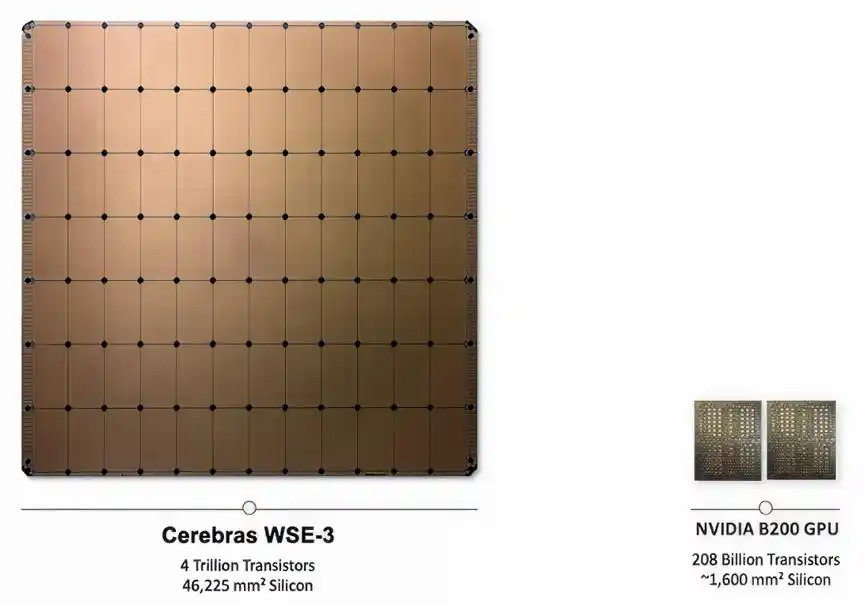
Comparación de tamaño entre el chip Cerebras WSE-3 y la GPU NVIDIA B200

La esencia de Cerebras: Una máquina de computación "cerca de la memoria" basada en SRAM

Cerebras Systems fue fundada en Silicon Valley por Andrew Feldman y otros. El equipo fundador original provenía en su mayoría de una empresa llamada SeaMicro, especializada en servidores micro de bajo consumo, que luego fue adquirida por AMD. Luego:

En 2015, el equipo fundador estableció la ruta de la "computación a escala de oblea".

En 2016, completaron el registro, la ronda de financiación Serie A, y entraron en una fase de desarrollo en modo sigiloso.

En 2019, lanzaron su primer producto, el chip WSE-1 y el sistema CS-1, basados en el proceso de 16nm de TSMC.

En 2021, lanzaron la segunda generación de productos, basados en el proceso de 7nm de TSMC.

En 2024, lanzaron la tercera generación de productos (WSE-3 / CS-3), basados en el proceso de 5nm de TSMC. El chip y el sistema se fabricaron completamente en los Estados Unidos, siendo un sistema de chips puramente de fabricación estadounidense.
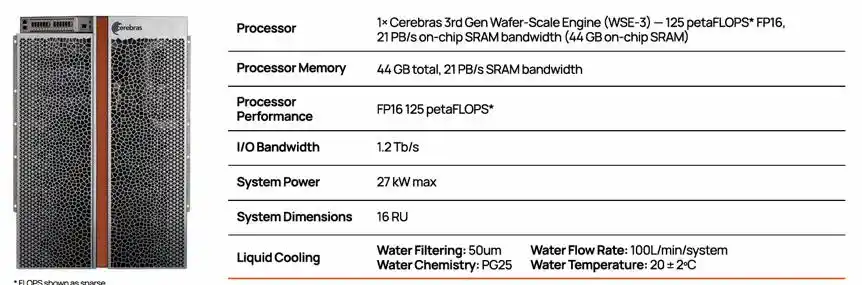
Configuración del sistema CS-3, que incluye 1 chip WSE-3

La filosofía arquitectónica del Motor a Escala de Oblea (Wafer-Scale Engine, WSE) de Cerebras es simple, directa y va al grano: Utilizar la ampliación extrema del espacio físico para obtener una compresión extrema de la latencia en el movimiento de datos.

Un chip normal se fabrica cortando una oblea en muchos chips pequeños, como hace NVIDIA con sus GPUs. Cerebras hace lo contrario: no corta, sino que toma casi toda la oblea para hacer un chip gigantesco, llamado Wafer-Scale Engine, WSE.

Mientras que un chip tradicional se forma cortando una oblea completa de 300 mm de diámetro en cientos de chips pequeños; Cerebras opta por conservar la oblea completa y utilizarla directamente como todo el chip. El WSE-3 más reciente tiene 4 billones de transistores, 900,000 núcleos de IA, cada uno equipado con 48 KB de SRAM local, lo que le da al chip completo 44 GB de SRAM en el chip, proporcionando un ancho de banda de memoria en el chip (on‐chip memory bandwidth) de 21 PB/s y un ancho de banda de red (fabric bandwidth) de 214 Pb/s. Esto es miles de veces mayor que el ancho de banda de la HBM tradicional.
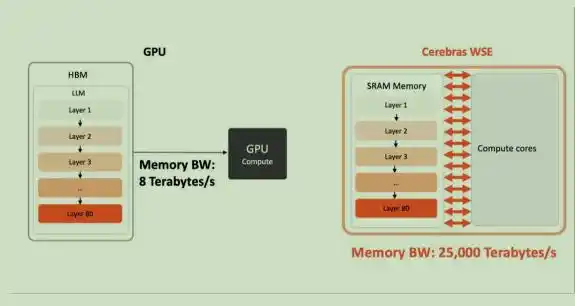
El ancho de banda de memoria de Cerebras WSE es 2625 veces mayor que el del chip empaquetado NVIDIA B200, rompiendo el cuello de botella del ancho de banda de memoria en escenarios de razonamiento de modelos grandes.

En la arquitectura de Cerebras, los pesos del modelo nunca se almacenan en la SRAM, sino en la memoria externa MemoryX, y se transfieren capa por capa hacia el gran chip. La implementación separa el almacenamiento de los pesos del modelo neuronal de las unidades de cálculo.

Todos los pesos del modelo se almacenan externamente en el módulo de expansión de memoria MemoryX. Los pesos necesarios para el cálculo de cada capa de la red se transmiten a demanda, capa por capa, al sistema CS-3. Los pesos se almacenan en la DRAM y la memoria flash de MEMORY X y se transmiten al sistema CS-3 a velocidad de ancho de banda completo. Estos pesos no se almacenan en el sistema CS-3, ni siquiera de forma temporal en caché. El CS-3 realiza los cálculos confiando en el mecanismo de flujo de datos subyacente de sus núcleos.

Cerebras, gracias a su arquitectura a escala de oblea, muestra barreras aplastantes en el razonamiento de LLM limitado por el ancho de banda de memoria. Durante la generación token por token, los pesos fluyen capa por capa desde el MemoryX externo hasta el CS-3. Ejecutando diferentes modelos, la velocidad de tokens es de 1.5 a 5 veces mayor que la de la NVIDIA B200.
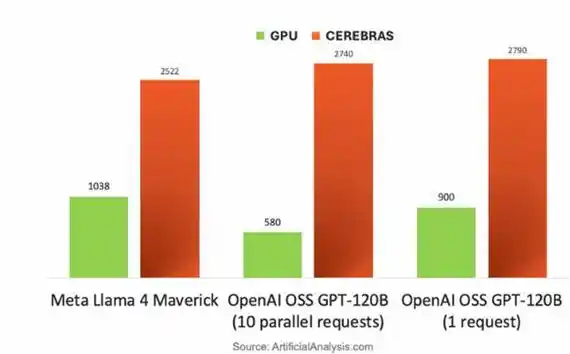
Comparación de la velocidad de tokens entre la GPU NVIDIA DGX B200 y el chip Cerebras CS-3, ejecutando diferentes modelos grandes

Su ventaja central radica en: los 44 GB de SRAM en el chip del CS-3 proporcionan un ancho de banda súper alto de 21 PB/s (2625 veces el de la B200) y una interconexión de 214 Pb/s, liberando la transmisión del flujo de pesos de las limitaciones de la interfaz HBM. Por lo tanto, su rendimiento es especialmente destacado en TTFT (Time To First Token, tiempo desde que se envía la solicitud hasta que el modelo devuelve el primer token), contextos largos y cargas de trabajo de agentes.

Aunque los pesos están externos en MemoryX y se cargan capa por capa a demanda y no se almacenan en caché en el chip, el CS-3, confiando en el mecanismo de flujo de datos de sus núcleos, realiza cálculos completos con precisión FP16 sin pérdidas en la SRAM; además, gracias a la escalabilidad lineal del rendimiento, también libera un rendimiento agregado sorprendente en razonamiento concurrente multiusuario.

Además del ancho de banda, también hay una ventaja en consumo energético. Recientemente, Liu Sheng, presidente de Zhongji Innolight, también mencionó en un discurso que el requisito de los clientes para los módulos ópticos es de 1 pJ/bit, mientras que actualmente es de 10 pJ/bit. En el chip de Cerebras, el consumo energético de la interconexión es de solo 0.15 pJ/bit, mientras que el consumo energético de la interconexión de las GPU actuales es de 10 pJ/bit.
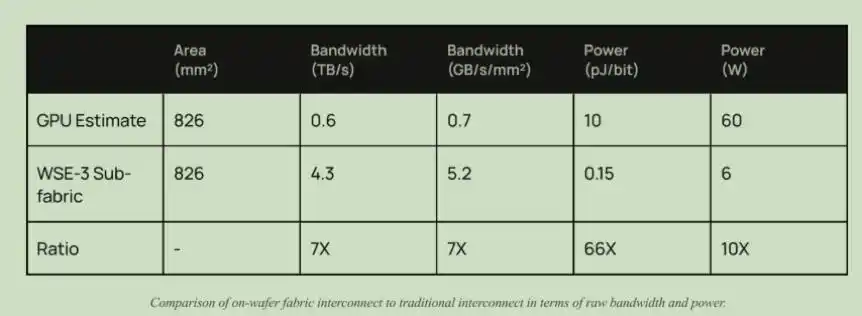
Comparación del ancho de banda y el consumo energético entre la arquitectura de interconexión de Cerebras y la de las GPU

Por lo tanto, si la arquitectura de chip grande a escala de oblea de Cerebras se convierte en la corriente principal para el razonamiento o incluso el entrenamiento de IA, podría tener un impacto significativo y un cambio estructural en el volumen de envíos de los módulos ópticos tradicionales y el CPO (Co-Packaged Optics). La lógica central es: la alta demanda de módulos ópticos y CPO existe esencialmente para resolver el cuello de botella del ancho de banda en la "interconexión entre chips" y "interconexión entre nodos" en los clústeres de GPU; mientras que la arquitectura de Cerebras resuelve el problema precisamente "eliminando la interconexión distribuida".

Contraintuitivo: Los "falsos y verdaderos" puntos débiles del chip grande a escala de oblea

El núcleo de un chip siempre reside en el Trade Off (el arte de la compensación). Cerebras, para lograr un ancho de banda extremo de la SRAM en el chip, también trae algunos problemas.

¿Bajo rendimiento?

Todo lo contrario, el tamaño de un solo núcleo de IA se reduce a 0.05 mm² (1% del tamaño de un núcleo de cálculo individual de la H100), por lo que el rendimiento es en realidad más alto. Mediante el enrutamiento en el chip, se pueden apagar y evitar los núcleos defectuosos, lo que aumenta la tolerancia a defectos en 100 veces en comparación con los procesadores multinúcleo tradicionales. De hecho, el chip completo tiene 1 millón de núcleos de IA, pero considerando el rendimiento, se anuncian oficialmente como 900,000 núcleos de IA.

¿Solo es bueno en razonamiento, no en entrenamiento?

En los primeros años desde la fundación de Cerebras, el entrenamiento era el tema principal, por lo que la compañía siempre se centró mucho en el trabajo de entrenamiento. Es solo que cuando la demanda de razonamiento se disparó, la gente descubrió que sus ventajas en razonamiento eran más evidentes.

En realidad, el cálculo distribuido simplificado también trae una serie de ventajas, como la reducción de la complejidad del código y la reducción de la sobrecarga de comunicación.

Entrenar un modelo de 175 mil millones de parámetros en 4000 GPUs generalmente requiere alrededor de 20,000 líneas de código de entrenamiento distribuido.

Cerebras logró un entrenamiento equivalente con 565 líneas de código: todo el modelo cabe en la oblea y no es necesario lidiar con la complejidad del paralelismo de datos.

La escalabilidad de la SRAM está muerta, la ventaja central se enfrenta a un techo físico.

El producto de tercera generación se basa en el proceso de 5nm de TSMC, y su capacidad de SRAM solo aumentó un 10% en comparación con el producto de segunda generación basado en el proceso de 7nm de TSMC. Después de los 5nm, el área de la celda de SRAM casi ya no se reduce con los avances en el proceso.

Esto significa que Cerebras ya no puede aumentar significativamente su ventaja central (capacidad de SRAM) actualizando el proceso de TSMC (por ejemplo, pasando de 5nm a 3nm) como lo hacía antes.

Limitados por el tamaño de la oblea, la capacidad de disipación de calor y el costo de fabricación, los recursos de almacenamiento en el chip, como la SRAM, son difíciles de escalar linealmente de manera sincronizada con los núcleos de cálculo, encontrándose con un cuello de botella en la proporción de recursos. Esto prácticamente bloquea su camino de evolución.
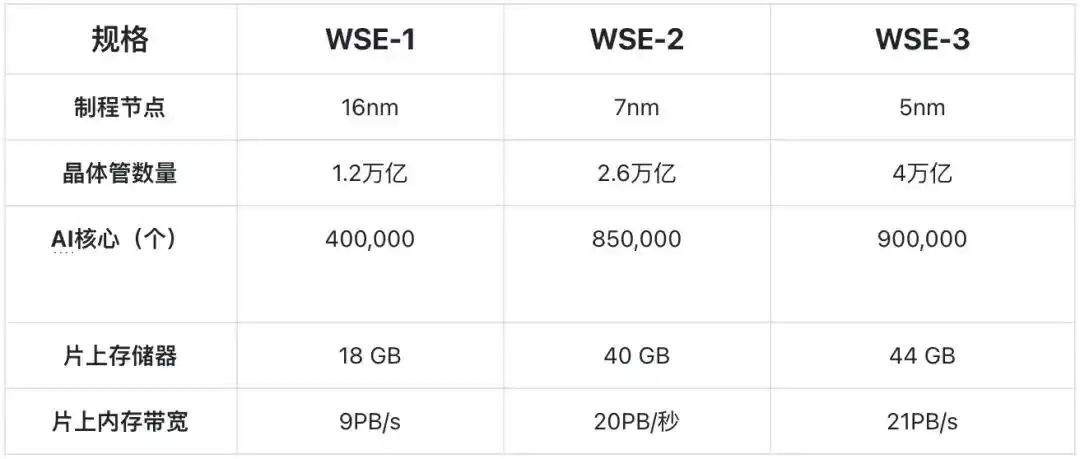
Especificaciones técnicas de las tres generaciones de productos de Cerebras

El triple infierno de la disipación de calor, el proceso y el ecosistema.

El calor se concentra en toda la oblea, la densidad del flujo de calor es alta, por lo que debe depender de salas de servidores personalizadas y sistemas de refrigeración líquida dedicados. Además, la generalidad del ecosistema significa que los clientes deben adaptarse a su pila de software personalizada, la compatibilidad con marcos de programación generales existentes como CUDA es débil, y los costos de portabilidad y adaptación del software son altos.

Bajo ancho de banda fuera del chip, convirtiéndose en una "isla" de expansión.

Debido a las limitaciones del diseño físico a escala de oblea, el número de pines de E/S que se pueden sacar en el borde del WSE es extremadamente limitado, lo que resulta en un ancho de banda de E/S de solo 150 GB/s. Comparado con el ancho de banda bidireccional de 1.8 TB/s de NVIDIA NVLink, esto es como una caracola. Esto significa que es extremadamente difícil para el WSE expandirse hacia afuera a alta velocidad. Aunque la interconexión SwarmX de Cerebras funciona bastante bien en combinaciones de múltiples sistemas, frente a modelos muy grandes que requieren interconexión de alta velocidad entre múltiples chips, el ancho de banda externo extremadamente bajo se convierte en una limitación física estructural.

Disputa de rutas: Autodesarrollo de los grandes fabricantes, ¿cuánto tiempo le queda a la ventana de oportunidad de Cerebras?

Los métodos de los grandes fabricantes para resolver la "necesidad de mayor ancho de banda y menor latencia en el razonamiento" no se limitan a la ruta de la oblea completa. Están llevando a cabo un cerco a la ventaja tecnológica de las startups a través de tres caminos paralelos.

1 Chips ASIC autodesarrollados

El Google TPU v8 ya se ha dividido en versiones específicas para entrenamiento y específicas para razonamiento; el AWS Trainium 4 está en camino; el Microsoft Maia ya se usa internamente en Azure, construido sobre el proceso de 3nm de TSMC, con núcleos tensoriales nativos FP8/FP4, un sistema de memoria rediseñado, equipado con 216 GB de HBM3e y 272 MB de SRAM en el chip; incluso Anthropic ha comenzado a evaluar el desarrollo de su propio chip de razonamiento.

Esta ruta tiene una probabilidad muy alta, y conducirá directamente a que el TAM (Total Addressable Market, mercado total direccionable) de "adquisiciones de razonamiento de terceros" en 2028 se comprima entre un 10% y un 25%.

2 La generalización del proceso en la ruta del empaquetado estándar

Este es un golpe directo y contundente para Cerebras.

El SoW (System-on-Wafer) de TSMC ya está ampliamente disponible para los clientes, y el interposer CoWoS 9.5x estará disponible en 2027.

Lo que hacen estos dos productos – unir múltiples dies a nivel de oblea – es esencialmente generalizar y popularizar el proceso físico de Cerebras.

El Vera Rubin de NVIDIA entrará en este ecosistema en la segunda mitad de 2026.

Aunque la tecnología de unión entre retículas (cross-reticle stitching) propia de Cerebras es exclusiva, la ventana de exclusividad es de solo 2 a 3 años como máximo. Después de 2027-2028, su barrera de proceso será diluida por el empaquetado avanzado de TSMC.

3 La ruptura de la interconexión/óptica computacional

La interconexión y el muro de memoria de los chips electrónicos han llegado a su límite. El alto ancho de banda, baja latencia y cero interferencia de los fotones son la solución definitiva.

La ruta óptica representada por Lumentum está surgiendo. La mayor ventaja de la oblea completa es el cálculo en el chip, pero los modelos inevitablemente serán cada vez más grandes, y la interconexión de alta velocidad más allá de la escala de oblea es una necesidad.

Con la madurez del CPO (Co-Packaged Optics) y las interconexiones ópticas, es muy probable que en el futuro veamos E/S ópticas introducidas directamente en la oblea WSE, rompiendo las limitaciones de la interconexión eléctrica; y NVIDIA también podría, a través de la adquisición de empresas con ventajas arquitectónicas específicas (como Groq LPU), combinadas con la interconexión óptica, desarrollar sistemas a escala de oblea compatibles con el software existente de sus súper nodos.

Carrera al borde del precipicio: El negocio y la entrega de Cerebras

Cerebras se enfrenta actualmente a una carrera al borde del precipicio forzada por enormes pedidos.

Las transacciones con grandes clientes como OpenAI obligan a Cerebras a transformarse de una empresa de chips a un nuevo tipo de proveedor de servicios en la nube. Ya no solo vende hardware, sino que necesita bloquear y construir una enorme cantidad de capacidad de energía e instalaciones de centros de datos a corto plazo.

Según los requisitos del contrato, Cerebras necesita entregar una capacidad de centro de datos de 250 MW por año entre 2026 y 2028. Sin embargo, los requisitos de los sistemas a escala de oblea para las salas de servidores son extremadamente altos, no se pueden meter directamente en un IDC tradicional con refrigeración por aire. Actualmente, el progreso de Cerebras en la preparación de la capacidad de los centros de datos ya está claramente por detrás de los requisitos del contrato.

Desde la fabricación del chip hasta la construcción de la fábrica, desde la aprobación de la energía hasta el despliegue del sistema de enfriamiento, esto es un pantano de activos pesados y ciclos largos.

Epílogo: ¿A la izquierda o a la derecha?

Volviendo a la premisa inicial, cuando el punto de inflexión de la capacidad computacional de razonamiento ha llegado, el núcleo de la arquitectura de la capacidad computacional siempre reside en la compensación.

No hay una respuesta absolutamente correcta o incorrecta, solo la solución óptima relativa para la carga de trabajo más importante. Y la carga de trabajo ya está cambiando.

Cerebras fue a la izquierda, optando por la optimización física extrema, usando toda la oblea y una enorme cantidad de SRAM para obtener una latencia extremadamente baja en una sola tarea, lo que es invencible en escenarios extremadamente sensibles a la latencia del primer token.

NVIDIA fue a la derecha, optando por mantener la generalidad, usando HBM + NVLink + un gran rendimiento agregado de clústeres para enfrentar los mil cambios de la carga de trabajo, respondiendo a lo cambiante con lo inmutable.

Vientos y olas se levantan, el camino por delante es incierto. Es precisamente esta doble incertidumbre técnica y comercial la que incuba la posibilidad de la disrupción. En la marea computacional hacia la AGI, es aún temprano para sacar conclusiones definitivas – porque donde hay incertidumbre, hay oportunidad.

Este artículo proviene del WeChat Official Account "Garlic Particle Machine Research Institute", autor: Pili Youxia


Related Questions

Q¿Qué evento marcó un punto de inflexión en el desarrollo global de la IA en 2026 según el artículo?

AEn 2026, los gastos de capital en inferencia de los hiperescaladores de la nube superaron, por primera vez en la historia, a los gastos de capital en entrenamiento.

Q¿Cuál es la filosofía arquitectónica fundamental del Wafer-Scale Engine (WSE) de Cerebras para abordar el problema del 'muro de memoria'?

ALa filosofía arquitectónica del WSE de Cerebras es utilizar la ampliación extrema del espacio físico para lograr una compresión extrema de la latencia en el movimiento de datos, manteniendo casi toda una oblea de silicio como un solo chip gigante.

QSegún el artículo, ¿qué ventaja clave tiene el chip CS-3 de Cerebras en comparación con la GPU B200 de NVIDIA para la inferencia de modelos grandes?

ALa ventaja clave del CS-3 es su ancho de banda de memoria interno (on-chip) de 21 PB/s, que es 2625 veces mayor que el de la GPU B200 de NVIDIA, rompiendo así el cuello de botella del ancho de banda de memoria en escenarios de inferencia de modelos grandes.

Q¿Cuáles son las tres vías principales que, según el artículo, están utilizando los grandes fabricantes para competir con el enfoque de Cerebras y abordar las necesidades de inferencia?

ALas tres vías principales son: 1) El desarrollo de chips ASIC propios (como Google TPU, AWS Trainium, Microsoft Maia). 2) La generalización de procesos de empaquetado estándar (como SoW y CoWoS de TSMC). 3) El avance en interconexión óptica y computación óptica.

Q¿Qué desafío comercial y de entrega crítico enfrenta actualmente Cerebras según la última parte del artículo?

ACerebras enfrenta el desafío de transformarse de una empresa de chips a un proveedor de servicios en la nube, ya que debe construir y entregar rápidamente una gran capacidad de centros de datos (250 MW anuales entre 2026 y 2028) para cumplir con contratos de clientes importantes, un proceso complejo y de largo plazo que involucra aprobaciones de energía y sistemas de refrigeración especializados.

Related Reads

Uncovering the Truth About Agent Commerce, Payments, and Infrastructure

Decoding Agent Commerce, Payments, and Infrastructure: The Reality Over the past year, I've been building infrastructure for the Agent economy, engaging with major players like Stripe, Visa, Coinbase, Google, and dozens of startups. A clear conclusion emerges: true, large-scale demand does not yet exist. Startups face structural challenges. Data points illustrate this gap. Stripe's Agent commerce platform has over 1,000 merchants but only single-digit transacting agents. Visa's Agent payment token requires 9-month KYC and a $250M revenue threshold, accessible only to giants like Amazon. On-chain analysis reveals actual daily Agent transaction volume is around $17k, half of which are test transactions. The article analyzes four potential markets: **1. Agent-to-Merchant (A2M):** Current AI shopping UX is often inferior to traditional e-commerce for visual, comparison-heavy purchases (clothing, electronics). Chat interfaces are a step back. Real merchant interest is defensive "Agent Engine Optimization," fearing future obsolescence, not current demand. Potential exists in high-frequency, low-decision purchases (e.g., food delivery) or simplifying terrible UX (complex checkouts, non-native shoppers), but these require massive consumer distribution channels dominated by giants like DoorDash and Amazon. **2. Agent-to-API (A2A):** Developers already have subscriptions and billing for core APIs (compute, data). The argument for micro-payments via crypto for sub-dollar API calls is addressed by pre-paid balances today. The deeper issue is supplier resistance; major SaaS firms rely on enterprise contracts, not fractional cent pricing. Opportunity lies in the long tail of niche services, but this is a smaller market catering to developers, a historically low-paying group. **3. Agent-to-Agent (A2A):** This remains a theoretical long-term vision with near-zero current transaction volume. It involves unique challenges: discovery, trust, negotiation, dispute resolution. When it materializes, it will require a fundamentally new settlement infrastructure for high-speed, variable-value, multi-party transactions. It's a real long-term bet, but not the current market. **4. Agent-to-Finance (A2F):** This is the only category with existing, paying demand. Integrating AI into financial workflows (trading, portfolio management) is a natural evolution and enables new capabilities like autonomous rebalancing. However, competition favors incumbents with regulatory licenses, compliance infrastructure, and existing client relationships. **The Real Issue:** Why is infrastructure still being built? Incumbents can afford long-term bets, and payment companies see every problem as a nail for their payment hammer. However, payment is just one piece. The core challenge is *coordination*—orchestrating work between Agents and humans, verifying outcomes, and settling results. Payment is part of settlement, which is part of coordination. Companies that solve the coordination problem will subsume payments, not the other way around. Startups lack the infinite runway of giants and must find today's real market, which, after a year of exploration, lies outside these four categories—in an area with real, growing, and underserved activity.

marsbit3h ago

Uncovering the Truth About Agent Commerce, Payments, and Infrastructure

marsbit3h ago

Trading

Spot
Futures

Hot Articles

What is LINON

Linde plc Tokenized Stock (Ondo): Revolutionizing Traditional Equity Access Through Blockchain Innovation The emergence of Linde plc Tokenized Stock (Ondo), represented by the ticker $LINON, signifies a monumental shift in the fusion of traditional financial structures and decentralized finance (DeFi). This innovative financial instrument showcases the tremendous potential of blockchain technology to democratize access to traditional equity markets while ensuring the security and regulatory compliance necessary for institutional-grade financial products. Through Ondo Finance's pioneering tokenization platform, $LINON provides a seamless pathway for global investors to engage with one of the world's leading industrial gas companies, Linde plc, creating a blockchain-native representation of the underlying equity. Introduction to Linde plc Tokenized Stock The landscape of financial markets is witnessing a groundbreaking transformation through the tokenization of real-world assets. Linde plc Tokenized Stock (Ondo) epitomizes this revolutionary approach by bridging the gap between conventional stock ownership and blockchain-enabled financial infrastructure. The $LINON token allows investors to gain exposure to one of the prominent industrial companies worldwide through decentralized technology. Operating within Ondo Finance's comprehensive ecosystem, $LINON symbolizes a practical application of tokenization technology that enhances accessibility, efficiency, and global connectivity in traditional financial markets. By leveraging blockchain infrastructure, this tokenized stock enables international investors to participate in U.S. equity markets, overcoming traditional barriers associated with cross-border investing. The significance of $LINON goes beyond technological innovation; it represents a fundamental shift in asset structuring, distribution, and trading in the digital age. This tokenized stock maintains all the economic benefits associated with traditional Linde plc shares while offering improved liquidity, programmable compliance features, and seamless integration with decentralized finance protocols. The development of $LINON indicates a growing acceptance of blockchain technology as a viable means for traditional finance, exemplifying how even well-established assets like Linde plc can integrate into blockchain systems. This approach preserves the core attributes that appeal to investors while introducing advanced capabilities that enhance the overall investment proposition. Project Overview and Objectives Linde plc Tokenized Stock (Ondo) encapsulates a strategic effort to democratize access to traditional equity markets through advanced blockchain technologies. The primary objective of $LINON is to provide approved global investors seamless access to the economic exposure associated with Linde plc shares, furthering an effort to create a more inclusive financial ecosystem. Beyond the digital representation of traditional assets, $LINON endeavors to eliminate barriers of geography and time zones that limit investor participation. Its design ensures that blockchain technology can elevate traditional investment vehicles without undermining the security or compliance requirements expected by investors. Key goals of the project include enhanced liquidity provision, programmable compliance mechanisms, and interoperability with other blockchain networks. Each $LINON token is fortified by actual Linde plc securities housed at U.S.-registered broker-dealers, allowing holders to reap economic advantages akin to traditional stockholders, such as dividend reinvestment. Furthermore, $LINON aims to establish new industry standards for institutional-grade tokenized securities, paving the way for traditional assets to embrace blockchain technology while remaining compliant with regulatory frameworks. By associating itself with a company as reputable as Linde plc, the project opens avenues for exploring tokenized equities catering to both conservative institutional players and daring retail investors. Project Creator and Development Team The vision for Linde plc Tokenized Stock (Ondo) comes from Nathan Allman, founder and CEO of Ondo Finance. His background in traditional finance coupled with expertise in blockchain technology positions him uniquely to navigate the complexities of asset tokenization. Allman's academic journey began at Brown University, focusing on Economics and Biology, equipping him with valuable analytical skills. His time at Goldman Sachs in the Digital Assets division strengthened his understanding of the interplay between financial institutions and emerging technologies, laying the groundwork for his later endeavors in alternative investment strategies. Under Allman's guidance, Ondo Finance has emerged as a leader in asset tokenization, launching $LINON as a flagship example of the company's larger mission towards revolutionizing traditional financial systems using blockchain technology. His commitment to leveraging blockchain for creating institutional-grade financial products has shaped the landscape of real-world asset tokenization. Investment and Funding Structure The growth of Ondo Finance, the platform powering Linde plc Tokenized Stock (Ondo), is bolstered by robust financial backing from prestigious venture capital firms and strategic investors. This strong investment foundation underpins the development of the key infrastructure essential for compliant tokenized securities like $LINON. In August 2021, Ondo Finance secured $4 million in seed funding led by a major venture capital firm, which enabled the company to commence platform development and establish the necessary regulatory processes for tokenizing real-world assets. This early investment cemented Ondo Finance's credibility within the industry. The Series A funding round followed, garnering $20 million with participation from renowned firms committed to transformative technology companies. This backing demonstrated substantial institutional confidence in Ondo Finance's vision, allowing it to hone its approach to asset tokenization through mechanisms that ensure compliance and accessibility. Noteworthy contributors, including institutional investors and experienced partners, have added significant value to Ondo Finance’s development efforts. Their involvement underscores the confidence across sectors in Ondo Finance's approach to bridging traditional finance with blockchain innovations. Technical Infrastructure and Innovation The technical architecture that underpins Linde plc Tokenized Stock (Ondo) represents a sophisticated melding of traditional finance systems and cutting-edge blockchain technology. The architecture's foundation is built on the Ethereum network, renowned for its security and programmability—both critical for intricate financial instruments. The $LINON tokenization process comprises creating a blockchain-native representation of Linde plc shares that preserves economic benefits while augmenting investor capabilities. Each token corresponds to actual shares held at U.S.-registered broker-dealers, creating a compliant custody structure that legitimizes the asset's existence and value. Automated compliance systems are integrated into the tokenization process, managing critical components such as know-your-customer (KYC) verification and anti-money laundering (AML) protocols. This incorporation of programmable compliance empowers $LINON to uphold regulatory standards essential for institutional proliferation. Cross-chain interoperability characterizes the advanced technical features of $LINON. While initially deployed on Ethereum, the framework is designed for expansion to other networks such as Solana and BNB Chain. This adaptability enhances liquidity and accessibility, allowing investors to select their preferred blockchain ecosystems. Historical Timeline and Development Crafting the history of Linde plc Tokenized Stock (Ondo) unfolds in parallel with the evolution of Ondo Finance's tokenization platform. The timeline's inception dates back to March 2021 when Nathan Allman laid the foundations for creating institutional-grade financial products on blockchain infrastructure. The initial funding round in August 2021 provided crucial resources for developing the platform and establishing partnerships necessary for effective tokenization. By January 2023, Ondo Finance launched its tokenized treasury products, establishing mechanisms that would facilitate future tokenized equities such as $LINON. A pivotal milestone arose in February 2025 when Ondo Chain—a Layer 1 blockchain designed specifically for asset tokenization—was introduced. This infrastructure enhances capabilities vital for institutional markets, demonstrating Ondo Finance's long-term commitment to tokenization. Subsequently, the launch of Ondo Global Markets in September 2025 marked the official debut of $LINON. This milestone showcased the successful transition from development to active trading, enabling investors around the world to access American financial markets seamlessly. Ongoing development plans include a targeted expansion of available tokenized assets to over 1,000 by the end of 2025, pointing to a bright future for Ondo Finance's ecosystem and its mission to broaden tokenized equity accessibility. Regulatory Compliance and Legal Framework The legal architecture governing Linde plc Tokenized Stock (Ondo) emphasizes a sophisticated approach to regulatory compliance, allowing tokenized securities to be implemented within a blockchain-based framework. The legal structure governing $LINON spans multiple jurisdictions while maintaining a robust legal footing. Compliance systems ensure that only eligible investors can access the token, enforced through automated verification that aligns with international regulations. This innovative regulatory technology promises real-time enforcement of complex requirements, considerably enhancing efficiency in operating within the regulatory landscape. The custody framework undergirding $LINON ensures that the underlying shares are securely held at U.S.-registered broker-dealers, complying with necessary regulations while delivering blockchain-driven access to investors. The token maintains its economic equivalency and security through this carefully structured custody arrangement. KYC and AML compliance systems are embedded within the smart contract architecture, ensuring integrity and adherence to regulatory practices while fostering transparency for investors. The jurisdictional restrictions mark a commitment to navigating the evolving landscape of international securities laws. Market Impact and Industry Significance The advent of Linde plc Tokenized Stock (Ondo) holds profound implications for the broader financial landscape, symbolizing a clear shift towards blockchain-enabled markets. $LINON serves as a proof-of-concept for integrating traditional companies into blockchain ecosystems, showcasing the potential benefits such as broader accessibility and improved efficiency. The market's response to $LINON indicates a growing acceptance of tokenization among institutional investors, contributing to the emergence of an expanding sector wherein traditional assets can be interconnected with blockchain innovations. The success of $LINON further solidifies market confidence, indicating an overarching shift towards recognizing asset tokenization as a transformative force in finance. Future Development and Expansion Plans The future trajectory for Linde plc Tokenized Stock (Ondo) centers around the expansion of the tokenization ecosystem and enhanced infrastructure supporting blockchain-enabled financial services. Plans for cross-chain integration usher in new opportunities for liquidity and flexibility within the investment framework, with existing capabilities poised for continuous enhancement. With the introduction of Ondo Chain, Ondo Finance aims to transition $LINON to an optimized blockchain environment specifically designed for asset tokenization. This new infrastructure heralds exciting prospects for the development of institutional-grade financial products, ensuring ongoing compatibility with contemporary investment strategies. Further integration with decentralized finance protocols signifies a commitment to empowering $LINON holders through advanced financial strategies. The anticipated expansion of available tokenized assets promises to broaden investor access, enhancing the utility and appeal of the platform. In alignment with ambitions for regulatory expansion, ongoing efforts to secure approvals for new jurisdictions will enhance investor access, further positioning $LINON at the forefront of the burgeoning tokenization market. Conclusion Linde plc Tokenized Stock (Ondo), as represented by the $LINON token, stands at the intersection of traditional finance and blockchain innovation. It embodies a transformative milestone in how financial assets are structured, distributed, and engaged within modern investment ecosystems. The technical sophistication behind $LINON, combined with its regulatory compliance framework, illustrates that asset tokenization can improve financial infrastructure rather than simply digitizing existing products. This pioneering effort not only enhances investor access to U.S. equity markets but also signifies an evolution of how traditional financial services can integrate blockchain technology. As the asset tokenization market grows exponentially, with prospects suggesting significant valuation increases, $LINON paves the way for a future where tokenized securities become standard fixtures in the financial landscape. The trajectory of $LINON will undoubtedly influence how traditional finance adapts to a transformed, blockchain-powered world.

3.1k Total ViewsPublished 2025.12.05Updated 2025.12.05

What is LINON

What is CRMON

Salesforce Tokenized Stock (Ondo): Revolutionising Traditional Equity Access Through Blockchain Innovation The emergence of Salesforce Tokenized Stock (CRMON) marks a pivotal advancement in integrating traditional financial markets with blockchain technology. This innovative approach offers investors unprecedented access to equity exposure through tokenisation. Developed by Ondo Finance, CRMON provides tokenholders with economic exposure equivalent to holding Salesforce stock (CRM) while automatically reinvesting dividends. This effectively bridges the gap between conventional equity markets and decentralised finance (DeFi). Introduction and Comprehensive Overview of Salesforce Tokenized Stock In recent years, the financial landscape has dramatically transformed due to blockchain technology, fundamentally altering how investors access and interact with traditional assets. The development of Salesforce Tokenized Stock (CRMON) is a prime example of this evolution, representing a sophisticated fusion of conventional equity markets with cutting-edge distributed ledger technology. CRMON is a tokenised version of Salesforce stock, emerging from the innovative work of Ondo Finance, a leading platform in the real-world asset tokenisation sector that positions itself as a bridge between traditional finance and decentralised systems. Designed to provide tokenholders with economic exposure that mirrors the performance of the underlying Salesforce stock, CRMON incorporates automatic dividend reinvestment mechanisms. This eliminates many traditional barriers associated with international equity investment, such as complex brokerage relationships, currency conversion challenges, and restricted trading hours. The tokenisation process reimagines stock ownership as a blockchain-native asset while maintaining its economic equivalence with the underlying security, offering enhanced portability and integration capabilities within decentralised finance ecosystems. CRMON transcends its individual utility as an investment instrument to represent a fundamental shift in how financial markets can operate in an increasingly digital world. By maintaining full backing through U.S.-registered broker-dealers and implementing robust compliance frameworks, CRMON demonstrates that tokenised securities can achieve the regulatory standards necessary for institutional adoption while delivering the technological advantages of blockchain infrastructure. Understanding Tokenized Real-World Assets and CRMON's Strategic Position Tokenised real-world assets signify one of the most significant innovations in modern finance, fundamentally reimagining how traditional securities are represented, traded, and utilised within digital ecosystems. CRMON operates as a tokenised equity instrument correlating directly with Salesforce stock while optimising accessibility and efficiency. This aligns with Ondo Finance's broader mission to democratise access to institutional-grade financial products through innovative tokenisation strategies. The tokenisation process guarantees complete economic equivalence with the underlying Salesforce equity. Each CRMON token represents a proportional claim on Salesforce stock held by qualified custodians, with dividend payments automatically reinvested to maintain continuous exposure to total return performance. This structure simplifies dividend management and ensures that tokenholders receive the full economic benefit of their equity exposure, encompassing both capital appreciation and income generation. Ondo Finance's strategy in tokenising Salesforce stock demonstrates its expertise in creating compliant, institutional-grade products that meet traditional financial markets' stringent requirements. The platform’s focus on merging regulatory compliance with blockchain benefits positions it at the forefront of decentralised finance, captivating both institutional and retail investors seeking blockchain-native solutions. The Technology and Innovation Framework Behind CRMON The technological infrastructure supporting CRMON integrates blockchain technology with traditional financial mechanisms, delivering institutional-grade security and compliance while maintaining the operational advantages of decentralised systems. Built on the Ethereum blockchain, CRMON utilises robust smart contract capabilities to ensure transparent, secure operations. The smart contract architecture incorporates layered security and compliance mechanisms, enabling automated compliance checks and real-time asset backing verification. Integration with oracle services maintains accurate pricing and dividend information, ensuring CRMON reflects the underlying Salesforce stock's accurate performance. This architecture delivers automated dividend reinvestments and other corporate actions, eliminating manual processing requirements and directly enhancing tokenholder benefits. Ondo Finance ensures CRMON's security structure includes daily third-party verification of holdings, independent collateral agents, and a multiple-layer custody system through partnerships with established financial institutions. This framework safeguards tokenholder interests against operational risks while providing robust asset backing. The user interface enhances integration capabilities, allowing seamless interaction between CRMON and various decentralised finance protocols, as well as cryptocurrency exchanges. This interoperability enables users to leverage their tokenised equity across multiple platforms, creating sophisticated investment strategies that marry traditional equity characteristics with blockchain-native innovation. Leadership and Corporate Structure of Ondo Finance The leadership team behind CRMON and Ondo Finance blends expertise from traditional finance and blockchain technology, presenting a robust combination of skills essential for successfully bridging conventional markets with decentralised finance. Nathan Allman, the founder and CEO, emerged from a distinguished financial background before establishing Ondo Finance in 2021. Allman's experience includes notable roles at major financial institutions, including significant contributions to developing cryptocurrency market services. His insights into regulatory compliance were paramount in developing products like CRMON that successfully unify traditional securities with blockchain technology. With a team of professionals boasting substantial experience in both conventional finance and blockchain sectors, Ondo Finance's leadership comprises diverse expertise that covers every aspect of tokenised asset development. Justin Schmidt serves as President and COO, contributing unique operational expertise, while Chris Tyrell brings essential compliance knowledge. Investment Landscape and Funding History The investment landscape surrounding Ondo Finance reflects significant institutional confidence in its mission to tokenise real-world assets. The company has raised substantial funds through various investment rounds, attracting leading venture capital firms and strategic investors that recognise the transformative potential of tokenised securities like CRMON. Notably, Ondo Finance completed a successful Series A funding round in 2022, led by well-known venture capital firms. This funding success validates Ondo Finance's innovative approach to creating compliant, institutional-grade tokenised products. In total, Ondo Finance has successfully secured substantial funding, raising significant capital for product development and market expansion, including a noteworthy token sale that reinforced its governance structure through the establishment of the ONDO token. The diverse composition of investors reflects broad market confidence in Ondo Finance's business model, demonstrating support from both traditional and blockchain-native organisations. Operational Mechanics and Technical Implementation The operational framework supporting CRMON exemplifies sophisticated integration of traditional financial mechanisms with blockchain technology. The technical implementation introduces multiple layers of security, compliance, and operational efficiency to meet institutional standards while enhancing accessibility. The tokenisation process begins by acquiring actual Salesforce stock through U.S.-registered broker-dealers, ensuring each CRMON token maintains direct correlation with the underlying equity performance. Smart contracts automate operational processes, including dividend reinvestment and corporate action processing, facilitating a streamlined user experience. The Minting and redemption processes allow authorised participants to manage CRMON tokens effectively. During U.S. trading hours, institutions can mint new tokens by depositing stablecoins that are used to purchase corresponding Salesforce equity. This structure maintains a tight correlation with underlying assets, enhancing liquidity and price discovery. Additionally, the infrastructure supports twenty-four-hour token transfer capabilities, providing CRMON holders with operations outside traditional market hours. This represents a significant advantage over conventional securities ownership, thus promoting integration with decentralised finance applications. Plans for cross-chain compatibility through partnerships signal further ambitions for CRMON's market reach. By expanding to other blockchain networks, Ondo Finance aims to enhance accessibility and user engagement with tokenised equity products. Timeline and Historical Development of Tokenized Equity Innovation The timeline of CRMON's development and Ondo Finance's broader tokenised capabilities demonstrates a systematic innovation process beginning with the company's founding in 2021. 2021: Ondo Finance is founded by Nathan Allman and co-founders, launching initial products focused on structured vault offerings on the Ethereum blockchain. 2022: The company completes substantial funding rounds—both equity and token sales—totaling significant capital and launching initial tokenised U.S. Treasury products. 2023-2024: Ondo Finance experiences substantial growth, establishing partnerships with major financial institutions while expanding its product offerings beyond fixed-income securities. February 2025: Ondo Global Markets is announced, marking the transition into equity tokenisation with plans for accessing over one hundred U.S. stocks and ETFs. September 2025: The official launch of Ondo Global Markets includes CRMON alongside other tokenised equity offerings, marking a significant evolution in Ondo Finance's product ecosystem. This timeline highlights the organisation's rapid growth and its capability to adapt its technological and compliance frameworks to accommodate different asset classes effectively while maintaining security and regulatory integrity. Regulatory Framework and Compliance Approach Ondo Finance's regulatory framework showcases a sophisticated compliance strategy, essential for achieving institutional adoption in the tokenised securities market. The company's strong partnerships with U.S.-registered broker-dealers promote adherence to Securities and Exchange Commission regulations and apply robust investor protections. Acquisitions, such as Oasis Pro—a registered broker-dealer—significantly enhance Ondo Finance's compliance capabilities, ensuring thorough alignment with existing regulatory structures. The company employs independent verification procedures that foster transparency, aiming for a solid performance standards reputation. Furthermore, Ondo Finance's commitment extends to international regulatory compliance, ensuring token access remains restricted to eligible investors while adhering to pertinent cross-border securities regulations. Comprehensive attention to tax implications and reporting requirements fortifies the security and compliance landscape of CRMON, ensuring that investor obligations remain manageable. Future Prospects and Market Positioning The forward-looking landscape for CRMON and Ondo Finance illustrates substantial growth opportunities driven by institutional adoption of blockchain technology and escalating demand for efficient alternatives to conventional securities ownership. Market projections indicate the tokenised asset sector could value multiple trillion dollars by 2030. With plans to scale CRMON offerings significantly and integrate it with a dedicated blockchain infrastructure—Ondo Chain—Ondo Finance aims to elevate its institutional-grade tokenised asset operations. Additionally, the development of strategic partnerships enhances distribution capabilities while establishing the company's credibility in the financial market. Furthermore, the integration of tokenised equity with decentralised finance protocols offers new potential for innovative financial products and strategies previously impossible with traditional securities. These factors underscore CRMON's positioning to effectively capture increased market share and deliver innovative solutions for international investment exposure. Conclusion Salesforce Tokenized Stock (CRMON) symbolises a transformative development within financial markets, successfully bridging traditional equity ownership with blockchain technology to create unprecedented accessibility for global investors. Through Ondo Finance's sophisticated tokenisation framework, CRMON provides complete economic exposure to Salesforce equity performance while enhancing operational advantages that exceed traditional ownership. The launch of CRMON reflects the broader evolution of financial markets towards blockchain infrastructures that maintain regulatory compliance while delivering increased efficiency. Ondo Finance's extensive approach to regulatory adherence, institutional-grade security, and technological innovation solidifies CRMON as a model for future tokenised securities, delivering access previously unattainable in conventional brokerage structures. As the tokenised asset sector continues to develop, CRMON is well-positioned to address historical inefficiencies in capital markets while providing investors with innovative solutions for accessing traditional securities. The outlook for CRMON looks exceptionally promising, supported by ambitious expansion plans, technological innovations, and strategic partnerships, thereby representing a pioneering model of modern financial infrastructure evolving through blockchain integration.

3.2k Total ViewsPublished 2025.12.05Updated 2025.12.05

What is CRMON

What is SHOPON

Shopify Tokenized Stock (Ondo): A Comprehensive Analysis of Real-World Asset Tokenization in Web3 This article delves into the Shopify Tokenized Stock (Ondo), recognised by its ticker symbol $SHOPON, exploring its implications at the intersection of traditional finance and blockchain technology. As a part of Ondo Finance's tokenized securities platform, Shopify’s tokenized stock exemplifies advancements in democratizing access to global capital markets through innovative digital assets. Introduction and Overview of Shopify Tokenized Stock (Ondo) Shopify Tokenized Stock (Ondo), or $SHOPON, portrays a pivotal innovation in the realm of tokenized securities, allowing investors to gain economic exposure akin to directly owning shares of Shopify Inc. This token, developed under the umbrella of Ondo Finance, not only provides investors with the ability to hold digital representations of the company’s stock but also integrates features such as automatic reinvestment of dividends. This advancement represents a substantial shift in the landscape of decentralized finance (DeFi), linking conventional equity markets with blockchain solutions designed to enhance accessibility, transparency, and liquidity. By eliminating geographical barriers and enabling 24/7 trading capabilities, $SHOPON is positioned as a bridge connecting traditional financial instruments and the emerging Web3 ecosystem. What is Shopify Tokenized Stock (Ondo), $SHOPON? The $SHOPON token serves as a digital manifestation of Shopify Inc.'s shares, engineered to provide a direct correlation to the underlying asset's performance. Through the utilization of blockchain technology, the token gives holders a mechanism to participate in the economic benefits associated with equity ownership, including capital appreciation and dividend distribution. The unique aspect of $SHOPON lies in its automatic dividend reinvestment mechanism, which allows returns to compound without necessitating active management by the investor. This feature inherently enhances its attractiveness as an investment vehicle, particularly for individuals seeking passive income growth alongside exposure to high-performing equities. The tokenization process is facilitated by the custody of actual Shopify shares through regulated intermediaries, ensuring that every $SHOPON token is verifiably backed by real equity. This structure empowers investors with the dual advantages of both traditional financial characteristics and the innovative benefits tied to blockchain technology. Who is the Creator of Shopify Tokenized Stock (Ondo)? The creator of Shopify Tokenized Stock (Ondo), Nathan Allman, is an experienced figure in the finance sector, formerly associated with Goldman Sachs. His rich background includes significant expertise in digital asset development, bridging the gap between traditional finance and cryptocurrencies. Allman’s educational journey, marked by studies at Brown University, provided him with a deep understanding of economics and biology, equipping him with analytical skills that inform his strategic vision. In 2021, he founded Ondo Finance, committing to developing tokenized securities that meet institutional-grade standards while leveraging blockchain's transformative capabilities. Under Allman's leadership, Ondo Finance has focused on creating compliant and innovative financial products that empower a diverse investor base. Who are the Investors of Shopify Tokenized Stock (Ondo)? The investment landscape surrounding Shopify Tokenized Stock (Ondo) is notably robust, underpinned by significant institutional support. Primarily, Pantera Capital stands out as a strategic partner through the Ondo Catalyst initiative, a $250 million commitment aimed at accelerating the development of on-chain capital markets. This partnership not only signifies institutional confidence in the potential of tokenized assets but also reinforces Ondo Finance's operational capabilities and market positioning. The funding pathways have included earlier rounds that amassed millions in seed funding and further structural investments, solidifying relationships with both venture capital firms and private investors. Moreover, the financial framework is complemented by strategic partnerships with established financial institutions and technology companies, enhancing Ondo’s infrastructure and operational expertise. How Does Shopify Tokenized Stock (Ondo), $SHOPON Work? At the core of $SHOPON's operational framework is a sophisticated system integrating traditional finance mechanisms with blockchain technology. The custody of actual Shopify shares ensures that token holders retain authentic economic exposure, safeguarding their investments in line with recognized legal structures. The smart contracts employed in managing $SHOPON handle various functions, including automatic dividend reinvestment and ownership transfer, offering instant settlement and increased liquidity, marking a significant departure from conventional trading systems plagued by multi-day settlement delays. By providing interoperability with other decentralized finance applications, $SHOPON empowers holders with potentially lucrative opportunities for advanced investment strategies, including lending and automated market making. This complex integration presents a unique value proposition, catering to both traditional and crypto-native investors. The innovative structure of $SHOPON also allows for real-time settlements and transactions documented on the blockchain, delivering unparalleled transparency and security—a major advancement over standard equity trading practices. Timeline of Shopify Tokenized Stock (Ondo) March 2021: Nathan Allman establishes Ondo Finance, initially focusing on decentralized finance yield optimization. August 2021: Completion of a $4 million seed funding round led by Pantera Capital. January 2023: Launch of initial tokenized treasury security products, laying the groundwork for future equity tokenization. July 2025: Announcement of the Ondo Catalyst initiative, a strategic investment program valued at $250 million, aimed at propelling the development of tokenization in capital markets. September 3, 2025: Launch of Ondo Global Markets featuring over 100 tokenized U.S. stocks and ETFs, including $SHOPON. Technical Implementation and Blockchain Infrastructure Shopify Tokenized Stock (Ondo) operates on a technical architectural framework that marries blockchain protocols with traditional financial custody arrangements. The ecosystem leverages Ethereum's smart contract capabilities, providing seamless transaction management while ensuring compliance with regulatory standards through established financial custodians. Central to this architecture are security measures and transparent transaction records that affirm the legitimacy of each tokenholder's economic stake. With automated features managed by intricate smart contracts, $SHOPON not only streamlines ownership transfers but also allows for the tactical reinvestment of dividends—a hallmark of modern investment strategies. Moreover, the incorporation of LayerZero technology facilitates cross-chain interoperability, making $SHOPON accessible across multiple blockchain environments while preserving its functional robustness. This forward-thinking technical design positions $SHOPON as an adaptable asset within the larger DeFi milieu. Regulatory Framework and Compliance Architecture $SHOPON's regulatory framework is built upon the meticulous navigation of existing financial regulations that govern securities. The custody arrangements for the underlying Shopify shares are managed by U.S.-regulated broker-dealers, ensuring compliance and protection for investors. By maintaining a separation between the blockchain tokenization process and traditional custody, $SHOPON adheres to legal requirements while offering innovative functionalities that challenge conventional constraints. This dual-layered compliance approach enhances investor confidence and underscores Ondo Finance's commitment to regulatory integrity. Notably, the availability of $SHOPON is tailored to international investors from regions such as Asia-Pacific, Europe, and Africa, as regulatory parameters in the U.S. and U.K. present challenges in accessing tokenized securities. Market Access and Global Distribution Strategy The distribution strategy of $SHOPON is keenly designed to optimize global access while conforming to regulatory standards. The platform aims to establish comprehensive coverage for eligible investors across multiple regions, effectively dismantling traditional barriers through the implementation of blockchain technology. Integration with various cryptocurrency wallets and exchanges also promotes user-friendliness and accessibility, establishing a streamlined experience for investors to manage their holdings. Moreover, the 24/7 trading capabilities afforded by the tokenized model allow participants to react promptly to market shifts, fundamentally transforming how global equities are accessed and traded. Technology Integration and Cross-Chain Functionality The remarkable technological underpinnings of $SHOPON propagate its multi-chain functionality, set to expand its reach beyond Ethereum to networks such as Solana and BNB Chain. Such cross-chain capabilities allow users flexibility when navigating between blockchains, concurrently leveraging distinct network attributes to optimize their trading experience. LayerZero serves as the backbone for ensuring decentralized transfers between networks while providing the requisite security and speed, quintessential for maintaining investor trust. This comprehensive interoperability illustrates $SHOPON's commitment to being a versatile, user-centric asset in the evolving investment landscape. Ecosystem Integration and DeFi Compatibility Incorporating $SHOPON into broader DeFi protocols signifies its potential beyond traditional stock ownership. Token holders can leverage their holdings for various sophisticated strategies and applications, enhancing investment returns and liquidity management. By establishing a presence in lending protocols and automated trading systems, $SHOPON effectively democratizes access to advanced financial strategies previously limited to institutional investors. Such integration contributes to a more competitive and dynamic financial landscape, where individual investors can capitalize on tools typically reserved for larger entities. Risk Management and Security Framework Security remains paramount in the operational infrastructure of $SHOPON. The tokenization framework employs multiple layers of protection—beginning with regulated custody of the underlying Shopify shares. The operational protocols establish rigorous auditing, key management, and transaction monitoring standards, thus safeguarding against potential vulnerabilities. Moreover, meticulous adherence to evolving regulatory requirements provides an extra layer of security, fortifying investor protections and institutional compliance. Market Impact and Industry Implications The introduction of Shopify Tokenized Stock (Ondo) heralds a transformative shift in how financial markets operate, emphasizing the potential of tokenized securities to reshape traditional investment paradigms. The successful integration of $SHOPON encapsulates the efficiencies inherent in blockchain technology and opens avenues for new user demographics previously barred from extensive market participation. The impact extends beyond the immediate benefits to token holders, indicating broader trends that may challenge the status quo of investment services, particularly in addressing geographic restrictions and operational costs typically associated with traditional brokerage platforms. Undeniably, $SHOPON encapsulates the potential for traditional institutions to innovate further, leveraging the increasing demand for seamless blockchain access to complement existing financial infrastructure. Future Development Roadmap and Strategic Vision As Ondo Finance looks forward, the trajectory of $SHOPON rests on ambitious goals aimed at broadening the spectrum of available tokenized assets significantly. Over the next few years, plans are in place to expand to more than 1,000 tokenized securities, further enhancing market participation and investment options for individuals worldwide. Continued integration with traditional financial actors, development of specialized institutional products, and enhancements in automated trading capabilities will ensure that $SHOPON maintains its position at the forefront of financial innovation. Regulatory collaboration will also remain a focal point, establishing a framework that not only supports the compliance requirements but also promotes a healthy environment for tokenized asset proliferation. Conclusion and Market Significance In summary, Shopify Tokenized Stock (Ondo), represented by the ticker $SHOPON, is more than merely a tokenized equity offering; it embodies the innovation possible when traditional finance collides with modern blockchain applications. With a robust technical architecture, a commitment to compliance, and a clear strategic vision, $SHOPON exemplifies the potential for tokenized assets to enhance liquidity, accessibility, and functionality in capital markets. As the global investment landscape evolves, the transformative implications of $SHOPON extend beyond individual investors to revolutionize how financial instruments are perceived, traded, and utilized within both traditional and decentralized frameworks.

3.2k Total ViewsPublished 2025.12.05Updated 2025.12.05

What is SHOPON

Discussions

Welcome to the HTX Community. Here, you can stay informed about the latest platform developments and gain access to professional market insights. Users' opinions on the price of ERA (ERA) are presented below.

活动图片