Bitcoin On-chain Metrics Confirm Lacklustre Capital Influx and Bottom Cycle Consolidation Phase

zycryptoPublished on 2022-08-26Last updated on 2022-08-26

Abstract

The cryptocurrency industry has not been attracting many new investors since April this year, so cryptocurrency projects now do not have the much-needed momentum to push up crypto prices.

The cryptocurrency industry has not been attracting many new investors since April this year, so cryptocurrency projects now do not have the much-needed momentum to push up crypto prices. Traders and investors should expect the current bear market cycle to last for some more days or weeks because on-chain data shows that additional accumulation is needed for the crypto prices to gain the required momentum for a sustained upward trend, notes analysts from Glassnode.

The analysts say that the drop in the number of new entrant investors and traders, especially in Bitcoin, is evidenced by a decline in the monthly average of new wallet addresses as one of the basic metrics that can be used to measure demand. This monthly average is currently lower than the yearly average, as seen in the below chart.
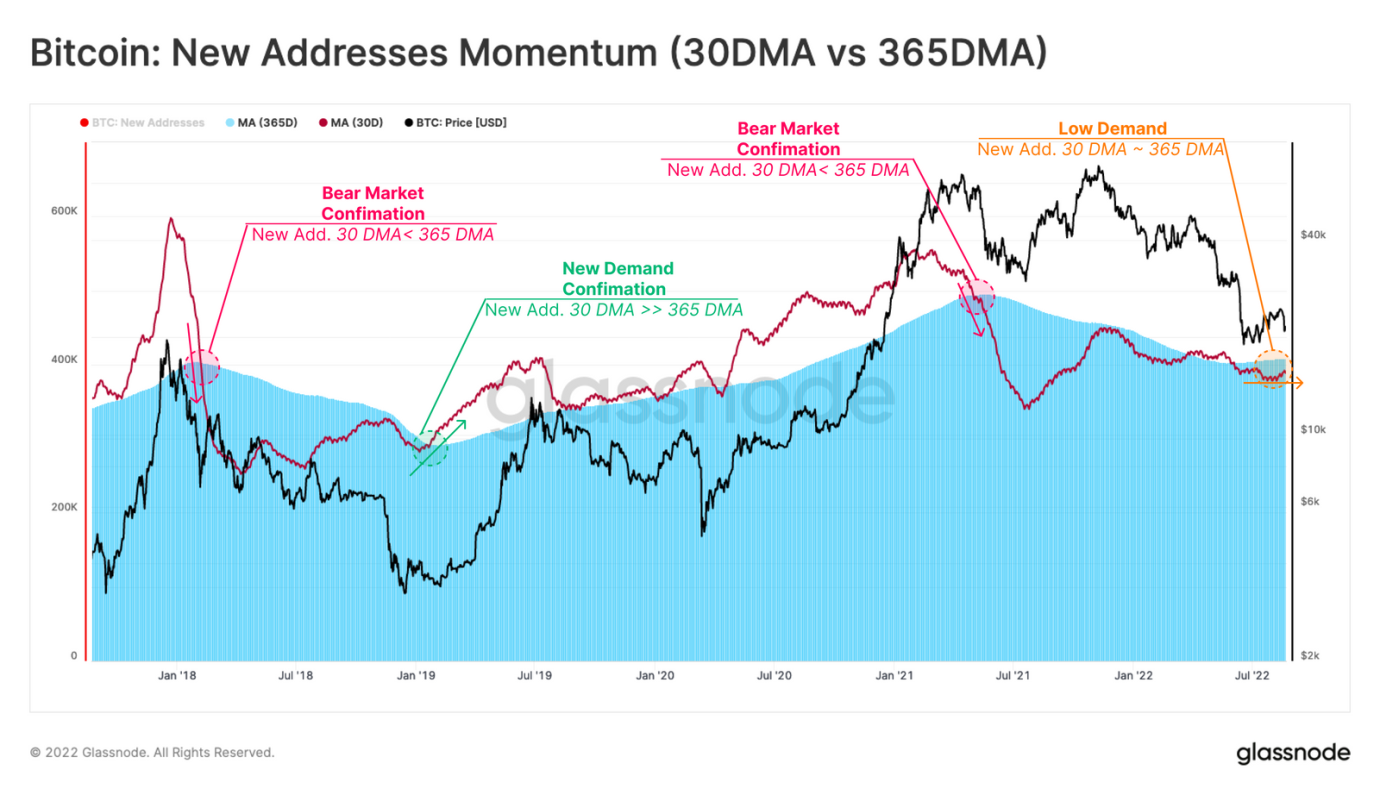
According to them, a drop in the number of new addresses lowers the demand directly while supply remains pretty the same.

“The recent price uptrend also failed to attract a significant wave of new active users, which is particularly noticeable among retail investors and speculators. The monthly momentum of exchange flows is also not suggesting a new wave of investors entering the market, implying a lackluster influx of capital.”

The spike in monthly average above the yearly average has historically signalled an uptick in market demand and prices, they write.

Other on-chain metrics have also confirmed the prevailing bear market, noted the Glassnode analysts, including a decrease in retail-side demand for Bitcoin. The decrease in retail-side demand is characterized by a decrease in the total volume of small transactions (transactions of value less than $10,000) in the last few months. The miner revenue from fees also tells the same story as exchange flows.

“Exchange flows have now declined to multi-year lows, returning to late-2020 levels. Similar to the retail investor volumes, this suggests a general lack of speculative interest in the asset persists.”

Bitcoin has struggled to trade above $22,500 for over two months since falling off the $30,000 cliff on June 10 this year. Many other analysts agree that the current is a possible bear cycle bottom phase. However, it is not clear when the phase could end. The same applies to Ethereum and most of the other top ten cryptocurrencies.

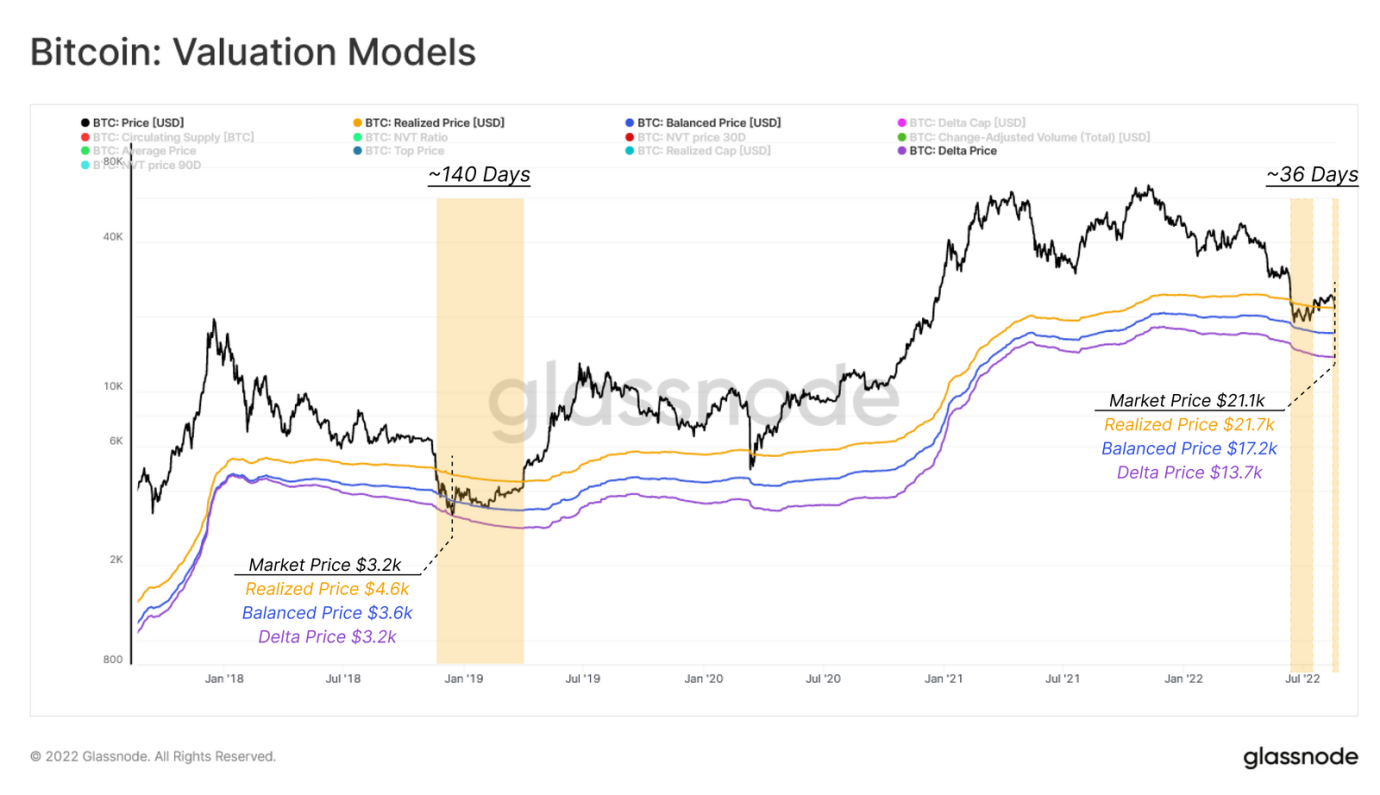
The analysts noted that the current market cycle resembles the bottom formation cycle experienced in 2018-2019. During that phase, Bitcoin traded below the Realized Price of $4,600 for 140 days. Hence, it is reasonable for traders and investors to expect the prevailing bear market – which has lasted only 36 days so far – to last longer. Bitcoin spot price is below the Realized Price of $21,300.

Related Reads

MLCC Capacitor Price Increase: A Comprehensive Overview of Beneficiary Companies

Recent teardown reports of Nvidia's next-generation AI chips have reignited investor interest in the MLCC (Multi-Layer Ceramic Capacitor) sector. Analysis of the Rubin architecture VR200 server reveals a 30% increase in MLCC count and a 182% surge in component value per rack compared to the previous generation, with GPU board usage nearly doubling. High-power, high-voltage hardware designs are driving massive adoption of high-end, high-withstand-voltage, and large-capacity MLCCs, exacerbating supply shortages. The global MLCC supply-demand balance remains tight. Leading Japanese and Korean manufacturers have successively raised prices across series, compounded by overseas capacity constraints and long-term customer order locks at major factories. Delivery lead times for high-end products now exceed 20 weeks, with capacity struggling to keep pace with surging orders. Demand drivers include AI servers, automotive electronics, and recovering consumer electronics, leading to both volume and price increases for MLCCs. The industry chain beneficiaries are outlined as follows: **1. MLCC Product Manufacturers:** Direct beneficiaries of price hikes. Key Chinese companies include Fenghua Advanced Technology (leading domestic player), Sanhuan Group (vertical integration from materials to products), and others like Hongyuan Electronics (military focus) and Torch Electron (specialty ceramics). **2. MLCC Raw Materials & Components:** The foundation of the supply chain. * **Release Film:** A critical consumable in production. Companies include Jiemei Technology (domestic leader), Shuangxing New Materials, and Sidike. * **Metal Powders (Ni/Cu):** Core materials for internal electrodes. Key suppliers are Boqian New Materials, Yuean New Materials, and Gripm Advanced Materials. * **Dielectric Ceramic Powder:** The core material determining MLCC performance. Sinocera Advanced Materials is a global leader, while Sanhuan Group and Fenghua Advanced Technology also have significant in-house capabilities. The report highlights that rising AI server power is significantly increasing requirements for chip capacitors and inductors, forecasting explosive industry growth aligned with projected GPU/TPU shipments through 2027-2028.

marsbit20m ago

MLCC Capacitor Price Increase: A Comprehensive Overview of Beneficiary Companies

marsbit20m ago

Morning Post | Michael Saylor Says This Week's Buy Was Bonds, Not Bitcoin; StablR Suffers Attack Losing Approximately $2.8 Million; US Congress Reintroduces Bitcoin Reserve Bill

This cryptocurrency industry digest covers key developments from May 25. MicroStrategy's Michael Saylor clarified the company purchased bonds, not Bitcoin, this week. In regulatory news, the US Congress reintroduced a Bitcoin reserve bill, with Republican backing aiming to accumulate 5% of global supply. The legal and audit firms for the collapsed FTX agreed to a $66 million settlement over fraud allegations. Several CFTC officials skeptical of prediction market oversight were reportedly suspended and forced out. On the security front, the StablR stablecoin was attacked and de-pegged, resulting in an estimated $2.8 million loss for the attacker. The Ethereum Foundation faced criticism, though a researcher defended its core protocol-building mission over influencing ETH's price. Market data from GMGN showed the top 24-hour trending meme tokens on ETH were HEX, SHIB, LINK, PEPE, and mUSD. On Solana, leaders were TROLL, neet, WORLDCUP, HANTA, and Buttcoin. Base chain's top tokens included TOSHI, KEYCAT, BRETT, CLANKER, and LUNA. Featured articles included an a16z analysis arguing tokenization, or real-world assets (RWA), is fundamentally transforming asset nature and financial systems, with the market growing tenfold to ~$34 billion in two years. Another piece deconstructed Hyperliquid's success through a five-layer financial stack framework, emphasizing the critical importance of building from a robust settlement layer upward.

链捕手1h ago

Morning Post | Michael Saylor Says This Week's Buy Was Bonds, Not Bitcoin; StablR Suffers Attack Losing Approximately $2.8 Million; US Congress Reintroduces Bitcoin Reserve Bill

链捕手1h ago

SuperEx's Mars Exploration Dream: Digital Currency is the Key to Unlocking Economic Exchanges in the Interstellar Era

SuperEx envisions digital currencies as the key to enabling economic exchange in the interstellar era. Inspired by humanity's enduring dream of space exploration, exemplified by Elon Musk’s Mars colonization plan and the UAE's Mars Science City project, SuperEx established a space fund to support such initiatives. The exchange positions itself not merely as a trading platform but as a contributor to humanity's future, claiming that user transactions help fuel the journey to Mars. The article argues that traditional sovereign currencies will be inadequate for interplanetary economies due to their limitations in free cross-border flow. In contrast, digital currencies, built on Web3.0 principles of decentralization, distributed ledgers, and smart contracts, possess the borderless, shared, and accessible attributes necessary for future interstellar trade. Examples like Bitcoin demonstrate this potential. SuperEx presents itself as the world's first Web3.0-based digital asset exchange, aiming to lay the groundwork for a future interstellar economic system. It reports over 10 million users, support for 1000+ trading pairs, and integration with a decentralized wallet (Super Wallet) for security. Its long-term goal is to evolve into a fully decentralized autonomous organization (DAO), with its existing SuperEx DAO already being one of the largest Web3.0 communities. Ultimately, SuperEx's vision is to create a free, borderless financial world, leveraging blockchain technology to empower individual value and freedom.

链捕手1h ago

SuperEx's Mars Exploration Dream: Digital Currency is the Key to Unlocking Economic Exchanges in the Interstellar Era

链捕手1h ago

Trading

Spot
Futures

Hot Articles

What is $BITCOIN

DIGITAL GOLD ($BITCOIN): A Comprehensive Analysis Introduction to DIGITAL GOLD ($BITCOIN) DIGITAL GOLD ($BITCOIN) is a blockchain-based project operating on the Solana network, which aims to combine the characteristics of traditional precious metals with the innovation of decentralized technologies. While it shares a name with Bitcoin, often referred to as “digital gold” due to its perception as a store of value, DIGITAL GOLD is a separate token designed to create a unique ecosystem within the Web3 landscape. Its goal is to position itself as a viable alternative digital asset, although specifics regarding its applications and functionalities are still developing. What is DIGITAL GOLD ($BITCOIN)? DIGITAL GOLD ($BITCOIN) is a cryptocurrency token explicitly designed for use on the Solana blockchain. In contrast to Bitcoin, which provides a widely recognized value storage role, this token appears to focus on broader applications and characteristics. Notable aspects include: Blockchain Infrastructure: The token is built on the Solana blockchain, known for its capacity to handle high-speed and low-cost transactions. Supply Dynamics: DIGITAL GOLD has a maximum supply capped at 100 quadrillion tokens (100P $BITCOIN), although details regarding its circulating supply are currently undisclosed. Utility: While precise functionalities are not explicitly outlined, there are indications that the token could be utilized for various applications, potentially involving decentralized applications (dApps) or asset tokenization strategies. Who is the Creator of DIGITAL GOLD ($BITCOIN)? At present, the identity of the creators and development team behind DIGITAL GOLD ($BITCOIN) remains unknown. This situation is typical among many innovative projects within the blockchain space, particularly those aligning with decentralized finance and meme coin phenomena. While such anonymity may foster a community-driven culture, it intensifies concerns about governance and accountability. Who are the Investors of DIGITAL GOLD ($BITCOIN)? The available information indicates that DIGITAL GOLD ($BITCOIN) does not have any known institutional backers or prominent venture capital investments. The project seems to operate on a peer-to-peer model focused on community support and adoption rather than traditional funding routes. Its activity and liquidity are primarily situated on decentralized exchanges (DEXs), such as PumpSwap, rather than established centralized trading platforms, further highlighting its grassroots approach. How DIGITAL GOLD ($BITCOIN) Works The operational mechanics of DIGITAL GOLD ($BITCOIN) can be elaborated on based on its blockchain design and network attributes: Consensus Mechanism: By leveraging Solana’s unique proof-of-history (PoH) combined with a proof-of-stake (PoS) model, the project ensures efficient transaction validation contributing to the network's high performance. Tokenomics: While specific deflationary mechanisms have not been extensively detailed, the vast maximum token supply implies that it may cater to microtransactions or niche use cases that are still to be defined. Interoperability: There exists the potential for integration with Solana’s broader ecosystem, including various decentralized finance (DeFi) platforms. However, the details regarding specific integrations remain unspecified. Timeline of Key Events Here is a timeline that highlights significant milestones concerning DIGITAL GOLD ($BITCOIN): 2023: The initial deployment of the token occurs on the Solana blockchain, marked by its contract address. 2024: DIGITAL GOLD gains visibility as it becomes available for trading on decentralized exchanges like PumpSwap, allowing users to trade it against SOL. 2025: The project witnesses sporadic trading activity and potential interest in community-led engagements, although no noteworthy partnerships or technical advancements have been documented as of yet. Critical Analysis Strengths Scalability: The underlying Solana infrastructure supports high transaction volumes, which could enhance the utility of $BITCOIN in various transaction scenarios. Accessibility: The potential low trading price per token could attract retail investors, facilitating wider participation due to fractional ownership opportunities. Risks Lack of Transparency: The absence of publicly known backers, developers, or an audit process may yield skepticism regarding the project's sustainability and trustworthiness. Market Volatility: The trading activity is heavily reliant on speculative behavior, which can result in significant price volatility and uncertainty for investors. Conclusion DIGITAL GOLD ($BITCOIN) emerges as an intriguing yet ambiguous project within the rapidly evolving Solana ecosystem. While it attempts to leverage the “digital gold” narrative, its departure from Bitcoin's established role as a store of value underscores the need for a clearer differentiation of its intended utility and governance structure. Future acceptance and adoption will likely depend on addressing the current opacity and defining its operational and economic strategies more explicitly. Note: This report encompasses synthesised information available as of October 2023, and developments may have transpired beyond the research period.

363 Total ViewsPublished 2025.05.13Updated 2025.05.13

What is $BITCOIN

Discussions

Welcome to the HTX Community. Here, you can stay informed about the latest platform developments and gain access to professional market insights. Users' opinions on the price of BTC (BTC) are presented below.

活动图片