Esta Skill de IA para el diseño de gráficos de Xiaohongshu ha encontrado una ruta para generar imágenes sin etiquetas de IA

marsbitPublished on 2026-05-28Last updated on 2026-05-28

Abstract

En febrero de 2026, Xiaohongshu exigió que el contenido generado por IA se etiquete activamente. El proyecto de código abierto guizang-social-card-skill ofrece una ruta alternativa: genera gráficos para Xiaohongshu y portadas de WeChat usando HTML+CSS renderizados por un motor de navegador, con imágenes de bibliotecas como Unsplash, evitando que los píxeles provengan de modelos de IA generativa. El sistema utiliza 28 plantillas de diseño (estilos Editorial y Suizo). La IA selecciona el diseño, posiciona el texto, gestiona mapas (con MapLibre) y busca imágenes, escribiendo el código HTML/CSS final que Playwright renderiza en PNG. Prioriza fotos del usuario y luego busca en bancos de imágenes. Un script valida la tipografía para evitar errores. Esta estrategia evade los actuales modelos de detección de IA de Xiaohongshu, que analizan patrones de píxeles típicos de modelos de difusión. Sin embargo, su viabilidad depende de si la plataforma amplía la definición de "contenido sintético generado por IA" para incluir imágenes renderizadas por programas. El artículo contrasta tres rutas técnicas: 1) Generación directa con IA (ej. Midjourney), objetivo principal de detección. 2) Motores de plantillas vía API (ej. Bannerbear), riesgo de detección por producción en masa. 3) Herramientas específicas de plataforma (ej. para Pinterest), más seguras pero menos flexibles. La solución de Guizang se sitúa en un punto intermedio. Las plantillas son ideales para blogs de viajes con mapas e i...

En febrero de 2026, Xiaohongshu anunció que todo el contenido generado o sintetizado por IA debía ser identificado activamente, y el contenido no identificado sería restringido en su distribución. Más de tres meses después, apareció en GitHub un proyecto de código abierto llamado guizang-social-card-skill, especializado en generar gráficos 3:4 para Xiaohongshu y portadas para WeChat Official Accounts. Su enfoque técnico tiene una elección inusual: no utiliza ningún modelo de IA para generar píxeles de imagen; toda la composición se renderiza mediante HTML+CSS, y las imágenes de apoyo provienen de la búsqueda en bancos de fotos reales como Unsplash. Su salida no es una "imagen generada por IA", sino una captura de pantalla rasterizada por el motor de un navegador.

Esta elección responde a un cambio concreto. Desde 2026, Xiaohongshu ha implementado un modelo de reconocimiento audiovisual que analiza los patrones de distribución de píxeles en las imágenes y las características del audio para detectar contenido generado por IA. En el mismo periodo, se gestionaron más de 800.000 cuentas alojando IA y casi 150.000 notas falsificadas por IA. Para los creadores de contenido que necesitan producir imágenes y texto con alta frecuencia, la probabilidad de que las imágenes generadas por Midjourney o Canva AI sean detectadas y marcadas está en constante aumento. La Skill del Maestro Zang eligió otro camino: dejar que la IA tome las decisiones de maquetación y confiar los píxeles finales al motor de renderizado y a los bancos de fotos reales.

Esta es una desviación técnica deliberada. Pero hasta dónde pueda llegar este esquema depende de la elasticidad de la definición de "contenido generado/sintetizado por IA" por parte de la plataforma.

28 esqueletos de maquetación, la IA se encarga de la lógica del diseño, no de la pintura

El Maestro Zang, cuyo nombre real es Gui Zang, había lanzado anteriormente guizang-ppt-skill, otra herramienta de IA orientada al diseño de gráficos y texto. Esta social-card-skill está más enfocada: genera gráficos 3:4 para Xiaohongshu, y portadas 1:1 y 21:9 para WeChat Official Accounts, con resoluciones de salida de 1080×1440, 1080×1080 y 2100×900 respectivamente.
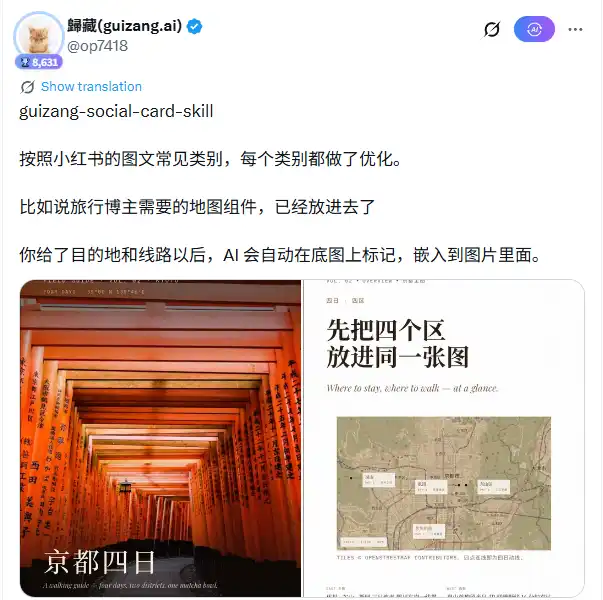

En cuanto a la arquitectura técnica, esta Skill incorpora 28 esqueletos de maquetación, divididos en dos sistemas visuales: Editorial (estilo revista, 16 plantillas) y Swiss (estilo Internacional Suizo, 12 plantillas), con 10 preajustes de paleta de colores temáticos. Después de que el usuario introduce un destino, itinerario o tema de la nota, la IA se encarga de seleccionar el esqueleto de maquetación adecuado, decidir la posición del texto, procesar los parámetros de anotación del mapa y luego escribir todas las decisiones de diseño en HTML+CSS. El motor de renderizado Playwright se hace cargo de los siguientes pasos, capturando pantalla página por página para generar PNG.

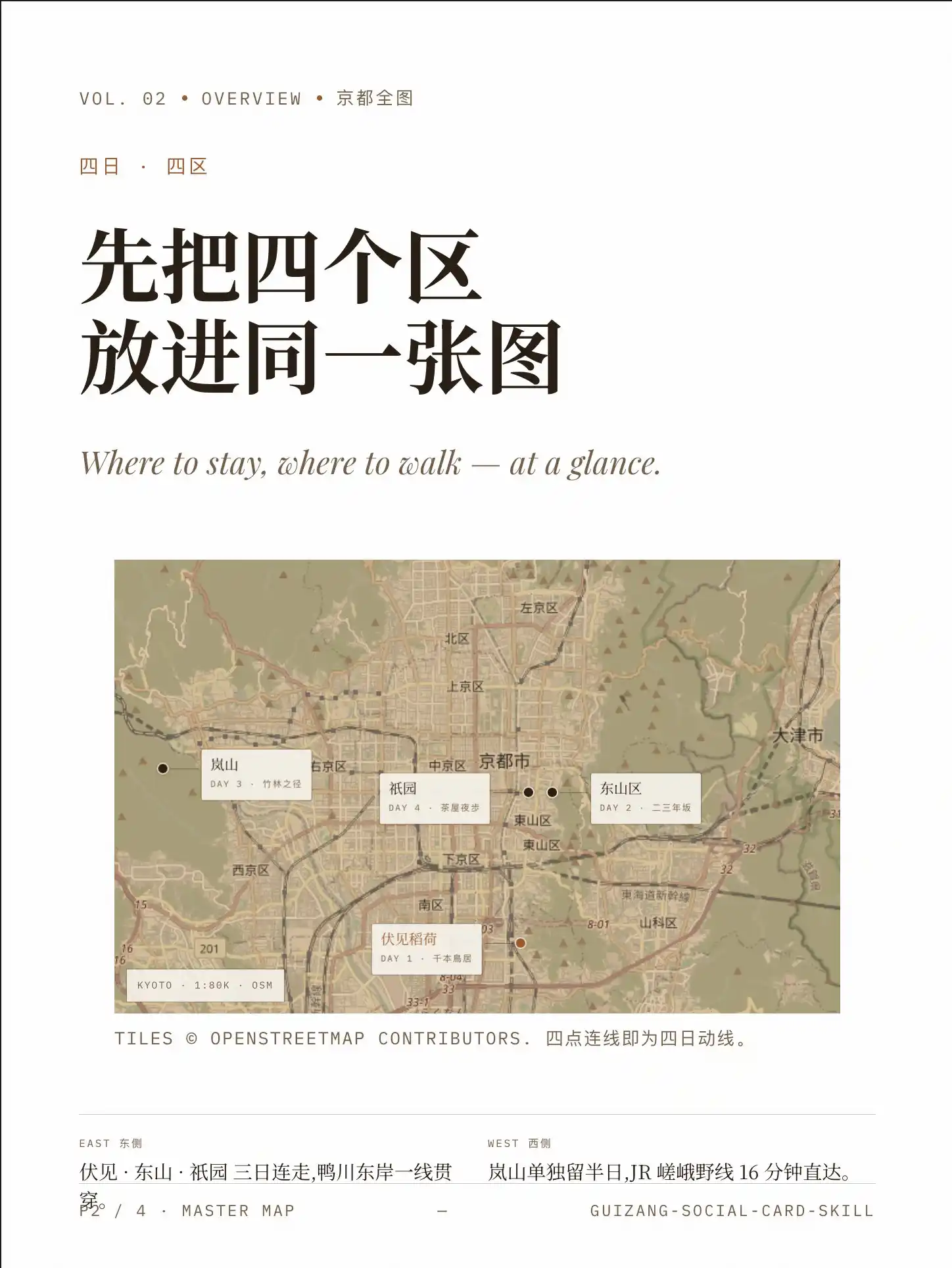
Un componente especialmente útil para los bloggers de viajes es el módulo de mapas. Utiliza MapLibre para cargar teselas reales de OpenStreetMap, admitiendo múltiples marcadores de ubicación y líneas de conexión. El usuario solo necesita proporcionar el nombre de la ciudad o el lugar de interés, y la IA genera automáticamente un mapa base con anotaciones y lo integra en el diseño. El flujo de trabajo para las fuentes de imágenes tiene una prioridad clara: las fotos reales proporcionadas por el usuario tienen la máxima prioridad; si no hay imágenes del usuario, se buscan automáticamente imágenes de apoyo en este orden: Unsplash → Pexels → Flickr CC → Wallhaven.
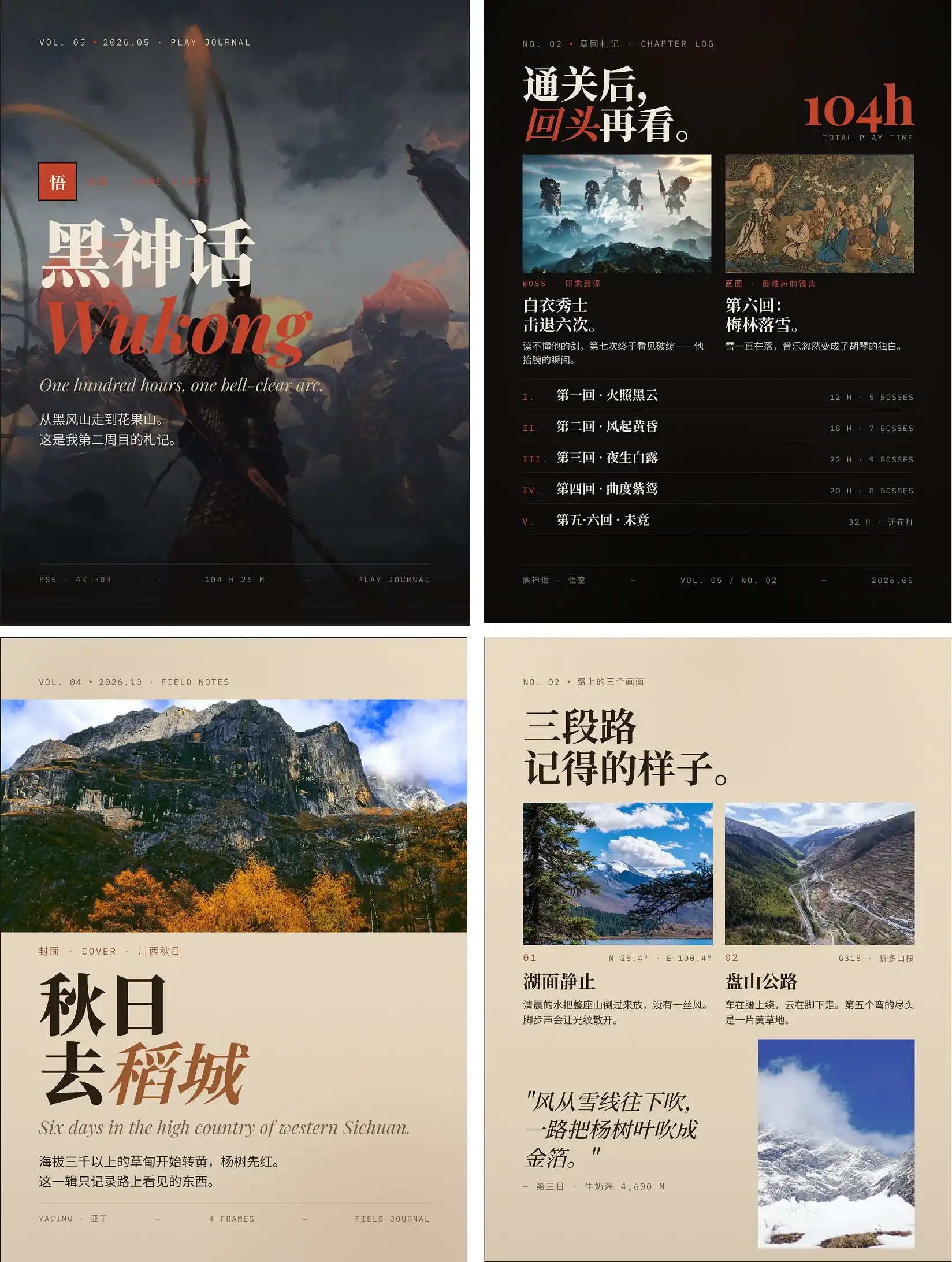

Todo el proceso se ejecuta en siete pasos: Intake (recepción de entrada) → Style & Theme (determinación de estilo y tema) → Layout Selection (selección de maquetación) → Asset Prep (preparación de activos) → Compose & Render (diseño y renderizado) → Deliver & Review (entrega y revisión) → Iterate (modificaciones iterativas). Cada paso se registra en archivos .poster dentro del directorio task. Para generar imágenes por lotes se ejecuta node render.mjs, y Playwright renderiza cada una. Hay otro script de validación, validate-social-deck.mjs, que mide los elementos DOM en un entorno de navegador real, detectando problemas de maquetación como desbordamiento de texto, tamaño de fuente excesivo o colisión de elementos en el pie de página.

El objetivo de diseño de este mecanismo es claro: ser preciso y controlable como un software de maquetación para impresión, no libre pero impredecible como un modelo de difusión. El costo es que la libertad creativa se limita a 28 plantillas. Para creadores que dependen de un estilo fotográfico personal, elementos dibujados a mano o collages irregulares, estos esqueletos de maquetación no ofrecen una mejora de eficiencia, sino una restricción de diseño.

En cuanto a la barrera de entrada, la versión CLI requiere instalar Playwright, entorno Node, y obtener permisos de API para Claude Code o Codex. También hay una entrada web en xiaohongshu.guizang.ai para usuarios no desarrolladores, pero no hay información pública que compare si su integridad funcional es consistente con la versión CLI. Los tweets de X y las README actualizadas del desarrollador indican que este proyecto aún está en rápida iteración.

Los píxeles no provienen de modelos generativos, pero el cumplimiento no equivale a seguridad a largo plazo

La lógica de detección de contenido de IA de Xiaohongshu, según el análisis de información pública y documentación técnica, depende principalmente de un modelo de reconocimiento audiovisual. Este modelo analiza los patrones de distribución de píxeles en las imágenes para determinar si el contenido proviene de modelos generativos de IA. Los modelos de difusión y GAN dejan huellas estadísticas específicas a nivel de píxel al generar imágenes, que difieren de los patrones naturales de luz y sombra, distorsión de lente o ruido capturados por sensores de cámara. El objetivo de entrenamiento del modelo de reconocimiento audiovisual es precisamente capturar esta inconsistencia estadística.

La lógica de elusión de la Skill del Maestro Zang se basa en una distinción clave: los píxeles de sus imágenes de salida no provienen de ningún modelo generativo. El motor de renderizado HTML rasteriza los estilos CSS, y la distribución de píxeles resultante se parece más a una captura de pantalla de la interfaz del navegador o a la salida de software de autoedición. Las partes fotográficas provienen de material fotográfico real de bancos como Unsplash, imágenes capturadas por cámaras y procesadas manualmente, que no llevan las huellas de modelos de difusión.


Pero este distingo es válido solo bajo la premisa de que la definición de "contenido generado/sintetizado por IA" por parte de la plataforma se limite precisamente a la línea de "generación de píxeles por modelos de IA". El anuncio oficial de Xiaohongshu utiliza la expresión "contenido generado/sintetizado por IA", cuyo alcance no es estrecho. Si la plataforma amplía la definición a "salida renderizada por programa con diseño asistido por IA", o si incluye las características de renderizado de navegador de las imágenes rasterizadas HTML en el conjunto de entrenamiento del modelo de reconocimiento, la ventaja técnica actual de este esquema desaparecería.

La plataforma tiene la base técnica y la motivación de gobernanza para ampliar la definición. El propio modelo de reconocimiento audiovisual está en iteración continua. Si en los datos de entrenamiento se incluyen muchas muestras comparativas de imágenes renderizadas HTML frente a imágenes generadas por IA, el modelo puede aprender a distinguir entre las "características de suavizado subpixel del renderizado de fuentes en navegador" y los "bloques de píxeles irregulares generados por GAN al crear texto". Actualmente no hay información pública que indique que Xiaohongshu haya iniciado entrenamiento en esta dirección, pero desde el límite de capacidad del modelo, esta expansión es técnicamente factible.

Un elemento de cumplimiento más relevante tiene que ver con la gestión de mini programas. Actualmente no se ve documentación oficial que indique que esta Skill esté registrada con un número de registro de modelo o haya completado los trámites de cumplimiento pertinentes. Si la plataforma añade requisitos de trazabilidad de la cadena de herramientas en el flujo de revisión de contenido, la falta de información de registro podría convertirse en un nuevo punto de bloqueo.

Motores de plantillas por API, herramientas personalizadas para plataformas y renderizado HTML están trazando tres caminos divergentes

Al observar las herramientas del mercado que generan imágenes para redes sociales, se ve que se están dividiendo en tres rutas técnicas diferentes. Cada una enfrenta una estructura de riesgo de revisión distinta.

Generación directa de imágenes por modelos de IA. El representante de esta ruta es la función Magic Design lanzada por Canva AI en abril de 2026, que genera diseños que incluyen elementos visuales de IA directamente a partir de prompts de texto. Las imágenes generadas por Midjourney, DALL·E y otros modelos también pertenecen a esta categoría. El problema es claro: estas imágenes son el objetivo principal del modelo de reconocimiento audiovisual. La respuesta de Canva es fomentar el etiquetado transparente, no eludir la detección. En Xiaohongshu, no hay datos públicos que confirmen si las publicaciones con imágenes generadas por IA pierden peso en las recomendaciones tras ser etiquetadas, pero la política de "restricción de distribución de contenido de IA no identificado" ya está establecida. Cada actualización de versión del modelo de difusión puede cambiar las características estadísticas de los píxeles, y el modelo de detección correspondiente también se iterará, lo que enfrenta a los creadores con un blanco en constante movimiento.

Renderizado por motor de plantillas a través de API. Bannerbear es típico de esta ruta. El usuario crea una plantilla en un diseñador, modifica las variables de las capas enviando datos JSON a través de una API REST, y el servidor renderiza y devuelve PNG o JPG. Su núcleo también es "renderizado por programa" y no "generación de píxeles por modelo", por lo que la salida no contiene huellas de modelos de difusión. La diferencia con la Skill del Maestro Zang es que las plantillas de Bannerbear dependen del diseño manual; la IA no participa en las decisiones de maquetación; la Skill del Maestro Zang hace que Claude lea y escriba HTML directamente, delegando la elección de maquetación a la IA. El riesgo de la solución Bannerbear está en otra dimensión: cuando muchas cuentas utilizan la misma plantilla, la misma paleta de colores y la misma fuente para producir gráficos, incluso si cada imagen no es generada por IA, puede activar el reconocimiento de "producción masiva programática" por parte de la plataforma. Las condiciones para activar las reglas antispam no son idénticas a la detección de IA, pero para los creadores que gestionan cuentas en masa, el resultado sigue siendo una distribución restringida.

Generación personalizada para la plataforma. Pin Generator está diseñado específicamente para Pinterest, generando automáticamente imágenes de Pin que se ajustan a las preferencias del algoritmo de la plataforma. El núcleo de esta ruta no es eludir, sino adaptarse por completo: dimensiones, estilo visual, ritmo de publicación, todo se alinea con las normas de la plataforma. La ventaja es el riesgo de revisión más bajo; la desventaja es obvia: la capacidad de la herramienta está atada a las reglas de la plataforma; si Pinterest ajusta su algoritmo o restringe el uso de API de terceros, la herramienta deja de funcionar directamente. Comparada con la Skill del Maestro Zang, la primera es una herramienta exclusiva para una plataforma, la segunda es una solución genérica multiplataforma. La exclusiva es más segura pero más frágil; la genérica multiplataforma es más flexible pero más compleja, una compensación que aparece repetidamente en el campo de las herramientas de IA.

Las tres rutas tienen estructuras de riesgo diferentes. La generación por IA es la más libre, pero cada actualización responde a nuevos modelos de detección. El motor de plantillas es el más estable, pero puede ser afectado por reglas antispam. El renderizado HTML está entre ambos: la maquetación es controlada flexiblemente por la IA, los píxeles se dejan al navegador y a material fotográfico real, eludiendo la detección en el nivel de "generación de píxeles por IA", pero no puede hacer frente a una expansión semántica de las reglas por parte de la plataforma.

El límite superior del sistema de maquetación no está en el código, sino en el tipo de contenido

Los 28 esqueletos de maquetación cubren dos sistemas visuales principales: estilo revista y estilo suizo. Para los bloggers de viajes que necesitan mostrar rutas en mapas, líneas de tiempo o itinerarios de varios días, este sistema tiene una alta compatibilidad. La anotación de mapas y la conexión de itinerarios son la información central de estas notas, y los esqueletos de maquetación estructuran esa información manteniendo un aspecto profesional.

Pero el ecosistema de contenido de Xiaohongshu es mucho más rico que las guías de viaje. Las notas sobre moda dependen del estilo fotográfico personal y la paleta de colores, las reseñas de maquillaje requieren fotos macro en alta definición y comparaciones de productos, y el contenido de estilo de vida hace un uso intensivo de collages de varias imágenes y anotaciones manuscritas. El "diseño" de estos tipos de contenido no es una presentación estructurada de información, sino una expresión de estética y emoción personal. Los 28 esqueletos de maquetación no son una herramienta en este contexto, son una restricción.

Las limitaciones técnicas también son reales. Actualmente admite tres dimensiones: 1080×1440 (Xiaohongshu 3:4), 2100×900 (WeChat Official Account 21:9) y 1080×1080 (WeChat Official Account 1:1). No admite portadas verticales 9:16 para Douyin ni portadas horizontales 16:9 para Bilibili. Los bancos de imágenes dependen de Unsplash y Pexels, cuyo material tiende a fotografía de alta calidad, adecuada para viajes, paisajes y arquitectura urbana. Pero la cobertura de material frecuente para contenido vertical como primeros planos de comida, fotos de productos cosméticos o artículos de moda es limitada en estos bancos. La estrategia de priorizar imágenes del usuario puede aliviar parcialmente este problema, siempre que el creador tenga suficiente material fotográfico real acumulado.

El mecanismo de validación es un arma de doble filo. validate-social-deck.mjs puede interceptar problemas de maquetación antes de generar la imagen, garantizando que 100 renderizaciones por lotes salgan sin errores. Esto es una garantía de eficiencia en escenarios operativos que requieren docenas de imágenes diarias. Pero también significa que cualquier diseño que no cumpla las reglas predefinidas de las plantillas será rechazado por el script. Los creadores que quieran añadir un adorno de texto inclinado o un margen personalizado a una plantilla estándar no pueden simplemente arrastrar y ajustar como en Canva; necesitan editar directamente el código fuente HTML y CSS.

La barrera de despliegue local es otro punto de diferenciación. Los creadores que puedan ejecutar scripts Playwright y Node pueden personalizar profundizando en los esqueletos de maquetación y scripts de renderizado. Pero para la mayoría de los bloggers de Xiaohongshu, lo que encuentran es un subconjunto de funcionalidades en la interfaz web. Estas dos clases de usuarios obtienen un valor práctico muy diferente de esta Skill. Los usuarios centrales de los proyectos de código abierto son creadores y desarrolladores con conocimientos técnicos dispuestos a experimentar, no la demanda de "generar imágenes con un clic" del productor de contenido promedio.

No hay una respuesta universal, pero la divergencia de rutas técnicas en sí misma ya dice mucho

Un blogger de viajes de Xiaohongshu se enfrenta a tres opciones: usar Midjourney para generar imágenes de itinerario con estilo ilustrado, asumiendo el riesgo de ser etiquetado y penalizado; usar Bannerbear configurando una plantilla e inyectando datos masivamente cada día, asumiendo el riesgo de homogeneidad que conllevan las reglas antispam; o usar la Skill del Maestro Zang, dejar que la IA elija la maquetación y renderizar la imagen con HTML, asumiendo el riesgo de que la plataforma amplíe la definición de "contenido sintetizado". No hay una carta segura, solo combinaciones de diferentes estructuras de riesgo.

Este panorama transmite por sí mismo un mensaje: la iteración de confrontación entre la plataforma y las herramientas de IA ya ha comenzado. Cada vez que la plataforma actualiza su modelo de detección, termina el período de ventaja técnica de un conjunto de herramientas. Cada vez que una nueva herramienta encuentra una ruta de elusión, la plataforma ajusta su estrategia. Este no es un proceso que converja en un estado estable. La validez de la solución de renderizado HTML depende de si la dirección de entrenamiento del modelo de reconocimiento audiovisual de Xiaohongshu sigue centrándose en las "características de píxeles de modelos de difusión" o se expande a "todos los píxeles que no sean de fotografía nativa".

Para los creadores de contenido, distinguir entre "IA asistencial" y "IA sustitutiva" adquiere un significado práctico. La postura de la plataforma es clara: fomenta la IA como amplificador creativo, se opone al uso de la IA para sustituir la producción masiva de baja calidad. En la Skill del Maestro Zang, la IA toma decisiones de maquetación, no genera contenido; las fotos son reales, las maquetaciones son esqueletos prediseñados por humanos. Esto cae precisamente en el ámbito de la "IA asistencial". Aquellas publicaciones en las que tanto el texto como las imágenes están generados completamente por modelos generativos son las que la plataforma quiere combatir claramente.

Aún no está claro si esta distinción se convertirá en un criterio operativo para la revisión de la plataforma. Pero los desarrolladores de herramientas ya están respondiendo a esta definición con sus elecciones técnicas.

Related Questions

Q¿Qué técnica utiliza el proyecto guizang-social-card-skill para generar imágenes y evitar la detección de contenido AI en Xiaohongshu?

AUtiliza HTML + CSS para renderizar el diseño y toma capturas de pantalla a través de un motor de renderizado como Playwright. Las imágenes de fondo provienen de bibliotecas de fotos reales como Unsplash, por lo que los píxeles no se generan mediante un modelo de IA, lo que ayuda a eludir la detección del modelo de reconocimiento audiovisual de Xiaohongshu.

Q¿Cuáles son las tres rutas técnicas principales mencionadas en el artículo para generar imágenes en redes sociales, y qué riesgos presentan?

A1. Generación directa con modelos de IA (ej. Midjourney): riesgo de ser detectado y etiquetado. 2. Renderizado mediante motores de plantillas API (ej. Bannerbear): riesgo de activar reglas anti-spam por homogeneidad. 3. Renderizado HTML con IA (como guizang-social-card-skill): riesgo de que la plataforma amplíe la definición de 'contenido sintético AI'. Cada ruta tiene una estructura de riesgo diferente.

Q¿Por qué el proyecto guizang-social-card-skill es especialmente adecuado para blogs de viajes, según el artículo?

APorque incluye un módulo de mapas que usa MapLibre y OpenStreetMap, permitiendo marcar y conectar múltiples ubicaciones automáticamente. Sus 28 estructuras de diseño cubren estilos editorial y suizo, ideales para mostrar itinerarios, líneas de tiempo y planes de viaje de manera estructurada y profesional.

Q¿Qué limitaciones tiene el sistema de diseño de 28 estructuras del guizang-social-card-skill para otros tipos de contenido en Xiaohongshu?

ALas estructuras son rígidas y no se adaptan bien a contenidos que dependen fuertemente del estilo personal, como moda, maquillaje o lifestyle, donde el diseño suele ser una expresión emocional y estética. Además, las bibliotecas de imágenes como Unsplash tienen cobertura limitada para fotos específicas de comida, cosméticos o atuendos.

QSegún el artículo, ¿qué distinción importante sugiere la aparición de herramientas como guizang-social-card-skill en cuanto al uso de IA en plataformas?

ASugiere una distinción entre 'asistencia con IA' y 'sustitución por IA'. La plataforma parece fomentar la IA como amplificador creativo (como en la toma de decisiones de diseño), pero desincentiva la producción masiva y de baja calidad generada completamente por IA. Esta herramienta se sitúa en el lado de la asistencia, ya que las fotos son reales y los diseños son estructuras prediseñadas por humanos.

Related Reads

Behind HYPE's Repeated Record Highs, the 'Minions' in the Ecosystem Can't Keep Up

While HYPE, the native token of the Hyperliquid ecosystem, surges to new all-time highs above $76 and attracts significant institutional ETF inflows, a starkly different reality unfolds within its HyperEVM application layer. Multiple core DeFi protocols across lending, NFTs, stablecoins, and DEXs have announced shutdowns between May and June. The article argues HYPE functions more like an "application stock" than a traditional ecosystem token. Its value is anchored to the trading fees from Hyperliquid's core perpetual contracts platform (HyperCore), which boasts a diversified revenue stream from crypto, commodities, and indices. Approximately 97% of protocol fees fund buybacks and burns of HYPE. This means HYPE's price is largely decoupled from the health of projects built on HyperEVM. The closures of significant projects like lending protocol HypurrFi (peak TVL >$300M) and NFT marketplace Drip.Trade highlight a structural tension. Hyperliquid's minimalist philosophy offers infrastructure without official grants, liquidity support, or marketing coordination for HyperEVM projects. This forces protocols into a fiercely competitive environment from day one. Furthermore, the success of HyperCore creates a liquidity vacuum, and mechanisms like HIP-3 (allowing direct perpetual market deployment) divert user attention and capital away from application-layer projects. The stronger the core perpetual trading business becomes, the more difficult it is for peripheral "DeFi lego" projects to survive and capture value, despite the flagship token's rising price.

Foresight News16m ago

Behind HYPE's Repeated Record Highs, the 'Minions' in the Ecosystem Can't Keep Up

Foresight News16m ago

Conversation with Arthur Hayes: AI Has Drained Market Liquidity, BTC Will Be Below 100k by Year-End

In this June 2026 podcast interview, BitMEX co-founder Arthur Hayes explains his decision to sell his major crypto holdings (HYPE, NEAR, Worldcoin, Zcash). His rationale is based on a macro view linking oil prices, the Iran conflict, US politics, and an impending AI bubble burst. Hayes argues that high oil prices, driven by the ongoing war, will pressure domestic US inflation. To salvage the Republican Party's chances in the midterm elections, he believes Donald Trump may pivot to a populist, anti-AI stance—advocating for taxes and regulation—which would deflate the AI investment narrative. He sees the AI sector, particularly massive capital expenditure on data centers, as having absorbed nearly all excess market liquidity (around $1.5 trillion in debt issuance since 2025), starving other assets like Bitcoin. He highlights the upcoming SpaceX IPO at a ~$1.8 trillion valuation and 100x price-to-sales ratio as a potential tipping point. If these hyped IPOs underperform, it could shatter market confidence in AI. In such a scenario, all risk assets, including crypto, would fall together as correlations converge to 1 during a broad correction. Hayes has moved his portfolio into Treasuries and energy stocks (like ExxonMobil), predicting Bitcoin will be below $100k by year-end. He sees a potential crypto bull market only after the AI frenzy cools, liquidity stops flowing exclusively into AI, and possibly after a significant market downturn prompts new monetary stimulus.

marsbit27m ago

Conversation with Arthur Hayes: AI Has Drained Market Liquidity, BTC Will Be Below 100k by Year-End

marsbit27m ago

Fed's Internal Doves Flock to Hawkish Stance, Warsh's Debut "Between a Rock and a Hard Place"

U.S. Federal Reserve officials who previously advocated for rate cuts, including Governor Christopher Waller, have recently shifted their stance, with many now not ruling out the possibility of future rate hikes. This sets a challenging stage for new Fed Chair Kevin Warsh's first policy meeting. Appointed by President Trump based on his dovish views, Warsh now faces a committee where the debate has pivoted from "when to cut" to "whether to hike," driven by persistent inflation above 3%, a strong labor market, and supply-side pressures from AI infrastructure demands and geopolitical tensions. Key figures illustrate the shift. Governor Waller, once concerned about employment, now says data has pushed him toward considering rate increases. Even moderate voices like Governor Lisa Cook, while expecting inflation to ease, have indicated readiness to hike if it fails to do so. Long-time hawks such as regional Fed presidents Beth Hammack, Lorie Logan, and Neel Kashkari have grown more vocal, arguing that the real policy rate is effectively falling and that action may soon be needed. The upcoming Fed meeting is expected to keep rates steady but will likely remove the "easing bias" from its statement, signaling a neutral stance between cuts and hikes. The quarterly "dot plot" is anticipated to show most officials projecting no cuts this year, with some potentially indicating hikes. Chair Warsh, a critic of the Fed's reliance on forward guidance like the dot plot, must navigate communicating this pivot using tools he has questioned, all while steering policy in a direction counter to the preferences of the president who appointed him. The consensus suggests the Fed's next move could well be a rate increase.

marsbit1h ago

Fed's Internal Doves Flock to Hawkish Stance, Warsh's Debut "Between a Rock and a Hard Place"

marsbit1h ago

The Trillion-Yuan Market Cap 'Yi Zhong Tian': Who is the True Value King?

The article analyzes the three leading Chinese optical module companies, collectively nicknamed "Yi Zhong Tian": Xinyisheng, Zhongji Innolight, and TFC Optical Communication. It evaluates their "cost-performance" not by current stock price, but through three lenses: PEG ratio (growth vs. valuation), earnings quality, and premium/discount for certainty. Xinyisheng shows the most attractive PEG ratio and high profitability, but its valuation reflects discounts for risks like high customer concentration and reliance on overseas markets. Zhongji Innolight, the most expensive, commands a premium for its market leadership, dominant share in key products like 800G/1.6T modules, and higher earnings certainty, though it faces geopolitical risks. TFC Optical, as an upstream component supplier ("water seller"), has the highest gross margin and bets on the long-term CPO/NPO architecture trend, but trades at a high valuation with more stable, less explosive growth. The core argument is that while these companies dominate module assembly, the true profit pool and technological moat lie upstream in laser and switch chips, currently controlled by U.S. firms like Lumentum and Coherent. The long-term "cost-performance" for these Chinese leaders hinges on whether the domestic industry, exemplified by companies like Yuanjie Technology, can successfully move up the value chain into high-power laser chips. Otherwise, their high growth may remain confined to the lower-margin assembly segment.

marsbit1h ago

The Trillion-Yuan Market Cap 'Yi Zhong Tian': Who is the True Value King?

marsbit1h ago

Trading

Spot
Futures

Hot Articles

What is LINON

Linde plc Tokenized Stock (Ondo): Revolutionizing Traditional Equity Access Through Blockchain Innovation The emergence of Linde plc Tokenized Stock (Ondo), represented by the ticker $LINON, signifies a monumental shift in the fusion of traditional financial structures and decentralized finance (DeFi). This innovative financial instrument showcases the tremendous potential of blockchain technology to democratize access to traditional equity markets while ensuring the security and regulatory compliance necessary for institutional-grade financial products. Through Ondo Finance's pioneering tokenization platform, $LINON provides a seamless pathway for global investors to engage with one of the world's leading industrial gas companies, Linde plc, creating a blockchain-native representation of the underlying equity. Introduction to Linde plc Tokenized Stock The landscape of financial markets is witnessing a groundbreaking transformation through the tokenization of real-world assets. Linde plc Tokenized Stock (Ondo) epitomizes this revolutionary approach by bridging the gap between conventional stock ownership and blockchain-enabled financial infrastructure. The $LINON token allows investors to gain exposure to one of the prominent industrial companies worldwide through decentralized technology. Operating within Ondo Finance's comprehensive ecosystem, $LINON symbolizes a practical application of tokenization technology that enhances accessibility, efficiency, and global connectivity in traditional financial markets. By leveraging blockchain infrastructure, this tokenized stock enables international investors to participate in U.S. equity markets, overcoming traditional barriers associated with cross-border investing. The significance of $LINON goes beyond technological innovation; it represents a fundamental shift in asset structuring, distribution, and trading in the digital age. This tokenized stock maintains all the economic benefits associated with traditional Linde plc shares while offering improved liquidity, programmable compliance features, and seamless integration with decentralized finance protocols. The development of $LINON indicates a growing acceptance of blockchain technology as a viable means for traditional finance, exemplifying how even well-established assets like Linde plc can integrate into blockchain systems. This approach preserves the core attributes that appeal to investors while introducing advanced capabilities that enhance the overall investment proposition. Project Overview and Objectives Linde plc Tokenized Stock (Ondo) encapsulates a strategic effort to democratize access to traditional equity markets through advanced blockchain technologies. The primary objective of $LINON is to provide approved global investors seamless access to the economic exposure associated with Linde plc shares, furthering an effort to create a more inclusive financial ecosystem. Beyond the digital representation of traditional assets, $LINON endeavors to eliminate barriers of geography and time zones that limit investor participation. Its design ensures that blockchain technology can elevate traditional investment vehicles without undermining the security or compliance requirements expected by investors. Key goals of the project include enhanced liquidity provision, programmable compliance mechanisms, and interoperability with other blockchain networks. Each $LINON token is fortified by actual Linde plc securities housed at U.S.-registered broker-dealers, allowing holders to reap economic advantages akin to traditional stockholders, such as dividend reinvestment. Furthermore, $LINON aims to establish new industry standards for institutional-grade tokenized securities, paving the way for traditional assets to embrace blockchain technology while remaining compliant with regulatory frameworks. By associating itself with a company as reputable as Linde plc, the project opens avenues for exploring tokenized equities catering to both conservative institutional players and daring retail investors. Project Creator and Development Team The vision for Linde plc Tokenized Stock (Ondo) comes from Nathan Allman, founder and CEO of Ondo Finance. His background in traditional finance coupled with expertise in blockchain technology positions him uniquely to navigate the complexities of asset tokenization. Allman's academic journey began at Brown University, focusing on Economics and Biology, equipping him with valuable analytical skills. His time at Goldman Sachs in the Digital Assets division strengthened his understanding of the interplay between financial institutions and emerging technologies, laying the groundwork for his later endeavors in alternative investment strategies. Under Allman's guidance, Ondo Finance has emerged as a leader in asset tokenization, launching $LINON as a flagship example of the company's larger mission towards revolutionizing traditional financial systems using blockchain technology. His commitment to leveraging blockchain for creating institutional-grade financial products has shaped the landscape of real-world asset tokenization. Investment and Funding Structure The growth of Ondo Finance, the platform powering Linde plc Tokenized Stock (Ondo), is bolstered by robust financial backing from prestigious venture capital firms and strategic investors. This strong investment foundation underpins the development of the key infrastructure essential for compliant tokenized securities like $LINON. In August 2021, Ondo Finance secured $4 million in seed funding led by a major venture capital firm, which enabled the company to commence platform development and establish the necessary regulatory processes for tokenizing real-world assets. This early investment cemented Ondo Finance's credibility within the industry. The Series A funding round followed, garnering $20 million with participation from renowned firms committed to transformative technology companies. This backing demonstrated substantial institutional confidence in Ondo Finance's vision, allowing it to hone its approach to asset tokenization through mechanisms that ensure compliance and accessibility. Noteworthy contributors, including institutional investors and experienced partners, have added significant value to Ondo Finance’s development efforts. Their involvement underscores the confidence across sectors in Ondo Finance's approach to bridging traditional finance with blockchain innovations. Technical Infrastructure and Innovation The technical architecture that underpins Linde plc Tokenized Stock (Ondo) represents a sophisticated melding of traditional finance systems and cutting-edge blockchain technology. The architecture's foundation is built on the Ethereum network, renowned for its security and programmability—both critical for intricate financial instruments. The $LINON tokenization process comprises creating a blockchain-native representation of Linde plc shares that preserves economic benefits while augmenting investor capabilities. Each token corresponds to actual shares held at U.S.-registered broker-dealers, creating a compliant custody structure that legitimizes the asset's existence and value. Automated compliance systems are integrated into the tokenization process, managing critical components such as know-your-customer (KYC) verification and anti-money laundering (AML) protocols. This incorporation of programmable compliance empowers $LINON to uphold regulatory standards essential for institutional proliferation. Cross-chain interoperability characterizes the advanced technical features of $LINON. While initially deployed on Ethereum, the framework is designed for expansion to other networks such as Solana and BNB Chain. This adaptability enhances liquidity and accessibility, allowing investors to select their preferred blockchain ecosystems. Historical Timeline and Development Crafting the history of Linde plc Tokenized Stock (Ondo) unfolds in parallel with the evolution of Ondo Finance's tokenization platform. The timeline's inception dates back to March 2021 when Nathan Allman laid the foundations for creating institutional-grade financial products on blockchain infrastructure. The initial funding round in August 2021 provided crucial resources for developing the platform and establishing partnerships necessary for effective tokenization. By January 2023, Ondo Finance launched its tokenized treasury products, establishing mechanisms that would facilitate future tokenized equities such as $LINON. A pivotal milestone arose in February 2025 when Ondo Chain—a Layer 1 blockchain designed specifically for asset tokenization—was introduced. This infrastructure enhances capabilities vital for institutional markets, demonstrating Ondo Finance's long-term commitment to tokenization. Subsequently, the launch of Ondo Global Markets in September 2025 marked the official debut of $LINON. This milestone showcased the successful transition from development to active trading, enabling investors around the world to access American financial markets seamlessly. Ongoing development plans include a targeted expansion of available tokenized assets to over 1,000 by the end of 2025, pointing to a bright future for Ondo Finance's ecosystem and its mission to broaden tokenized equity accessibility. Regulatory Compliance and Legal Framework The legal architecture governing Linde plc Tokenized Stock (Ondo) emphasizes a sophisticated approach to regulatory compliance, allowing tokenized securities to be implemented within a blockchain-based framework. The legal structure governing $LINON spans multiple jurisdictions while maintaining a robust legal footing. Compliance systems ensure that only eligible investors can access the token, enforced through automated verification that aligns with international regulations. This innovative regulatory technology promises real-time enforcement of complex requirements, considerably enhancing efficiency in operating within the regulatory landscape. The custody framework undergirding $LINON ensures that the underlying shares are securely held at U.S.-registered broker-dealers, complying with necessary regulations while delivering blockchain-driven access to investors. The token maintains its economic equivalency and security through this carefully structured custody arrangement. KYC and AML compliance systems are embedded within the smart contract architecture, ensuring integrity and adherence to regulatory practices while fostering transparency for investors. The jurisdictional restrictions mark a commitment to navigating the evolving landscape of international securities laws. Market Impact and Industry Significance The advent of Linde plc Tokenized Stock (Ondo) holds profound implications for the broader financial landscape, symbolizing a clear shift towards blockchain-enabled markets. $LINON serves as a proof-of-concept for integrating traditional companies into blockchain ecosystems, showcasing the potential benefits such as broader accessibility and improved efficiency. The market's response to $LINON indicates a growing acceptance of tokenization among institutional investors, contributing to the emergence of an expanding sector wherein traditional assets can be interconnected with blockchain innovations. The success of $LINON further solidifies market confidence, indicating an overarching shift towards recognizing asset tokenization as a transformative force in finance. Future Development and Expansion Plans The future trajectory for Linde plc Tokenized Stock (Ondo) centers around the expansion of the tokenization ecosystem and enhanced infrastructure supporting blockchain-enabled financial services. Plans for cross-chain integration usher in new opportunities for liquidity and flexibility within the investment framework, with existing capabilities poised for continuous enhancement. With the introduction of Ondo Chain, Ondo Finance aims to transition $LINON to an optimized blockchain environment specifically designed for asset tokenization. This new infrastructure heralds exciting prospects for the development of institutional-grade financial products, ensuring ongoing compatibility with contemporary investment strategies. Further integration with decentralized finance protocols signifies a commitment to empowering $LINON holders through advanced financial strategies. The anticipated expansion of available tokenized assets promises to broaden investor access, enhancing the utility and appeal of the platform. In alignment with ambitions for regulatory expansion, ongoing efforts to secure approvals for new jurisdictions will enhance investor access, further positioning $LINON at the forefront of the burgeoning tokenization market. Conclusion Linde plc Tokenized Stock (Ondo), as represented by the $LINON token, stands at the intersection of traditional finance and blockchain innovation. It embodies a transformative milestone in how financial assets are structured, distributed, and engaged within modern investment ecosystems. The technical sophistication behind $LINON, combined with its regulatory compliance framework, illustrates that asset tokenization can improve financial infrastructure rather than simply digitizing existing products. This pioneering effort not only enhances investor access to U.S. equity markets but also signifies an evolution of how traditional financial services can integrate blockchain technology. As the asset tokenization market grows exponentially, with prospects suggesting significant valuation increases, $LINON paves the way for a future where tokenized securities become standard fixtures in the financial landscape. The trajectory of $LINON will undoubtedly influence how traditional finance adapts to a transformed, blockchain-powered world.

3.2k Total ViewsPublished 2025.12.05Updated 2025.12.05

What is LINON

What is CRMON

Salesforce Tokenized Stock (Ondo): Revolutionising Traditional Equity Access Through Blockchain Innovation The emergence of Salesforce Tokenized Stock (CRMON) marks a pivotal advancement in integrating traditional financial markets with blockchain technology. This innovative approach offers investors unprecedented access to equity exposure through tokenisation. Developed by Ondo Finance, CRMON provides tokenholders with economic exposure equivalent to holding Salesforce stock (CRM) while automatically reinvesting dividends. This effectively bridges the gap between conventional equity markets and decentralised finance (DeFi). Introduction and Comprehensive Overview of Salesforce Tokenized Stock In recent years, the financial landscape has dramatically transformed due to blockchain technology, fundamentally altering how investors access and interact with traditional assets. The development of Salesforce Tokenized Stock (CRMON) is a prime example of this evolution, representing a sophisticated fusion of conventional equity markets with cutting-edge distributed ledger technology. CRMON is a tokenised version of Salesforce stock, emerging from the innovative work of Ondo Finance, a leading platform in the real-world asset tokenisation sector that positions itself as a bridge between traditional finance and decentralised systems. Designed to provide tokenholders with economic exposure that mirrors the performance of the underlying Salesforce stock, CRMON incorporates automatic dividend reinvestment mechanisms. This eliminates many traditional barriers associated with international equity investment, such as complex brokerage relationships, currency conversion challenges, and restricted trading hours. The tokenisation process reimagines stock ownership as a blockchain-native asset while maintaining its economic equivalence with the underlying security, offering enhanced portability and integration capabilities within decentralised finance ecosystems. CRMON transcends its individual utility as an investment instrument to represent a fundamental shift in how financial markets can operate in an increasingly digital world. By maintaining full backing through U.S.-registered broker-dealers and implementing robust compliance frameworks, CRMON demonstrates that tokenised securities can achieve the regulatory standards necessary for institutional adoption while delivering the technological advantages of blockchain infrastructure. Understanding Tokenized Real-World Assets and CRMON's Strategic Position Tokenised real-world assets signify one of the most significant innovations in modern finance, fundamentally reimagining how traditional securities are represented, traded, and utilised within digital ecosystems. CRMON operates as a tokenised equity instrument correlating directly with Salesforce stock while optimising accessibility and efficiency. This aligns with Ondo Finance's broader mission to democratise access to institutional-grade financial products through innovative tokenisation strategies. The tokenisation process guarantees complete economic equivalence with the underlying Salesforce equity. Each CRMON token represents a proportional claim on Salesforce stock held by qualified custodians, with dividend payments automatically reinvested to maintain continuous exposure to total return performance. This structure simplifies dividend management and ensures that tokenholders receive the full economic benefit of their equity exposure, encompassing both capital appreciation and income generation. Ondo Finance's strategy in tokenising Salesforce stock demonstrates its expertise in creating compliant, institutional-grade products that meet traditional financial markets' stringent requirements. The platform’s focus on merging regulatory compliance with blockchain benefits positions it at the forefront of decentralised finance, captivating both institutional and retail investors seeking blockchain-native solutions. The Technology and Innovation Framework Behind CRMON The technological infrastructure supporting CRMON integrates blockchain technology with traditional financial mechanisms, delivering institutional-grade security and compliance while maintaining the operational advantages of decentralised systems. Built on the Ethereum blockchain, CRMON utilises robust smart contract capabilities to ensure transparent, secure operations. The smart contract architecture incorporates layered security and compliance mechanisms, enabling automated compliance checks and real-time asset backing verification. Integration with oracle services maintains accurate pricing and dividend information, ensuring CRMON reflects the underlying Salesforce stock's accurate performance. This architecture delivers automated dividend reinvestments and other corporate actions, eliminating manual processing requirements and directly enhancing tokenholder benefits. Ondo Finance ensures CRMON's security structure includes daily third-party verification of holdings, independent collateral agents, and a multiple-layer custody system through partnerships with established financial institutions. This framework safeguards tokenholder interests against operational risks while providing robust asset backing. The user interface enhances integration capabilities, allowing seamless interaction between CRMON and various decentralised finance protocols, as well as cryptocurrency exchanges. This interoperability enables users to leverage their tokenised equity across multiple platforms, creating sophisticated investment strategies that marry traditional equity characteristics with blockchain-native innovation. Leadership and Corporate Structure of Ondo Finance The leadership team behind CRMON and Ondo Finance blends expertise from traditional finance and blockchain technology, presenting a robust combination of skills essential for successfully bridging conventional markets with decentralised finance. Nathan Allman, the founder and CEO, emerged from a distinguished financial background before establishing Ondo Finance in 2021. Allman's experience includes notable roles at major financial institutions, including significant contributions to developing cryptocurrency market services. His insights into regulatory compliance were paramount in developing products like CRMON that successfully unify traditional securities with blockchain technology. With a team of professionals boasting substantial experience in both conventional finance and blockchain sectors, Ondo Finance's leadership comprises diverse expertise that covers every aspect of tokenised asset development. Justin Schmidt serves as President and COO, contributing unique operational expertise, while Chris Tyrell brings essential compliance knowledge. Investment Landscape and Funding History The investment landscape surrounding Ondo Finance reflects significant institutional confidence in its mission to tokenise real-world assets. The company has raised substantial funds through various investment rounds, attracting leading venture capital firms and strategic investors that recognise the transformative potential of tokenised securities like CRMON. Notably, Ondo Finance completed a successful Series A funding round in 2022, led by well-known venture capital firms. This funding success validates Ondo Finance's innovative approach to creating compliant, institutional-grade tokenised products. In total, Ondo Finance has successfully secured substantial funding, raising significant capital for product development and market expansion, including a noteworthy token sale that reinforced its governance structure through the establishment of the ONDO token. The diverse composition of investors reflects broad market confidence in Ondo Finance's business model, demonstrating support from both traditional and blockchain-native organisations. Operational Mechanics and Technical Implementation The operational framework supporting CRMON exemplifies sophisticated integration of traditional financial mechanisms with blockchain technology. The technical implementation introduces multiple layers of security, compliance, and operational efficiency to meet institutional standards while enhancing accessibility. The tokenisation process begins by acquiring actual Salesforce stock through U.S.-registered broker-dealers, ensuring each CRMON token maintains direct correlation with the underlying equity performance. Smart contracts automate operational processes, including dividend reinvestment and corporate action processing, facilitating a streamlined user experience. The Minting and redemption processes allow authorised participants to manage CRMON tokens effectively. During U.S. trading hours, institutions can mint new tokens by depositing stablecoins that are used to purchase corresponding Salesforce equity. This structure maintains a tight correlation with underlying assets, enhancing liquidity and price discovery. Additionally, the infrastructure supports twenty-four-hour token transfer capabilities, providing CRMON holders with operations outside traditional market hours. This represents a significant advantage over conventional securities ownership, thus promoting integration with decentralised finance applications. Plans for cross-chain compatibility through partnerships signal further ambitions for CRMON's market reach. By expanding to other blockchain networks, Ondo Finance aims to enhance accessibility and user engagement with tokenised equity products. Timeline and Historical Development of Tokenized Equity Innovation The timeline of CRMON's development and Ondo Finance's broader tokenised capabilities demonstrates a systematic innovation process beginning with the company's founding in 2021. 2021: Ondo Finance is founded by Nathan Allman and co-founders, launching initial products focused on structured vault offerings on the Ethereum blockchain. 2022: The company completes substantial funding rounds—both equity and token sales—totaling significant capital and launching initial tokenised U.S. Treasury products. 2023-2024: Ondo Finance experiences substantial growth, establishing partnerships with major financial institutions while expanding its product offerings beyond fixed-income securities. February 2025: Ondo Global Markets is announced, marking the transition into equity tokenisation with plans for accessing over one hundred U.S. stocks and ETFs. September 2025: The official launch of Ondo Global Markets includes CRMON alongside other tokenised equity offerings, marking a significant evolution in Ondo Finance's product ecosystem. This timeline highlights the organisation's rapid growth and its capability to adapt its technological and compliance frameworks to accommodate different asset classes effectively while maintaining security and regulatory integrity. Regulatory Framework and Compliance Approach Ondo Finance's regulatory framework showcases a sophisticated compliance strategy, essential for achieving institutional adoption in the tokenised securities market. The company's strong partnerships with U.S.-registered broker-dealers promote adherence to Securities and Exchange Commission regulations and apply robust investor protections. Acquisitions, such as Oasis Pro—a registered broker-dealer—significantly enhance Ondo Finance's compliance capabilities, ensuring thorough alignment with existing regulatory structures. The company employs independent verification procedures that foster transparency, aiming for a solid performance standards reputation. Furthermore, Ondo Finance's commitment extends to international regulatory compliance, ensuring token access remains restricted to eligible investors while adhering to pertinent cross-border securities regulations. Comprehensive attention to tax implications and reporting requirements fortifies the security and compliance landscape of CRMON, ensuring that investor obligations remain manageable. Future Prospects and Market Positioning The forward-looking landscape for CRMON and Ondo Finance illustrates substantial growth opportunities driven by institutional adoption of blockchain technology and escalating demand for efficient alternatives to conventional securities ownership. Market projections indicate the tokenised asset sector could value multiple trillion dollars by 2030. With plans to scale CRMON offerings significantly and integrate it with a dedicated blockchain infrastructure—Ondo Chain—Ondo Finance aims to elevate its institutional-grade tokenised asset operations. Additionally, the development of strategic partnerships enhances distribution capabilities while establishing the company's credibility in the financial market. Furthermore, the integration of tokenised equity with decentralised finance protocols offers new potential for innovative financial products and strategies previously impossible with traditional securities. These factors underscore CRMON's positioning to effectively capture increased market share and deliver innovative solutions for international investment exposure. Conclusion Salesforce Tokenized Stock (CRMON) symbolises a transformative development within financial markets, successfully bridging traditional equity ownership with blockchain technology to create unprecedented accessibility for global investors. Through Ondo Finance's sophisticated tokenisation framework, CRMON provides complete economic exposure to Salesforce equity performance while enhancing operational advantages that exceed traditional ownership. The launch of CRMON reflects the broader evolution of financial markets towards blockchain infrastructures that maintain regulatory compliance while delivering increased efficiency. Ondo Finance's extensive approach to regulatory adherence, institutional-grade security, and technological innovation solidifies CRMON as a model for future tokenised securities, delivering access previously unattainable in conventional brokerage structures. As the tokenised asset sector continues to develop, CRMON is well-positioned to address historical inefficiencies in capital markets while providing investors with innovative solutions for accessing traditional securities. The outlook for CRMON looks exceptionally promising, supported by ambitious expansion plans, technological innovations, and strategic partnerships, thereby representing a pioneering model of modern financial infrastructure evolving through blockchain integration.

3.3k Total ViewsPublished 2025.12.05Updated 2025.12.05

What is CRMON

What is SHOPON

Shopify Tokenized Stock (Ondo): A Comprehensive Analysis of Real-World Asset Tokenization in Web3 This article delves into the Shopify Tokenized Stock (Ondo), recognised by its ticker symbol $SHOPON, exploring its implications at the intersection of traditional finance and blockchain technology. As a part of Ondo Finance's tokenized securities platform, Shopify’s tokenized stock exemplifies advancements in democratizing access to global capital markets through innovative digital assets. Introduction and Overview of Shopify Tokenized Stock (Ondo) Shopify Tokenized Stock (Ondo), or $SHOPON, portrays a pivotal innovation in the realm of tokenized securities, allowing investors to gain economic exposure akin to directly owning shares of Shopify Inc. This token, developed under the umbrella of Ondo Finance, not only provides investors with the ability to hold digital representations of the company’s stock but also integrates features such as automatic reinvestment of dividends. This advancement represents a substantial shift in the landscape of decentralized finance (DeFi), linking conventional equity markets with blockchain solutions designed to enhance accessibility, transparency, and liquidity. By eliminating geographical barriers and enabling 24/7 trading capabilities, $SHOPON is positioned as a bridge connecting traditional financial instruments and the emerging Web3 ecosystem. What is Shopify Tokenized Stock (Ondo), $SHOPON? The $SHOPON token serves as a digital manifestation of Shopify Inc.'s shares, engineered to provide a direct correlation to the underlying asset's performance. Through the utilization of blockchain technology, the token gives holders a mechanism to participate in the economic benefits associated with equity ownership, including capital appreciation and dividend distribution. The unique aspect of $SHOPON lies in its automatic dividend reinvestment mechanism, which allows returns to compound without necessitating active management by the investor. This feature inherently enhances its attractiveness as an investment vehicle, particularly for individuals seeking passive income growth alongside exposure to high-performing equities. The tokenization process is facilitated by the custody of actual Shopify shares through regulated intermediaries, ensuring that every $SHOPON token is verifiably backed by real equity. This structure empowers investors with the dual advantages of both traditional financial characteristics and the innovative benefits tied to blockchain technology. Who is the Creator of Shopify Tokenized Stock (Ondo)? The creator of Shopify Tokenized Stock (Ondo), Nathan Allman, is an experienced figure in the finance sector, formerly associated with Goldman Sachs. His rich background includes significant expertise in digital asset development, bridging the gap between traditional finance and cryptocurrencies. Allman’s educational journey, marked by studies at Brown University, provided him with a deep understanding of economics and biology, equipping him with analytical skills that inform his strategic vision. In 2021, he founded Ondo Finance, committing to developing tokenized securities that meet institutional-grade standards while leveraging blockchain's transformative capabilities. Under Allman's leadership, Ondo Finance has focused on creating compliant and innovative financial products that empower a diverse investor base. Who are the Investors of Shopify Tokenized Stock (Ondo)? The investment landscape surrounding Shopify Tokenized Stock (Ondo) is notably robust, underpinned by significant institutional support. Primarily, Pantera Capital stands out as a strategic partner through the Ondo Catalyst initiative, a $250 million commitment aimed at accelerating the development of on-chain capital markets. This partnership not only signifies institutional confidence in the potential of tokenized assets but also reinforces Ondo Finance's operational capabilities and market positioning. The funding pathways have included earlier rounds that amassed millions in seed funding and further structural investments, solidifying relationships with both venture capital firms and private investors. Moreover, the financial framework is complemented by strategic partnerships with established financial institutions and technology companies, enhancing Ondo’s infrastructure and operational expertise. How Does Shopify Tokenized Stock (Ondo), $SHOPON Work? At the core of $SHOPON's operational framework is a sophisticated system integrating traditional finance mechanisms with blockchain technology. The custody of actual Shopify shares ensures that token holders retain authentic economic exposure, safeguarding their investments in line with recognized legal structures. The smart contracts employed in managing $SHOPON handle various functions, including automatic dividend reinvestment and ownership transfer, offering instant settlement and increased liquidity, marking a significant departure from conventional trading systems plagued by multi-day settlement delays. By providing interoperability with other decentralized finance applications, $SHOPON empowers holders with potentially lucrative opportunities for advanced investment strategies, including lending and automated market making. This complex integration presents a unique value proposition, catering to both traditional and crypto-native investors. The innovative structure of $SHOPON also allows for real-time settlements and transactions documented on the blockchain, delivering unparalleled transparency and security—a major advancement over standard equity trading practices. Timeline of Shopify Tokenized Stock (Ondo) March 2021: Nathan Allman establishes Ondo Finance, initially focusing on decentralized finance yield optimization. August 2021: Completion of a $4 million seed funding round led by Pantera Capital. January 2023: Launch of initial tokenized treasury security products, laying the groundwork for future equity tokenization. July 2025: Announcement of the Ondo Catalyst initiative, a strategic investment program valued at $250 million, aimed at propelling the development of tokenization in capital markets. September 3, 2025: Launch of Ondo Global Markets featuring over 100 tokenized U.S. stocks and ETFs, including $SHOPON. Technical Implementation and Blockchain Infrastructure Shopify Tokenized Stock (Ondo) operates on a technical architectural framework that marries blockchain protocols with traditional financial custody arrangements. The ecosystem leverages Ethereum's smart contract capabilities, providing seamless transaction management while ensuring compliance with regulatory standards through established financial custodians. Central to this architecture are security measures and transparent transaction records that affirm the legitimacy of each tokenholder's economic stake. With automated features managed by intricate smart contracts, $SHOPON not only streamlines ownership transfers but also allows for the tactical reinvestment of dividends—a hallmark of modern investment strategies. Moreover, the incorporation of LayerZero technology facilitates cross-chain interoperability, making $SHOPON accessible across multiple blockchain environments while preserving its functional robustness. This forward-thinking technical design positions $SHOPON as an adaptable asset within the larger DeFi milieu. Regulatory Framework and Compliance Architecture $SHOPON's regulatory framework is built upon the meticulous navigation of existing financial regulations that govern securities. The custody arrangements for the underlying Shopify shares are managed by U.S.-regulated broker-dealers, ensuring compliance and protection for investors. By maintaining a separation between the blockchain tokenization process and traditional custody, $SHOPON adheres to legal requirements while offering innovative functionalities that challenge conventional constraints. This dual-layered compliance approach enhances investor confidence and underscores Ondo Finance's commitment to regulatory integrity. Notably, the availability of $SHOPON is tailored to international investors from regions such as Asia-Pacific, Europe, and Africa, as regulatory parameters in the U.S. and U.K. present challenges in accessing tokenized securities. Market Access and Global Distribution Strategy The distribution strategy of $SHOPON is keenly designed to optimize global access while conforming to regulatory standards. The platform aims to establish comprehensive coverage for eligible investors across multiple regions, effectively dismantling traditional barriers through the implementation of blockchain technology. Integration with various cryptocurrency wallets and exchanges also promotes user-friendliness and accessibility, establishing a streamlined experience for investors to manage their holdings. Moreover, the 24/7 trading capabilities afforded by the tokenized model allow participants to react promptly to market shifts, fundamentally transforming how global equities are accessed and traded. Technology Integration and Cross-Chain Functionality The remarkable technological underpinnings of $SHOPON propagate its multi-chain functionality, set to expand its reach beyond Ethereum to networks such as Solana and BNB Chain. Such cross-chain capabilities allow users flexibility when navigating between blockchains, concurrently leveraging distinct network attributes to optimize their trading experience. LayerZero serves as the backbone for ensuring decentralized transfers between networks while providing the requisite security and speed, quintessential for maintaining investor trust. This comprehensive interoperability illustrates $SHOPON's commitment to being a versatile, user-centric asset in the evolving investment landscape. Ecosystem Integration and DeFi Compatibility Incorporating $SHOPON into broader DeFi protocols signifies its potential beyond traditional stock ownership. Token holders can leverage their holdings for various sophisticated strategies and applications, enhancing investment returns and liquidity management. By establishing a presence in lending protocols and automated trading systems, $SHOPON effectively democratizes access to advanced financial strategies previously limited to institutional investors. Such integration contributes to a more competitive and dynamic financial landscape, where individual investors can capitalize on tools typically reserved for larger entities. Risk Management and Security Framework Security remains paramount in the operational infrastructure of $SHOPON. The tokenization framework employs multiple layers of protection—beginning with regulated custody of the underlying Shopify shares. The operational protocols establish rigorous auditing, key management, and transaction monitoring standards, thus safeguarding against potential vulnerabilities. Moreover, meticulous adherence to evolving regulatory requirements provides an extra layer of security, fortifying investor protections and institutional compliance. Market Impact and Industry Implications The introduction of Shopify Tokenized Stock (Ondo) heralds a transformative shift in how financial markets operate, emphasizing the potential of tokenized securities to reshape traditional investment paradigms. The successful integration of $SHOPON encapsulates the efficiencies inherent in blockchain technology and opens avenues for new user demographics previously barred from extensive market participation. The impact extends beyond the immediate benefits to token holders, indicating broader trends that may challenge the status quo of investment services, particularly in addressing geographic restrictions and operational costs typically associated with traditional brokerage platforms. Undeniably, $SHOPON encapsulates the potential for traditional institutions to innovate further, leveraging the increasing demand for seamless blockchain access to complement existing financial infrastructure. Future Development Roadmap and Strategic Vision As Ondo Finance looks forward, the trajectory of $SHOPON rests on ambitious goals aimed at broadening the spectrum of available tokenized assets significantly. Over the next few years, plans are in place to expand to more than 1,000 tokenized securities, further enhancing market participation and investment options for individuals worldwide. Continued integration with traditional financial actors, development of specialized institutional products, and enhancements in automated trading capabilities will ensure that $SHOPON maintains its position at the forefront of financial innovation. Regulatory collaboration will also remain a focal point, establishing a framework that not only supports the compliance requirements but also promotes a healthy environment for tokenized asset proliferation. Conclusion and Market Significance In summary, Shopify Tokenized Stock (Ondo), represented by the ticker $SHOPON, is more than merely a tokenized equity offering; it embodies the innovation possible when traditional finance collides with modern blockchain applications. With a robust technical architecture, a commitment to compliance, and a clear strategic vision, $SHOPON exemplifies the potential for tokenized assets to enhance liquidity, accessibility, and functionality in capital markets. As the global investment landscape evolves, the transformative implications of $SHOPON extend beyond individual investors to revolutionize how financial instruments are perceived, traded, and utilized within both traditional and decentralized frameworks.

3.3k Total ViewsPublished 2025.12.05Updated 2025.12.05

What is SHOPON

Discussions

Welcome to the HTX Community. Here, you can stay informed about the latest platform developments and gain access to professional market insights. Users' opinions on the price of ROUTE (ROUTE) are presented below.

活动图片