OG Ethereum dengan Keuntungan 630.000% Bangun Setelah 10 Tahun Tertidur

bitcoinistPublished on 2026-05-27Last updated on 2026-05-27

Abstract

Data on-chain mengungkapkan dompet Ethereum kuno yang berisi 2.000 ETH, tidak aktif selama hampir 11 tahun, tiba-tiba kembali aktif. Dompet yang diklasifikasikan sebagai "alamat pre-mine" ini awalnya menerima ETH pada 2015, ketika 2.000 ETH hanya bernilai sekitar $620. Alamat tersebut baru saja melakukan transaksi pertamanya setelah 10,8 tahun, dimulai dengan transfer uji coba 1 ETH, diikuti perpindahan hampir semua saldo, yakni 1.997,9 ETH. Nilai total aset itu kini mencapai lebih dari $4,2 juta, mencerminkan keuntungan hampir 630.000%. Para analis menduga aktivitas mendadak ini mungkin karena pemilik menemukan kembali kunci akses yang hilang atau terlupakan, bukan sekadar strategi hold jangka panjang. Hingga saat ini, dana tersebut belum masuk ke bursa terpusat, sehingga belum jelas apakah investor berencana menjualnya. Sementara itu, harga Ethereum sempat turun mendekati $2.000 beberapa hari lalu, namun kini kembali diperdagangkan di sekitar $2.130.

Data on-chain menunjukkan dompur Ethereum kuno yang berisi 2.000 ETH dan tidak aktif selama hampir 11 tahun tiba-tiba hidup kembali.

Dompet OG Ethereum Mengubah $620 Menjadi $4,2 Juta

Menurut data dari layanan pelacak transaksi cryptocurrency Whale Alert, sebuah dompet Ethereum lama baru saja mematahkan fase dormansi 10,8 tahun. Alamat yang dimaksud menyimpan total 2.000 ETH, senilai $620 pada tahun 2015.

Dompet ini sangat tua sehingga Whale Alert mengklasifikasikannya sebagai alamat pra-tambang. Dalam konteks ETH, "alamat pra-tambang" merujuk pada alamat yang menerima tokennya sebelum penambangan dimulai di jaringan saat peluncuran publiknya pada tahun 2015. Dompet semacam itu dialokasikan koin-koin ini karena milik kontributor awal dan peserta presale pada tahun 2014.

Menariknya, meskipun masuk lebih awal ke dalam cryptocurrency, investor khusus ini tidak pernah berpartisipasi dalam aktivitas apa pun, dengan satu-satunya transaksi mereka selama lebih dari 10 tahun adalah deposit yang mereka terima saat genesis blockchain.

Kini, alamat pra-tambang tersebut tiba-tiba diaktifkan kembali. Di bawah ini adalah detail terkait transaksi yang mematahkan masa dormansi panjang untuk dompet tersebut.
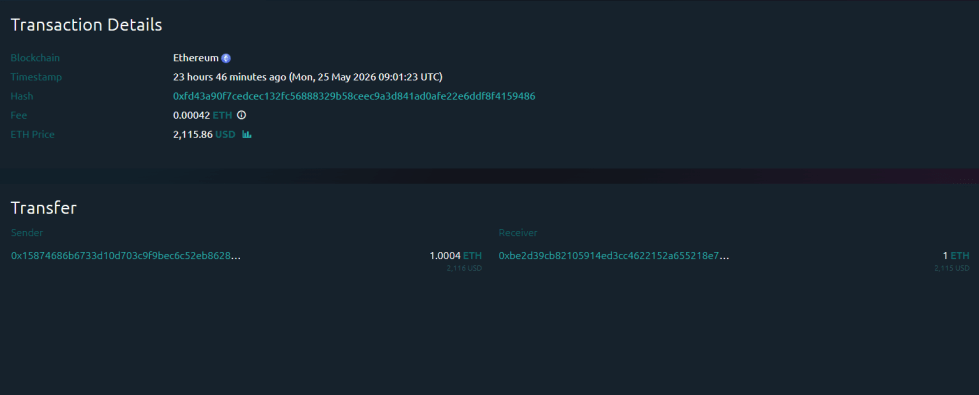
Sepertinya investor memindahkan jumlah kecil dengan transfer ini | Sumber: Whale Alert

Seperti yang terlihat, perpindahan itu hanya melibatkan jumlah 1 ETH, menunjukkan bahwa kemungkinan besar itu adalah transaksi uji coba. Setelah transfer ini, dompet tersebut melakukan beberapa transaksi lagi, termasuk perpindahan 1.997,9 ETH yang hampir mengosongkan saldonya sepenuhnya. Sejauh ini, koin-koin ini belum sampai ke bursa terpusat, jadi sulit untuk mengatakan apakah investor berencana menjualnya.

Seperti yang disebutkan sebelumnya, tumpukan Ethereum yang dipegang oleh alamat tersebut hanya bernilai $620 pada tahun 2015. Hari ini, jumlah yang sama dikonversi menjadi lebih dari $4,2 juta, mewakili keuntungan hampir 630.000%.

Apa yang bisa menjadi alasan di balik OG ini membuat kembalinya tiba-tiba? Nah, jawabannya terletak pada apa yang terjadi pada dompet setelahnya terdiam. Seringkali, alamat yang setua ini mencapai usianya bukan melalui HODLing yang teguh, tetapi karena hilang atau terlupakan. Oleh karena itu, mungkin saja alamat ini tidak dapat diakses selama dormansi dan baru-baru ini kuncinya ditemukan kembali.

Skenario yang kurang mungkin, tetapi bukan tidak mungkin, adalah bahwa saldo Ethereum memang mencapai usianya dengan holding jangka panjang. Jika demikian, investor akan menjadi salah satu yang paling tangguh di sektor aset digital.

Harga ETH

Ethereum menurun menuju level $2.000 beberapa hari lalu, tetapi cryptocurrency ini berhasil naik kembali karena harganya sekarang diperdagangkan sekitar $2.130.

Harga koin tampaknya secara keseluruhan mengikuti lintasan sideways dalam beberapa hari terakhir | Sumber: ETHUSDT di TradingView


Related Questions

QMenurut data on-chain, berapa lama dompet Ethereum kuno tersebut tidak aktif sebelum tiba-tiba aktif kembali?

ADompet Ethereum kuno tersebut telah tidak aktif selama hampir 11 tahun (tepatnya 10,8 tahun) sebelum tiba-tiba aktif kembali.

QApa yang dimaksud dengan 'pre-mine address' dalam konteks Ethereum seperti yang disebutkan dalam artikel?

ADalam konteks Ethereum, 'pre-mine address' merujuk pada alamat yang menerima token ETH-nya sebelum penambangan dimulai di jaringan, yaitu sebelum peluncuran publiknya pada tahun 2015. Dompet seperti ini biasanya dialokasikan koin karena dimiliki oleh kontributor awal dan peserta presale pada tahun 2014.

QBerapa keuntungan persentase yang didapat oleh investor dari dompet Ethereum OG tersebut sejak 2015?

AInvestor dari dompet Ethereum OG tersebut mendapatkan keuntungan sebesar hampir 630.000% sejak tahun 2015.

QTransaksi pertama apa yang dilakukan dompet setelah bangun dari dormansi, dan apa kemungkinan tujuannya?

ATransaksi pertama yang dilakukan adalah transfer sebesar 1 ETH. Menurut artikel, hal ini kemungkinan merupakan transaksi uji coba (test transaction) sebelum melakukan transfer yang lebih besar.

QSalah satu alasan yang mungkin menyebabkan dompet tua seperti ini tidak aktif dalam waktu lama, menurut artikel, adalah apa?

AMenurut artikel, alasan yang mungkin adalah dompet tersebut menjadi tidak dapat diakses (misalnya karena kunci pribadi hilang atau terlupakan) selama masa dormansinya, dan kunci tersebut baru saja ditemukan kembali.

Related Reads

Dalio's Latest Warning: Don't Get Carried Away by AI, Real Returns on US Stocks in the Next 5-10 Years Could Be -5% to -10%

Ray Dalio, founder of Bridgewater Associates, warns investors against excessive concentration in AI stocks. He argues the current market, dominated by a few AI giants, mirrors historical patterns where revolutionary new technologies lead to high risk, volatility, and uncertainty. While acknowledging AI's transformative potential, Dalio emphasizes that most investors fail at this stage of the cycle by over-concentrating in a handful of leading companies. He cites inherent risks: companies cannot accurately forecast investment needs or external shocks (e.g., monetary policy, geopolitics, taxes), face potential disruption from future technologies and international competition (notably from China), and experience significant price swings. Dalio's core advice is diversification, calling it his "Holy Grail of Investing." He presents a mathematical case that a well-diversified portfolio of 15-20 uncorrelated, good bets offers a superior risk-adjusted return compared to a concentrated position. Dalio also offers a cautious outlook, suggesting U.S. stocks may deliver real returns of -5% to -10% over the next 5-10 years based on valuation and bubble indicators. He concludes that in the face of high uncertainty, the prudent strategy is not to avoid betting entirely, but to avoid large, concentrated bets where one lacks sufficient informational edge. Instead, investors should build a strategically balanced, diversified portfolio.

marsbit1h ago

Dalio's Latest Warning: Don't Get Carried Away by AI, Real Returns on US Stocks in the Next 5-10 Years Could Be -5% to -10%

marsbit1h ago

Rain Valuation Approaches $20 Billion: The Battle for U-Cards Extends to Rewards Systems

Rain, a stablecoin payments infrastructure company, is shifting the competitive focus for U Cards from simple issuance to user retention and repeated usage. On June 15, Rain launched "Rain Rewards," an embedded loyalty program capability within its card-issuing infrastructure. This allows partner businesses—like fintech platforms and neobanks—to configure branded loyalty points, earning rules, redemptions, and merchant promotions directly within their card products. The system, built from the 2025 acquisition of Uptop, ensures points are only issued upon final transaction settlement, preventing liabilities from refunds. Trials, such as with Avalanche Card, reportedly boosted spending by 25% among enrolled users. Founded by Farooq Malik and Charles Yoo-Naut, Rain evolved from a tool for managing Web3 company expenses into a full-stack enterprise platform. It is a Principal Member of Visa and Mastercard, enabling partners to issue stablecoin-backed cards and wallets while leveraging traditional payment networks. Notably, the popular U Card Plasma One is issued by Rain under Visa's authority. Rain also integrates with Visa's stablecoin settlement pilot, using USDC for network settlement. Rain's rapid funding reflects growing institutional interest in stablecoin payment infrastructure. It raised a $245 million Series A in March 2025, a $58 million Series B in August 2025, and a $250 million Series C in January of this year, reaching a $19.5 billion valuation. Annualized transaction volume exceeds $3 billion, serving over 200 partners including Western Union and Nuvei. Beyond cards, Rain is expanding into programmable payments. Its June 2026 "Agent Control Layer" allows businesses to set spending rules—like merchant categories, amounts, and frequency—for AI agents before transactions occur. This positions Rain not as a single product but as an operating system for stablecoin payments, handling everything from card issuance and wallet management to rewards, on/off-ramps, and automated compliance. The goal is to enable seamless, often invisible, real-world spending of on-chain assets.

Foresight News1h ago

Rain Valuation Approaches $20 Billion: The Battle for U-Cards Extends to Rewards Systems

Foresight News1h ago

Google TPU Shipments Revised Up by 50%

Recent industry research indicates a significant upward revision in the shipments of Google's TPU (Tensor Processing Unit) chips. Previous expectations for 2027 were set at around 10 million units, but new estimates now point to 15 million units, a 50% increase. This substantial boost directly translates to higher demand across the entire supporting supply chain. Google's TPU clusters utilize a standardized all-optical interconnect architecture. Consequently, key hardware components are deeply integrated and scaled in fixed ratios with the chips. The 15 million TPU target will drive corresponding demand increases for NPO optical engines (roughly a 1:1 match), 1.6T optical modules, OCS optical switches, high-end server power supplies, fiber optics & MPO connectors, and liquid cooling solutions. Among these, liquid cooling is highlighted as the sector experiencing the most significant transformation and offering the most stable potential for excess returns. As next-generation TPU chips reach power levels where traditional air cooling is insufficient, liquid cooling becomes essential. 2026 is forecasted as the first year of substantial adoption for Google's liquid cooling solutions. This shift, coupled with delivery and capacity bottlenecks faced by incumbent overseas manufacturers, is creating a prime window for domestic Chinese suppliers to enter and secure Google's core supply chain. The market size for Google-specific liquid cooling is projected to potentially triple from a baseline of hundreds of billions to around 300 billion units by 2028. The logic for the fiber optic sector is also being rewritten. Once considered a cyclical commodity tied to telecom operator procurement, fiber is now a strategic and scarce resource for AI Data Centers (AIDC). A severe supply-demand imbalance, driven by the long lead time for preform production (18-24 months) and surging demand from cloud giants, is supporting strong performance. Chinese fiber manufacturers are well-positioned to capture a significant share of global AIDC demand, with exports potentially reaching 200-300 million core kilometers in 2026. Overall, the investment focus within the AI computing industry is shifting from pure "chip performance speculation" towards the more certain incremental growth in computing infrastructure and its supporting ecosystem. The upward revision in Google TPU shipments, along with the potential for further doubling by 2028, is seen as solidifying performance visibility for the entire supporting supply chain over the next two years.

marsbit2h ago

Google TPU Shipments Revised Up by 50%

marsbit2h ago

Trading

Spot
Futures

Hot Articles

How to Buy GAIN

Welcome to HTX.com! We've made purchasing GriffinAI (GAIN) simple and convenient. Follow our step-by-step guide to embark on your crypto journey.Step 1: Create Your HTX AccountUse your email or phone number to sign up for a free account on HTX. Experience a hassle-free registration journey and unlock all features.Get My AccountStep 2: Go to Buy Crypto and Choose Your Payment MethodCredit/Debit Card: Use your Visa or Mastercard to buy GriffinAI (GAIN) instantly.Balance: Use funds from your HTX account balance to trade seamlessly.Third Parties: We've added popular payment methods such as Google Pay and Apple Pay to enhance convenience.P2P: Trade directly with other users on HTX.Over-the-Counter (OTC): We offer tailor-made services and competitive exchange rates for traders.Step 3: Store Your GriffinAI (GAIN)After purchasing your GriffinAI (GAIN), store it in your HTX account. Alternatively, you can send it elsewhere via blockchain transfer or use it to trade other cryptocurrencies.Step 4: Trade GriffinAI (GAIN)Easily trade GriffinAI (GAIN) on HTX's spot market. Simply access your account, select your trading pair, execute your trades, and monitor in real-time. We offer a user-friendly experience for both beginners and seasoned traders.

3.3k Total ViewsPublished 2025.09.24Updated 2026.06.02

How to Buy GAIN

Discussions

Welcome to the HTX Community. Here, you can stay informed about the latest platform developments and gain access to professional market insights. Users' opinions on the price of GAIN (GAIN) are presented below.

活动图片