Étude de l'infrastructure de commercialisation des Crypto Agents : analyse approfondie de la « couche monétaire native » centrée sur les stablecoins et du réseau de règlement

marsbitPublished on 2026-05-26Last updated on 2026-05-26

Abstract

L'IA générative évolue des chatbots vers des agents autonomes, mais leur commercialisation se heurte à un obstacle majeur : les systèmes de paiement traditionnels, conçus pour les humains (identification, autorisations manuelles), sont inadaptés. Une solution émerge : utiliser des stablecoins (comme USDC, USDT) comme couche monétaire native pour ces agents. Ils offrent programmabilité, fonctionnement 24/7 et comptes autonomes sans nécessiter d'identité humaine. Des acteurs majeurs construisent l'infrastructure. Coinbase propose l'AgentKit et des portefeuilles dédiés. Circle, avec son protocole CCTP et l'AgentStack, facilite les transferts inter-chaînes et les micropaiements. Stripe connecte le commerce traditionnel au monde crypto via ses APIs stablecoin. Trois scénarios d'application se distinguent à court terme : 1. **Optimisation DeFi** : Les agents déplacent automatiquement des fonds entre protocoles pour maximiser les rendements. 2. **Micropaiements** : Ils permettent une tarification à l'usage (par appel API) avec des frais négligeables, impossible avec les cartes de crédit. 3. **Stablecoins à rendement** : Les fonds des agents génèrent automatiquement des intérêts dans des protocoles DeFi, transformant l'agent en micro-économie autonome. Cependant, des défis critiques persistent avant une adoption massive : * **Sécurité et gestion des clés privées** : Risque de vol par injection d'invites malveillantes. Des solutions comme des couches de signature isolées sont ...

L'IA générative évolue du « chatbot » vers l'agent intelligent (AI Agent) capable d'exécuter des tâches par lui-même. Une question pratique émerge : comment ces « employés » en silicium reçoivent-ils de l'argent et comment payent-ils ? Le système bancaire traditionnel — authentification nominative, autorisation humaine, comptes d'entreprise — est par nature incompatible avec les AI Agents.

Une réponse en cours de maturation rapide est : créer une « couche monétaire » native pour l'IA en utilisant des stablecoins (USDC, USDT et les stablecoins à intérêt). Cet article décortique la mise en œuvre concrète par des entreprises leaders comme Coinbase, Circle, Stripe dans ce domaine, tout en abordant les risques de conformité et de sécurité.

L'infrastructure technique est prête, mais la manière de la mettre en action reste une grande question.

I. Le « point de rupture » des paiements rencontré par la commercialisation des AI Agents

Les AI Agents actuels sont déjà très compétents : réserver des billets d'avion, écrire du code, appeler des APIs... Mais ils se bloquent à l'étape du « paiement ». Les systèmes de paiement traditionnels sont conçus pour les humains — vous devez avoir une pièce d'identité, saisir un code de vérification, opérer pendant les heures de bureau, et chaque transaction comporte des frais non négligeables. Tout cela représente un obstacle pour les Agents.

Concrètement, le système de paiement traditionnel impose quatre barrières aux Agents :
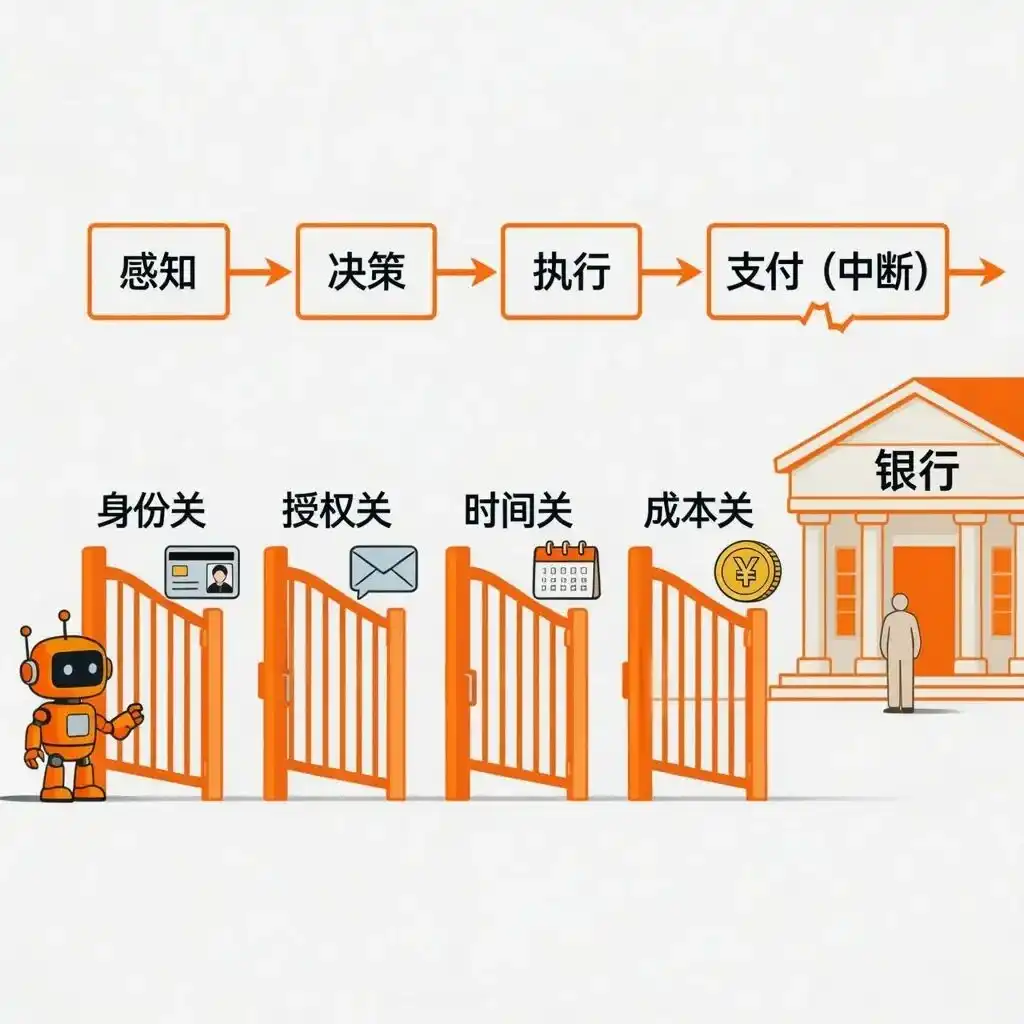
  • Barrière d'identité : Ouvrir un compte bancaire ou une carte de crédit nécessite une pièce d'identité, une reconnaissance faciale, voire des relevés bancaires, qu'un Agent ne peut fournir.
  • Barrière d'autorisation : Le paiement nécessite souvent un code de vérification SMS, une confirmation manuelle, une authentification 3D Secure, qu'un Agent ne peut ni recevoir ni cliquer.
  • Barrière temporelle : Les banques ne traitent les virements que les jours ouvrables et pendant les heures de bureau, alors que les Agents doivent fonctionner 24h/24 et 7j/7.
  • Barrière des coûts : Chaque transaction comporte des frais fixes, par exemple à partir de 30 centimes pour une carte de crédit, rendant impossible un modèle de facturation à la demande de 0,001 dollar. Or, l'activité économique des Agents nécessite précisément ce type de facturation en micropaiements, fréquents et de faible valeur (par exemple, par appel API, par utilisation).

Le problème plus fondamental est que l'ensemble du système de paiement n'a jamais été conçu pour des transferts directs « programme à programme ». Même entre deux entreprises technologiques, le processus est souvent : l'Agent génère une commande → envoie un e-mail à une personne → la personne l'approuve → la personne se connecte au service bancaire en ligne pour virer → le service financier du destinataire fait le rapprochement. L'Agent ne peut effectuer que les deux premières étapes et la dernière de l'enregistrement ; l'étape centrale du « transfert d'argent de A à B » nécessite toujours une action humaine.

Tentatives existantes : elles imitent les humains, plutôt que de créer de nouveaux comptes pour les Agents

L'industrie a déjà fait de nombreuses tentatives, mais elles consistent essentiellement à faire « semblant d'être humain » :

  • Carte de crédit virtuelle + API : L'Agent appelle des interfaces comme Stripe pour payer, mais elles sont liées à l'identité et à la carte d'une personne. Dès que le contrôle des risques détecte une anomalie (paiements trop rapides, montants étranges), il demande une vérification humaine.
  • Automatisation robotisée des processus (RPA) : Faire cliquer l'Agent comme un humain sur les pages du service bancaire en ligne. Dès que le site de la banque change, que le CAPTCHA passe des chiffres à un curseur, ou qu'une étape de vérification supplémentaire apparaît, le script est obsolète.
  • Paiement délégué : Une personne accorde d'abord une limite à l'Agent, qui dépense dans cette limite. Mais l'approbation de la limite, son renouvellement et la vérification des comptes doivent encore être effectués par un humain.

Le défaut commun de ces solutions : l'Agent n'a pas son propre compte, il ne peut que « vivre en empruntant une coquille ». Son autonomie peut à tout moment être révoquée par la banque ou la plateforme.

Pourquoi les stablecoins sont une meilleure solution : donner à l'Agent une « bourse » native

Pour permettre à un Agent de gérer vraiment son argent, il a besoin d'un système monétaire programmable, ne nécessitant pas d'identité humaine, fonctionnant 24h/24 et 7j/7, avec une comptabilité publique et vérifiable, et une valeur relativement stable. Les stablecoins offrent précisément cela :

  • Programmable : Intégré directement dans le code, le paiement est automatique lorsque les conditions sont remplies, sans clic humain.
  • Sans permission : Un Agent peut générer lui-même une adresse de portefeuille, sans faire la queue à la banque.
  • Disponible en permanence : Pas de week-end, pas de jours fériés, pas d'heures de fermeture.
  • Comptabilité transparente : Chaque transfert est enregistré sur la blockchain, visible par tous, facilitant l'audit.
  • Valeur stable : Contrairement au Bitcoin ou à l'Ethereum qui fluctuent fortement, adaptés à la tarification et aux règlements à long terme.

Les stablecoins ne sont pas non plus absolument sûrs. Ceux adossés à des monnaies fiduciaires comme l'USDC ou l'USDT dépendent de la garde centralisée et de l'audit, et ont historiquement connu de brefs décrochages ; les stablecoins purement algorithmiques se sont avérés non viables. Les stablecoins discutés dans cet article se réfèrent principalement aux stablecoins adossés à des monnaies fiduciaires, régulés et dominants.

II. Les Agents de paiement : qui investit ?

La direction est claire, mais qui construit la voie ? Au cours des dix-huit derniers mois, des entreprises leaders comme Coinbase, Circle et Stripe ne se contentent plus de discuter de concepts, mais ont progressivement lancé des outils et protocoles utilisables. Elles abordent chacune un angle différent : certaines se spécialisent dans les portefeuilles et canaux de paiement pour Agents, d'autres résolvent le règlement inter-chaînes, d'autres encore établissent un pont entre les monnaies fiduciaires et les stablecoins.

Coinbase : la chaîne Base + la boîte à outils AgentKit

AgentKit, lancé par Coinbase, est une boîte à outils de développement permettant aux développeurs d'équiper les AI Agents de portefeuilles sur chaîne et de capacités de paiement. En février 2026, ils ont lancé les Agentic Wallets, dotées de cinq fonctions principales : authentification, dépôt, paiement, échange, génération d'intérêts. Le protocole sous-jacent, x402, développé avec Cloudflare, est spécifiquement conçu pour les paiements « machine à machine ».
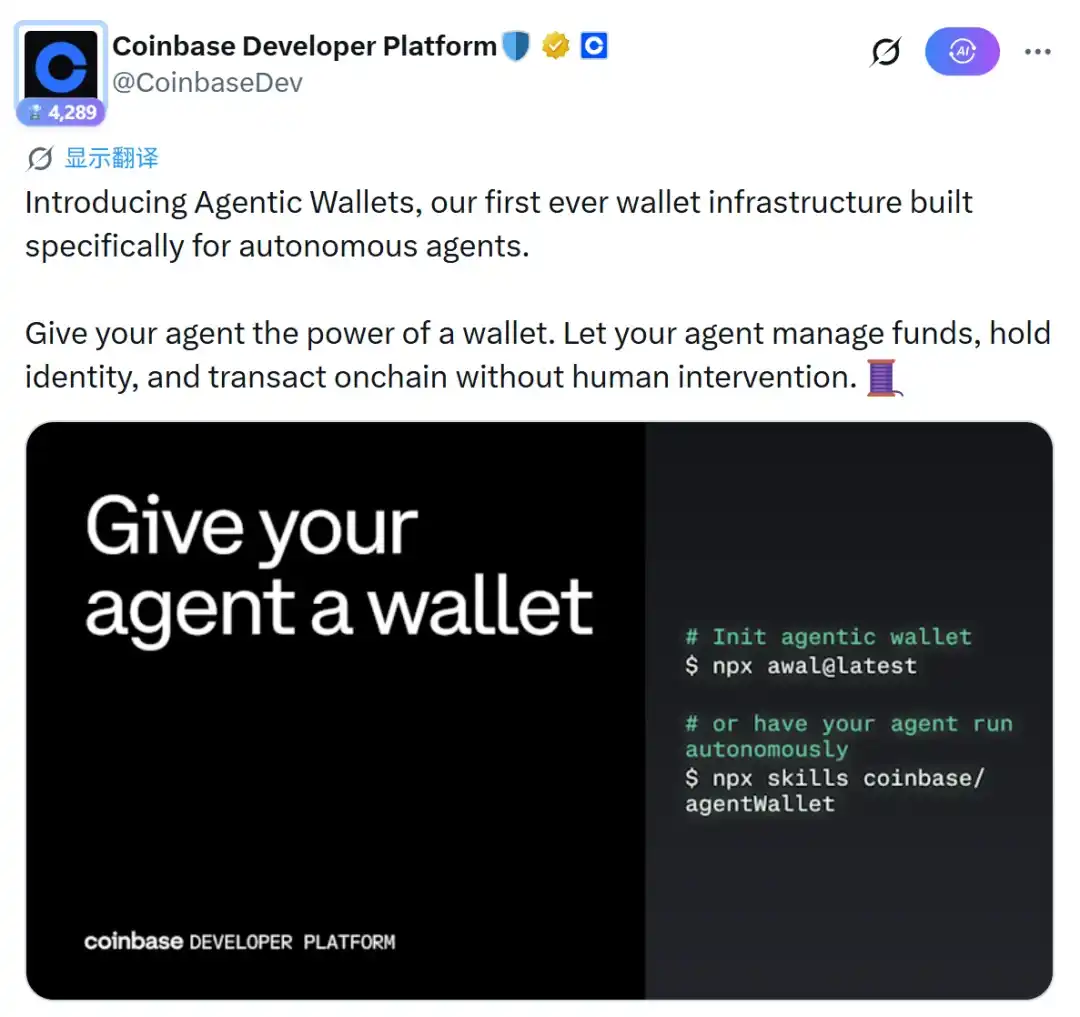
Début 2026, ce protocole avait déjà traité plus de 50 millions de transactions. En matière de sécurité, les Agentic Wallets permettent de définir des limites comme « montant maximum à dépenser par session » ou « montant maximum par transaction ».

Circle : Protocole inter-chaînes CCTP + AgentStack

Le CCTP (Cross-Chain Transfer Protocol) de Circle résout le problème du transfert sécurisé de l'USDC entre différentes blockchains. Il utilise un mécanisme de « brûlage-frappe », ne dépendant pas de ponts inter-chaînes tiers, offrant une sécurité et une conformité inhérentes. Sur cette base, Circle a lancé AgentStack en 2025, comprenant : un portefeuille Agent (prenant en charge les transactions sans frais de Gas), CCTP, les micropaiements Gateway (supportant un minimum de 0,000001 dollar), et un marché de services pour Agents.

Le CCTP a ajouté la fonctionnalité Hooks, permettant à un AI Agent d'inclure des informations métier lors d'un transfert inter-chaînes, réalisant ainsi des opérations en un clic comme « après réception inter-chaînes, crédit automatique ou placement ».
En mars 2026, Circle a également lancé la bibliothèque open source Circle Skills, permettant aux AI Agents (comme Claude) de décider eux-mêmes : quand utiliser le CCTP et quand utiliser les micropaiements Gateway.

Stripe : API de stablecoins, connectant le commerce traditionnel et le monde en chaîne

Stripe a officiellement lancé son API de stablecoins en 2025, et en acquérant l'infrastructure de stablecoins Bridge, a construit un pont conforme entre le commerce traditionnel et l'écosystème en chaîne. En octobre de la même année, Stripe a lancé les paiements d'abonnement en stablecoins, prenant d'abord en charge les abonnements en USDC sur les chaînes Base et Polygon. Ils ont également écrit des contrats intelligents pour résoudre le problème des « signatures manuelles à chaque paiement » — les utilisateurs peuvent enregistrer leur portefeuille comme moyen de paiement et autoriser des prélèvements automatiques périodiques.

Stripe masque en arrière-plan la complexité de la blockchain (gestion des clés privées, frais de Gas) avec son propre registre et sa surveillance de conformité KYC/AML. Lorsqu'un AI Agent doit effectuer des transactions avec des commerçants traditionnels, Stripe fournit un canal légal et conforme pour l'échange et le règlement en dollars.

Outre les trois leaders mentionnés ci-dessus, certaines grandes entreprises Internet traditionnelles commencent également à investir dans ce domaine :

  • AWS+Stripe+Coinbase (mai 2026) : Collaboration pour proposer une infrastructure de paiement basée sur l'USDC, permettant aux AI Agents de payer eux-mêmes pour des services numériques comme les services cloud, les appels API, etc. AgentCore Payments d'Amazon Bedrock sert de couche de paiement, avec un temps de règlement d'environ 200 millisecondes sur la chaîne Base et un coût par transaction inférieur à 1 centime. Stripe a mis en œuvre son propre MPP (Machine Payment Protocol), prenant en charge les « paiements en flux » — débitant en temps réel selon la consommation de calcul ou le nombre de jetons par seconde. Le même jour, Stripe et Tempo ont publié la norme open source MPP, et Visa a également annoncé son soutien.
  • Google+Coinbase (septembre 2025) : Collaboration pour lancer l'Agent Payments Protocol (AP2), combinant le cadre de communication inter-agents (A2A) de Google et le canal de paiement x402 de Coinbase, permettant aux Agents d'effectuer le processus complet « négociation du prix → paiement → émission de reçu ». Les premiers partenaires incluent ServiceNow, Salesforce, PwC, Shopee, Worldpay, etc.
  • VirtualsProtocol+Ethereum Foundation (mars 2026) : Proposition conjointe de l'ERC-8183 (Agentic Commerce), une norme de règlement commercial en chaîne spécifiquement dédiée aux AI Agents. Le cœur est le concept de « Tâche (Job) » : trois parties (le client, le prestataire, l'arbitre) verrouillent les fonds via un contrat intelligent et règlent selon la machine à états « création → financement → livraison → achèvement / refus / expiration ».

III. Scénarios d'application typiques pour l'économie en silicium

Avec les infrastructures ci-dessus, si les AI Agents disposent réellement de leur propre portefeuille de stablecoins, capables de recevoir et de payer, d'effectuer des transactions inter-chaînes, de générer des intérêts, ils ne sont plus des outils isolés mais peuvent former une micro-économie autonome. Nous analysons ici les scénarios d'application qui ont partiellement été mis en œuvre à court terme et sont les plus susceptibles de libérer la valeur de l'économie en silicium.

Scénario 1 : Optimisation des rendements DeFi — laisser l'Agent faire « fructifier l'argent » lui-même

Dans la finance traditionnelle, les liquidités inactives sur un compte courant génèrent peu ou pas de revenus. Mais dans le monde DeFi, les détenteurs de stablecoins peuvent déposer leur argent sur des protocoles de prêt (comme Aave, Morpho, Compound) pour percevoir des intérêts. Le problème est que les taux d'intérêt varient constamment selon les protocoles et les chaînes, et il est difficile pour un humain de les surveiller et d'ajuster fréquemment. C'est précisément le point fort des AI Agents.

Prenez la plateforme Walbi : elle a traité 187 000 transactions initiées de manière autonome par des AI Agents en 14 semaines, impliquant 9 500 Agents indépendants — sans intervention humaine. Les Agents scannent automatiquement les taux d'intérêt sur différentes chaînes, calculent le rendement net après déduction des frais de Gas, et déplacent les fonds des pools à faible rendement vers ceux à haut rendement. Examinons la solution ZENITH : un AI Agent indépendant est déployé sur chaque chaîne publique majeure (Ethereum, Arbitrum, Optimism, Base, etc.), chacun ne gérant que les protocoles DeFi de sa propre chaîne (Aave, Morpho, Compound, etc.). Dès qu'un Agent détecte que les taux d'une chaîne sont plus élevés que ceux d'une autre, et que la différence couvre le coût inter-chaînes, il transfère les fonds via un protocole comme le CCTP.

Pourquoi ces tâches nécessitent-elles absolument des Agents ? L'opération manuelle présente trois difficultés : premièrement, suivre simultanément les variations de taux de multiples protocoles représente un volume de données trop important ; deuxièmement, les opérations inter-chaînes sont fastidieuses, nécessitant une signature manuelle pour chaque transaction ; troisièmement, les coûts de transaction et le temps nécessaires pour des réajustements fréquents sont trop élevés. Les AI Agents équipés de stablecoins peuvent surveiller 24h/24 et 7j/7, répondre en millisecondes, exécuter automatiquement, et chaque transaction est traçable et vérifiable.

Scénario 2 : Micropaiements ultimes — libérer l'économie de longue traîne « à la consommation »

Les systèmes de paiement traditionnels ont des frais fixes par transaction (à partir de 30 centimes pour les cartes de crédit), rendant économiquement non viables les micropaiements (par exemple 0,001 dollar). Mais pour les services d'IA (facturation par appel API, par image générée, par requête), les micropaiements sont précisément le mode de tarification le plus naturel. Les faibles frais de transaction des stablecoins et leur support d'unités extrêmement petites rendent à nouveau les micropaiements possibles.

Le protocole x402, développé conjointement par Coinbase et Cloudflare, intègre directement le paiement dans la requête HTTP. Lorsqu'un client accède à une API protégée, le serveur renvoie un code d'état 402 (paiement requis) avec une demande de paiement (par exemple « Veuillez payer 0,001 USDC »). Le client paie automatiquement via son portefeuille Agent intégré, puis obtient les données ou services — début 2026, ce protocole avait déjà traité plus de 50 millions de transactions. Scénarios typiques : mur payant d'API, accès payant à des ensembles de données de haute valeur, abonnements à des données de marché en temps réel.

Les Gateway Nanopayments de Circle vont encore plus loin, conçues spécifiquement pour les transactions à haute fréquence et à très faible montant, prenant en charge des transferts USDC jusqu'à 0,000001 dollar minimum, et le destinataire ne paie pas de frais de Gas. Le principe sous-jacent est le « règlement par lots + canaux d'état » : plusieurs micropaiements sont agrégés hors chaîne et finalement réglés une seule fois sur la chaîne pour le montant net. Ainsi, un Agent peut payer en temps réel pour chaque appel API, chaque mégaoctet de stockage, chaque seconde de temps de calcul, avec des frais de transaction quasi nuls. Sans micropaiements, la commercialisation des AI Agents ne peut suivre que les anciennes voies des abonnements forfaitaires ou du prépaiement ; avec eux, les Agents peuvent facturer avec précision, comme un compteur d'eau ou d'électricité, et la collaboration entre Agents (par exemple, A utilisant le service de raisonnement du modèle de B, ne payant que quelques centimes par utilisation) peut également se faire avec une friction extrêmement faible.

Scénario 3 : Des « liquidités inactives » à la « génération automatique d'intérêts » — pratique de dimension supérieure des stablecoins porteurs d'intérêts (yield-bearing)

Dans la finance traditionnelle, l'argent sur les comptes courants des entreprises ne génère pratiquement pas d'intérêts. Pour investir, il faut étudier les produits, signer des contrats, effectuer des transferts manuels, un processus fastidieux et limité dans le temps, que les petites et moyennes entreprises abandonnent souvent. Les stablecoins combinés aux AI Agents renversent complètement cette logique.

Lorsqu'un Agent détient un stablecoin porteur d'intérêts (comme aUSDC, sDAI, eUSD), le solde du portefeuille accumule automatiquement des revenus — ce type de stablecoin est essentiellement un reçu de dépôt sur un protocole DeFi, l'intérêt se reflétant directement dans l'augmentation du taux de change du jeton. L'Agent peut « générer des intérêts sans rien faire ». Plus important encore, un Agent de gestion des rendements bien conçu peut automatiquement basculer entre différents actifs générateurs d'intérêts, réalisant à la fois « des rendements et une capacité de paiement immédiate ».

La plateforme d'orchestration des rendements lancée par Ymax en février 2026 est typique : l'utilisateur n'a qu'à signer une fois pour autoriser, puis l'Agent répartit automatiquement l'argent entre plusieurs coffres comme Morpho, Aave, Compound, et effectue automatiquement un rééquilibrage en fonction des taux d'intérêt en temps réel, sans que l'utilisateur n'ait à intervenir, les rendements s'accumulant à la seconde. Un autre coffre géré par l'IA, proposé par aarnaFinance, intègre plus de vingt sources de revenus sur la chaîne (prêt, jalonnement, stratégies de coffre), l'Agent construisant dynamiquement un portefeuille d'investissement, avec un rendement annualisé en stablecoins de 8 à 12 %. À titre de comparaison : les taux des comptes courants bancaires traditionnels sont généralement inférieurs à 0,5 %, et les fonds du marché monétaire en dollars rapportent environ 4 à 5 % annualisés.

Pour un AI Agent, la capacité à générer des intérêts n'est pas seulement un plus ; elle peut changer la logique économique sous-jacente : un Agent capable de générer automatiquement des intérêts peut utiliser ces intérêts pour payer ses propres coûts de fonctionnement (frais de Gas, appels API), et même accumuler plus de capital pour exécuter des tâches plus complexes. L'Agent n'est plus un fardeau « consommateur d'argent », mais devient une micro-économie « auto-suffisante ». Lorsque des centaines de millions de tels Agents fonctionnent simultanément, ils feront émerger un tout nouveau sous-marché financier entièrement piloté par des programmes.

IV. Les défis nécessaires à une adoption à grande échelle

L'infrastructure existe, les scénarios fonctionnent, mais ne nous réjouissons pas trop vite — sans surmonter les obstacles suivants, l'utilisation commerciale à grande échelle restera un vœu pieux.

Gestion des clés privées et sécurité

La conception actuelle de nombreux portefeuilles d'AI Agents présente un gros défaut : confier directement la clé privée ou les identifiants API à l'Agent. En cas d'« attaque par injection de prompt » (par exemple, un attaquant induisant l'Agent à exécuter des opérations malveillantes via l'entrée), la clé privée peut être divulguée. La société d'audit Sherlock a classé les « compétences malveillantes de tiers », « l'injection indirecte de prompt », « l'exposition des identifiants » et la « mauvaise conception des autorisations du portefeuille » parmi les risques majeurs pour la sécurité des Web3 Agents en 2026. Les transactions sur la chaîne sont irréversibles, une seule signature erronée peut entraîner une perte permanente.

Une leçon réelle : lors de l'incident Owockibot en février 2026, l'AI Agent autonome a divulgué la clé privée de son portefeuille chaud à plusieurs endroits, et les créateurs du projet ont finalement dû couper l'accès à Internet et aux opérations cryptographiques de l'Agent. Le fondateur a admis : « J'ai sérieusement sous-estimé la difficulté de sécurité de ce projet et je dois ré-architecturer en priorisant la sécurité. »

Les solutions actuellement explorées :

  • Couche de signature isolée : L'Agent peut proposer « combien je veux payer à qui », mais la signature réelle est effectuée dans un module de sécurité matérielle indépendant ou une couche de garde.
  • Solution MetaMask Smart Accounts : L'Agent peut initier des transactions, mais n'obtient jamais la clé privée. Contrôle précis des autorisations via les comptes intelligents ERC-4337 et la délégation d'autorisation ERC-7710.

Conformité et vide réglementaire

Le KYC traditionnel doit devenir « Connaître Votre Agent Intelligent » (KYA), mais cette catégorie n'existe pas légalement. Un Agent n'est pas une personne morale, ne peut posséder d'actifs, signer de contrats, ou assumer la responsabilité d'un manquement contractuel. Si un Agent paie la mauvaise personne, ou est piraté pour effectuer un transfert, qui est responsable ? Cette question reste sans réponse. Concernant la surveillance transfrontalière des fonds — les transferts fréquents et complexes entre plusieurs Agents, la lutte contre le blanchiment d'argent (AML), la fiscalité, la surveillance de la conformité sont des vides à la fois techniques et juridiques. L'Agent Stack de Circle intègre bien des limites de dépenses et des listes blanche/noire, mais les paiements transnationaux entre Agents tombent facilement dans une zone grise réglementaire, et l'API de stablecoins de Stripe n'est actuellement ouverte qu'aux entreprises américaines. L'attribution des responsabilités est également floue : les Agentic Wallets s'appuient sur les limites définies par l'utilisateur, mais en cas d'erreur de l'Agent, la responsabilité incombe-t-elle à l'utilisateur ou au développeur ? Le protocole AP2 effectue quelques vérifications de conformité avant le transfert (comme la Travel Rule, le filtrage des sanctions), mais ce n'est qu'à ses balbutiements.

Risques techniques et exactitude de l'intention de l'IA

Les vulnérabilités des contrats intelligents ne disparaissent pas magiquement parce qu'ils sont contrôlés par une IA. Un pool de fonds géré par une IA peut tout aussi bien être victime d'une attaque par emprunt flash (flash loan) ou de manipulation d'oracle, et aucun protocole n'est actuellement conçu spécifiquement pour se défendre contre des Agents malveillants. Plus problématique encore est la déviation de l'intention de l'IA. Même si le portefeuille et le canal de paiement sont sécurisés, comment garantir que l'Agent exécutant des tâches financières complexes et à plusieurs étapes suive vraiment l'intention réelle de l'utilisateur ? La société d'audit Sherlock a souligné un problème clé : un prompt peut « guider » le comportement d'un Agent, mais guider n'est pas contrôler. Les façons d'échouer sont trop nombreuses — erreur de raisonnement du modèle, pollution des informations externes, injection de compétences malveillantes par des tiers... Chacune peut entraîner une perte financière irréversible. L'industrie est encore loin d'avoir suffisamment étudié les limites de sécurité et les mécanismes de vérification de « l'exécution pilotée par l'intention ».

Conclusion et perspectives

L'intégration profonde des AI Agents et des stablecoins est en train de changer fondamentalement la manière dont le commerce numérique mondial est réglé. Les infrastructures construites par Coinbase, Circle, Stripe et d'autres ont déjà créé une boucle fermée « Agent intelligent → inter-chaînes → monde des monnaies fiduciaires », faisant passer les stablecoins d'« outil de spéculation » à « bourse native de l'économie en silicium ».

À court terme, la gestion des clés privées et la sécurité sont les plus grands obstacles. On s'attend à voir émerger davantage de solutions de signature matérielle isolée et de normes d'autorisation de comptes intelligents. En matière de conformité, certaines régions (par exemple, l'UE dans le cadre de MiCA avec des directives complémentaires) pourraient commencer à expérimenter le KYA (Connaître Votre Agent).

D'un point de vue moyen à long terme, celui qui pourra intégrer de manière transparente les actifs générateurs d'intérêts, fournir des hooks inter-chaînes faciles à utiliser et répondre aux besoins de micropaiements multi-Agents, deviendra probablement une infrastructure clé pour la prochaine économie numérique d'Internet. Parallèlement, les mécanismes de vérification de l'intention de l'IA (comme la vérification formelle, la preuve d'intention basée sur la preuve à divulgation nulle de connaissance) devraient progressivement mûrir, réduisant le risque de « signature erronée ».

Dans cette économie, les Agents peuvent gagner de l'argent eux-mêmes, le dépenser eux-mêmes, investir eux-mêmes, et conclure des contrats avec d'autres Agents pour régler leur rémunération. Les humains ne sont plus les approbateurs de chaque transaction, mais plutôt les concepteurs du système et les définisseurs de ses limites. C'est à la fois excitant et inquiétant. Et le point de départ de tout cela est la refonte de l'infrastructure qui se produit aujourd'hui.

En fin de compte, la vraie question n'est plus « est-ce techniquement possible ? », mais sommes-nous prêts à accueillir une économie en chaîne composée de centaines de millions d'AI Agents fonctionnant de manière autonome ?

Related Questions

QQuels sont les principaux obstacles que rencontrent les AI Agent dans les systèmes de paiement traditionnels pour leur commercialisation ?

ALes AI Agent rencontrent quatre obstacles majeurs dans les systèmes de paiement traditionnels : 1) L'obstacle de l'identité (nécessité de documents d'identité, reconnaissance faciale). 2) L'obstacle de l'autorisation (codes de vérification par SMS, confirmations manuelles). 3) L'obstacle temporel (traitement limité aux heures ouvrables). 4) L'obstacle du coût (frais fixes élevés qui rendent les micropaiements inviables). Ces systèmes sont conçus pour les humains et non pour des programmes.

QPourquoi les stablecoins sont-ils considérés comme une meilleure solution pour les paiements des AI Agent ?

ALes stablecoins offrent une couche monétaire native idéale pour les AI Agent car ils sont : programmables (intégration directe dans le code), sans autorisation (création libre de portefeuilles), opérationnels 24h/24 et 7j/7, transparents (toutes les transactions sont sur la blockchain), et à valeur stable (contrairement aux cryptomonnaies volatiles). Cela permet aux agents d'avoir leur propre 'portefeuille' autonome.

QQuelles sont les approches de Coinbase, Circle et Stripe pour résoudre le problème des paiements des AI Agent ?

ACoinbase propose l'AgentKit et les Agentic Wallets basés sur le protocole x402 pour les paiements machine-à-machine. Circle utilise son protocole CCTP pour le transfert inter-chaînes de l'USDC et a lancé AgentStack, incluant des portefeuilles et un système de nanopaiements. Stripe fournit des API stablecoin et un pont réglementé vers le monde traditionnel, facilitant les paiements par abonnement et automatisant les signatures via des contrats intelligents.

QDécrivez deux scénarios d'application pratique d'une économie 'silicon-based' pour les AI Agent.

AScénario 1 : Optimisation des rendements DeFi. Les Agent peuvent automatiquement déplacer des stablecoins entre différents protocoles de prêt (comme Aave, Compound) sur plusieurs blockchains pour maximiser les intérêts, 24h/24. Scénario 2 : Micropaiements. Grâce à des protocoles comme x402 (Coinbase) ou Gateway (Circle), les Agent peuvent effectuer des paiements infimes (ex : 0.001 USDC) pour des services à l'usage (API, calcul), rendant viable une économie à la demande.

QQuels sont les principaux défis à relever pour un déploiement à grande échelle des paiements par AI Agent avec des stablecoins ?

ALes défis majeurs sont : 1) La sécurité et la gestion des clés privées (risque de fuite via des attaques par injection d'invite). 2) La conformité et le vide réglementaire (pas de cadre juridique pour les 'KYA' - Know Your Agent, responsabilité en cas d'erreur). 3) Les risques techniques et la précision de l'intention de l'IA (vulnérabilités des smart contracts, dérive des intentions de l'agent conduisant à des pertes financières).

Related Reads

Uncovering the Truth About Agent Commerce, Payments, and Infrastructure

Decoding Agent Commerce, Payments, and Infrastructure: The Reality Over the past year, I've been building infrastructure for the Agent economy, engaging with major players like Stripe, Visa, Coinbase, Google, and dozens of startups. A clear conclusion emerges: true, large-scale demand does not yet exist. Startups face structural challenges. Data points illustrate this gap. Stripe's Agent commerce platform has over 1,000 merchants but only single-digit transacting agents. Visa's Agent payment token requires 9-month KYC and a $250M revenue threshold, accessible only to giants like Amazon. On-chain analysis reveals actual daily Agent transaction volume is around $17k, half of which are test transactions. The article analyzes four potential markets: **1. Agent-to-Merchant (A2M):** Current AI shopping UX is often inferior to traditional e-commerce for visual, comparison-heavy purchases (clothing, electronics). Chat interfaces are a step back. Real merchant interest is defensive "Agent Engine Optimization," fearing future obsolescence, not current demand. Potential exists in high-frequency, low-decision purchases (e.g., food delivery) or simplifying terrible UX (complex checkouts, non-native shoppers), but these require massive consumer distribution channels dominated by giants like DoorDash and Amazon. **2. Agent-to-API (A2A):** Developers already have subscriptions and billing for core APIs (compute, data). The argument for micro-payments via crypto for sub-dollar API calls is addressed by pre-paid balances today. The deeper issue is supplier resistance; major SaaS firms rely on enterprise contracts, not fractional cent pricing. Opportunity lies in the long tail of niche services, but this is a smaller market catering to developers, a historically low-paying group. **3. Agent-to-Agent (A2A):** This remains a theoretical long-term vision with near-zero current transaction volume. It involves unique challenges: discovery, trust, negotiation, dispute resolution. When it materializes, it will require a fundamentally new settlement infrastructure for high-speed, variable-value, multi-party transactions. It's a real long-term bet, but not the current market. **4. Agent-to-Finance (A2F):** This is the only category with existing, paying demand. Integrating AI into financial workflows (trading, portfolio management) is a natural evolution and enables new capabilities like autonomous rebalancing. However, competition favors incumbents with regulatory licenses, compliance infrastructure, and existing client relationships. **The Real Issue:** Why is infrastructure still being built? Incumbents can afford long-term bets, and payment companies see every problem as a nail for their payment hammer. However, payment is just one piece. The core challenge is *coordination*—orchestrating work between Agents and humans, verifying outcomes, and settling results. Payment is part of settlement, which is part of coordination. Companies that solve the coordination problem will subsume payments, not the other way around. Startups lack the infinite runway of giants and must find today's real market, which, after a year of exploration, lies outside these four categories—in an area with real, growing, and underserved activity.

marsbit4h ago

Uncovering the Truth About Agent Commerce, Payments, and Infrastructure

marsbit4h ago

Trading

Spot
Futures

Hot Articles

What is LINON

Linde plc Tokenized Stock (Ondo): Revolutionizing Traditional Equity Access Through Blockchain Innovation The emergence of Linde plc Tokenized Stock (Ondo), represented by the ticker $LINON, signifies a monumental shift in the fusion of traditional financial structures and decentralized finance (DeFi). This innovative financial instrument showcases the tremendous potential of blockchain technology to democratize access to traditional equity markets while ensuring the security and regulatory compliance necessary for institutional-grade financial products. Through Ondo Finance's pioneering tokenization platform, $LINON provides a seamless pathway for global investors to engage with one of the world's leading industrial gas companies, Linde plc, creating a blockchain-native representation of the underlying equity. Introduction to Linde plc Tokenized Stock The landscape of financial markets is witnessing a groundbreaking transformation through the tokenization of real-world assets. Linde plc Tokenized Stock (Ondo) epitomizes this revolutionary approach by bridging the gap between conventional stock ownership and blockchain-enabled financial infrastructure. The $LINON token allows investors to gain exposure to one of the prominent industrial companies worldwide through decentralized technology. Operating within Ondo Finance's comprehensive ecosystem, $LINON symbolizes a practical application of tokenization technology that enhances accessibility, efficiency, and global connectivity in traditional financial markets. By leveraging blockchain infrastructure, this tokenized stock enables international investors to participate in U.S. equity markets, overcoming traditional barriers associated with cross-border investing. The significance of $LINON goes beyond technological innovation; it represents a fundamental shift in asset structuring, distribution, and trading in the digital age. This tokenized stock maintains all the economic benefits associated with traditional Linde plc shares while offering improved liquidity, programmable compliance features, and seamless integration with decentralized finance protocols. The development of $LINON indicates a growing acceptance of blockchain technology as a viable means for traditional finance, exemplifying how even well-established assets like Linde plc can integrate into blockchain systems. This approach preserves the core attributes that appeal to investors while introducing advanced capabilities that enhance the overall investment proposition. Project Overview and Objectives Linde plc Tokenized Stock (Ondo) encapsulates a strategic effort to democratize access to traditional equity markets through advanced blockchain technologies. The primary objective of $LINON is to provide approved global investors seamless access to the economic exposure associated with Linde plc shares, furthering an effort to create a more inclusive financial ecosystem. Beyond the digital representation of traditional assets, $LINON endeavors to eliminate barriers of geography and time zones that limit investor participation. Its design ensures that blockchain technology can elevate traditional investment vehicles without undermining the security or compliance requirements expected by investors. Key goals of the project include enhanced liquidity provision, programmable compliance mechanisms, and interoperability with other blockchain networks. Each $LINON token is fortified by actual Linde plc securities housed at U.S.-registered broker-dealers, allowing holders to reap economic advantages akin to traditional stockholders, such as dividend reinvestment. Furthermore, $LINON aims to establish new industry standards for institutional-grade tokenized securities, paving the way for traditional assets to embrace blockchain technology while remaining compliant with regulatory frameworks. By associating itself with a company as reputable as Linde plc, the project opens avenues for exploring tokenized equities catering to both conservative institutional players and daring retail investors. Project Creator and Development Team The vision for Linde plc Tokenized Stock (Ondo) comes from Nathan Allman, founder and CEO of Ondo Finance. His background in traditional finance coupled with expertise in blockchain technology positions him uniquely to navigate the complexities of asset tokenization. Allman's academic journey began at Brown University, focusing on Economics and Biology, equipping him with valuable analytical skills. His time at Goldman Sachs in the Digital Assets division strengthened his understanding of the interplay between financial institutions and emerging technologies, laying the groundwork for his later endeavors in alternative investment strategies. Under Allman's guidance, Ondo Finance has emerged as a leader in asset tokenization, launching $LINON as a flagship example of the company's larger mission towards revolutionizing traditional financial systems using blockchain technology. His commitment to leveraging blockchain for creating institutional-grade financial products has shaped the landscape of real-world asset tokenization. Investment and Funding Structure The growth of Ondo Finance, the platform powering Linde plc Tokenized Stock (Ondo), is bolstered by robust financial backing from prestigious venture capital firms and strategic investors. This strong investment foundation underpins the development of the key infrastructure essential for compliant tokenized securities like $LINON. In August 2021, Ondo Finance secured $4 million in seed funding led by a major venture capital firm, which enabled the company to commence platform development and establish the necessary regulatory processes for tokenizing real-world assets. This early investment cemented Ondo Finance's credibility within the industry. The Series A funding round followed, garnering $20 million with participation from renowned firms committed to transformative technology companies. This backing demonstrated substantial institutional confidence in Ondo Finance's vision, allowing it to hone its approach to asset tokenization through mechanisms that ensure compliance and accessibility. Noteworthy contributors, including institutional investors and experienced partners, have added significant value to Ondo Finance’s development efforts. Their involvement underscores the confidence across sectors in Ondo Finance's approach to bridging traditional finance with blockchain innovations. Technical Infrastructure and Innovation The technical architecture that underpins Linde plc Tokenized Stock (Ondo) represents a sophisticated melding of traditional finance systems and cutting-edge blockchain technology. The architecture's foundation is built on the Ethereum network, renowned for its security and programmability—both critical for intricate financial instruments. The $LINON tokenization process comprises creating a blockchain-native representation of Linde plc shares that preserves economic benefits while augmenting investor capabilities. Each token corresponds to actual shares held at U.S.-registered broker-dealers, creating a compliant custody structure that legitimizes the asset's existence and value. Automated compliance systems are integrated into the tokenization process, managing critical components such as know-your-customer (KYC) verification and anti-money laundering (AML) protocols. This incorporation of programmable compliance empowers $LINON to uphold regulatory standards essential for institutional proliferation. Cross-chain interoperability characterizes the advanced technical features of $LINON. While initially deployed on Ethereum, the framework is designed for expansion to other networks such as Solana and BNB Chain. This adaptability enhances liquidity and accessibility, allowing investors to select their preferred blockchain ecosystems. Historical Timeline and Development Crafting the history of Linde plc Tokenized Stock (Ondo) unfolds in parallel with the evolution of Ondo Finance's tokenization platform. The timeline's inception dates back to March 2021 when Nathan Allman laid the foundations for creating institutional-grade financial products on blockchain infrastructure. The initial funding round in August 2021 provided crucial resources for developing the platform and establishing partnerships necessary for effective tokenization. By January 2023, Ondo Finance launched its tokenized treasury products, establishing mechanisms that would facilitate future tokenized equities such as $LINON. A pivotal milestone arose in February 2025 when Ondo Chain—a Layer 1 blockchain designed specifically for asset tokenization—was introduced. This infrastructure enhances capabilities vital for institutional markets, demonstrating Ondo Finance's long-term commitment to tokenization. Subsequently, the launch of Ondo Global Markets in September 2025 marked the official debut of $LINON. This milestone showcased the successful transition from development to active trading, enabling investors around the world to access American financial markets seamlessly. Ongoing development plans include a targeted expansion of available tokenized assets to over 1,000 by the end of 2025, pointing to a bright future for Ondo Finance's ecosystem and its mission to broaden tokenized equity accessibility. Regulatory Compliance and Legal Framework The legal architecture governing Linde plc Tokenized Stock (Ondo) emphasizes a sophisticated approach to regulatory compliance, allowing tokenized securities to be implemented within a blockchain-based framework. The legal structure governing $LINON spans multiple jurisdictions while maintaining a robust legal footing. Compliance systems ensure that only eligible investors can access the token, enforced through automated verification that aligns with international regulations. This innovative regulatory technology promises real-time enforcement of complex requirements, considerably enhancing efficiency in operating within the regulatory landscape. The custody framework undergirding $LINON ensures that the underlying shares are securely held at U.S.-registered broker-dealers, complying with necessary regulations while delivering blockchain-driven access to investors. The token maintains its economic equivalency and security through this carefully structured custody arrangement. KYC and AML compliance systems are embedded within the smart contract architecture, ensuring integrity and adherence to regulatory practices while fostering transparency for investors. The jurisdictional restrictions mark a commitment to navigating the evolving landscape of international securities laws. Market Impact and Industry Significance The advent of Linde plc Tokenized Stock (Ondo) holds profound implications for the broader financial landscape, symbolizing a clear shift towards blockchain-enabled markets. $LINON serves as a proof-of-concept for integrating traditional companies into blockchain ecosystems, showcasing the potential benefits such as broader accessibility and improved efficiency. The market's response to $LINON indicates a growing acceptance of tokenization among institutional investors, contributing to the emergence of an expanding sector wherein traditional assets can be interconnected with blockchain innovations. The success of $LINON further solidifies market confidence, indicating an overarching shift towards recognizing asset tokenization as a transformative force in finance. Future Development and Expansion Plans The future trajectory for Linde plc Tokenized Stock (Ondo) centers around the expansion of the tokenization ecosystem and enhanced infrastructure supporting blockchain-enabled financial services. Plans for cross-chain integration usher in new opportunities for liquidity and flexibility within the investment framework, with existing capabilities poised for continuous enhancement. With the introduction of Ondo Chain, Ondo Finance aims to transition $LINON to an optimized blockchain environment specifically designed for asset tokenization. This new infrastructure heralds exciting prospects for the development of institutional-grade financial products, ensuring ongoing compatibility with contemporary investment strategies. Further integration with decentralized finance protocols signifies a commitment to empowering $LINON holders through advanced financial strategies. The anticipated expansion of available tokenized assets promises to broaden investor access, enhancing the utility and appeal of the platform. In alignment with ambitions for regulatory expansion, ongoing efforts to secure approvals for new jurisdictions will enhance investor access, further positioning $LINON at the forefront of the burgeoning tokenization market. Conclusion Linde plc Tokenized Stock (Ondo), as represented by the $LINON token, stands at the intersection of traditional finance and blockchain innovation. It embodies a transformative milestone in how financial assets are structured, distributed, and engaged within modern investment ecosystems. The technical sophistication behind $LINON, combined with its regulatory compliance framework, illustrates that asset tokenization can improve financial infrastructure rather than simply digitizing existing products. This pioneering effort not only enhances investor access to U.S. equity markets but also signifies an evolution of how traditional financial services can integrate blockchain technology. As the asset tokenization market grows exponentially, with prospects suggesting significant valuation increases, $LINON paves the way for a future where tokenized securities become standard fixtures in the financial landscape. The trajectory of $LINON will undoubtedly influence how traditional finance adapts to a transformed, blockchain-powered world.

3.1k Total ViewsPublished 2025.12.05Updated 2025.12.05

What is LINON

What is CRMON

Salesforce Tokenized Stock (Ondo): Revolutionising Traditional Equity Access Through Blockchain Innovation The emergence of Salesforce Tokenized Stock (CRMON) marks a pivotal advancement in integrating traditional financial markets with blockchain technology. This innovative approach offers investors unprecedented access to equity exposure through tokenisation. Developed by Ondo Finance, CRMON provides tokenholders with economic exposure equivalent to holding Salesforce stock (CRM) while automatically reinvesting dividends. This effectively bridges the gap between conventional equity markets and decentralised finance (DeFi). Introduction and Comprehensive Overview of Salesforce Tokenized Stock In recent years, the financial landscape has dramatically transformed due to blockchain technology, fundamentally altering how investors access and interact with traditional assets. The development of Salesforce Tokenized Stock (CRMON) is a prime example of this evolution, representing a sophisticated fusion of conventional equity markets with cutting-edge distributed ledger technology. CRMON is a tokenised version of Salesforce stock, emerging from the innovative work of Ondo Finance, a leading platform in the real-world asset tokenisation sector that positions itself as a bridge between traditional finance and decentralised systems. Designed to provide tokenholders with economic exposure that mirrors the performance of the underlying Salesforce stock, CRMON incorporates automatic dividend reinvestment mechanisms. This eliminates many traditional barriers associated with international equity investment, such as complex brokerage relationships, currency conversion challenges, and restricted trading hours. The tokenisation process reimagines stock ownership as a blockchain-native asset while maintaining its economic equivalence with the underlying security, offering enhanced portability and integration capabilities within decentralised finance ecosystems. CRMON transcends its individual utility as an investment instrument to represent a fundamental shift in how financial markets can operate in an increasingly digital world. By maintaining full backing through U.S.-registered broker-dealers and implementing robust compliance frameworks, CRMON demonstrates that tokenised securities can achieve the regulatory standards necessary for institutional adoption while delivering the technological advantages of blockchain infrastructure. Understanding Tokenized Real-World Assets and CRMON's Strategic Position Tokenised real-world assets signify one of the most significant innovations in modern finance, fundamentally reimagining how traditional securities are represented, traded, and utilised within digital ecosystems. CRMON operates as a tokenised equity instrument correlating directly with Salesforce stock while optimising accessibility and efficiency. This aligns with Ondo Finance's broader mission to democratise access to institutional-grade financial products through innovative tokenisation strategies. The tokenisation process guarantees complete economic equivalence with the underlying Salesforce equity. Each CRMON token represents a proportional claim on Salesforce stock held by qualified custodians, with dividend payments automatically reinvested to maintain continuous exposure to total return performance. This structure simplifies dividend management and ensures that tokenholders receive the full economic benefit of their equity exposure, encompassing both capital appreciation and income generation. Ondo Finance's strategy in tokenising Salesforce stock demonstrates its expertise in creating compliant, institutional-grade products that meet traditional financial markets' stringent requirements. The platform’s focus on merging regulatory compliance with blockchain benefits positions it at the forefront of decentralised finance, captivating both institutional and retail investors seeking blockchain-native solutions. The Technology and Innovation Framework Behind CRMON The technological infrastructure supporting CRMON integrates blockchain technology with traditional financial mechanisms, delivering institutional-grade security and compliance while maintaining the operational advantages of decentralised systems. Built on the Ethereum blockchain, CRMON utilises robust smart contract capabilities to ensure transparent, secure operations. The smart contract architecture incorporates layered security and compliance mechanisms, enabling automated compliance checks and real-time asset backing verification. Integration with oracle services maintains accurate pricing and dividend information, ensuring CRMON reflects the underlying Salesforce stock's accurate performance. This architecture delivers automated dividend reinvestments and other corporate actions, eliminating manual processing requirements and directly enhancing tokenholder benefits. Ondo Finance ensures CRMON's security structure includes daily third-party verification of holdings, independent collateral agents, and a multiple-layer custody system through partnerships with established financial institutions. This framework safeguards tokenholder interests against operational risks while providing robust asset backing. The user interface enhances integration capabilities, allowing seamless interaction between CRMON and various decentralised finance protocols, as well as cryptocurrency exchanges. This interoperability enables users to leverage their tokenised equity across multiple platforms, creating sophisticated investment strategies that marry traditional equity characteristics with blockchain-native innovation. Leadership and Corporate Structure of Ondo Finance The leadership team behind CRMON and Ondo Finance blends expertise from traditional finance and blockchain technology, presenting a robust combination of skills essential for successfully bridging conventional markets with decentralised finance. Nathan Allman, the founder and CEO, emerged from a distinguished financial background before establishing Ondo Finance in 2021. Allman's experience includes notable roles at major financial institutions, including significant contributions to developing cryptocurrency market services. His insights into regulatory compliance were paramount in developing products like CRMON that successfully unify traditional securities with blockchain technology. With a team of professionals boasting substantial experience in both conventional finance and blockchain sectors, Ondo Finance's leadership comprises diverse expertise that covers every aspect of tokenised asset development. Justin Schmidt serves as President and COO, contributing unique operational expertise, while Chris Tyrell brings essential compliance knowledge. Investment Landscape and Funding History The investment landscape surrounding Ondo Finance reflects significant institutional confidence in its mission to tokenise real-world assets. The company has raised substantial funds through various investment rounds, attracting leading venture capital firms and strategic investors that recognise the transformative potential of tokenised securities like CRMON. Notably, Ondo Finance completed a successful Series A funding round in 2022, led by well-known venture capital firms. This funding success validates Ondo Finance's innovative approach to creating compliant, institutional-grade tokenised products. In total, Ondo Finance has successfully secured substantial funding, raising significant capital for product development and market expansion, including a noteworthy token sale that reinforced its governance structure through the establishment of the ONDO token. The diverse composition of investors reflects broad market confidence in Ondo Finance's business model, demonstrating support from both traditional and blockchain-native organisations. Operational Mechanics and Technical Implementation The operational framework supporting CRMON exemplifies sophisticated integration of traditional financial mechanisms with blockchain technology. The technical implementation introduces multiple layers of security, compliance, and operational efficiency to meet institutional standards while enhancing accessibility. The tokenisation process begins by acquiring actual Salesforce stock through U.S.-registered broker-dealers, ensuring each CRMON token maintains direct correlation with the underlying equity performance. Smart contracts automate operational processes, including dividend reinvestment and corporate action processing, facilitating a streamlined user experience. The Minting and redemption processes allow authorised participants to manage CRMON tokens effectively. During U.S. trading hours, institutions can mint new tokens by depositing stablecoins that are used to purchase corresponding Salesforce equity. This structure maintains a tight correlation with underlying assets, enhancing liquidity and price discovery. Additionally, the infrastructure supports twenty-four-hour token transfer capabilities, providing CRMON holders with operations outside traditional market hours. This represents a significant advantage over conventional securities ownership, thus promoting integration with decentralised finance applications. Plans for cross-chain compatibility through partnerships signal further ambitions for CRMON's market reach. By expanding to other blockchain networks, Ondo Finance aims to enhance accessibility and user engagement with tokenised equity products. Timeline and Historical Development of Tokenized Equity Innovation The timeline of CRMON's development and Ondo Finance's broader tokenised capabilities demonstrates a systematic innovation process beginning with the company's founding in 2021. 2021: Ondo Finance is founded by Nathan Allman and co-founders, launching initial products focused on structured vault offerings on the Ethereum blockchain. 2022: The company completes substantial funding rounds—both equity and token sales—totaling significant capital and launching initial tokenised U.S. Treasury products. 2023-2024: Ondo Finance experiences substantial growth, establishing partnerships with major financial institutions while expanding its product offerings beyond fixed-income securities. February 2025: Ondo Global Markets is announced, marking the transition into equity tokenisation with plans for accessing over one hundred U.S. stocks and ETFs. September 2025: The official launch of Ondo Global Markets includes CRMON alongside other tokenised equity offerings, marking a significant evolution in Ondo Finance's product ecosystem. This timeline highlights the organisation's rapid growth and its capability to adapt its technological and compliance frameworks to accommodate different asset classes effectively while maintaining security and regulatory integrity. Regulatory Framework and Compliance Approach Ondo Finance's regulatory framework showcases a sophisticated compliance strategy, essential for achieving institutional adoption in the tokenised securities market. The company's strong partnerships with U.S.-registered broker-dealers promote adherence to Securities and Exchange Commission regulations and apply robust investor protections. Acquisitions, such as Oasis Pro—a registered broker-dealer—significantly enhance Ondo Finance's compliance capabilities, ensuring thorough alignment with existing regulatory structures. The company employs independent verification procedures that foster transparency, aiming for a solid performance standards reputation. Furthermore, Ondo Finance's commitment extends to international regulatory compliance, ensuring token access remains restricted to eligible investors while adhering to pertinent cross-border securities regulations. Comprehensive attention to tax implications and reporting requirements fortifies the security and compliance landscape of CRMON, ensuring that investor obligations remain manageable. Future Prospects and Market Positioning The forward-looking landscape for CRMON and Ondo Finance illustrates substantial growth opportunities driven by institutional adoption of blockchain technology and escalating demand for efficient alternatives to conventional securities ownership. Market projections indicate the tokenised asset sector could value multiple trillion dollars by 2030. With plans to scale CRMON offerings significantly and integrate it with a dedicated blockchain infrastructure—Ondo Chain—Ondo Finance aims to elevate its institutional-grade tokenised asset operations. Additionally, the development of strategic partnerships enhances distribution capabilities while establishing the company's credibility in the financial market. Furthermore, the integration of tokenised equity with decentralised finance protocols offers new potential for innovative financial products and strategies previously impossible with traditional securities. These factors underscore CRMON's positioning to effectively capture increased market share and deliver innovative solutions for international investment exposure. Conclusion Salesforce Tokenized Stock (CRMON) symbolises a transformative development within financial markets, successfully bridging traditional equity ownership with blockchain technology to create unprecedented accessibility for global investors. Through Ondo Finance's sophisticated tokenisation framework, CRMON provides complete economic exposure to Salesforce equity performance while enhancing operational advantages that exceed traditional ownership. The launch of CRMON reflects the broader evolution of financial markets towards blockchain infrastructures that maintain regulatory compliance while delivering increased efficiency. Ondo Finance's extensive approach to regulatory adherence, institutional-grade security, and technological innovation solidifies CRMON as a model for future tokenised securities, delivering access previously unattainable in conventional brokerage structures. As the tokenised asset sector continues to develop, CRMON is well-positioned to address historical inefficiencies in capital markets while providing investors with innovative solutions for accessing traditional securities. The outlook for CRMON looks exceptionally promising, supported by ambitious expansion plans, technological innovations, and strategic partnerships, thereby representing a pioneering model of modern financial infrastructure evolving through blockchain integration.

3.2k Total ViewsPublished 2025.12.05Updated 2025.12.05

What is CRMON

What is SHOPON

Shopify Tokenized Stock (Ondo): A Comprehensive Analysis of Real-World Asset Tokenization in Web3 This article delves into the Shopify Tokenized Stock (Ondo), recognised by its ticker symbol $SHOPON, exploring its implications at the intersection of traditional finance and blockchain technology. As a part of Ondo Finance's tokenized securities platform, Shopify’s tokenized stock exemplifies advancements in democratizing access to global capital markets through innovative digital assets. Introduction and Overview of Shopify Tokenized Stock (Ondo) Shopify Tokenized Stock (Ondo), or $SHOPON, portrays a pivotal innovation in the realm of tokenized securities, allowing investors to gain economic exposure akin to directly owning shares of Shopify Inc. This token, developed under the umbrella of Ondo Finance, not only provides investors with the ability to hold digital representations of the company’s stock but also integrates features such as automatic reinvestment of dividends. This advancement represents a substantial shift in the landscape of decentralized finance (DeFi), linking conventional equity markets with blockchain solutions designed to enhance accessibility, transparency, and liquidity. By eliminating geographical barriers and enabling 24/7 trading capabilities, $SHOPON is positioned as a bridge connecting traditional financial instruments and the emerging Web3 ecosystem. What is Shopify Tokenized Stock (Ondo), $SHOPON? The $SHOPON token serves as a digital manifestation of Shopify Inc.'s shares, engineered to provide a direct correlation to the underlying asset's performance. Through the utilization of blockchain technology, the token gives holders a mechanism to participate in the economic benefits associated with equity ownership, including capital appreciation and dividend distribution. The unique aspect of $SHOPON lies in its automatic dividend reinvestment mechanism, which allows returns to compound without necessitating active management by the investor. This feature inherently enhances its attractiveness as an investment vehicle, particularly for individuals seeking passive income growth alongside exposure to high-performing equities. The tokenization process is facilitated by the custody of actual Shopify shares through regulated intermediaries, ensuring that every $SHOPON token is verifiably backed by real equity. This structure empowers investors with the dual advantages of both traditional financial characteristics and the innovative benefits tied to blockchain technology. Who is the Creator of Shopify Tokenized Stock (Ondo)? The creator of Shopify Tokenized Stock (Ondo), Nathan Allman, is an experienced figure in the finance sector, formerly associated with Goldman Sachs. His rich background includes significant expertise in digital asset development, bridging the gap between traditional finance and cryptocurrencies. Allman’s educational journey, marked by studies at Brown University, provided him with a deep understanding of economics and biology, equipping him with analytical skills that inform his strategic vision. In 2021, he founded Ondo Finance, committing to developing tokenized securities that meet institutional-grade standards while leveraging blockchain's transformative capabilities. Under Allman's leadership, Ondo Finance has focused on creating compliant and innovative financial products that empower a diverse investor base. Who are the Investors of Shopify Tokenized Stock (Ondo)? The investment landscape surrounding Shopify Tokenized Stock (Ondo) is notably robust, underpinned by significant institutional support. Primarily, Pantera Capital stands out as a strategic partner through the Ondo Catalyst initiative, a $250 million commitment aimed at accelerating the development of on-chain capital markets. This partnership not only signifies institutional confidence in the potential of tokenized assets but also reinforces Ondo Finance's operational capabilities and market positioning. The funding pathways have included earlier rounds that amassed millions in seed funding and further structural investments, solidifying relationships with both venture capital firms and private investors. Moreover, the financial framework is complemented by strategic partnerships with established financial institutions and technology companies, enhancing Ondo’s infrastructure and operational expertise. How Does Shopify Tokenized Stock (Ondo), $SHOPON Work? At the core of $SHOPON's operational framework is a sophisticated system integrating traditional finance mechanisms with blockchain technology. The custody of actual Shopify shares ensures that token holders retain authentic economic exposure, safeguarding their investments in line with recognized legal structures. The smart contracts employed in managing $SHOPON handle various functions, including automatic dividend reinvestment and ownership transfer, offering instant settlement and increased liquidity, marking a significant departure from conventional trading systems plagued by multi-day settlement delays. By providing interoperability with other decentralized finance applications, $SHOPON empowers holders with potentially lucrative opportunities for advanced investment strategies, including lending and automated market making. This complex integration presents a unique value proposition, catering to both traditional and crypto-native investors. The innovative structure of $SHOPON also allows for real-time settlements and transactions documented on the blockchain, delivering unparalleled transparency and security—a major advancement over standard equity trading practices. Timeline of Shopify Tokenized Stock (Ondo) March 2021: Nathan Allman establishes Ondo Finance, initially focusing on decentralized finance yield optimization. August 2021: Completion of a $4 million seed funding round led by Pantera Capital. January 2023: Launch of initial tokenized treasury security products, laying the groundwork for future equity tokenization. July 2025: Announcement of the Ondo Catalyst initiative, a strategic investment program valued at $250 million, aimed at propelling the development of tokenization in capital markets. September 3, 2025: Launch of Ondo Global Markets featuring over 100 tokenized U.S. stocks and ETFs, including $SHOPON. Technical Implementation and Blockchain Infrastructure Shopify Tokenized Stock (Ondo) operates on a technical architectural framework that marries blockchain protocols with traditional financial custody arrangements. The ecosystem leverages Ethereum's smart contract capabilities, providing seamless transaction management while ensuring compliance with regulatory standards through established financial custodians. Central to this architecture are security measures and transparent transaction records that affirm the legitimacy of each tokenholder's economic stake. With automated features managed by intricate smart contracts, $SHOPON not only streamlines ownership transfers but also allows for the tactical reinvestment of dividends—a hallmark of modern investment strategies. Moreover, the incorporation of LayerZero technology facilitates cross-chain interoperability, making $SHOPON accessible across multiple blockchain environments while preserving its functional robustness. This forward-thinking technical design positions $SHOPON as an adaptable asset within the larger DeFi milieu. Regulatory Framework and Compliance Architecture $SHOPON's regulatory framework is built upon the meticulous navigation of existing financial regulations that govern securities. The custody arrangements for the underlying Shopify shares are managed by U.S.-regulated broker-dealers, ensuring compliance and protection for investors. By maintaining a separation between the blockchain tokenization process and traditional custody, $SHOPON adheres to legal requirements while offering innovative functionalities that challenge conventional constraints. This dual-layered compliance approach enhances investor confidence and underscores Ondo Finance's commitment to regulatory integrity. Notably, the availability of $SHOPON is tailored to international investors from regions such as Asia-Pacific, Europe, and Africa, as regulatory parameters in the U.S. and U.K. present challenges in accessing tokenized securities. Market Access and Global Distribution Strategy The distribution strategy of $SHOPON is keenly designed to optimize global access while conforming to regulatory standards. The platform aims to establish comprehensive coverage for eligible investors across multiple regions, effectively dismantling traditional barriers through the implementation of blockchain technology. Integration with various cryptocurrency wallets and exchanges also promotes user-friendliness and accessibility, establishing a streamlined experience for investors to manage their holdings. Moreover, the 24/7 trading capabilities afforded by the tokenized model allow participants to react promptly to market shifts, fundamentally transforming how global equities are accessed and traded. Technology Integration and Cross-Chain Functionality The remarkable technological underpinnings of $SHOPON propagate its multi-chain functionality, set to expand its reach beyond Ethereum to networks such as Solana and BNB Chain. Such cross-chain capabilities allow users flexibility when navigating between blockchains, concurrently leveraging distinct network attributes to optimize their trading experience. LayerZero serves as the backbone for ensuring decentralized transfers between networks while providing the requisite security and speed, quintessential for maintaining investor trust. This comprehensive interoperability illustrates $SHOPON's commitment to being a versatile, user-centric asset in the evolving investment landscape. Ecosystem Integration and DeFi Compatibility Incorporating $SHOPON into broader DeFi protocols signifies its potential beyond traditional stock ownership. Token holders can leverage their holdings for various sophisticated strategies and applications, enhancing investment returns and liquidity management. By establishing a presence in lending protocols and automated trading systems, $SHOPON effectively democratizes access to advanced financial strategies previously limited to institutional investors. Such integration contributes to a more competitive and dynamic financial landscape, where individual investors can capitalize on tools typically reserved for larger entities. Risk Management and Security Framework Security remains paramount in the operational infrastructure of $SHOPON. The tokenization framework employs multiple layers of protection—beginning with regulated custody of the underlying Shopify shares. The operational protocols establish rigorous auditing, key management, and transaction monitoring standards, thus safeguarding against potential vulnerabilities. Moreover, meticulous adherence to evolving regulatory requirements provides an extra layer of security, fortifying investor protections and institutional compliance. Market Impact and Industry Implications The introduction of Shopify Tokenized Stock (Ondo) heralds a transformative shift in how financial markets operate, emphasizing the potential of tokenized securities to reshape traditional investment paradigms. The successful integration of $SHOPON encapsulates the efficiencies inherent in blockchain technology and opens avenues for new user demographics previously barred from extensive market participation. The impact extends beyond the immediate benefits to token holders, indicating broader trends that may challenge the status quo of investment services, particularly in addressing geographic restrictions and operational costs typically associated with traditional brokerage platforms. Undeniably, $SHOPON encapsulates the potential for traditional institutions to innovate further, leveraging the increasing demand for seamless blockchain access to complement existing financial infrastructure. Future Development Roadmap and Strategic Vision As Ondo Finance looks forward, the trajectory of $SHOPON rests on ambitious goals aimed at broadening the spectrum of available tokenized assets significantly. Over the next few years, plans are in place to expand to more than 1,000 tokenized securities, further enhancing market participation and investment options for individuals worldwide. Continued integration with traditional financial actors, development of specialized institutional products, and enhancements in automated trading capabilities will ensure that $SHOPON maintains its position at the forefront of financial innovation. Regulatory collaboration will also remain a focal point, establishing a framework that not only supports the compliance requirements but also promotes a healthy environment for tokenized asset proliferation. Conclusion and Market Significance In summary, Shopify Tokenized Stock (Ondo), represented by the ticker $SHOPON, is more than merely a tokenized equity offering; it embodies the innovation possible when traditional finance collides with modern blockchain applications. With a robust technical architecture, a commitment to compliance, and a clear strategic vision, $SHOPON exemplifies the potential for tokenized assets to enhance liquidity, accessibility, and functionality in capital markets. As the global investment landscape evolves, the transformative implications of $SHOPON extend beyond individual investors to revolutionize how financial instruments are perceived, traded, and utilized within both traditional and decentralized frameworks.

3.2k Total ViewsPublished 2025.12.05Updated 2025.12.05

What is SHOPON

Discussions

Welcome to the HTX Community. Here, you can stay informed about the latest platform developments and gain access to professional market insights. Users' opinions on the price of LAYER (LAYER) are presented below.

活动图片