Claude always makes mistakes in writing code? These 12 rules reduce the error rate to 3%

marsbitPublished on 2026-05-14Last updated on 2026-05-14

Abstract

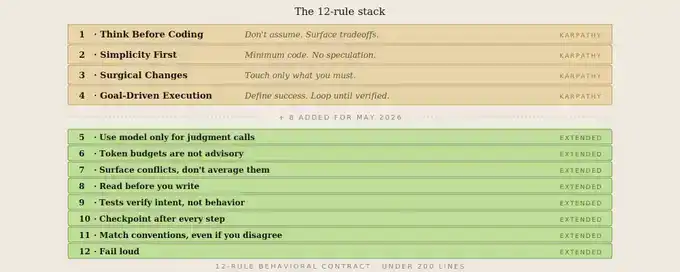
Claude's Coding Errors Drop to 3% with 12 Key Rules In early 2026, Andrej Karpathy's critique of Claude's coding failures led to the creation of a CLAUDE.md file with 4 foundational rules: "Think before coding," "Prefer simplicity," "Make surgical edits," and "Execute goal-first." These effectively reduced common errors from 40% to 3% in applicable tasks. However, as Claude Code evolved into multi-step agent workflows by May 2026, new failure modes emerged. Eight additional rules were developed to address these gaps: 5. Don't make non-linguistic decisions (e.g., API retry logic). 6. Set hard token budgets to prevent runaway iterations. 7. Expose conflicts; don't average contradictory code patterns. 8. Read existing code before writing to avoid duplication. 9. Ensure tests validate real logic, not just pass. 10. Use checkpoints for long-running, multi-step tasks. 11. Follow existing conventions over introducing new patterns. 12. Fail explicitly; avoid silent failures that appear successful. Testing across 30 codebases showed the 12-rule version maintained a 76% adherence rate while reducing the overall error rate to 3%, covering new agent-specific issues. The key is to treat CLAUDE.md as a behavioral contract targeting observed failures, keeping it under 200 lines for effectiveness. Users should adapt the rules to their specific workflows.

Editor's Note: In January 2026, Andrej Karpathy's complaints about Claude writing code led to the emergence of a seemingly small but extremely crucial file in the AI programming workflow: CLAUDE.md. Forrest Chang later organized these issues into 4 behavioral rules, attempting to constrain Claude's common mistakes when coding: silent assumptions, over-engineering, unintended damage to unrelated code, and lack of clear success criteria.

But a few months later, the use cases for Claude Code are no longer just "make the model write a piece of code." With multi-step Agents, hook chain triggering, skill loading conflicts, and multi-repository collaboration becoming the norm, new failure modes have begun to emerge: the model losing control during long tasks, tests passing without verifying real logic, migrations completing but silently skipping errors, and different coding styles being incorrectly mixed.

The author of this article tested 30 codebases over 6 weeks and added 8 new rules on top of Karpathy's original 4 rules, aiming to cover the new problems arising as AI programming moves from single-shot completions to Agent-driven collaboration.

The following is the original text:

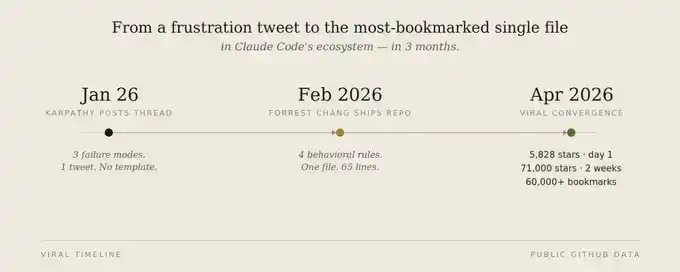
In late January 2026, Andrej Karpathy posted a tweet thread complaining about Claude's approach to writing code. He pointed out three typical problems: making incorrect assumptions without explanation, over-complicating things, and causing unintended damage to code that shouldn't have been touched.

Forrest Chang saw this tweet thread, distilled the complaints into 4 behavioral rules, wrote them into a separate CLAUDE.md file, and published it on GitHub. The project gained 5,828 stars on its first day, was bookmarked 60,000 times within two weeks, and now has 120,000 stars, becoming the fastest-growing single-file code repository of 2026.
Subsequently, I tested it with 30 codebases over 6 weeks.

These 4 rules are indeed effective. Errors that previously appeared with roughly a 40% probability dropped to below 3% for tasks where these rules were applicable. The problem is, this template was initially created to address errors Claude made when writing code in January.

By May 2026, the problems facing the Claude Code ecosystem had changed: Agents conflicting with each other, hook chain triggering, skill loading conflicts, and multi-step workflow disruptions across sessions.

So, I added 8 more rules. Below is the complete 12-rule version of CLAUDE.md: why each one is worth adding, and where the original Karpathy template will quietly fail in 4 specific areas.

If you want to skip the explanation and start using it directly, the complete file is at the end of the article.

Why This Matters

The CLAUDE.md file for Claude Code is the most underestimated file in the entire AI programming tech stack. Most developers typically make three kinds of mistakes:

First, treating it as a preference trash can, stuffing all their habits into it until it bloats to over 4000 tokens, with rule compliance dropping to 30%.

Second, not using it at all, re-prompting every time. This leads to 5x token waste and a lack of consistency between sessions.

Third, copying a template once and never updating it. It might work for two weeks, but as the codebase changes, it will fail without you even realizing it.

The Anthropic official documentation is clear: CLAUDE.md is essentially just advisory. Claude will follow it about 80% of the time. Once it exceeds 200 lines, compliance drops noticeably because important rules get drowned in noise.

Karpathy's template solves this: one file, 65 lines, 4 rules. This is the minimum baseline.

But the ceiling can be higher. Adding the following 8 rules means it covers not just the code-writing problems Karpathy complained about in January 2026, but also the Agent orchestration problems that emerged by May 2026—problems that didn't exist when the original template was written.

The Original 4 Rules

If you haven't seen Forrest Chang's repository, here's the basic version:

Rule 1: Think before you code.
Don't make silent assumptions. State your assumptions, expose trade-offs. Ask before guessing. Propose counterarguments when simpler alternatives exist.

Rule 2: Simple first.
Use the minimal code that solves the problem. Don't add imagined features. Don't design abstraction layers for one-off code. If a senior engineer would find it overcomplicated, simplify it.

Rule 3: Surgical changes.
Only modify what must be changed. Don't "optimize" adjacent code, comments, or formatting as a side effect. Don't refactor what isn't broken. Maintain consistency with the existing style.

Rule 4: Execute toward the goal.
Define success criteria first, then iterate in cycles until verification is complete. Don't tell Claude each step; tell it what the successful outcome should look like and let it iterate.

These 4 rules solve roughly 40% of the failure modes I've seen in unsupervised Claude Code sessions. The remaining 60% of problems lie in the gaps outlined below.
My 8 New Rules, and Why

Each rule comes from a real moment when Karpathy's original 4 rules were no longer sufficient. Below, I'll describe the scenario first, then give the corresponding rule.

Rule 5: Don't let the model do non-language work

Karpathy's rules didn't cover this. So the model started deciding issues that should have been handled by deterministic code: whether to retry an API call, how to route a message, when to escalate. The result was inconsistent decisions every week. You got an unstable, $0.003-per-token if-else statement.

The moment was this: There was code calling Claude to "decide whether to retry on a 503 error." It worked fine initially for two weeks, then suddenly became unstable because the model started treating the request body as part of the decision context. The retry strategy became random because the prompt itself was random.

Rule 6: Set a hard token budget, no exceptions

A CLAUDE.md without budget constraints is a blank check. Every loop can spiral out of control into a 50,000-token context dump. The model won't stop itself.

The moment was this: A debugging session lasted 90 minutes. The model kept iterating over the same 8KB error message, gradually forgetting which fixes it had already tried. In the end, it started proposing solutions I had rejected 40 messages earlier. With a token budget, this process should have been terminated at the 12-minute mark.

Rule 7: Expose conflicts, don't average them out

When two parts of a codebase contradict each other, Claude tries to please both sides, resulting in incoherent code.

The moment was this: A codebase had two error-handling patterns: one using async/await with explicit try/catch, another using a global error boundary. Claude wrote new code that used both. Errors got handled twice. It took me 30 minutes to figure out why errors were being swallowed two times over.

Rule 8: Read first, then write

Karpathy's "Surgical changes" tells Claude not to modify adjacent code. But it doesn't tell Claude to understand adjacent code first. Without this, Claude writes new code that conflicts with existing code 30 lines away.

The moment was this: Claude added a function right next to an existing function that did exactly the same thing, because it didn't read the original function first. Both functions performed the same task. But due to import order, the new function overrode the old one, which had been the de facto standard for 6 months.

Rule 9: Testing is not optional, but tests are not the goal

Karpathy's "Execute toward the goal" implies testing can be a success criterion. But in practice, Claude treats "tests pass" as the sole goal, writing code that passes shallow tests but breaks other things.

The moment was this: Claude wrote 12 tests for an authentication function; all passed. But the authentication logic broke in production. The tests were just verifying the function "returned something," not that it returned the correct thing. The function passed because it returned a constant.

Rule 10: Long-running operations need checkpoints

Karpathy's template assumes interaction is one-off. But real Claude Code work is often multi-step: refactoring across 20 files, building a feature in one session, debugging across multiple commits. Without checkpoints, one wrong step can lose all previous progress.

The moment was this: A 6-step refactoring task failed on step 4. By the time I noticed, Claude had already completed steps 5 and 6 on top of the erroneous state. Unraveling the fix took longer than redoing the entire task. With checkpoints, step 4 would have revealed the problem.

Rule 11: Conventions over novelty

In a codebase with established patterns, Claude loves to introduce its own style. Even if its way is "better," introducing a second pattern is worse than any single pattern.

The moment was this: Claude introduced hooks into a React codebase based on class components. It ran. But it also broke the codebase's existing testing patterns, which relied on componentDidMount. It took half a day to delete and rewrite it.

Rule 12: Fail loudly, not silently

Claude's most expensive failures are often the ones that look like successes. A function "runs" but returns wrong data; a migration "completes" but skips 30 records; a test "passes" but only because the assertion itself is wrong.

The moment was this: Claude said a database migration "completed successfully." In reality, it silently skipped 14% of records triggering constraint conflicts. The skipping was logged but not explicitly surfaced. Eleven days later, when report data started showing anomalies, we discovered the problem.

Data Results

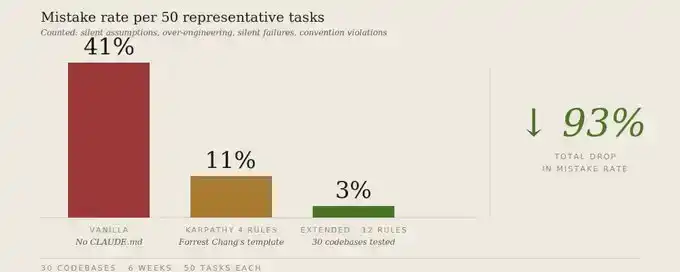
Over 6 weeks, I tracked the same set of 50 representative tasks across 30 codebases, testing three configurations.
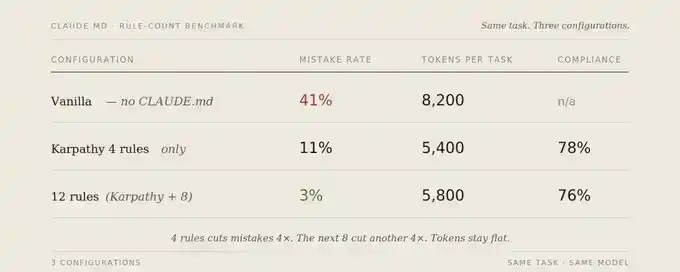
Error rate refers to: tasks needing correction or rewriting to match original intent. Counted errors include: silent erroneous assumptions, over-engineering, unintended damage, silent failures, convention violations, conflict averaging, missed checkpoints.

Compliance rate refers to: when a rule applies, how likely Claude is to explicitly apply it.

The truly interesting result isn't just the error rate dropping from 41% to 3%. More importantly, expanding from 4 to 12 rules barely increased compliance burden—compliance only dropped from 78% to 76%, but the error rate fell another 8 percentage points. The new rules cover failure modes the original 4 didn't handle; they aren't competing for the same attention budget.
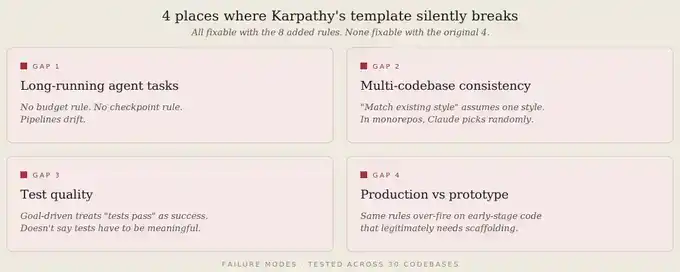
Where the Karpathy Template Quietly Fails

Even without new rules, the original 4-rule template is insufficient in at least 4 areas.

First, long-running Agent tasks.
Karpathy's rules mainly target the moment Claude is writing code. But what happens when Claude runs a multi-step pipeline? The original template has no budget rule, no checkpoint rule, no "fail loudly" rule. So the pipeline slowly drifts.

Second, multi-repository consistency.
"Match existing style" assumes only one style. But in a monorepo with 12 services, Claude must choose which style to match. The original rules don't tell it how. So it either picks randomly or averages several styles together.

Third, test quality.
"Execute toward the goal" treats "tests pass" as success, without stating tests must be meaningful. Result: Claude writes tests that verify almost nothing, but that make it overconfident.

Fourth, production vs. prototyping differences.
The same 4 rules that prevent production code from being over-engineered can also slow down prototyping. Because prototyping sometimes needs 100 lines of exploratory scaffolding to find direction first. Karpathy's "Simple first" triggers too easily for early-stage code.

These 8 new rules aren't meant to replace Karpathy's original 4, but to patch their gaps: the original template corresponds to the auto-completion-like coding scenario of January 2026; by May 2026, Claude Code has entered an Agent-driven, multi-step, multi-repository collaborative environment, and the problems faced are different.
What Didn't Work

Before finalizing these 12 rules, I tried other approaches.

Adding rules I saw on Reddit / X.
Most were either rephrasing Karpathy's original 4 rules or domain-specific rules that couldn't generalize, like "Always use Tailwind classes." I eventually removed them all.

More than 12 rules.
I tested up to 18. After 14, compliance dropped from 76% to 52%. The 200-line limit is real. Beyond that, Claude starts pattern-matching to "there are rules here" instead of reading each rule.

Rules dependent on specific tools.
For example, "Always use eslint." If eslint isn't installed in the project, the rule fails, silently. I later rephrased them to be tool-agnostic, e.g., changing "use eslint" to "follow styles already enforced in the codebase."

Putting examples in CLAUDE.md instead of rules.
Examples consume more context than rules. Three examples use roughly the same context as 10 rules, and Claude easily overfits to examples. Rules are abstract, examples are concrete. So, use rules.

"Be careful," "Think deeply," "Stay focused."
These are noise. Compliance for such instructions dropped to about 30% because they aren't verifiable. I replaced them with more specific imperative rules like "State assumptions explicitly."

Telling Claude to act like a "senior engineer."
This didn't work. Claude already thinks it's like a senior engineer. The real issue isn't whether it thinks so, but whether it executes like one. Imperative rules narrow this gap; identity prompts don't.

The Complete 12-Rule CLAUDE.md

Below is the complete version ready for copy-paste.

Temporarily unable to display this content outside of Lark Docs.

Save it as CLAUDE.md in your repository root. Below these 12 rules, add project-specific rules like tech stack, test commands, error patterns, etc. Keep the total under 200 lines; beyond that, rule compliance drops noticeably.

How to Install

Just two steps:

1. Append Karpathy's 4 basic rules to your existing CLAUDE.md
curl https://raw.githubusercontent.com/forrestchang/andrej-karpathy-skills/main/CLAUDE.md >> CLAUDE.md


2. Paste Rules 5–12 from this article below them

Save the file in the repository root. The >> is crucial—it appends to any existing CLAUDE.md instead of overwriting your project-specific rules.

Mental Model

CLAUDE.md isn't a wishlist; it's a behavioral contract to block specific failure patterns you've observed.

Each rule should answer one question: What error does it prevent?

Karpathy's 4 rules prevent the failure modes he saw in January 2026: silent assumptions, over-engineering, unintended damage, weak success criteria. They are the foundation; don't skip them.

My 8 new rules prevent the new failure modes emerging after May 2026: Agent loops without budget constraints, multi-step tasks without checkpoints, tests that seem to test but miss critical logic, and problems where silent failures are packaged as silent successes. They are incremental patches.

Of course, results vary. If you don't run multi-step pipelines, Rule 10 is less important. If your codebase has only one unified style enforced by linters, Rule 11 is redundant. After reading these 12, keep the rules that truly correspond to errors you've actually made; delete the rest.

A 6-rule CLAUDE.md tailored to your real failure patterns is better than a 12-rule version where 6 rules are never applicable.

Conclusion

Karpathy's tweet in January 2026 was essentially a complaint. Forrest Chang turned it into 4 rules. Ultimately, 120,000 developers starred the result. And most of them are still using only those 4 rules today.

The models have advanced, and the ecosystem has changed. Multi-step Agents, hook chains, skill loading, multi-repo collaboration—these didn't exist when Karpathy wrote that tweet. The original 4 rules don't solve these problems. They aren't wrong; they're incomplete.

Add 8 more rules. 6 weeks of testing across 30 codebases. Error rate drops from 41% to 3%.

Bookmark this article tonight and paste these 12 rules into your CLAUDE.md. If it saves you a week of Claude-related detours, feel free to share it.


Related Questions

QWhat was the original 4-rule CLAUDE.md template created to solve, and how effective was it?

AThe original 4-rule CLAUDE.md template was created to solve the typical errors Andrej Karpathy complained about in January 2026 regarding Claude's coding behavior: silent assumptions, over-engineering, unintended collateral damage to unrelated code, and lack of clear success criteria. In tests, it reduced the error rate from around 40% to below 3% for tasks where these rules applied.

QWhat are two of the new problems that emerged in the Claude Code ecosystem by May 2026 that the original 4 rules didn't cover?

ABy May 2026, new failure modes included agents conflicting with each other, chain reactions from hooks, skill loading conflicts, and interruptions in multi-step, cross-session workflows. The original rules were insufficient for these issues related to agent orchestration and long-running tasks.

QAccording to the article, what are two common mistakes developers make when using a CLAUDE.md file?

ATwo common mistakes are: 1) Treating it as a preference dump, stuffing all personal habits into it until it bloats to over 4000 tokens, causing rule compliance to drop to 30%. 2) Not using it at all and re-prompting every time, which wastes 5x more tokens and lacks consistency across sessions.

QWhat does Rule 6 ('Set a hard token budget, no exceptions') aim to prevent, and what was the 'moment' that revealed its necessity?

ARule 6 aims to prevent uncontrolled, runaway iterative processes where a debugging session could spiral into a 50,000-token context dump without the model stopping itself. The revealing moment was a 90-minute debugging session where the model kept iterating over the same 8KB error message, forgetting previous fixes and eventually proposing solutions that had been rejected 40 messages earlier.

QWhy does the author advise against having more than 12-14 rules in a CLAUDE.md file, and what was the observed effect of exceeding this limit?

AThe author advises against having more than 12-14 rules because Anthropic's documentation states that compliance noticeably drops once the file exceeds 200 lines, as important rules get drowned out by noise. In tests, when the rule count exceeded 14, compliance rates dropped from 76% to 52%, as Claude started pattern-matching for 'rules are here' instead of reading each rule carefully.

Related Reads

The AI Stock Genius Who Made 60x Bets $7.7 Billion on Nvidia Topping Out

An AI-focused hedge fund named Situational Awareness LP, known for its 60x returns, has taken a significant bearish stance on semiconductor stocks in Q1 2026. Its 13F filing reveals a massive 148% quarterly increase in nominal exposure to $13.677 billion, with over 60% of the new exposure directed towards put options on major chip players. Key bearish bets include $2.04 billion in puts on the VanEck Semiconductor ETF (SMH) and $1.56 billion on NVIDIA, alongside positions against Broadcom, Oracle, AMD, and others. The fund simultaneously increased its long equity holdings in AI infrastructure and compute providers like CoreWeave and Bitcoin mining companies repurposing for compute. The core thesis behind this positioning is a shift in the primary constraint for AI expansion. The fund argues that while GPU supply was the critical bottleneck in previous years, the new limiting factors for large-scale AI cluster deployment are physical infrastructure: electrical grid access (with multi-year backlogs in the US), power availability, land, and data center construction timelines. The fund is not betting against AI's success but rather hedging against potential valuation corrections in semiconductor stocks whose prices may have run ahead, while directly investing in the downstream physical bottlenecks—power and data center capacity—it believes will capture value next. This move translates a previously theoretical narrative about infrastructure constraints into a concrete, high-conviction portfolio structure.

链捕手3h ago

The AI Stock Genius Who Made 60x Bets $7.7 Billion on Nvidia Topping Out

链捕手3h ago

Trading

Spot
Futures

Hot Articles

What is SONIC

Sonic: Pioneering the Future of Gaming in Web3 Introduction to Sonic In the ever-evolving landscape of Web3, the gaming industry stands out as one of the most dynamic and promising sectors. At the forefront of this revolution is Sonic, a project designed to amplify the gaming ecosystem on the Solana blockchain. Leveraging cutting-edge technology, Sonic aims to deliver an unparalleled gaming experience by efficiently processing millions of requests per second, ensuring that players enjoy seamless gameplay while maintaining low transaction costs. This article delves into the intricate details of Sonic, exploring its creators, funding sources, operational mechanics, and the timeline of significant events that have shaped its journey. What is Sonic? Sonic is an innovative layer-2 network that operates atop the Solana blockchain, specifically tailored to enhance the existing Solana gaming ecosystem. It accomplishes this through a customised, VM-agnostic game engine paired with a HyperGrid interpreter, facilitating sovereign game economies that roll up back to the Solana platform. The primary goals of Sonic include: Enhanced Gaming Experiences: Sonic is committed to offering lightning-fast on-chain gameplay, allowing players and developers to engage with games at previously unattainable speeds. Atomic Interoperability: This feature enables transactions to be executed within Sonic without the need to redeploy Solana programmes and accounts. This makes the process more efficient and directly benefits from Solana Layer1 services and liquidity. Seamless Deployment: Sonic allows developers to write for Ethereum Virtual Machine (EVM) based systems and execute them on Solana’s SVM infrastructure. This interoperability is crucial for attracting a broader range of dApps and decentralised applications to the platform. Support for Developers: By offering native composable gaming primitives and extensible data types - dining within the Entity-Component-System (ECS) framework - game creators can craft intricate business logic with ease. Overall, Sonic's unique approach not only caters to players but also provides an accessible and low-cost environment for developers to innovate and thrive. Creator of Sonic The information regarding the creator of Sonic is somewhat ambiguous. However, it is known that Sonic's SVM is owned by the company Mirror World. The absence of detailed information about the individuals behind Sonic reflects a common trend in several Web3 projects, where collective efforts and partnerships often overshadow individual contributions. Investors of Sonic Sonic has garnered considerable attention and support from various investors within the crypto and gaming sectors. Notably, the project raised an impressive $12 million during its Series A funding round. The round was led by BITKRAFT Ventures, with other notable investors including Galaxy, Okx Ventures, Interactive, Big Brain Holdings, and Mirana. This financial backing signifies the confidence that investment foundations have in Sonic’s potential to revolutionise the Web3 gaming landscape, further validating its innovative approaches and technologies. How Does Sonic Work? Sonic utilises the HyperGrid framework, a sophisticated parallel processing mechanism that enhances its scalability and customisability. Here are the core features that set Sonic apart: Lightning Speed at Low Costs: Sonic offers one of the fastest on-chain gaming experiences compared to other Layer-1 solutions, powered by the scalability of Solana’s virtual machine (SVM). Atomic Interoperability: Sonic enables transaction execution without redeployment of Solana programmes and accounts, effectively streamlining the interaction between users and the blockchain. EVM Compatibility: Developers can effortlessly migrate decentralised applications from EVM chains to the Solana environment using Sonic’s HyperGrid interpreter, increasing the accessibility and integration of various dApps. Ecosystem Support for Developers: By exposing native composable gaming primitives, Sonic facilitates a sandbox-like environment where developers can experiment and implement business logic, greatly enhancing the overall development experience. Monetisation Infrastructure: Sonic natively supports growth and monetisation efforts, providing frameworks for traffic generation, payments, and settlements, thereby ensuring that gaming projects are not only viable but also sustainable financially. Timeline of Sonic The evolution of Sonic has been marked by several key milestones. Below is a brief timeline highlighting critical events in the project's history: 2022: The Sonic cryptocurrency was officially launched, marking the beginning of its journey in the Web3 gaming arena. 2024: June: Sonic SVM successfully raised $12 million in a Series A funding round. This investment allowed Sonic to further develop its platform and expand its offerings. August: The launch of the Sonic Odyssey testnet provided users with the first opportunity to engage with the platform, offering interactive activities such as collecting rings—a nod to gaming nostalgia. October: SonicX, an innovative crypto game integrated with Solana, made its debut on TikTok, capturing the attention of over 120,000 users within a short span. This integration illustrated Sonic’s commitment to reaching a broader, global audience and showcased the potential of blockchain gaming. Key Points Sonic SVM is a revolutionary layer-2 network on Solana explicitly designed to enhance the GameFi landscape, demonstrating great potential for future development. HyperGrid Framework empowers Sonic by introducing horizontal scaling capabilities, ensuring that the network can handle the demands of Web3 gaming. Integration with Social Platforms: The successful launch of SonicX on TikTok displays Sonic’s strategy to leverage social media platforms to engage users, exponentially increasing the exposure and reach of its projects. Investment Confidence: The substantial funding from BITKRAFT Ventures, among others, emphasizes the robust backing Sonic has, paving the way for its ambitious future. In conclusion, Sonic encapsulates the essence of Web3 gaming innovation, striking a balance between cutting-edge technology, developer-centric tools, and community engagement. As the project continues to evolve, it is poised to redefine the gaming landscape, making it a notable entity for gamers and developers alike. As Sonic moves forward, it will undoubtedly attract greater interest and participation, solidifying its place within the broader narrative of blockchain gaming.

1.4k Total ViewsPublished 2024.04.04Updated 2024.12.03

What is SONIC

What is $S$

Understanding SPERO: A Comprehensive Overview Introduction to SPERO As the landscape of innovation continues to evolve, the emergence of web3 technologies and cryptocurrency projects plays a pivotal role in shaping the digital future. One project that has garnered attention in this dynamic field is SPERO, denoted as SPERO,$$s$. This article aims to gather and present detailed information about SPERO, to help enthusiasts and investors understand its foundations, objectives, and innovations within the web3 and crypto domains. What is SPERO,$$s$? SPERO,$$s$ is a unique project within the crypto space that seeks to leverage the principles of decentralisation and blockchain technology to create an ecosystem that promotes engagement, utility, and financial inclusion. The project is tailored to facilitate peer-to-peer interactions in new ways, providing users with innovative financial solutions and services. At its core, SPERO,$$s$ aims to empower individuals by providing tools and platforms that enhance user experience in the cryptocurrency space. This includes enabling more flexible transaction methods, fostering community-driven initiatives, and creating pathways for financial opportunities through decentralised applications (dApps). The underlying vision of SPERO,$$s$ revolves around inclusiveness, aiming to bridge gaps within traditional finance while harnessing the benefits of blockchain technology. Who is the Creator of SPERO,$$s$? The identity of the creator of SPERO,$$s$ remains somewhat obscure, as there are limited publicly available resources providing detailed background information on its founder(s). This lack of transparency can stem from the project's commitment to decentralisation—an ethos that many web3 projects share, prioritising collective contributions over individual recognition. By centring discussions around the community and its collective goals, SPERO,$$s$ embodies the essence of empowerment without singling out specific individuals. As such, understanding the ethos and mission of SPERO remains more important than identifying a singular creator. Who are the Investors of SPERO,$$s$? SPERO,$$s$ is supported by a diverse array of investors ranging from venture capitalists to angel investors dedicated to fostering innovation in the crypto sector. The focus of these investors generally aligns with SPERO's mission—prioritising projects that promise societal technological advancement, financial inclusivity, and decentralised governance. These investor foundations are typically interested in projects that not only offer innovative products but also contribute positively to the blockchain community and its ecosystems. The backing from these investors reinforces SPERO,$$s$ as a noteworthy contender in the rapidly evolving domain of crypto projects. How Does SPERO,$$s$ Work? SPERO,$$s$ employs a multi-faceted framework that distinguishes it from conventional cryptocurrency projects. Here are some of the key features that underline its uniqueness and innovation: Decentralised Governance: SPERO,$$s$ integrates decentralised governance models, empowering users to participate actively in decision-making processes regarding the project’s future. This approach fosters a sense of ownership and accountability among community members. Token Utility: SPERO,$$s$ utilises its own cryptocurrency token, designed to serve various functions within the ecosystem. These tokens enable transactions, rewards, and the facilitation of services offered on the platform, enhancing overall engagement and utility. Layered Architecture: The technical architecture of SPERO,$$s$ supports modularity and scalability, allowing for seamless integration of additional features and applications as the project evolves. This adaptability is paramount for sustaining relevance in the ever-changing crypto landscape. Community Engagement: The project emphasises community-driven initiatives, employing mechanisms that incentivise collaboration and feedback. By nurturing a strong community, SPERO,$$s$ can better address user needs and adapt to market trends. Focus on Inclusion: By offering low transaction fees and user-friendly interfaces, SPERO,$$s$ aims to attract a diverse user base, including individuals who may not previously have engaged in the crypto space. This commitment to inclusion aligns with its overarching mission of empowerment through accessibility. Timeline of SPERO,$$s$ Understanding a project's history provides crucial insights into its development trajectory and milestones. Below is a suggested timeline mapping significant events in the evolution of SPERO,$$s$: Conceptualisation and Ideation Phase: The initial ideas forming the basis of SPERO,$$s$ were conceived, aligning closely with the principles of decentralisation and community focus within the blockchain industry. Launch of Project Whitepaper: Following the conceptual phase, a comprehensive whitepaper detailing the vision, goals, and technological infrastructure of SPERO,$$s$ was released to garner community interest and feedback. Community Building and Early Engagements: Active outreach efforts were made to build a community of early adopters and potential investors, facilitating discussions around the project’s goals and garnering support. Token Generation Event: SPERO,$$s$ conducted a token generation event (TGE) to distribute its native tokens to early supporters and establish initial liquidity within the ecosystem. Launch of Initial dApp: The first decentralised application (dApp) associated with SPERO,$$s$ went live, allowing users to engage with the platform's core functionalities. Ongoing Development and Partnerships: Continuous updates and enhancements to the project's offerings, including strategic partnerships with other players in the blockchain space, have shaped SPERO,$$s$ into a competitive and evolving player in the crypto market. Conclusion SPERO,$$s$ stands as a testament to the potential of web3 and cryptocurrency to revolutionise financial systems and empower individuals. With a commitment to decentralised governance, community engagement, and innovatively designed functionalities, it paves the way toward a more inclusive financial landscape. As with any investment in the rapidly evolving crypto space, potential investors and users are encouraged to research thoroughly and engage thoughtfully with the ongoing developments within SPERO,$$s$. The project showcases the innovative spirit of the crypto industry, inviting further exploration into its myriad possibilities. While the journey of SPERO,$$s$ is still unfolding, its foundational principles may indeed influence the future of how we interact with technology, finance, and each other in interconnected digital ecosystems.

54 Total ViewsPublished 2024.12.17Updated 2024.12.17

What is $S$

What is AGENT S

Agent S: The Future of Autonomous Interaction in Web3 Introduction In the ever-evolving landscape of Web3 and cryptocurrency, innovations are constantly redefining how individuals interact with digital platforms. One such pioneering project, Agent S, promises to revolutionise human-computer interaction through its open agentic framework. By paving the way for autonomous interactions, Agent S aims to simplify complex tasks, offering transformative applications in artificial intelligence (AI). This detailed exploration will delve into the project's intricacies, its unique features, and the implications for the cryptocurrency domain. What is Agent S? Agent S stands as a groundbreaking open agentic framework, specifically designed to tackle three fundamental challenges in the automation of computer tasks: Acquiring Domain-Specific Knowledge: The framework intelligently learns from various external knowledge sources and internal experiences. This dual approach empowers it to build a rich repository of domain-specific knowledge, enhancing its performance in task execution. Planning Over Long Task Horizons: Agent S employs experience-augmented hierarchical planning, a strategic approach that facilitates efficient breakdown and execution of intricate tasks. This feature significantly enhances its ability to manage multiple subtasks efficiently and effectively. Handling Dynamic, Non-Uniform Interfaces: The project introduces the Agent-Computer Interface (ACI), an innovative solution that enhances the interaction between agents and users. Utilizing Multimodal Large Language Models (MLLMs), Agent S can navigate and manipulate diverse graphical user interfaces seamlessly. Through these pioneering features, Agent S provides a robust framework that addresses the complexities involved in automating human interaction with machines, setting the stage for myriad applications in AI and beyond. Who is the Creator of Agent S? While the concept of Agent S is fundamentally innovative, specific information about its creator remains elusive. The creator is currently unknown, which highlights either the nascent stage of the project or the strategic choice to keep founding members under wraps. Regardless of anonymity, the focus remains on the framework's capabilities and potential. Who are the Investors of Agent S? As Agent S is relatively new in the cryptographic ecosystem, detailed information regarding its investors and financial backers is not explicitly documented. The lack of publicly available insights into the investment foundations or organisations supporting the project raises questions about its funding structure and development roadmap. Understanding the backing is crucial for gauging the project's sustainability and potential market impact. How Does Agent S Work? At the core of Agent S lies cutting-edge technology that enables it to function effectively in diverse settings. Its operational model is built around several key features: Human-like Computer Interaction: The framework offers advanced AI planning, striving to make interactions with computers more intuitive. By mimicking human behaviour in tasks execution, it promises to elevate user experiences. Narrative Memory: Employed to leverage high-level experiences, Agent S utilises narrative memory to keep track of task histories, thereby enhancing its decision-making processes. Episodic Memory: This feature provides users with step-by-step guidance, allowing the framework to offer contextual support as tasks unfold. Support for OpenACI: With the ability to run locally, Agent S allows users to maintain control over their interactions and workflows, aligning with the decentralised ethos of Web3. Easy Integration with External APIs: Its versatility and compatibility with various AI platforms ensure that Agent S can fit seamlessly into existing technological ecosystems, making it an appealing choice for developers and organisations. These functionalities collectively contribute to Agent S's unique position within the crypto space, as it automates complex, multi-step tasks with minimal human intervention. As the project evolves, its potential applications in Web3 could redefine how digital interactions unfold. Timeline of Agent S The development and milestones of Agent S can be encapsulated in a timeline that highlights its significant events: September 27, 2024: The concept of Agent S was launched in a comprehensive research paper titled “An Open Agentic Framework that Uses Computers Like a Human,” showcasing the groundwork for the project. October 10, 2024: The research paper was made publicly available on arXiv, offering an in-depth exploration of the framework and its performance evaluation based on the OSWorld benchmark. October 12, 2024: A video presentation was released, providing a visual insight into the capabilities and features of Agent S, further engaging potential users and investors. These markers in the timeline not only illustrate the progress of Agent S but also indicate its commitment to transparency and community engagement. Key Points About Agent S As the Agent S framework continues to evolve, several key attributes stand out, underscoring its innovative nature and potential: Innovative Framework: Designed to provide an intuitive use of computers akin to human interaction, Agent S brings a novel approach to task automation. Autonomous Interaction: The ability to interact autonomously with computers through GUI signifies a leap towards more intelligent and efficient computing solutions. Complex Task Automation: With its robust methodology, it can automate complex, multi-step tasks, making processes faster and less error-prone. Continuous Improvement: The learning mechanisms enable Agent S to improve from past experiences, continually enhancing its performance and efficacy. Versatility: Its adaptability across different operating environments like OSWorld and WindowsAgentArena ensures that it can serve a broad range of applications. As Agent S positions itself in the Web3 and crypto landscape, its potential to enhance interaction capabilities and automate processes signifies a significant advancement in AI technologies. Through its innovative framework, Agent S exemplifies the future of digital interactions, promising a more seamless and efficient experience for users across various industries. Conclusion Agent S represents a bold leap forward in the marriage of AI and Web3, with the capacity to redefine how we interact with technology. While still in its early stages, the possibilities for its application are vast and compelling. Through its comprehensive framework addressing critical challenges, Agent S aims to bring autonomous interactions to the forefront of the digital experience. As we move deeper into the realms of cryptocurrency and decentralisation, projects like Agent S will undoubtedly play a crucial role in shaping the future of technology and human-computer collaboration.

679 Total ViewsPublished 2025.01.14Updated 2025.01.14

What is AGENT S

Discussions

Welcome to the HTX Community. Here, you can stay informed about the latest platform developments and gain access to professional market insights. Users' opinions on the price of S (S) are presented below.

活动图片