$30 Billion DeFi Capital Exodus: LayerZero Stumbles, Chainlink Feasts

marsbitPublished on 2026-05-13Last updated on 2026-05-13

Abstract

Following the major DeFi security incident involving Kelp DAO, a significant migration of funds is underway from the cross-chain protocol LayerZero to Chainlink's CCIP (Cross-Chain Interoperability Protocol). Over $30 billion in Total Value Locked (TVL) from protocols like Kelp DAO, Solv Protocol, Re, and Tydro has moved to Chainlink in the past week, driven by security concerns. LayerZero is facing a severe trust crisis after the attack. Initially denying responsibility, LayerZero Labs has now issued a public apology, acknowledging management oversights. These include a vulnerable "1/1" single-node configuration for its Decentralized Verification Network (DVN) and past misuse of a multi-signature wallet by a team member. The protocol's weekly bridge volume has slumped to near-historic lows of around $470 million. In contrast, Chainlink is experiencing a surge in adoption and activity. Its independent active addresses recently hit multi-month highs, and whales have been accumulating LINK tokens. Beyond DeFi, Chainlink is securing partnerships with traditional finance giants like DTCC, European stock exchange operator SIX Group, and asset manager Amundi. While LayerZero has announced security upgrades—such as migrating to stronger multi-signature configurations and developing a second DVN client—and contributed to a rescue fund, the event underscores that security is becoming a decisive competitive factor as DeFi matures.

Author: Nancy, PANews

With several leading protocols stepping in to inject capital, quickly covering the funding gap and advancing on-chain recovery, the rescue efforts for the Kelp DAO attack incident have recently seen substantial progress. However, compared to the financial repairs, the harder thing to restore remains market trust.

At the center of this vortex, cross-chain leader LayerZero is facing accelerating withdrawals from many protocols and was forced to make a dramatic shift in attitude within just a few weeks—from initially shifting blame and denying responsibility to now publicly apologizing and initiating rectifications. Meanwhile, Chainlink has unexpectedly become a beneficiary of this crisis, with its CCIP protocol absorbing a large portion of migrating liquidity, showing notable growth in on-chain data.

Securing $30 Billion in Migration in a Single Week, Chainlink Reaps Security Dividends

As the largest DeFi security incident to date in 2026, the Kelp DAO attack has accelerated the migration of on-chain liquidity.

As LayerZero's security controversy continues to ferment, an increasing number of DeFi protocols are reevaluating cross-chain risks and proactively seeking more reliable havens. Over the past week, Chainlink has intensively announced multiple migration cases.

On May 9, Chainlink officially disclosed that four protocols, including Kelp DAO, Solv Protocol, Re, and Tydro, had recently abandoned their original cross-chain bridge or oracle solutions and migrated to Chainlink CCIP. The combined TVL of these related protocols exceeds $30 billion. The official even specifically added the phrase "The Great Migration" to hype this ecosystem shift, revealing strong competitive undertones.

Behind this migration wave is a realignment centered on security.

And besides DeFi protocols realigning due to security concerns, Chainlink has also been continuously gaining favor from traditional financial institutions and crypto projects in recent months.

In March of this year, Coinbase directly put its exchange market data on-chain for the first time via Chainlink's newly launched DataLink service; Europe's largest asset management firm, Amundi, collaborated with Spiko to launch a tokenized public fund based on Chainlink.

In April, OpenAssets formed a strategic partnership with Chainlink, launching an asset tokenization infrastructure solution for institutions; major European stock exchange operator SIX Group partnered with Chainlink to push Swiss and Spanish stock market data on-chain; AWS Marketplace listed Chainlink data services, connecting traditional cloud and blockchain.

In May, the US Depository Trust & Clearing Corporation (DTCC) announced the introduction of Chainlink to build a blockchain collateral management platform, aiming to achieve near-real-time settlement around the clock; Huma Finance partnered with Chainlink to introduce institutional-grade yield products into the multi-chain ecosystem.

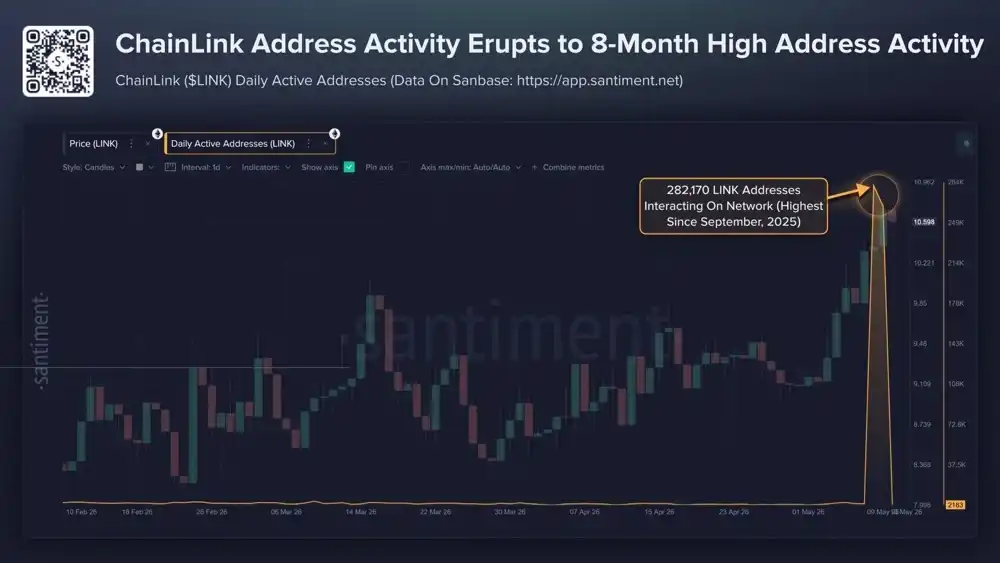
Accompanying the ongoing ecosystem expansion, Chainlink's on-chain activity has also noticeably heated up. According to Santiment monitoring, Chainlink's number of unique active addresses broke 282,000 and 264,000 on May 9 and 10, respectively, hitting the highest records since September 2025, and noted this was primarily influenced by the recent large-scale migration of DeFi protocol infrastructure.
Meanwhile, official Chainlink data shows that the total value of its cross-chain tokens has exceeded $61.8 billion, with CCIP transaction volume reaching $19.5 billion.

Market confidence is also reflected in changes in LINK token holdings. According to Santiment monitoring earlier this month, over the past month, Chainlink whale and shark addresses holding between 100,000 and 10 million LINK cumulatively added 32.93 million LINK. Historically, this has often been a strong bullish signal. Over the past 30 days, LINK has risen approximately 19.7%.

LayerZero Faces Trust Crisis, Officials Issue Emergency Apology and Overhaul

Currently, LayerZero is mired in a trust crisis.

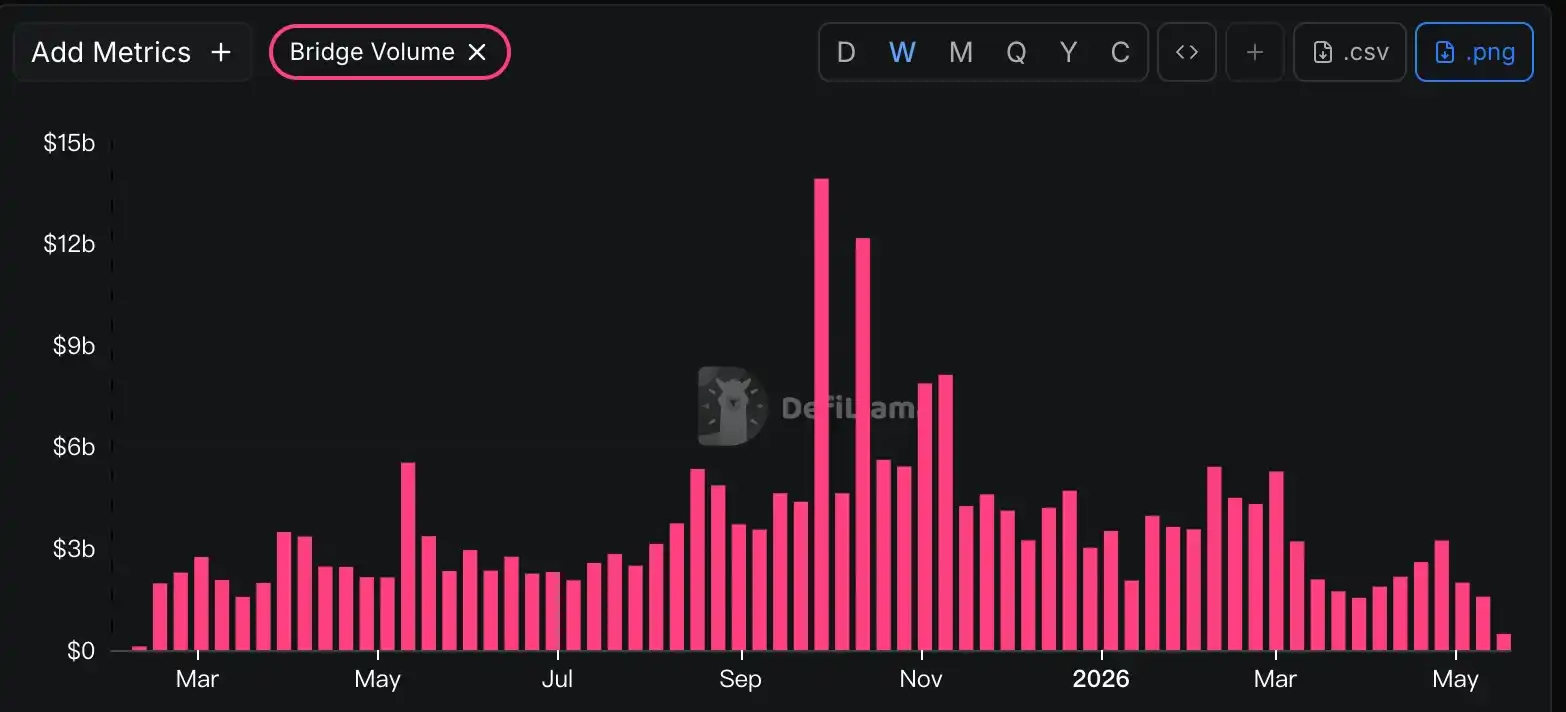
According to DefiLlama data, LayerZero's weekly Bridge transaction volume has now declined to about $470 million, approaching historical lows. This attack incident has plunged LayerZero into a trust crisis.
In the early stages of the hack, Kelp DAO attributed the vulnerability exploit to LayerZero's security issues. Subsequently, LayerZero quickly denied responsibility, stating that multiple accusations by Kelp DAO in the rsETH security incident were completely false.

But the controversy did not subside. Last week, LayerZero Labs co-founder and CEO Bryan Pellegrino engaged in heated debates with several security researchers in the ETHSecurity Community Telegram group.

The focal point of contention is that LayerZero Labs could immediately upgrade the default library contract without a timelock, theoretically allowing forged cross-chain messages. This exposed over $3 billion in LZ OFT assets to potential risk for a period. Security researcher Banteg pointed out that several mainstream projects, including Ethena and EtherFi, were still using this default library weeks ago, and about $178 million in assets remain exposed to risk.

Simultaneously, on-chain data also showed that LayerZero's multi-signature address had conducted Meme coin trading, DEX swaps, and cross-chain bridging operations unrelated to multi-signature duties, further raising community concerns about key security. In response, Bryan admitted that related operations were indeed performed by multi-signature team members but denied they constituted "Meme coin speculation trading," claiming the purpose was merely "testing PEPE OFT functionality," and stated that the involved members had been removed.

To mitigate risks, Bryan also publicly advised project teams to promptly adopt a "fixed configuration" to replace the default configuration. Subsequently, Banteg published a list of LayerZero projects still using the default library contract and called on related protocols to migrate as soon as possible.

These remarks quickly sparked industry discussion and skepticism. Chainlink Strategy Lead Zach Rynes had previously criticized LayerZero Labs, stating that its multi-signature keys had long suffered from serious OPSEC (operational security) failures, directly exposing tens of billions in OFT assets to security risks. He further stated that if LayerZero and the industry had truly heeded the persistent warnings from security researchers over the past few years, such attack incidents could have been entirely avoided.

Facing market舆论 and ongoing ecosystem bleeding, LayerZero's attitude shifted noticeably. On May 9, LayerZero officially released a public apology statement, addressing the security incidents and communication issues over the past three weeks.

LayerZero Labs stated that the internal RPC it used had been attacked by the Lazarus Group over the past three weeks, compromising the authenticity source of its DVN (Decentralized Verification Network), while external RPC providers suffered DDoS attacks. The incident affected only 0.14% of applications and approximately 0.36% of asset value, the LayerZero protocol itself was unaffected, and over $9 billion in assets continued normal cross-chain flow after the incident.

However, LayerZero Labs also acknowledged for the first time that it was responsible for management oversight in previously allowing DVNs to provide security for high-value transactions with a "1/1" single-node configuration, which posed a single point of failure risk. The official also disclosed that three and a half years ago, a multi-signature signer mistakenly used a multi-signature hardware wallet for personal transactions. That signer has been removed, and the relevant wallet has been rotated.

Regarding subsequent rectifications, LayerZero Labs announced a series of security upgrade measures, including: already ceasing services for the 1/1 DVN configuration, currently migrating all path default configurations to a 5/5 multi-signature setup with a minimum of 3/3; developing a second DVN client based on Rust to achieve client diversity; launching the dedicated multi-signature tool OneSig to enhance signature security; and launching the unified management platform Console for asset issuance configuration and abnormal behavior detection.

Additionally, LayerZero also contributed over 10,000 ETH to this DeFi United rescue effort, of which 5,000 ETH will be used for the fund, and the remaining 5,000 ETH will be reserved for Aave.

Despite the escalating controversy, LayerZero has not completely lost its market. Major assets, including Ethena's USDe product, EtherFi's weETH asset, and BitGo's WBTC, continue to use LayerZero's OFT standard.

Every major security crisis triggers a redistribution of liquidity and discourse power. As the crypto industry increasingly moves towards mainstream financial markets, the criteria for evaluating underlying infrastructure will become ever more stringent, with security capabilities becoming one of the core competitive advantages.


Related Questions

QWhat was the immediate consequence of the Kelp DAO hack on the cross-chain infrastructure landscape?

AIt triggered a rapid migration of DeFi liquidity away from LayerZero due to security concerns, with over $30 billion in TVL from protocols like Kelp DAO moving to Chainlink's CCIP within a week.

QAccording to the article, what were two key security issues highlighted by researchers regarding LayerZero?

AFirst, LayerZero's default library contract, which could be upgraded instantly without a timelock, potentially allowing forged cross-chain messages. Second, suspicious non-multisig-related activities from a multisig signer address, raising concerns about key security.

QHow did Chainlink's on-chain activity and LINK token react to the migration trend mentioned in the article?

AChainlink's daily active unique addresses surged to over 282,000 and 264,000, the highest since September 2025. Furthermore, whales and sharks holding 100k to 10M LINK accumulated over 32.9 million LINK in a month, while the LINK token price rose approximately 19.7% in 30 days.

QWhat specific corrective measures did LayerZero announce in its public apology on May 9th?

ALayerZero announced several measures: stopping service for 1/1 DVN configurations, migrating all paths to at least 3/3 or 5/5 multisig setups, developing a second DVN client in Rust for client diversity, launching a dedicated multisig tool called OneSig, and releasing a management platform called Console for configuration and anomaly detection.

QDespite the crisis, which major assets and protocols were mentioned as still continuing to use LayerZero's technology?

AMajor assets and protocols continuing to use LayerZero's OFT standard include Ethena's USDe, EtherFi's weETH, and BitGo's WBTC.

Related Reads

Tiger Research: On-Chain Risk Operators, The Market Cap Gap Between 147 Trillion and 70 Billion

This report by Tiger Research examines the evolution of risk management in decentralized finance (DeFi) lending. It highlights a power shift from protocol developers to specialized professional risk operators who manage on-chain capital. The era of protocols and community governance solely dictating DeFi lending is ending. A new professional asset management layer has emerged. While the sector is nascent, capital and distribution channels are rapidly consolidating around top risk operator teams, whose past performance is now a key criterion for institutional entry. The industry's development, accelerated by modular infrastructures like Morpho, has led to a clear division of labor mirroring traditional finance: distribution channels (e.g., exchanges), strategy/risk management (the risk operators), and product infrastructure/asset custody (smart contract protocols). This structure lowers the entry barrier for traditional institutions. Currently, the total value managed by risk operators is approximately $70 billion, dominated by a few leading teams like Steakhouse (RWA focus), Sentora (AI models), and Gauntlet (crisis management). Competition now centers on collateral standards, distribution access, and crisis response capabilities. The report outlines three primary entry paths for institutions: 1) **Distribution Model**: Leveraging external risk operators as backend service providers (common for exchanges). 2) **Asset Supply Model**: Onboarding real-world assets to DeFi as collateral. 3) **Independent Operator Model**: Building an in-house team to become a risk operator (e.g., Bitwise). The core opportunity lies in the strategy/risk management layer, where traditional financial institutions can leverage their existing expertise in due diligence and risk assessment without deep technical development. A vast opportunity gap exists: the global traditional asset management industry manages ~$147 trillion, while the entire DeFi sector is only ~$800 billion, with the risk operator niche at ~$70 billion. This disparity signifies immense growth potential. Once robust risk frameworks and clearer regulations are established, even a minor allocation from traditional markets could trigger exponential DeFi growth. Early movers who help build these foundational systems will gain significant rule-setting influence and first-mover advantages.

marsbit6m ago

Tiger Research: On-Chain Risk Operators, The Market Cap Gap Between 147 Trillion and 70 Billion

marsbit6m ago

Interview with Circle's Chief Economist: USDC's Entry into Hyperliquid Benefits Circle and HYPE, Stablecoins Are Becoming Marginal Buyers of U.S. Treasuries

In an interview with Circle's Chief Economist Gordon Liao, the conversation covers the strategic significance of USDC replacing USDH as the reference asset on the decentralized perpetual exchange Hyperliquid. This shift, facilitated by Coinbase as the reserve manager and Circle providing technical infrastructure, aims to capture net interest income for the platform, with 90% of reserve earnings directed back to Hyperliquid for HYPE token buybacks. Liao discusses how stablecoins like USDC, with their substantial on-chain settlement volumes (e.g., $21 trillion in Q1 2026), are emerging as marginal buyers of U.S. Treasuries, concentrating on short-term debt and effectively reducing the weighted duration of the market, which may provide underlying support for long-term rates. The dialogue also explores the evolving nature of stablecoins as both a medium of exchange and a vehicle for capital and collateral liquidity. Additionally, the panel touches on the CLARITY Act's legislative progress, noting compromises around "activity-based rewards" and remaining hurdles like ethics concerns. On AI, there's debate over value capture, with predictions that distribution and application layers, rather than foundational model companies like OpenAI, will accrue most value. Regarding the bond market, Liao attributes the rise in 30-year yields primarily to an increased term premium (around 80 bps) driven by supply-demand dynamics, including fiscal expansion and changing investor demand, rather than expectations of Fed rate hikes.

marsbit11m ago

Interview with Circle's Chief Economist: USDC's Entry into Hyperliquid Benefits Circle and HYPE, Stablecoins Are Becoming Marginal Buyers of U.S. Treasuries

marsbit11m ago

Cryptocurrency Asset Recovery: A Lucrative, Low-Profile Business

Summary: The article explores the growing business of cryptocurrency asset recovery, highlighting it as a quiet but profitable niche. While many assume recovery involves dramatic hacking or theft cases, the most common issues are everyday operational errors: sending crypto to the wrong blockchain network, forgetting transaction memos/Tags, hardware wallet failures, incorrect seed phrase backups, and frozen centralized exchange accounts. As cryptocurrency adoption expands to less technical users, the volume of such costly mistakes increases. This creates a genuine, recurring demand for professional recovery services. The article notes a paradox: while the technology emphasizes user-controlled assets, the complexity often necessitates expert intermediaries, similar to traditional financial services. However, the field is fraught with risks, including middlemen and secondary scammers who prey on desperate users. Truly professional teams avoid promising guaranteed results, instead focusing on diagnosing the specific problem—whether it's a technical wallet issue, an exchange compliance matter, or an unsolvable private key loss. The author concludes by noting the professionalization of this market and announces a partnership with a specialized recovery team, offering readers a preliminary assessment for issues like wrong-chain deposits, lost access, or frozen accounts, while emphasizing ethical practices and realistic expectations.

marsbit58m ago

Cryptocurrency Asset Recovery: A Lucrative, Low-Profile Business

marsbit58m ago

Cryptocurrency Asset Recovery: A Lucrative, Under-the-Radar Business

Cryptocurrency Asset Recovery: A Lucrative, Low-Key Business The article discusses the burgeoning business of cryptocurrency asset recovery, driven by common yet often crippling user errors rather than sensational hacking incidents. Key problem areas include selecting the wrong blockchain for a deposit, omitting required memos/tags when sending to exchanges, physical wallet device failures, errors in backing up or modifying seed phrases, and issues with frozen accounts or withdrawals on centralized exchanges. As cryptocurrency adoption grows among mainstream users—including retail investors and businesses—these operational mistakes increase. The decentralized nature of crypto places full responsibility for asset security on users, who may lack the technical expertise to navigate complex chains, wallets, and protocols. Even centralized exchanges, while offering some support, often present users with cumbersome, non-intuitive processes for resolving issues. This creates a persistent and growing demand for professional recovery services. However, the field is rife with risks, including middlemen without real expertise and outright scammers who promise guaranteed recovery, request sensitive information like private keys, or charge advance "fees." Legitimate service providers typically avoid absolute guarantees, as recovery feasibility depends heavily on the specific technical or administrative circumstances of each case. The business is evolving from an informal market into a professional one requiring a combination of technical analysis, exchange/platform communication, and legal/compliance knowledge. The article concludes by noting the author's partnership with a professional recovery team, offering preliminary assessments for issues like incorrect deposits, wallet access problems, or exchange account freezes, with an emphasis on realistic evaluation over promises.

链捕手1h ago

Cryptocurrency Asset Recovery: A Lucrative, Under-the-Radar Business

链捕手1h ago

Trading

Spot
Futures
活动图片