Circle Giảm Giá, Có Đáng Để Mua Vào?

marsbitPublished on 2026-04-04Last updated on 2026-04-04

Abstract

Vòng tròn (Circle), công ty phát hành stablecoin USDC lớn thứ hai thế giới, đang trong quá trình chuyển đổi từ một công ty phụ thuộc vào lãi suất sang một mạng lưới cơ sở hạ tầng kỹ thuật số. Bài viết phân tích liệu sự chuyển đổi này có đang diễn ra và tiềm năng định giá. Doanh thu chính của Circle hiện nay (95%) đến từ lãi suất thu được trên tài sản dự trữ (chủ yếu là trái phiếu kho bạc Mỹ) hỗ trợ cho USDC. Tuy nhiên, dữ liệu cho thấy USDC đang được sử dụng tích cực để thanh toán hơn là chỉ nắm giữ: khối lượng giao dịch trên chuỗi tăng 247% trong năm 2025, và USDC chiếm 64% khối lượng thanh toán thực tế (theo Visa), dù vốn hóa thị trường chỉ bằng một nửa USDT. Circle đang phát triển ba lớp doanh mới: Mạng lưới thanh toán (CPN) cho chuyển tiền xuyên biên giới, Giao thức chuyển chuỗi chéo (CCTP) và một blockchain riêng cho các tổ chức (Arc). Doanh thu không từ lãi suất ("Other Revenue") đang tăng trưởng mạnh, đạt 37 triệu USD/quý. Các rủi ro chính bao gồm lãi suất giảm nhanh hơn tốc độ tăng trưởng USDC, sự cạnh tranh từ các stablecoin mới và khả năng Tether (USDT) trở nên tuân thủ hơn. Kết luận, giá trị hiện tại của Circle chủ yếu phản ánh doanh thu từ lãi suất. Tiềm năng tăng trưởng 5-10 lần phụ thuộc vào thành công của việc mở rộng USDC, cải thiện tỷ suất lợi nhuận và phát triển các dòng doanh thu phi lãi suất mới. Cần theo dõi ba chỉ số chính: lượng USDC lưu hành, tỷ lệ giao dịch thực tế và doanh thu không từ lãi suất.

Tác giả: Leo Z

I. Circle là gì

Circle là đơn vị phát hành USDC. USDC là stablecoin lớn thứ hai toàn cầu, với lượng lưu thông khoảng 770 tỷ USD, mỗi đồng USDC đều được hỗ trợ bởi tài sản USD tương đương (chủ yếu là trái phiếu kho bạc ngắn hạn Mỹ) làm dự trữ.

Nguồn thu nhập của Circle rất đơn giản: họ đầu tư các khoản dự trữ này vào trái phiếu kho bạc Mỹ để kiếm chênh lệch lãi suất. Tổng doanh thu năm tài chính 2025 (FY2025) là 27,5 tỷ USD, trong đó 95% đến từ lãi dự trữ. Họ lên sàn vào tháng 6 năm 2025, vốn hóa thị trường hiện tại khoảng 150-200 tỷ USD.

Định giá thị trường cho Circle về cơ bản bằng "Lượng lưu thông USDC × Lãi suất × Bội số bảo thủ". Điều này có nghĩa là: nếu bạn cho rằng Circle chỉ là một công ty kiếm lãi, thì định giá hiện tại về cơ bản là hợp lý. Nếu bạn cho rằng nó đang trở thành một mạng lưới cơ sở hạ tầng đô la kỹ thuật số dựa trên phí, thì giá hiện tại còn lâu mới phản ánh được phần giá trị đó.

Bài viết này sẽ trả lời câu hỏi: Sự chuyển đổi có đang diễn ra không? Có bao nhiêu bằng chứng? Giá trị bao nhiêu?

II. Vấn đề cốt lõi: USDC đang được "Nắm giữ" hay được "Sử dụng"?

Trước khi thảo luận về định giá, hãy trả lời một câu hỏi quan trọng hơn bất kỳ mô hình tài chính nào.

Cùng là 770 tỷ USD USDC, nếu nó chỉ được các tổ chức giữ để kiếm chênh lệch lãi suất, thì Circle là một công ty tài chính nhạy cảm với lãi suất, định giá 10-15x. Nếu nó đang được sử dụng thường xuyên để thanh toán, quyết toán, chuyển tiền xuyên biên giới và các nhà phát triển gọi, thì Circle đang trở thành một mạng lưới cơ sở hạ tầng dựa trên phí, định giá 25-30x.

Hai điểm dữ liệu quan trọng có thể giúp bạn đánh giá:

Thứ nhất, tốc độ tăng khối lượng giao dịch trên chuỗi của USDC vượt xa tốc độ tăng lượng lưu thông. FY2025, lượng lưu thông USDC tăng 72%, nhưng khối lượng giao dịch trên chuỗi tăng 247%. Điều này có nghĩa là mỗi đô la USDC đang được sử dụng thường xuyên hơn. Đây không phải là "lượng tồn kho lớn hơn" mà là "tốc độ luân chuyển nhanh hơn".

Thứ hai, USDC đã vượt qua USDT để trở thành tài sản quyết toán lớn nhất. Visa Onchain Analytics loại bỏ khoảng 85% nhiễu trên chuỗi (bot, chuyển khoản nội bộ sàn giao dịch, arbitrage tần suất cao). Sau khi điều chỉnh, USDC chiếm 64% khối lượng quyết toán kinh tế thực (Mizuho, tháng 2/2026), trong khi USDT chỉ chiếm khoảng 28% — mặc dù lượng lưu thông của USDT gấp 2,4 lần USDC.

Khoảng cách này tự nó là tín hiệu mạnh nhất: USDC đang chuyển từ "tài sản mọi người nắm giữ" thành "mạng lưới mọi người sử dụng". Nhưng sự chuyển đổi này vẫn chưa hoàn tất — phần sau sẽ nói về những điều kiện cần để xác nhận.

III. Cấu trúc thu nhập ba tầng

Thu nhập của Circle chia làm ba tầng. Thị trường hiện tại hầu như chỉ định giá cho tầng đầu tiên.

Tầng 1: Thu nhập lãi từ USDC — Circle kiếm tiền như thế nào ngày hôm nay

USDC là điểm khởi đầu của Circle, và cũng là nguồn của 95% thu nhập hiện tại. Tính đến cuối năm 2025, lượng lưu thông USDC là 753 tỷ USD, tăng 72% so với cùng kỳ, vượt xa mục tiêu tăng trưởng hàng năm 40% của chính Circle.

Logic thu nhập rất đơn giản: Khoảng 80% dự trữ USDC được đầu tư vào trái phiếu kho bạc ngắn hạn Mỹ (thông qua quỹ USDXX do BlackRock quản lý), kiếm chênh lệch lãi suất.

Thu nhập lãi ≈ Lượng lưu thông USDC trung bình × Tỷ suất lợi nhuận dự trữ

Tỷ suất lợi nhuận dự trữ Q4 2025 là 3,81%, giảm 68 điểm cơ bản so với quý trước. Điều này phơi bày mâu thuẫn cốt lõu: Lượng lưu thông đang tăng trưởng nhanh, nhưng lãi suất đang giảm, cả hai đang đối trọng nhau. Nếu lãi suất mục tiêu của Fed giảm xuống 3%, Circle cần USDC tăng trưởng lên trên 1500 tỷ USD để duy trì mức thu nhập hiện tại.

Vấn đề cấu trúc: Coinbase lấy đi phần lớn thu nhập. Theo thỏa thuận chia sẻ ký năm 2023, lãi USDC trên nền tảng Coinbase 100% thuộc về Coinbase, lãi ngoài nền tảng Coinbase lấy 50%. FY2025, cứ mỗi 1 đô la lãi Circle kiếm được, khoảng 60 cent được chia cho các đối tác phân phối.

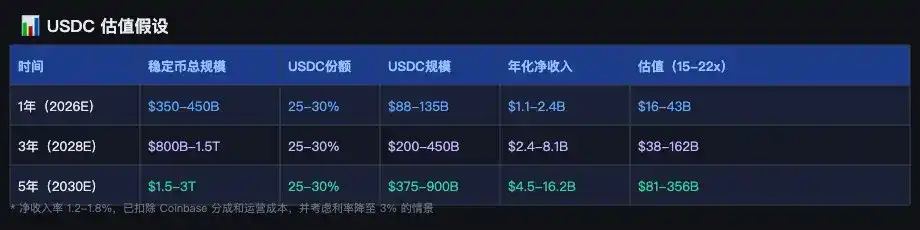
Tin tốt là tỷ suất lợi nhuận đang được cải thiện. Tỷ suất lợi nhuận RLDC (Doanh thu trừ Chi phí Phân phối) tăng từ 30,0% trong Q4 2024 lên 40,1% trong Q4 2025. Tỷ lệ thu nhập ròng 1,2-1,8%, đã trừ đi phần chia cho Coinbase và chi phí vận hành.
Tầng 2: Thu nhập Thanh toán & Giao dịch — Doanh nghiệp mới đang phát triển

Đây là chìa khóa quyết định Circle có thể thoát khỏi nhãn "công ty lãi suất" hay không.

CPN (Circle Payments Network) ra mắt vào tháng 5 năm 2025, cung cấp dịch vụ quyết toán xuyên biên giới 7×24 dựa trên USDC cho ngân hàng, công ty thanh toán và doanh nghiệp. Tính đến tháng 2 năm 2026, TPV hàng năm đạt 57 tỷ USD, tăng khoảng 100 lần kể từ khi ra mắt. 55 tổ chức đã kết nối, 74 tổ chức đang trong quá trình xét duyệt, 500+ trong pipeline. Bao phủ 14 thị trường bao gồm Brazil, Canada, Hong Kong, Ấn Độ, Mexico, Nigeria, Mỹ, v.v.

Nhưng 57 tỷ USD so với thị trường thanh toán xuyên biên giới toàn cầu 16 nghìn tỷ USD, vẫn chưa đến 0,04%. Giá trị của CPN không nằm ở quy mô ngày hôm nay, mà ở khả năng tăng trưởng có thể duy trì hay không. Nếu nó chiếm được 1% thị phần thị trường xuyên biên giới, đó sẽ là khối lượng giao dịch hàng năm 1600 tỷ USD — phí phát sinh có thể gần bằng hoặc thậm chí vượt quá thu nhập từ lãi, và không bị ảnh hưởng bởi lãi suất.

CCTP (Giao thức Chuyển Chuỗi Chéo) thực hiện chuyển USDC nguyên bản xuyên chuỗi thông qua "hủy-đúc". Q4 2025 xử lý 413 tỷ USD, tăng 3,7 lần so với cùng kỳ. Thị phần USDC chuyển chuỗi tăng từ 25% cuối năm 2024 lên 62% vào tháng 1 năm 2026, bao phủ 30 chuỗi. CCTP V2 giới thiệu phí Fast Transfer — một nguồn thu mới.

Other Revenue (Thu nhập phi lãi) là bằng chứng trực tiếp nhất về "sự chuyển đổi". FY2025 tăng vọt từ 3 triệu USD/quý lên 37 triệu USD/quý, bao gồm dịch vụ đăng ký 24,7 triệu USD, thu nhập giao dịch 12,2 triệu USD, thu nhập nút xác thực Canton Network 7 triệu USD. Ban lãnh đạo hướng dẫn 150-170 triệu USD cho năm 2026.

Phần thu nhập này không bị ảnh hưởng bởi lãi suất và cũng không cần chia cho Coinbase. Khi nó vượt quá 10% tổng doanh thu, thị trường có thể bắt đầu nhìn Circle bằng phương pháp định giá khác. Hiện tại khoảng 4%.

Tầng 3: Nền tảng Quyết toán — Khả năng dài hạn

Arc là chuỗi quyết toán cấp tổ chức mà Circle dự định ra mắt mainnet vào năm 2026, với USDC là token gas nguyên bản. Hiện testnet đã xử lý hơn 166 triệu giao dịch, thời gian xác nhận 0,5 giây, 100+ tổ chức tham gia (bao gồm Goldman Sachs và Mastercard).

Lộ trình của Arc chia làm bốn giai đoạn:

M1 Public Testnet (Đã hoàn thành) → M2 Đưa tiền thật lên chuỗi (2026) → M3 Kịch bản ký quỹ/tài sản thế chấp/quyết toán triển khai (2027-28) → M4 Viết vào Quy trình Vận hành Tiêu chuẩn của tổ chức (2029-30)

Trước M2, giá trị của Arc bằng không. Nhưng nếu cuối cùng nó trở thành tiêu chuẩn quyết toán cấp tổ chức, giá trị của Circle sẽ không còn là "công ty thu phí", mà là "công ty nền tảng". Đây là điều kiện cần thiết cho lợi nhuận 10x trở lên.

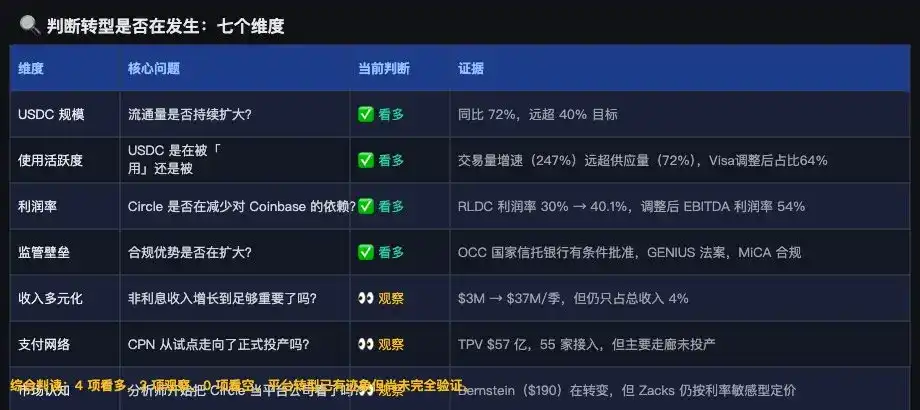
IV. Đánh giá liệu sự chuyển đổi có đang diễn ra: Bảy chiều kích

Chỉ nhìn vào một chỉ số duy nhất dễ đánh giá sai. Điều quan trọng là xem nhiều chiều kích có đồng thời cải thiện hay không — khi quy mô, mức độ hoạt động, tỷ suất lợi nhuận, thu nhập mới, tăng trưởng người dùng đều hướng về cùng một hướng, thì sự chuyển đổi đang diễn ra.
V. Ba chỉ số theo dõi quan trọng nhất

1 Lượng lưu thông USDC (Xem hàng ngày)

Cơ sở thu nhập của Circle. Lượng lưu thông × Tỷ suất lợi nhuận dự trữ = Thu nhập lãi. Nên theo dõi "Lượng lưu thông trung bình quý" thay vì ảnh chụp cuối kỳ. Hiện tại khoảng 770 tỷ USD.

Nguồn dữ liệu: defillama.com/stablecoin/usd-coin (cập nhật hàng ngày), circle.com/transparency (chứng minh dự trữ hàng tuần)

2 Tỷ trọng USDC trong khối lượng giao dịch đã điều chỉnh của Visa (Xem hàng tuần)

Trả lời câu hỏi cốt lõi: USDC đang được sử dụng hay được nắm giữ. Lượng cung chỉ chiếm 25%, nhưng khối lượng giao dịch đã điều chỉnh chiếm 64% — mỗi đô la USDC làm nhiều việc hơn USDT 2-3 lần.

Nguồn dữ liệu: visaonchainanalytics.com → Lọc theo Stablecoin → Nhấp "Show % of Total" → Đọc đường USDC

3 Other Revenue - Thu nhập phi lãi (Xem hàng quý)

Chỉ số duy nhất chứng minh trực tiếp Circle kiếm được tiền ngoài lãi. Không bị ảnh hưởng bởi lãi suất, không cần chia cho Coinbase. Hiện tại 37 triệu USD/quý, hướng dẫn 150-170 triệu USD (năm 2026). Khi vượt quá 10% tổng doanh thu, phương pháp định giá sẽ thay đổi.

Nguồn dữ liệu: circle.com/pressroom (báo cáo tài chính hàng quý), SEC EDGAR tìm kiếm Circle Internet Group

VI. Chất xúc tác gần đây

Thỏa thuận chia sẻ với Coinbase hết hạn (Tháng 8 năm 2026)

Đây là chất xúc tác đơn lẻ lớn nhất trong vòng 24 tháng tới. Hiện tại Circle chia khoảng 60% doanh thu cho các đối tác phân phối. Nếu sau khi đàm phán lại, tỷ suất lợi nhuận RLDC tăng từ 40% lên 50-55%, hiệu ứng tương đương với việc tăng lợi nhuận ngay lập tức 25-35%. Nhưng Coinbase không có động lực nhượng bộ đáng kể — việc phân phối USDC trên nền tảng Coinbase vẫn là động cơ tăng trưởng lớn nhất của Circle. Kết quả không chắc chắn, nhưng khả năng hướng đi tốt hơn hiện trạng là lớn hơn.

Giấy phép Ngân hàng Ủy thác Quốc gia OCC

Được phê duyệt có điều kiện vào tháng 12 năm 2025. Phê duyệt đầy đủ có nghĩa là: có thể trực tiếp mở tài khoản chính tại Fed (kiếm lãi suất IORB, loại bỏ rủi ro đối tác), xử lý luồng đúc/đổi hàng năm 4830 tỷ USD mà không cần thông qua ngân hàng thương mại, xây dựng rào cản tin cậy không thể vượt qua cho việc doanh nghiệp và chính phủ áp dụng USDC. Không có đơn vị phát hành stablecoin nào khác có điều này.

x402 Foundation (Thành lập tháng 4 năm 2026)

Coinbase đóng góp giao thức thanh toán x402 cho Linux Foundation. x402 kích hoạt mã trạng thái HTTP 402 thành lớp thanh toán nguyên bản của internet, cho phép AI agent, API và ứng dụng có thể quyết toán trực tiếp trong tương tác HTTP — mặc định sử dụng USDC.

Các bên tham gia: Google, AWS, Stripe, Visa, Mastercard, Amex, Shopify, Microsoft, Cloudflare, Circle. Nếu x402 trở thành tiêu chuẩn thanh toán cho AI agent, mỗi giao dịch vi mô máy-máy sẽ đẩy cao mức sử dụng (velocity) của USDC mà không cần tăng lượng nắm giữ (supply).

Lưu ý: x402 do Coinbase dẫn dắt, không phải do Circle dẫn dắt. Tác động đến CRCL: Có phần tích cực, mở rộng các trường hợp sử dụng USDC, nhưng không thay đổi quy mô cơ bản.

VII. Điều kiện cho lợi nhuận 5-10 lần

3-5x (Độ tin cậy cao) — Chỉ dựa vào tăng trưởng USDC

USDC theo CAGR 40% đến năm 2028 khoảng 200-300 tỷ USD. Ngay cả khi lãi suất giảm xuống 3%, 250 tỷ USD × 1,5% chênh lệch lãi ròng = 37,5 tỷ USD thu nhập ròng. Định giá 20x, vốn hóa 750 tỷ USD. Từ mức 150-200 tỷ USD hiện tại lên 750 tỷ USD, khoảng 4x. Không cần CPN hoặc Arc đóng góp bất kỳ điều gì.

10x (Cần nhiều điều kiện đồng thời thành hiện thực)

Từ 15-20 tỷ USD lên 150-200 tỷ USD, phải đồng thời xảy ra:

1. CPN TPV trong 2-3 năm vượt 1000 tỷ USD, ít nhất một hành lang chính thức đi vào vận hành sản xuất

2. Thỏa thuận chia sẻ với Coinbase được cải thiện, tỷ suất lợi nhuận RLDC đạt 50%+

3. Other Revenue vượt quá 10% tổng doanh thu, chứng minh có thu nhập phi lãi suất có thể mở rộng quy mô

4. Arc ít nhất đạt đến giai đoạn M2 (đưa tiền thật lên chuỗi), bắt đầu được thị trường định giá

Bốn điều kiện này hiện chỉ có điều thứ hai (tỷ suất lợi nhuận) đang được cải thiện rõ ràng. 10x là một vị thế mà bạn "kiếm được", không phải là vị thế bạn "đánh cược".

VIII. Rủi ro chính

Lãi suất giảm nhanh hơn tốc độ tăng trưởng USDC

Q4 2025 đã xuất hiện tín hiệu này: lãi suất giảm 68bps, phần nào bù đắp cho 100% tăng trưởng lượng lưu thông. Nếu Fed giảm xuống 2,5-3% trong năm 2026-2027, có thể xuất hiện cửa sổ 1-2 quý lợi nhuận thấp hơn dự kiến.

Tether tuân thủ

Lợi thế khác biệt lớn nhất của USDC là tuân thủ. Nhưng Tether trong 9 tháng đầu năm 2025 đã kiếm được 100 tỷ USD, đang đàm phán kiểm toán toàn diện với Big Four. Nếu Tether có được vị thế tuân thủ trong vòng 2-3 năm tới, lợi thế khác biệt của USDC sẽ bị suy yếu đáng kể. USDT hiện chiếm hơn 60% thị phần, vốn hóa 1830 tỷ USD — nó có đủ nguồn lực.

Cạnh tranh từ stablecoin mới có lợi tức & các gã khổng lồ thanh toán như Stripe

Ethena (USDe), Sky và các stablecoin mới khác đang giành thị phần bằng cách trả lợi tức trực tiếp cho người nắm giữ. Circle bị hạn chế bởi vị thế tuân thủ quy định, hiện không thể trả lãi trực tiếp cho người nắm giữ USDC.

Stripe là thành viên sáng lập của x402 Foundation, đồng thời cũng đang xây dựng hệ thống thanh toán stablecoin riêng. Chiến lược của Stripe là kết nối với tất cả các tiêu chuẩn có thể thắng — việc tham gia của nó không đại diện cho sự hỗ trợ độc quyền cho USDC, và cũng không loại trừ khả năng Stripe ra mắt stablecoin riêng hoặc tích hợp sâu USDT trong tương lai.

IX. Kết luận

Circle không phải là một công ty "chắc chắn sẽ trở thành nghìn tỷ". Nhưng nó có thể là một trong số ít công ty fintech hiện nay có điều kiện cấu trúc để chạm tới trần nhà đó.
Định giá hiện tại hầu như chỉ phản ánh thu nhập lãi từ USDC. Thị trường đang hỏi: Circle rốt cuộc là một công ty tài chính dựa vào lãi suất, hay là một cơ sở hạ tầng đô la kỹ thuật số dựa trên phí? Câu trả lời vẫn chưa xác định — nhưng dữ liệu đang nghiêng về khả năng sau.

Theo dõi cốt lõi là ba việc: Lượng lưu thông USDC có đang tăng hay không, mỗi đô la USDC có đang được sử dụng thường xuyên hơn hay không, thu nhập ngoài lãi có đang lớn hơn hay không. Khi cả ba cùng cải thiện, sự chuyển đổi đang diễn ra.

Nguồn dữ liệu: Circle IR, SEC EDGAR, DefiLlama, Visa Onchain Analytics, Artemis Terminal, CoinDesk, Mizuho Research

Miễn trừ trách nhiệm: Bài viết này không cấu thành lời khuyên đầu tư. Tất cả dữ liệu tính đến tháng 4 năm 2026.

Related Questions

QCircle là gì và nguồn thu nhập chính của họ đến từ đâu?

ACircle là công ty phát hành USDC, stablecoin lớn thứ hai toàn cầu với lượng lưu thông khoảng 770 tỷ USD. Nguồn thu chính của Circle (95% tổng doanh thu năm tài chính 2025) đến từ việc đầu tư tài sản dự trữ hỗ trợ USDC (chủ yếu là trái phiếu kho bạc Mỹ ngắn hạn) để kiếm chênh lệch lãi suất.

QDữ liệu nào cho thấy USDC đang chuyển từ một tài sản để 'nắm giữ' sang một mạng lưới để 'sử dụng'?

AHai điểm dữ liệu quan trọng: 1) Khối lượng giao dịch trên chuỗi của USDC (tăng 247% trong FY2025) tăng nhanh hơn nhiều so với tốc độ tăng lượng lưu thông (72%). 2) Theo Visa Onchain Analytics (đã điều chỉnh loại bỏ nhiễu), USDC chiếm 64% khối lượng thanh toán kinh tế thực, so với 28% của USDT, mặc dù lượng lưu thông của USDT lớn hơn 2.4 lần. Điều này cho thấy mỗi đô la USDC đang được sử dụng tích cực hơn cho các giao dịch thực.

QBa lớp cấu trúc doanh thu của Circle là gì?

A1) Lớp 1: Thu nhập từ lãi USDC - nguồn thu chính hiện tại. 2) Lớp 2: Thu nhập từ thanh toán và giao dịch - bao gồm Mạng lưới Thanh toán Circle (CPN) và Giao thức Chuyển tiền Liên chuỗi (CCTP), đại diện cho các dòng doanh thu mới không phụ thuộc vào lãi suất. 3) Lớp 3: Nền tảng định cư (Arc) - một cơ hội dài hạn để trở thành tiêu chuẩn cơ sở hạ tầng cho các giao dịch thể chế.

QCác chất xúc tác gần đây quan trọng cho Circle là gì?

ACác chất xúc tác chính bao gồm: 1) Thỏa thuận chia sẻ doanh thu với Coinbase hết hạn vào tháng 8/2026, có khả năng cải thiện tỷ suất lợi nhuận. 2) Giấy phép Ngân hàng Ủy thác Quốc gia từ OCC, nâng cao uy tín và hiệu quả. 3) Sự ra mắt của x402 Foundation, thúc đẩy việc sử dụng USDC như một phương tiện thanh toán gốc cho Internet và AI.

QNhững rủi ro chính đối với Circle và USDC là gì?

ACác rủi ro chính bao gồm: 1) Lãi suất giảm nhanh hơn tốc độ tăng trưởng của USDC, ảnh hưởng đến thu nhập lãi. 2) Khả năng Tether (USDT) trở nên tuân thủ quy định hơn, làm giảm lợi thế cạnh tranh của USDC. 3) Sự cạnh tranh từ các stablecoin mới trả lợi tức cho người nắm giữ và từ các gã khổng lồ thanh toán như Stripe.

Related Reads

Fed's Internal Doves Flock to Hawkish Stance, Warsh's Debut "Between a Rock and a Hard Place"

U.S. Federal Reserve officials who previously advocated for rate cuts, including Governor Christopher Waller, have recently shifted their stance, with many now not ruling out the possibility of future rate hikes. This sets a challenging stage for new Fed Chair Kevin Warsh's first policy meeting. Appointed by President Trump based on his dovish views, Warsh now faces a committee where the debate has pivoted from "when to cut" to "whether to hike," driven by persistent inflation above 3%, a strong labor market, and supply-side pressures from AI infrastructure demands and geopolitical tensions. Key figures illustrate the shift. Governor Waller, once concerned about employment, now says data has pushed him toward considering rate increases. Even moderate voices like Governor Lisa Cook, while expecting inflation to ease, have indicated readiness to hike if it fails to do so. Long-time hawks such as regional Fed presidents Beth Hammack, Lorie Logan, and Neel Kashkari have grown more vocal, arguing that the real policy rate is effectively falling and that action may soon be needed. The upcoming Fed meeting is expected to keep rates steady but will likely remove the "easing bias" from its statement, signaling a neutral stance between cuts and hikes. The quarterly "dot plot" is anticipated to show most officials projecting no cuts this year, with some potentially indicating hikes. Chair Warsh, a critic of the Fed's reliance on forward guidance like the dot plot, must navigate communicating this pivot using tools he has questioned, all while steering policy in a direction counter to the preferences of the president who appointed him. The consensus suggests the Fed's next move could well be a rate increase.

marsbit12m ago

Fed's Internal Doves Flock to Hawkish Stance, Warsh's Debut "Between a Rock and a Hard Place"

marsbit12m ago

The Trillion-Yuan Market Cap 'Yi Zhong Tian': Who is the True Value King?

The article analyzes the three leading Chinese optical module companies, collectively nicknamed "Yi Zhong Tian": Xinyisheng, Zhongji Innolight, and TFC Optical Communication. It evaluates their "cost-performance" not by current stock price, but through three lenses: PEG ratio (growth vs. valuation), earnings quality, and premium/discount for certainty. Xinyisheng shows the most attractive PEG ratio and high profitability, but its valuation reflects discounts for risks like high customer concentration and reliance on overseas markets. Zhongji Innolight, the most expensive, commands a premium for its market leadership, dominant share in key products like 800G/1.6T modules, and higher earnings certainty, though it faces geopolitical risks. TFC Optical, as an upstream component supplier ("water seller"), has the highest gross margin and bets on the long-term CPO/NPO architecture trend, but trades at a high valuation with more stable, less explosive growth. The core argument is that while these companies dominate module assembly, the true profit pool and technological moat lie upstream in laser and switch chips, currently controlled by U.S. firms like Lumentum and Coherent. The long-term "cost-performance" for these Chinese leaders hinges on whether the domestic industry, exemplified by companies like Yuanjie Technology, can successfully move up the value chain into high-power laser chips. Otherwise, their high growth may remain confined to the lower-margin assembly segment.

marsbit22m ago

The Trillion-Yuan Market Cap 'Yi Zhong Tian': Who is the True Value King?

marsbit22m ago

Has the Crypto Market Bottomed? Here's What Institutions Think

The crypto market is in a period of significant debate, with leading institutions offering differing views on whether a bottom has been reached. Three prominent firms have published detailed analyses: * **Galaxy Digital** argues Bitcoin has **not yet bottomed**. Their analysis of 13 historical indicators across six dimensions (valuation, profit-taking, miner pressure, etc.) shows only four are fully met. They project a potential bottom range between $30k and $54k. * **NYDIG** states a bottom is **possible but not likely**. While metrics are close to historic bear market extremes, they note the absence of a classic panic-selling event. They also suggest increased institutional adoption may have structurally altered the market cycle, potentially leading to a shallower downturn. * **Standard Chartered Bank** asserts the **bottom has already occurred** at around $59k. They cite two key factors: potential US-Iran diplomatic progress and the anticipated SpaceX IPO, which they believe absorbed capital and caused ETF selling pressure that is now subsiding. They forecast a year-end price target of $100k. Despite the surface-level disagreement, the reports share critical common ground more valuable for long-term investors: 1. All three believe the market bottom will form **within this year**. 2. All agree the current price is **closer to the bottom than to previous highs**. 3. All maintain a **bullish long-term outlook** for Bitcoin and a new cycle. The core takeaway is that while the exact bottom price ($40k, $50k, or $60k) is debated, the consensus is that a bottom is imminent. For long-term holders, the primary focus should not be pinpointing the absolute low, but on the future potential for prices to reach $100k, $200k, or higher. The fundamental thesis for Bitcoin—sovereign debt accumulation, inflation, declining trust in centralized institutions, global digitization, and improved accessibility—remains intact and is arguably strengthening. The overall landscape is viewed as more favorable than in previous crypto winters.

marsbit33m ago

Has the Crypto Market Bottomed? Here's What Institutions Think

marsbit33m ago

The 'Chip' Challenge and Breakthroughs in China's Optical Industry Chain

China's Photonics Industry: Bottlenecks and Breakthroughs In the global AI race, computing chips dominate the narrative, but the underlying bottleneck increasingly defining the scale of AI clusters is light—or more specifically, optical connectivity. Optical modules, which translate electrical signals to light and vice versa, are crucial for connecting thousands of GPUs in AI data centers, preventing data congestion and ensuring efficient model training. High-speed modules (800G, 1.6T) are now standard, with performance hinging on advanced DSP (Digital Signal Processor) chips. This is where a critical dependency lies. Two US giants—Marvell and Broadcom—collectively dominate over 90% of the high-end DSP chip market. Chinese optical module leaders like Zhongji Innolight and Eoptolink rely on these chips to manufacture modules for overseas AI customers, primarily in North America. While this creates a supply chain vulnerability, complete decoupling is difficult. Marvell derives over half its revenue from Greater China, and the US firms depend on Chinese partners for chip packaging and optical components. The risk from laser chips (e.g., from Lumentum), another key component, is considered more manageable due to multiple global suppliers and faster progress in domestic alternatives from companies like YOFC and Accelink. To mitigate risks, China's industry is pursuing a multi-pronged strategy: diversifying supply chains and locking in long-term orders; fostering a domestic market ecosystem to adopt homegrown DSPs from firms like Huawei HiSilicon and CETC; accelerating R&D in high-speed DSPs and advanced packaging; and investing in next-gen technologies like silicon photonics and Co-Packaged Optics (CPO) to reduce reliance on discrete DSPs. The ultimate solution lies not in short-term博弈 but in persistent advancement of domestic high-end chip R&D and manufacturing. While challenges remain in performance, certification, and ecosystem building, China's vast domestic market and manufacturing base provide a crucial buffer, buying time for the industry to achieve greater technological independence.

marsbit46m ago

The 'Chip' Challenge and Breakthroughs in China's Optical Industry Chain

marsbit46m ago

Behind SpaceX's $2 Trillion Market Cap: Why Does Musk Always Have the Next Move Planned?

On June 12th, SpaceX debuted on the Nasdaq, reaching a valuation that briefly touched $2 trillion. This marked the culmination of a 24-year journey from its founding in 2002, driven by Elon Musk's frustration at the high cost of buying rockets. The company's path was defined by early failures, with its first three Falcon 1 launches ending in explosions before a successful 2008 flight opened the era of commercial spaceflight. Key to its model was a fixed-price NASA contract, incentivizing cost reduction. SpaceX mastered rocket reusability, first achieving a Falcon 9 landing in 2015, which drastically cut launch costs. This enabled its profitable Starlink satellite internet constellation, envisioned years before reusability was proven, to create an internal market for frequent launches. Similarly, the next-generation Starship rocket was in development long before its first flight, with its business case evolving from Mars colonization to supporting the emerging concept of in-orbit data centers for AI—a story now central to its valuation. The company's recent IPO, a reversal of its long-standing "no IPO" stance, is funding this ambitious "space-based compute" vision. While major tech players like Google, Blue Origin, and others are investing heavily, significant technical and cost hurdles remain. Ultimately, SpaceX's history is one of creating its own demand: first with Starlink and now with space-based AI compute, betting that its next rocket will enable its next giant market.

marsbit49m ago

Behind SpaceX's $2 Trillion Market Cap: Why Does Musk Always Have the Next Move Planned?

marsbit49m ago

Trading

Spot
Futures

Hot Articles

What is USDC(WORMHOLE)

USD Coin (Wormhole): A Comprehensive Overview Introduction In the rapidly evolving world of cryptocurrencies, USD Coin (Wormhole), referred to as $USDC(Wormhole), stands out as a pioneering solution within the DeFi (Decentralized Finance) landscape. Operating on several blockchain platforms, including Solana, USD Coin (Wormhole) is more than just a digital representation of the United States dollar. It embodies the innovative spirit of modern finance, enabling seamless cross-chain transactions and enhanced interoperability among diverse blockchain ecosystems through the advanced Wormhole protocol. What is USD Coin (Wormhole)? USD Coin (Wormhole) is a tokenized version of the US dollar designed to facilitate frictionless transactions across different blockchain networks. Its primary aim is to bolster liquidity and enhance the functionality of the DeFi ecosystem. By leveraging the Wormhole protocol, which establishes a robust cross-chain communication network, users can effortlessly transfer USDC tokens across various platforms. This cross-chain capability marks a significant advancement in cryptocurrency use, promoting a more interconnected and efficient ecosystem where assets can flow freely between different blockchains. The value proposition of USD Coin (Wormhole) lies not only in its stability, being pegged to the US dollar, but also in its ability to bridge gaps between disparate blockchain environments. This innovative approach fosters a greater level of participation among users and developers, paving the way for new and exciting applications within decentralized finance. Who is the creator of USD Coin (Wormhole)? The origins of USD Coin (Wormhole) are intricately tied to the Wormhole network, which was developed by Jump Crypto. While specific individual creators are not prominently documented, Jump Crypto is notable for its involvement in advancing blockchain technology and supporting its applications in finance. By creating the Wormhole network, Jump Crypto has played a vital role in promoting cross-chain asset transfers, enhancing the efficiency and diversity of cryptocurrency usage. Who are the investors of USD Coin (Wormhole)? The success of USD Coin (Wormhole) is supported by investments from several notable funds and organizations within the cryptocurrency realm. Key investors include: Coinbase Ventures: A prominent venture capital arm backed by one of the leading cryptocurrency exchanges in the industry, Coinbase Ventures provides essential capital and strategic support to promising blockchain projects. Arrington XRP Capital: Specializing in digital assets, Arrington XRP Capital recognizes the potential of innovative projects like USD Coin (Wormhole) and has invested accordingly to back its development. Jump Trading: As the parent organization of Jump Crypto, Jump Trading brings not only investment but a wealth of expertise in trading technology and market dynamics to bolster the Wormhole project. How Does USD Coin (Wormhole) Work? The operational framework of USD Coin (Wormhole) is intricately designed to facilitate effective cross-chain transactions, maximizing security and efficiency. Here’s a simplified overview of how it functions: Asset Locking: When a user wishes to transfer USDC from one blockchain to another, they first lock their tokens on the source blockchain. This process ensures that the assets are secure and are set to be either burned or moved later. Token Minting: After the tokens are locked, an equivalent amount of USDC is minted on the destination blockchain. This provides the user with access to their funds on a new platform, reflecting the flexibility that the Wormhole protocol enables. Cross-Chain Transfer: The Wormhole protocol efficiently facilitates the entire transfer process. It ensures that once the USDC is minted on the destination chain, the equivalent tokens are burned on the source chain. The result is a seamless transfer of value between two distinct blockchain environments. This cross-chain methodology ensures that transactions remain secure and transparent, significantly enhancing liquidity within the different DeFi ecosystems. Timeline of USD Coin (Wormhole) Understanding the evolution of USD Coin (Wormhole) provides vital context for its significance in the cryptocurrency arena. Here’s a timeline highlighting important milestones in the project’s history: 2021: The Wormhole project is launched, establishing a framework for cross-chain asset transfers and setting the stage for the development of USD Coin (Wormhole). 2022: The Wormhole network experiences a significant challenge with a security breach that results in a $325 million theft. However, the incident is later addressed and refunded by Jump Crypto, showcasing the project’s commitment to security and transparency. 2023: USD Coin (Wormhole) integrates with Circle’s Cross-Chain Transfer Protocol (CCTP), enhancing its capabilities for cross-chain transfers and further solidifying its place within the DeFi ecosystem. 2024: Ongoing development and expansion of the Wormhole network continue, aimed at increasing the utility and reach of USD Coin (Wormhole) as well as enhancing its operational framework. Key Features The success of USD Coin (Wormhole) can be attributed to several key features that differentiate it from other cryptocurrency offerings: Cross-Chain Interoperability At the core of USD Coin (Wormhole) is its ability to facilitate seamless transfers across multiple blockchain networks. This interoperability serves as a cornerstone for decentralized finance, allowing various platforms to interact with each other, thereby accelerating the evolution of financial services. Security Wormhole employs a well-designed Guardian Network comprised of node validators that ensure secure cross-chain transactions. This collective oversight minimizes the risk of fraud and provides users with confidence that their assets are protected during cross-chain transfers. Liquidity Enhancement By enabling USDC to circulate freely across different blockchains, USD Coin (Wormhole) enhances liquidity in the DeFi ecosystem. This increased liquidity can foster more efficient trading, contribute to better pricing strategies, and improve the overall market dynamics encompassing various digital assets. Conclusion USD Coin (Wormhole) is a pivotal innovation in the blockchain space, reinforcing the capabilities of decentralized finance (DeFi) and establishing a more connected financial ecosystem. With its robust framework for cross-chain transactions, security features, and strong backing from reputable investors, USD Coin (Wormhole) is positioned to play a key role in the future of cryptocurrency. As the digital finance landscape continues to evolve, USD Coin (Wormhole) not only embraces the future of interconnectivity among blockchain networks but also reaffirms the power of tokenization and blockchain technology in transforming how we perceive and utilize value in a digital world. By navigating the complexities of cross-chain functionality, it demonstrates a sophisticated approach to enabling financial inclusivity and innovation in the world of cryptocurrencies.

1.2k Total ViewsPublished 2024.04.01Updated 2024.12.03

What is USDC(WORMHOLE)

What is $USDC

Classic USDC: A Comprehensive Overview Introduction to Classic USDC In the rapidly evolving landscape of the cryptocurrency market, stablecoins have emerged as critical components, particularly in providing stability amid the volatility that characterizes digital assets. One such project is Classic USDC, a digital currency initiative that aims to deliver a stable and reliable medium of exchange. By maintaining a 1:1 peg with the US dollar, Classic USDC strives to offer users a dependable digital asset, equipped for various applications within the web3 and cryptocurrency ecosystems. What is Classic USDC? Classic USDC is fundamentally a stablecoin, which is a type of cryptocurrency designed to minimize the price volatility typically seen in the digital asset market. Specifically, Classic USDC aspires to represent the value of the US dollar closely, ensuring that users can leverage this digital currency for transactions, savings, and other financial activities without the fear of sudden price fluctuations that can otherwise plague many cryptocurrencies. The primary aim of Classic USDC is to provide a reliable and trustworthy digital equivalent of the US dollar, designed for seamless integration into a wide range of web3 applications, decentralized finance (DeFi) platforms, and other crypto-related financial systems. By delivering a stable digital currency, Classic USDC seeks to facilitate everyday commerce, make blockchain technology more user-friendly, and encourage the adoption of cryptocurrencies for mainstream usage. Creator of Classic USDC The identity of the creator or the development team behind Classic USDC remains largely unknown, and the lack of transparency has led to a degree of uncertainty regarding the project’s origins. While many cryptocurrency initiatives prominently showcase their founders and development teams, Classic USDC does not provide clear information about its creators, which poses challenges for potential users or investors weighing the project's credibility and reliability. Investors of Classic USDC Alongside the ambiguity surrounding its creators, Classic USDC also lacks specificity with regards to its investors. The financial backing of a project can often lend it credibility and stabilize its operations; however, the absence of documented investment foundations or organizations supporting Classic USDC raises questions about its funding structure. This lack of clarity could potentially hinder stakeholder confidence in the project. How Does Classic USDC Work? The operational mechanics of Classic USDC rely heavily on its reserve system, which is fundamental to the underpinnings of any stablecoin. Classic USDC undertakes to maintain a reserve of assets that directly correspond to the value of the digital currency in circulation. Specifically, for every Classic USDC token issued, an equivalent amount of backing assets is retained in reserve, whether in cash or near-cash equivalents. This strategy is designed to uphold the value of Classic USDC, offering reassurance to users that redeeming their tokens for US dollars is feasible at any time. This reserve structure aims to enhance the stability and reliability of Classic USDC, positioning it as a secure alternative in the cryptocurrency market. By ensuring that the value of Classic USDC is consistently correlated with the US dollar, the project aspires to engender trust among users who may be wary of the broader market dynamics. Timeline of Classic USDC The history of Classic USDC is marked by several key milestones that reflect its journey and evolution within the cryptocurrency ecosystem: 2021: The inception of Classic USDC is noted, introducing a new digital currency option designed for stability. During this year, the first records of the token’s activity surfaced and its initial price levels were established. 2024: Classic USDC begins to experience notable price fluctuations, as the crypto market overall grapples with various trends and user sentiment. Predictions regarding its future potential emerge, indicating a strong interest from market observers and analysts who foresee growth opportunities. Future Projections Experts speculate that Classic USDC may reach higher levels of adoption and stability in the years to come, with potential further developments anticipated around 2025 and 2026. However, these projections should be approached with cautious optimism, as the cryptocurrency market is inherently unpredictable, and various external factors may influence the trajectory of Classic USDC. Key Points About Classic USDC Stability: Classic USDC’s core proposition revolves around providing a digital currency that parallels the value of the US dollar, thereby ensuring stability in an often volatile marketplace. Reserve System: The project’s commitment to maintaining a reserve of assets to back its value underscores its reliability and operational soundness. Web3 and Crypto Integration: Classic USDC is engineered to facilitate easy integration within various applications, aiming to enhance the user experience and broaden the acceptance of cryptocurrency in everyday transactions. Future Growth Potential: While still emerging, Classic USDC holds prospective avenues for growth as awareness and utilization of stablecoins increases in the web3 and crypto contexts. Conclusion Classic USDC presents itself as a notable stablecoin initiative within the cryptocurrency sphere, striving to provide users with a reliable digital currency that embodies the stability of the US dollar. Despite uncertainties regarding its creators and financial backing, the underpinning principles of Classic USDC—centered on reserve-backed assurances—endeavour to position it as a trustworthy option for individuals and businesses navigating the digital economy. With an eye towards the future, market analysts are keen to observe how Classic USDC evolves in response to the shifting dynamics of the cryptocurrency landscape, potentially establishing itself as a significant player in the realm of stablecoins.

631 Total ViewsPublished 2024.05.01Updated 2024.12.03

What is $USDC

Discussions

Welcome to the HTX Community. Here, you can stay informed about the latest platform developments and gain access to professional market insights. Users' opinions on the price of USDC (USDC) are presented below.

活动图片