复盘比特币熊市周期,什么价位才能抄底?

深潮TechFlowPublished on 2026-02-13Last updated on 2026-06-12

Abstract

熊市才是穷人的翻身机会。

作者:深潮 TechFlow

2 月 6 日凌晨,当比特币跌破 6 万美元时,整个加密社区陷入恐慌。距离 2025 年 10 月的历史高点 126,000 美元,比特币已经跌去了 52%。

但如果你翻开比特币 15 年的价格历史,会发现一个残酷的事实:52%的跌幅,在历史上只能算“毛毛雨”。

比特币熊市的“跌幅密码”

让我们先看一组数据:
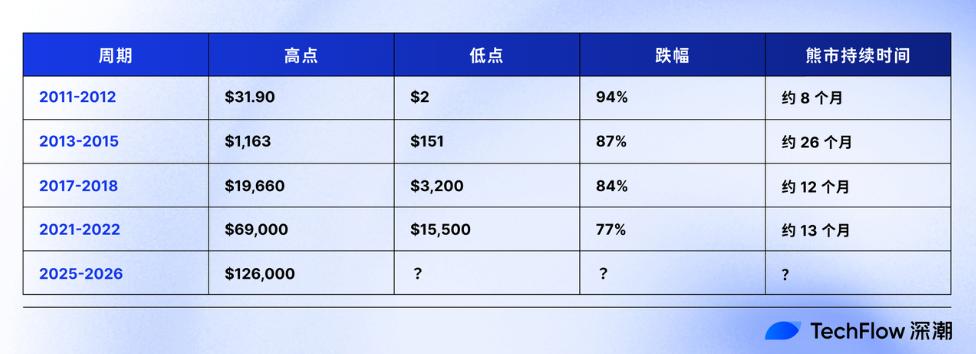
这张表格揭示了一个清晰的规律:每一轮熊市的最大跌幅都在递减。

从 94% 到 87%,再到 84%、77%,比特币的“熊市标准”正在以每轮 5-10 个百分点的幅度收窄。

更精确地看这个递减规律:

2011→2013: 减少 7 个百分点(94%→87%)

2013→2017: 减少 3 个百分点(87%→84%)

2017→2021: 减少 7 个百分点(84%→77%)

平均每轮递减约 5-7 个百分点。

为什么?

1.市值基数变大,波动性自然降低

2011 年,比特币的市值只有几千万美元,一个"鲸鱼"抛售就能让价格崩盘 94%。

2026 年,即便比特币从高点腰斩至 6 万美元,市值依然超过 1 万亿美元。要让一个万亿级资产再跌 30-40%,需要的抛售体量是 2011 年的几千倍。

2.机构入场,提供了“流动性缓冲垫”

2018 年之前,比特币的持有者主要是散户和早期矿工。一旦恐慌,所有人一起踩踏,没有任何"接盘方"。

2022 年之后,贝莱德、富达、灰度等机构通过 ETF 持有了数十万枚比特币。这些机构不会因为一次暴跌就恐慌性抛售,他们的存在相当于在市场中放置了一张"安全网"。

根据彭博数据,截至 2026 年 1 月底,美国比特币现货 ETF 的总持仓量超过 90 万枚 BTC,价值超过 700 亿美元。这些筹码的"锁定效应",直接降低了市场的可抛售供应量。

3.比特币从“投机品”向“资产类别”演化

2011-2013 年,比特币还是极客的玩具,价格完全由情绪驱动。

2017-2021 年,比特币开始被当作"数字黄金",但依然缺乏明确的估值锚点。

2025 年之后,比特币 ETF 获批、GENIUS 法案推动稳定币立法、特朗普提出"战略储备"计划,无论这些政策是否真正落地,比特币已经从"边缘资产"变成了"主流金融体系的一部分"。

这种演化导致的结果,就是波动性的降低。

4.减半周期的供给冲击在减弱

过去,比特币的价格主要受到 4 年减半周期的影响,每四年,新增供应量减少 50%。

2012 年第一次减半时,每天新增产出从 7,200 枚降至 3,600 枚,供给冲击巨大。

2024 年第四次减半后,每天新增产出从 900 枚降至 450 枚,虽然百分比相同,但绝对数量的减少幅度已经很小,对市场的冲击力也在递减。

供给端的"通缩效应"在减弱,需求端的"投机狂热"也在降温,两者共同导致了波动性的收窄。

如果历史重演,这次的"底"在哪里?
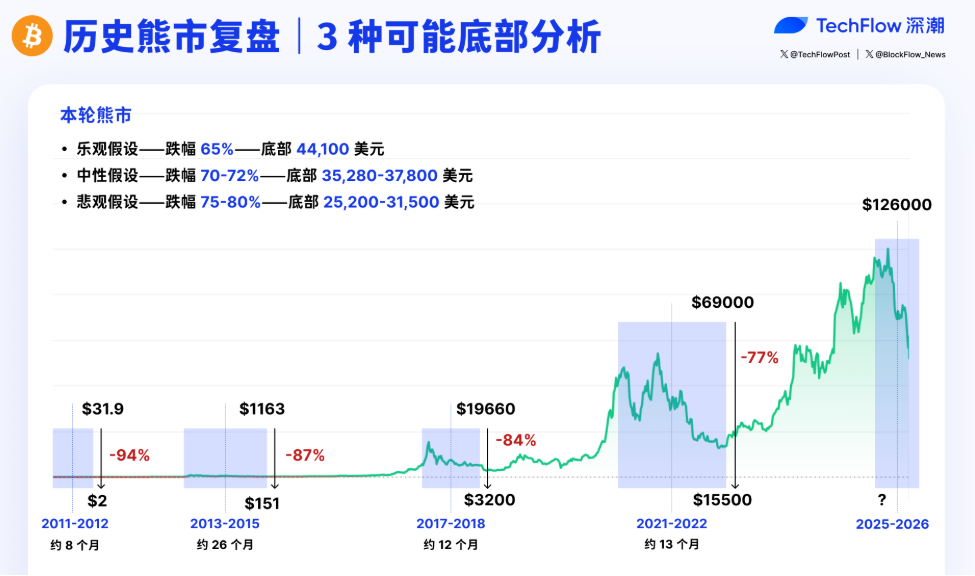
基于"每轮递减"的历史规律,我们可以推演三种情景:

情景 1:乐观假设,跌幅收窄至 65%

如果这轮周期的最大跌幅为 65%(比上一轮 77%再降 12 个百分点,略高于历史平均递减幅度):

底部价格 = 126,000 × (1 - 65%) = 44,100 美元

从 6 万美元到 4.41 万美元,还有 26% 的下跌空间。

支持理由:

机构持仓占比创历史新高,ETF 提供了强大的"买盘支撑"

美联储虽然鹰派,但市场已将 2026 年降息预期从 7 月提前至 6 月

特朗普 3 月 7 日的白宫加密货币峰会可能释放政策利好

稳定币虽然负增长,但 TVL(总锁仓量)依然稳定在 2300 亿美元以上

风险因素:

Strategy 等高杠杆持仓者如果被迫卖币,会引发连锁反应

特朗普的"战略储备"承诺迟迟未兑现,市场可能失去耐心

如果你相信这个情景: 你应该在 5 万美元以下开始分批建仓,4.5 万美元附近可以加大力度。

情景 2:中性假设——跌幅 70-72%

如果这轮周期的最大跌幅为 70-72%(严格遵循"递减 5-7 个百分点"的历史规律):

底部价格(70%) = 126,000 × (1 - 70%) = 37,800 美元

底部价格(72%) = 126,000 × (1 - 72%) = 35,280 美元

从 6 万美元到 3.5-3.78 万美元,还有 37-41%的下跌空间。

支持理由:

完美符合历史规律,既不过于乐观,也不过于悲观

当前宏观环境(降息预期+缩表担忧)的复杂度,与 2018 年相当

3.5-3.8 万美元对应比特币的"200 周移动平均线",历史上这条线是强支撑

风险因素:

如果美国经济陷入衰退,所有风险资产都将遭遇无差别抛售

AI 泡沫如果破裂,科技股崩盘将带崩比特币

如果你相信这个情景: 你应该把主要子弹留到 4 万美元以下,3.5-4.5 万美元是你的"重仓区间"。

情景 3:悲观假设——跌幅回归 75-80%

如果这次"真的不一样",市场结构性崩塌导致跌幅回归到 2017-2022 年的平均水平:

底部价格(75%) = 126,000 × (1 - 75%) = 31,500

美元底部价格(80%) = 126,000 × (1 - 80%) = 25,200 美元

从当前 7 万美元到 2.5-3.15 万美元,将是一场再跌 50%的屠杀。

支持理由:

2 月 6 日的"三杀"(美股、黄金、比特币同步暴跌)显示,比特币的"避险属性"彻底破产

ETF 虽然吸收了大量筹码,但也意味着机构可以"一键抛售"

特朗普政府的关税政策引发全球贸易战,可能导致全球性衰退

加密行业人才流失、VC 退圈(如 Multicoin 联创 Kyle Samani 宣布离场)显示行业信心崩塌

如果你相信这个情景: 你应该现在就清仓离场,等彻底崩盘到 3 万美元以下再说,或者只留 10-20%仓位"赌一把",其余资金撤出观望。

不要害怕错过

一些人总是担心,如果错过了这次熊市底部的买入机会怎么办?

答案很简单,追涨或者等下一个周期。

加密货币不是你人生唯一的翻身机会。如果你觉得它是,那你已经输了。

2015 年,错过 150 美元的人,在 2018 年 3200 美元时其实还有机会。

2018 年,错过 3200 美元的人,在 2022 年 1.5 万美元时也还有机会。

但前提是:你要活到下一个周期。

不要因为一次梭哈失败,就彻底离开这个市场。

此外,大部分人只关心"在哪个价位买",却忽略了"什么时候卖"。

举三个案例:

案例 1:

老张在 2018 年 12 月,比特币 3200 美元时重仓买入。2019 年 6 月,比特币涨到 1.3 万美元,老张觉得"牛市来了",没卖。2019 年 12 月,比特币跌回 7000 美元,老张觉得"完蛋了",割肉离场。

最后的结局:盈利不到 1 倍,还被洗出局,错过了 2021 年的 6.9 万美元。

案例 2:

小李也在 3,200 美元买入,但他给自己定了一个规则:"不涨到 5 万美元,绝不卖。"2019-2020 年的所有波动,他都不为所动。2021 年 4 月,比特币涨到 6.3 万美元,小李卖出 50%,锁定 15 倍利润。剩下 50%一直拿到 2021 年 11 月的 6.9 万美元高点,最终卖出。

结局:平均获利 18 倍。

案例 3:

老王从 2018 年 12 月开始,每个月定投 1000 元,不管涨跌。坚持了 3 年,到 2021 年 12 月停止定投。

他的平均成本约 1.2 万美元(因为前期买得便宜,后期买得贵)。2021 年 11 月,比特币 6.9 万美元时,他卖出全部,盈利约 4.7 倍。

结局:虽然不如小李,但他完全不需要"择时",执行起来最简单。

这三个案例告诉我们,抄到底部不重要,拿得住才重要。

如果不是一开始抱有终身囤币的想法,那提前定好"止盈计划",定投虽然不性感,但最适合普通人,绝大多数不可能底部买入顶部卖出,分批买入和分批卖出永远是相对较好的方法。

写在最后:熊市才是穷人的翻身机会

2011 年,在 2 美元买入比特币的人,现在已经实现了 3 万倍收益(即便按近期底部 6 万美元计算)。

2015 年,在 150 美元买入的人,现在是 400 倍。

2018 年,在 3200 美元买入的人,现在是 18.75 倍。

2022 年,在 1.5 万美元买入的人,现在是 4 倍。

每一轮熊市,都是一次财富的重新分配。

那些在高点疯狂追涨的人,在熊市中被洗出局;那些在底部恐慌性抛售的人,把筹码拱手让给了别人。

而真正赚钱的,永远是那些在所有人都绝望时,敢于分批建仓的人。

只要你相信,比特币的价格会吹来,还会更高。

2018 年,当比特币跌到 3200 美元时,有人说:"比特币已死"。

2022 年,当比特币跌到 1.5 万美元时,不少人惊呼,加密货币末日到来。

2026 年 2 月,当比特币跌破 6 万美元时,全世界都在问:"这次真的不一样了吗?"

如果你相信"历史会重演",那么现在到未来 6-12 个月,就是你人生中为数不多的、能以"相对低价"买入"未来"的时刻。

至于你信不信,这是你的选择。

免责声明:本文仅供历史数据参考,不构成投资建议。加密货币投资风险极高,请根据自身情况谨慎决策。作者及深潮 TechFlow 不对任何投资损失负责。

Related Reads

Crypto Market Makers Are Collectively Seeking Change as Money Becomes Harder to Earn

**Summary: Crypto Market Makers Adapt as Margins Shrink** Leading crypto market maker GSR exemplifies a broader industry shift, moving beyond traditional market-making to become a full-service "Web3 investment bank." Its recent strategic acquisitions—including an SEC-registered broker-dealer, rebranded as GSR Securities—and purchases of token advisory firms aim to create an integrated platform covering token design, fundraising, listing, liquidity provision, and asset management. This includes launching an ETF and investing in tokenization platforms like Libeara, backed by a strategic investment from Standard Chartered's SC Ventures. This transformation is not unique to GSR. Other major players like Keyrock, B2C2, Wintermute, and DWF Labs are also expanding geographically, pursuing regulatory licenses (especially under frameworks like MiCA in the EU), and diversifying into over-the-counter (OTC) trading, asset management, and real-world asset tokenization. The driving force behind this collective pivot is a rapidly changing market. Profits from traditional altcoin market-making are declining due to fewer viable projects, reduced client budgets, increased competition, and smarter, more demanding clients. Simultaneously, regulatory pressures are mounting, making compliance a baseline cost. Extreme market events further expose teams lacking robust risk controls. Consequently, the crypto market-making business model is evolving from one reliant on information asymmetry and volatility to a more institutionalized, regulated, and service-diverse industry. Survival now depends on building systemic capabilities beyond mere liquidity provision.

marsbit27m ago

Crypto Market Makers Are Collectively Seeking Change as Money Becomes Harder to Earn

marsbit27m ago

Market Adjusts Following Google's $84.7 Billion Fundraising, AI Valuations Now Focus on Payback Speed

After Alphabet's announcement of an $84.75 billion equity financing round, market focus for AI investment is shifting from pure growth narratives to capital efficiency and payback periods. The core argument is that AI is being re-priced from a software-like growth story into a heavy-asset infrastructure cycle, requiring massive capital expenditure (CapEx) on chips, data centers, and power grids. While Alphabet's financing itself is not a distress signal—part of it is for administrative purposes like tax obligations on stock compensation—it highlights the enormous capital demands of AI infrastructure. This demand extends beyond tech giants to pure-play AI model companies (like OpenAI, Anthropic), data center REITs, and utilities. Major tech firms are projected to spend heavily on AI data centers in 2026, signaling a broad-based capital cycle the market must absorb. Consequently, valuation logic is changing. Investors are moving away from questions about who has the strongest AI narrative and are now prioritizing clear visibility into orders, stable cash flows, and the cost of capital. This has led to recent pressure on high-multiple AI software and semiconductor stocks, while "picks-and-shovels" hardware, data center, and power assets with firmer near-term demand may see relative support. The key going forward will be monitoring whether rising CapEx guidance across companies is matched by a timely monetization of AI investments into revenue and cash flow. The market's tolerance for high spending depends on demonstrable returns. While the long-term AI thesis remains intact, the valuation framework has fundamentally shifted to emphasize capital discipline and payback speed.

marsbit34m ago

Market Adjusts Following Google's $84.7 Billion Fundraising, AI Valuations Now Focus on Payback Speed

marsbit34m ago

Trading

Spot
Futures

Hot Articles

What is $BITCOIN

DIGITAL GOLD ($BITCOIN): A Comprehensive Analysis Introduction to DIGITAL GOLD ($BITCOIN) DIGITAL GOLD ($BITCOIN) is a blockchain-based project operating on the Solana network, which aims to combine the characteristics of traditional precious metals with the innovation of decentralized technologies. While it shares a name with Bitcoin, often referred to as “digital gold” due to its perception as a store of value, DIGITAL GOLD is a separate token designed to create a unique ecosystem within the Web3 landscape. Its goal is to position itself as a viable alternative digital asset, although specifics regarding its applications and functionalities are still developing. What is DIGITAL GOLD ($BITCOIN)? DIGITAL GOLD ($BITCOIN) is a cryptocurrency token explicitly designed for use on the Solana blockchain. In contrast to Bitcoin, which provides a widely recognized value storage role, this token appears to focus on broader applications and characteristics. Notable aspects include: Blockchain Infrastructure: The token is built on the Solana blockchain, known for its capacity to handle high-speed and low-cost transactions. Supply Dynamics: DIGITAL GOLD has a maximum supply capped at 100 quadrillion tokens (100P $BITCOIN), although details regarding its circulating supply are currently undisclosed. Utility: While precise functionalities are not explicitly outlined, there are indications that the token could be utilized for various applications, potentially involving decentralized applications (dApps) or asset tokenization strategies. Who is the Creator of DIGITAL GOLD ($BITCOIN)? At present, the identity of the creators and development team behind DIGITAL GOLD ($BITCOIN) remains unknown. This situation is typical among many innovative projects within the blockchain space, particularly those aligning with decentralized finance and meme coin phenomena. While such anonymity may foster a community-driven culture, it intensifies concerns about governance and accountability. Who are the Investors of DIGITAL GOLD ($BITCOIN)? The available information indicates that DIGITAL GOLD ($BITCOIN) does not have any known institutional backers or prominent venture capital investments. The project seems to operate on a peer-to-peer model focused on community support and adoption rather than traditional funding routes. Its activity and liquidity are primarily situated on decentralized exchanges (DEXs), such as PumpSwap, rather than established centralized trading platforms, further highlighting its grassroots approach. How DIGITAL GOLD ($BITCOIN) Works The operational mechanics of DIGITAL GOLD ($BITCOIN) can be elaborated on based on its blockchain design and network attributes: Consensus Mechanism: By leveraging Solana’s unique proof-of-history (PoH) combined with a proof-of-stake (PoS) model, the project ensures efficient transaction validation contributing to the network's high performance. Tokenomics: While specific deflationary mechanisms have not been extensively detailed, the vast maximum token supply implies that it may cater to microtransactions or niche use cases that are still to be defined. Interoperability: There exists the potential for integration with Solana’s broader ecosystem, including various decentralized finance (DeFi) platforms. However, the details regarding specific integrations remain unspecified. Timeline of Key Events Here is a timeline that highlights significant milestones concerning DIGITAL GOLD ($BITCOIN): 2023: The initial deployment of the token occurs on the Solana blockchain, marked by its contract address. 2024: DIGITAL GOLD gains visibility as it becomes available for trading on decentralized exchanges like PumpSwap, allowing users to trade it against SOL. 2025: The project witnesses sporadic trading activity and potential interest in community-led engagements, although no noteworthy partnerships or technical advancements have been documented as of yet. Critical Analysis Strengths Scalability: The underlying Solana infrastructure supports high transaction volumes, which could enhance the utility of $BITCOIN in various transaction scenarios. Accessibility: The potential low trading price per token could attract retail investors, facilitating wider participation due to fractional ownership opportunities. Risks Lack of Transparency: The absence of publicly known backers, developers, or an audit process may yield skepticism regarding the project's sustainability and trustworthiness. Market Volatility: The trading activity is heavily reliant on speculative behavior, which can result in significant price volatility and uncertainty for investors. Conclusion DIGITAL GOLD ($BITCOIN) emerges as an intriguing yet ambiguous project within the rapidly evolving Solana ecosystem. While it attempts to leverage the “digital gold” narrative, its departure from Bitcoin's established role as a store of value underscores the need for a clearer differentiation of its intended utility and governance structure. Future acceptance and adoption will likely depend on addressing the current opacity and defining its operational and economic strategies more explicitly. Note: This report encompasses synthesised information available as of October 2023, and developments may have transpired beyond the research period.

363 Total ViewsPublished 2025.05.13Updated 2025.05.13

What is $BITCOIN

Discussions

Welcome to the HTX Community. Here, you can stay informed about the latest platform developments and gain access to professional market insights. Users' opinions on the price of BTC (BTC) are presented below.

活动图片