Del camino salvaje a la mesa: por qué la regulación es el camino inevitable

比推Published on 2026-02-09Last updated on 2026-02-09

Abstract

Resumen: De la economía subterránea a la mesa: por qué el cumplimiento normativo es el camino inevitable El artículo analiza la evolución de los intercambios de criptomonedas, destacando cómo el cumplimiento normativo se ha convertido en un requisito fundamental para la supervivencia y escalabilidad. Binance, que en 2017 aprovechó arbitrajes regulatorios para convertirse en el principal exchange global, en 2025 se somete al marco regulatorio de ADGM en Emiratos Árabes Unidos, aunque persisten dudas sobre su efectividad. Mientras, Coinbase avanza en la regulación estadounidense bajo nuevas leyes, con un enfoque en la separación de funciones (transacción, custodia, liquidación). Hyperliquid emerge como ejemplo de "arbitraje de segundo nivel", operando desde Singapur y captando parte del mercado global sin regulación plena, aunque con limitaciones de escala. Se destaca que ningún modelo de "economía subterránea" puede escalar sin adaptarse a marcos regulatorios, dada la presión internacional y el riesgo de sanciones. El texto también explora el papel de los RWA (activos del mundo real tokenizados), señalando que China avanza en directrices para la tokenización de valores bajo supervisión regulatoria, aunque con enfoque conservador. La conclusión subraya que, aunque la innovación inicial puede beneficiarse de vacíos legales, la madurez del sector exige cumplimiento para acceder a mercados más amplios y estables.

Escrito por: Zuoye

Título original: La regulación es el rito de iniciación de la economía subterránea


En 2017, Binance se convirtió rápidamente en el número uno del mundo mediante el arbitraje regulatorio, pero en 2025, Hyperliquid, más libre, solo logró captar el 15% de la cuota de Binance. ¿Acaso RWA, como fuente de activos subyacentes para DeFi, tiene espacio para el arbitraje regulatorio y un futuro escalable?

La regulación se convirtió en la tendencia principal de 2026: Binance, un exchange offshore, se regularizó oficialmente en ADGM de los Emiratos Árabes Unidos; Coinbase logró avances con la Ley de Talentos y la Ley de Claridad; incluso una gran potencia oriental probó "principialmente" la regulación de RWA.

Estamos en un punto de inflexión claro: blockchain no reemplazará a internet, Web3 es solo un engaño presumido, el efecto de listado terminó con la compra de Bitcoin por parte de Binance. Sin embargo, Hyperliquid se enfoca en metales preciosos y mercados de predicción, mientras que la tokenización de RWA representada por monedas (stablecoins), acciones (acciones estadounidenses), bonos (bonos del Tesoro estadounidense, bonos de alto riesgo) y fondos (cobertura, activos) está en auge.

En este contexto, la regulación supera el papel ceremonial simple de "obtener licencias de países pequeños para arbitrar regulaciones de países grandes" y evoluciona hacia un marco real que separa transacciones, liquidación y custodia. Cuando la industria supere las limitaciones de escala, los beneficios regulatorios serán rentables.

En silencio, la regulación no solo significa el final de una era de crecimiento frenético; entre truenos, siempre habrá espacio de arbitraje donde el desarrollo intercambie por escala.

Comencemos por los exchanges para vislumbrar las consideraciones económicas más allá de la regulación.

Wall Street civilizada, bárbaros locos

Los conquistadores bárbaros, según una ley histórica eterna, son conquistados por la civilización superior de los pueblos que someten.

En 2022, FTX colapsó dramáticamente. Wall Street también consideró ocupar el sector de exchanges: Castle Securities, Fidelity y Charles Schwab colaboraron para lanzar EDX Markets en Singapur, operando bajo el marco regulatorio de MAS de Singapur, siguiendo el principio de separación de transacciones y custodia.

Con la SEC bajo Gary Gensler persiguiendo implacablemente a Binance, Coinbase y Kraken solo pudieron refugiarse en el mercado spot estadounidense, sin poder incursionar en mercados avanzados como futuros y opciones. En ese momento, el mercado también depositó grandes esperanzas en EDX Markets.

De no ser por lo inesperado, deberíamos haber presenciado la caída de Binance, como BitMEX después del 12 de marzo de 2020. Pero la historia nunca se repite: Hyperliquid fue el verdadero ganador. Una Binance degradada y Coinbase, aún refugiada en el mercado estadounidense, no fueron los protagonistas de la siguiente escena.

Para conocer la experiencia de los exitosos, debemos entender las lecciones de los perdedores.

Después de su fundación en 2017, Binance hizo al menos dos cosas correctas:

  • Al abrazar activamente la expansión global, continuó aceptando usuarios de China continental, donde el volumen de transacciones y la escala de usuarios actuaron como un subibaja.

  • En 2019, lanzó IEO (Oferta Inicial en Exchange), creando un efecto de riqueza real antes del "DeFi Summer".

Después de la prohibición del 4 de septiembre, proporcionar servicios de transacción a usuarios de China continental entró en una "zona gris". La tercera regulación dirigida directamente a las plataformas de trading exigía que no pudieran proporcionar servicios de cotización, matching o liquidación. Si nos basamos en la respuesta de He Yi a Cathie Wood, Binance respondería que "no proporciona servicios a usuarios de China continental".

De 2017 a 2019, Binance se consolidó como el primer exchange offshore global. De 2020 a 2022, llenó el vacío del mercado de futuros tras BitMEX. De 2022 a 2024, dominó el mercado global de altcoins, donde el efecto de listado equivalía al efecto "listado en Binance".

Al entrar en 2025, Binance se regularizó oficialmente bajo el marco de ADGM de Abu Dhabi, Emiratos Árabes Unidos, dividiéndose en tres entidades: trading, liquidación y OTC, pero esto aún conserva el arbitraje característico de Binance.

Especialmente porque la regulación no impidió que el equipo de listado de Binance incluyera memecoins. Además, ADGM y todo el sistema financiero de los EAU carecen de la capacidad para regular un gigante como Binance. Basta con ver la impotencia de las Bahamas ante FTX.com.
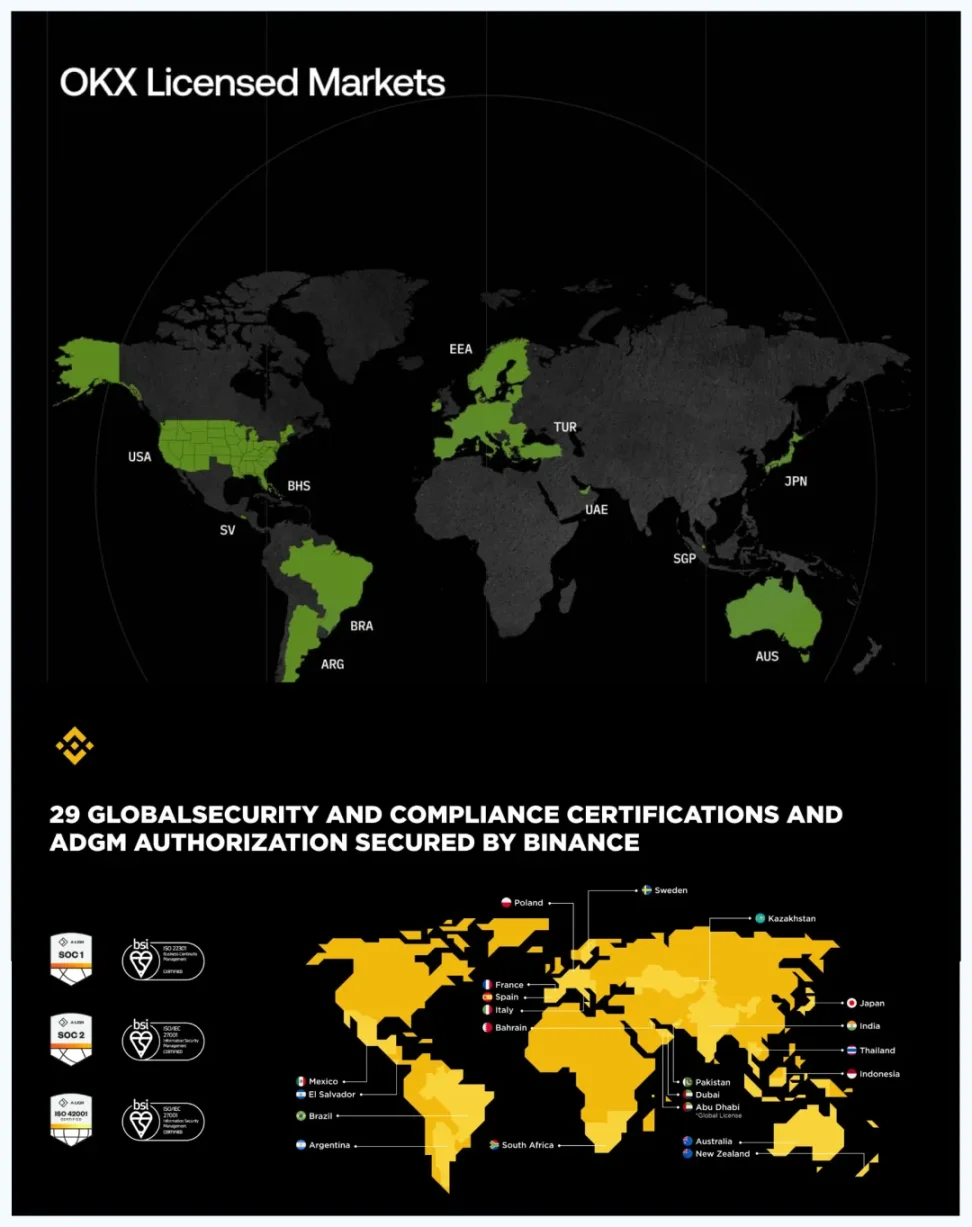
Leyenda de la imagen: "Hacer oposiciones" para regularizarse, Fuente de la imagen: @binance @okx

Coinbase fue la más compliant tras el colapso de FTX, pero esta compliance provino de la transformación continua de la SEC, CFTC y OCC bajo la administración de Trump, exigiendo medidas más favorables hacia las criptomonedas.

Básicamente, la SEC se encarga de revisar si un token cumple la definición de valor, la CFTC supervisa el trading de derivados, la OCC supervisa las licencias bancarias para servicios de custodia. EE.UU. no tiene una "licencia de exchange de cripto" similar a ADGM, solo alcances regulatorios por tipo de negocio.
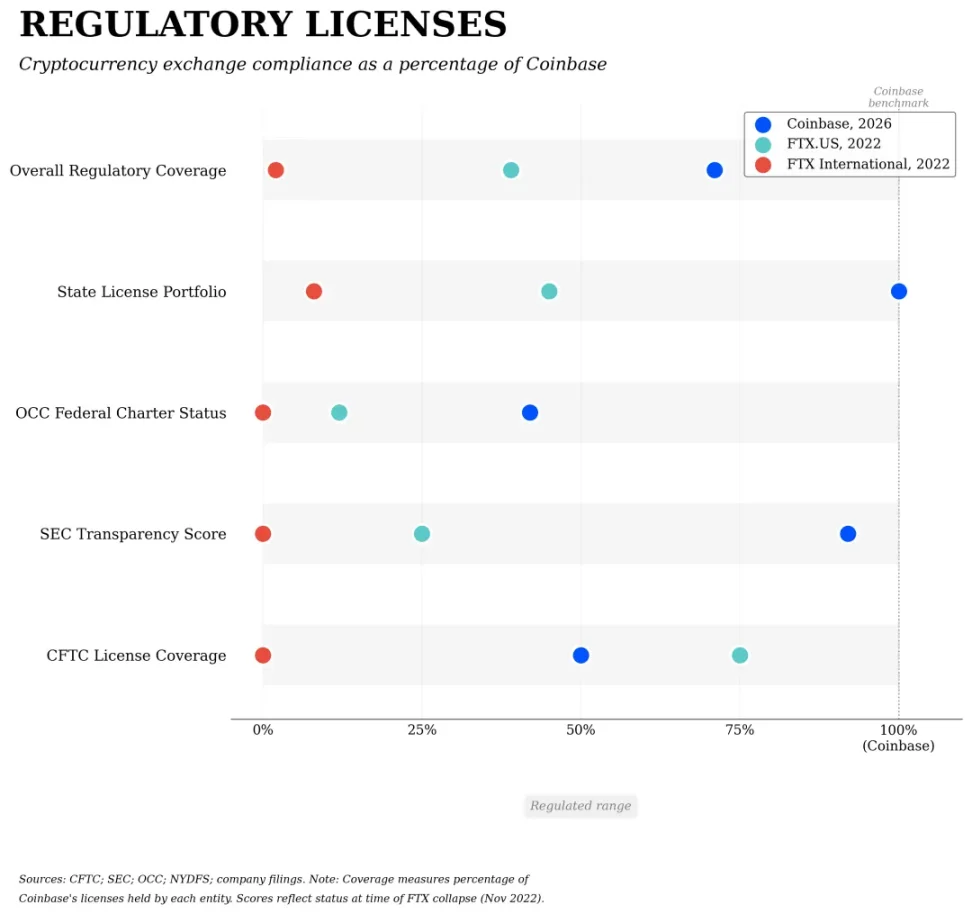
Leyenda: Progreso regulatorio, Fuente de la imagen: @zuoyeweb3

La construcción de este marco regulatorio aún está en proceso, pero es seguro que Coinbase dará forma al marco regulatorio estadounidense, cubriendo listado (spot, futuros), trading (spot, futuros), custodia (minorista, institucional), liquidación/liquidación (fiat, cripto), auditoría (técnica, de activos)/seguro (fiat, cripto) en todos los aspectos.

La licencia de Binance bajo ADGM y la licencia de Coinbase en EE.UU. no son conceptos en absoluto comparables. La licencia de este último entrará realmente en el ámbito de gestión de los reguladores.

La regulación consiste en aclarar las reglas, no en proteger los intereses de los minoristas. Por ejemplo, los clientes institucionales disfrutan de protección por quiebra en los servicios de custodia de Coinbase, cuya entidad correspondiente es Coinbase Custody Trust Company.

Pero los fondos depositados por minoristas comunes en Coinbase corresponden a la entidad Coinbase Inc. Si es fiat, podría estar protegido por el seguro de depósitos FDIC del banco correspondiente, pero los activos cripto podrían sufrir el destino de FTX.

Por ejemplo, los compradores del token FTT de FTX fueron considerados titulares de equity y no estaban estrictamente protegidos en sus reclamos. Coinbase es similar. La única buena noticia es que Coinbase no ha enfrentado una crisis de corrida bancaria.

Hyperliquid ingresa "sin licencia" al campo RWA

El progreso humano ya no será como los terribles ídolos paganos, que solo pueden beber el dulce néctar usando los cráneos de sus víctimas como copas.

El arbitraje regulatorio aún existe. En el campo del trading de activos cripto, Hyperliquid, el compatriota estadounidense de EDX, también comenzó en Singapur y está erosionando el mercado global de Binance y el mercado estadounidense de Coinbase.

Puede llamarse "arbitraje de segundo orden": Binance arbitra las regulaciones globales, Hyperliquid arbitra a Binance.
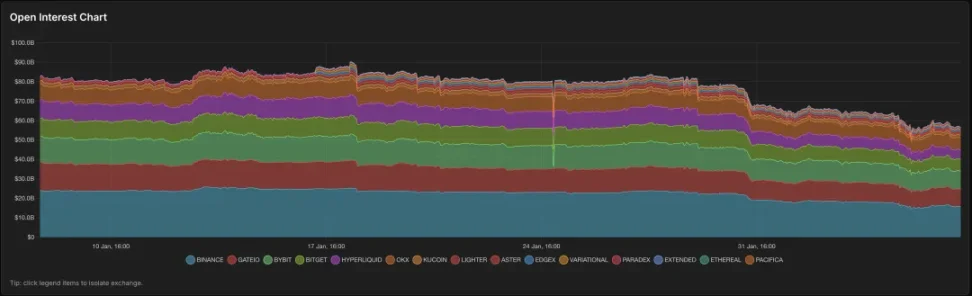
Leyenda: CEX y DEX, difícil determinar un ganador, Fuente de la imagen: @LorisTools

Hyperliquid bloquea direcciones IP estadounidenses, pero este bloqueo no tiene ningún efecto práctico. Comparemos: es casi imposible que un usuario estadounidense abra una cuenta en Binance global, solo puede usar Binance US.

Coinbase apenas comenzó a permitir operaciones con futuros para usuarios estadounidenses, pero su volumen de negocios es prácticamente inexistente. Así, en un espacio extraño, Hyperliquid capturó a algunos usuarios europeos y estadounidenses fuera de Binance y Coinbase, desarrollando negocios de derivados.

Pero hay que notar: el arbitraje de Hyperliquid no puede reproducir el milagro de crecimiento de Binance, ni aprender de Coinbase para ocupar el mercado regulatorio estadounidense. Probablemente solo ocupe el 15% de la cuota de mercado de Binance.

A medida que Hyperliquid se enfoca en negocios no tradicionales como metales preciosos y mercados de predicción, su impacto en los mercados financieros globales se fortalece gradualmente. Si EE.UU. puede regular Binance y Tornado Cash, entonces la acción contra Hyperliquid tampoco encontrará resistencia de Singapur.

En definitiva, la mayoría de los modelos de "economía subterránea" no pueden ingresar al campo de la escalabilidad. Tomemos USDT como ejemplo: es cada vez más estricto en sus reservas de emisión y bloqueo de circulación. El ataque a Bybit donde los hackers perdonaron USDT y la congelación de USDT negros tras el caso Huiwang son pruebas claras.

  • Huiwang puede sostener toda la economía subterránea de Camboya e incluso del sudeste asiático, pero Camboya no puede pagar el precio de ser incluida en la "lista gris" de lavado de dinero del FATF.

  • Binance puede sostener la economía en la cadena BNB liderada por altcoins, pero el efecto de compresión entre China y EE.UU. impide que Binance acceda a activos de trading más优质.

Esto es esencialmente la ventaja de bajos costos regulatorios que posee EE.UU. Las sanciones económicas estadounidenses hacia el exterior no se basan核心mente en el dólar y el ejército. EE.UU. es el mercado de consumo único más grande del mundo y el principal mercado financiero. Una vez que Camboya y Binance sean cortados de EE.UU., su destino será Corea del Norte.

Por eso Binance paga un alto precio por regularizarse, por eso la regulación de Hyperliquid es solo cuestión de tiempo.

Discutamos un problema延伸: ¿Puede RWA replicar la trayectoria del sector de trading de activos cripto? Es decir, preservarse a sí mismo en el arbitraje regulatorio y desarrollar el volumen de negocios dentro del marco regulatorio.

Esto se basa en la doble premisa de que Hyperliquid, en el campo del trading de activos cripto, casi不可能 superar a Binance, y en grado de regulación, casi不可能 superar a Coinbase.

Si estuviéramos en 2017, el propio CZ probablemente no creería que los CEX son el futuro. Mirando hacia atrás, los sellos y monedas conmemorativas, P2P, O2O, ofo fueron modas pasajeras. Mirando hacia adelante, la minería DeFi, NFT, GameFi, SocialFi terminaron sin resultados.

Por lo tanto, Binance y BNB deberían entenderse como proyectos. Su halo es perpetuado por el efecto riqueza. Deberían haber terminado abruptamente, como una burbuja financiera tras otra.

Pero bajo el efecto de red, el efecto de red del trading se libera de las restricciones de los activos cripto e ingresa en todos los campos financieros, encontrándose así con RWA en un sentido amplio. Las stablecoins con rendimiento impactan las CBDC, la securitización basada en activos tarde o temprano también se tokenizará.

Por ejemplo, esta guía regulatoria de la Gran Potencia Oriental es esencialmente un derrame del impacto estadounidense en el sector financiero, que reescribirá las finanzas en cadena de manera peculiar.
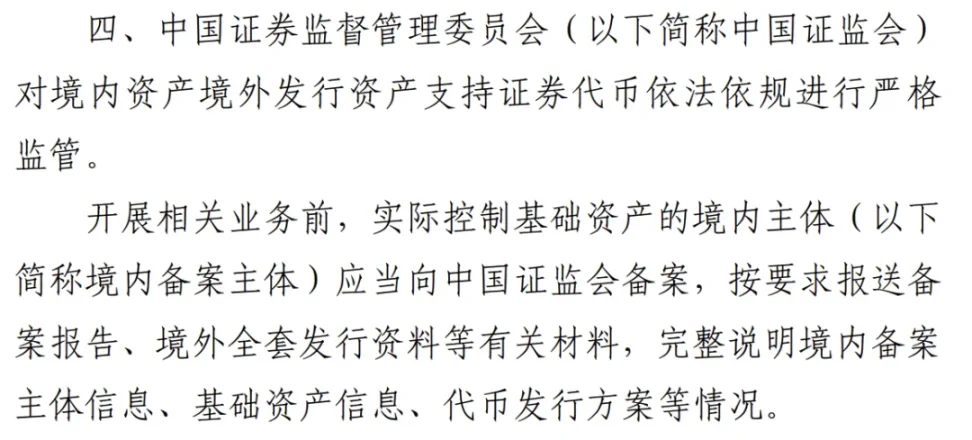
Leyenda: Las flores fragantes dentro del muro perfuman fuera

La interpretación de Caixin sobre las nuevas medidas regulatorias orientales las divide en deuda externa, equity, securitización de activos y otras cuatro categorías. Pero en mi opinión, el único significativo es el enfoque en la tokenización de valores, que se alinea con la dirección reformista de "securitizar todos los activos". Al respecto:

  • Se aclara que la autoridad competente es la Comisión de Regulación de Valores (CSRC)

  • Requiere la aprobación de la CSRC para su emisión

  • Solo se permite la emisión desde dentro del territorio hacia fuera

Además, esta guía de tokenización de valores aclara explícitamente que tanto los derechos como los ingresos deben ser compliant. Esto corresponde al proceso evolutivo alentado por la SEC para la "tokenización de acciones" nativas. Los casos del stablecoin del renminbi en el extranjero, la deuda externa y los fondos son más especiales.

  • El negocio de stablecoins de renminbi offshore siempre existió, Tether también está involucrado, pero carece de uso práctico y su volumen de negocios es muy pequeño.

  • La emisión de deuda externa y la tokenización de fondos ya se llevan a cabo de facto, completamente aisladas de los activos internos y emitidas para clientes extranjeros, sin relación con esta guía.

Esta regulación involucra la emisión en el extranjero de activos internos, esencialmente enfatizando este aislamiento: lo externo es externo, lo interno es interno. Solo cuando se cruzan es necesario entrar en el proceso regulatorio.

En el campo actual de RWA, China y EE.UU. ya están de facto ocupando territorios. Esta liquidez que se desborda hacia la cadena es suficiente para reescribir el panorama financiero actual.

Conclusión

El destino de una industria, por supuesto, depende de la lucha propia, pero también debe considerar el curso de la historia.

El propio CZ probablemente no creía que los CEX fueran el futuro, incluso Bitcoin era solo una fase de una nueva forma de esquema piramidal, que rápidamente se convertiría en un término histórico efímero como P2P o los préstamos de alta tasa.

Pero nadie imaginó que los CEX sobrevivirían hasta 2026. Hyperliquid se lanza hacia nuevas formas como metales preciosos y mercados de predicción, pero aún no ha superado (Flip) a Binance.

Si a Hyperliquid se le suma RWA, esta vez, ¿podrá llegar a la otra orilla?


Twitter:https://twitter.com/BitpushNewsCN

Grupo TG de Bitpush:https://t.me/BitPushCommunity

Suscripción TG de Bitpush: https://t.me/bitpush

Enlace original:https://www.bitpush.news/articles/7610212

Related Questions

Q¿Por qué la regulación se ha convertido en el tema principal en 2026 para la industria de las criptomonedas?

ALa regulación se ha convertido en el tema principal en 2026 porque las empresas, como Binance, están buscando legitimidad y acceso a mercados más amplios. La adopción de marcos regulatorios, como el de ADGM en Emiratos Árabes Unidos, permite a las empresas operar de manera más transparente y acceder a activos financieros tradicionales, lo que es crucial para su crecimiento y sostenibilidad a largo plazo.

Q¿Qué diferencias clave existen entre la regulación de Binance en ADGM y la de Coinbase en Estados Unidos?

ALa regulación de Binance en ADGM se basa en un marco de 'licencia de intercambio de criptomonedas' que puede no tener la misma supervisión rigurosa, mientras que Coinbase en Estados Unidos opera bajo un marco regulatorio fragmentado con la SEC, CFTC y OCC, que supervisan aspectos específicos como valores, derivados y custodia, ofreciendo una supervisión más integral y estricta.

Q¿Cómo está afectando Hyperliquid a los mercados de criptomonedas y qué limitaciones enfrenta?

AHyperliquid está afectando los mercados al ofrecer derivados y servicios no tradicionales, capturando alrededor del 15% del mercado de Binance. Sin embargo, enfrenta limitaciones como la imposibilidad de superar a Binance en escala o competir con Coinbase en cumplimiento regulatorio, y eventualmente necesitará regularizarse para crecer sosteniblemente.

Q¿Qué papel juega RWA (Real World Assets) en la evolución de las finanzas descentralizadas (DeFi)?

ARWA juega un papel crucial en DeFi al permitir la tokenización de activos tradicionales como acciones, bonos y materias primas, lo que acerca las finanzas descentralizadas a los mercados financieros convencionales. Esto facilita la liquidez y accesibilidad, pero requiere marcos regulatorios claros para escalar, como se ve en las directrices de China y Estados Unidos.

Q¿Cuál es el impacto de las nuevas directrices regulatorias de China sobre la tokenización de activos?

ALas nuevas directrices de China impactan la tokenización al establecer que la emisión de tokens de valores debe ser aprobada por la CSRC y solo permite la emisión doméstica hacia el extranjero. Esto refuerza la separación entre mercados nacionales e internacionales y promueve la合规ización, aunque limita la innovación dentro de China.

Related Reads

Morgan Stanley Digital Asset Head: Bitcoin Reaching $1M Would Not Be Surprising, But a Real Catalyst Might Require a Crisis That Shatters the Old System

Summary: In a podcast interview, Morgan Stanley's Head of Digital Asset Strategy, Amy Oldenburg, discusses Bitcoin's potential and institutional adoption. She argues Bitcoin's next major surge might require a catalyst—a crisis that shatters the traditional financial system, after which Bitcoin could emerge as the only intact asset. While she sees a $1 million price as possible within five years, she expects slower, more stable growth. Oldenburg traces Bitcoin's logic to her experience in emerging markets, where decentralized mobile money (like M-Pesa) provided critical financial security where traditional banks failed. She notes that early Bitcoin adopters often came from international finance, seeking alternatives to centralized systems. Regarding institutions, she explains that Morgan Stanley, as a bank holding company, faces stricter regulatory hurdles than pure asset managers like BlackRock. While client demand drove their Bitcoin ETP launch (MSBT), which set a firm record, most financial advisors remain hesitant due to Bitcoin's recent price stagnation and volatility. She identifies an education gap as a major barrier, with many advisors and clients not understanding the differences between various crypto assets or between holding spot Bitcoin versus an ETP. Oldenburg also discusses the tension between Bitcoin's cypherpunk, self-custody ethos and the convenience of centralized financial products, acknowledging the value of both approaches. She concludes that the digital asset space is still in its early stages, with a long journey ahead involving more complex products and technologies.

marsbit19m ago

Morgan Stanley Digital Asset Head: Bitcoin Reaching $1M Would Not Be Surprising, But a Real Catalyst Might Require a Crisis That Shatters the Old System

marsbit19m ago

Cursor: Why Did It Board Elon Musk's Rocket?

SpaceX announced its first major acquisition after its historic IPO: a $60 billion all-stock deal to acquire AI programming startup Cursor (parent company Anysphere). Cursor is a popular AI coding assistant that allows developers to switch between models from OpenAI, Anthropic, Google, and others. Founded in 2022 by MIT graduates including CEO Michael Truell, Cursor saw explosive revenue growth, reaching a $4 billion annualized run rate by early 2026. However, its market share had declined as key supplier Anthropic launched its own competing product, Claude Code. Facing dependency risks, Cursor decided to build its own AI model, Composer, but lacked the necessary computing power. In April 2026, Cursor and SpaceX revealed a partnership and an option agreement: SpaceX could acquire Cursor for $60 billion post-IPO, or pay a breakup fee and provide substantial computing resources. After SpaceX's successful IPO, it exercised the option. The deal gives Cursor access to SpaceX's massive "Colossus" supercomputer, while SpaceX gains Cursor's strong foothold among elite software engineers to boost its AI capabilities, as Musk's xAI model Grok lags in programming. The acquisition aligns with SpaceX's broader AI and orbital data center ambitions, as Musk targets $1 trillion in revenue by 2030. For Truell, who once aimed to build an enduring independent company, joining SpaceX represents a monumental bet on an unprecedented scale.

marsbit19m ago

Cursor: Why Did It Board Elon Musk's Rocket?

marsbit19m ago

Trading

Spot
Futures

Hot Articles

What is LINON

Linde plc Tokenized Stock (Ondo): Revolutionizing Traditional Equity Access Through Blockchain Innovation The emergence of Linde plc Tokenized Stock (Ondo), represented by the ticker $LINON, signifies a monumental shift in the fusion of traditional financial structures and decentralized finance (DeFi). This innovative financial instrument showcases the tremendous potential of blockchain technology to democratize access to traditional equity markets while ensuring the security and regulatory compliance necessary for institutional-grade financial products. Through Ondo Finance's pioneering tokenization platform, $LINON provides a seamless pathway for global investors to engage with one of the world's leading industrial gas companies, Linde plc, creating a blockchain-native representation of the underlying equity. Introduction to Linde plc Tokenized Stock The landscape of financial markets is witnessing a groundbreaking transformation through the tokenization of real-world assets. Linde plc Tokenized Stock (Ondo) epitomizes this revolutionary approach by bridging the gap between conventional stock ownership and blockchain-enabled financial infrastructure. The $LINON token allows investors to gain exposure to one of the prominent industrial companies worldwide through decentralized technology. Operating within Ondo Finance's comprehensive ecosystem, $LINON symbolizes a practical application of tokenization technology that enhances accessibility, efficiency, and global connectivity in traditional financial markets. By leveraging blockchain infrastructure, this tokenized stock enables international investors to participate in U.S. equity markets, overcoming traditional barriers associated with cross-border investing. The significance of $LINON goes beyond technological innovation; it represents a fundamental shift in asset structuring, distribution, and trading in the digital age. This tokenized stock maintains all the economic benefits associated with traditional Linde plc shares while offering improved liquidity, programmable compliance features, and seamless integration with decentralized finance protocols. The development of $LINON indicates a growing acceptance of blockchain technology as a viable means for traditional finance, exemplifying how even well-established assets like Linde plc can integrate into blockchain systems. This approach preserves the core attributes that appeal to investors while introducing advanced capabilities that enhance the overall investment proposition. Project Overview and Objectives Linde plc Tokenized Stock (Ondo) encapsulates a strategic effort to democratize access to traditional equity markets through advanced blockchain technologies. The primary objective of $LINON is to provide approved global investors seamless access to the economic exposure associated with Linde plc shares, furthering an effort to create a more inclusive financial ecosystem. Beyond the digital representation of traditional assets, $LINON endeavors to eliminate barriers of geography and time zones that limit investor participation. Its design ensures that blockchain technology can elevate traditional investment vehicles without undermining the security or compliance requirements expected by investors. Key goals of the project include enhanced liquidity provision, programmable compliance mechanisms, and interoperability with other blockchain networks. Each $LINON token is fortified by actual Linde plc securities housed at U.S.-registered broker-dealers, allowing holders to reap economic advantages akin to traditional stockholders, such as dividend reinvestment. Furthermore, $LINON aims to establish new industry standards for institutional-grade tokenized securities, paving the way for traditional assets to embrace blockchain technology while remaining compliant with regulatory frameworks. By associating itself with a company as reputable as Linde plc, the project opens avenues for exploring tokenized equities catering to both conservative institutional players and daring retail investors. Project Creator and Development Team The vision for Linde plc Tokenized Stock (Ondo) comes from Nathan Allman, founder and CEO of Ondo Finance. His background in traditional finance coupled with expertise in blockchain technology positions him uniquely to navigate the complexities of asset tokenization. Allman's academic journey began at Brown University, focusing on Economics and Biology, equipping him with valuable analytical skills. His time at Goldman Sachs in the Digital Assets division strengthened his understanding of the interplay between financial institutions and emerging technologies, laying the groundwork for his later endeavors in alternative investment strategies. Under Allman's guidance, Ondo Finance has emerged as a leader in asset tokenization, launching $LINON as a flagship example of the company's larger mission towards revolutionizing traditional financial systems using blockchain technology. His commitment to leveraging blockchain for creating institutional-grade financial products has shaped the landscape of real-world asset tokenization. Investment and Funding Structure The growth of Ondo Finance, the platform powering Linde plc Tokenized Stock (Ondo), is bolstered by robust financial backing from prestigious venture capital firms and strategic investors. This strong investment foundation underpins the development of the key infrastructure essential for compliant tokenized securities like $LINON. In August 2021, Ondo Finance secured $4 million in seed funding led by a major venture capital firm, which enabled the company to commence platform development and establish the necessary regulatory processes for tokenizing real-world assets. This early investment cemented Ondo Finance's credibility within the industry. The Series A funding round followed, garnering $20 million with participation from renowned firms committed to transformative technology companies. This backing demonstrated substantial institutional confidence in Ondo Finance's vision, allowing it to hone its approach to asset tokenization through mechanisms that ensure compliance and accessibility. Noteworthy contributors, including institutional investors and experienced partners, have added significant value to Ondo Finance’s development efforts. Their involvement underscores the confidence across sectors in Ondo Finance's approach to bridging traditional finance with blockchain innovations. Technical Infrastructure and Innovation The technical architecture that underpins Linde plc Tokenized Stock (Ondo) represents a sophisticated melding of traditional finance systems and cutting-edge blockchain technology. The architecture's foundation is built on the Ethereum network, renowned for its security and programmability—both critical for intricate financial instruments. The $LINON tokenization process comprises creating a blockchain-native representation of Linde plc shares that preserves economic benefits while augmenting investor capabilities. Each token corresponds to actual shares held at U.S.-registered broker-dealers, creating a compliant custody structure that legitimizes the asset's existence and value. Automated compliance systems are integrated into the tokenization process, managing critical components such as know-your-customer (KYC) verification and anti-money laundering (AML) protocols. This incorporation of programmable compliance empowers $LINON to uphold regulatory standards essential for institutional proliferation. Cross-chain interoperability characterizes the advanced technical features of $LINON. While initially deployed on Ethereum, the framework is designed for expansion to other networks such as Solana and BNB Chain. This adaptability enhances liquidity and accessibility, allowing investors to select their preferred blockchain ecosystems. Historical Timeline and Development Crafting the history of Linde plc Tokenized Stock (Ondo) unfolds in parallel with the evolution of Ondo Finance's tokenization platform. The timeline's inception dates back to March 2021 when Nathan Allman laid the foundations for creating institutional-grade financial products on blockchain infrastructure. The initial funding round in August 2021 provided crucial resources for developing the platform and establishing partnerships necessary for effective tokenization. By January 2023, Ondo Finance launched its tokenized treasury products, establishing mechanisms that would facilitate future tokenized equities such as $LINON. A pivotal milestone arose in February 2025 when Ondo Chain—a Layer 1 blockchain designed specifically for asset tokenization—was introduced. This infrastructure enhances capabilities vital for institutional markets, demonstrating Ondo Finance's long-term commitment to tokenization. Subsequently, the launch of Ondo Global Markets in September 2025 marked the official debut of $LINON. This milestone showcased the successful transition from development to active trading, enabling investors around the world to access American financial markets seamlessly. Ongoing development plans include a targeted expansion of available tokenized assets to over 1,000 by the end of 2025, pointing to a bright future for Ondo Finance's ecosystem and its mission to broaden tokenized equity accessibility. Regulatory Compliance and Legal Framework The legal architecture governing Linde plc Tokenized Stock (Ondo) emphasizes a sophisticated approach to regulatory compliance, allowing tokenized securities to be implemented within a blockchain-based framework. The legal structure governing $LINON spans multiple jurisdictions while maintaining a robust legal footing. Compliance systems ensure that only eligible investors can access the token, enforced through automated verification that aligns with international regulations. This innovative regulatory technology promises real-time enforcement of complex requirements, considerably enhancing efficiency in operating within the regulatory landscape. The custody framework undergirding $LINON ensures that the underlying shares are securely held at U.S.-registered broker-dealers, complying with necessary regulations while delivering blockchain-driven access to investors. The token maintains its economic equivalency and security through this carefully structured custody arrangement. KYC and AML compliance systems are embedded within the smart contract architecture, ensuring integrity and adherence to regulatory practices while fostering transparency for investors. The jurisdictional restrictions mark a commitment to navigating the evolving landscape of international securities laws. Market Impact and Industry Significance The advent of Linde plc Tokenized Stock (Ondo) holds profound implications for the broader financial landscape, symbolizing a clear shift towards blockchain-enabled markets. $LINON serves as a proof-of-concept for integrating traditional companies into blockchain ecosystems, showcasing the potential benefits such as broader accessibility and improved efficiency. The market's response to $LINON indicates a growing acceptance of tokenization among institutional investors, contributing to the emergence of an expanding sector wherein traditional assets can be interconnected with blockchain innovations. The success of $LINON further solidifies market confidence, indicating an overarching shift towards recognizing asset tokenization as a transformative force in finance. Future Development and Expansion Plans The future trajectory for Linde plc Tokenized Stock (Ondo) centers around the expansion of the tokenization ecosystem and enhanced infrastructure supporting blockchain-enabled financial services. Plans for cross-chain integration usher in new opportunities for liquidity and flexibility within the investment framework, with existing capabilities poised for continuous enhancement. With the introduction of Ondo Chain, Ondo Finance aims to transition $LINON to an optimized blockchain environment specifically designed for asset tokenization. This new infrastructure heralds exciting prospects for the development of institutional-grade financial products, ensuring ongoing compatibility with contemporary investment strategies. Further integration with decentralized finance protocols signifies a commitment to empowering $LINON holders through advanced financial strategies. The anticipated expansion of available tokenized assets promises to broaden investor access, enhancing the utility and appeal of the platform. In alignment with ambitions for regulatory expansion, ongoing efforts to secure approvals for new jurisdictions will enhance investor access, further positioning $LINON at the forefront of the burgeoning tokenization market. Conclusion Linde plc Tokenized Stock (Ondo), as represented by the $LINON token, stands at the intersection of traditional finance and blockchain innovation. It embodies a transformative milestone in how financial assets are structured, distributed, and engaged within modern investment ecosystems. The technical sophistication behind $LINON, combined with its regulatory compliance framework, illustrates that asset tokenization can improve financial infrastructure rather than simply digitizing existing products. This pioneering effort not only enhances investor access to U.S. equity markets but also signifies an evolution of how traditional financial services can integrate blockchain technology. As the asset tokenization market grows exponentially, with prospects suggesting significant valuation increases, $LINON paves the way for a future where tokenized securities become standard fixtures in the financial landscape. The trajectory of $LINON will undoubtedly influence how traditional finance adapts to a transformed, blockchain-powered world.

3.2k Total ViewsPublished 2025.12.05Updated 2025.12.05

What is LINON

What is CRMON

Salesforce Tokenized Stock (Ondo): Revolutionising Traditional Equity Access Through Blockchain Innovation The emergence of Salesforce Tokenized Stock (CRMON) marks a pivotal advancement in integrating traditional financial markets with blockchain technology. This innovative approach offers investors unprecedented access to equity exposure through tokenisation. Developed by Ondo Finance, CRMON provides tokenholders with economic exposure equivalent to holding Salesforce stock (CRM) while automatically reinvesting dividends. This effectively bridges the gap between conventional equity markets and decentralised finance (DeFi). Introduction and Comprehensive Overview of Salesforce Tokenized Stock In recent years, the financial landscape has dramatically transformed due to blockchain technology, fundamentally altering how investors access and interact with traditional assets. The development of Salesforce Tokenized Stock (CRMON) is a prime example of this evolution, representing a sophisticated fusion of conventional equity markets with cutting-edge distributed ledger technology. CRMON is a tokenised version of Salesforce stock, emerging from the innovative work of Ondo Finance, a leading platform in the real-world asset tokenisation sector that positions itself as a bridge between traditional finance and decentralised systems. Designed to provide tokenholders with economic exposure that mirrors the performance of the underlying Salesforce stock, CRMON incorporates automatic dividend reinvestment mechanisms. This eliminates many traditional barriers associated with international equity investment, such as complex brokerage relationships, currency conversion challenges, and restricted trading hours. The tokenisation process reimagines stock ownership as a blockchain-native asset while maintaining its economic equivalence with the underlying security, offering enhanced portability and integration capabilities within decentralised finance ecosystems. CRMON transcends its individual utility as an investment instrument to represent a fundamental shift in how financial markets can operate in an increasingly digital world. By maintaining full backing through U.S.-registered broker-dealers and implementing robust compliance frameworks, CRMON demonstrates that tokenised securities can achieve the regulatory standards necessary for institutional adoption while delivering the technological advantages of blockchain infrastructure. Understanding Tokenized Real-World Assets and CRMON's Strategic Position Tokenised real-world assets signify one of the most significant innovations in modern finance, fundamentally reimagining how traditional securities are represented, traded, and utilised within digital ecosystems. CRMON operates as a tokenised equity instrument correlating directly with Salesforce stock while optimising accessibility and efficiency. This aligns with Ondo Finance's broader mission to democratise access to institutional-grade financial products through innovative tokenisation strategies. The tokenisation process guarantees complete economic equivalence with the underlying Salesforce equity. Each CRMON token represents a proportional claim on Salesforce stock held by qualified custodians, with dividend payments automatically reinvested to maintain continuous exposure to total return performance. This structure simplifies dividend management and ensures that tokenholders receive the full economic benefit of their equity exposure, encompassing both capital appreciation and income generation. Ondo Finance's strategy in tokenising Salesforce stock demonstrates its expertise in creating compliant, institutional-grade products that meet traditional financial markets' stringent requirements. The platform’s focus on merging regulatory compliance with blockchain benefits positions it at the forefront of decentralised finance, captivating both institutional and retail investors seeking blockchain-native solutions. The Technology and Innovation Framework Behind CRMON The technological infrastructure supporting CRMON integrates blockchain technology with traditional financial mechanisms, delivering institutional-grade security and compliance while maintaining the operational advantages of decentralised systems. Built on the Ethereum blockchain, CRMON utilises robust smart contract capabilities to ensure transparent, secure operations. The smart contract architecture incorporates layered security and compliance mechanisms, enabling automated compliance checks and real-time asset backing verification. Integration with oracle services maintains accurate pricing and dividend information, ensuring CRMON reflects the underlying Salesforce stock's accurate performance. This architecture delivers automated dividend reinvestments and other corporate actions, eliminating manual processing requirements and directly enhancing tokenholder benefits. Ondo Finance ensures CRMON's security structure includes daily third-party verification of holdings, independent collateral agents, and a multiple-layer custody system through partnerships with established financial institutions. This framework safeguards tokenholder interests against operational risks while providing robust asset backing. The user interface enhances integration capabilities, allowing seamless interaction between CRMON and various decentralised finance protocols, as well as cryptocurrency exchanges. This interoperability enables users to leverage their tokenised equity across multiple platforms, creating sophisticated investment strategies that marry traditional equity characteristics with blockchain-native innovation. Leadership and Corporate Structure of Ondo Finance The leadership team behind CRMON and Ondo Finance blends expertise from traditional finance and blockchain technology, presenting a robust combination of skills essential for successfully bridging conventional markets with decentralised finance. Nathan Allman, the founder and CEO, emerged from a distinguished financial background before establishing Ondo Finance in 2021. Allman's experience includes notable roles at major financial institutions, including significant contributions to developing cryptocurrency market services. His insights into regulatory compliance were paramount in developing products like CRMON that successfully unify traditional securities with blockchain technology. With a team of professionals boasting substantial experience in both conventional finance and blockchain sectors, Ondo Finance's leadership comprises diverse expertise that covers every aspect of tokenised asset development. Justin Schmidt serves as President and COO, contributing unique operational expertise, while Chris Tyrell brings essential compliance knowledge. Investment Landscape and Funding History The investment landscape surrounding Ondo Finance reflects significant institutional confidence in its mission to tokenise real-world assets. The company has raised substantial funds through various investment rounds, attracting leading venture capital firms and strategic investors that recognise the transformative potential of tokenised securities like CRMON. Notably, Ondo Finance completed a successful Series A funding round in 2022, led by well-known venture capital firms. This funding success validates Ondo Finance's innovative approach to creating compliant, institutional-grade tokenised products. In total, Ondo Finance has successfully secured substantial funding, raising significant capital for product development and market expansion, including a noteworthy token sale that reinforced its governance structure through the establishment of the ONDO token. The diverse composition of investors reflects broad market confidence in Ondo Finance's business model, demonstrating support from both traditional and blockchain-native organisations. Operational Mechanics and Technical Implementation The operational framework supporting CRMON exemplifies sophisticated integration of traditional financial mechanisms with blockchain technology. The technical implementation introduces multiple layers of security, compliance, and operational efficiency to meet institutional standards while enhancing accessibility. The tokenisation process begins by acquiring actual Salesforce stock through U.S.-registered broker-dealers, ensuring each CRMON token maintains direct correlation with the underlying equity performance. Smart contracts automate operational processes, including dividend reinvestment and corporate action processing, facilitating a streamlined user experience. The Minting and redemption processes allow authorised participants to manage CRMON tokens effectively. During U.S. trading hours, institutions can mint new tokens by depositing stablecoins that are used to purchase corresponding Salesforce equity. This structure maintains a tight correlation with underlying assets, enhancing liquidity and price discovery. Additionally, the infrastructure supports twenty-four-hour token transfer capabilities, providing CRMON holders with operations outside traditional market hours. This represents a significant advantage over conventional securities ownership, thus promoting integration with decentralised finance applications. Plans for cross-chain compatibility through partnerships signal further ambitions for CRMON's market reach. By expanding to other blockchain networks, Ondo Finance aims to enhance accessibility and user engagement with tokenised equity products. Timeline and Historical Development of Tokenized Equity Innovation The timeline of CRMON's development and Ondo Finance's broader tokenised capabilities demonstrates a systematic innovation process beginning with the company's founding in 2021. 2021: Ondo Finance is founded by Nathan Allman and co-founders, launching initial products focused on structured vault offerings on the Ethereum blockchain. 2022: The company completes substantial funding rounds—both equity and token sales—totaling significant capital and launching initial tokenised U.S. Treasury products. 2023-2024: Ondo Finance experiences substantial growth, establishing partnerships with major financial institutions while expanding its product offerings beyond fixed-income securities. February 2025: Ondo Global Markets is announced, marking the transition into equity tokenisation with plans for accessing over one hundred U.S. stocks and ETFs. September 2025: The official launch of Ondo Global Markets includes CRMON alongside other tokenised equity offerings, marking a significant evolution in Ondo Finance's product ecosystem. This timeline highlights the organisation's rapid growth and its capability to adapt its technological and compliance frameworks to accommodate different asset classes effectively while maintaining security and regulatory integrity. Regulatory Framework and Compliance Approach Ondo Finance's regulatory framework showcases a sophisticated compliance strategy, essential for achieving institutional adoption in the tokenised securities market. The company's strong partnerships with U.S.-registered broker-dealers promote adherence to Securities and Exchange Commission regulations and apply robust investor protections. Acquisitions, such as Oasis Pro—a registered broker-dealer—significantly enhance Ondo Finance's compliance capabilities, ensuring thorough alignment with existing regulatory structures. The company employs independent verification procedures that foster transparency, aiming for a solid performance standards reputation. Furthermore, Ondo Finance's commitment extends to international regulatory compliance, ensuring token access remains restricted to eligible investors while adhering to pertinent cross-border securities regulations. Comprehensive attention to tax implications and reporting requirements fortifies the security and compliance landscape of CRMON, ensuring that investor obligations remain manageable. Future Prospects and Market Positioning The forward-looking landscape for CRMON and Ondo Finance illustrates substantial growth opportunities driven by institutional adoption of blockchain technology and escalating demand for efficient alternatives to conventional securities ownership. Market projections indicate the tokenised asset sector could value multiple trillion dollars by 2030. With plans to scale CRMON offerings significantly and integrate it with a dedicated blockchain infrastructure—Ondo Chain—Ondo Finance aims to elevate its institutional-grade tokenised asset operations. Additionally, the development of strategic partnerships enhances distribution capabilities while establishing the company's credibility in the financial market. Furthermore, the integration of tokenised equity with decentralised finance protocols offers new potential for innovative financial products and strategies previously impossible with traditional securities. These factors underscore CRMON's positioning to effectively capture increased market share and deliver innovative solutions for international investment exposure. Conclusion Salesforce Tokenized Stock (CRMON) symbolises a transformative development within financial markets, successfully bridging traditional equity ownership with blockchain technology to create unprecedented accessibility for global investors. Through Ondo Finance's sophisticated tokenisation framework, CRMON provides complete economic exposure to Salesforce equity performance while enhancing operational advantages that exceed traditional ownership. The launch of CRMON reflects the broader evolution of financial markets towards blockchain infrastructures that maintain regulatory compliance while delivering increased efficiency. Ondo Finance's extensive approach to regulatory adherence, institutional-grade security, and technological innovation solidifies CRMON as a model for future tokenised securities, delivering access previously unattainable in conventional brokerage structures. As the tokenised asset sector continues to develop, CRMON is well-positioned to address historical inefficiencies in capital markets while providing investors with innovative solutions for accessing traditional securities. The outlook for CRMON looks exceptionally promising, supported by ambitious expansion plans, technological innovations, and strategic partnerships, thereby representing a pioneering model of modern financial infrastructure evolving through blockchain integration.

3.3k Total ViewsPublished 2025.12.05Updated 2025.12.05

What is CRMON

What is SHOPON

Shopify Tokenized Stock (Ondo): A Comprehensive Analysis of Real-World Asset Tokenization in Web3 This article delves into the Shopify Tokenized Stock (Ondo), recognised by its ticker symbol $SHOPON, exploring its implications at the intersection of traditional finance and blockchain technology. As a part of Ondo Finance's tokenized securities platform, Shopify’s tokenized stock exemplifies advancements in democratizing access to global capital markets through innovative digital assets. Introduction and Overview of Shopify Tokenized Stock (Ondo) Shopify Tokenized Stock (Ondo), or $SHOPON, portrays a pivotal innovation in the realm of tokenized securities, allowing investors to gain economic exposure akin to directly owning shares of Shopify Inc. This token, developed under the umbrella of Ondo Finance, not only provides investors with the ability to hold digital representations of the company’s stock but also integrates features such as automatic reinvestment of dividends. This advancement represents a substantial shift in the landscape of decentralized finance (DeFi), linking conventional equity markets with blockchain solutions designed to enhance accessibility, transparency, and liquidity. By eliminating geographical barriers and enabling 24/7 trading capabilities, $SHOPON is positioned as a bridge connecting traditional financial instruments and the emerging Web3 ecosystem. What is Shopify Tokenized Stock (Ondo), $SHOPON? The $SHOPON token serves as a digital manifestation of Shopify Inc.'s shares, engineered to provide a direct correlation to the underlying asset's performance. Through the utilization of blockchain technology, the token gives holders a mechanism to participate in the economic benefits associated with equity ownership, including capital appreciation and dividend distribution. The unique aspect of $SHOPON lies in its automatic dividend reinvestment mechanism, which allows returns to compound without necessitating active management by the investor. This feature inherently enhances its attractiveness as an investment vehicle, particularly for individuals seeking passive income growth alongside exposure to high-performing equities. The tokenization process is facilitated by the custody of actual Shopify shares through regulated intermediaries, ensuring that every $SHOPON token is verifiably backed by real equity. This structure empowers investors with the dual advantages of both traditional financial characteristics and the innovative benefits tied to blockchain technology. Who is the Creator of Shopify Tokenized Stock (Ondo)? The creator of Shopify Tokenized Stock (Ondo), Nathan Allman, is an experienced figure in the finance sector, formerly associated with Goldman Sachs. His rich background includes significant expertise in digital asset development, bridging the gap between traditional finance and cryptocurrencies. Allman’s educational journey, marked by studies at Brown University, provided him with a deep understanding of economics and biology, equipping him with analytical skills that inform his strategic vision. In 2021, he founded Ondo Finance, committing to developing tokenized securities that meet institutional-grade standards while leveraging blockchain's transformative capabilities. Under Allman's leadership, Ondo Finance has focused on creating compliant and innovative financial products that empower a diverse investor base. Who are the Investors of Shopify Tokenized Stock (Ondo)? The investment landscape surrounding Shopify Tokenized Stock (Ondo) is notably robust, underpinned by significant institutional support. Primarily, Pantera Capital stands out as a strategic partner through the Ondo Catalyst initiative, a $250 million commitment aimed at accelerating the development of on-chain capital markets. This partnership not only signifies institutional confidence in the potential of tokenized assets but also reinforces Ondo Finance's operational capabilities and market positioning. The funding pathways have included earlier rounds that amassed millions in seed funding and further structural investments, solidifying relationships with both venture capital firms and private investors. Moreover, the financial framework is complemented by strategic partnerships with established financial institutions and technology companies, enhancing Ondo’s infrastructure and operational expertise. How Does Shopify Tokenized Stock (Ondo), $SHOPON Work? At the core of $SHOPON's operational framework is a sophisticated system integrating traditional finance mechanisms with blockchain technology. The custody of actual Shopify shares ensures that token holders retain authentic economic exposure, safeguarding their investments in line with recognized legal structures. The smart contracts employed in managing $SHOPON handle various functions, including automatic dividend reinvestment and ownership transfer, offering instant settlement and increased liquidity, marking a significant departure from conventional trading systems plagued by multi-day settlement delays. By providing interoperability with other decentralized finance applications, $SHOPON empowers holders with potentially lucrative opportunities for advanced investment strategies, including lending and automated market making. This complex integration presents a unique value proposition, catering to both traditional and crypto-native investors. The innovative structure of $SHOPON also allows for real-time settlements and transactions documented on the blockchain, delivering unparalleled transparency and security—a major advancement over standard equity trading practices. Timeline of Shopify Tokenized Stock (Ondo) March 2021: Nathan Allman establishes Ondo Finance, initially focusing on decentralized finance yield optimization. August 2021: Completion of a $4 million seed funding round led by Pantera Capital. January 2023: Launch of initial tokenized treasury security products, laying the groundwork for future equity tokenization. July 2025: Announcement of the Ondo Catalyst initiative, a strategic investment program valued at $250 million, aimed at propelling the development of tokenization in capital markets. September 3, 2025: Launch of Ondo Global Markets featuring over 100 tokenized U.S. stocks and ETFs, including $SHOPON. Technical Implementation and Blockchain Infrastructure Shopify Tokenized Stock (Ondo) operates on a technical architectural framework that marries blockchain protocols with traditional financial custody arrangements. The ecosystem leverages Ethereum's smart contract capabilities, providing seamless transaction management while ensuring compliance with regulatory standards through established financial custodians. Central to this architecture are security measures and transparent transaction records that affirm the legitimacy of each tokenholder's economic stake. With automated features managed by intricate smart contracts, $SHOPON not only streamlines ownership transfers but also allows for the tactical reinvestment of dividends—a hallmark of modern investment strategies. Moreover, the incorporation of LayerZero technology facilitates cross-chain interoperability, making $SHOPON accessible across multiple blockchain environments while preserving its functional robustness. This forward-thinking technical design positions $SHOPON as an adaptable asset within the larger DeFi milieu. Regulatory Framework and Compliance Architecture $SHOPON's regulatory framework is built upon the meticulous navigation of existing financial regulations that govern securities. The custody arrangements for the underlying Shopify shares are managed by U.S.-regulated broker-dealers, ensuring compliance and protection for investors. By maintaining a separation between the blockchain tokenization process and traditional custody, $SHOPON adheres to legal requirements while offering innovative functionalities that challenge conventional constraints. This dual-layered compliance approach enhances investor confidence and underscores Ondo Finance's commitment to regulatory integrity. Notably, the availability of $SHOPON is tailored to international investors from regions such as Asia-Pacific, Europe, and Africa, as regulatory parameters in the U.S. and U.K. present challenges in accessing tokenized securities. Market Access and Global Distribution Strategy The distribution strategy of $SHOPON is keenly designed to optimize global access while conforming to regulatory standards. The platform aims to establish comprehensive coverage for eligible investors across multiple regions, effectively dismantling traditional barriers through the implementation of blockchain technology. Integration with various cryptocurrency wallets and exchanges also promotes user-friendliness and accessibility, establishing a streamlined experience for investors to manage their holdings. Moreover, the 24/7 trading capabilities afforded by the tokenized model allow participants to react promptly to market shifts, fundamentally transforming how global equities are accessed and traded. Technology Integration and Cross-Chain Functionality The remarkable technological underpinnings of $SHOPON propagate its multi-chain functionality, set to expand its reach beyond Ethereum to networks such as Solana and BNB Chain. Such cross-chain capabilities allow users flexibility when navigating between blockchains, concurrently leveraging distinct network attributes to optimize their trading experience. LayerZero serves as the backbone for ensuring decentralized transfers between networks while providing the requisite security and speed, quintessential for maintaining investor trust. This comprehensive interoperability illustrates $SHOPON's commitment to being a versatile, user-centric asset in the evolving investment landscape. Ecosystem Integration and DeFi Compatibility Incorporating $SHOPON into broader DeFi protocols signifies its potential beyond traditional stock ownership. Token holders can leverage their holdings for various sophisticated strategies and applications, enhancing investment returns and liquidity management. By establishing a presence in lending protocols and automated trading systems, $SHOPON effectively democratizes access to advanced financial strategies previously limited to institutional investors. Such integration contributes to a more competitive and dynamic financial landscape, where individual investors can capitalize on tools typically reserved for larger entities. Risk Management and Security Framework Security remains paramount in the operational infrastructure of $SHOPON. The tokenization framework employs multiple layers of protection—beginning with regulated custody of the underlying Shopify shares. The operational protocols establish rigorous auditing, key management, and transaction monitoring standards, thus safeguarding against potential vulnerabilities. Moreover, meticulous adherence to evolving regulatory requirements provides an extra layer of security, fortifying investor protections and institutional compliance. Market Impact and Industry Implications The introduction of Shopify Tokenized Stock (Ondo) heralds a transformative shift in how financial markets operate, emphasizing the potential of tokenized securities to reshape traditional investment paradigms. The successful integration of $SHOPON encapsulates the efficiencies inherent in blockchain technology and opens avenues for new user demographics previously barred from extensive market participation. The impact extends beyond the immediate benefits to token holders, indicating broader trends that may challenge the status quo of investment services, particularly in addressing geographic restrictions and operational costs typically associated with traditional brokerage platforms. Undeniably, $SHOPON encapsulates the potential for traditional institutions to innovate further, leveraging the increasing demand for seamless blockchain access to complement existing financial infrastructure. Future Development Roadmap and Strategic Vision As Ondo Finance looks forward, the trajectory of $SHOPON rests on ambitious goals aimed at broadening the spectrum of available tokenized assets significantly. Over the next few years, plans are in place to expand to more than 1,000 tokenized securities, further enhancing market participation and investment options for individuals worldwide. Continued integration with traditional financial actors, development of specialized institutional products, and enhancements in automated trading capabilities will ensure that $SHOPON maintains its position at the forefront of financial innovation. Regulatory collaboration will also remain a focal point, establishing a framework that not only supports the compliance requirements but also promotes a healthy environment for tokenized asset proliferation. Conclusion and Market Significance In summary, Shopify Tokenized Stock (Ondo), represented by the ticker $SHOPON, is more than merely a tokenized equity offering; it embodies the innovation possible when traditional finance collides with modern blockchain applications. With a robust technical architecture, a commitment to compliance, and a clear strategic vision, $SHOPON exemplifies the potential for tokenized assets to enhance liquidity, accessibility, and functionality in capital markets. As the global investment landscape evolves, the transformative implications of $SHOPON extend beyond individual investors to revolutionize how financial instruments are perceived, traded, and utilized within both traditional and decentralized frameworks.

3.3k Total ViewsPublished 2025.12.05Updated 2025.12.05

What is SHOPON

Discussions

Welcome to the HTX Community. Here, you can stay informed about the latest platform developments and gain access to professional market insights. Users' opinions on the price of ROUTE (ROUTE) are presented below.

活动图片